
Contents
Archaeologists call the small equipment of personal care "toilet objects": razors, tweezers, pins, mirrors, combs, and from the Archaic period the strigil used to scrape oil and dirt off the skin after exercise or bathing. In Cyprus almost all of them come from tombs, and most are copper alloy, with iron used for many later strigils and ivory or bone for combs and handles. The class has never been studied as a whole for the island. Eftychia Zachariou-Kaila, writing in 2009, noted that the metal grooming objects from Cypriot cemeteries had not been thoroughly studied, apart from the material from the Amathus necropolis published by Marie-José Chavane in 1990 [1]. What follows draws the scattered evidence together, object by object. You can see all toilet objects in the catalogue; most of them are Cesnola pieces now in the Metropolitan Museum of Art.
What counts as a toilet object
The label is a modern one, and its edges are soft. A razor is plainly a grooming tool; a long bronze pin with an eye near the head could have fastened a garment, held up hair, or applied eye paint. Lena Åström, publishing the Late Cypriot small finds for the Swedish Cyprus Expedition in 1972, admitted that the use of many pins was "unknown" [2]. The same blade can be a "razor" in one report and a "scraper" in the next (see below). So the category on this page is a convenience: it collects objects that touched the body for the purpose of grooming, or probably did, and it flags the cases where function is inferred from shape alone.
There is also a survival problem. Tombs preserve what people chose to bury, and metal survives where wood, leather and textile do not. Combs, which Zachariou-Kaila notes are never metal in Cyprus [1], survive only when made of ivory or bone. Wooden combs and cosmetic boxes, if they existed in numbers, are gone.
| Object | Main material | Date range in Cyprus | Typical context |
|---|---|---|---|
| Razor or scraper | Copper, arsenical copper | Early Cypriot III to Late Cypriot I | Tomb groups, often with tweezers |
| Tweezers | Copper, copper alloy | Philia facies to Late Cypriot; still found in Roman tombs | Tomb groups (Lapithos, Vounous) |
| Toggle pin | Copper alloy, later silver and gold | Early Cypriot to Late Cypriot | Tombs; probably dress pins |
| Mirror | Copper alloy | Late Cypriot II onward; common from Cypro-Archaic II | Tombs, male and female |
| Comb | Ivory, bone | Late Cypriot IIC to IIIB | Tombs and settlements |
| Strigil | Bronze, iron | Cypro-Archaic to Roman | Votives and tombs |
Razors and scrapers
The earliest Cypriot grooming blades are flat, rectangular copper blades with a narrow tang for a handle. Åström's Late Cypriot razor Type 1 has a rectangular blade, a blunt end, a low midrib and a flat, narrow tang; examples come from tombs at Ayios Iakovos and Akhera. These, she wrote, "come from burial groups of the very beginning of L.C. I and are of a type occurring in Early Cypriote III and Middle Cypriote" [2]. In other words, the type belongs to the Middle Bronze Age and only lingers into the Late Bronze Age.
The excavators of the Middle Cypriot settlement at Alambra published the same class of blade as a "scraper". Their example has a rectangular tang with one rivet hole and is, they wrote, a "traditional type with best parallels in Early Cypriot III/Middle Cypriot I"; J. R. Stewart had earlier published a comparable piece as a razor. Analysis showed less than 0.01% tin and 0.91% arsenic: arsenical copper, with no deliberate tin bronze [3]. The two names describe one object, and nothing in its context settles whether it shaved hair or scraped hides. "Razor" is the older and more common term, and it is the one the Met's Cesnola razor carries.
.](https://cdn.ancientcyprus.com/single-artifacts/74.51.5299.jpg)
That razor illustrates a limit shared by almost every toilet object in American and British museums. It came with the collection of Luigi Palma di Cesnola, bought by subscription in 1874 to 1876, and like the rest of that collection it has no recorded tomb. Its date can only be estimated from shape, by comparison with excavated pieces such as those from Alambra and Ayios Iakovos.
Tweezers
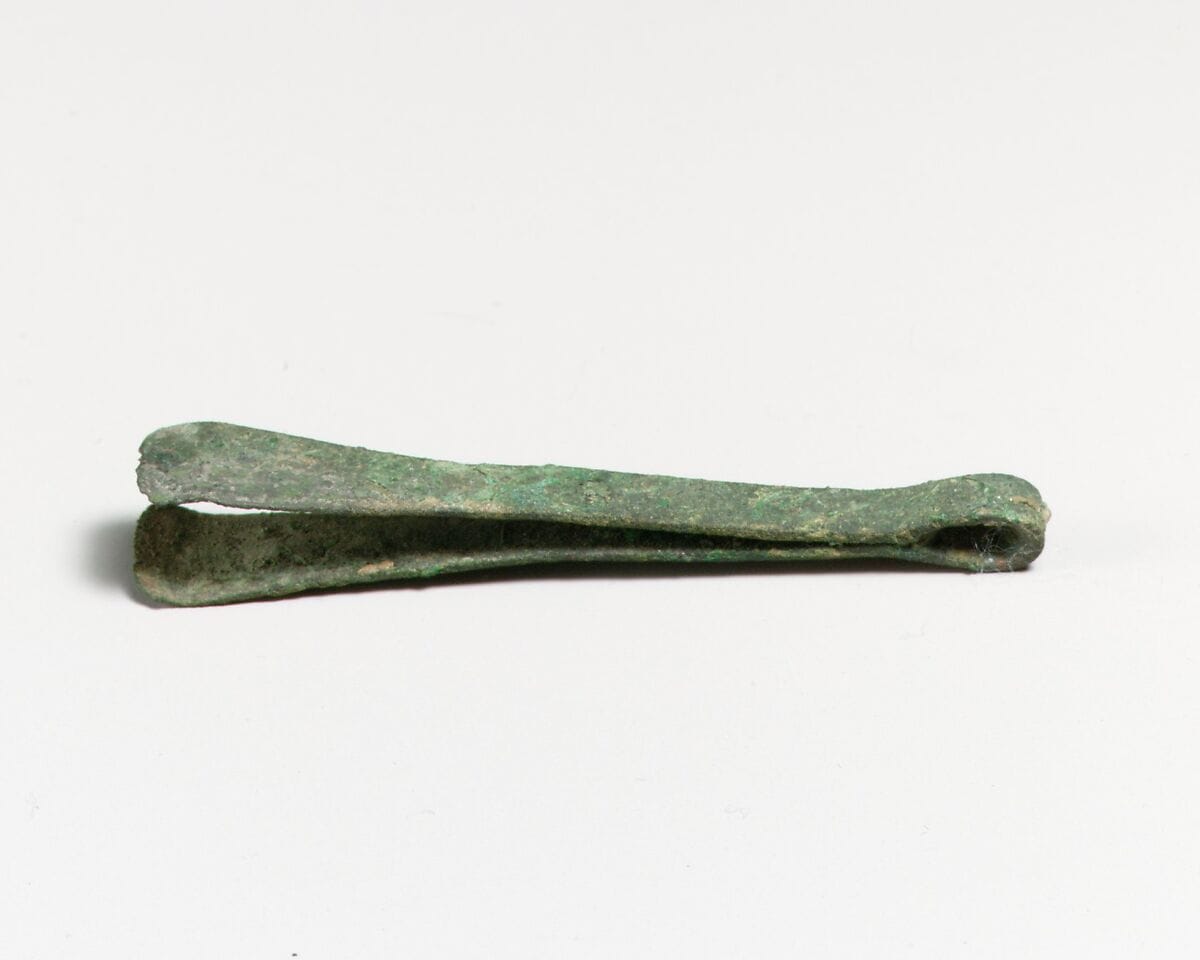
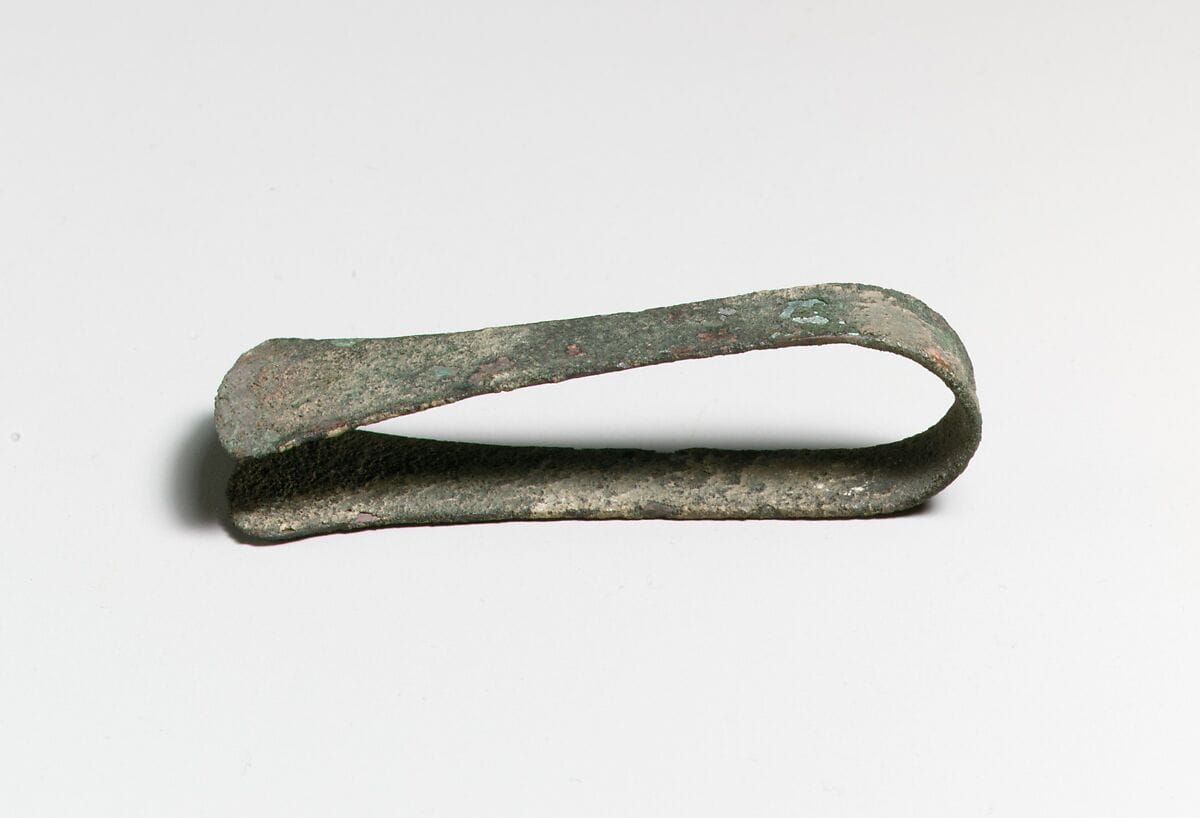
Tweezers are among the oldest Cypriot grooming tools. Maria Rosaria Belgiorno, who excavated at Pyrgos-Mavroraki, traces the first bronze tweezers in Cyprus to the Philia facies at the start of the Early Bronze Age, and notes that around the beginning of the second millennium BC a form with enlarged ends appears in Cyprus, the Aegean islands and Mesopotamia "almost contemporaneously". Many come from the Early and Middle Bronze Age tombs of Lapithos, and two were found in Pyrgos Tomb 21 (Early Cypriot III to Middle Cypriot I). She regards them as tools for facial and body care "for both men and women" [4]. The Early Cypriot tomb groups from Bellapais-Vounous also contain tweezers alongside daggers, knives and pins (see Vounous and Early Bronze Age burial).
The Alambra report gives the clearest picture of how the type was used in burial. Tweezers are "often associated with scrapers": of fourteen pairs from the University of Pennsylvania's excavations at Lapithos, only one was in a tomb group that lacked a scraper, a pattern recorded by Ellen Herscher in 1978. Most are unalloyed or arsenical copper, with two flaring arms and with or without a loop at the top; a form with a compressed loop and expanded ends is common in Middle Cypriot I [3]. The pairing suggests a shaving kit, a blade and tweezers buried together.
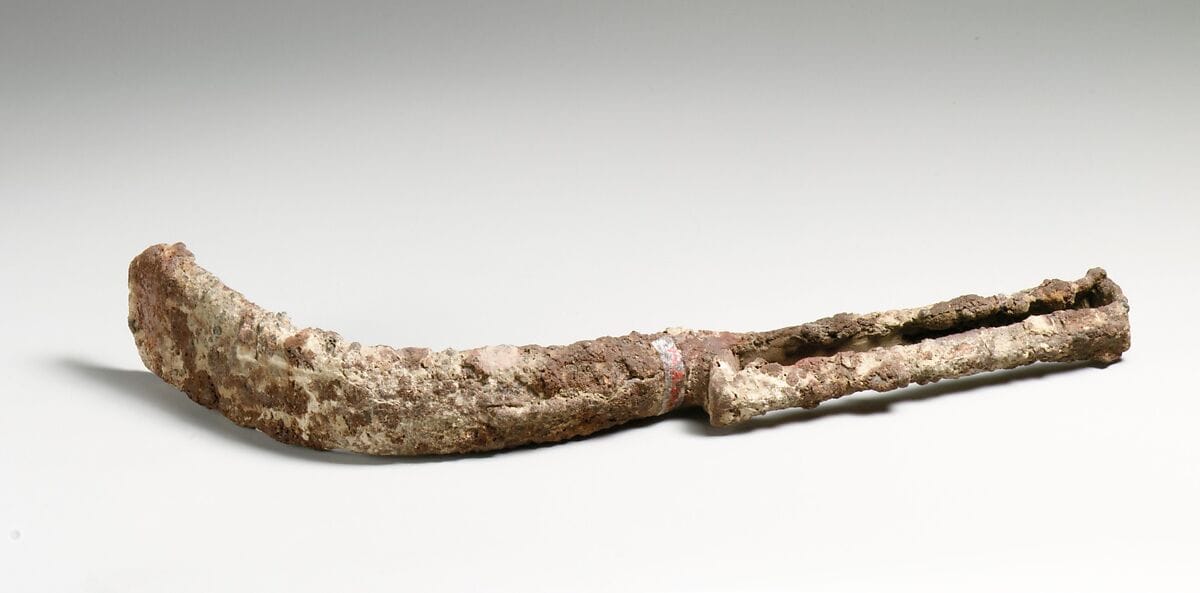
In the Late Bronze Age the type continues in three forms. Åström's Type 1 has a pinched loop spring and belongs to Late Cypriot I; Type 2, with an open spring, is confined to Late Cypriot I and II; Type 3 appears in Late Cypriot IIIB and, in her words, "may indicate the revived use of these objects during a later period" [2]. Findspots include Arpera, Milia, Akhera and Episkopi-Bamboula. Tweezers remain in use much later: Zachariou-Kaila notes that they are "known from early on" in Cyprus but seem to drop out of Roman tomb inventories [1]. The catalogue holds two Cesnola pairs in New York, 74.51.5437 and 74.51.5436.
Pins, toggle pins and "kohl-sticks"
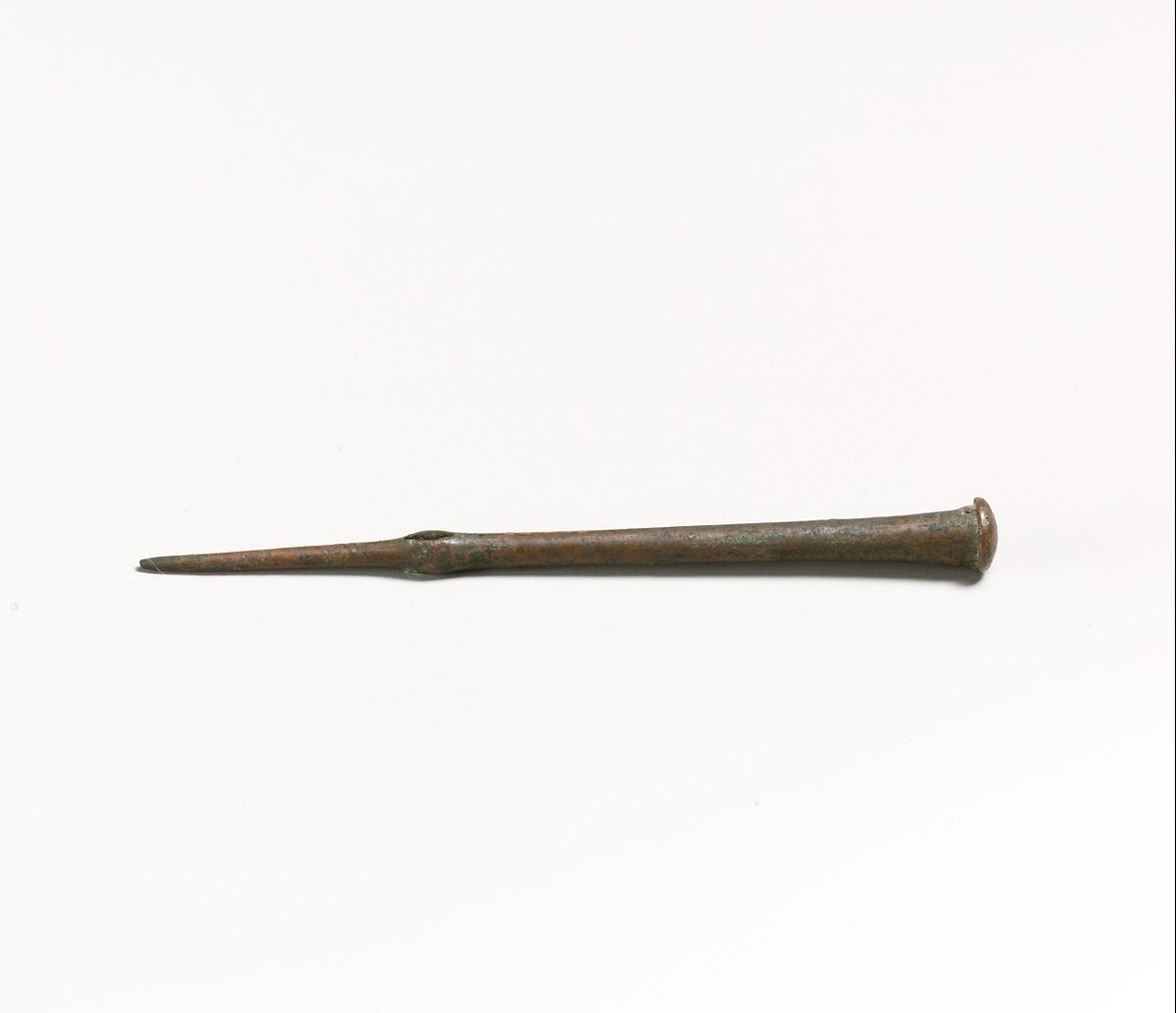
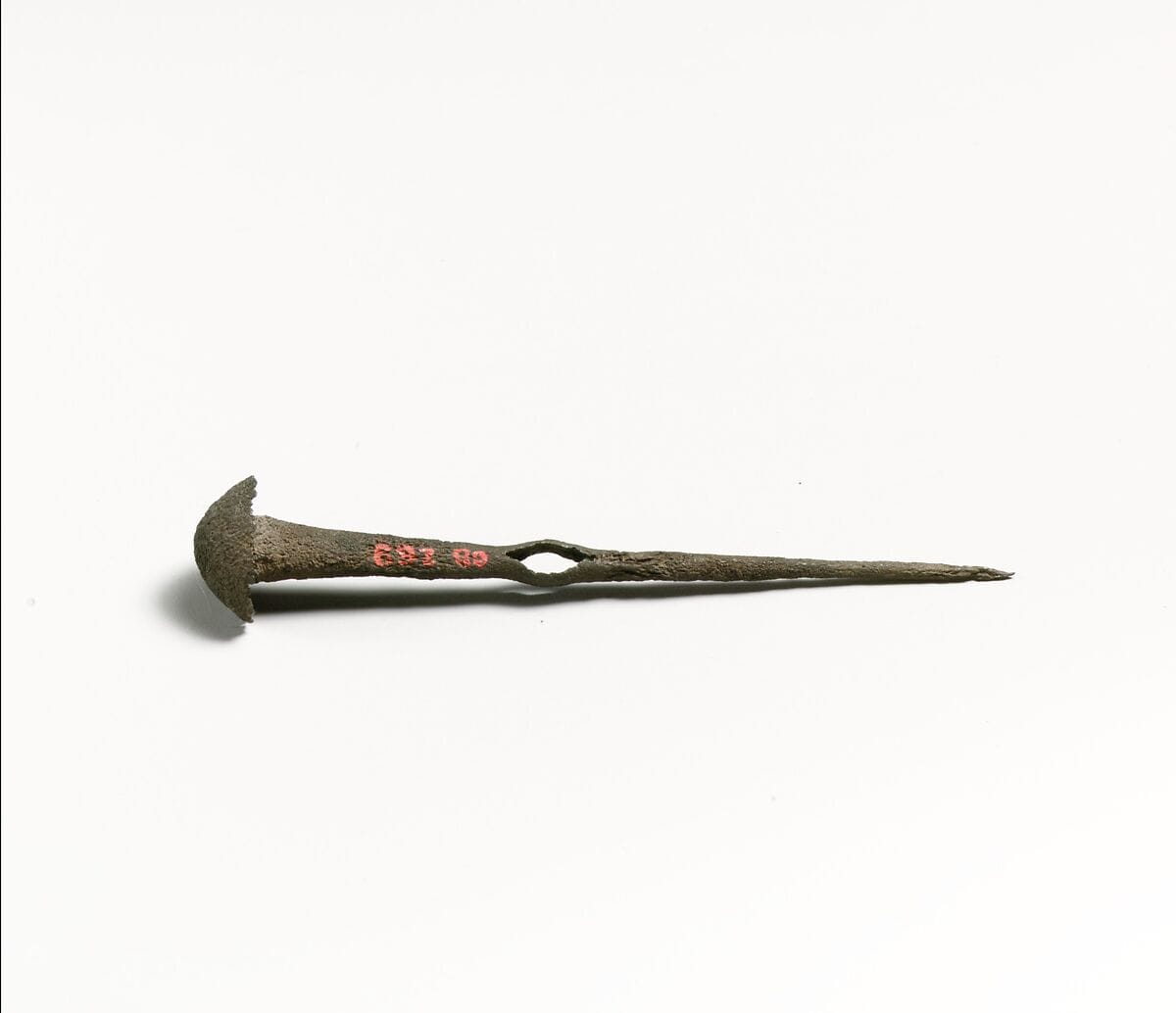
The Met calls a group of its Cesnola pins "eyelet type"; Cypriot specialists call the same thing a toggle pin, a straight pin with a pierced eye on the shank through which a cord could pass. Toggle pins, Åström wrote, "first occur in bronze in Early Cypriote and are common throughout the Middle Bronze Age". Plain-headed pins continue in every phase of the Late Cypriot period, but they are "less common than in Middle Cypriote", and a knot-headed pin in an early Late Cypriot tomb at Ayios Iakovos is a Middle Cypriot survival. Silver toggle pins of the Late Bronze Age have close parallels in gold and bronze pins from Palestine [2].
Hans-Günter Buchholz and Vassos Karageorghis catalogued Middle Cypriot bronze toggle pins with button-like and mushroom heads, some over 20 cm long, as "dress pins, with eye" [5]. That is the more likely function for most of them: the eye held a cord that secured the pin in a garment (see clothing and dress). The catalogue files the Met's eyelet pins under toilet objects (74.51.5525, 74.51.5528, 74.51.5527), following the museum's grouping, but the dress-fastening reading has the stronger support. The Met's record for a related pin, 74.51.5373, gives a length of 14.3 cm.
One group of pins does have a cosmetic case. Pomegranate-headed pins of ivory and bone appear in Late Cypriot IIB to IIIB. At Lachish in Palestine pins of this kind were found with toilet objects, and Åström considered it "possible that they were used as kohl-sticks", to apply eye paint; she dismissed the idea that they served as hair curlers as "hardly practicable" [2]. Late Cypriot potters also made small flasks that imitate Egyptian column-shaped kohl tubes, a form she describes as particular to Cyprus and Palestine [2].
Mirrors
Mirrors arrive late. Zachariou-Kaila observes that in Cyprus they "scarcely appear before the end of the thirteenth century B.C.", and that only in the Cypro-Archaic II period do they begin to appear more often [1]. Belgiorno has suggested that a polished black clay slab from the Pyrgos workshop might have served as a mirror in the Early Bronze Age, but this is her proposal and no Bronze Age metal mirror before the Late Cypriot period is known [4].
Peter Fischer, publishing a new find from Hala Sultan Tekke in 2024, counts about 41 copper-alloy mirror discs from Late Cypriot Cyprus and notes their "great diversity in forms". Most are tanged mirrors of Near Eastern type, with a triangular or trapezoidal tang fitted into a handle: imports and imitations of Levantine and Egyptian styles, plus local forms. Aegean mirrors, whose disc was riveted to the handle, are a tiny minority and were imported, not copied. Besides the Hala Sultan Tekke example from Chamber Tomb XX, the only other riveted mirror comes from Enkomi Tomb 66, excavated by the British Museum in 1896; it measures 15.6 cm across and weighs 785 g, and Hector Catling described it in 1964 as "almost certainly an import from the Aegean" [6]. Åström's typology agrees: her Type 1 mirror belongs to Late Cypriot II and is an Aegean type, while the tanged Type 2 is common in Late Cypriot IIIA, with one example from Late Cypriot IIC and a few from IIIB. Four tanged mirrors of Cypriot type have been found on Rhodes [2].
Cypriot tanged mirrors also travelled west. Fulvia Lo Schiavo, Ellen Macnamara and Lucia Vagnetti dated the Cypriot examples to the thirteenth and part of the twelfth century BC, traced examples to Pantalica in Sicily and to Sardinia, and suggested that the type "probably" has an Egyptian origin and could have reached Cyprus through Syria; the island's own examples include finds from Kition [7].
.](https://cdn.ancientcyprus.com/britishmuseum/4146-ivory-lion-mirror.png)
The best-preserved Late Cypriot mirrors in the catalogue come from the same 1896 Enkomi excavations. One is a hammered bronze disc with a tapering tang and a separate ivory handle carved with a lion attacking a bull (British Museum 1897,0401.402). A second ivory handle, its disc lost, carries a lion attacking a bull on one face and a warrior killing a griffin on the other (1897,0401.872). Åström records an ivory mirror handle with Mycenaean-style carving from an Enkomi tomb that held no pottery, so it cannot be closely dated [2]. Handles like these are the main evidence that Late Cypriot mirrors were prestige objects as much as practical ones.
After the Bronze Age the mirror becomes a regular grave good. Demetrios Michaelides, following Chavane's study of the Amathus tombs, sorts the later Cypriot mirrors into three groups [8]. The first is a circular disc with a short tang, a type already known in the Late Bronze Age that becomes the characteristic form from the end of the Archaic through the Classical and Hellenistic periods; an example is the British Museum's tanged mirror from Amathus, 12 cm across. The second is a plain disc, sometimes slightly convex, with a soldered handle or a perforated rim, though not every such disc is certainly a mirror. The third is the hinged mirror with a lid, a Greek form that appears from the late Classical period and is popular in Hellenistic and Roman times. The best Cypriot example is mirror 2536/88 from a tomb at Nea Paphos excavated in 1983, whose repoussé lid shows Venus with Cupids, the first of its type found on the island [8]. Zachariou-Kaila adds that Roman mirrors were made of a high-tin copper alloy, and that the only known silver mirror from Cyprus is in the Pitt Rivers Museum in Oxford [1].
Combs and bone handles
Combs are scarce. "Six ivory combs and two of bone have been found in Cyprus and most of them are fragmentary," Åström wrote in 1972 [2]. One rectangular comb handle from Enkomi she considered "more Mycenaean", and a bone comb from Apliki "probably an import from the Aegean area"; but most are Eastern in character, including double combs (teeth on both sides) of a type known at Megiddo, Hama and Tell Abu Hawam and absent from the Aegean. Her Type 2a dates to Late Cypriot IIC, the double comb Type 1 to Late Cypriot III, and Type 2b, decorated with dotted concentric circles and apparently unique, to Late Cypriot IIIB; she regarded it as a Cypriot creation [2]. The ivory itself probably came from Syria, and its use in Cyprus is secure from Late Cypriot IIB to IIC [2]. The catalogue holds an ivory comb from the British Museum's Enkomi excavations, 7.5 cm long, rectangular, with three incised lines at the base of the teeth. For ivory-working more broadly, see jewellery.
The Met's Cesnola collection also includes small carved bone strips catalogued with an either-or title, "toilet box or handle" (74.51.5257; Met record), 9.7 cm long. The museum gives no date, and their function as box fittings or handles is a description of shape. They are best read as bone fittings of uncertain use.
Strigils and the bath
The strigil, a curved metal scraper for removing oil, sweat and dust from the skin, is a Greek bath and gymnasium tool. In Cyprus Zachariou-Kaila finds it first in the Cypro-Archaic period, as a votive at the sanctuary of Anat-Athena at Idalion and as a grave good at Cellarka, a cemetery of Salamis. It becomes a widespread burial offering in the Cypro-Classical period. A "Roman type" with a rectangular loop handle appears from the mid-fourth century BC, and two Roman types follow, the standard one by the first century BC [1]. George McFadden, publishing a tomb at Ayios Ermoyenis near Kourion in 1946, noted that Hellenistic and earlier strigils had open handles, and listed Cypriot examples from Marion tombs 22, 34, 52, 56 and 72 and from Idalion [9].
Strigils were often hung on a ring together with a small oil flask, the aryballos, and carried to the bath. Metal aryballoi are very rare in Cyprus; Zachariou-Kaila counts three in the Department of Antiquities collections. The largest Cypriot group comes from tomb P.M. 3339 at Polis-Ambeli tou Englezou, with more than 1,400 finds of the first century BC to the first century AD: twelve iron strigils, one copper-alloy strigil, a mirror and a silver spoon [1]. The catalogue holds two Cesnola strigils: a bronze one the Met dates to the fifth century BC (74.51.5470; Met record), and an iron one, 23.5 cm long, with no century given (74.51.5467).
Perfumed oil was the other half of this kit. Zachariou-Kaila points to a sixth-century BC inscription from Rantidi naming a perfumer [1], and Belgiorno's work at Pyrgos argues for organised perfume production on the island as early as the Bronze Age [4]. See also medicine in ancient Cyprus, where scented oils and unguents also appear.
Who used them
The evidence comes almost entirely from graves, so it records burial choices. Within that limit, a few patterns hold. In the Bronze Age, blades and tweezers are buried together, which reads most easily as a shaving kit [3]. Mirrors are usually, but not always, a woman's object: Michaelides notes that a mirror "does not necessarily" mean a female burial, though "in the vast majority of instances" it will [8], and Zachariou-Kaila cites a bronze mirror with a man of 35 to 40 in an early Hellenistic tomb at Nea Paphos [1]. Michaelides also notes that some Hellenistic and Roman mirrors were deliberately cut in two before burial, and links the practice to the "killing" of swords that first appears in the Late Bronze Age; this is his interpretation, not a settled rule [8]. Strigils follow the Greek association with exercise and bathing and appear in both sanctuaries and tombs from the sixth century BC [1].
The longer pattern is one of addition. Razors, tweezers and pins belong to the Early and Middle Bronze Age; mirrors and ivory combs join them in the Late Bronze Age, many of them imports or copies of Levantine, Egyptian and Aegean types (see the Mycenaeans and Cyprus); strigils arrive with the Archaic period. For the copper that most of these objects were made of, see copper metallurgy.
Objects on this page
- Copper alloy razorMiddle Bronze Age II · 1800–1725 BC
 TweezersEarly Bronze Age I · 3200–2000 BC
 TweezersEarly Bronze Age I · 3200–2000 BC
 Pin, eyelet typeBronze Age · 3900 BC–100 AD
 Pin, eyelet typeBronze Age · 3900 BC–100 AD
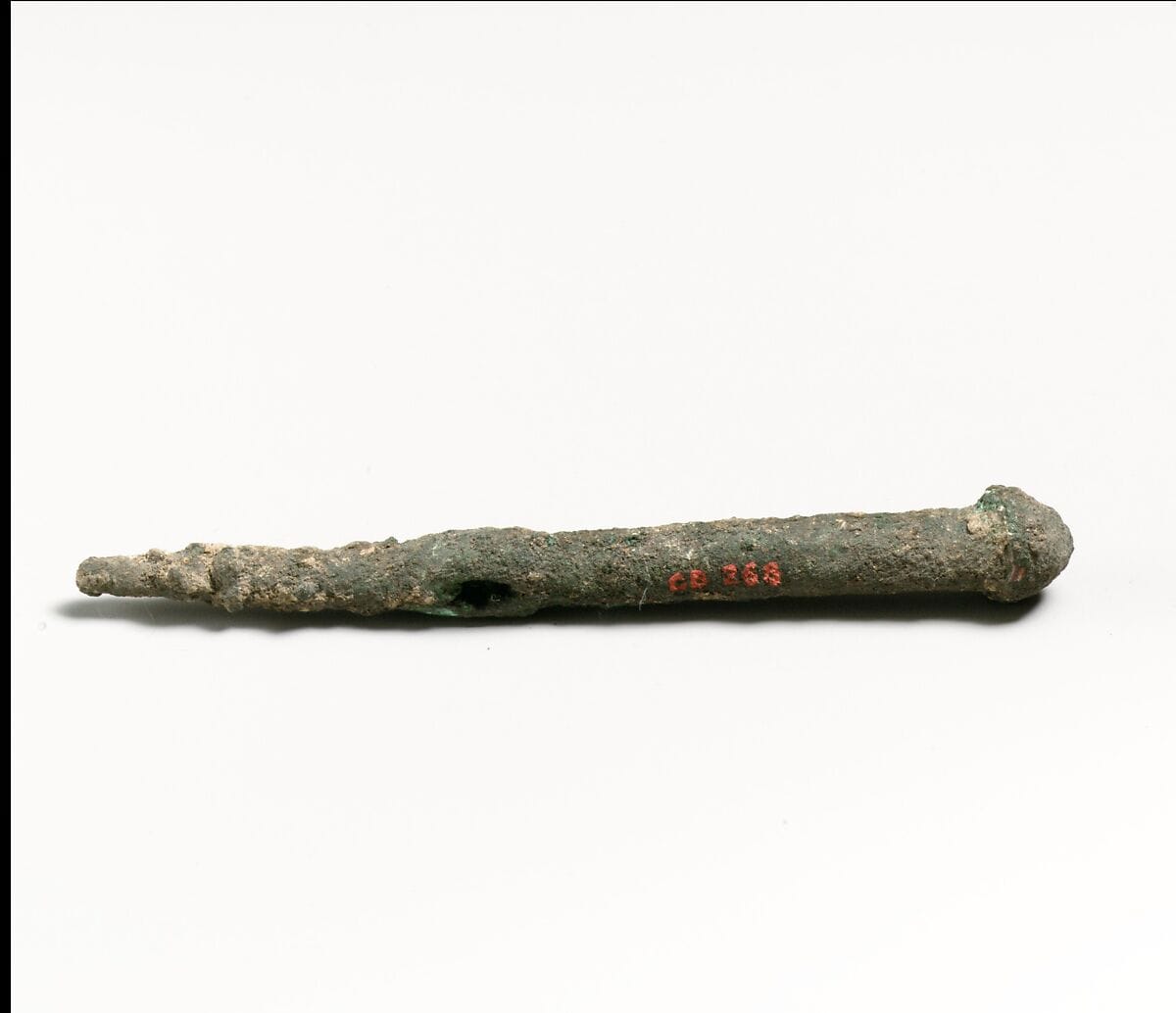 Pin, eyelet typeBronze Age · 3900 BC–100 AD
- Ivory Lion MirrorLate Bronze Age III · 1250–1050 BC
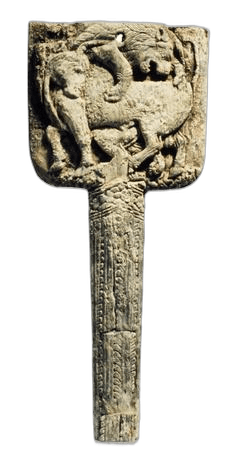 Ivory Mirror HandleLate Bronze Age III · 1250–1050 BC
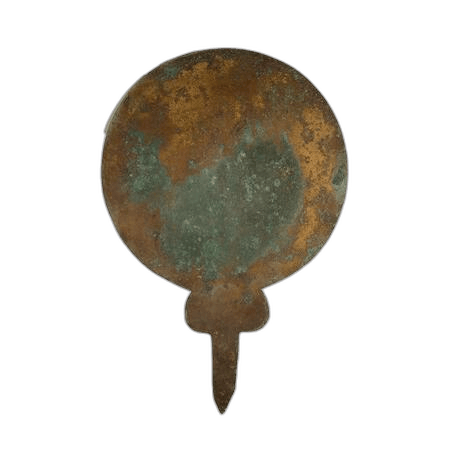 Bronze Tang MirrorClassical · 500–300 BC
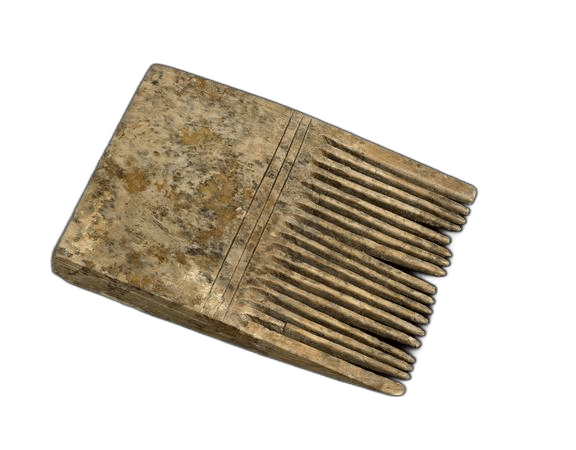 Ivory Carved CombLate Bronze Age III · 1340–1050 BC
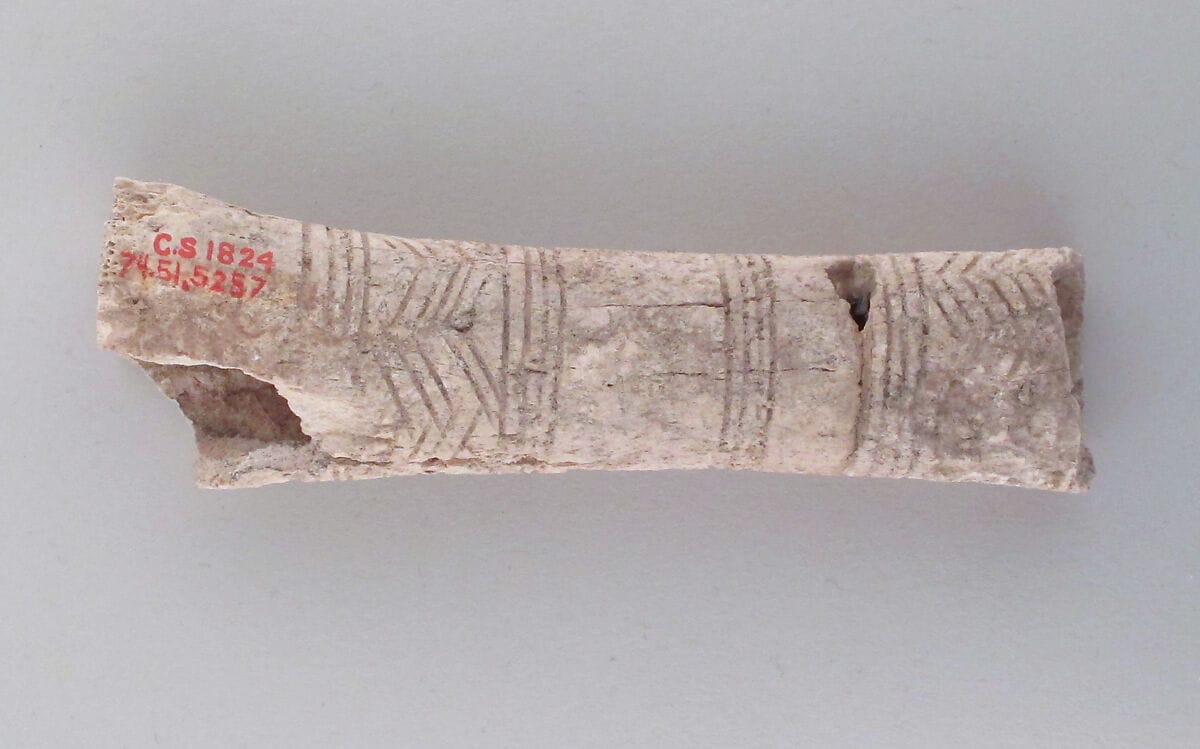 Toilet box or handleBronze Age · 3900 BC–100 AD
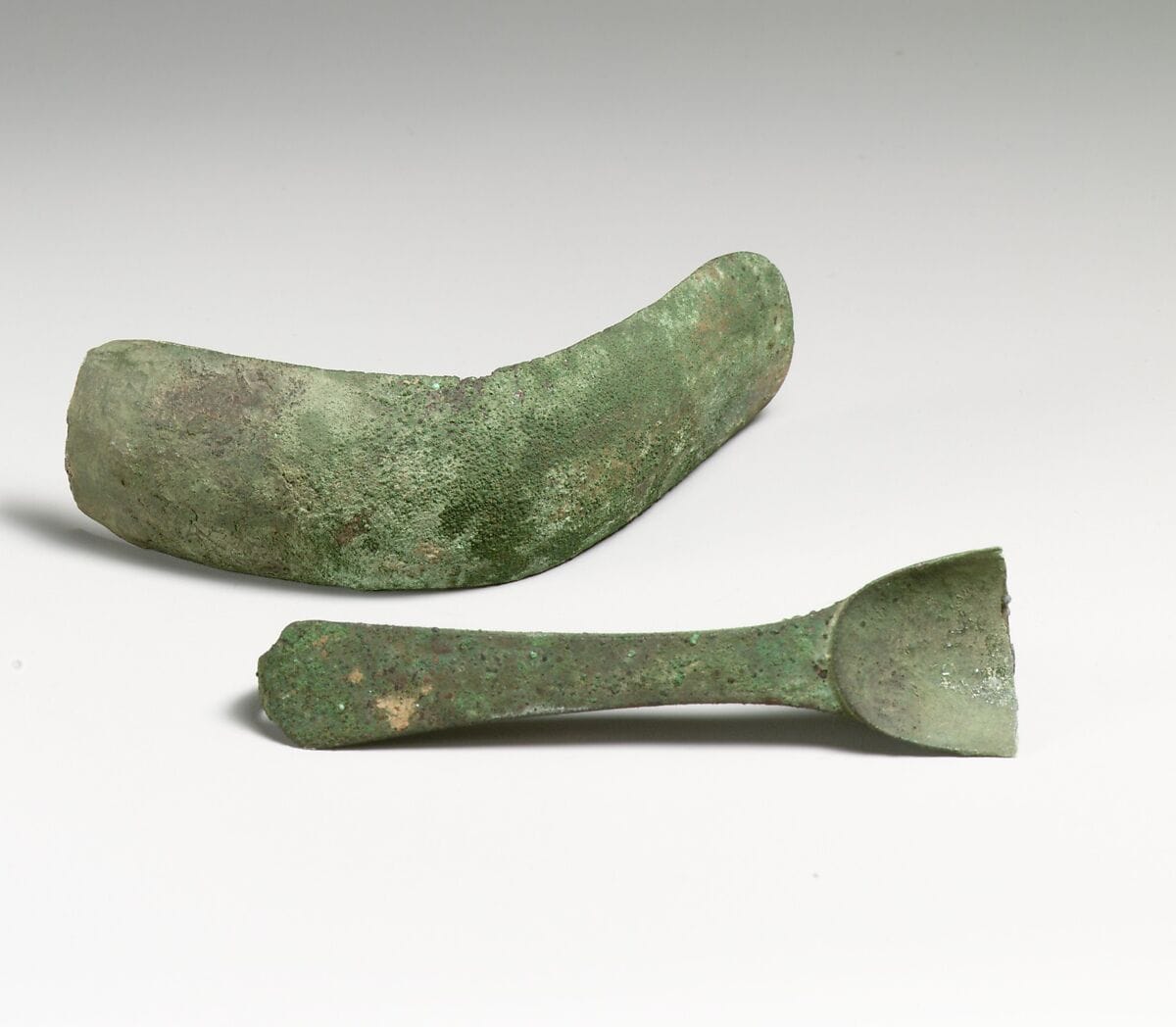 StrigilClassical · 499–400 BC
and 1 more object mentioned on this page
In the catalogue
References
- 1.Zachariou-Kaila, E. (2009). Personal grooming: Metal objects from Roman Cyprus. Cahiers du Centre d'Études Chypriotes, 39. https://www.persee.fr/doc/cchyp_0761-8271_2009_num_39_1_931
- 2.Åström, L. (1972). Other arts and crafts. In P. Åström, The Swedish Cyprus Expedition, Vol. IV, Part 1D: The Late Cypriote Bronze Age. Other arts and crafts, relative and absolute chronology, foreign relations, historical conclusions. Swedish Cyprus Expedition.
- 3.Coleman, J. E., et al. (1996). Alambra: A Middle Bronze Age settlement in Cyprus. Archaeological investigations by Cornell University 1974–1985 (Studies in Mediterranean Archaeology 118). Paul Åströms Förlag.
- 4.Belgiorno, M. R. (n.d.). The perfume of Cyprus: From Pyrgos to François Coty, the route of a millenary charm (3rd rev. ed.). De Strobel.
- 5.Buchholz, H.-G., & Karageorghis, V. (1973). Prehistoric Greece and Cyprus: An archaeological handbook. Phaidon.
- 6.Fischer, P. M. (2024). An Aegean mirror from Hala Sultan Tekke, Cyprus. Oxford Journal of Archaeology, 43, 152–172.
- 7.Lo Schiavo, F., Macnamara, E., & Vagnetti, L. (1985). Late Cypriot imports to Italy and their influence on local bronzework. Papers of the British School at Rome, 53, 1–71. https://doi.org/10.1017/S0068246200011491
- 8.Michaelides, D. (2001). A decorated mirror from Nea Paphos. In D. Bolger & N. Serwint (Eds.), Engendering Aphrodite: Women and society in ancient Cyprus. American Schools of Oriental Research.
- 9.McFadden, G. H. (1946). A tomb of the necropolis of Ayios Ermoyenis at Kourion. American Journal of Archaeology, 50.