
Contents
Most of the metal vessels that survive from ancient Cyprus come from tombs, and many of the finest from the tombs of kings. In the site's catalogue the class covers bronze, silver and gold bowls, jugs, cauldrons and strainers, together with the bronze tripods and stands on which vessels were set. The stands are furniture rather than containers, but they belong with the vessels: their crowning ring, as one study of them puts it, "leaves no doubt that vases were intended to be placed upon it" [1]. Large bronze cauldrons were feasting equipment and were occasionally reused as urns for the ashes of the dead [2], while the small decorated bowls that scholars call "bowls or phialae" were held in the hand for drinking and pouring libations [3, p. 16]. This entry follows the class from the Late Bronze Age stands to the Archaic silver bowls of the Cesnola Collection. Mining, smelting and the general technology of bronze are treated under copper metallurgy, and silver, gold and tin as metals under gold, silver, tin, arsenic and iron. You can see all metal vessels in the catalogue.
| Form | Material | Date | Key finds | Source |
|---|---|---|---|---|
| Rod tripod | Cast bronze | 13th to 11th century BCE contexts | Enkomi, Kourion, Palaepaphos; exported to Crete, Tiryns, Athens | [1] |
| Four-sided stand | Cast bronze, openwork | LC IIC to Cypro-Geometric II | Cyprus; Knossos North Cemetery Tomb 201; Tel Nami | [1] |
| Large handled bowl | Bronze, cast then hammered | Cypro-Geometric | Palaepaphos-Skales Tomb 49 | [6] |
| High-tin bowl | Bronze with 16.5 to 25.5% tin | Cypro-Geometric to Archaic | Palaepaphos-Plakes Tombs 142, 144, 145 | [5] |
| Flat bowl with swing handle | Bronze | CA I to CA II | Tamassos Tombs 4 and 12; Amathus; Idalion Tomb 2 | [2] |
| Cauldron | Bronze, with cast protomes | CA I to CA II | Salamis Tomb 79; Tamassos Tombs 12 and 15 | [2] |
| Decorated bowl (phiale) | Silver, gilded silver, bronze | 7th to 6th century BCE | Cesnola Collection, Kourion; Idalion; Salamis | [3], [7] |
What counts as a metal vessel
The word covers objects that were made in very different ways. Stands and tripods were cast by the lost-wax method [1]. The large Cypro-Geometric bowls from Palaepaphos were probably cast and then finished by hammering [6], and the decorated Archaic bowls were raised from sheet silver or bronze and decorated in repoussé, with outlines traced on the surface [3, p. 15]. Bronze is the commonest material. The silver bowls in this class are Archaic, and the Met also holds a phiale of silver and gold of the late sixth century BCE (74.51.4572).
A useful distinction runs between plain vessels, which were made in numbers and often imitated the shapes of clay pots, and showpieces made for kings and their tombs. Clay counterparts of the commoner forms are described under bowls, jugs and strainers. The stands themselves are treated as furniture as well as metalwork, and their links with ivory-inlaid wooden tables are discussed under furniture.
Late Bronze Age rod tripods and four-sided stands
The bronze stands are the best-studied Cypriot metal vessels of the Late Bronze Age. A corpus of 63, possibly 65, rod tripods and four-sided stands from Cyprus, the Syro-Palestinian coast and the Aegean includes 38 of Cypriot tradition and 23 of Aegean, more specifically Cretan, tradition. Of the Cypriot pieces that can be classified, 23 are rod tripods and 11 are four-sided stands; at least five of the four-sided stands ran on wheels, the others on feet. They come from tombs, sanctuaries and hoards, in contexts from Late Cypriot IIC to Cypro-Geometric II [1]. H. W. Catling called them the "greatest technical masterpieces of bronzework of any period during the Late Bronze Age in the East Mediterranean", and James Muhly ranked them among "the most impressive bronzes produced in the ancient world during the second half of the second millennium BC" (both quoted in [1]).
A rod tripod is a ring carried on three legs; the ring may be plain, ridged, spiralled or decorated with figured scenes. A four-sided stand is an open rectangular frame of struts, on feet or wheels, crowned by a ring. Its openwork panels carry processions of gift-bearers and musicians, chariots, lions, bulls and griffins in combat, and single lions and sphinxes [1]. The two types have different ancestries. The rod tripod is a Cypriot version of a Near Eastern form, with clay tripods at Kültepe and Hattusha in the nineteenth century BC and bronze examples at Alalakh, and the earliest Cypriot contexts date to the thirteenth century BC. The four-sided stands "have no typological precursors in bronzework" and seem to translate wooden furniture decorated with ivory into bronze [1]. Small versions exist too: one from Pyla is 7.6 cm high [1].
What the stands held is unknown. None of the excavated examples was found with a vase on it, but in tombs they are often accompanied by bronze phialae, and their contents may have been water, wine or burning incense. None comes from a clearly cultic context; most are from tombs or hoards [1]. They were kept for a long time. A stand found in an Athenian grave on the Pnyx, dated by its pottery to the mid-eighth century, is a Late Bronze Age Cypriot piece [1]. Ora Negbi notes that stands for wine-mixing kraters appear as prestige furniture in royal banquets from the thirteenth century, and, following Hartmut Matthäus, that tripod stands found in eleventh- to ninth-century tombs at Kourion-Kaloriziki and Palaepaphos-Skales were made in local workshops at Enkomi from LC IIC "until, at least, the end of LC III, and perhaps further still to CGI" [4].
](https://cdn.ancientcyprus.com/single-artifacts/74.51.5684.jpg)
The Metropolitan Museum's bronze rod tripod from the Cesnola Collection is a good example of the type: 37.5 cm high with a ring 24.8 cm across, dated to about 1250 to 1050 BCE (Met 74.51.5684).
The stands also travelled. The rod tripods from Tiryns and the Pnyx and the four-sided stand from Knossos North Cemetery Tomb 201 are Cypriot exports, while ten of the twelve Cretan rod tripods were made in Aegean workshops; a stand from Tel Nami on the Israeli coast is "undoubtedly Cypriot" [1]. In Sardinia the picture is mixed: some tripods were imported from Cyprus and others imitated them, and lead isotope analysis suggests that most of the Sardinian pieces were made on the island [4].
Cypro-Geometric bowls from Palaepaphos
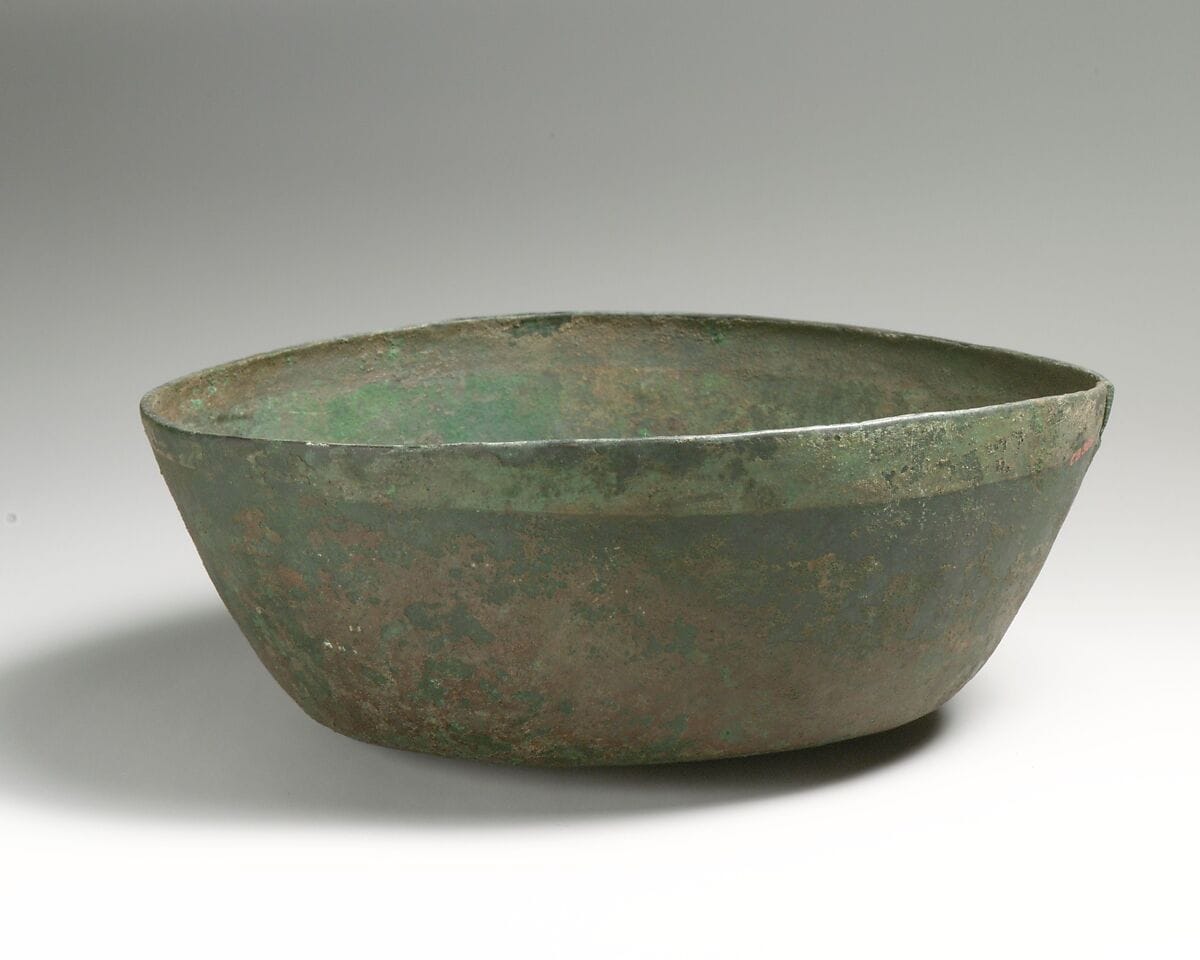
In the eleventh century BC bronze bowls in Cyprus are usually small and have no handles. The Cypro-Geometric cemetery at Palaepaphos-Skales broke that pattern with a wide range of large bowls, which suggests that metalworking flourished in the area [6]. A bowl from Skales Tomb 49 in the Cyprus Museum is 20 cm high and 37.1 cm across: a plain hemispherical body, probably cast and then hammered, with two horizontal loop handles riveted on opposite sides, each topped by goat protomes and bridged to the body by twisted wire [6].
Analysis of bowls from the neighbouring Plakes tombs adds a point about appearance. Five bowls from Tombs 142, 144 and 145 are high-tin bronzes with 16.5 to 25.5% tin, which gives the surface a golden colour; the excavators interpret them as imitations of gold vessels. Three have two riveted handles and were hammered, and their handles have broken because the alloy is brittle; the two plain ones are thick-walled and were cast by the lost-wax method. Vessels from Skales show the same high-tin trend [5]. Tin itself was imported, a story told under metals beyond copper.
Cypro-Archaic bronzes: bowls, jugs, cups and cauldrons
The Cypro-Archaic tombs of the kings produced a new repertoire of bronze tableware with close parallels in Phoenician and North Syrian metalwork. Flat drinking bowls with an omega-shaped swing handle on a rod-shaped attachment below the rim occur in five variants and date to CA I and II. They were found in Tamassos Tombs 4 and 12, Amathus tomb 84 and Idalion Tomb 2, and two unprovenanced examples are in the Cesnola Collection in New York. The handle type goes back to New Kingdom Egypt and the Levant, and a fragmentary strainer from Enkomi, of LC IIC date, already has one. Hartmut Matthäus regarded the flattest bowls with long attachments as advanced Phoenician metalwork; examples reached Nimrud, Greece, Italy, Sardinia, Iberia and Sudan [2].
Bronze jugs decorated with a Phoenician palmette have clay parallels, noted by Einar Gjerstad, in Bichrome Red II (V) jugs of CA II. Three long-spouted cups are known, from Idalion, from Tamassos (now lost) and of unknown provenance; their forerunners at Nimrud, Tell Halaf and Karatepe make them a Phoenician continuation of a North Syrian type [2].
The cauldrons are the largest pieces. Salamis Royal Tomb 79, of CA I, held two. The first has a high conical foot, a squat round body, an inturned spout, two rod attachments for an omega swing handle, three cast bull protomes, and a palmette and Hathor plaque with a winged sun disc below each attachment. The second is unique in Cyprus: a double-walled body with a round bottom, four embossed double-headed siren attachments with spread wings and eight cast griffin protomes, a scheme that is "unparalleled in Cyprus, the Near East, Greece and Etruria" and so probably the work of a local Cypro-Phoenician workshop [2]. The same tomb's chariots and furniture are described under Iron Age arms and armour and furniture. At Tamassos, Royal Tomb 12 held two cauldrons and Tomb 15 one, all of CA II. Cauldrons of the Tamassos form, with a rounded bottom, a high carinated shoulder and a low wide rim, also come from Salamis and Marion, and four unprovenanced examples are in London, Oxford and New York. Their high-shouldered ancestors at Tell es-Sa'idiyeh and Jatt, of Late Bronze Age to Iron I date, point to a Near Eastern origin. Found together with flat bowls in Tamassos Tomb 12, the cauldrons look like banqueting sets [2].
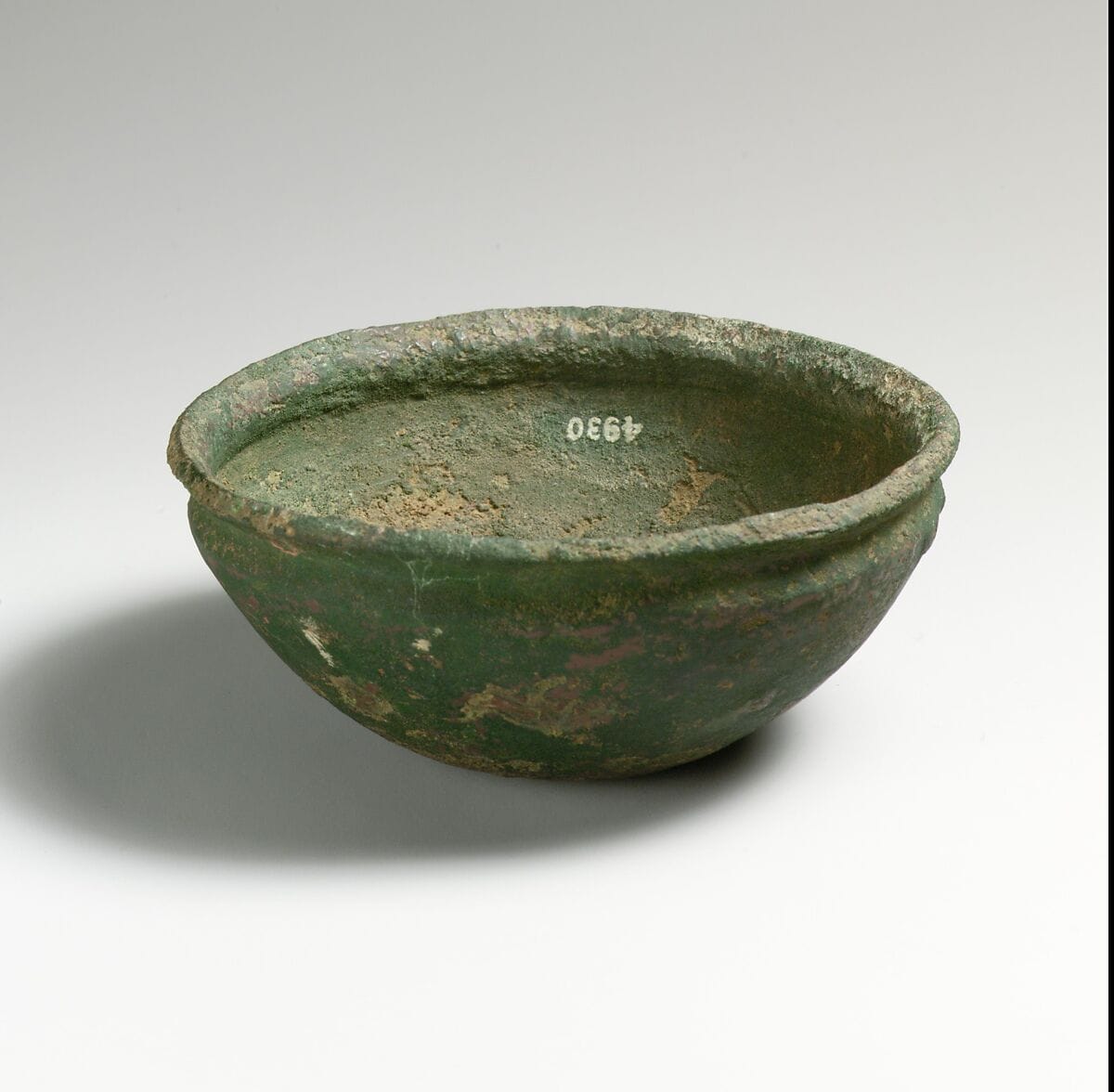
A small plain example of Archaic bronze tableware is the Met's bronze phiale, about 600 BCE, 4.9 cm high and 11.3 cm across (Met 74.51.5597).
Decorated silver and bronze bowls
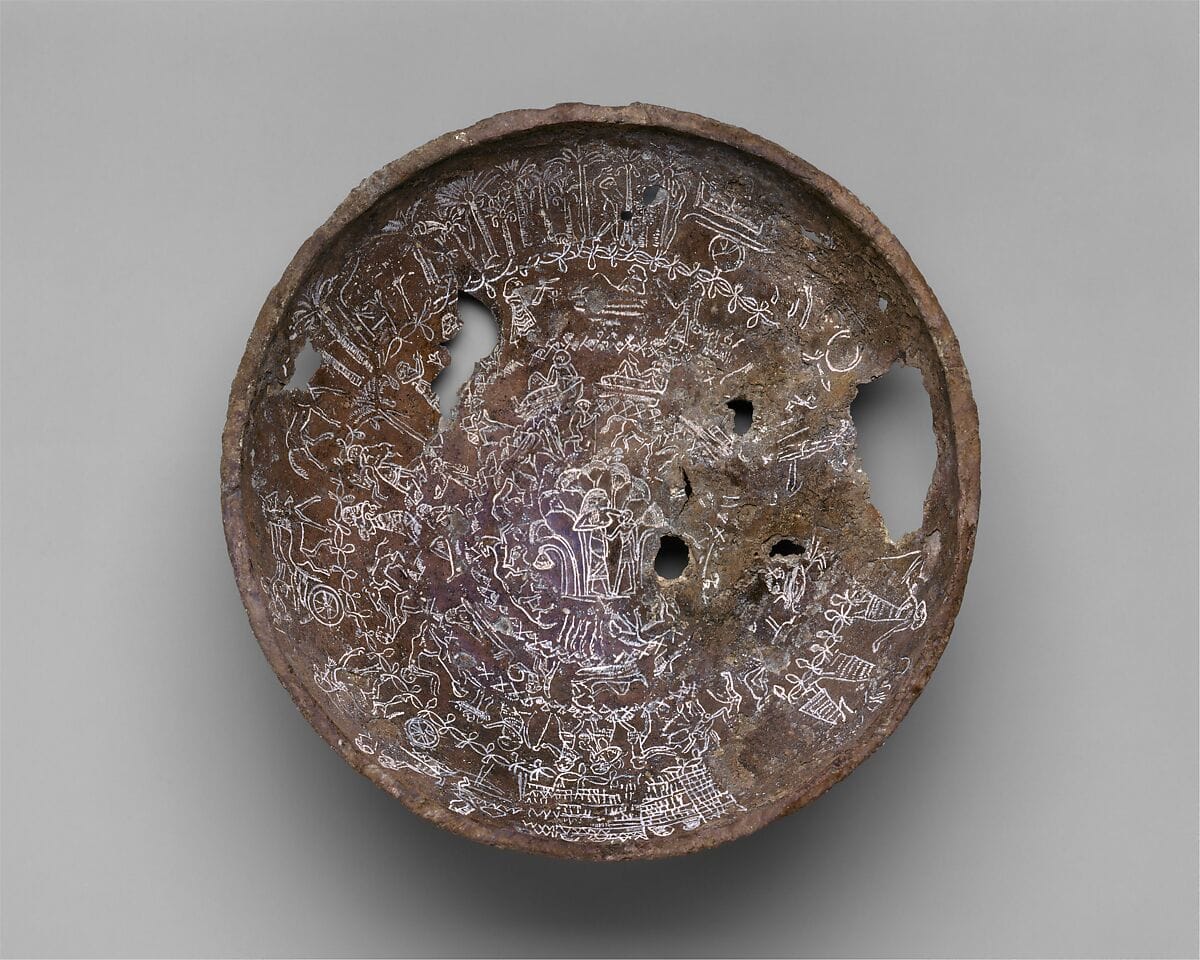
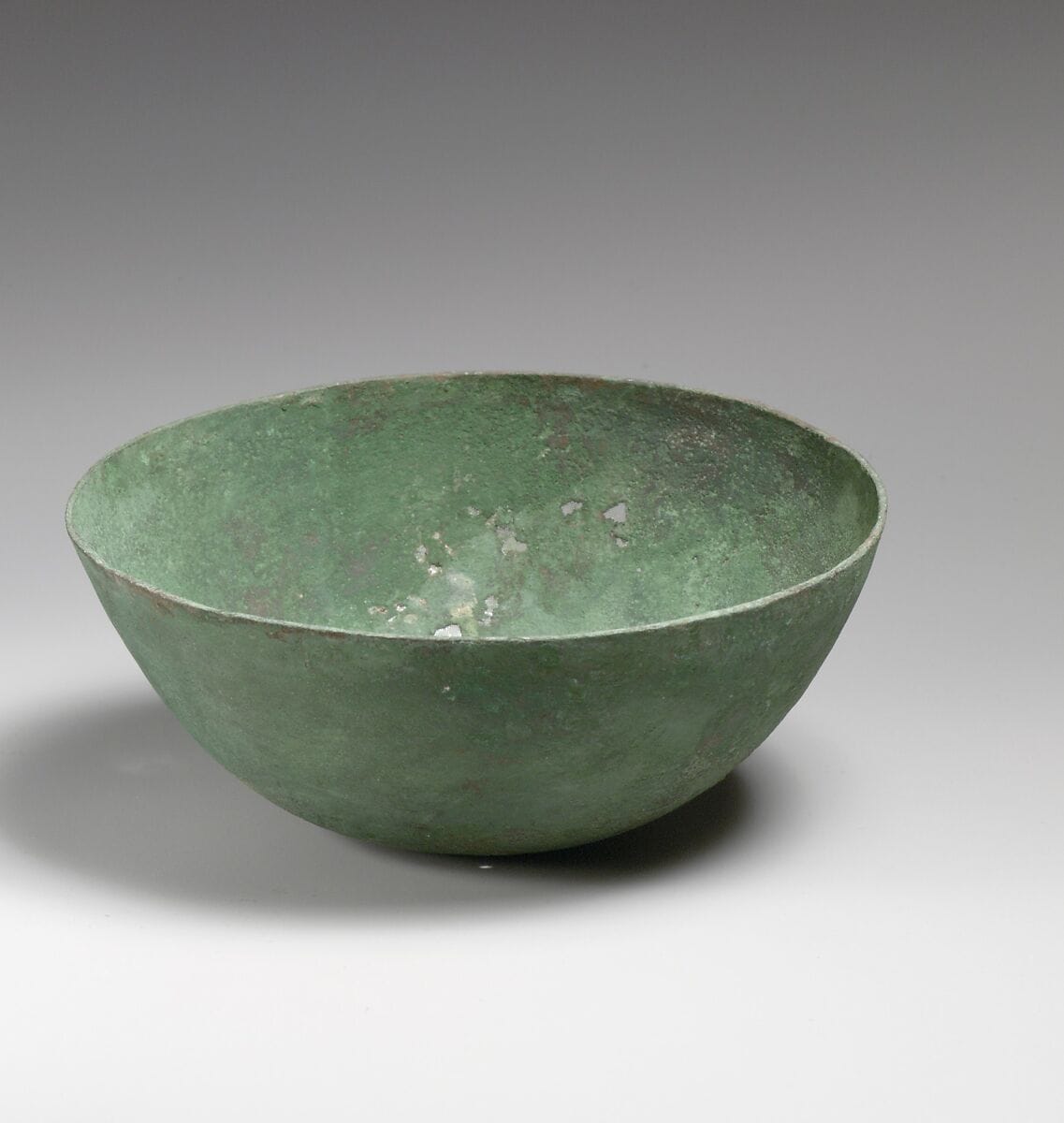
The Cesnola Collection in the Metropolitan Museum holds "by far the single richest body of decorated metal bowls from ancient Cyprus, often referred to as 'Cypro-Phoenician'" [3, p. 13]. These are shallow bowls of silver, sometimes gilded, or bronze, decorated inside with concentric registers around a central medallion. Glenn Markoe published more than seventy such bowls from across the Mediterranean, and a bronze bowl from Lefkandi in Euboea, of about 600 BC, has been added since [3]. About 22 precious-metal examples are known from Archaic Cyprus [7]. Their use was ceremonial drinking and libation: Neo-Assyrian reliefs from Ashurnasirpal II to Ashurbanipal show such bowls in use, and they are small enough to hold in one hand [3].
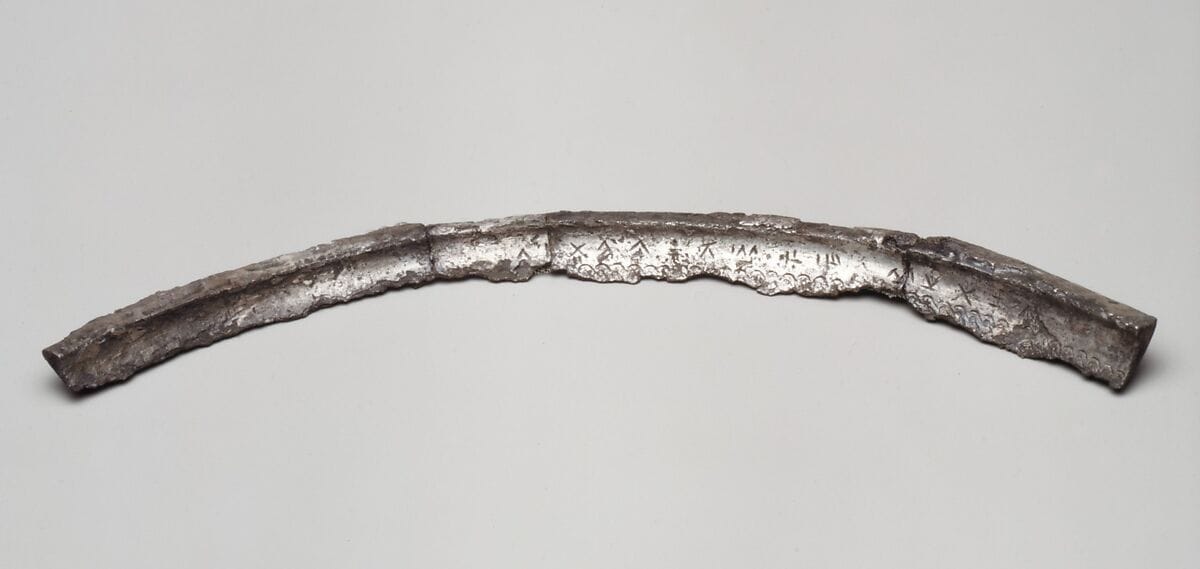
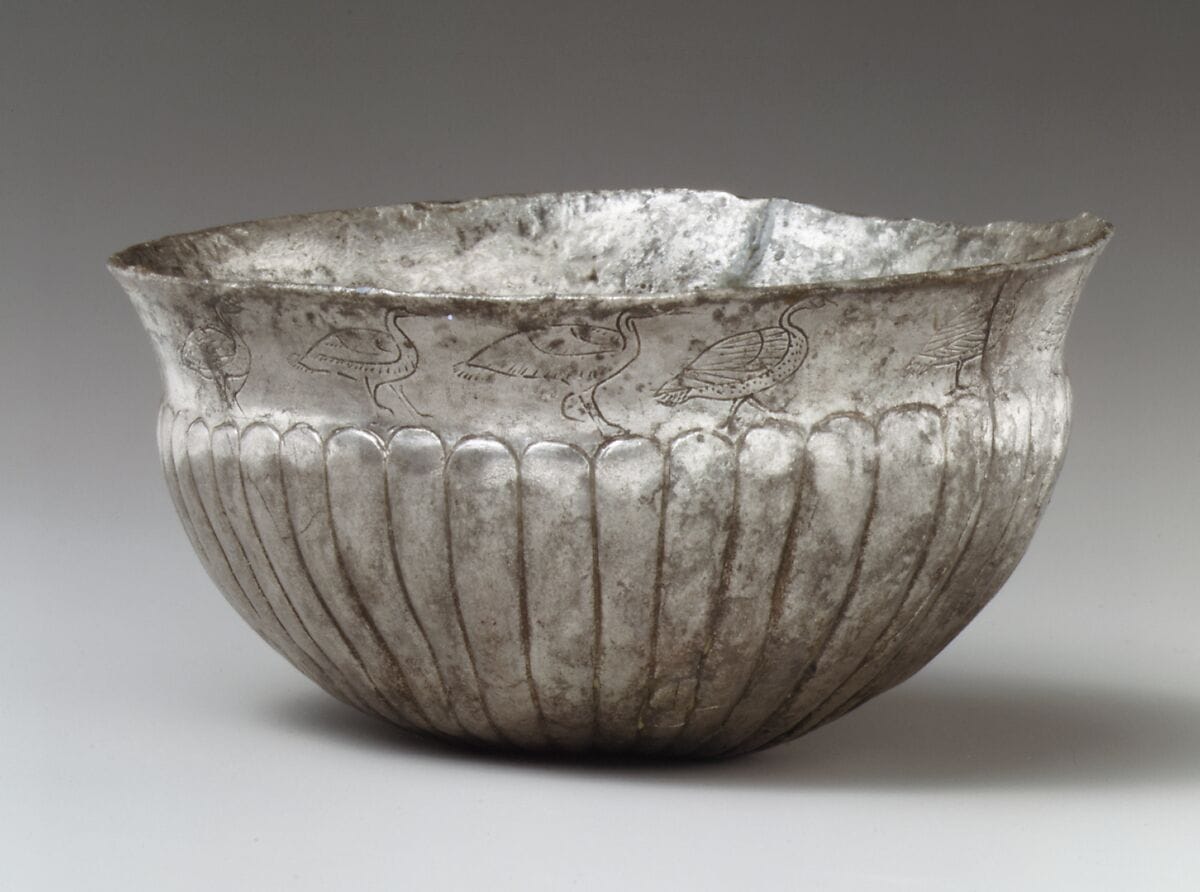
The best-known Met example is the silver bowl of about 675 to 625 BCE, 15.3 cm across, with Isis suckling Horus in its central medallion and animals in the outer registers (Met 74.51.4555). Its silver is discussed under metals beyond copper. Vassos Karageorghis studied another, MMA 74.51.4557, whose decoration was worked in repoussé with traced outlines, in registers bordered by guilloche, with papyrus flowers in the inner register. It carries a Cypriot syllabic inscription in the Paphian script read as Kyprothales, and Karageorghis suggested that a native Cypriot craftsman made it for a Greek-speaking king or queen of the island [3, p. 15]. Inscriptions name owners on other bowls too: a seventh-century silver bowl was inscribed by Akestor and Eteandros, kings (basileis) of Paphos, and two fragmentary seventh-century silver bowls from the "Kourion treasure" carry the names of kings [7]. A later piece is the inscribed silver bowl fragment of the latter sixth century, 14.6 cm long (Met 74.51.4552a), and the small silver bowl with birds, 10.3 cm across, is sixth century (Met 74.51.4562). Bronze bowls of the same family come from Idalion (MMA 74.51.5700) and Salamis (British Museum) [3].
Luigi Palma di Cesnola reported that a hoard of precious objects came from a "royal tomb" at Kourion. Karageorghis found "no real evidence to support this assertion": the objects of the so-called Kourion Treasure probably came from several findspots [3]. The bowls are treated as a collection under the Cesnola Collection.
Lampstands and strainers
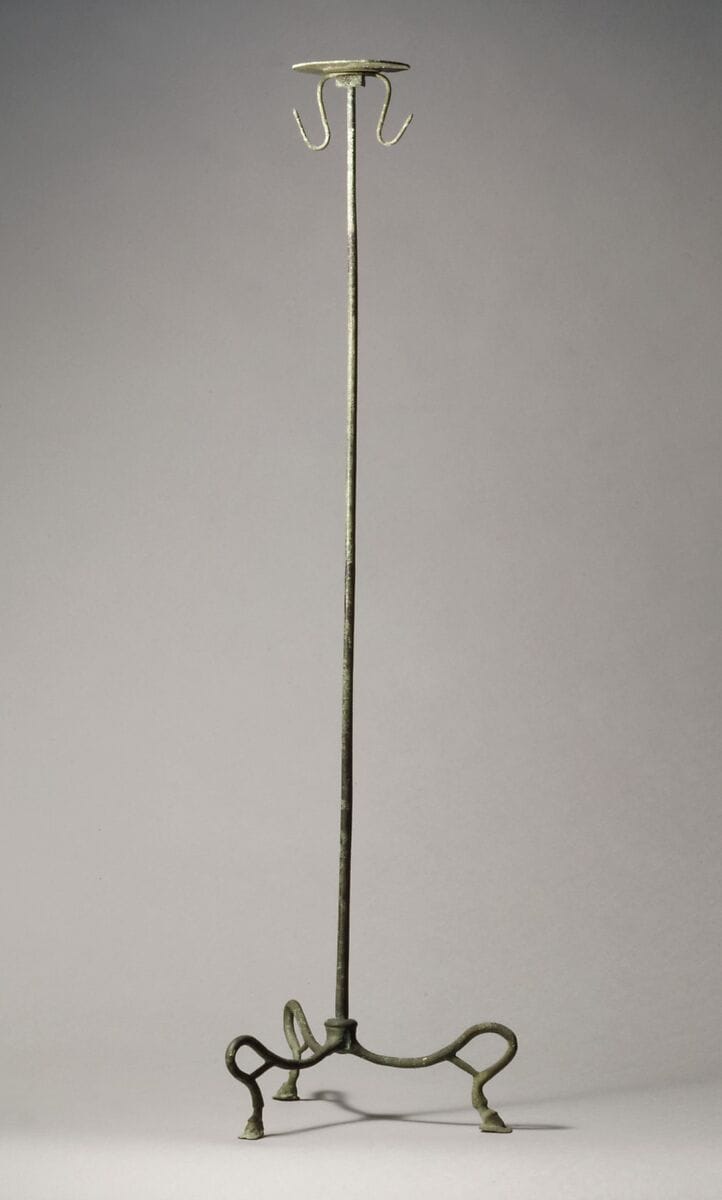
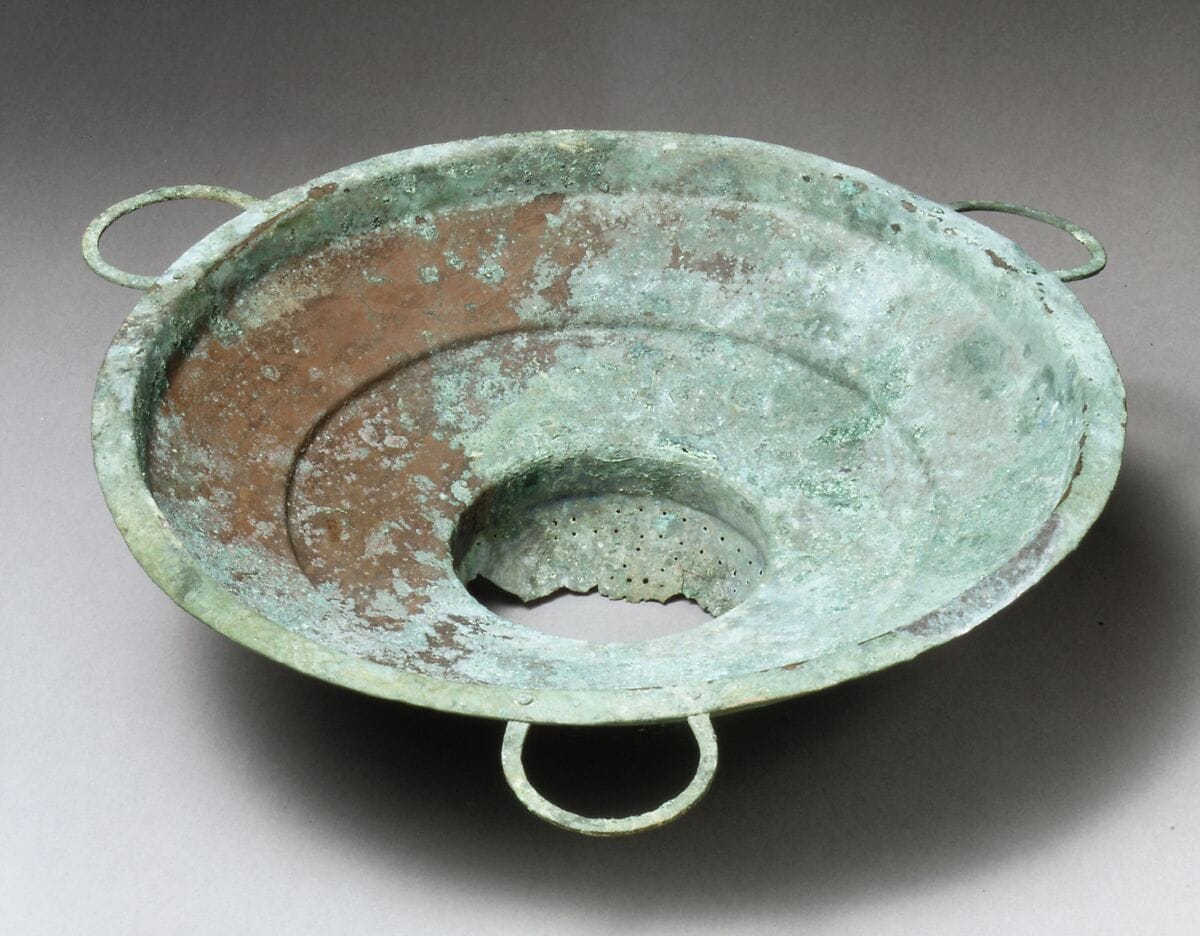
Two smaller groups in the catalogue round out the class. The Met's bronze lampstand, of the late sixth century BCE, stands 65.4 cm high on hoof feet (Met 74.51.5666). It is a stand for a lamp rather than a container, and the catalogue lists it with the vessels as bronze support furniture, like the earlier tripods and stands. The large Cesnola strainer, 37.5 cm across and 12.2 cm high, is dated in the catalogue to the tenth century BCE; strainers with swing handles go back at least to the LC IIC example from Enkomi mentioned above [2]. Clay strainers are described under strainer.
Open questions
Who made the decorated bowls is the longest-running debate. Gjerstad used the label "Cypro-Phoenician" for one type in 1946; Markoe concluded in 1985 that the bowls found in Cyprus were made by Phoenicians working on the island; Karageorghis uses the term for works that mix Cypriot and Phoenician styles with strongly Egyptianizing motifs, and regards the question of whether Phoenicians introduced the style as "still subject to debate" [3, p. 13]. None of the 22 Cypriot-found precious bowls carries a Phoenician inscription, and the inscribed ones name Cypriot kings [7]. The same question applies to the Archaic cauldrons: the bull-protome attachments on Cypriot cauldrons differ from those found at Olympia, but whether the Cypro-Phoenician workshops that made them worked in Cyprus or in Phoenicia is unresolved [2].
For the Late Bronze Age stands the debate is technical. One view holds that each stand was cast in a single pour from a composite wax model; the majority view favours casting the parts separately and joining them, on the grounds that a one-piece casting would have been extremely difficult. The single-pour argument replies that the many contact points between struts would have required even more metallurgical joins if the parts had been cast separately [1]. The Sardinian tripods, imports or local copies, and the high-tin Palaepaphos bowls as deliberate imitations of gold [5], are further open points. Related pages: Cypro-Classical metalwork, the Neo-Assyrian Empire and the article on metal in ancient Cyprus.
Objects on this page
In the catalogue
References
- 1.Cypriot bronze stands and their Mediterranean perspective. Journal article (English, with Catalan abstract).
- 2.Phoenician bronzes in Cyprus. Chapter in an edited volume (J. J. Ávila).
- 3.Karageorghis, V. (1999). A Cypriot silver bowl reconsidered: 1. The iconography of the decoration. Metropolitan Museum Journal, 34, 13–20. https://www.jstor.org/stable/1513042
- 4.Negbi, O. Urbanism on Late Bronze Age Cyprus: LC II in retrospect. Bulletin of the American Schools of Oriental Research. https://www.jstor.org/stable/25066873
- 5.Karageorghis, V., & Raptou, E. (2014). Appendix I: pXRF chemical analysis. In Necropoleis at Palaepaphos from the end of the Late Bronze Age to the Cypro-Archaic period. The Cyprus Institute.
- 6.Karageorghis, V. Ancient Cyprus: 7,000 years of art and archaeology.
- 7.Greeks on the island of Cyprus: At home or abroad. Wiley Blackwell. https://doi.org/10.1002/9781118341339.ch12