
Collector
William Ewart Gladstone
fl. 1872–1893 · United Kingdom
British statesman and Homeric scholar who wrote on Cesnola's Cyprus finds, corresponded with both Cesnola brothers and kept a Salamis epitaph at Hawarden.
Biography
W. E. Gladstone, the British statesman, was, in Olivier Masson's words, much interested in antiquity and the Homeric question, and he kept a Greek epitaph from Salamis at Hawarden3,4. He was born at 62 Rodney Street, Liverpool, on 29 December 1809, and died on the morning of Ascension Day, 19 May 18985.
Cyprus in politics
Gladstone denounced the Cyprus Convention of 1878 as "insane" and criticised it that year and the next5. In 1880, with his Liberals back in power, he privately expressed the idea that Cyprus might be passed to Greece6. In 1881, however, the reply to telegrams sent to him by Cypriots advocating union with Greece said that the island was "held by this Country under the Convention with the Porte as a part of the Ottoman Empire", and that proposals violating the Convention could not be discussed7.
Cesnola and Homer
Luigi Palma di Cesnola dined with Gladstone in London in December 1872, when, by Cesnola's own account, Cyrus W. Field placed him at the right hand of the Premier8. A contemporary account quoted by Marangou says Gladstone visited the Cesnola collection "delightedly" and remarked, "Well, they will be our children's if not ours"8. Olivier Masson describes the two men as on excellent terms, and says Gladstone, prime minister from 1868 to 1874, did much to promote Heinrich Schliemann in England3.
Gladstone's critical review "Homer's Place in History" appeared in the Contemporary Review in June 1874 and drew attention to implements found by Cesnola in Cyprus showing extensive use of uncombined copper for cutting9. Masson notes that the article mentioned Cesnola's work as a preliminary to a great eulogy of Schliemann3. The first chapter of his Homeric Synchronism (1876) opens with "the important researches of General Cesnola in Cyprus", whose sculptured objects, he wrote, "considerably enlarged the range of prehistoric Art"10. In the same book Gladstone held that "a strong connection between Cyprus and Phoenicia at the time of the Troica, can hardly be doubted"10.
In a letter of 7 October 1875 Cesnola told Hiram Hitchcock that Gladstone had written him a long letter and sent the pamphlets on Vaticanism11. Marangou says that in 1876 Cesnola tried to meet Gladstone and invited him to see the gold collection, believing he could move the British Museum to buy it8. In December 1876, according to Cesnola's letter to Hitchcock, it was Gladstone who put him in touch with the publisher John Murray3. Marangou calls Gladstone "the then British Prime Minister" at this point, though Masson gives his premiership as 1868 to 18743,8. Luigi's letters to Gladstone of 1876 to 1891 survive, among them an invitation to dine in London with Schliemann on 1 April 187712.
The Phileas stone
On 9 July 1881 Gladstone thanked Alessandro Palma di Cesnola for an album of photographs of the antiquities he had found in Cyprus, and congratulated him on continuing "General di Cesnola's valuable work"13. The letter was printed among the recommendations in the album's second edition14. Alessandro's letters to Gladstone of 28 and 31 July 1882 survive12. On 29 July 1882 Gladstone wrote to him that the references to a future life in a Salamis epitaph "seem to savour of Egyptian ideas, which probably were in vogue in the island"15.
The sources differ on the giver of the stone: Alessandro wrote that he, the author, gave the marble to Gladstone, who kept it at Hawarden4. Masson wrote that it was given "par Cesnola lui-même" before the sales, without a forename1. It is the funerary epigram for Phileas (Corpus no. 192, Peek GV 842), whose whereabouts, long unknown, were noticed by Denis Feissel1. Georges Colonna-Ceccaldi also sent Gladstone his scholarly works, and Gladstone's office replied6.
Ohnefalsch-Richter and the museum claim
On 3 February 1893 Gladstone wrote from Downing Street to Max Ohnefalsch-Richter that a thorough examination of Kypros, the Bible and Homer had been out of his power, but that he was "deeply impressed with its importance"16. He wrote that Cyprus was, he apprehended, "a great advanced post of Phoenician navigation, commerce and civilisation", and that the author's views of the Cypriot Aphrodite, so far as he had been able to examine them, appeared to him "in close correspondence with the evidence supplied by the texts of Homer"16. Ohnefalsch-Richter reproduced the letter in facsimile5,16.
Ohnefalsch-Richter claimed in 1893 that he had secured Gladstone's intervention to press the High Commissioner to create a Cyprus Museum6. An account quoted by Merrillees claims that Gladstone, as Prime Minister, instructed Robert Biddulph to press for its founding2. The colloquium author who reported the 1893 claim had seen no contemporary documents supporting it6.
Life and work
1881
- Statesman; A. P. di Cesnola gave him the Salamis funerary epigram for Phileas, which stayed in his collection at Hawarden Castle; thanked Cesnola in 1881 for the album.
1882
- Wrote a letter to the author dated 29th July 1882 commenting on the inscription's references to a future life.
1884
by 1884
Alessandro Palma di Cesnola gave him the Salamis funerary epigram for Phileas (Corpus no. 192), figured in Salaminia p. 104; before the Cesnola sales; it stayed in Gladstone's old collection at Hawarden Castle (Wales)
Through their hands
2 records- 1882Gift received
Gift receivedprobablyCesnola, apparently Alessandro, gave Gladstone a Greek metrical epitaph from Salamis in 1882; it is kept at Hawarden.
Received from Alessandro (Alexander) Palma di CesnolaGreek inscription from Salamis (metrical epitaph of six lines)Tatton-Brown 1989, p. 86
- n.d.Gift received
Gift receivedCesnola gave Gladstone the funerary inscription, which remained at Hawarden Castle.
Received from Luigi Palma di Cesnolafunerary epigram for PhileasNo. Salamina, p. 104; Corpus no. 192Masson 1996, p. 26
In the Archive
1 item1 document.
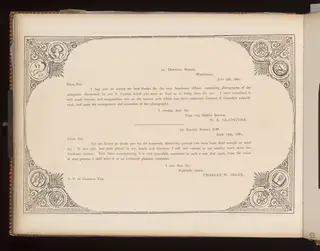
Photographs: Lawrence-Cesnola album, Wellcome Collection, London (Public domain)
Connections
5 peopleSales, gifts & bequests
- Received from Alessandro (Alexander) Palma di CesnolaprobablyCesnola, apparently Alessandro, gave Gladstone a Greek metrical epitaph from Salamis in 1882; it is kept at Hawarden. Tatton-Brown 1989, p. 861882–1884
- Received from Luigi Palma di CesnolaCesnola gave Gladstone the funerary inscription, which remained at Hawarden Castle. Masson 1996, p. 26
Scholarship
- Corresponded with Luigi Palma di CesnolaAntiquities of Cyprus; Cesnola collection Reid, T. Wemyss (Thomas Wemyss), 1842-1905, The life of William Ewart Gladstone (1899); Harper's New Monthly Magazine 1880-06: Vol 61 Iss 361 (1880); Luca Bombardieri; Elisa Panero, Cyprus: Crossroads of Civilizations (2021), p. 461872–1893
- Corresponded with Alessandro (Alexander) Palma di CesnolaManuscriptsAlessandro corresponded with the politician William Gladstone. Tatton-Brown 1989, p. 86
- Corresponded with Max Ohnefalsch-Richterdisputedalleged lobbying about the Ottoman antiquities law and founding of a Cyprus Museum R. S. Merrillees, 2005, Towards a fuller history of the Cyprus Museum, p. 14
Colleagues & contacts
- Connected with John Murrayintroduction of Cesnola to Murray Olivier Masson, L. Palma di Cesnola, H. Schliemann et l'éditeur John Murray (1994), p. 81874–1876
- Connected with Luigi Palma di CesnolaContemporary Review article 1874; Collezione Cesnola Olivier Masson, L. Palma di Cesnola, H. Schliemann et l'éditeur John Murray (1994), p. 8; Il Carroccio. The Italian review, Rivista di coltura, propaganda e difesa italiana in America1874–1876
- Helped Luigi Palma di CesnolaGladstone put Cesnola in contact with Murray. Masson 1994, p. 81876
- Worked with Alessandro (Alexander) Palma di CesnolaSalaminia (Cyprus) The Athenaeum 1885-07-11: Iss 30111885
- Worked with Max Ohnefalsch-RichterVictoria Daily Times (1893-07-10) (1893)1893
- Connected with W. PeekpossiblyPhileas epigram (Peek GVI 842): Peek's edition of a stone that Cesnola gave to Gladstone; no direct contact with Gladstone is attested O. Masson, 1996, Les deux collections Cesnola: quelques compléments, p. 25
Objects
Salamis funerary epigram for Phileas (Corpus no. 192; Peek GV 842)
From Salamisby 1884
Mentioned in
10 mentionsDocuments · 4
- L. Palma di Cesnola, H. Schliemann et l'éditeur John Murray
Helped · 1876 · p. 8
Gladstone put Cesnola in contact with Murray.
Masson 1994
- La dispersion des antiquités chypriotes: les deux collections Cesnola
1996
received a funerary inscription
Masson 1996
- Cyprus: Crossroads of Civilizations
Bombardieri & Panero 2021
- Towards a fuller history of the Cyprus Museum
Merrillees 2005
On Ancient Cyprus · 1
- People · 5listed under Connections
- Archivelisted under In the Archive
Sources
- 1.Olivier Masson (1996). “La dispersion des antiquités chypriotes: les deux collections Cesnola”. Cahiers du Centre d'Études Chypriotes 25, 3-32. Online
- 2.Robert Stuart Merrillees (2005). “Towards a fuller history of the Cyprus Museum”. Cahiers du Centre d'Études Chypriotes 35, 191-214. Online
- 3.Olivier Masson (1994). “L. Palma di Cesnola, H. Schliemann et l'éditeur John Murray”. Cahiers du Centre d'Études Chypriotes 21, 7-14.
- 4.Alessandro Palma di Cesnola (1887). Salamina (Cipro): storia, tesori e antichità di Salamina nell'isola di Cipro.
- 5.T. Wemyss Reid (ed.) (1899). The Life of William Ewart Gladstone.
- 6.Cyprus in the 19th Century AD: Fact, Fancy and Fiction. Papers of the 22nd British Museum Classical Colloquium.
- 7.Government of Cyprus (1895). The Cyprus Gazette.
- 8.A. G. Marangou (ed.) (2000). The Consul Luigi Palma di Cesnola 1832-1904: Life and Deeds.
- 9.British Association for the Advancement of Science (1875). Report of the Forty-Fourth Meeting of the British Association for the Advancement of Science, held at Belfast in August 1874.
- 10.W. E. Gladstone (1876). Homeric Synchronism: An Enquiry into the Time and Place of Homer. Macmillan.
- 11.David Soren (ed.). The Sanctuary of Apollo Hylates at Kourion, Cyprus. The University of Arizona Press.
- 12.Olivier Masson. “[Paper on the Cesnola brothers' archives and collections]”. Cyprus and the East Mediterranean in the Iron Age: proceedings of the seventh British Museum Classical Colloquium.
- 13.A. P. di Cesnola (1881). Lawrence-Cesnola Collection. Cyprus Antiquities excavated by Major Alexander Palma di Cesnola, 1876 to 1879. London, W. Holmes & Son.
- 14.L. Bombardieri (ed.), E. Panero (ed.) (2021). Cyprus: Crossroads of Civilizations. Turin.
- 15.Alexander Palma di Cesnola (1884). Salaminia (Cyprus): The History, Treasures, and Antiquities of Salamis in the Island of Cyprus. London, Whiting and Company.
- 16.Max Ohnefalsch-Richter (1893). Kypros, the Bible and Homer. London, Asher & Co..
- 17.Olivier Masson (1994). “L. Palma di Cesnola, H. Schliemann et l'éditeur John Murray”. Cahiers du Centre d'Études Chypriotes 21, 7-14.
- 18.V. Tatton-Brown (ed.) (1989). Cyprus and the East Mediterranean in the Iron Age: Proceedings of the Seventh British Museum Classical Colloquium, April 1988. London, British Museum Publications.
- 19.Masson 1996, 'Les deux collections Cesnola: quelques compléments', CCEC 25.
- 20.Alexander Palma di Cesnola, Salaminia (Cyprus): The History, Treasures, & Antiquities of Salamis in the Island of Cyprus (second edition) (1884).
- 21.Olivier Masson, 1994, L. Palma di Cesnola, H. Schliemann et l'éditeur John Murray.
- 22.R. S. Merrillees, 2005, Towards a fuller history of the Cyprus Museum.
- 23.Reid, T. Wemyss (Thomas Wemyss), 1842-1905, The life of William Ewart Gladstone (1899).
- 24.Victoria Daily Times (1893-07-10) (1893).
- 25.Harper's New Monthly Magazine 1880-06: Vol 61 Iss 361 (1880).
- 26.Luca Bombardieri; Elisa Panero, Cyprus: Crossroads of Civilizations (2021).
- 27.Olivier Masson, L. Palma di Cesnola, H. Schliemann et l'éditeur John Murray (1994).
- 28.Il Carroccio. The Italian review, Rivista di coltura.
- 29.The Athenaeum 1885-07-11: Iss 3011.
- 30.Masson 1996, "La dispersion des antiquités chypriotes: les deux collections Cesnola", CCEC 25.
- 31.V. Tatton-Brown, 1989, Cyprus and the East Mediterranean in the Iron Age: Proceedings of the Seventh British Museum Classical Colloquium, April 1988.
- 32.Olivier Masson, 1996, La dispersion des antiquités chypriotes: les deux collections Cesnola.
- 33.Anna G. Marangou, 2000, The Consul Luigi Palma di Cesnola 1832-1904: Life and Deeds(p. 233); Anna G. Marangou, 2000, The Consul Luigi Palma di Cesnola 1832-1904: Life and Deeds(p. 277); Anna G. Marangou, 2000, The Consul Luigi Palma di Cesnola 1832-1904: Life and Deeds(p. 288).
- 34.O. Masson, 1996, Les deux collections Cesnola: quelques compléments.
Corrections and additions
Did you know this person?
We would like to hear from relatives, colleagues and anyone who knows more about this person's life and work.
Missing from this record
- Dates of birth and death unknown
- No photograph
We would like to hear about
- Dates and places of birth and death
- Other spellings or names they used
- Photographs, letters or papers
- Their work, collections or excavations
- A mistake in what we say
If this page is about you, write to us and we will correct it or take it down. Tell us if you would like to be thanked by name on the page.