
Contents
A strainer is any vessel with deliberate perforations that let liquid through and hold solids back. On this site it is one of the nine basic shapes, and the bucket is deliberately wide: it takes in jugs with a perforated plate inside the spout, jars with a pierced disc across the mouth, shallow bowls with holes in the floor, funnels, and the bronze strainers that accompanied Iron Age wine sets. Desmond Morris counted three forms in Cypriot pottery, one appearing in the Late Bronze Age and two running through the Iron Age [1, p. 76], and Einar Gjerstad traced the Iron Age strainer and the side-spouted strainer jug to Syro-Palestinian models [3, p. 180]. Between those two statements lies the whole history of the shape on the island, together with an unresolved argument about what was being strained.
Definition and Morris's three forms
Morris's list is the clearest starting point. "The first appears in the Late Bronze Age, where it is referred to as a 'Side-spouted Strainer in Tankard Form' by Astrom (1972). In this case, the perforations are in the flat top of the vessel, suggesting that something was squeezed down onto the strainer and the juice which collected inside it was then poured out of the side-spout. A second form consists of a shallow bowl with holes in the lower, central region. A third takes the form of a jug with a perforated plate inside the spout" [1, p. 76; 2]. The three are mechanically different. In the first the strainer is the lid and the vessel receives what passes through it; in the second the bowl is the strainer and the liquid passes out of it; in the third the strainer sits at the outlet and filters the vessel's contents on the way out. Only the third is a pouring vessel in the ordinary sense, which is why the strainer jug is usually catalogued among jugs in museum typologies and why the site's separate bucket exists: the perforations, not the body, are what the shape is about.
Bronze Age strainers: Black Slip and Base Ring
The earliest strainer Morris could show is a Middle Bronze Age handmade Black Slip jug, round-based, 19 cm high, with a disc at the top of the round spout "perforated by three holes" and minor incisions on handle and shoulders (DM-HBS-10) [1, p. 76]. The strainer plate sits in the mouth rather than in a side-spout, and it belongs to the family of thin-walled dark-slipped wares that grew out of late Red Polished at the end of the Middle Cypriot period.
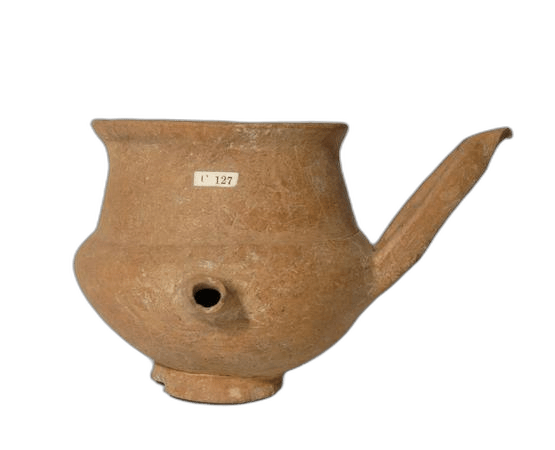
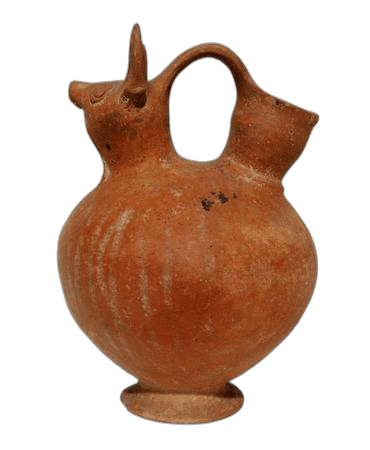
The Late Bronze Age form is the Base Ring ware strainer jar that Paul Åström named. The British Museum's example (1898,1201.111) shows the type exactly as Morris described it: a Base Ring I jar with an ovoid-piriform body on a ring base, a cylindrical upper body, "a perforated disc across the mouth with a large central opening for straining the contents," a short tubular spout at the shoulder and a wishbone handle /artifact/3737-base-ring-strainer-jar. The same museum holds a Base Ring strainer flask (1938,0413.1) with two spouts joined by a basket handle, one in the form of a bull's head and the other a wide cylinder containing a perforated disc /artifact/3892-base-ring-strainer-flask, which puts the strainer in the company of the zoomorphic and complex vessels of the period. The Ashmolean's Red Polished funnel with a basket handle (AN1888.666) is the simplest possible strainer, a cone with a hole, and is assigned to the Bronze Age on ware alone. The British Museum's Red Polished III funnel (1884,1210.70), a hemispherical body 17.5 cm high with a spout at the base, is catalogued as Middle Cypriot I to II.
The twelfth-century strainer jug
The side-spouted strainer jug of Aegean type, Furumark's shape FS 155, is one of the diagnostic vessels of the twelfth century BCE in the eastern Mediterranean. Jeremy Rutter observes that although the form was produced early on the Greek mainland it "never seems to have caught on there, and it appears to have been altogether absent from Crete," whereas "on Cyprus, in Philistia, and in the southeastern Aegean, the strainer jug became extremely popular during the twelfth century B.C." [4]. The Cypriot examples belong to the wheelmade White Painted Wheelmade III ware of Late Cypriot IIIA, the locally made Aegean-style pottery whose arrival is discussed under Mycenaeans and the Late Bronze Age; the same shape then continues without a break into Proto-White Painted. Trude Dothan, tracing the Philistine version, noted that "as in Cyprus, where strainer-spout jugs continue to appear throughout the periods of Proto-White Painted down to Cypro-Geometric I-II," the Palestinian potters absorbed the form into their own repertoire in several variations through the Iron Age [5, p. 171]. The Philistine Bichrome connection is one of the clearer cases of a Cypriot shape travelling with its decoration.
Rutter's explanation of the geography is the origin of the "beer jug" debate. Wine was the preferred drink in the Aegean, and "no drinking vessel with a built-in filter was in regular demand"; in the Levant the strainer jug "is often referred to as a 'beer jug,' because the multiple small perforations at the base of the spout performed the task of a filter by keeping the barley kernels floating in the liquid out of the drinker's mouth" [4]. On that argument Cyprus and Philistia drank something with solids in it. The counter-arguments are set out in the Oriental Institute's catalogue of its Levantine strainer jug: the beer reading rests partly on the biblical picture of the Philistines as great drinkers, and other scholars have proposed draining the dregs from wine, or use "as a watering can, pitcher, or 'teapot' for straining the leaves from hot beverages" [7]. No residue analysis of a Cypriot strainer jug has been published, so the Cypriot side of the question is open.
Iron Age strainer jugs and bowls
In Gjerstad's Cypro-Geometric catalogue the strainer jug appears among the spout-jugs of White Painted I, with the tubular spout on the shoulder and often a basket handle, and a Cypro-Geometric III novelty places the handle opposite the spout [3, pp. 44, 47]. He counted both the strainer and "the side-spouted jug with open strainer" among the shapes of Syro-Palestinian origin in the Iron Age repertoire, alongside the bowl on three loop legs and the lentoid two-handled bottle [3, p. 180]. The Swedish expedition's tombs at Amathus supplied two Cypro-Geometric strainer jugs now in the Medelhavsmuseet, Stockholm: a White Painted II strainer jug from Tomb 10, 18.8 cm high (A. 010:026), and a Bichrome II strainer jug from Tomb 19, 24 cm high (A. 019:016). A White Painted I jug in the Pierides Foundation Museum is typical: ovoid body on a base-ring, cylindrical neck with a mid-ridge, out-curved rim, flat handle from neck-ridge to shoulder, and "tubular spout with strainer on the shoulder," 24.8 cm high, painted with horizontal bands and three chequered triangles on the shoulder [6, p. 146]. Morris's two wheelmade White Painted strainer jugs (DM-WWP-179, 14.1 cm, and DM-WWP-178, 15.8 cm) have a ring base, a round spout and a cutaway side-spout with a disc at its base pierced by three and six holes respectively, and he compares the second to Gjerstad's Figure XIII no. 19 [1, p. 76]. The form passed into Black-on-Red: Morris's Black-on-Red strainer jug (DM-BOR-21) has four holes and, on the neck below the spout, a modelled human face with painted eyes, eyebrows and lips, "converting the strainer-jug into a 'vessel-shaped figure'" [1, p. 76]. The Cesnola collection includes a Cypro-Archaic I barrel-shaped jug with a strainer decorated with birds, and a Black-on-Red II jug with strainer spout, which show the form surviving into the Archaic Bichrome and Black-on-Red workshops.
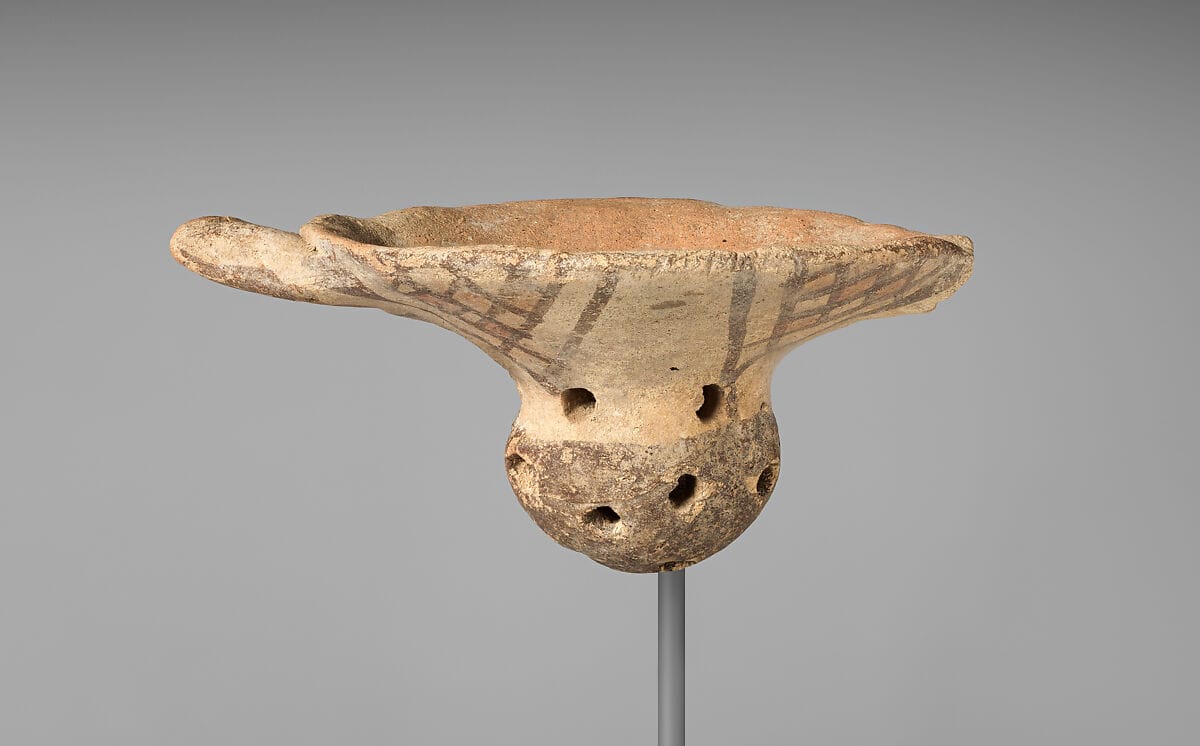
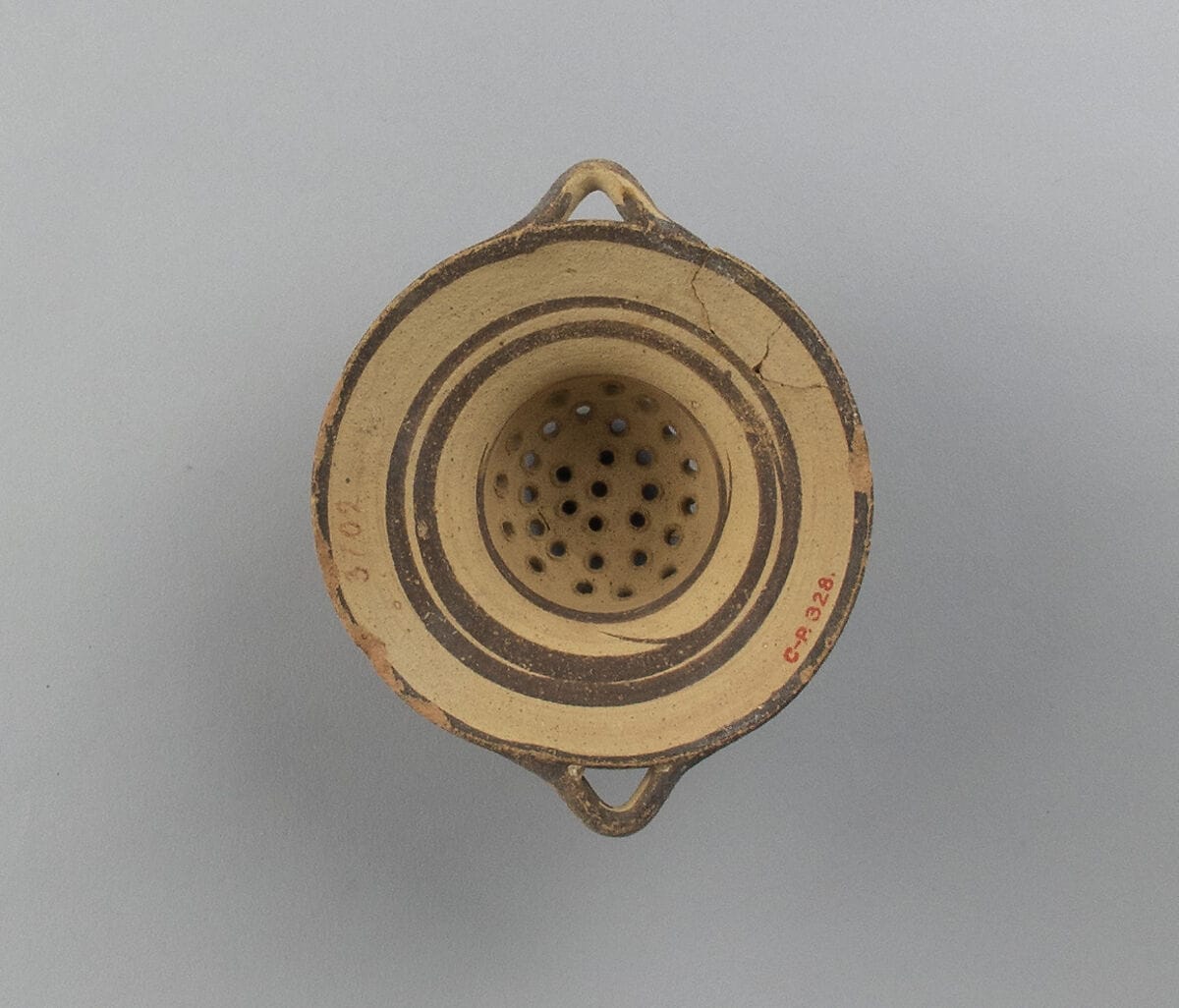
The strainer bowl, Morris's second form, is represented in New York by a Cypro-Geometric I strainer with two handles and painted bands, 5.7 cm high and 12.4 cm across (Met 74.51.477), and by further strainers of Iron Age date (Met 74.51.471, 74.51.472; a Late Iron Age example, 74.51.5611); two limestone strainers (Met 74.51.5152, 74.51.5153) show the same tool in stone. Strainer dishes and bowls are also displayed in the Pierides Museum, the Larnaca District Museum and the Kourion Museum. A shallow bowl pierced in the floor is a sieve rather than a filter, and its uses (curds, olives, honey, the washing of grain) need not have anything to do with drink.
Bronze strainers and the wine set
By the Cypro-Geometric period the strainer had a metal form and a fixed social setting. The excavators of Palaepaphos-Skales write that bronze strainers "are very common in Cyprus, particularly in Cypro-Geometric I and Cypro-Archaic tombs of warriors at Palaepaphos," that "they formed part of wine sets, used during symposia, where both eating and drinking took place," that "in some cases they appear also in clay," and that they usually have two handles but occur with one or three; they are equally common in the Levant [8, Tomb 199]. This is the strongest functional evidence for any Cypriot strainer, and it points to wine, not beer. Whether the same is true of the twelfth-century clay strainer jugs three centuries earlier is exactly what the beer-jug debate disputes. The bronze strainers, ladles and bowls of these tombs are the set within which the Iron Age dipper also belongs.
Function and find contexts
Cypriot strainers are known from tombs and from a few settlements, and their functional interpretation depends on which of Morris's three forms is in question. The Base Ring strainer jar with its lidded perforated top is the one form for which a process (pressing or squeezing something onto the strainer and drawing off the liquid through the side-spout) can be read from the vessel itself [1, p. 76]. The strainer jug filters on the way out, and its association with Levantine and Philistine drinking practice is the basis of the beer reading [4; 5]. The bronze strainers of the Palaepaphos warrior tombs are wine equipment by every contextual indicator [8]. The perforated bowls are sieves whose contents are unknown. Across all four, the pattern of publication is the same: shape and association are well recorded, and chemistry is absent.
Named examples
| Vessel | Ware and date | Collection and number | Notes |
|---|---|---|---|
| Strainer jug, round spout with 3-holed disc | Handmade Black Slip, Middle Cypriot | Desmond Morris collection DM-HBS-10 | H 19 cm |
| Side-spouted strainer jar with perforated disc across mouth | Base Ring I, Late Cypriot | British Museum 1898,1201.111 | Wishbone handle, tubular shoulder spout |
| Strainer flask with bull-head spout and strainer spout | Base Ring, Late Cypriot | British Museum 1938,0413.1 | Two spouts joined by basket handle |
| Spout-jug with strainer on shoulder | White Painted I, Cypro-Geometric I | Pierides Foundation Museum, Larnaca | H 24.8 cm |
| Strainer jugs with cutaway side-spout, 3 and 6 holes | Wheelmade White Painted, Iron Age | Desmond Morris collection DM-WWP-179, DM-WWP-178 | H 14.1 cm, 15.8 cm |
| Strainer jug with modelled human face | Black-on-Red, Iron Age | Desmond Morris collection DM-BOR-21 | 4 holes |
| Strainer bowl with two handles | Cypro-Geometric I (?) | Metropolitan Museum of Art 74.51.477 | H 5.7 cm, D 12.4 cm |
| Strainers | Iron Age | Metropolitan Museum of Art 74.51.471, 74.51.472, 74.51.5611 | |
| Limestone strainers | Metropolitan Museum of Art 74.51.5152, 74.51.5153 | ||
| Bronze strainers in warrior tombs | Cypro-Geometric I to Cypro-Archaic | Palaepaphos-Skales excavations | Part of wine sets with bowls and ladles |
Summary
The Cypriot strainer is three shapes sharing one feature. The Base Ring strainer jar of the Late Bronze Age is a lidded press; the strainer jug, arriving with the Aegean-style pottery of the twelfth century and taken up in White Painted, Bichrome and Black-on-Red, is a filtering pourer that Cyprus shared with Philistia and the Levant; and the perforated bowl is a sieve. Gjerstad's view that the Iron Age forms are Syro-Palestinian in origin and Rutter's view that the twelfth-century strainer jug marks a difference in drink between the Aegean and the eastern Mediterranean are compatible, and both remain untested by residue work on Cypriot material. The bronze strainers of the Palaepaphos warrior tombs show where the shape ended up: in the wine set of the Cypro-Geometric and Archaic elite.
Objects on this page
References
- 1.Morris, D. (1985). The Art of Ancient Cyprus, with a Check-list of the Author's Collection. Oxford: Phaidon.
- 2.Åström, P. (1972). The Late Cypriote Bronze Age: Architecture and Pottery. The Swedish Cyprus Expedition, Vol. IV, Part 1C. Lund: The Swedish Cyprus Expedition.
- 3.Gjerstad, E. (1948). The Swedish Cyprus Expedition, Vol. IV, Part 2: The Cypro-Geometric, Cypro-Archaic and Cypro-Classical Periods. Stockholm: The Swedish Cyprus Expedition.
- 4.Rutter, J. B. (2006). Neopalatial and later Minoan pottery. In J. W. Shaw & M. C. Shaw (Eds.), Kommos V: The Monumental Minoan Buildings at Kommos. Princeton: Princeton University Press.
- 5.Dothan, T. (1982). The Philistines and Their Material Culture. Jerusalem: Israel Exploration Society.
- 6.Karageorghis, V. (1985). Ancient Cypriote Art in the Pierides Foundation Museum. Larnaca: Pierides Foundation.
- 7.Novacek, G. V. (2011). Ancient Israel: Highlights from the Collections of the Oriental Institute, University of Chicago. Chicago: Oriental Institute Museum.
- 8.Karageorghis, V., & Raptou, E. (2016). Palaepaphos-Skales: Tombs of the Late Cypriote IIIB and Cypro-Geometric Periods (Excavations of 2008 and 2011). Nicosia: The Cyprus Institute.