
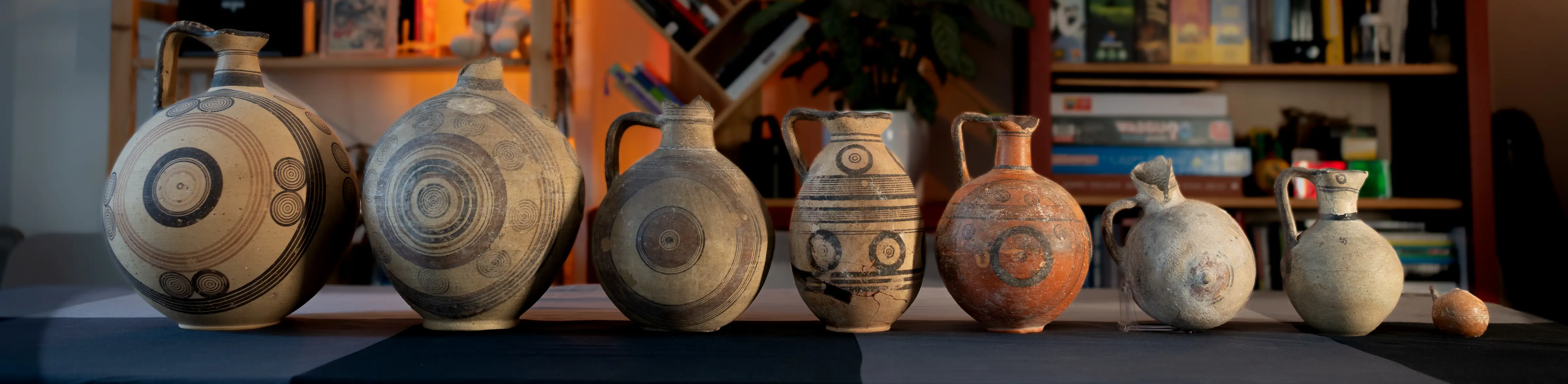
Red-on-White (RW) ware is the painted pottery that defines the Cypriot Chalcolithic. The recipe is simple: a pale, chalky body or slip carrying patterns in matt red to brown paint. The ware first appears in small quantities during the Ceramic Neolithic of the fifth millennium BCE, beside the combed and monochrome red wares of the Sotira culture, and it becomes the dominant decorated pottery of the island between about 3900 and 2800 BCE, at Erimi, Lemba-Lakkous, Kissonerga-Mosphilia and Souskiou. Porphyrios Dikaios identified it at Erimi in the 1930s and treated it as the hallmark of the period he was the first to call Chalcolithic [1]. Edgar Peltenburg's Lemba Archaeological Project, from 1976, supplied the stratified sequences that turned Dikaios's single-site typology into an island-wide chronology [2], and Diane Bolger's stylistic analysis gave the ware its internal phasing [3]. Because painted sherds are easy to see on a ploughed field, Red-on-White scatter has long been the primary criterion by which Chalcolithic sites are recognised in survey [4].
Definition and identification
The ware is defined by decoration and surface, not by shape. Dikaios's description of the Sotira material still serves: the surface "is either smoothed to resemble a slip or is covered with a thin buff slip on which the pattern is painted in red and later burnished" [5, p. 197]. The paint is a matt iron-red that fires anywhere from orange to dark brown, and burnishing after painting gives the better pieces a soft sheen. On a fresh break the fabric is yellow-buff and organic-tempered, often with a grey core where a short, low-temperature open firing failed to oxidise the wall through.
Petrography explains the pale ground. Boness, Clarke and Goren, working on 88 Ceramic Neolithic vessels from seven sites, found that potters ran a two-clay system: iron-rich, non-calcareous clays from the Troodos foothills for coarse and burnished monochrome wares, and calcareous marls (chiefly of the Pakhna formation) for the painted and combed wares, chosen because they fire to a light colour against which red paint reads clearly [6]. The "white" of Red-on-White is therefore often the fired marl itself, a self-slip, rather than a separately applied coat. Where a true white slip was added it is chalky and prone to flaking; the same team recorded firing temperatures below 750 °C for the whole assemblage, which is why the paint and slip on many sherds can be scratched with a fingernail [6].
At Erimi, Dikaios distinguished two Red-on-White fabrics, a fine white one and a coarser, darker one, with three qualities of slip, and observed that the coarser fabric dominated the upper, later levels [1, p. 28]. Bolger later pointed out that the composition of the red itself has never been properly analysed, so it remains uncertain whether what excavators call "paint" is a mineral pigment with a binder or simply a fine iron-rich clay slip applied with a brush [3]. Macroscopic examination favours the clay-slip reading, and the question is still open.
A practical warning for anyone handling sherds: the plain, unpainted parts of a Red-on-White vessel are indistinguishable from the "Plain White" sherds that Dikaios listed as a separate ware. Peltenburg argued that most such pieces are simply the undecorated background of painted pots and should be counted with them [13, p. 18].
From the comb to the brush: the Neolithic antecedents
Red-on-White was not invented in the Chalcolithic. At Sotira-Teppes, the type-site of the Ceramic Neolithic above the Kouris valley, Dikaios listed nine wares, of which only two carried real decoration: Combed ware, made by dragging a toothed tool through a wet red slip to expose the pale body beneath, and Red-on-White, made by painting red patterns onto the pale body [5, p. 188]. He presented them as an evolutionary chain. Combed ware came first; broad combed bands divided the pot into panels; a hybrid "red-on-white-and-combed" ware then painted the bands rather than slipping the whole pot before combing them; and finally the potter dropped the comb altogether and painted freely, producing the ware "which later formed the main characteristic of the following cultural stage, that of Erimi" [5, p. 195]. At Sotira, painted decoration is rare, roughly 4 per cent of the pottery once the hybrid is included, against more than 80 per cent monochrome and combed [8; 13, p. 18]. It becomes regular only at the end of Phase II and through Phase III, and by Phase IV sherds with chequerboard and filled-lozenge patterns already "usher in the style of the following cultural stage" [5, pp. 199–200].
The picture in the north was different. At Ayios Epiktitos-Vrysi on the Kyrenia coast, excavated by Peltenburg between 1969 and 1973, almost all the pottery is painted and combing never exceeds 5 per cent [9, p. 66]. Peltenburg drew the conclusion that painted and combed wares were regional preferences within one culture, not successive periods as Dikaios had supposed [9]. The Vrysi sequence also shows the painted style changing through its Early, Middle and Late phases: broad, tactile, curvilinear designs give way to thinner lines, angular motifs and a crowded field, and the Middle phase introduces both combing and "rippling", a multiple-brush technique that reproduces in positive what combing does in negative [12, pp. 101–103]. A group of nine Red-on-White sherds from Vrysi, given by Peltenburg to the Hunterian Museum in Glasgow, shows exactly this Neolithic vocabulary of wavy lines and broad bands (vessel fragments, Hunterian GLAHM:D.1972.2).
Two further points matter for dating. Red-on-White also occurs in the uppermost levels at Khirokitia, but this pottery belongs to a Ceramic Neolithic reoccupation of the abandoned aceramic village, not to the famous pre-pottery settlement; Dikaios himself, once radiocarbon dates arrived, attributed it to "squatters who established themselves among the ruins" [11; 5, p. 230]. And Joanne Clarke has argued that the coastal Red-on-White villages of the north were probably settled slightly earlier than the inland combed-ware villages of the south, so that the north-south stylistic divide is partly a time-transgressive gradient of pottery adoption rather than a purely synchronic regionalism [10, pp. 33, 140].
Chronology: Broad Line, Close Line, and the end of painting
The internal chronology of Red-on-White rests on Peltenburg's distinction between a Broad Line style and a Close Line style, which Bolger called "currently the only guide to the differentiation of stages in the evolution of the painted style" [3, pp. 83–84]. Broad Line pottery carries thick, loosely spaced strokes with large areas of solid red; it characterises the Late Neolithic and lingers into the Early Chalcolithic. Close Line pottery carries narrow, closely set parallel lines, often laid down with a multiple brush, so that the reserved pale ground rather than the paint dominates the composition; it is the style of the Middle Chalcolithic floruit. The two are separated by many centuries of development and do not occur together at the same site [3]. This stylistic axis must be kept apart from the north-south regional axis of the Neolithic; "Broad Line" is a period, not a place.
The absolute framework comes from the Lemba Archaeological Project and the Vasilikos Valley Project rather than from Erimi itself, which Dikaios dug before radiocarbon. Calibration opened a gap of about six centuries between the Sotira culture and Erimi, which is filled by a poorly visible Early Chalcolithic phase of timber and pit sites such as Kalavasos-Ayious and Kissonerga-Mylouthkia Period 2 [13, pp. 17–20]. At Kissonerga-Mosphilia, Period 2 pits produced over 30,000 sherds dominated by a Glossy Burnished ware, with Red-on-White still a minor component; painted pottery then rises through Period 3 to its Close Line climax in Period 3B, around 3200 to 2900 BCE [2]. At Lemba-Lakkous, a well-preserved Black Topped ware in the earliest deposits is succeeded by Red-on-White in Period 2, a sequence that allowed Peltenburg to detect a missing horizon at Kissonerga [2, p. 24]. Dikaios's own observation at Erimi, that painted pottery increases upward through the deposit while the plain red wares decline, fits this frame: the site spans the later Early and the Middle Chalcolithic [1; 13, pp. 19–20].
| Phase | Approximate dates (cal BCE) | Painted pottery | Type contexts |
|---|---|---|---|
| Late Neolithic (Sotira culture) | c. 4500 to 3900 | Broad Line Red-on-White, a few per cent in the south, dominant in the north | Sotira-Teppes, Ayios Epiktitos-Vrysi, Klepini-Troulli, Khirokitia reoccupation |
| Early Chalcolithic | c. 3900 to 3500 | Glossy Burnished ware, then early Red-on-White; first multiple-brush lattice | Kalavasos-Ayious, Kissonerga-Mylouthkia 2, Kissonerga-Mosphilia 2 |
| Middle Chalcolithic | c. 3500 to 2800 | Close Line Red-on-White at its peak; regional schools | Erimi, Lemba 1 and 2, Kissonerga-Mosphilia 3, Souskiou |
| Late Chalcolithic | c. 2800/2700 to 2400 | Red-on-White declines; Red and Black Stroke-Burnished and Coarse Painted jars dominate | Kissonerga-Mosphilia 4, Chlorakas-Palloures, Ambelikou-Ayios Georghios |
| Philia | c. 2400 | Red-on-White gone; Red Polished (Philia) replaces it | Kissonerga-Mosphilia 5 |
The end of the ware is as clear as its beginning. In the Late Chalcolithic the painted koine collapses and a monochrome tradition takes over: in the south-west the thin-walled, hard-fired Red and Black Stroke-Burnished ware, deliberately bicoloured by differential firing, together with coarse painted storage jars up to a metre tall and Anatolian-inspired spouted forms [14, p. 113; 2]. Peltenburg read this as "a substantial transformation in pottery technology", possibly signalling production above the household level [15]. By the Philia phase, around 2400 BCE, the incoming Red Polished (Philia) ware had replaced the whole Chalcolithic repertoire, and painting on a pale ground would not return to Cyprus until the White Painted wares of the Bronze Age, which are separated from Red-on-White by several centuries of monochrome pottery [16].
Shapes and painted grammar
Red-on-White was applied to a limited range of open and closed forms. The commonest are hemispherical bowls ("hemibowls"), deep bowls, and bowls with a tubular spout at the rim, followed by flasks and bottles with a globular body and cylindrical neck, holemouth jars, and, in the Middle and Late Chalcolithic, large storage jars [2; 3]. The shapes descend from Neolithic ones; the Cyprus Museum guide tradition, going back to Dikaios, holds that the bottles copy vessels of skin or gourd. Painted decoration is usually concentrated on the exterior of bowls and the shoulder and neck of closed vessels, though the interiors of open bowls are frequently painted too.
The motif vocabulary is geometric and dense. Lattice, chequerboard, filled and chained lozenges, zigzags, groups of parallel and converging bands, and rows of concentric rings recur across the island. In the Close Line style these are executed in fine multiple-brush strokes that give the surface a textile-like quality. A bowl lent by the Cyprus Museum to the Metropolitan Museum of Art, excavated at Kissonerga in 1984, is a representative Middle Chalcolithic hemibowl with a lattice band under the rim (terracotta bowl, Met L.2000.12.2).
Bolger's 1991 study applied a structural analysis, borrowed from linguistics, to whole vessels from Erimi, Lemba and Kissonerga-Mosphilia. She counted 29 design elements at Erimi, 25 at Lemba and 26 at Mosphilia, and found that the structural links between Erimi and Mosphilia were stronger than either site's links with Lemba, even though Erimi lies far from both western sites [3, pp. 88–94]. Distance, in other words, does not predict stylistic similarity; she inferred localised centres of production and "perhaps the result of increased craft specialization". Each site had a signature. At Erimi no single motif dominates and static and dynamic elements are combined on one vessel; at Mosphilia lattice is everywhere; at Lemba the style is minimalist, with much of the pot left blank [3, pp. 93–94].
Painting also spread to objects that were not pots. The building model KM 1446 from Kissonerga-Mosphilia, found in the Unit 1015 pit deposit of Period 3B packed with some fifty figurines and small objects, is a Red-on-White vessel in the form of a roundhouse, its walls and door painted in the same lattice and band grammar as the bowls [2]. Several of the pottery figurines in that deposit, including the birthing figure KM 1451, are painted in the same technique, so the ware supplies the colour scheme of the island's best-known Chalcolithic ritual assemblage; the stone cruciform figurines of the period are a separate, unpainted class.
Sites and contexts
Erimi-Pamboula, on a terrace above the Kouris river, is the type-site. Dikaios dug it in 1933 to 1935 and published it in 1936; the deep stratified deposit showed painted pottery rising through the levels, and the first copper objects appeared in the upper layers, which is why he called the culture Chalcolithic at all [1]. His attempt to trace the development of the ware within one site remained the standard study for half a century, but Erimi has no radiocarbon dates of its own and its levels are not phases in the modern sense.
Lemba-Lakkous, near the west coast north of Paphos, was excavated by Peltenburg from 1976 to 1983. Building 1, a large roundhouse about 6 m in diameter standing apart on the terrace edge, contained large quantities of Red-on-White storage jars, bowls and flasks together with a cache of stone axes and the limestone figure now known as the Lemba Lady, found "lying between large vessels" [14, p. 118]. The association of the painted ware with storage in a distinctive building is one of the few contexts that says something about how the pots were used rather than how they were decorated.
Kissonerga-Mosphilia, 1 km away, gives the longest sequence, from a Late Neolithic Period 1 through five periods to the Philia phase, and its Period 3B is the reference assemblage for Close Line Red-on-White [2]. At Souskiou, in the Dhiarizos valley, the ware occurs in the extramural cemeteries of Vathyrkakas and Laona, the only Chalcolithic burial grounds of their kind, where painted bowls and flasks accompany the picrolite cruciform pendants for which the site is famous [14]. In the south-central region, the Vasilikos Valley Project's Kalavasos-Ayious documents the Early Chalcolithic beginnings of the painted koine, and Kalavasos-Pamboules its Middle Chalcolithic development [13; 10]. Survey has added dozens of smaller scatters across the Paphos uplands, the Ktima lowlands and the Kyrenia district, almost all identified from Red-on-White sherds alone [4].
Debates
Four arguments run through the literature.
The first is classification. Dikaios's ware system, built under the influence of the Swedish Cyprus Expedition's Montelian typology, treated each ware as a bounded package of fabric, finish and shape. Peltenburg showed that Dikaios applied his own criteria inconsistently, that the Chalcolithic monochrome nomenclature (Red Slip, Red Lustrous, Red Monochrome, Red Monochrome Painted) had become "no less than dizzying", and that fabric types cut across shape and finish [7, pp. 27–37]. Douglas Baird proposed recording fabric, surface, shape and decoration as independent attributes; Bolger and others lumped the monochromes into a single Red Monochrome Painted class. Red-on-White survives this critique better than most, because painted decoration is a real and visible choice, but the counting problem noted above (plain sherds of painted pots) means published percentages of the ware are systematically too low.
The second is continuity across the Neolithic-Chalcolithic threshold. Trevor Watkins argued for "a fairly sharp cultural discontinuity" between Sotira and Erimi, treating the handful of combed sherds in the deepest Erimi levels as too slight to prove anything [13, pp. 16–20]. Dikaios, Catling and Peltenburg argued the opposite, and Clarke's renewed excavations at Kalavasos-Kokkinoyia, where combed ware occurs together with Early Chalcolithic burnished wares, now support a continuous transition in which "new ways of making and decorating pottery" coexisted for a time with the old [10, p. 44].
The third is the origin of painting itself. Dikaios thought combing gave the initial impetus to painting by "freeing" the potter from the monotony of the comb [3, p. 84]. Later excavation showed that combing and early Red-on-White were broadly contemporary, closely related but not sequential, so the neat chain of comb to hybrid to brush is better read as a description of technique than as a history.
The fourth is what the Middle Chalcolithic regional schools mean. Bolger's finding that stylistic similarity does not track distance implies that potters were not simply copying their neighbours; she connected the localised styles to growing household competition and craft specialisation in the mature Chalcolithic, an argument developed by Steel and by Peltenburg's model of a society that repeatedly resisted complexity [3, p. 94; 14, p. 113; 15]. The alternative, that the differences reflect sample size and the redeposition of earlier sherds in later contexts, has been raised by Clarke for the Neolithic and applies equally here [10, pp. 32–33].
Conclusion
Red-on-White ware is the longest-lived decorated pottery of prehistoric Cyprus, running from the Sotira villages of the later fifth millennium to the last painted jars of the Late Chalcolithic around 2500 BCE. It is a low-fired, hand-built, household product whose one technical sophistication was the choice of a pale-firing marl to carry the red. Its usefulness to archaeologists lies in that visibility: painted sherds mark Chalcolithic sites in survey, the Broad Line to Close Line shift dates deposits, and the collapse of painting in favour of burnished monochrome marks the approach of the Bronze Age. What the ware cannot do is speak for the Neolithic north, where it was already dominant a millennium before Erimi, or for the Bronze Age, whose painted wares owe it nothing direct. The next steps in its study are analytical rather than typological: a characterisation of the red pigment, and the fabric-led approaches that Clarke and Bolger have applied to the Neolithic and the Late Chalcolithic, extended to the Close Line assemblages of Erimi, Lemba and Kissonerga themselves [16; 3].
References
- 1.Dikaios, P. (1936). The excavations at Erimi, 1933–1935: Final report. *Report of the Department of Antiquities, Cyprus 1936*, 1–81.
- 2.Peltenburg, E. (1991). Kissonerga-Mosphilia: A major Chalcolithic site in Cyprus. *Bulletin of the American Schools of Oriental Research*, *282/283*, 17–35.
- 3.Bolger, D. L. (1991). The evolution of the Chalcolithic painted style. *Bulletin of the American Schools of Oriental Research*, *282/283*, 81–93.
- 4.Catling, H. W. (1966). *Cyprus in the Neolithic and Bronze Age periods* (Cambridge Ancient History, rev. ed., fasc. 43). Cambridge University Press.
- 5.Dikaios, P. (1961). *Sotira: A Neolithic settlement in Cyprus*. University Museum, University of Pennsylvania.
- 6.Boness, D., Clarke, J., & Goren, Y. (2015). Ceramic Neolithic pottery in Cyprus: Origin, technology and possible implications for social structure and identity. *Levant*, *47*(3), 233–254.
- 7.Barlow, J. A., Bolger, D. L., & Kling, B. (Eds.). (1991). *Cypriot ceramics: Reading the prehistoric record* (University Museum Monograph 74). University Museum, University of Pennsylvania.
- 8.Stanley Price, N. P. (1979). *Early prehistoric settlement in Cyprus: A review and gazetteer of sites, c. 6500–3000 B.C.* (BAR International Series 65). British Archaeological Reports.
- 9.Peltenburg, E. J. (1978). The Sotira culture: Regional diversity and cultural unity in Late Neolithic Cyprus. *Levant*, *10*(1), 55–74.
- 10.Clarke, J., McCartney, C., & Wasse, A. (2007). *On the margins of Southwest Asia: Cyprus during the 6th to 4th millennia BC*. Oxbow Books.
- 11.Dikaios, P. (1953). *Khirokitia: Final report on the excavation of a Neolithic settlement in Cyprus on behalf of the Department of Antiquities, 1936–1946*. Oxford University Press.
- 12.Peltenburg, E. J. (1982). *Vrysi: A subterranean settlement in Cyprus. Excavations at prehistoric Ayios Epiktitos Vrysi 1969–73*. Aris & Phillips.
- 13.Reade, J. (Ed.). (1981). *Chalcolithic Cyprus and western Asia* (British Museum Occasional Paper 26). British Museum.
- 14.Steel, L. (2004). *Cyprus before history: From the earliest settlers to the end of the Bronze Age*. Duckworth.
- 15.Peltenburg, E. (1993). Settlement discontinuity and resistance to complexity in Cyprus, ca. 4500–2500 B.C.E. *Bulletin of the American Schools of Oriental Research*, *292*, 9–23.
- 16.Bolger, D. (2007). Cultural interaction in 3rd millennium B.C. Cyprus: Evidence of ceramics. In S. Antoniadou & A. Pace (Eds.), *Mediterranean crossroads* (pp. 162–186). Pierides Foundation.