
Contents
On a group of small Cypriot juglets and aryballoi of the eighth and seventh centuries BC, painters drew sets of vertical wavy lines on the shoulder and often finished them with a tight curl, so that each line runs down in waves and ends in a hook. "Wavy hooks" is this site's name for that ending. It is not a term used in the literature. Giorgos Bourogiannis, writing on the Rhodian pottery that copied these juglets, speaks of "wavy lines ending in spirals" and "wavy lines with hooked spirals" [1]. Frank Stubbings, cataloguing Late Bronze Age imports, used "hooked spirals" for a related Mycenaean design [2, p. 50]. This entry keeps the site's label as a heading and uses the scholars' terms in the text. It covers three separate episodes that share the device, and it does not claim that one grew out of another.
Identifying the motif
The unit is a wavy line with a terminal curl. Without the curl it is an ordinary wavy line; if the waves sharpen into angles it becomes a zig-zag. Bourogiannis describes the Cypriot and Rhodian versions as "vertical sets of wavy lines that may end in spiral hooks", painted with multiple brushes beside encircling lines, small concentric circles and zigzags [1]. The word "may" matters: the hook is optional, and on some vessels of the class the wavy lines simply stop.
Two other patterns look similar at a glance. A running spiral is a chain of joined spirals with no free wavy stem; Stubbings keeps it apart from the hooked spiral when he describes a kylix from Enkomi Tomb 69 "with a running spiral round the bowl" [2, p. 50]. A running wave is a continuous horizontal band whose crests roll over into curls, the pattern an auction house called a "wave-pattern" on a large plate now in the Drakopoulos collection [5]. The hooked wavy line proper is usually vertical, set in a group, and each line ends on its own.
Hooked spirals on Mycenaean pottery in Cyprus
The earliest Cypriot find with the device in the sources used here is an import. In his survey of the first Mycenaean pottery to reach Cyprus, Stubbings singled out "the pyxis from Enkomi Tomb 3, which has hooked spirals on the sides and shoulder", and found its closest parallels in three pyxides from Ialysos on Rhodes and one from Prosymna in the Argolid [2, p. 50]. He placed this first group at the very end of the Mycenaean II period and judged it too scarce to suggest local manufacture [2, p. 50].
On the piriform jars of the same early horizon he made a sharper observation: the shape and its net pattern were "about equally common in Greece itself and in Rhodes", but "the decoration of hooked spirals, however, seems more peculiar to Rhodes" [2, p. 51]. He still concluded that none of the early types was peculiar to either the Argolid or Rhodes, and argued only that Rhodes, lying farther east, must have been involved in any eastward trade from Greece to Cyprus and Syria [2, p. 51]. The hooked spiral therefore leans towards Rhodes in his account without proving a Rhodian source for the pottery at Enkomi in the Late Bronze Age. The wider context of that trade is covered under Mycenaean contacts. The Drakopoulos collection holds a Mycenaean-style jar, catalogued as Aegean work said to have been found in Cyprus, which illustrates Mycenaean pottery in Cyprus more generally; its decoration is outside the scope of this entry.
White Painted IV juglets and the Spaghetti ware of Rhodes
The best-documented use of the hooked wavy line is Cypriot and belongs to the Cypro-Archaic I period. Bourogiannis states that "the decorative and morphological roots of Spaghetti-style ware are securely traced on Cyprus and more specifically among White Painted IV products of the Cypro-Archaic I period (750-600 BC)", and that Cypriot White Painted vessels "decorated with encircling lines, concentric circles and wavy lines with hooked spirals include ridge-necked juglets, small aryballoi and also other shapes such as oinochoai" [1]. The hook is the feature, he notes, "that gave the class its English name" [1], Spaghetti ware.
Two Rhodian pieces at Lund, both bought on Rhodes without recorded provenance, show the scheme as it was copied. Juglet LA 61, 9.4 cm high and of the early seventh century BC, has a zigzag below the neck ridge and, on the shoulder, "concentric circles alternating with vertical wavy lines ending in spirals"; aryballos LA 63, 6.1 cm high, has "four groups of vertical wavy lines ending in spirals on shoulder" [1]. Nicholas Salmon gives a slightly different account of the name: the aryballoi are named after the "typically Cypriot combination of small concentric circles and vertical wavy lines, sometimes united in a single 'spaghetti-like' ornament" [3]. The two descriptions are compatible. Bourogiannis stresses the hook at the end of the line, Salmon the join between line and circle.
For the Cypriot shape, a small handle-ridge jug with concentric circles in the Vassar College collection (CC48.265), catalogued as Cypriot of the eighth century BC, shows the ridged neck and circle decoration the Rhodian potters imitated; its record does not describe wavy lines.
Salmon divides the Rhodian aryballoi into three phases [3]:
| Phase | Shape | Date proposed by Salmon | Contexts cited |
|---|---|---|---|
| 1 | Globular, keeps the neck ridge of White Painted IV; a close, smaller copy of the Cypriot type | Tentatively c. 750 BC, from the upper limit of White Painted IV | Exochi grave K, with a juglet probably of White Painted IV; found only on Rhodes |
| 2 | Globular, squatter neck with no ridge | Last quarter of the 8th century to about the middle of the 7th | Kamiros, Patelles 45 (Late Geometric II); Exochi grave C; Ialysos, Drakidis 257 |
| 3 | More conical, flatter shoulder tapering sharply to the base | Mid to late 7th century, from associated Protocorinthian and Ionian pottery | Zambico 53 (with Protocorinthian aryballoi); Papatislures 14, with a North Ionian bird bowl of 630-610 BC |
Bourogiannis gives a similar arc in fewer words: the class appears on Rhodes around the end of the eighth century, is most popular in the first half of the seventh, and is out of fashion by the third quarter, replaced by Middle Protocorinthian aryballoi; it was exported to the south Aegean, Sicily and south Italy [1].
Where the ware was made
Both authors treat Rhodes as the home of the Spaghetti class, with Cyprus as its model. Bourogiannis notes that "more than one place of manufacture has been postulated" but concludes that Rhodes, at Ialysos and Kamiros, "must have been its primary place of origin", and that Cypriot White Painted IV originals reaching the island triggered the creation of the class [1]. Salmon takes the same view from the find distribution: the first-phase shape occurs only on Rhodes, which Knud Friis Johansen had already taken as evidence of local manufacture [3]. He summarises Bourogiannis's view that the class shows Cypriot influence on Rhodian pottery continuing after the Geometric period, despite a drop in Cypriot imports to the island, and adds that the same workshop produced a wider range of goods than the aryballoi alone [3].
The dating of the start is less settled than the table suggests. Salmon's c. 750 BC for phase 1 is expressly tentative and borrowed from the Cypriot series, because the graves lack other datable pottery [3]; Bourogiannis places the first Rhodian pieces around the end of the eighth century [1]. A reader should treat the half-century between those two figures as open.
A warning about "White Painted IV"
The label White Painted IV is used for two different Cypriot wares. The Iron Age White Painted IV that lies behind Spaghetti ware belongs to Cypro-Archaic I, 750 to 600 BC [1]. The Ashmolean Museum's White Painted IV juglet AN1896-1908.C.37, excavated by J. L. Myres at Kalopsida in 1894, is catalogued to Middle Cypriot III, about 1750 to 1650 BC. The two are a thousand years apart. Any source or dealer description that mentions White Painted IV with hooked wavy lines needs its period stated before it can be used; see the White Painted ware entry for the Bronze Age sequence and Middle Bronze Age for its date.
Hooks and waves on Bichrome
In the Cypro-Archaic Bichrome repertoire the hook turns up as a filling ornament. The catalogue of Ancient Cyprus: Cultures in Dialogue describes a Bichrome IV free-field jug in Brussels (A 1486) with "a hook below the handle" [4, cat. 232], a detail in the same spirit as the single floating motifs discussed under free-field art. The Drakopoulos free-field bird oinochoe belongs to the same broad family of Archaic jugs.
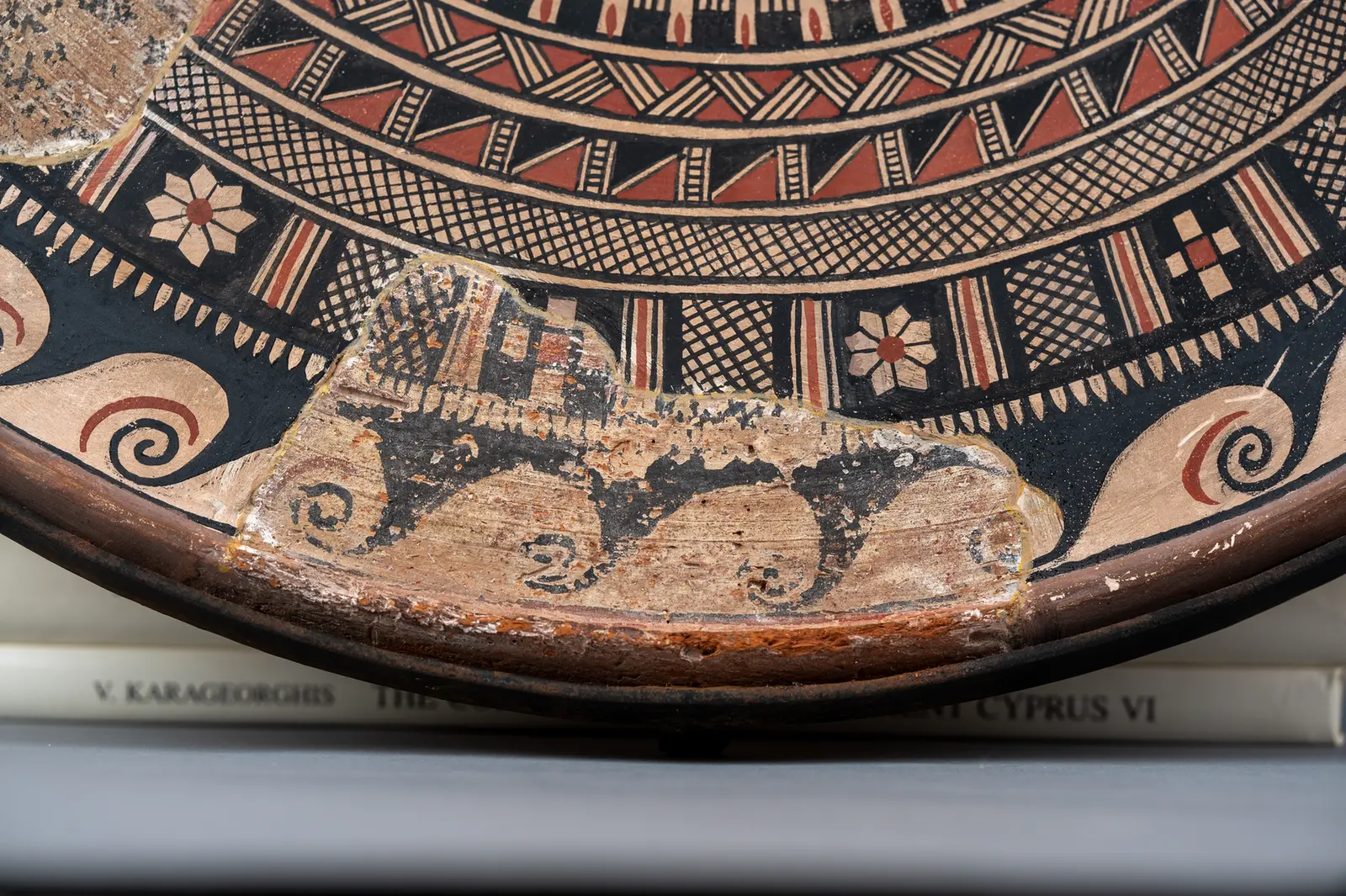
The large Archaic plate in the Drakopoulos collection (right, and at the top of this page) carries the horizontal version. Its rim frieze is a running wave in black and red whose crests curl over into spiral hooks, with bands of triangles, cross-hatching and rosettes inside. It needs to be read with care. When it was offered at TimeLine Auctions on 4 March 2025, the catalogue described a "wave-pattern in black and red" and recorded that the plate had been "repaired and partly restored with a fresh painted extension of the existing design", with an iron retaining rim with attachment lugs [5]. Part of the wave frieze visible in photographs is therefore modern paint, and only the original sectors are evidence for the ancient design. The lot was bought in [5]. As a dish with a continuous horizontal frieze it sits apart from the vertical hooked lines of the White Painted IV juglets, and there is no known connection between the two.
Incised hooks on Red Polished pottery
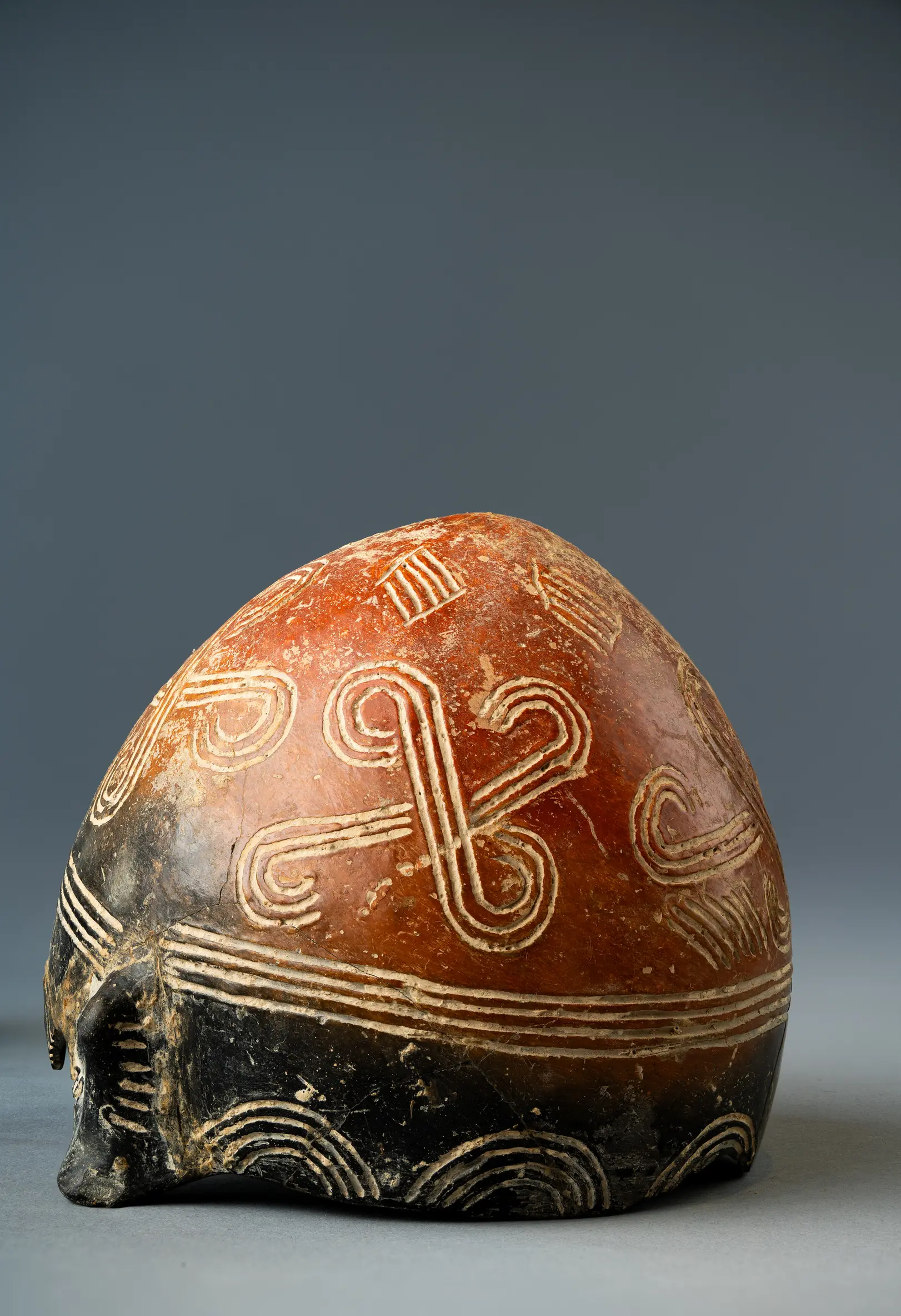
The Drakopoulos collection also has an Early Bronze Age example of hooked lines in a different technique. A Red Polished bowl, catalogued as an incised Red Polished bottle, is incised with S-shaped double spirals and hooked loops beside concentric circles and arcs. The lines are cut into the polished surface, not painted, and they belong to the Red Polished tradition of the Early Bronze Age, more than a thousand years before the Spaghetti juglets. We know of no published study of hooked incision on Red Polished ware, so the bowl is recorded here as an observation only.
Summary
The hooked wavy line appears in Cyprus in three unconnected settings. In the Late Bronze Age it arrives on imported Mycenaean pyxides and jars, such as the Enkomi Tomb 3 pyxis, where Stubbings thought the hooked spiral pointed to Rhodes [2, pp. 50-51]. In Cypro-Archaic I it is a Cypriot White Painted IV device on ridge-necked juglets and small aryballoi, and it was taken up on Rhodes as the defining mark of Spaghetti ware, made there from the late eighth century until Protocorinthian aryballoi replaced it [1], [3]. On Archaic Bichrome it survives as a free-field hook or, as a horizontal running wave, on plates such as the Drakopoulos example, whose frieze is partly restored [5]. For the plain line, see wavy lines; for the angular version, zig-zags; and for more pieces from the collection, the Drakopoulos collection page.
Objects on this page
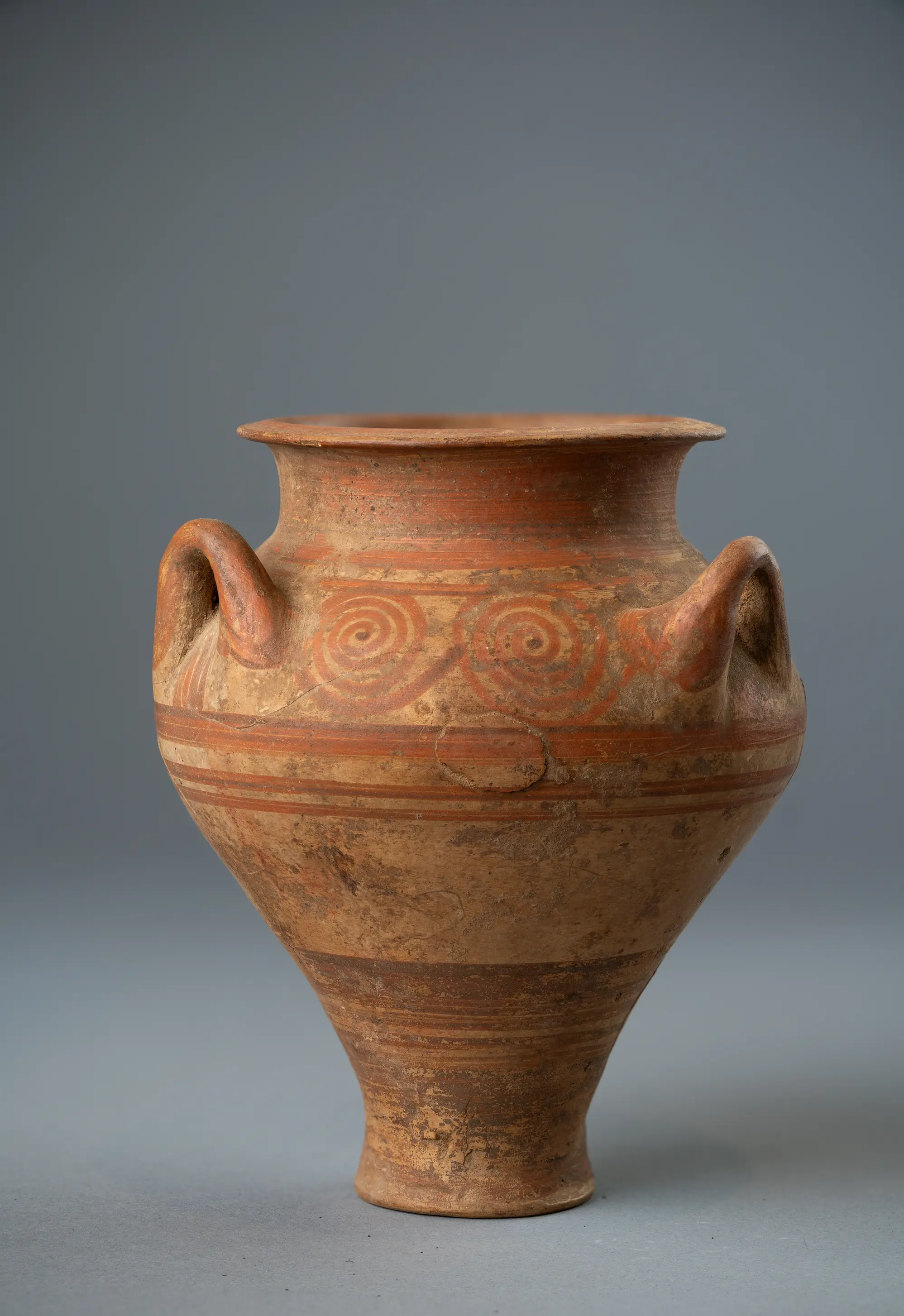 Cypriot Three-Handled Jar in the Mycenaean Style with Running SpiralsLate Bronze Age II · 1375–1300 BC
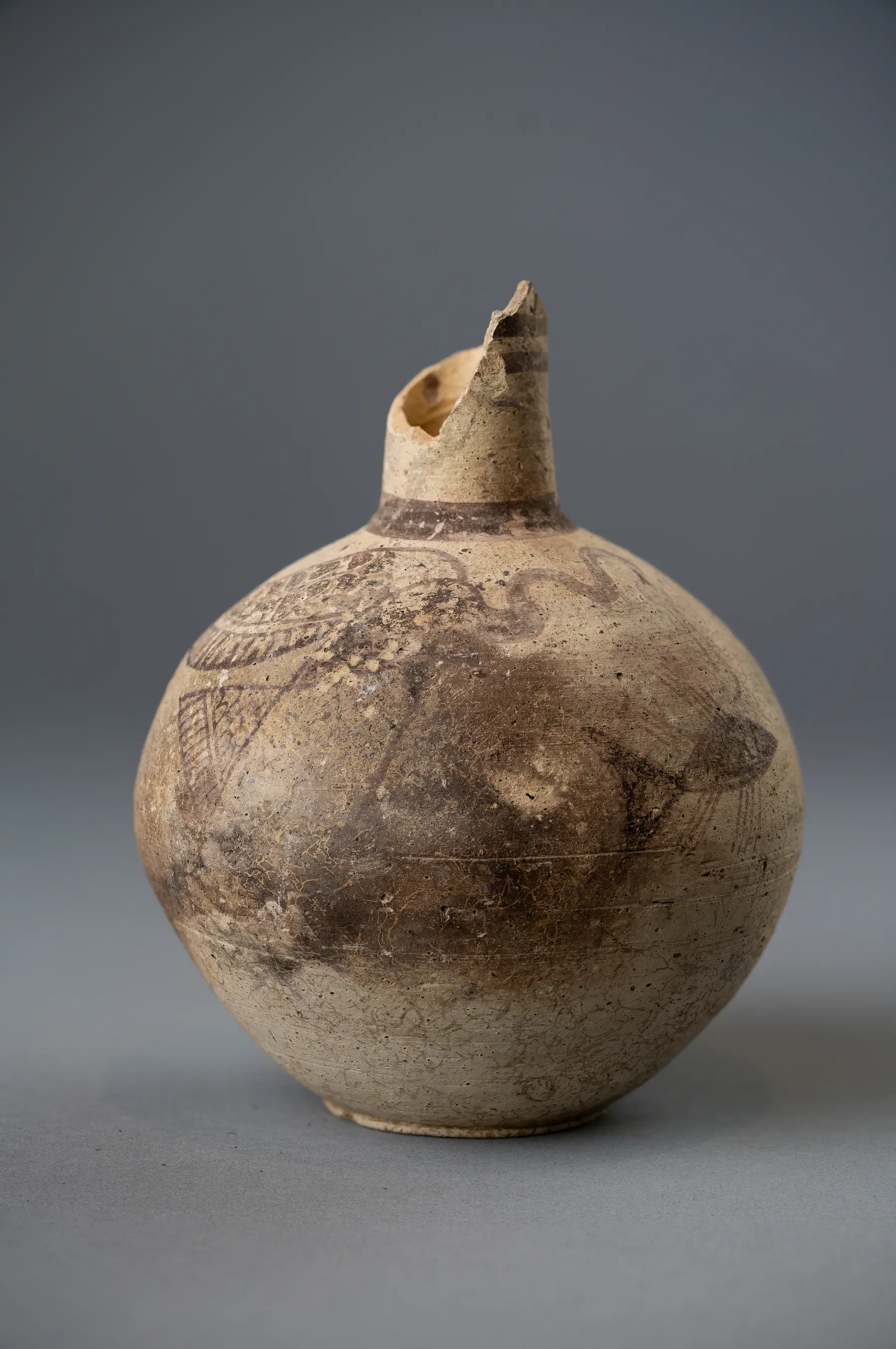 Bichrome IV Jug with a Waterfowl Catching a FishArchaic I · 750–600 BC
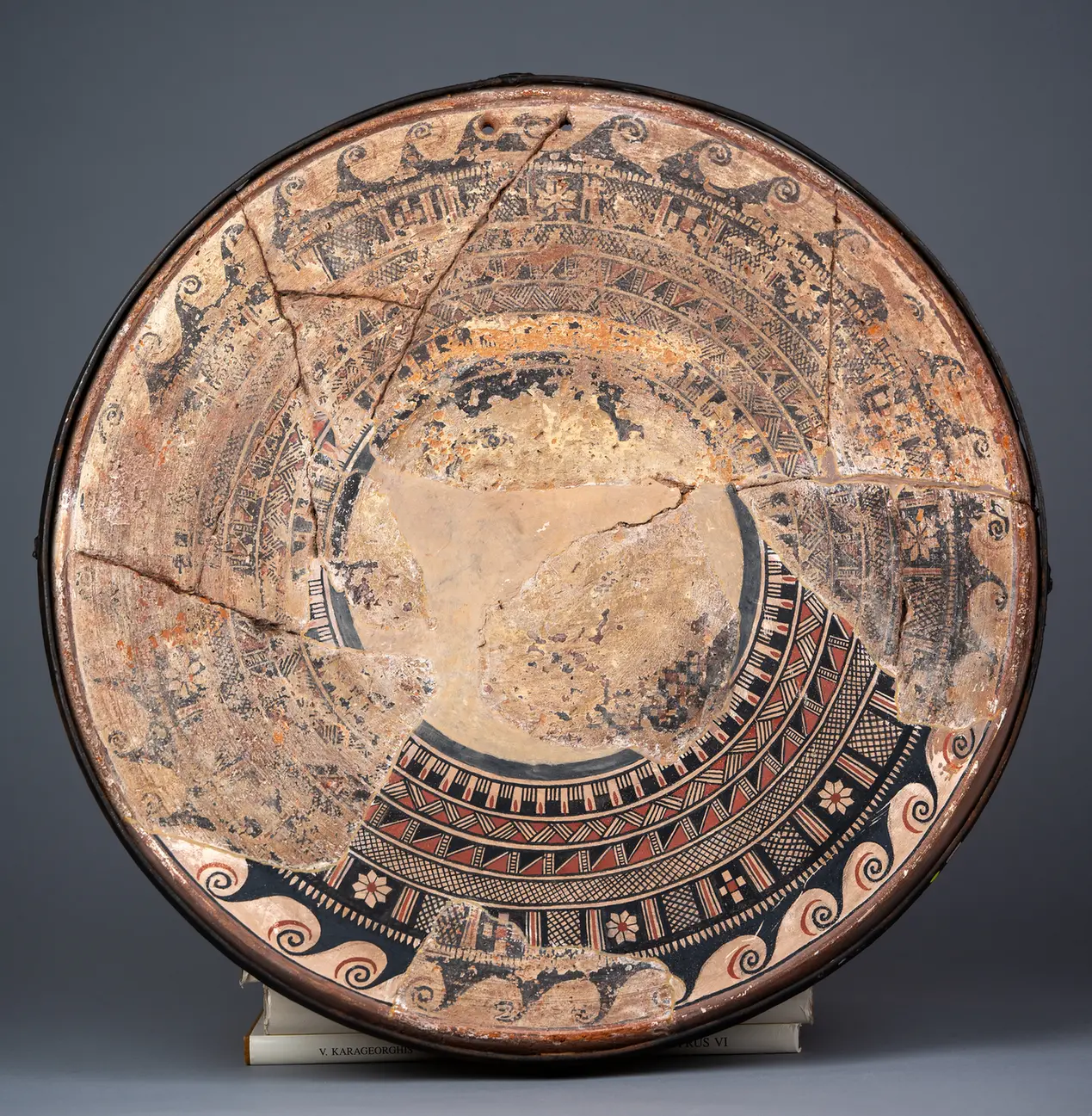 Large Bichrome Plate from Salamis with a Wave Band and Rosette MetopesArchaic I · 700–550 BC
- Black-topped Red Polished Tulip Bowl with Incised Spiral-armed Cross, Circles and ArcadesEarly Bronze Age II · 2300–2000 BC
References
- 1.Bourogiannis, G. (2019). Late Geometric, Subgeometric and Archaic pottery from Rhodes at Lund: A fresh look at some old finds. In S. Schierup (Ed.), Documenting ancient Rhodes: Archaeological expeditions and Rhodian antiquities (pp. 221-240). Aarhus University Press.
- 2.Stubbings, F. H. (1951). Mycenaean pottery from the Levant. Cambridge University Press.
- 3.Salmon, N. (2022). The ‘Spaghetti workshop’ of Rhodes: Cypriot inspirations, Rhodian alterations. In G. Bourogiannis (Ed.), Beyond Cyprus: Investigating Cypriot connectivity in the Mediterranean from the Late Bronze Age to the end of the Classical period (AURA Supplement 9). Athens University Review of Archaeology.
- 4.Pilides, D., & Papadimitriou, N. (Eds.). (2012). Ancient Cyprus: Cultures in dialogue. Department of Antiquities, Cyprus.
- 5.TimeLine Auctions. (2025, March 4). Lot 39: Large Cypriot plate with wave-pattern [Auction catalogue entry].