
Early Bronze Age II
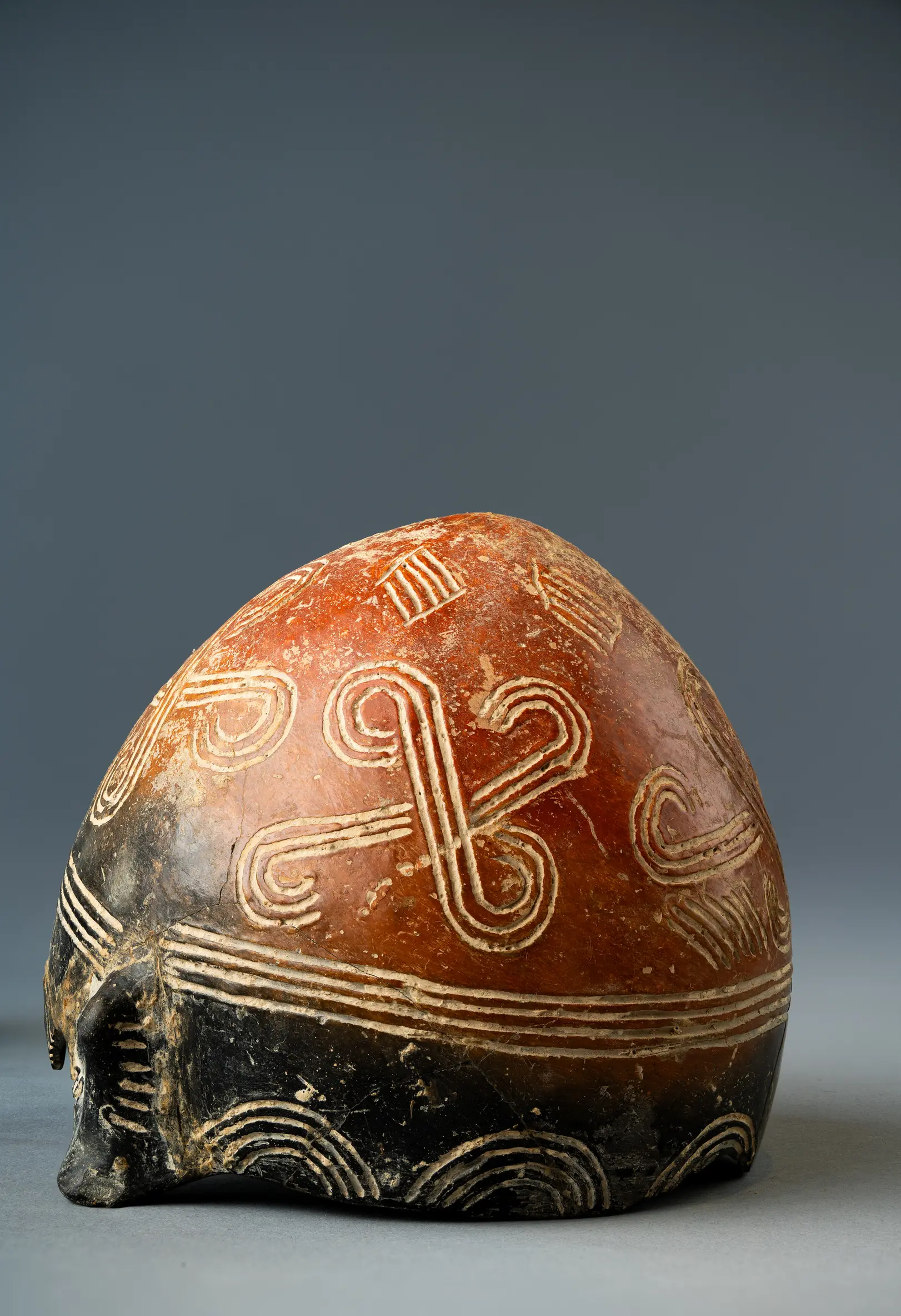
Black-topped Red Polished Tulip Bowl with Incised Spiral-armed Cross, Circles and Arcades
Early Cypriot black-topped Red Polished tulip bowl. It is incised with a spiral-armed hooked cross, ring-and-dot circles and an arcade of concentric semicircles.
Date
2300 - 2000 BC
Accession No.
BWL-BA-002
Collection
Alexis Drakopoulos
Provenance
- 1960s–2025, The Goodman Collection (acquired 1965–1969; photographed on slides in 1969)
- 2025–present, Alexis Drakopoulos, London
Early Cypriot I–II, c. 2300–2000 BCE · Red Polished ware, black-topped · Hand-made, incised, lime-filled
A deep tulip bowl with a pointed base, photographed resting on its rim. Lugs project sideways from the rim; the one best seen carries a column of short incised strokes. The decoration is laid out in zones. A band of four parallel lines runs round the body a short way above the rim. Below it, on the black rim zone, stands an arcade of concentric semicircles, three arcs to each. Above it, on a body that is black near the band and burnished red towards the base, the potter drew a large cross whose four double-line arms bend and coil into spirals, flanked by small ring-and-dot circles, spiral hooks and a few groups of short parallel strokes near the base. The lime fill is bright on the red zone. The black zone is worn and dusted with burial deposit, and a hairline crack crosses the red body.
Commentary
The deep ovoid body, pointed base and black-topped firing place this bowl among the Red Polished tulip bowls, Stewart's Class XIII B [1]. Its layout, with a lined band dividing a black rim zone from a red body, is close to British Museum 1939,0217.6 from Bellapais-Vounous, a black-topped tulip bowl with opposed convex rim lugs and white-filled incision, dated by the museum to about 2300–2100 BCE [2]. Two Vounous tulip bowls in Cambridge supply the motifs: 1951.1082 M combines horizontal lines with semicircles, and 1951.1099 B has circles and crosses on a body that is red below and black above [3]. Concentric circles are among the commonest Red Polished patterns at Vounous [4]. The date here, Early Cypriot I–II, c. 2300–2000 BCE, rests on these parallels. The bowl is later than the Philia phase, whose pottery has sparser incision and flat bases.
The cross is the unusual element. It has four arms, each drawn as a double line that turns at the end and coils into a spiral of two or three turns, so that in some views it reads as two interlocking S-curves. The form is often called a swastika, and this bowl is the subject of a separate essay on this site about that motif. Hooked crosses and coiled spirals are uncommon in the Red Polished repertoire, which is built mainly from concentric circles and semicircles, zigzags, hatched bands and lozenges. Spirals do occur, however: incised spirals decorate the hilt of a Red Polished model knife from Vounous Tomb 51, now in the Louvre, and Karageorghis took the recurrence of such motifs as a sign of a single Vounous workshop tradition [5]. Resemblances to hooked crosses in the Aegean or Anatolia are possible, but we know of no evidence that the motif carried the same meaning in Cyprus.
Technique follows the usual Red Polished sequence. The design was incised into leather-hard clay, the surface slipped and burnished, and the white paste pressed into the grooves after firing [6]. The black rim and interior come from firing the bowl upside down in ash or fuel. Webb and Frankel interpret tulip bowls as individual drinking cups [7]; what this one held is unknown. Its find-place is unrecorded.
The bowl was in the Goodman Collection by 1969, when it was photographed on slides.
References
- 1.Stewart, J.R. (1962) The Early Cypriote Bronze Age. In The Swedish Cyprus Expedition IV.1A. Lund: Swedish Cyprus Expedition, Index of Types, pp. 303–348 (Class XIII B).
- 2.British Museum, London, 1939,0217.6. Red Polished black-topped tulip bowl, Bellapais-Vounous, Early Cypriot I. Collection record.
- 3.Museum of Archaeology and Anthropology, Cambridge, 1951.1082 M and 1951.1099 B. Red Polished tulip bowls, Bellapais-Vounous. Collection records.
- 4.Dikaios, P. (1940) The Excavations at Vounous-Bellapais in Cyprus, 1931–2. Archaeologia 88, pp. 130–132.
- 5.Karageorghis, V. (1991) The Coroplastic Art of Ancient Cyprus I: Chalcolithic–Late Cypriot I. Nicosia: A.G. Leventis Foundation, models of knives, cat. Hb.6 (Louvre AO 17590) and commentary on class H.
- 6.Coleman, J.E., Barlow, J.A., Mogelonsky, M.K. and Schaar, K.W. (1996) Alambra: A Middle Bronze Age Settlement in Cyprus. SIMA 118. Jonsered: Paul Åströms Förlag, p. 298.
- 7.Webb, J.M. and Frankel, D. (2013) Cultural Regionalism and Divergent Social Trajectories in Early Bronze Age Cyprus. American Journal of Archaeology 117, pp. 59–81, p. 65.
More from the Catalogue
Browse related objects
Bichrome Kylix with Bird Free Field Art
Geometric III
Milk bowl
Bronze Age
Bowl
Geometric III
Krater
Archaic I
Handle of a bowl
Bronze Age
Bowl
Geometric I
Bowl
Bronze Age
Terracotta bowl
Chalcolithic
Silver bowl
Archaic I
Alabaster bowl
Classical
Bronze phiale (libation bowl)
Archaic II
Bowl fragment, inscribed
Archaic II
Bowl
Bronze Age
Bowl
Archaic I
Bowl
Late Bronze Age II
Bowl
Geometric III
Terracotta footed bowl
Archaic I
Marble bowl fragment with Phoenician inscription
Classical