
Contents
Almost no ancient Cypriot furniture survives. What the island does preserve, in large numbers, is furniture in miniature and in outline: pisé benches built into house walls, clay models of stools and enclosures, chairs and tables engraved on cylinder seals, and votive thrones carved in limestone. The one place where full-sized pieces come out of the ground is the royal necropolis of Salamis, and even there the wood had gone and the shapes had to be rebuilt from the metal and ivory that once covered them. This entry follows the evidence from the Neolithic to the end of the Cypro-Archaic period (c. 480 BCE), period by period, and marks where the labels "chair", "throne", "table" and "cradle" rest on interpretation. It belongs with the daily life hub and the entries on architecture and food and diet.
A history told in representations
The main study is Maro Theodossiadou's doctoral thesis, "Furniture and its Representations in Cyprus, from the Chalcolithic to the Archaic periods", written under J. N. Coldstream and still unpublished [1, p. 249 n. 1]. Her published summary opens with the problem in one sentence: "The study of furniture in Cyprus is actually a study of representations of furniture because three dimensional models, or their representations in other media, pre-date pieces of actual furniture by at least eight centuries" [1, p. 249]. The earliest models she counts come from Kissonerga-Mosphilia in the Middle Chalcolithic, around 3000 BCE. The earliest surviving pieces are "three bronze tables from Enkomi and Sinda" of Late Cypriot III, in the twelfth century BCE, and after them "an ivory bed, an ivory chair, a wooden silver-studded chair and a matching footstool" from the Archaic necropolis of Salamis, which she places at the end of Cypro-Archaic II, around 700 BCE [1, p. 249].
Across roughly 2,300 years, from the Chalcolithic to the Archaic, Theodossiadou found that "no more than ten pieces of actual furniture have survived, while as many as 313 representations have so far been found" [1, p. 249]. Her breakdown by period is below. The four period figures add up to 285, not 313; the published summary does not explain the difference, and the thesis that would is not in print.
| Period | Representations counted | Media |
|---|---|---|
| Chalcolithic | 6 | Clay models |
| Early and Middle Cypriot | 65 | All clay models |
| Late Cypriot | 122 (98 of them on cylinder seals) | Clay, bronze, painting on vases, seal engraving |
| Cypro-Geometric and Cypro-Archaic | 92 | Clay, stone, ivory, painting on vases, incision on bronze vessels, a few conoid seals and scarabs |
| Total stated | 313 | The four rows above sum to 285 |
Source: Theodossiadou 1995 [1, p. 251].
The unevenness of these numbers reflects the evidence more than the furniture: the Late Bronze Age looks rich because cylinder seals were in fashion, and the Early and Middle Bronze Age are known only through what potters chose to model in clay. Almost every piece of furniture we can see belongs to a special setting: a tomb, a sanctuary, a seal, a ritual scene. Ordinary household furniture is most visible in the Neolithic, when it was built from the same mud and stone as the house.
Neolithic: benches and platforms built into the house
In the round houses ("tholoi") of Khirokitia, the furniture was part of the architecture. Among the hearth types Porphyrios Dikaios defined there, his Type VI is a hearth "with adjoining platform": the fire sits on a small pisé base "attached to a larger and slightly higher platform also of pisé, which is flanked by low pisé partitions and extends to the inner face of the circular wall" [2, p. 233]. Dikaios read the larger platform as a seat by day and a bed by night: "The larger platform would probably have been used for sitting by the fire when it was lit, and at night as a bed" [2, p. 233]. He recorded four examples, in tholos X (two different floors), tholos XV and tholos XXII, two from his early period and two from his middle one. The bed is his inference from the shape and position of the platform; nothing found on it proves the use. His Type V hearth is a rectangular platform 0.20 m high with the centre paved by a thin limestone slab, and in tholos XLVII it was built over an earlier burial [2, p. 233].
At Sotira, the Ceramic Neolithic village Dikaios excavated, the fixtures are more varied and he gave them their own heading, "platforms or benches" [3, p. 163]. In House 2, Floor II, a raised platform of mud and stones stood north of the hearth, 1.20 m long, 60 cm wide and 30 cm high, with a slab and a quern still in place at its east end; Dikaios thought people sat on it to warm themselves at the fire. Benches ran along the walls of several houses: 1.60 m long in House 4 and House 12, 3 m long and 90 cm wide against the east wall of House 5, 1.30 m in House 24 with "two seats along its south face". In House 35 a bench beside the querns was "probably used as a seat during grinding", and in House 13 a platform 2 m long carried a pit-hearth [3, p. 163].
Dikaios also identified single seats: a cube of mud 30 by 27 by 17 cm on Floor II of House 1, and a low raised patch of mud in House 2 where someone knelt or sat to grind. Paved areas did double duty. The one near the hearth in House 1 "may mean that the paved area was used as table space for meals", while a paved area in the grinding compartment of House 2 served as a seat; single slabs set into floors propped querns or gave a hard working surface [3, p. 163]. None of this is movable, and all of it is read from position and size. What it does show is that a Neolithic household in the south of the island organised its floor space around two activities, keeping a fire and grinding grain, and built seating where those happened.
Chalcolithic: the first furniture models
The oldest free-standing furniture in Cypriot art is a seat, and it comes from a ritual deposit. In the ceremonial area at Kissonerga-Mosphilia, a pit held "a cache of nineteen figurines, a model stool, an intact triton shell, and twenty-seven stone tools", most of them packed inside a clay model of a building with a pivoting door, a central hearth, radial floor partitions and painted walls [4, p. 15]. The catalogue essay adds: "Three of the figures are seated on what must be regarded as birthing stools since one female figure has the head and arms of an emerging child painted on a panel inset between its legs" [4, p. 15]. The model stool itself is not described further in that account.
A second seated figure from the same site, KM 299, a surface find, is a Red-on-White terracotta of "a female figure seated on a four-legged stool" [5, p. 8]. The head and the two back legs of the stool are missing. The front legs are thick and cylindrical, widening towards the ground, and the woman's feet stop "well above the bottom of the legs of the stool, as though hanging in the air". With the stool the figure stands 11.4 cm high, and she wears a painted pendant that itself shows a seated figure with legs apart [5, p. 8]. The stool is a high four-legged seat, and its context (childbirth imagery, a ceremonial deposit) is the reason it was modelled at all. See Neolithic and Chalcolithic burial for the wider ritual setting, and the work of Edgar Peltenburg, who excavated the site.
Early and Middle Bronze Age: a bench, a backed seat and cradles
The best-known piece of Bronze Age furniture in Cyprus is a clay chair a few centimetres high. It sits inside the circular enclosure model from Bellapais-Vounous Tomb 22 (no. 26, Cyprus Museum), a bowl 37 cm across filled with modelled figures and animals [5, p. 140]. Several figures are "seated on a bench against the wall", among them a male "with folded arms" beside three more seated figures. Opposite them, as Vassos Karageorghis describes it in his catalogue of Cypriot terracottas, is "a large four-legged chair with a prominent back-rest consisting of three vertical flat bars and one horizontal bar". The man on it "wears a turban around his head and has perforated ears" and faces three poles modelled in relief [5, p. 140].
The same seat carries two labels in Karageorghis's own writing. In the Coroplastic Art catalogue it is a "chair" [5, p. 140]. In his general book on Cypriot archaeology it becomes a throne: "There is a figure seated on a throne, obviously the high priest or the chief of the community", with others "seated on benches to either side" [6, p. 49]. The object is the same; the second label carries an interpretation of the scene as a gathering under a single leader. A reader should also know that the model "was found in fragments and has been considerably restored". Karageorghis considered the overall composition "by no means conjectural; only the details of the figures are sometimes questioned" [5, p. 140]. For the tomb and the society behind it, see Vounous and Early Bronze Age burial and the article on Vounous.
Benches against a wall recur later in built form. Sjöqvist compared the Late Bronze Age sanctuary at Ayios Iakovos, a roughly circular area with "benches against the wall opposite" the entrance, to the Vounous model [5, p. 140].
The other furniture of the Early and Middle Bronze Age that clay preserves is the cradle. Hand-made White Painted models show an infant lying on a flat board with rounded corners and an arch over the head end; on some the lower half is thickened to show swaddling clothes, painted with lattice [5, pp. 173–174]. Examples include one in the Badisches Landesmuseum, Karlsruhe (inv. 66/111, 14.2 cm long) and one in the National Museum, Copenhagen (inv. 3715, 12 cm long), both without provenance [5, pp. 173–174]. Whether the boards show a real piece of nursery furniture, a burial board or a votive type is not settled by the models themselves; "cradle" is the catalogue's word and a reasonable one. Theodossiadou's 65 Early and Middle Cypriot representations are all clay models of this kind [1, p. 251]. For household context, see Early Bronze Age village life.
Late Bronze Age: furniture on seals
Cylinder seals reached Cyprus in Late Cypriot I, in the mid-sixteenth century BCE, were widespread by Late Cypriot IIC, and were replaced by conoid seals from Late Cypriot IIIA [1, p. 251]. What they were for is disputed (suggestions include amulets and jewellery), and many were in use for a long time before they were buried. They are also the largest single source for Late Bronze Age furniture, with 98 of Theodossiadou's 122 Late Cypriot representations [1, p. 251].
On a group of five cylinders she attributes to one engraver, Theodossiadou identifies two pieces of furniture she regards as specifically Cypriot, "a high back-rest chair" and "a four legged nest-stool", together with three kinds of table: a four-legged table with a rail framing the top, two tall three-legged tables, and a low table with crossed legs [1, p. 251]. The seals record forms that existed without telling us how common they were in houses.
The first surviving pieces fall at the very end of the period. Theodossiadou's "three bronze tables from Enkomi and Sinda" date to Late Cypriot III [1, p. 249]; this entry uses her label for them. Ivory is a separate question. The Late Cypriot II Tomb 11 at Enkomi, excavated by the Swedish Cyprus Expedition, produced ivory plaque fragments now in the Medelhavsmuseet (E. 011:276 and E. 011:279). The museum record does not say what the plaques belonged to, and we know of nothing published that shows Enkomi ivories decorated furniture, so they should not be called furniture inlays without that evidence.
Cypro-Archaic: the furniture of Salamis Tomb 79
The furniture Theodossiadou counts as surviving comes almost entirely from one tomb. Tomb 79 in the royal necropolis of Salamis has a façade almost 13 m wide and a dromos almost 17 m long; the chamber had been looted, but the dromos was intact [7, p. 95]. In it lay a throne and its footstool, a second throne and "a bed with ivory inlays", a bronze cauldron on an iron tripod, and two chariots [7, p. 95]. The date is given in slightly different terms by different authors: the end of Cypro-Archaic II, around 700 BCE [1, p. 249]; the late eighth century BCE [7, p. 95]; the eighth century [8, p. 159]; "the 8th or 7th century BCE" [9, p. 87]. Around 700 BCE is the common ground. For the period and its politics see Cypro-Archaic; for the site, Salamis.
| Piece | Construction | Size | Labels in the literature |
|---|---|---|---|
| Throne A | Wood with thin silver overlay; gilded rivets on backrest, seat front and stretcher | H. 105 cm, w. 61.5 cm (reconstructed) | Throne A [7] |
| Stool B | Wood with silver overlay | H. 25 cm, w. 26 cm (reconstructed) | Footstool of Throne A [7] |
| Ivory-covered throne | Wood faced with ivory plaques; gold sheet on top of backrest | H. 90 cm | Throne 3, no. 518 (Karageorghis); chair gamma (Feldman) |
| Bed | Wood with ivory inlays; headboard plaques cut down | Not given in sources used | Bed [7; 8] |
The silver-covered set is the Cyprus Museum's "Throne A" and "Stool B". The throne is four-legged with a rectangular seat and a flat backrest curved at the top, and the silver overlay was fixed with gilded rivets on the backrest, the front of the seat and the stretcher [7, p. 95]. Its published height of 105 cm (and the stool's 25 cm) is a reconstruction. As the catalogue entry puts it, "the wooden parts of the two pieces of furniture were not preserved, and their shape has been extensively reconstructed, based on the stains left by the silver overlay" [7, p. 95]. What was excavated is a pattern of silver and rivets in the soil; the throne in the museum is a modern frame built to hold it.
The ivory throne has two names. Karageorghis's caption calls it "throne 3" (no. 518); Feldman calls it "chair gamma" [6, p. 132; 8, pp. 155–156]. It was found "almost complete and in situ" against the far western wall at the bottom of the dromos [8, p. 155]. Its wooden frame was faced with ivory plaques, with a gold sheet along the top of the backrest, guilloche and inlaid palmettes on the back, and two openwork plaques, a sphinx and a composite lotus, restored under the arms; the reconstruction stands 90 cm high [6, p. 132]. Karageorghis compared it with a passage in Homer: "This throne corresponds very closely to that of Penelope as described by Homer" [6, p. 132]. That comparison is his reading, and it has shaped how the throne is displayed and discussed.
Two points about chair gamma are disputed. The first is whether the two finest plaques belong to it. Feldman notes that their placement on the chair was offered as "tentative", based mainly on their height, which matches the gap between armrest and seat; neither was found in place with the chair, unlike the rest of its ivory. The sphinx plaque (no. 258) lay about 70 cm to the north, and the lotus plaque (no. 143) lay on top of goods piled in the corner of the dromos [8, p. 156]. A 2015 article in Altorientalische Forschungen, "In search of identity", sums up the state of the question: "the connection of the two most refined pieces, including the sphinx, to the throne is contested" [9, p. 88]. The same article calls the Salamis throne "a rare example of a piece of furniture whose ivory veneers and inlays were found mostly in situ" [9, p. 87], and compares its simple rectangular frame and striped ivory backrest with an ivory throne-statuette from Tel Rehov in the southern Levant [9, p. 88].
The second is where the chair was made. The ivories of Tomb 79 have usually been read as Phoenician, with close parallels among the ivories from Nimrud and Samaria [9, p. 88]. Feldman argues instead that chair gamma was made locally, with imported ivories added to it: the chair and the bronze cauldron from the same burial "point to local (stylistically and technically distinct) production of the main component, which was then outfitted with more 'standard' pieces (possibly the à jour plaques on the chair and the griffin protomes on the bronze cauldron)" [8, p. 159]. She reads the bed the same way. Its two curved headboard plaques look as though they were cut down from larger plaques, and she concludes that the bed as buried was a composite of recycled and reused ivory parts [8, pp. 158–159]. From the reuse she draws a political inference: the rulers of Salamis may not have had open access to new ivory work of this kind [8, pp. 159–160].
That inference sits within a wider debate about the Salamis tombs. Feldman summarises Rupp's view that the extravagance of the Royal Tombs marks a new and insecure royal power in the eighth and seventh centuries, and Nicholas Blackwell's view that the early tombs record status competition in a period of instability, at the time when Assyrian kings were claiming tribute from Cyprus; Sargon II's stele near Kition records seven kings of Ya'a bringing tribute to him in Babylon [8, p. 159]. See the Neo-Assyrian Empire for that relationship. Whatever its workshop, the furniture of Tomb 79 is known because its metal and ivory coverings were buried with it.
Thrones for gods and votive furniture
Outside the Salamis tombs, Archaic furniture is known through votive sculpture and terracottas, mostly from sanctuaries, and most of it shows seats for divine or ritual figures.
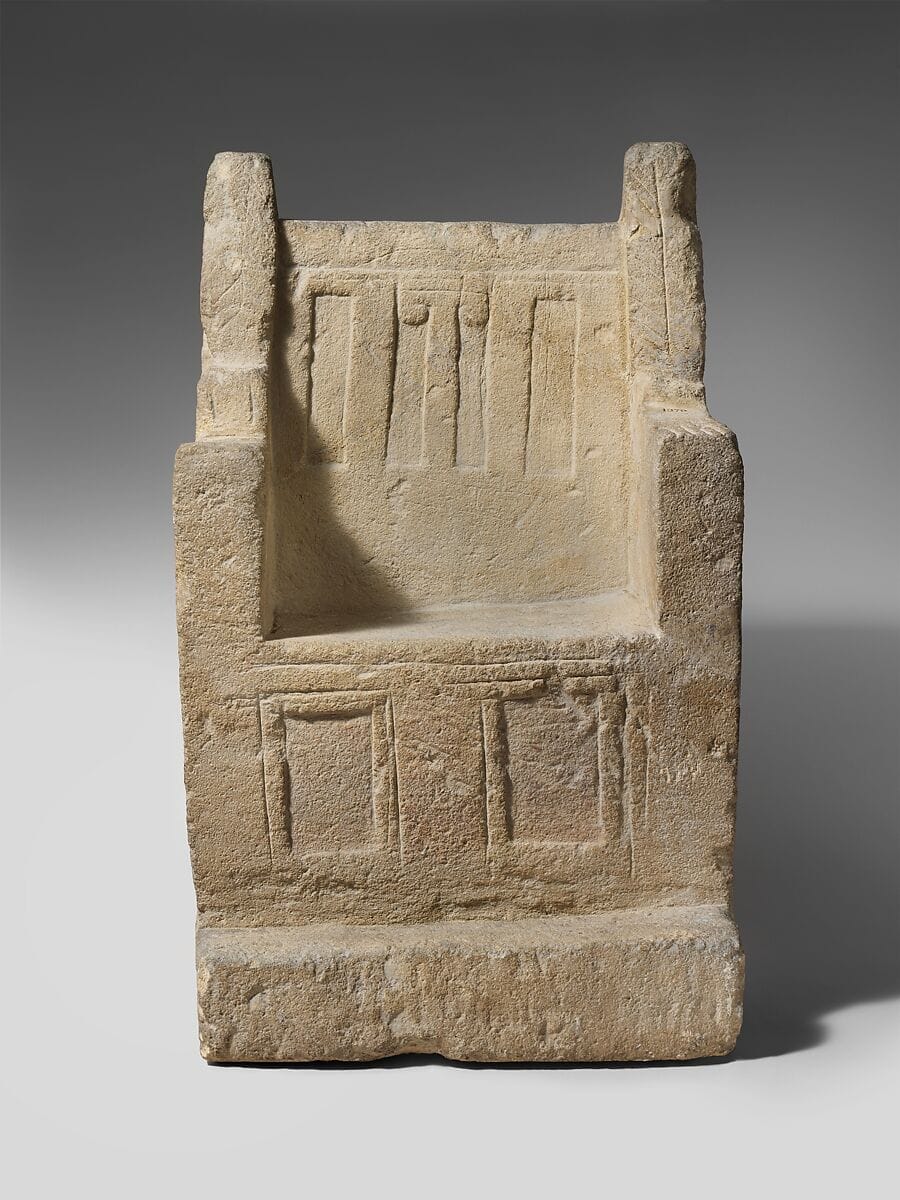
The limestone votive throne illustrated here and at the head of this entry is in the Cesnola collection of the Metropolitan Museum (Met 74.51.2498). The Met dates it to the sixth century BCE; it is 77.5 cm high, with a panelled back and front, and Cesnola recorded it as "from a temple at Amathus" (see Amathus). It is an empty seat carved in stone as an offering.
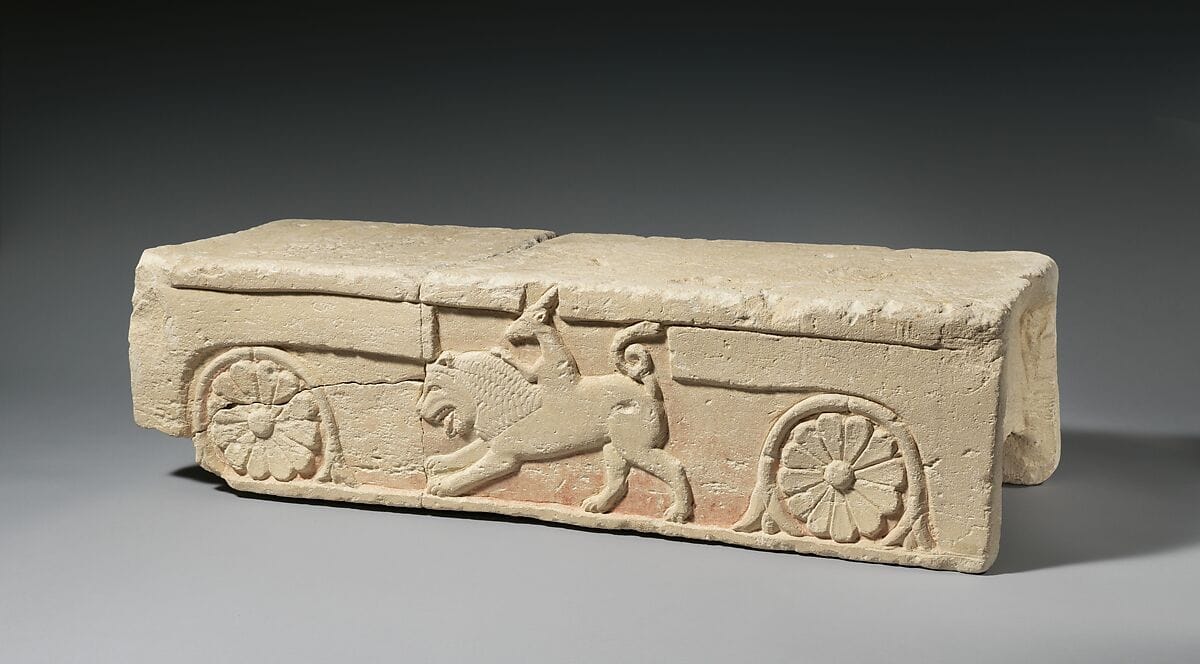
A limestone footstool with a relief of a chimera in the same collection (Met 74.51.2320) belongs a little later, to the first half of the fifth century BCE, at the start of the Cypro-Classical period; the Met's record describes it as the step or stool of a throne, and the site catalogue gives its find-place as the ruins of Golgoi. It is 72.2 cm long.
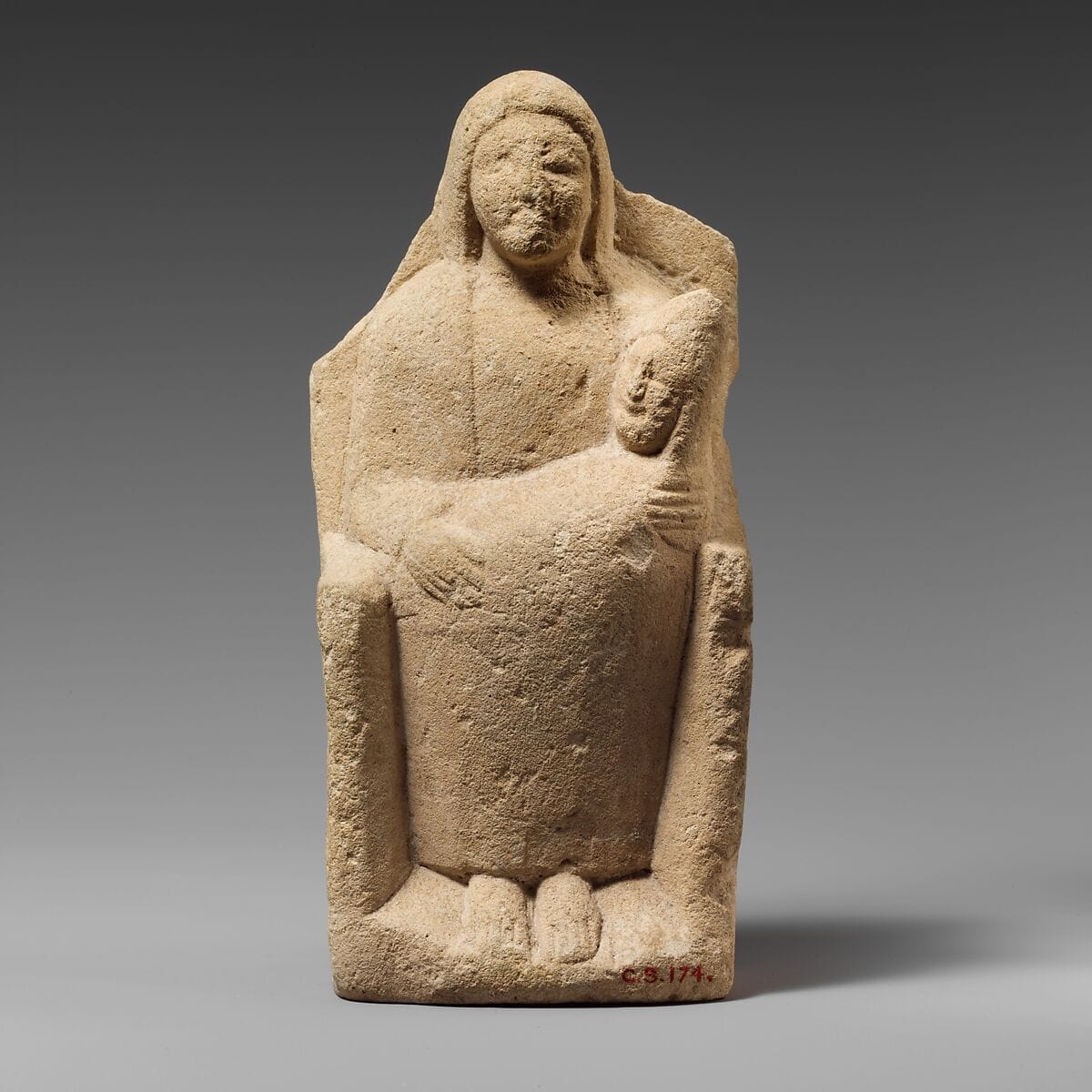
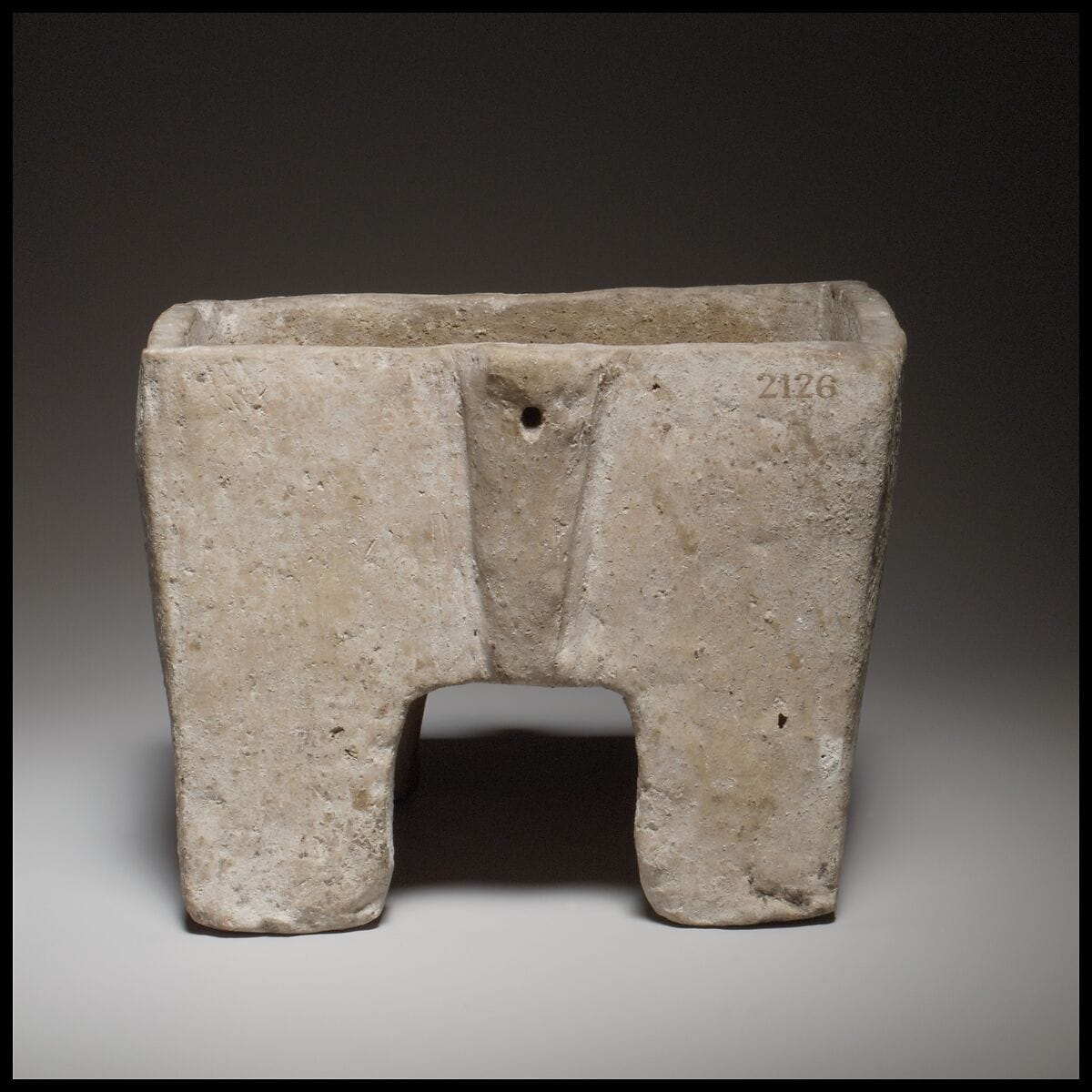
Terracottas show the same furniture in use. A throne side-piece from the Swedish Cyprus Expedition's excavation of the sanctuary at Ayia Irini takes the form of a winged sphinx with a conical crown, standing on three legs, and dates to Cypro-Archaic II, 600–475 BCE (Medelhavsmuseet A.I. 2331). Among the Met's Cesnola terracottas and limestones, a seated limestone kourotrophos, a nursing mother of the late sixth or early fifth century BCE, sits on a high-backed throne; a Cypro-Archaic II model of a chest stands on four low feet with a pierced knob on one side, a rare clay rendering of a storage piece rather than a seat. These descriptions follow the museum's own catalogue records rather than the specialist literature. Later echoes continue into the Cypro-Classical and Hellenistic periods, for instance a terracotta woman seated on a high-backed throne from the sanctuary of Artemis Paralia at Kition, dated 400–200 BCE (British Museum 1866,0101.9). For the sculptural context see Archaic limestone statues and Astarte figures.
What the evidence can and cannot show
The sources describe three kinds of furniture. The Neolithic benches and platforms are household fixtures, read from their positions by the hearth and the quern. The models, seals and votive seats are furniture as imagery: birthing stools, a backed seat at Vounous, chairs and tables on seals, thrones for gods. The Salamis pieces are full-sized, but they lost their wood and were rebuilt from stains, rivets and ivory, some of it of uncertain placement.
What is missing is the ordinary movable furniture of a Bronze Age or Iron Age house: the stools, tables, chests and beds that must have been made in wood and reed and have left no trace. The Kissonerga stools, the Vounous chair and the seal tables show that the forms existed, and the four-legged stool appears as early as the Chalcolithic. How widely such pieces were owned, and by whom, is not recoverable from the present evidence. Theodossiadou's thesis catalogue is unpublished, and until it is printed its totals, including the gap between 285 and 313, cannot be checked.
Objects on this page
References
- 1.Theodossiadou, M. (1995). Representations of furniture on cylinder seals from Late Bronze Age Cyprus. In C. Morris (Ed.), Klados: Essays in honour of J. N. Coldstream (Bulletin of the Institute of Classical Studies Supplement, pp. 249–260). Institute of Classical Studies. https://doi.org/10.1111/j.2041-5370.1995.tb02118.x
- 2.Dikaios, P. (1953). Khirokitia: Final report on the excavation of a Neolithic settlement in Cyprus on behalf of the Department of Antiquities, 1936–1946. Oxford University Press.
- 3.Dikaios, P. (1961). Sotira: A Neolithic settlement in Cyprus. University Museum, University of Pennsylvania.
- 4.J. Paul Getty Museum. (1990). Cyprus before the Bronze Age: Art of the Chalcolithic period. J. Paul Getty Museum.
- 5.Karageorghis, V. (1991). The coroplastic art of ancient Cyprus I: Chalcolithic–Late Cypriote I. A. G. Leventis Foundation.
- 6.Karageorghis, V. (1982). Cyprus: From the Stone Age to the Romans. Thames and Hudson.
- 7.Halbertsma, R. B., & Pilides, D. (Eds.). (2019). Cyprus: A dynamic island [Exhibition catalogue]. Sidestone Press.
- 8.Feldman, M. H. (2014). Communities of style: Portable luxury arts, identity, and collective memory in the Iron Age Levant. University of Chicago Press.
- 9.Naeh, L. (2015). In search of identity: The contribution of recent finds to our understanding of Iron Age ivory objects in the material culture of the southern Levant. Altorientalische Forschungen. https://doi.org/10.1515/aofo-2015-0006