
Contents
A model, in the Cypriot record, is a deliberately miniature rendering of a building, a cult place, a working scene, a boat, a vehicle or a piece of furniture, made as an object in its own right. The island has a long series of them, from a Chalcolithic house shaped as a bowl to the terracotta chariots, carts and shrines placed in Cypro-Archaic tombs and sanctuaries. Most come from graves, which shapes what survives and how it has been read. The catalogue holds more than eighty of them: see all models in the catalogue.
What counts as a model
Vassos Karageorghis, in his corpus of Cypriot terracottas, keeps freestanding models apart from the scenic groups that were modelled on the shoulders and rims of large vases [1, p. 148]. The distinction matters for several of the best-known pieces. Of one Early Bronze Age group he writes that it "was not detached from a large vase, like other scenic compositions, but was created as a model", and of another that it "is an independent work ... has not been detached from a vase, as has often been stated" [1, p. 154].
Five broad classes can be followed through time:
| Class | Main period | Examples |
|---|---|---|
| House or building models | Chalcolithic | Red on White house bowl, Kissonerga-Mosphilia |
| Enclosure and 'sanctuary' models | EC III to MC I | Vounous Tomb 22; two from Kotchati; Kalopsidha Tomb 5 |
| Scenes of work on a board, plaque or trough | EC III to MC | Vounous ploughing model; Louvre AM 816 and AM 957 |
| Boat and ship models | MC to Cypro-Archaic | Louvre AM 972; Kazaphani Tomb 2B; Met 74.51.1752 |
| Votive and funerary models of vehicles, shrines and chests | Cypro-Geometric to Cypro-Archaic | Quadrigas, carts, naiskoi, coffin models |
The word "model" does not settle what a piece represents. Whether a given object copies a real building or boat, and whether it was a toy, an offering or grave goods made for burial, is argued case by case below.
The Kissonerga house model
The earliest Cypriot model of a building comes from the "Ceremonial Area" at Kissonerga-Mosphilia. Under the wall of a large Middle Chalcolithic building (B994) the excavators found a rectangular, flat-bottomed pit with fire-cracked stones, pebbles and organic material, and more than fifty objects of stone, bone, shell and pottery lying in ash [2, p. 123]. Its focal object was "a Red on White bowl modelled to resemble a typical Middle Chalcolithic house, complete with internal central hearth, segmented floor and pivoted door" [2, p. 123]. Diane Bolger suggested that its painted designs reproduce wall paintings; before deposition the decoration had been covered with whitish clay, "as though to 'kill' it" [2, p. 123].
The pit also held ten stone figures, eight ceramic figures, a terracotta model of a stool, a triton shell and a broken anthropomorphic vessel [2, pp. 123–124]. The stone figurines measure 13 to 17 cm, and the terracotta figures are female, one of them shown giving birth [2, p. 124]. The stool model is discussed on the furniture page; the ware is described under Red on White ware.
Karageorghis treats the Kissonerga bowl as "a Chalcolithic antecedent to the Vounous model, dated about one thousand years earlier" [1, p. 149]. He notes that its floor carries low ridges and a rectangular central hearth, both absent at Vounous, and argues that "both models represent a particular building associated with a specific communal ritual", at Kissonerga perhaps one connected with birth or fertility [1, p. 150].
The Vounous enclosure model
The most discussed Cypriot model was found in fragments in Tomb 22 at Bellapais-Vounous and published by Porphyrios Dikaios in 1938 [1, pp. 148–149]. It is in the Cyprus Museum, Nicosia. Karageorghis notes that it is "considerably restored, but the composition is by no means conjectural" [1, p. 149].
It is a Red Polished shallow basin with a flat base and outward-splaying walls, 37 cm across; the wall stands 8 cm high and the doorway, with its raised lintel, 12 cm [1, p. 148]. To the left of the entrance is a pen in three parts holding two oxen and a standing figure. Outside the pen a woman stands holding an infant in a cradle, and another figure climbs the wall to look in. Inside, two large figures sit on a bench against the wall with further seated figures, six large standing figures with folded arms form a ring, and a male figure wearing a turban sits on a large four-legged chair with a high back, facing the wall. On the wall opposite the door three vertical poles in relief are each topped by "what looks like a bucranium" (a bull's skull), linked by horizontal bars from which a wavy band hangs. In front of them runs a low curved ridge, with a kneeling figure just outside it [1, pp. 148–149].
Descriptions of the poles differ. Buchholz and Karageorghis read them as "three human or divine beings" who "wear bull masks and hold snakes", and concluded that "the cult represented had the character of a mystery" [3, p. 171]. Karageorghis's later corpus describes them more cautiously as poles carrying bucrania [1, p. 149]. Both place the model at the end of the Early Bronze Age (Early Cypriot III) [3, p. 171; 5, p. 52]. Absolute dates printed for it in popular books vary by several centuries, so the relative date is the safer one.
Sanctuary, burial or village?
The meaning of the Vounous model has been argued since its publication [1, pp. 149–150]:
- A sanctuary. Dikaios read a religious ritual in which bull and snake stood for fertility and death. James Stewart concurred in 1962, adding that "Vounous was either a leading religious centre or the population was unusually religious" and that the place perhaps "owed its importance to the possession of an outstanding shrine of great sanctity". Jacqueline Karageorghis (1977) saw a sanctuary of fertility and death.
- A burial scene. David Frankel and Tamvaki (1973) compared the poles with the figure flanked by two vertical relief panels on the dromos wall of a tomb at Karmi-Palaealona. On their reading the enclosure is a tomb, the curved ridge the dromos, and the oxen food for the dead.
- A ceremony outside a tomb. Mogelonsky (1988) objected that the burial reading does not explain the benches and pens, that the chamber would be too large, and that no Cypriot burial seated the dead on a chair. She proposed a funeral ceremony held outside the tomb.
- A village scene. Morris (1985) saw "a village scene after a day's work". Karageorghis replied that this leaves the poles, the curved ridge and the kneeling and peering figures unexplained.
Karageorghis concluded that Dikaios's reading is "surely therefore still valid" [1, p. 149]. He pointed to the Kissonerga antecedent and to the Late Bronze Age sanctuary at Ayios Iakovos, a roughly circular area about 10 m across that Sjöqvist had already compared with the Vounous model [1, p. 149]. A more recent catalogue adds a caution: there is no evidence of actual Early Bronze Age sacred buildings, which "presumably were shaped as open-air precincts" [4, p. 248]. The tomb itself is discussed in Vounous and Early Bronze Age burial and in the article Vounous: a Bronze Age society known only from its dead.
The Kotchati and Kalopsidha shrine models
Two smaller Red Polished models from a tomb at Kotchati, in the Nicosia District, show a single wall rather than a whole enclosure. The larger, the Red Polished shrine shown at the head of this page (Cyprus Museum 1970/V-28/1), is a vertical panel 19 cm high, 15.5 cm wide and 1 cm thick on a narrow base [1, p. 152]. Three vertical ridges in relief rise from it, each topped by a flattened animal head with horns, ears and muzzle; the left-hand head has straight horns and may be a deer. The central ridge is wider and taller, 23.5 cm including its head. Narrow horizontal bars link the central ridge to the side ones, and a pair of upward-curving horns projects from the panel, front and back. On the "floor" stand a miniature amphora 4 cm high and a woman facing it, with a cylindrical body and pierced ears [1, p. 152]. The second Kotchati model (Cyprus Museum 1970/IV-30/1) is a 14 by 14 cm panel with heads on long necks, again with an amphora and a figure in front [1, p. 152]. A badly damaged third panel, 17 by 19 cm, comes from Tomb 5 at Kalopsidha (Cyprus Museum A1923); its missing tops were probably animal heads too [1, pp. 152–153].
Karageorghis first published the Kotchati pieces in 1970 as an abbreviated version of the Vounous sanctuary, with a woman pouring a libation to a divinity [1, p. 153]. Frankel and Tamvaki again connected the poles with the Karmi dromos relief and saw offerings for the dead. Jacqueline Karageorghis proposed an open-air agrarian cult place with libations to a chthonic divinity. Robert Merrillees (1980) thought the models "appear to have served both funerary and fertility purposes". Morris read the bulls' heads on poles as protective, like skulls fixed to walls in modern villages; Mogelonsky suggested the outer wall or entrance of a burial ground; Paul Åström (1988) reviewed all the proposals without adding another. Karageorghis's own judgement: "The religious character of the models cannot be denied" [1, p. 153]. He cited as parallels an Early Bronze Age III terracotta from Beth Yerah and the copper standards from Nahal Mishmar [1, p. 153].
The Turin catalogue calls the larger Kotchati model the "holy-of-holies of a prehistoric sanctuary", sharing the tripartite structure topped by bucrania seen at Vounous, and notes that the central pole may carry a deer skull [4, p. 248]. Its date line, "1700–1500 BC (Early Bronze Age, EC III–MC I)", does not match its own period label; Karageorghis treats the Kotchati pair as Early Cypriot III [5, p. 63]. The Kalopsidha model shows the type continuing: it "is almost a replica of the Early Cypriot III models from Kotchati, illustrating not only continuity but also homogeneity of religious beliefs" [5, p. 63]. The tulip bowls and cult vessels page covers the other ritual pottery of these tombs.
Scenes of work
One model from Vounous shows farm work rather than ritual. Found by looters and catalogued as "Special Series 1", it is a flat Red Polished board on five legs, 41 cm long and 19 cm wide, on legs 14 cm high [1, pp. 150–151]. Two pairs of yoked oxen, one behind the other, draw ploughs with a straight beam, share and upright handle, each with a ploughman behind. Two figures face each other holding an oblong trough, and a quadruped with traces of a saddle or panniers stands beside a human figure [1, p. 150; 3, p. 171]. Karageorghis calls it "one of the most successful representations of a scene from daily life" and holds that "no religious or ritual interpretation may be assigned to this scene. It is an agrarian scene", involving members of a family, as Dikaios had said [1, p. 151]. Dikaios compared the legged platform with Egyptian ploughing models; these are of wood and plaster and in a different style, and Mogelonsky judged the likeness possibly fortuitous [1, p. 151]. The farming context is set out in Early Bronze Age village life.
Two pieces in the Louvre of unknown provenance are read in several ways. A Red Slip trough (AM 816), 27.7 cm long, has five figures shown from the waist up along a ledge, among them a woman holding an infant and a figure holding a conical bowl, with seven small bowls applied to the rim. Morris saw washing; Caubet and colleagues suggested ritual, washing, or bread or beer making; Karageorghis saw potters at work [1, pp. 153–154]. A plaque with two figures and rows of bowls (AM 957) has been read as panniers ready for pack animals (Morris), a ritual group (Caubet) and two potters showing large basins (Karageorghis) [1, p. 154].
The Vounous tombs also gave Red Polished models of single objects: daggers from Tombs 45 and 29, a brush or comb from Tomb 9 and a spindle from Tomb 29, all Early Cypriot III [3, p. 171].
Boat and ship models
Bernard Knapp lists the Bronze Age clay vessels proposed as boats and questions "whether the Vounous vessel or any of three further ceramic models actually represent ships" [6, p. 98]. The candidates include a vessel from Bellapais-Vounous that Basch considered the earliest representation of a Cypriot ship, c. 2000 BCE, and a Red Polished III bowl in the Louvre (AO 17521) [6, p. 98]. The clearest is a White Painted II model in the Louvre (AM 972), with a rounded hull and projecting stem and stern posts, carrying eight people and two birds; it dates to the beginning of the Middle Bronze Age, c. 1900/1800 BCE [6, p. 99]. It is 25 cm long [3, p. 171]. A White Painted IV deep bowl from Politiko-Lambertis with five people sitting on its edge was read as a ship by Westerberg, but Frankel does not regard it as a boat model [6, p. 99].
From the Late Bronze Age come a deep-hulled model with a mast socket from Kazaphani Tomb 2B, Plain White handmade models from Maroni-Tsaroukkas, and a model from Enkomi-Ayios Iakovos now in Brussels (A1240), which Wachsmann suggests shows a Syro-Canaanite ship [6, p. 144]. The Kazaphani model is 45 cm long [3, p. 171]. Two richly painted Proto-White Painted boat models of Late Cypriot III date, one from Lapithos, close the series [3, p. 171].
Cypro-Archaic boat models from tombs said to be at Amathus are in the Cesnola collection of the Metropolitan Museum. The Met catalogue calls one of them (74.51.1752), 25.7 cm long, "one of the most accurately rendered models of a warship known so far", with a possible ram, catheads, a stern gallery and a mast socket [7, p. 57]. A plain model of a boat (74.51.1750) is 25.6 cm long, while a miniature terracotta boat (74.51.1751) is only 5.9 cm long and "crudely rendered" [7, p. 58]. The seafaring and ships entry places these models among the other evidence for Cypriot boats.
Chariots, carts, shrines and coffins
In the Cypro-Geometric and Cypro-Archaic periods the subjects change. "Chariot models, quite common throughout the Cypro-Archaic period, were deposited in both sanctuaries and tombs", and they also reached Phoenicia, Samos, Knidos and Naukratis [8, p. 146]. A model from Ovgoros (Cyprus Museum 1955/IX-26/1), 16.5 cm high and dated c. 650–550 BCE, carries a charioteer, an archer and a shield-bearer, with a figure leading the horses. The same entry notes that the quadriga "is the commonest type among Cypriot terracotta models" and that real chariots have been excavated at Salamis, Kition, Amathus and Palaepaphos [8, p. 146]. The Met's model of a chariot with driver (Met 74.51.1798) belongs to this series, and a solid, wheel-made Bichrome chariot wheel, 15.3 cm across, probably came from a wheel-made chariot model with horses [7, p. 41].
Whether such models were toys or offerings is open. One catalogue says of a wheel-made Bichrome IV chariot that these are "more likely toys, as opposed to accurate chariot models", and of a quadriga with bells in Brussels that "the dedication of models of quadrigas in sanctuaries also suggests they may have had a religious significance" [9, p. 214].
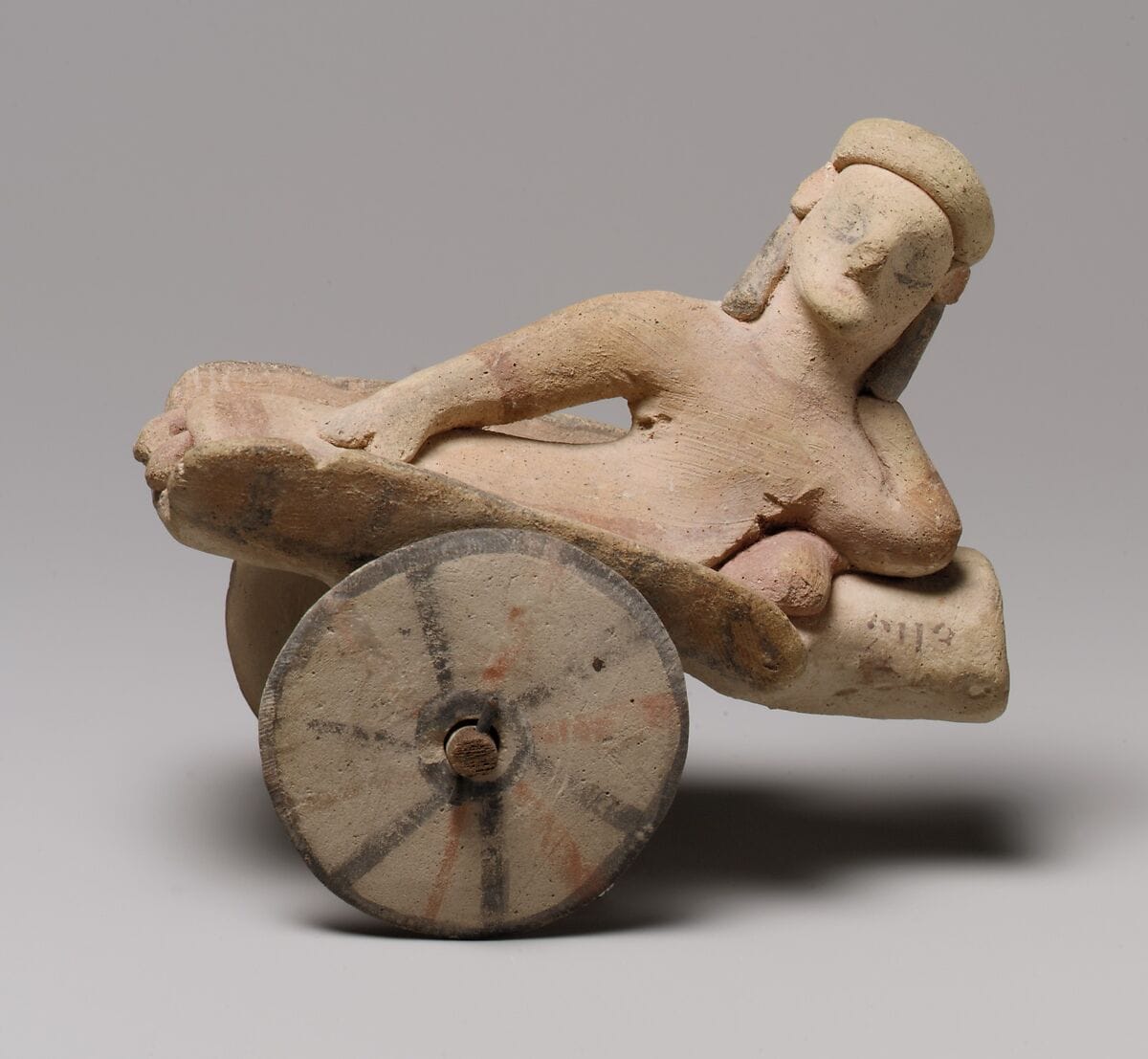
Carts with passengers are a related Cypro-Archaic II group in the Cesnola collection, several said to come from a tomb at Alambra. A terracotta cart in the series (74.51.1792), 10.8 cm high, carries two reclining figures with a smaller double-flute player on their laps; their mouths are open, "suggesting that they are singing" [7, p. 56]. Another cart with a human figure (74.51.1795), 10.5 cm high, has low sides, a tubular pole socket and painted spokes, with a man in a long robe reclining on a cushion [7, p. 55]; it is the cart illustrated here. A third cart with a human figure is Met 74.51.1794. Music in these groups is treated under music and instruments.
Shrine models (naiskoi) were offerings too. A Cypro-Archaic II naiskos in the Cyprus Museum (C 75), 11.6 cm high, frames an armless relief bust, read as female with hands to the breasts, under disc-and-crescent symbols; "these clay models are considered to have been dedications to the goddess", several sixth-century examples come from Amathus, and similar ones are known from the Levant [9, p. 262]. The Met has a comparable terracotta model of a shrine (74.51.1753), 9.9 cm high.
The Met also holds a Cypro-Archaic II model of a chest on feet, 13 cm high (Met 74.51.1757), and a model of a coffin 5.4 cm high (Met 74.51.1756). Stone was used as well: a limestone coffin model of Cypro-Geometric I date, c. 1050–950 BCE, measures 10.6 by 10.8 by 7.6 cm (Met 74.51.5163). Whether such boxes stood for coffins or for household chests is not settled by their museum labels.
Reading a model
Cypriot models survive mostly because they were buried. The Early Bronze Age group comes from the tombs of the north coast and the central plain, and the Iron Age carts and coffins from tombs as well, so the series is weighted towards what people chose to put in graves and sanctuaries. Some details recur across the record, such as the Kotchati bucrania and the Vounous poles, and others have no excavated counterpart, such as a circular Early Bronze Age shrine. Several of the most quoted pieces were found by looters or have no recorded provenance, among them the Vounous ploughing model and the two Louvre groups. The interpretations that follow each model, from sanctuary to tomb to village yard, are therefore best read alongside the excavated settlements and cemeteries in Middle Bronze Age village life and Bronze Age chamber tombs.
Objects on this page
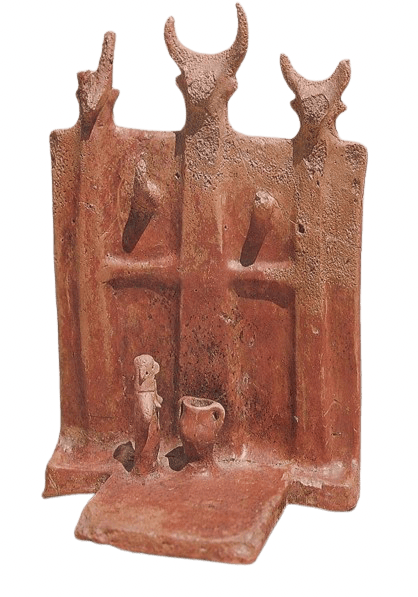 Red Polished ShrineMiddle Bronze Age I · 1950–1650 BC
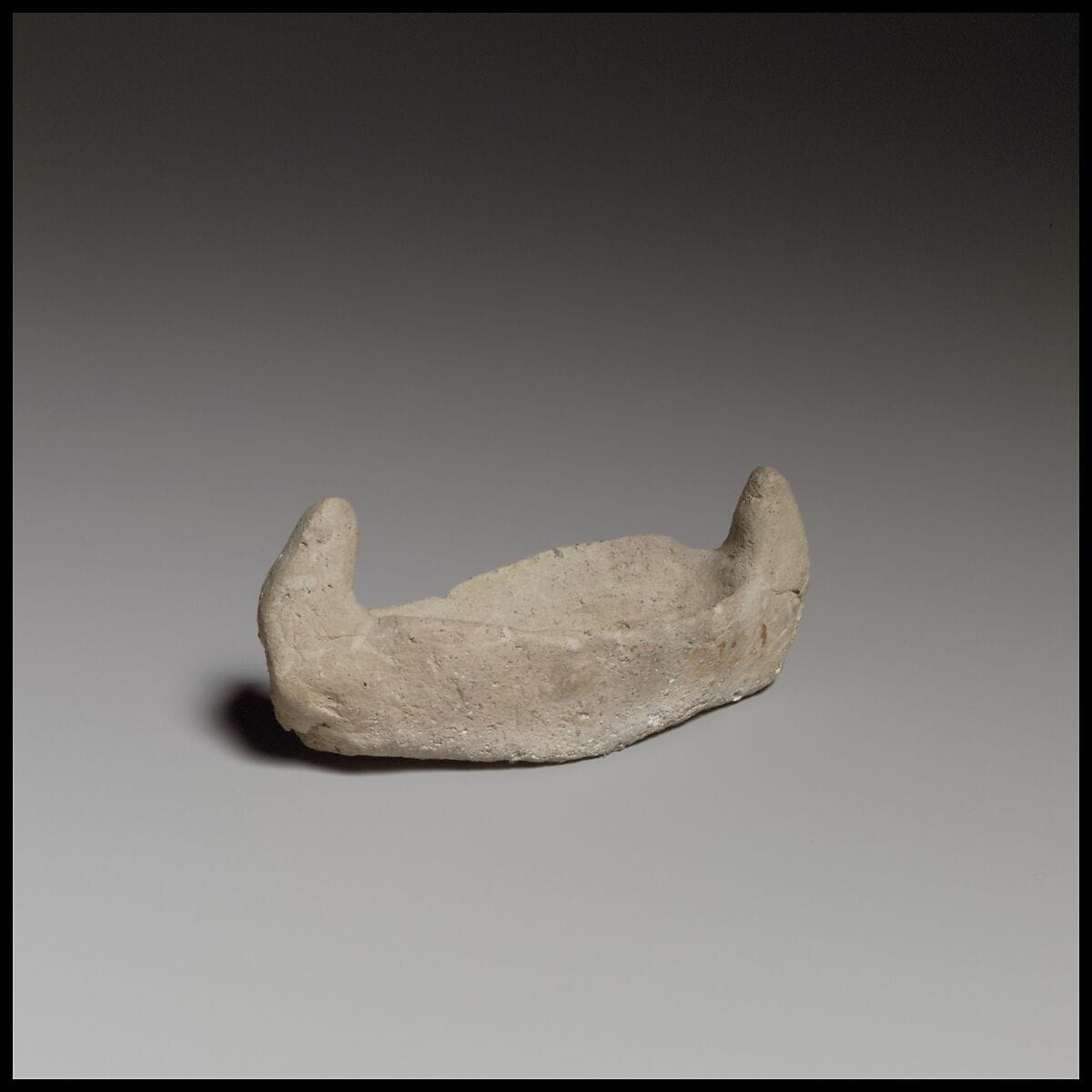 Terracotta model of a boatArchaic II · 600–480 BC
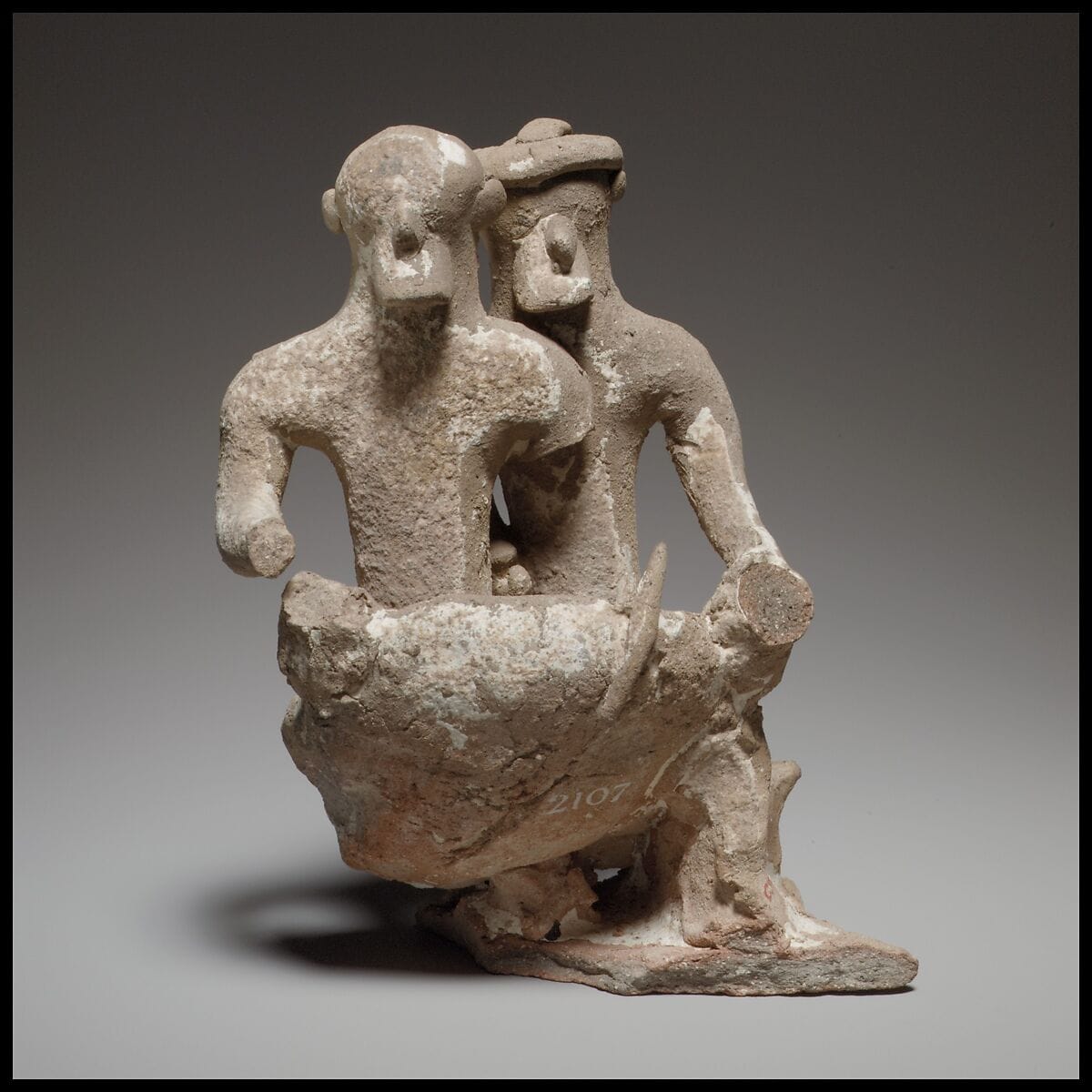 Model of a chariot with driverGeometric II · 999–600 BC
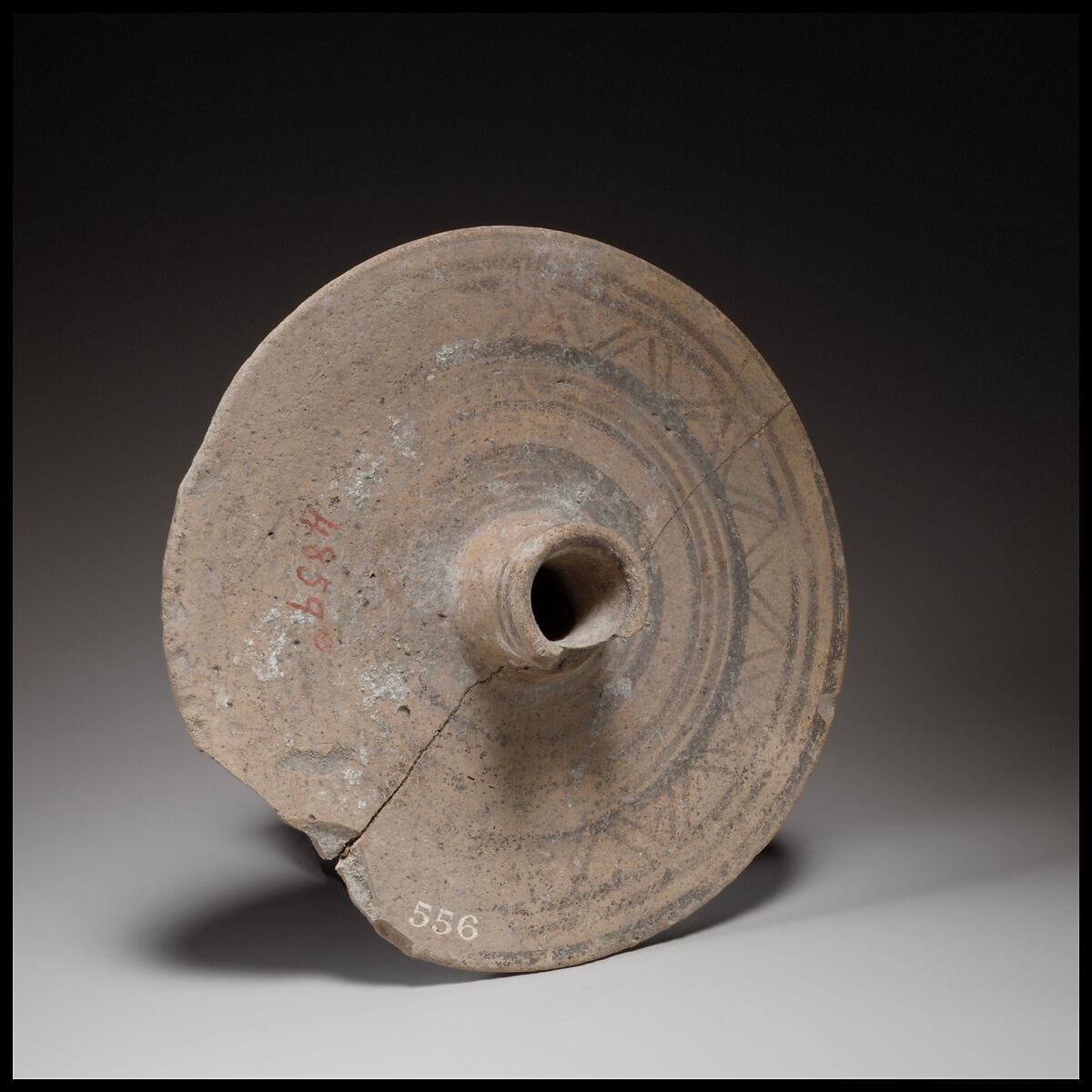 Chariot wheelArchaic I · 750–600 BC
- Model of a cart with a human figureArchaic II · 600–480 BC
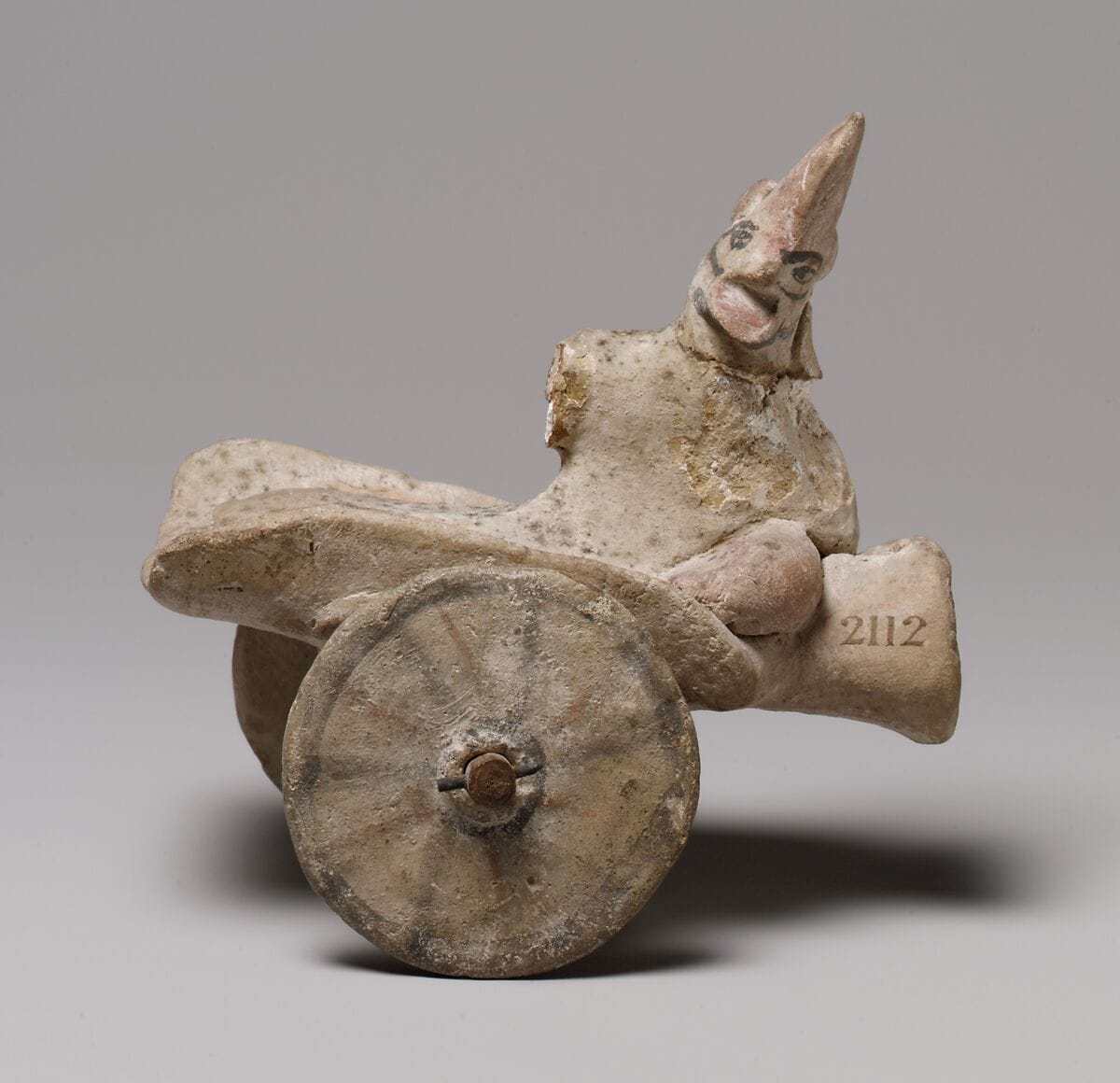 Model of a cart with a human figureArchaic II · 600–480 BC
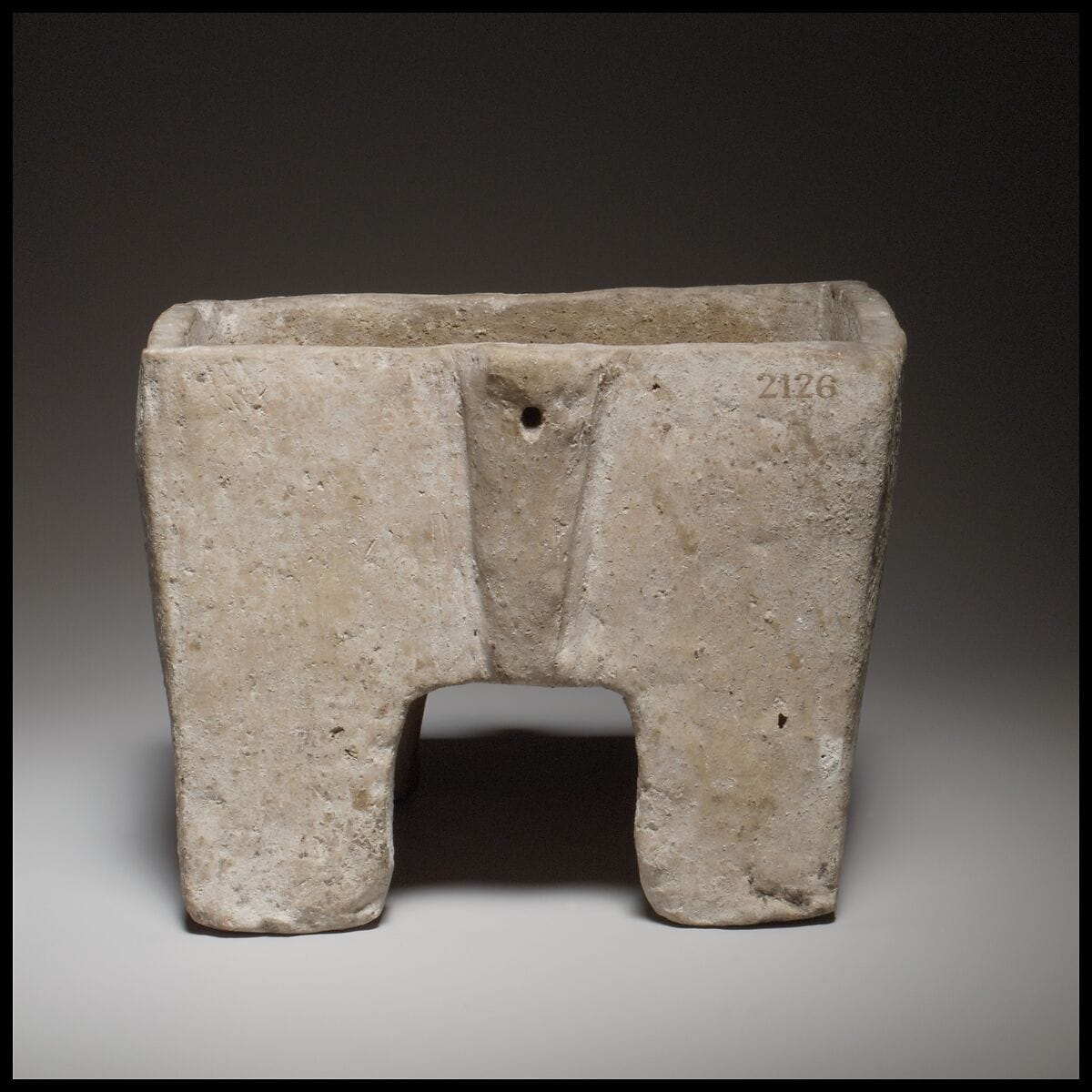 Model of a chestArchaic II · 600–480 BC
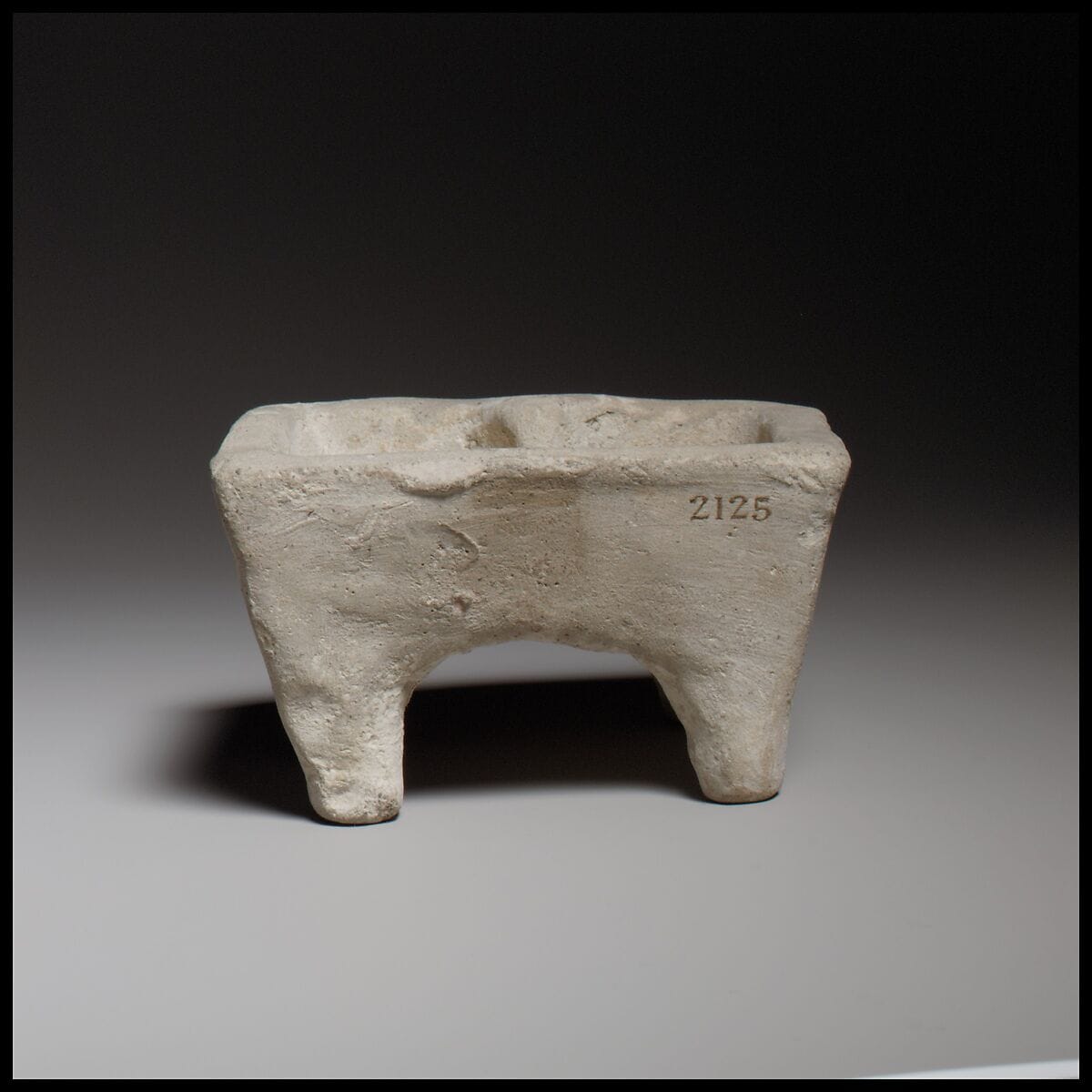 Model of a coffinArchaic II · 600–480 BC
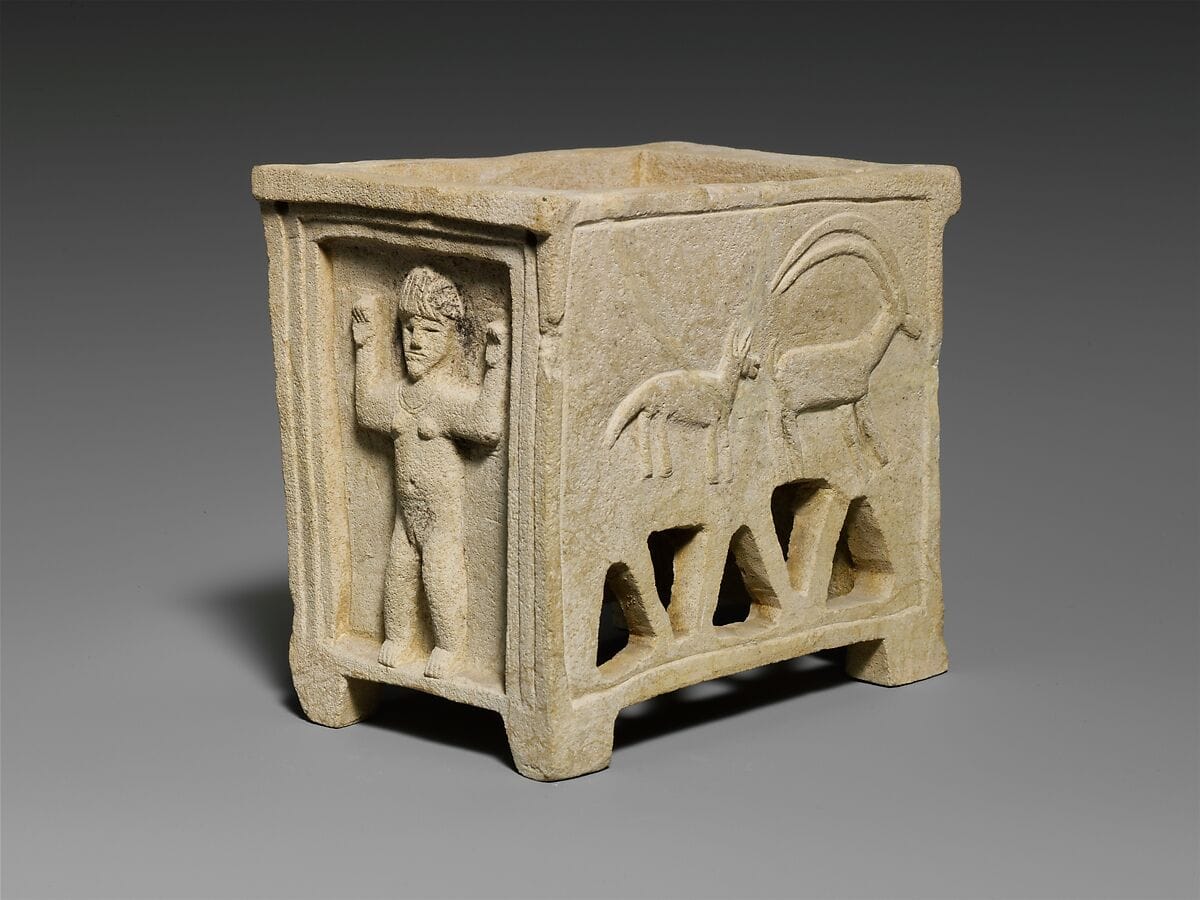 Limestone coffin modelGeometric I · 1050–950 BC
In the catalogue
References
- 1.Karageorghis, V. (1991). The coroplastic art of ancient Cyprus I: Chalcolithic–Late Cypriote I. A. G. Leventis Foundation.
- 2.Steel, L. (2004). Cyprus before history: From the earliest settlers to the end of the Bronze Age. Duckworth.
- 3.Buchholz, H.-G., & Karageorghis, V. (1973). Prehistoric Greece and Cyprus: An archaeological handbook. Phaidon.
- 4.Bombardieri, L., & Panero, E. (Eds.). (2021). Cyprus: Crossroads of civilizations [Exhibition catalogue]. Musei Reali, Turin.
- 5.Karageorghis, V. (1982). Cyprus: From the Stone Age to the Romans. Thames and Hudson.
- 6.Knapp, A. B. (2018). Seafaring and seafarers in the Bronze Age eastern Mediterranean. Sidestone Press. https://www.sidestone.com/books/seafaring-and-seafarers-in-the-bronze-age-eastern-mediterranean
- 7.Karageorghis, V., Merker, G. S., & Mertens, J. R. (2004). The Cesnola Collection of Cypriot art: Terracottas. Metropolitan Museum of Art.
- 8.Hadjisavvas, S. (Ed.). (2010). Cyprus: Crossroads of civilizations [Exhibition catalogue]. National Museum of Natural History, Smithsonian Institution.
- 9.Pilides, D., & Papadimitriou, N. (Eds.). (2012). Ancient Cyprus: Cultures in dialogue [Exhibition catalogue]. Department of Antiquities, Cyprus.