
Middle Bronze Age II
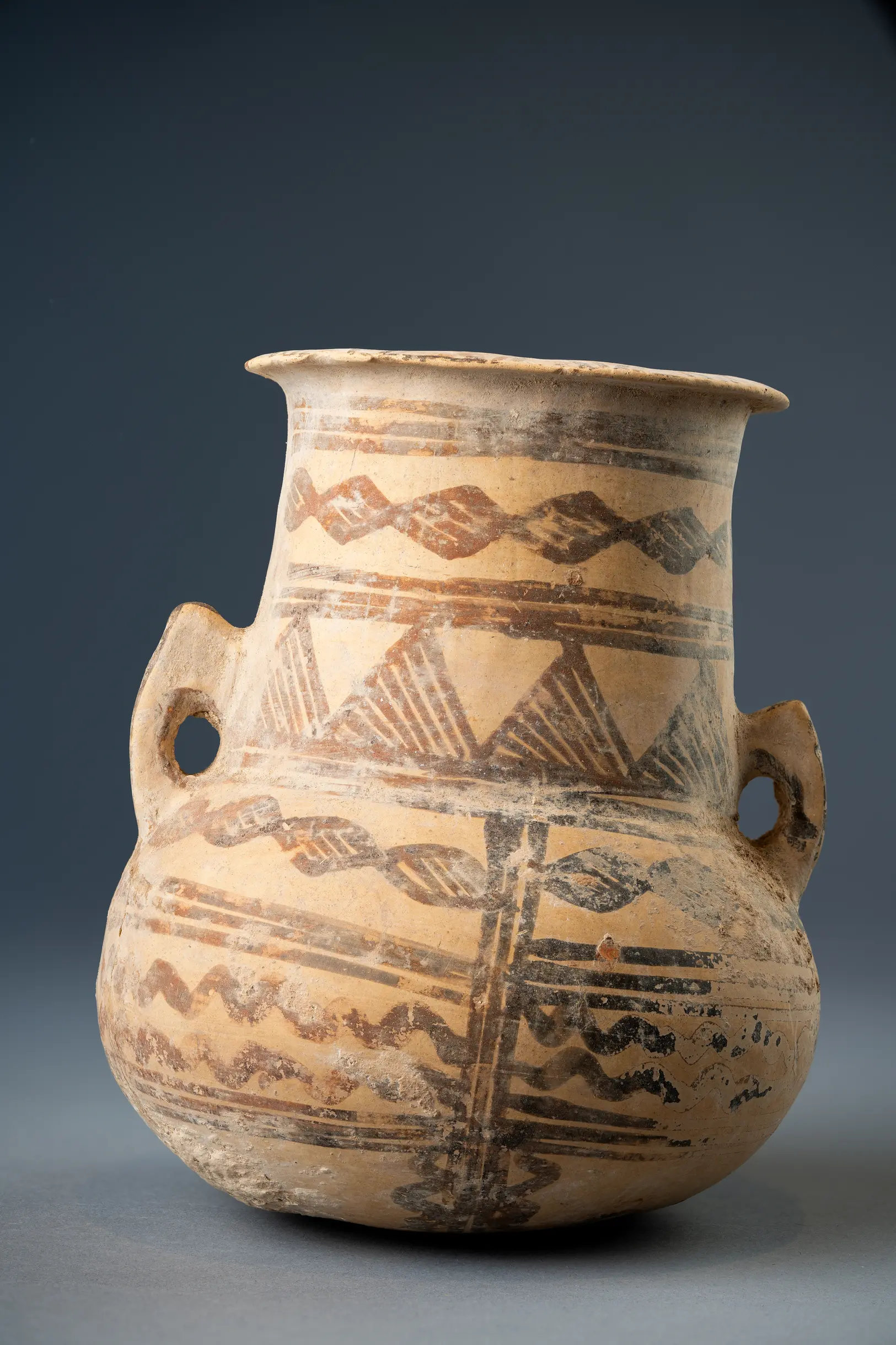
White Painted III-IV Amphora with Lozenge Chains and Hatched Triangles
Small handmade White Painted amphora with pierced lug handles, painted with hatched lozenge chains, hatched triangles, wavy lines and a vertical ladder. Middle Cypriot II–III.
Date
1850 - 1650 BC
Accession No.
JAR-BA-002
Collection
Alexis Drakopoulos
Provenance
- 1965–1969, acquired by The Goodman Collection
- 2025–present, Alexis Drakopoulos, London
Middle Cypriot II–III, c. 1850–1650 BCE · White Painted III–IV ware · Handmade
A small handmade amphora with a squat globular body, rounded base and a tall, wide neck that curves inward before flaring to a flat, everted lip. Two small vertical lug handles sit at the junction of neck and shoulder, each pierced by a large round hole and drawn up to a blunt point. The pale buff surface is painted in matt paint that fires from red-brown to near black. The neck carries, from the top, groups of encircling lines, a chain of hatched lozenges, and a frieze of standing hatched triangles. A second lozenge chain rings the shoulder, and bands and wavy lines circle the lower body. A vertical ladder of parallel lines runs down the front from shoulder to base, cutting across every horizontal zone. The lip is chipped, the paint worn in places, and there are patches of pale encrustation on the lower body.
Commentary
The vessel was published on the site as a "jar", but in the standard glossary for Middle Cypriot White Painted pottery a jar has no handles, and a closed vessel with two small vertical handles on a wide neck is an amphora [1]. The ware is White Painted, the fine handmade painted pottery that became the diagnostic tableware of the Middle Cypriot period, with its origins on the north coast at the end of the Early Bronze Age [2].
The numbered White Painted classes (II to VI) were set up by Gjerstad and reorganised by Åström around decorative schemes [3]. They are useful as a loose chronological frame, but authorities disagree over individual pieces, and a single Lapithos bowl can be catalogued as White Painted III in one publication and IV in another. This amphora is therefore best described as White Painted III–IV. Two features place it in the middle of the sequence, after the earliest White Painted. The paint is dark and matt, where the earliest White Painted has glossy red paint on a lustrous ground, and the decoration is laid out in stacked horizontal zones of lattice lozenges, hatched triangles and wavy lines, the "tectonic" north-coast manner. A date in Middle Cypriot II–III, c. 1850–1650 BCE, is proposed on this basis, with the earlier half of that range the more likely; the absolute figures follow the current radiocarbon chronology [4].
The closest published parallel is an amphora from Lapithos Tomb 316 in Stockholm (Medelhavsmuseet L. 316:117), described by the Swedish excavators as having straight and wavy lines around neck and base, bands of lattice lozenges around the body, and vertical wavy lines below the handles [5]. That last feature, a vertical element breaking the horizontal zones, finds an equivalent here in the ladder on the front face. A second Lapithos amphora (Medelhavsmuseet L. 315B-C:027), a globular vessel with wide cylindrical neck and two small handles, carries bands of zigzags, hatched triangles and wavy lines in the same syntax [6]. The Cesnola amphora in New York (Metropolitan Museum 74.51.1098) is a further example of the shape. By contrast, a White Painted V amphora from Enkomi in the British Museum (1897,0401.1299) shows how the vertical-band scheme was developed later, in the east, at the transition to the Late Bronze Age.
Small amphorae of this kind are known almost entirely from tombs, where they were laid with bowls, jugs and bronze tools. In life they probably held liquids or dry foods for serving, but no residue analysis of the type is known to us. The piercings in the handles suited a cord for suspension or for tying down a cover.
The find-spot of this amphora is unrecorded. The two Lapithos parallels often carry circles or crossed lines on the base, and a view of this vessel's base would test how close the relationship is. The few small strokes painted loosely on the right side of the lower body are hard to read in photographs and may be accidental.
References
- 1.Frankel, D. (1974) Middle Cypriot White Painted Pottery: An Analytical Study of the Decoration. Studies in Mediterranean Archaeology 42. Göteborg: Paul Åströms Förlag, pp. 32–36.
- 2.Karageorghis, V., Mertens, J.R. and Rose, M.E. (2000) Ancient Art from Cyprus: The Cesnola Collection in The Metropolitan Museum of Art. New York: The Metropolitan Museum of Art, p. 48.
- 3.Åström, P. (1972) The Swedish Cyprus Expedition IV:1B. The Middle Cypriote Bronze Age. Lund: The Swedish Cyprus Expedition.
- 4.Manning, S.W. (2013) 'Appendix: a new radiocarbon chronology for prehistoric and protohistoric Cyprus', in A.B. Knapp, The Archaeology of Cyprus: From Earliest Prehistory through the Bronze Age. Cambridge: Cambridge University Press.
- 5.Gjerstad, E., Lindros, J., Sjöqvist, E. and Westholm, A. (1934) The Swedish Cyprus Expedition I: Finds and Results of the Excavations in Cyprus 1927–1931. Stockholm: The Swedish Cyprus Expedition, Lapithos Tomb 316 (pp. 115–121), no. 117 (= Stockholm, Medelhavsmuseet L. 316:117).
- 6.Gjerstad, E., Lindros, J., Sjöqvist, E. and Westholm, A. (1934) The Swedish Cyprus Expedition I. Stockholm: The Swedish Cyprus Expedition, Lapithos Tomb 315, Chamber B–C (pp. 105–114), no. 27 (= Stockholm, Medelhavsmuseet L. 315B-C:027).
More from the Catalogue
Browse related objects
Amphora
Archaic II
Amphora
Geometric I
Amphora
Archaic II
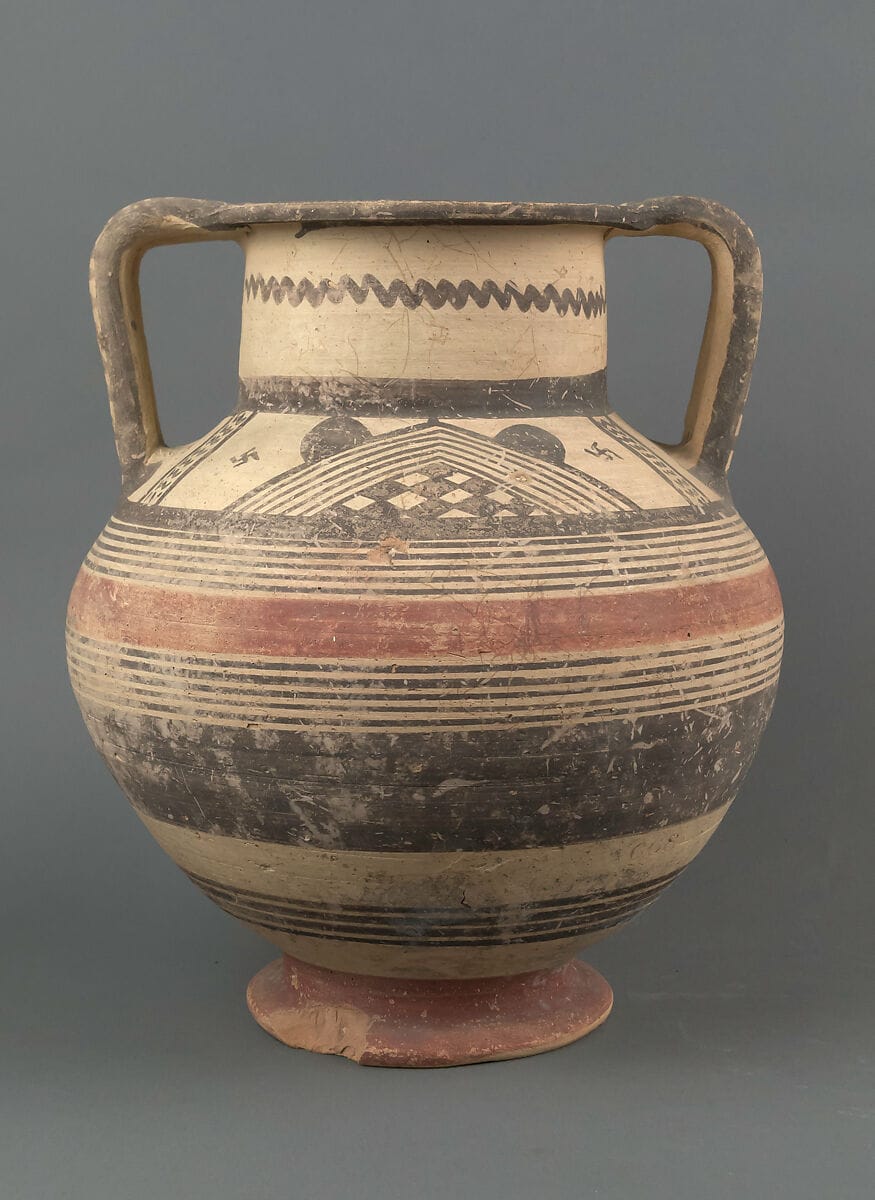
Amphora
Archaic I
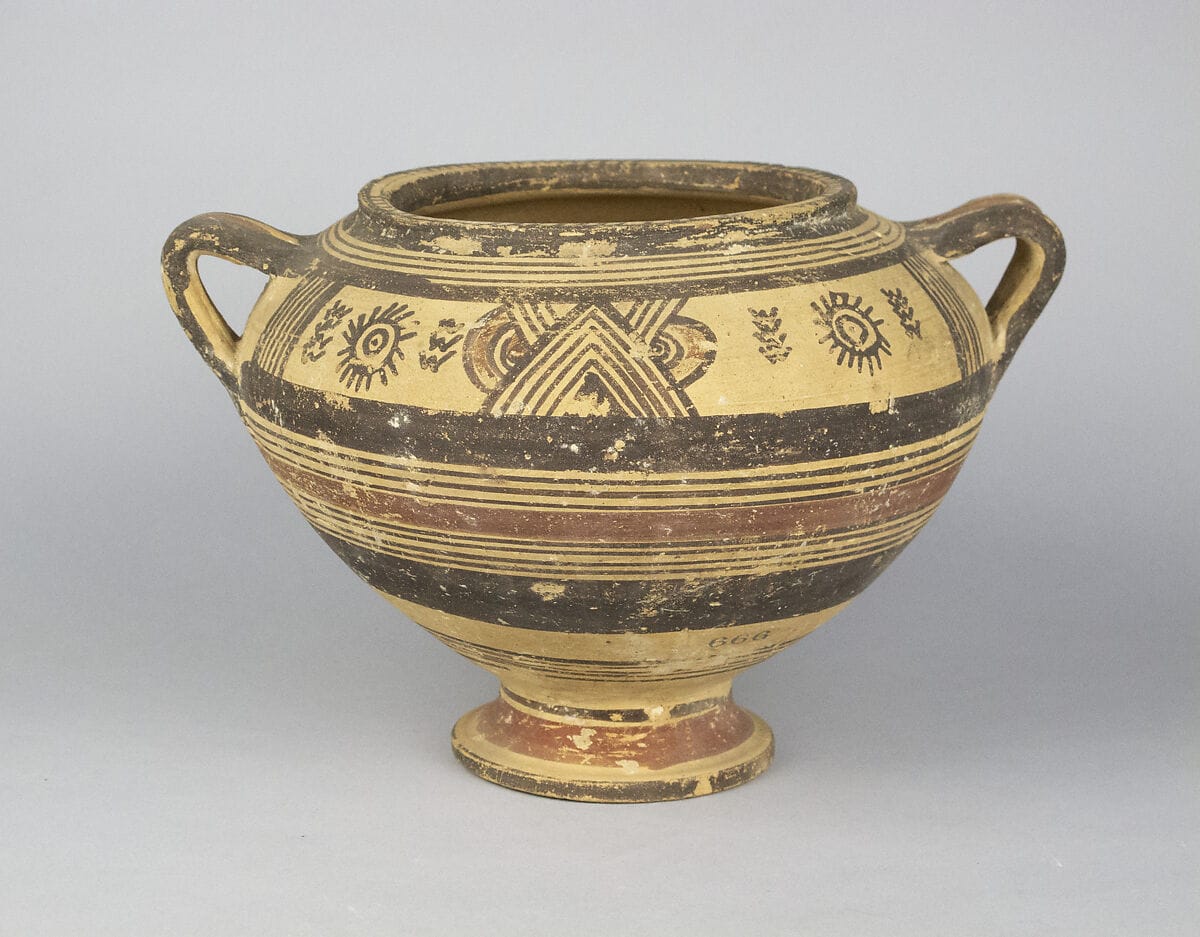
Dinos
Archaic I
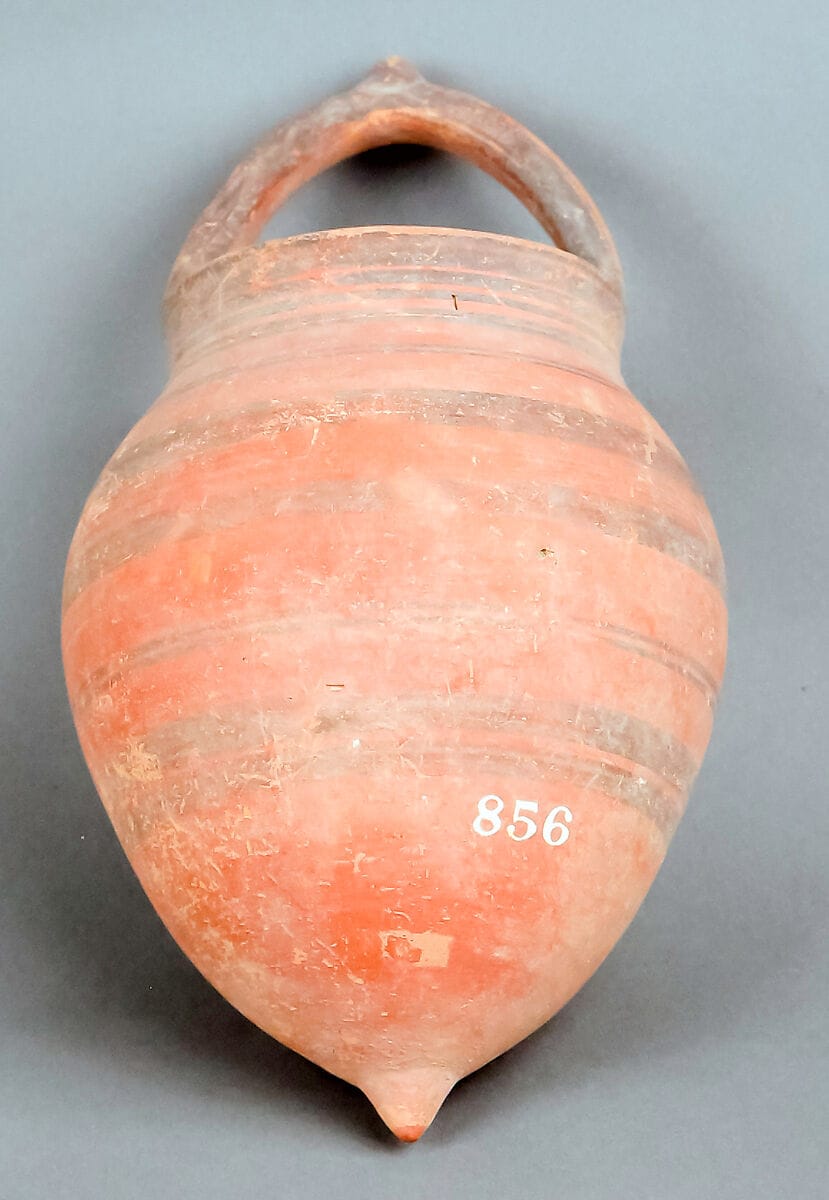
Amphoriskos
Geometric III
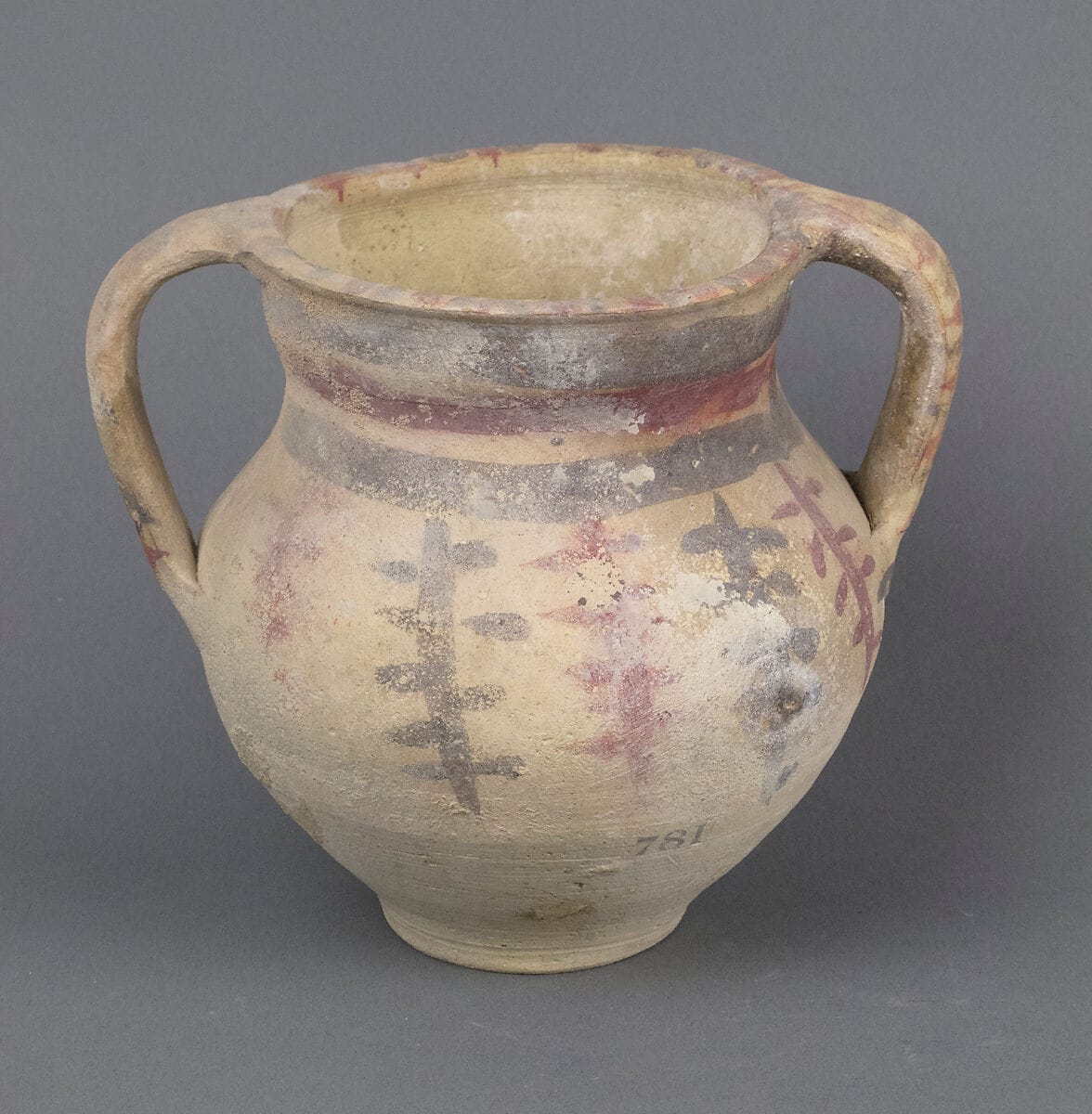
Amphoriskos
Archaic II
Limestone statuette of a boy holding an amphora
Hellenistic
Terracotta krater
Late Bronze Age III
Krater
Geometric I
Terracotta miniature amphora
Geometric III
Amphora
Late Bronze Age III
Amphora
Archaic II
Krater
Late Bronze Age III
Dinos
Archaic I
Amphora
Archaic
Terracotta amphora
Middle Bronze Age II
Amphora
Bronze Age