


Top to bottom
The painter divided the jar into horizontal registers and gave each its own ornament, dense at the top and thinning towards the foot. Scroll, and the jar reads itself from rim to foot.
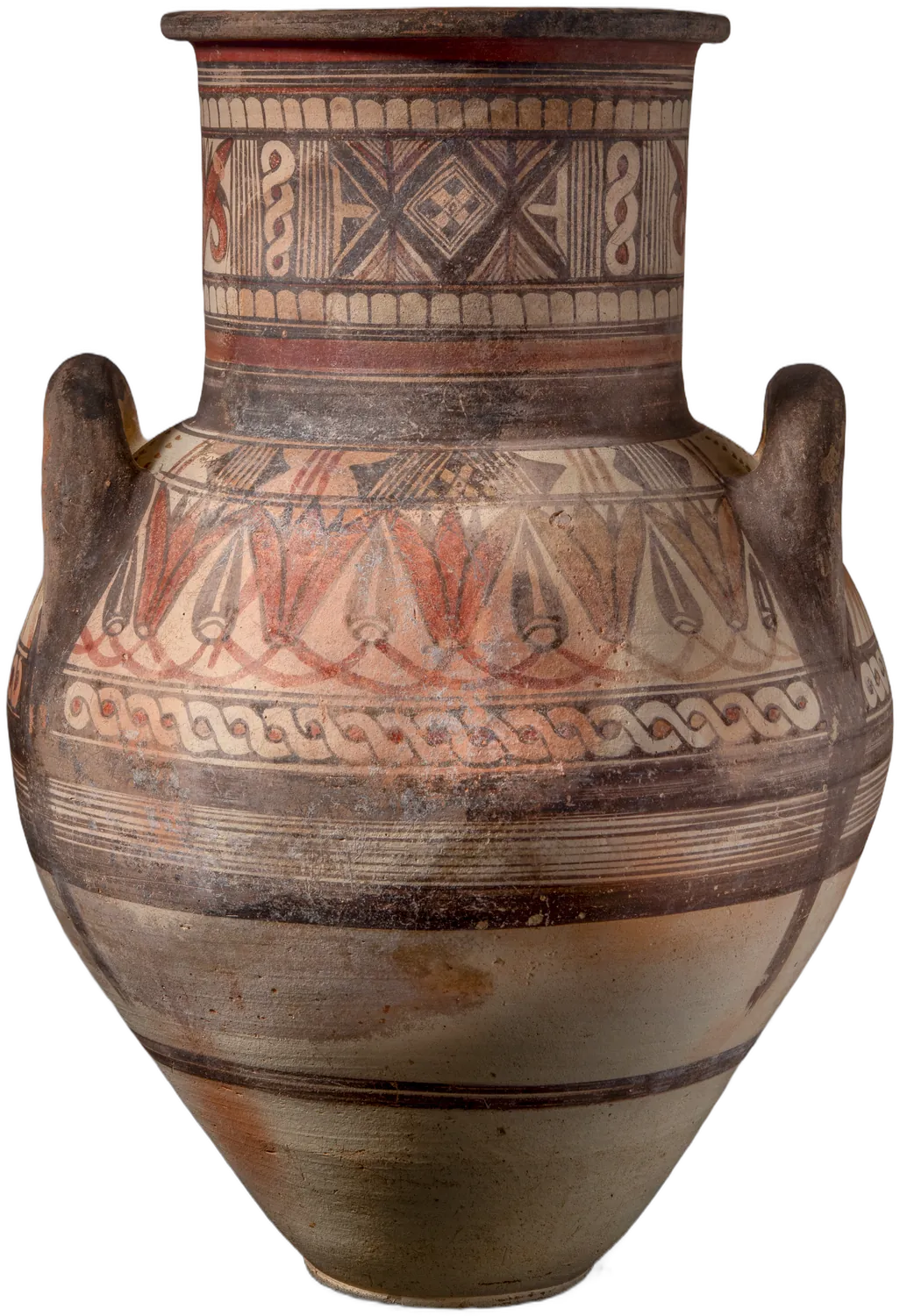
Cypro-Archaic I · c. 750–600 BC
A painted storage jar of about 750 to 600 BC. On its shoulder, an Egyptian water-lily, learned from Phoenician metalwork and repeated by a Cypriot painter until it became pattern.
The jar is wheel-made of pale buff clay and painted in two matt colours, a brown-black and a brick red. It has no recorded find-spot and no inscription, and nobody knows what it held. What we can say comes from its shape and its paint, and they say a good deal.
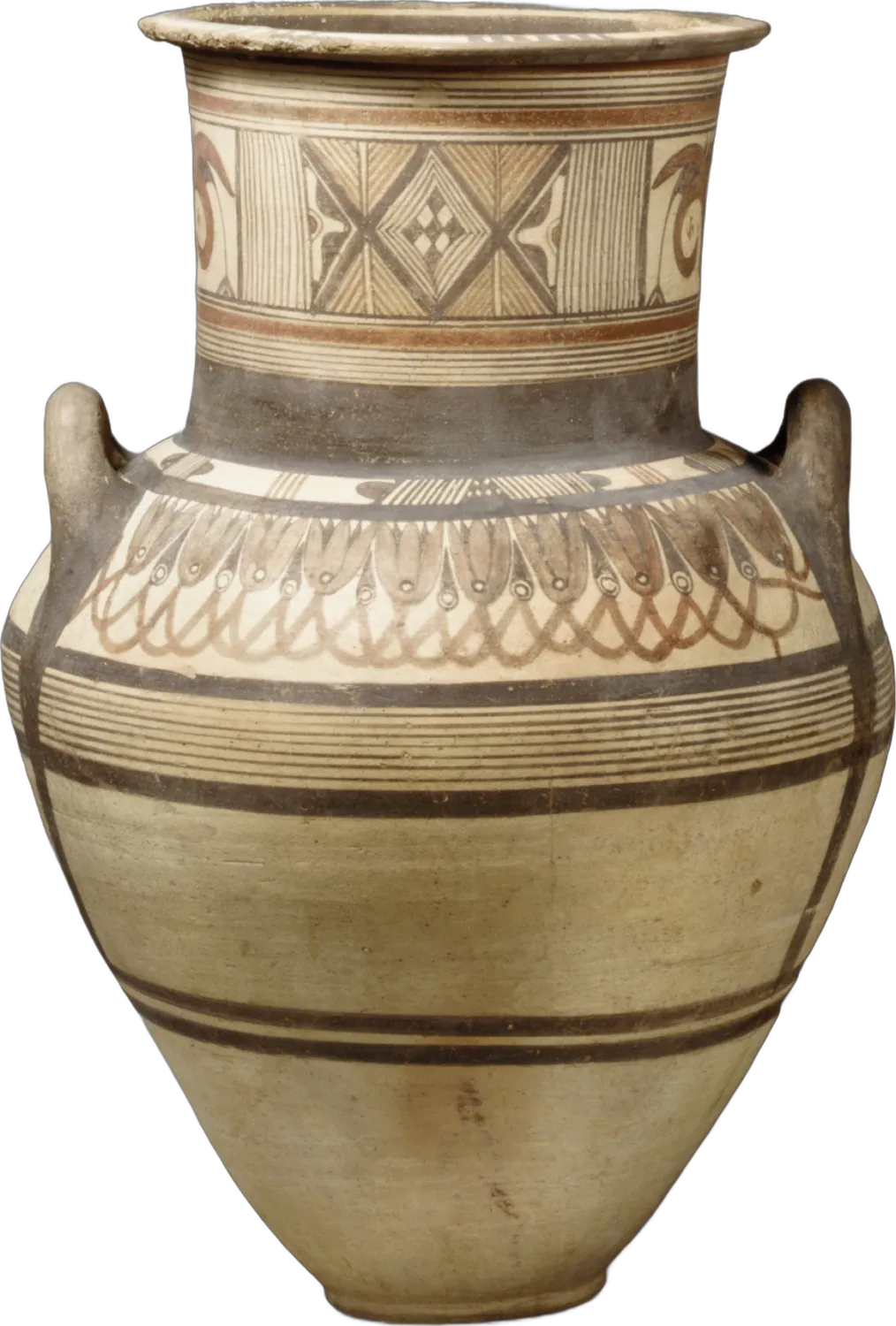
The shape is the Cypriot belly-handled amphora, Gjerstad's Bichrome IV “Amphora 2”: a tall neck that widens slightly to a flat, out-turned rim, two thick loop handles on the shoulder, and an ovoid body tapering to a low ring foot. The paint puts ornament of two very different ages side by side. On the neck, geometric panels of a kind Cypriot painters had used for three centuries and more; on the shoulder, a flower that had reached the island only recently, by way of Phoenician craftsmen.
IThree photographs
The jar has been photographed from three sides: both faces and one handle. The two faces repeat one design in different brushwork. The handle view shows what the faces hide: a red volute flower on the neck, directly above the handle, and a rayed triangle under it where the lotus chain breaks off.
Face A
The cross panel on the neck; the lotus chain washed in red and brown.
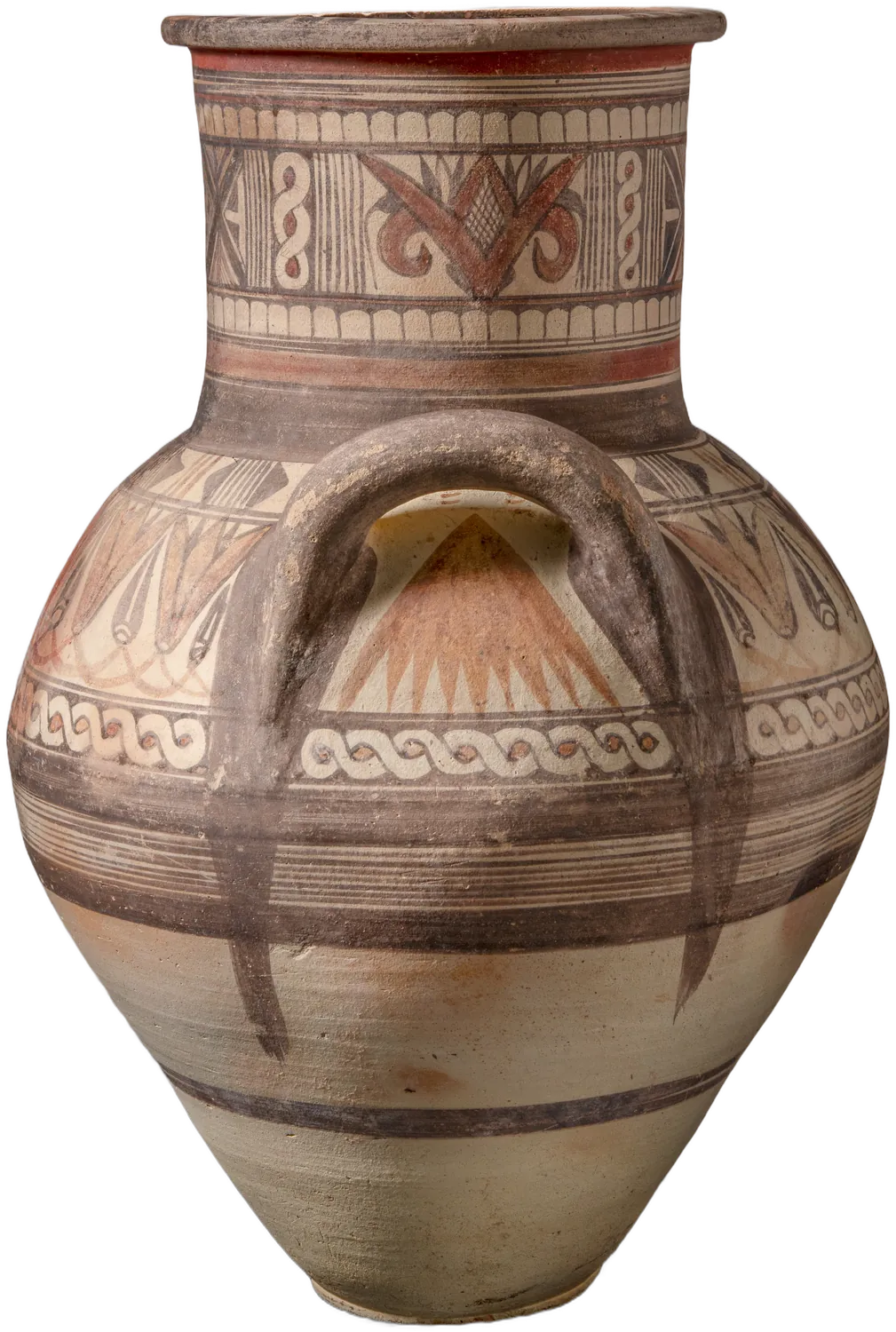
Handle
A red volute flower on the neck; a rayed triangle where the chain breaks off.
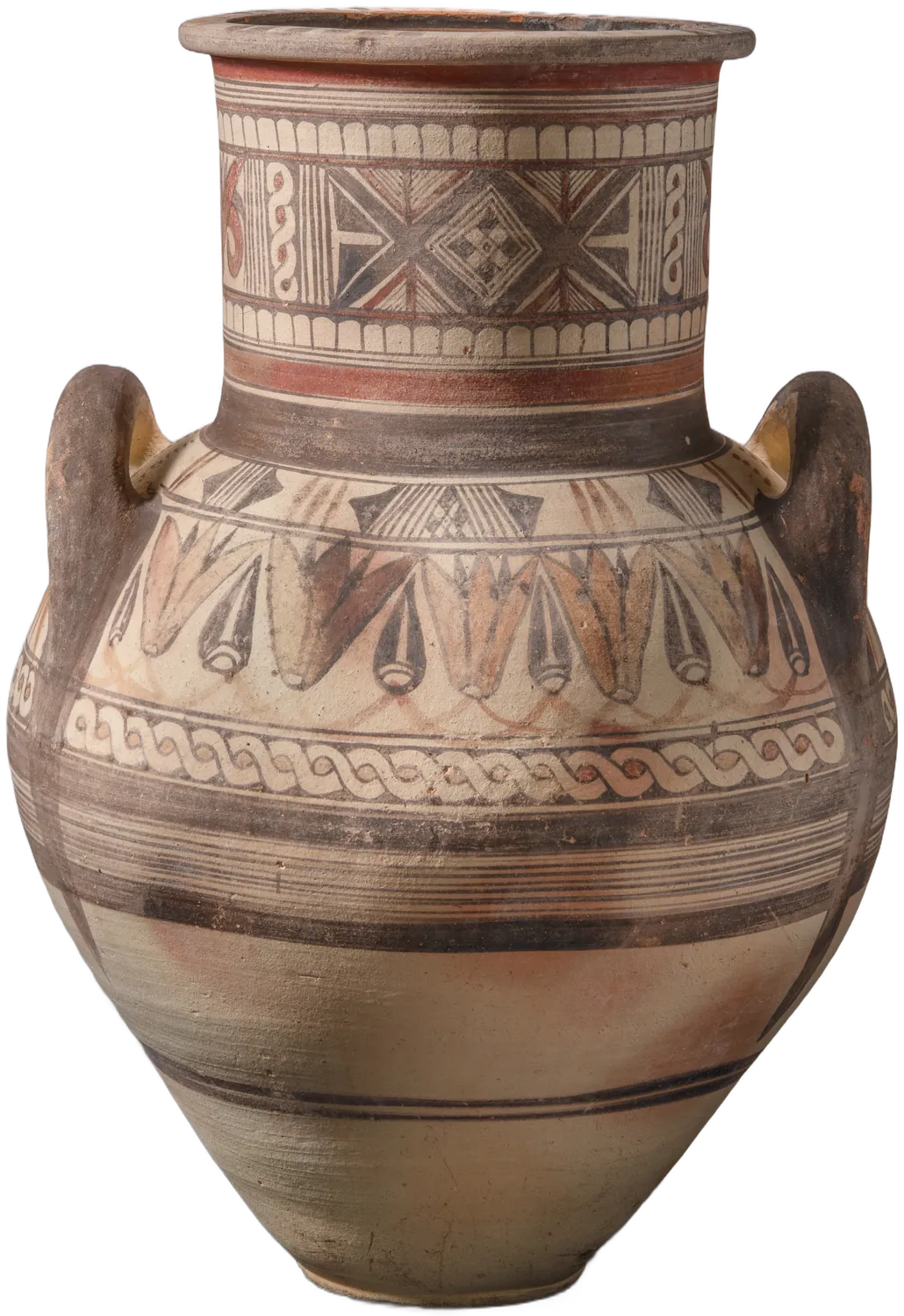
Face B
A second cross panel; the lotus chain washed mostly in brown.
IIRim to foot
Iron Age painters in Cyprus divided a big closed pot into horizontal zones and vertical panels and gave each its own motif. On this amphora the panels rule the neck and the friezes rule the shoulder. The lower body is left almost empty.
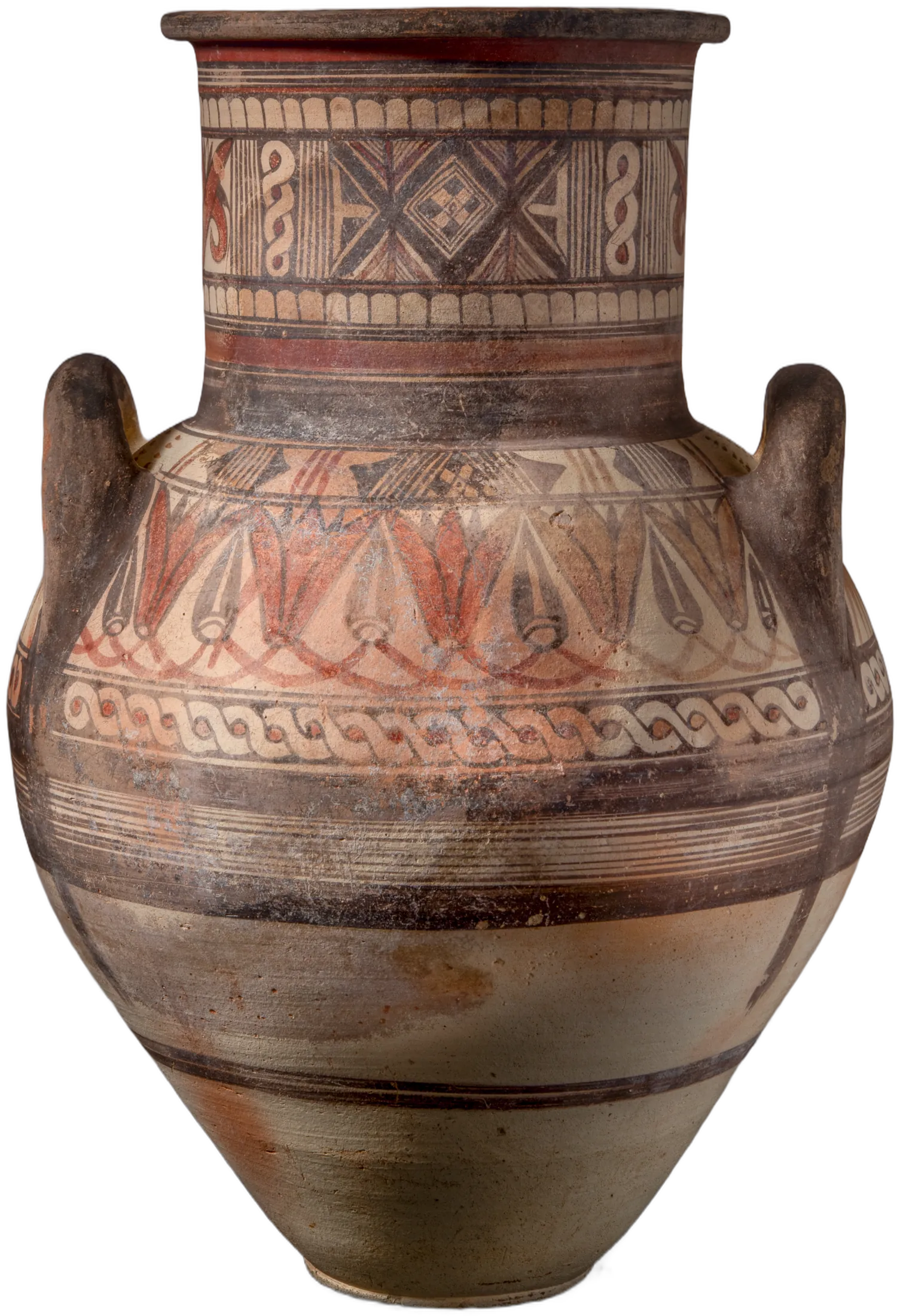
Top to bottom
The painter divided the jar into horizontal registers and gave each its own ornament, dense at the top and thinning towards the foot. Scroll, and the jar reads itself from rim to foot.
1 · Lip
The neck widens slightly to a heavy, flat rim turned outwards. Below it the painter ruled a red band and fine black lines, then a row of short strokes that leaves a string of pale tongues standing in reserve. The same row closes the neck panel below, so the main field is framed like a page between two borders.
2 · Neck
In Bichrome IV the neck of these amphorae becomes the main ornamental field, as it is here. At the centre of each face stands a square metope: a St Andrew's cross laid over concentric lozenges, round a small chequered lozenge. Columns of running S-spirals and ruled line-panels flank it. This is old Cypriot geometric ornament. A close relative of the built-up lozenge fills the central metope on Cypro-Geometric I pots from Lapithos, made more than three centuries earlier.
3 · Shoulder
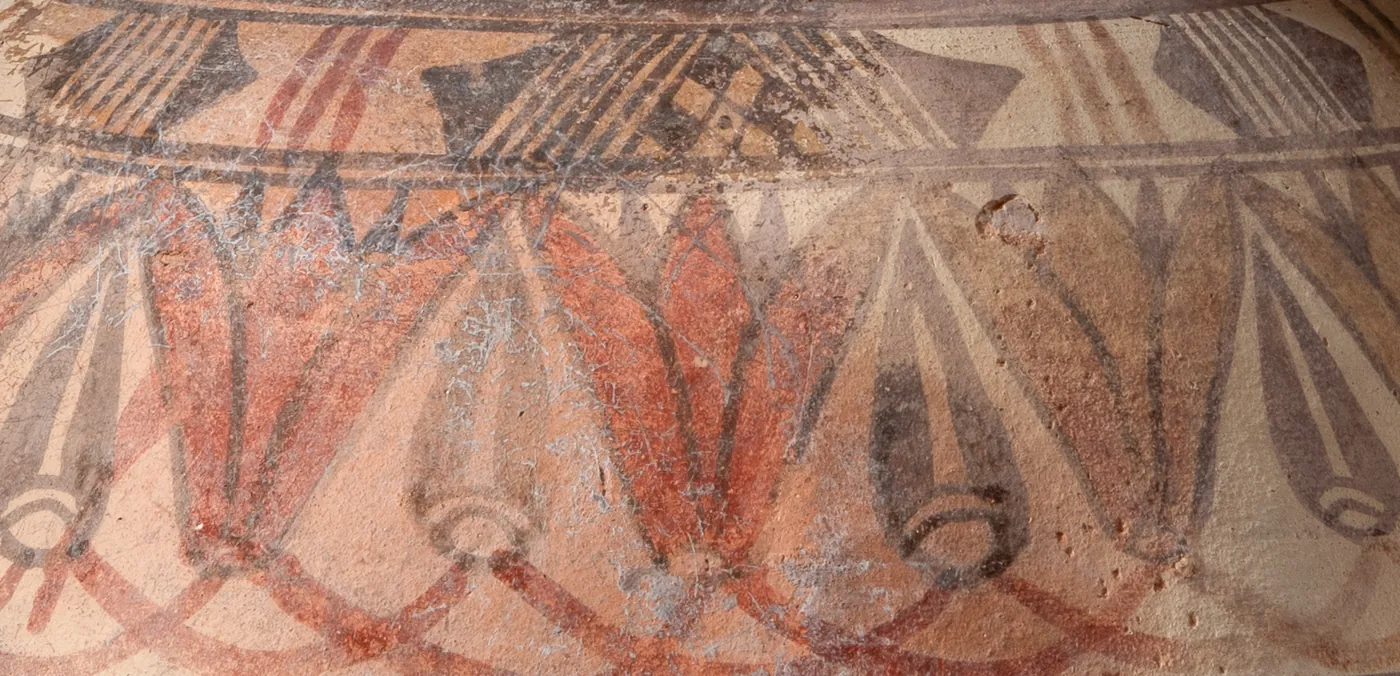
Round the shoulder runs the frieze that gives the class its name: open lotus flowers alternating with closed buds. They stand upright, each springing from a small ring, and looping stems join the rings below. The flowers are outlined in black and washed in red or brown. Every flower is drawn to the same template. Under each handle the chain gives way to a red rayed triangle.
4 · Cable
Beneath the flowers runs a cable: pale interlacing loops left in reserve against dark paint, with a red dot in the eye of each loop. After the upright, static flowers it carries the eye round the pot. The cable belongs to the guilloche family, which Gjerstad traced to the Near East; as a horizontal band it is common on Phoenician metal bowls.
5 · Bands
Then comes a block of close-set fine lines between broad dark bands, ruled right round the pot. From the lower root of each handle two dark strokes run down across them, tying the handles into the painted scheme.
6 · Body
The lower body is left plain buff, crossed by two widely spaced bands, and tapers to a low ring foot. All the dense work sits on the upper third of the jar. Gathering the ornament there and leaving the belly quiet is a mark of mature Cypro-Archaic I.
IIIBichrome
Take a detail of the jar and pull its colours apart. Each layer below was lifted from the photograph by colour alone, and the split shows how the painter shared the work between two paints.
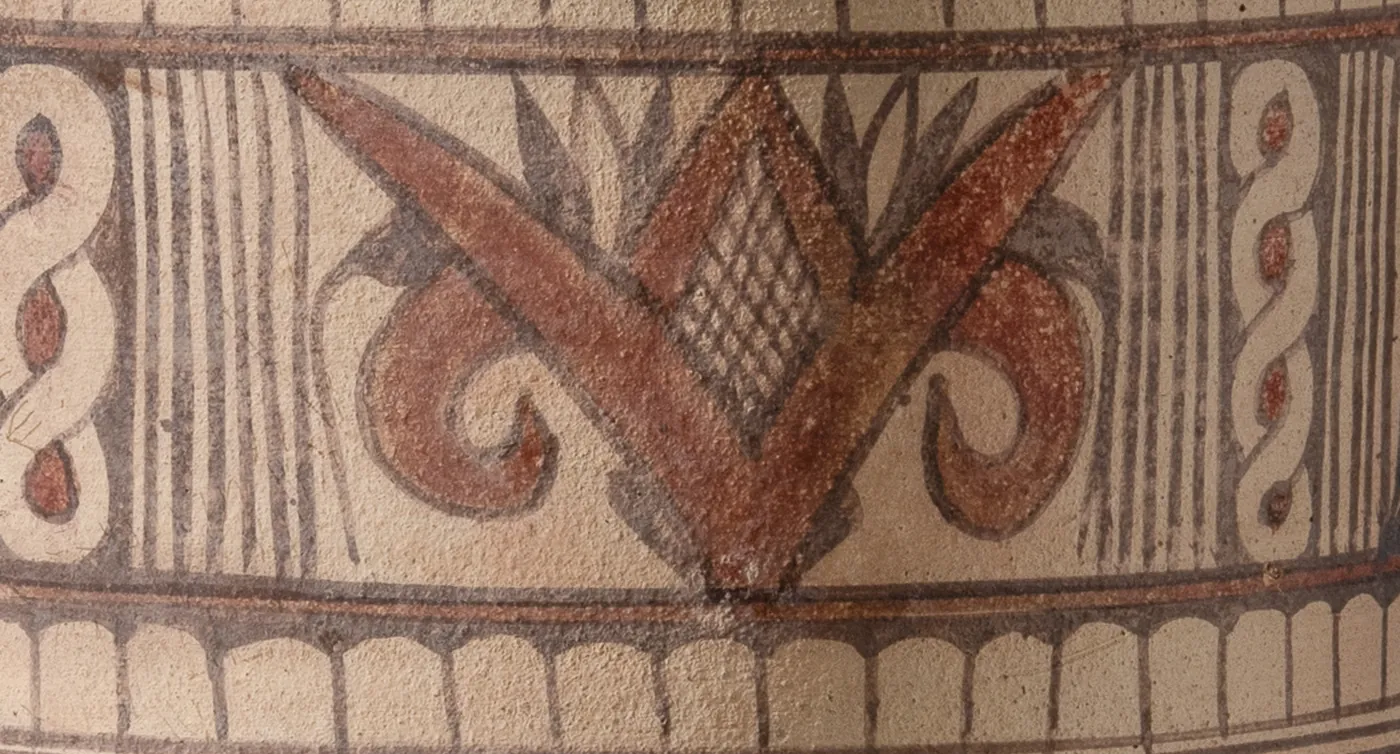
The black does the drawing: every outline, the ruled lines, the lattice in the flower's heart. The red fills: the arms and volutes of the flower, the dots in the S-spirals, the broad bands.
Bichrome means two colours on one pale ground. The black of Cypriot Bichrome is a manganese-rich earth, Cypriot umber, which stays dark in an ordinary firing with plenty of air. The red is an iron ochre, which stays red in the same firing. Aegean painters of the time made their black from fine iron-rich clay that turns black only when the kiln is starved of air. In Cyprus both colours came out of the kiln as they went in: a “what you see is what you get” approach, as Aloupi-Siotis and Lekka called it in 2017.
The paints on this jar have not been analysed. Measurements of other Cypriot Bichrome pottery find manganese in the blacks and iron in the reds.
IVThe flower
The lotus entered the Iron Age painter's repertoire late in the Cypro-Geometric period and became common in Cypro-Archaic I, the stage this jar belongs to. It arrived on objects: Phoenician and north Syrian metal bowls, ivories and textiles.
Egypt
The water-lily of the Nile
Botanically the flower is the Egyptian water-lily, Nymphaea. Egyptian artists drew it in profile: three outer petals, with smaller ones between.
Drawing of the type, after Gjerstad 1948
Phoenicia
Redrawn for metal and ivory
Phoenician and north Syrian craftsmen redrew it for metal bowls, ivories and textiles, with two lateral petals and three inner ones.
Drawing of the type, after Gjerstad 1948
Cyprus
This jar
The shoulder of face A. Every flower is drawn to one template, outlined in black, washed in red or brown and set in a chain with buds.
Photograph, detail of face A
Einar Gjerstad, who classified the pottery in 1948, found both types on Cypriot pots, with intermediate forms between them and a Cypriot preference for simplifying the flower into a diagram. The two drawings show the types as he defined them, not particular objects.
VThe label
In 1948 the Swedish archaeologist Einar Gjerstad published the classification of Cypriot Iron Age pottery that is still in use. His labels read like descriptions, and they are also dates. The name of the ware gives the technique; the Roman numeral gives the period. To call this jar Bichrome IV is already to place it in Cypro-Archaic I.
Bichrome
The ware: matt dark paint on a pale ground, with a second colour, matt red, added
IV
The period: Cypro-Archaic I
I
CG I
1050–950
II
CG II
950–850
III
CG III
850–750
IV
CA I
750–600
V
CA II
600–480
VI
CC I
480–400
VII
CC II
400–310
Cypro-Geometric, Cypro-Archaic and Cypro-Classical, in years BC as dated today
The order of Gjerstad's stages has held since 1948. The calendar years attached to them are cross-dated to the Levant and the Aegean and are still argued over. The fully developed lotus chain, the tall neck and the ornament gathered on the upper third all belong to mature Cypro-Archaic I, and a date in the 7th century BC is likely. Without a tomb group, the jar cannot be dated more closely.
VIThe workshop
Large Bichrome IV amphorae were, in the words of the Metropolitan Museum's catalogue, “common to the eastern part of Cyprus”. They were made to a formula, closely enough for catalogues to call some of them “almost certainly made in the same workshop”. The nearest published relative is in New York: amphora 74.51.972 from the Cesnola Collection, 80.3 cm high and said to be from Ormidhia, in the Larnaca district. Below, it stands beside ours and two more of the Met's series, all shown at the same height.
The Lotus Amphora
Drakopoulos Collection, London
JAR-AR-002
The twin
Metropolitan Museum of Art, New York, 74.51.972
H. 80.3 cm. Said to be from Ormidhia
Museum record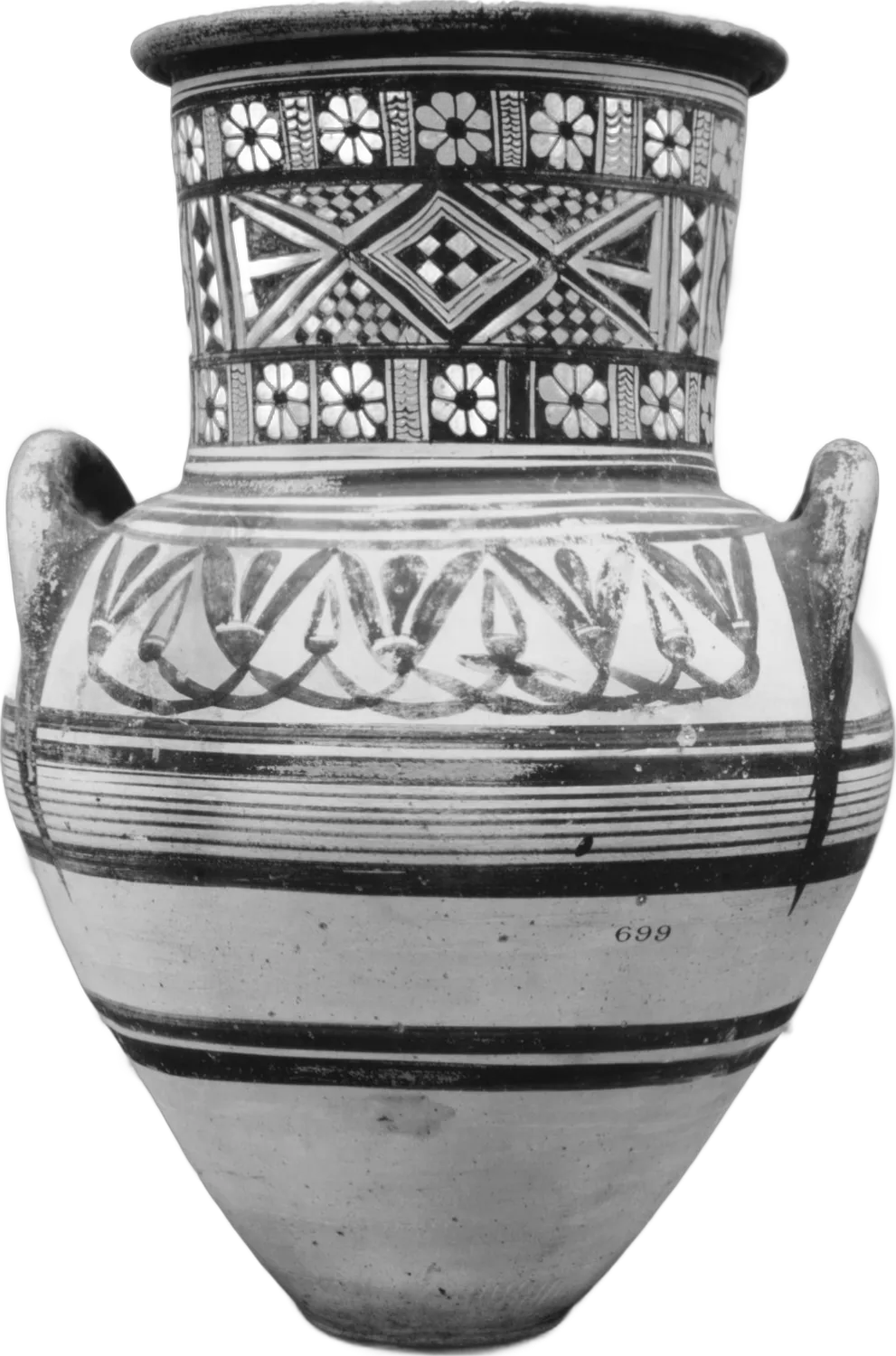
Rosettes on the neck
Metropolitan Museum of Art, New York, 74.51.978
H. 66 cm. Old photograph
Museum record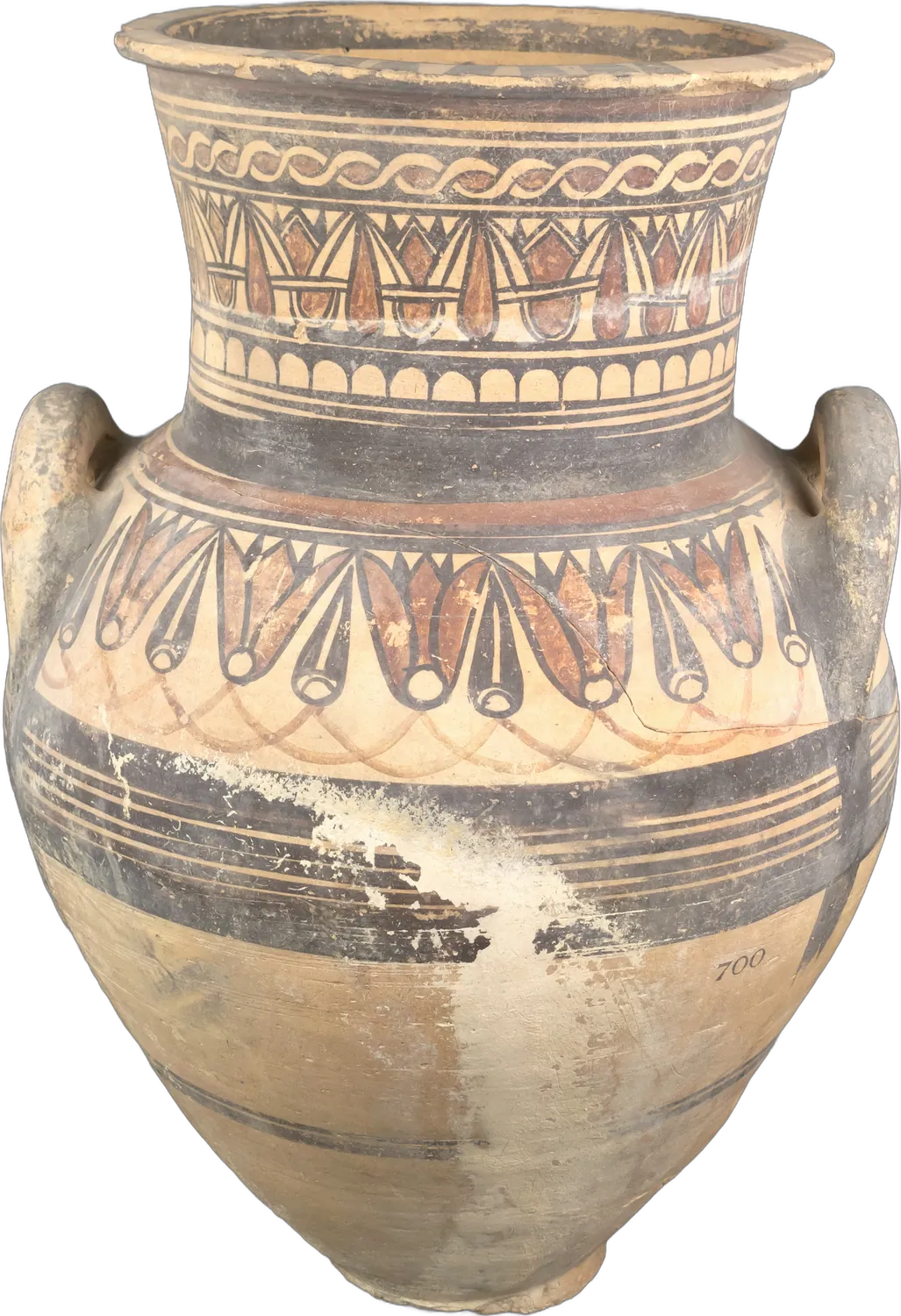
Lotus on the neck too
Metropolitan Museum of Art, New York, 74.51.981
H. 51.3 cm
Museum recordShown at the same height. The three in New York measure 80.3, 66 and 51.3 cm. Met photographs: The Metropolitan Museum of Art, Cesnola Collection (public domain).
All four carry the same shoulder chain of lotus flowers and buds, each rising from a ring, the rings joined below by looping stems. What changes is the brushwork: outlined and lightly washed on the twin, filled red and dark in alternation on 74.51.981, washed red and brown here.
Elsewhere in the family
Where the family was made is still open. The finds cluster in eastern Cyprus, and recent work ties the floral style to the workshops of Salamis and its region.
VIIStaying put
Cypriot pottery did travel in these centuries, mostly as small juglets of perfumed oil bound for the Levant, Cilicia and the Aegean. Big painted amphorae like this one rarely left the island; a few fragments of the floral style have turned up on the Levantine and Cilician coasts. Vessels of this size were storage jars that ended their use in chamber tombs, and whole examples survive almost only because they were buried. What they held, whether wine, oil or grain, has not been established by residue analysis for the class.
This jar's find-spot is unknown. If it came from a tomb, as most whole jars of its size did, that tomb is lost with it. What survives is the formula and one painter's handling of it: the lotus chain of its New York twin, and under it a cable band that the twin leaves out.
VIIIProvenance
This one did leave the island in the end. How and when is unknown, but its written history begins in a London saleroom in November 1926. From there a chain of names runs to today, with one gap in the middle.
11 November 1926
Lot 23 on the first day of a sale of Egyptian, Greek, Roman and Cypriot antiquities, illustrated on Plate III and described as “A Diota … on the shoulders a broad band of lotus flowers above a narrow band of guilloche”. The cataloguer called it “Kition fabric” and dated it to the 8th century BC.
Trace the 1926 sale yourselfFrom 1926
The buyers' list printed at the back of the catalogue gives the name, and nothing more. Zachariades bought all four of the big two-handled jars in the sale. We know nothing else of this buyer, nor when the jar changed hands again.
Until 1974
By the time of his death in 1974 the jar was in the collection of Edward Varley Kayley. It stayed with his family for another fifty years.
4 July 2024
The jar came back to a London saleroom as “A large Cypriot Bichrome Ware amphora decorated with lotus flowers”, from Kayley's collection and by descent. That catalogue did not mention 1926; the old plate and lot description supply the link.
2024–25
With the London gallery from the day of the sale until January 2025.
January 2025
Nearly a century after the lot was first catalogued, it is catalogued again, as JAR-AR-002.