
Early Bronze Age II
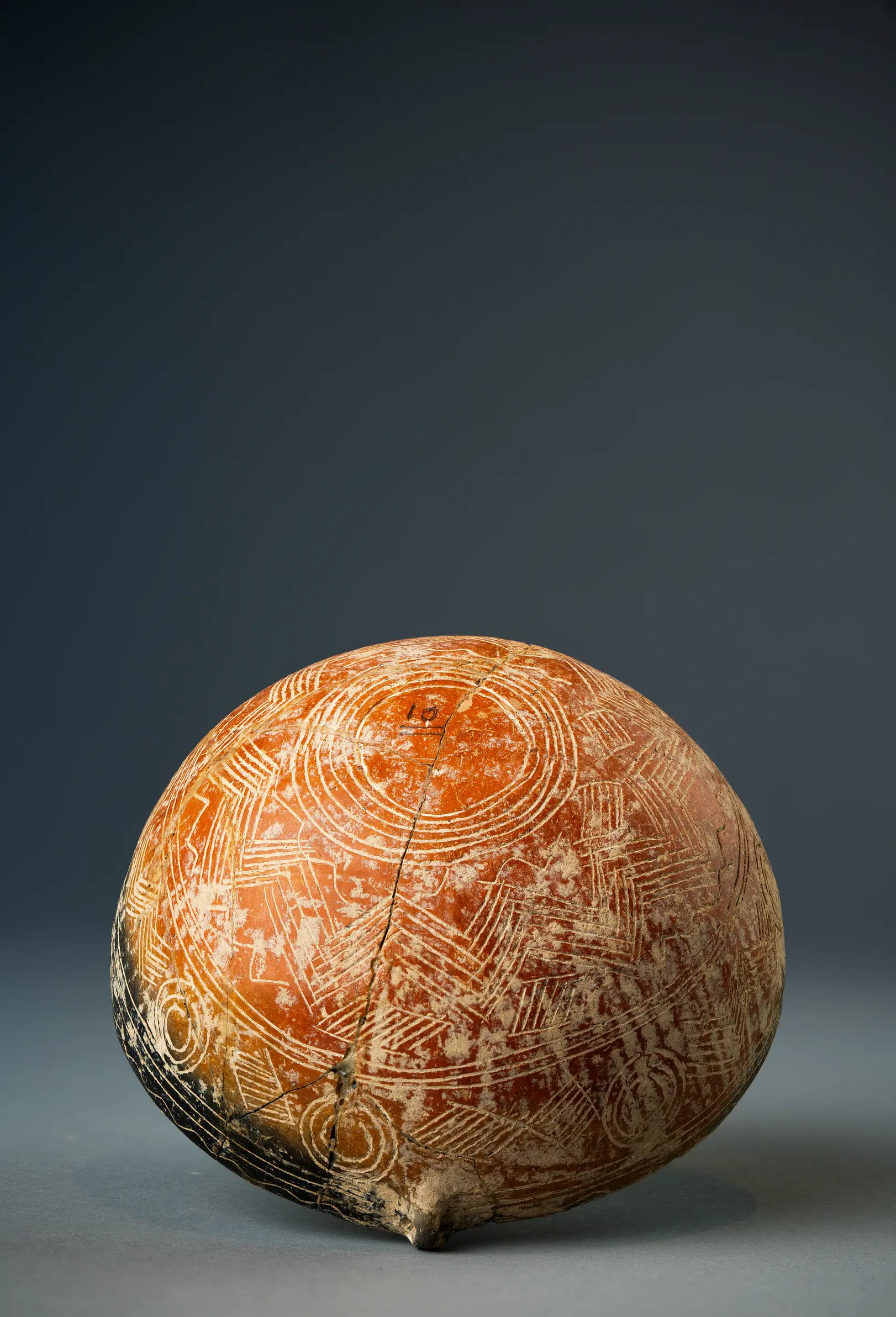
Red Polished Knob-lug Bowl with Incised Concentric Circles and Hatched Chevrons
Deep Red Polished knob-lug bowl covered in white-filled incision: a concentric-circle target on the base, panels of hatched chevrons, and small circle groups near a black-fired rim.
Date
2200 - 1900 BC
Accession No.
BWL-BA-003
Collection
Alexis Drakopoulos
Provenance
- 1960s–2025, The Goodman Collection (acquired 1965–1969)
- 2025–present, Alexis Drakopoulos, London
Early Cypriot II–Middle Cypriot I, c. 2200–1900 BCE · Red Polished ware, black-topped rim · Hand-made, incised, lime-filled
A deep, almost globular bowl with a rounded base, photographed upside down so that the base forms the crown and a small knob lug on the rim points downward. The orange-red slip is burnished to a soft sheen, and a narrow band of black firing runs along the rim. The whole outside is covered with white-filled incision. A target of five or six concentric circles is centred on the base. Around it the body is divided into panels of hatched chevrons and bands of parallel strokes, and smaller groups of concentric circles sit near the rim. White fill survives in nearly every groove and has smeared over parts of the surface. An old ink number, 10, is written on the base. A long crack runs from base to rim, with a second branch at the lower left.
Commentary
The hemispherical body, single rim lug and incised decoration make this a decorated knob-lug bowl, Stewart's Class XIII F in its incised variant (F3) [1]. The plain version of the same bowl was among the commonest vessels in north-coast Early Cypriot tombs: Kehrberg counted 43 examples in one Vounous tomb and 59 in one tomb at Lapithos-Palealona. Decorated examples are far fewer, from one to nine in a tomb [2].
The closest parallel is a small bowl in Cambridge from Pano Dhikomo-Mavro Nero, 1951.1084 A, with a pierced lug, a black interior, incised lines round the rim and eight concentric circles joined by lines and dashes [3]. Manchester Museum 35197, from Vounous Tomb 139, has the same red body shading to a black top and interior, white-filled incision and a pierced lug, and is dated Early Cypriot III–Middle Cypriot I [4]. Two bowls from Nicosia-Ayia Paraskevi in the British Museum, 1888,0927.16 and .17, combine a single pierced lug with hatched bands, zigzags and arcs and are dated about 2100–1900 BCE [5]. Concentric circles were among the favourite Red Polished motifs at Vounous [6].
Knob-lug bowls were made over a long period, from Early Cypriot II into Middle Cypriot I [7]. The deep near-globular profile and the all-over zoned decoration point to the later part of that range, and the closest parallels cluster in Early Cypriot III–Middle Cypriot I. Without a find context, c. 2200–1900 BCE is the safer bracket, with the later end more likely. Red Polished workshops on the north coast used white-filled incision far more than those in the centre and south, but the Dhikomo parallel is a reminder that decorated bowls were not confined to Vounous. The find-place of this bowl is unrecorded.
The circle target on the base is set where it would be seen when the bowl was turned over, hung by its lug or held up to drink. That suggests the underside was meant to be looked at, although how these bowls were displayed or stored is an inference from their decoration. Small bowls of this kind are usually taken as cups for drinking or for small offerings; their contents are unknown. The ink number on the base is an old collection mark whose origin has not been established.
References
- 1.Stewart, J.R. (1962) The Early Cypriote Bronze Age. In The Swedish Cyprus Expedition IV.1A. Lund: Swedish Cyprus Expedition, Index of Types, pp. 303–348 (Class XIII F).
- 2.Kehrberg, I. (1982) Early and Middle Cypriote Chronology Again. Levant 14, pp. 59–72.
- 3.Museum of Archaeology and Anthropology, Cambridge, 1951.1084 A. Red Polished hemispherical bowl with pierced lug, Pano Dhikomo-Mavro Nero. Collection record.
- 4.Manchester Museum, 35197. Red Polished bowl, Bellapais-Vounous cemetery B, Tomb 139 no. 31. Collection record.
- 5.British Museum, London, 1888,0927.16 and 1888,0927.17. Red Polished knob-lug bowls, Nicosia-Ayia Paraskevi. Collection records.
- 6.Dikaios, P. (1940) The Excavations at Vounous-Bellapais in Cyprus, 1931–2. Archaeologia 88, p. 131.
- 7.Åström, P. (1966) Excavations at Kalopsidha and Ayios Iakovos in Cyprus. SIMA 2. Lund, pp. 158–169.
More from the Catalogue
Browse related objects
Bichrome Kylix with Bird Free Field Art
Geometric III
Milk bowl
Bronze Age
Bowl
Geometric III
Krater
Archaic I
Handle of a bowl
Bronze Age
Bowl
Geometric I
Bowl
Bronze Age
Terracotta bowl
Chalcolithic
Silver bowl
Archaic I
Alabaster bowl
Classical
Bronze phiale (libation bowl)
Archaic II
Bowl fragment, inscribed
Archaic II
Bowl
Bronze Age
Bowl
Archaic I
Bowl
Late Bronze Age II
Bowl
Geometric III
Terracotta footed bowl
Archaic I
Marble bowl fragment with Phoenician inscription
Classical