
Early Bronze Age II
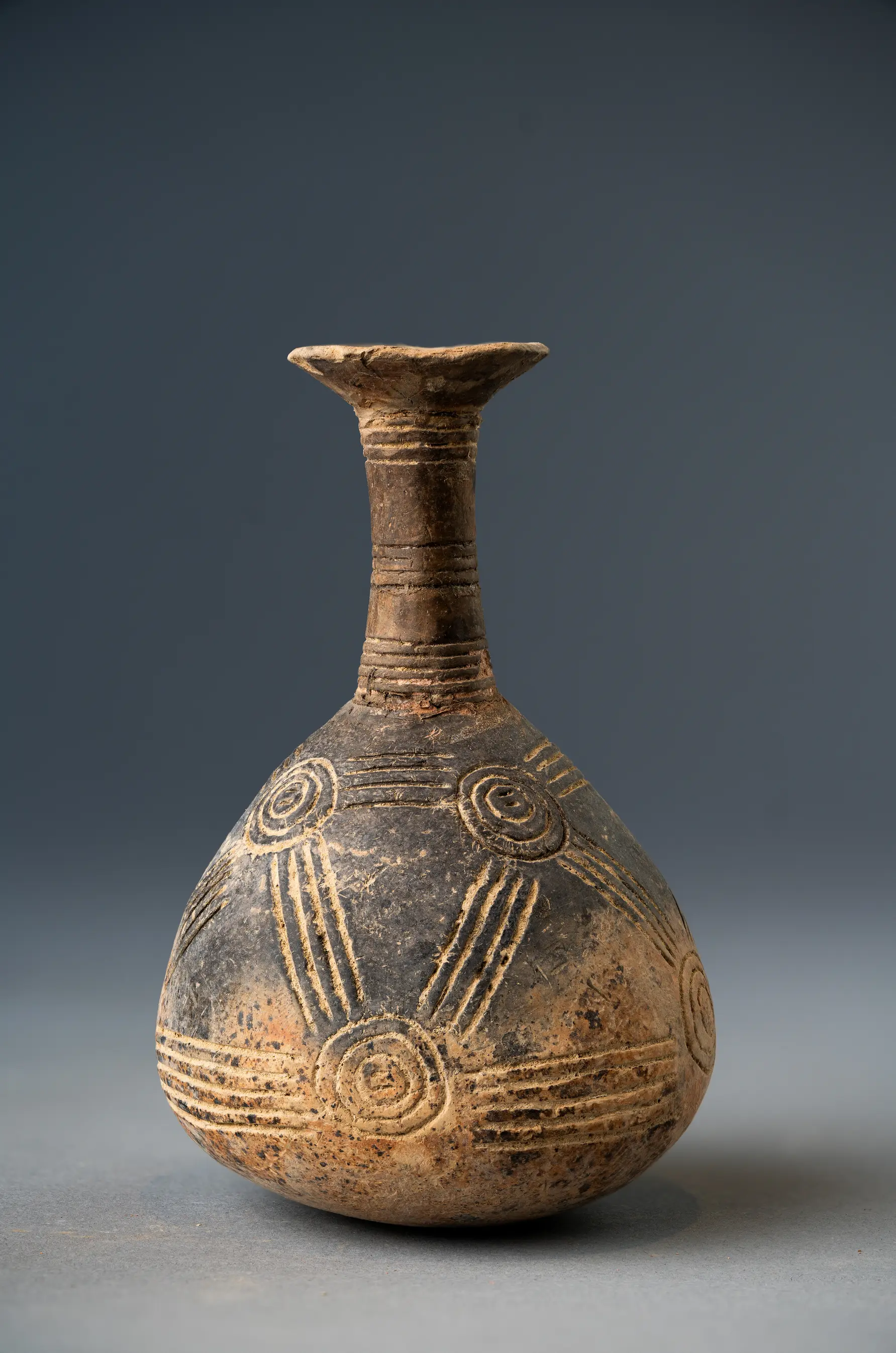
Red Polished Bottle with Linked Concentric Circles
Pear-shaped Early Cypriot Red Polished bottle incised with large concentric circles linked by bands of parallel lines into a net-like pattern.
Date
2300 - 2000 BC
Accession No.
BTL-BA-003
Collection
Alexis Drakopoulos
Provenance
- 1960s–2025, The Goodman Collection (acquired 1965–1969)
- 2025–present, Alexis Drakopoulos, London
Early Cypriot, c. 2300–2000 BCE · Red Polished ware · Handmade, incised with white fill
A pear-shaped bottle with a rounded base, a tall narrow neck and a broad, flat, disc-like rim. The surface is dark: grey to grey-black over the shoulder and upper body, browner on the neck, and shading on the lower body into a mottled buff and orange-brown scattered with black specks. The slip is worn and now mostly matt.
The incised scheme is bold and geometric. Three groups of horizontal lines divide the neck. On the shoulder sits a tier of large concentric circles, three or four rings each, and a second tier sits low on the body. Bands of four or five parallel lines run diagonally from each upper circle down to the lower ones, forming a net of triangles around the pot, and groups of horizontal lines run out sideways from the lower circles. Short line-groups fill the gaps between the shoulder circles. The grooves show pale against the dark surface, though the white fill is thin or lost in places. The rim edge is chipped.
Commentary
The bottle belongs to the incised Red Polished bottles of the Early Bronze Age that were made in large numbers on the north coast of Cyprus and are best known from the cemetery of Bellapais-Vounous [1][2]. Its shape, with a pear-shaped body, tall neck and wide everted rim, is that of the handleless bottles traded from the north coast to sites across the island around 2200 BCE [2][3]. Its decoration, large concentric circles tied together by bands of parallel lines, is the scheme that sets it apart from the other two bottles in this collection.
The same idea appears on several published pieces. The Teece Museum flask in Christchurch (51.57), black on its upper half and dated by the museum to the 21st century BCE, has concentric circles on two levels linked by groups of four lines into a repeating triangle pattern; the museum reads the design as a stylised carrying net with the circles as its knots [4]. That reading is attractive for this bottle too, though it cannot be proved. A jug from Vounous Tomb 65 in the Louvre (AO 17530, H. 14 cm) is decorated with "groups of parallels linking concentric circles" and is dated to 2300–2000 BCE [5], and a Vounous juglet in Cambridge (1951.1078 A) has concentric circles and parallel lines arranged in triangular patterns, with lime surviving in the grooves [6]. The two museum parallels from Vounous are handled vessels, which shows that the linked-circle design was shared across shapes within the same north-coast tradition.
The ware is harder to pin down than on the other two bottles. The dark upper body and lighter, mottled lower body suggest a black-topped firing like theirs, but the slip is so worn that the original contrast is now soft, and the firing may simply have been more reduced overall. Herscher described a south-coast Brown Polished ware of fine grey-brown fabric with a thin dark slip, used mostly for small bottles in Early Cypriot III and Middle Cypriot I [2]. Brown Polished decoration, however, runs to bands filled with lines, dots and short strokes, and the large linked circles here favour a north-coast Red Polished attribution.
A date of about 2300–2000 BCE follows from the parallels and from the dating of the north-coast bottle series as a whole [2][3]. The find-spot is unknown. The side photographed shows no string-holes or handle scar; the reverse and the height are still to be recorded.
References
- 1.Stewart, J.R. (1962) The Early Cypriote Bronze Age. The Swedish Cyprus Expedition IV.1A. Lund: Swedish Cyprus Expedition.
- 2.Herscher, E. (1991) 'Beyond Regionalism: Toward an Islandwide Early and Middle Cypriot Sequence.' In J.A. Barlow, D.L. Bolger and B. Kling (eds), Cypriot Ceramics: Reading the Prehistoric Record. Philadelphia: University Museum, pp. 45–50, esp. 46–47.
- 3.Swiny, S., Rapp, G. and Herscher, E. (eds) (2003) Sotira Kaminoudhia: An Early Bronze Age Site in Cyprus. CAARI Monograph 4. Boston: American Schools of Oriental Research, cat. P74, fig. 4.11.
- 4.Teece Museum of Classical Antiquities, University of Canterbury, Christchurch, 51.57, Red Polished flask (collection record).
- 5.Musée du Louvre, Paris, AO 17530, Red Polished jug from Bellapais-Vounous Tomb 65 (collection record).
- 6.Museum of Archaeology and Anthropology, University of Cambridge, 1951.1078 A, Red Polished juglet from Bellapais-Vounous (collection record).
More from the Catalogue
Browse related objects
Alabaster alabastron (perfume vase)
Archaic II
Terracotta bottle
Middle Bronze Age II
Alabaster alabastron (perfume vase)
Archaic II
Alabaster unguentarium
Hellenistic
Bottle
Classical
Rock crystal bottle
Classical
Terracotta spindle bottle
Late Bronze Age II
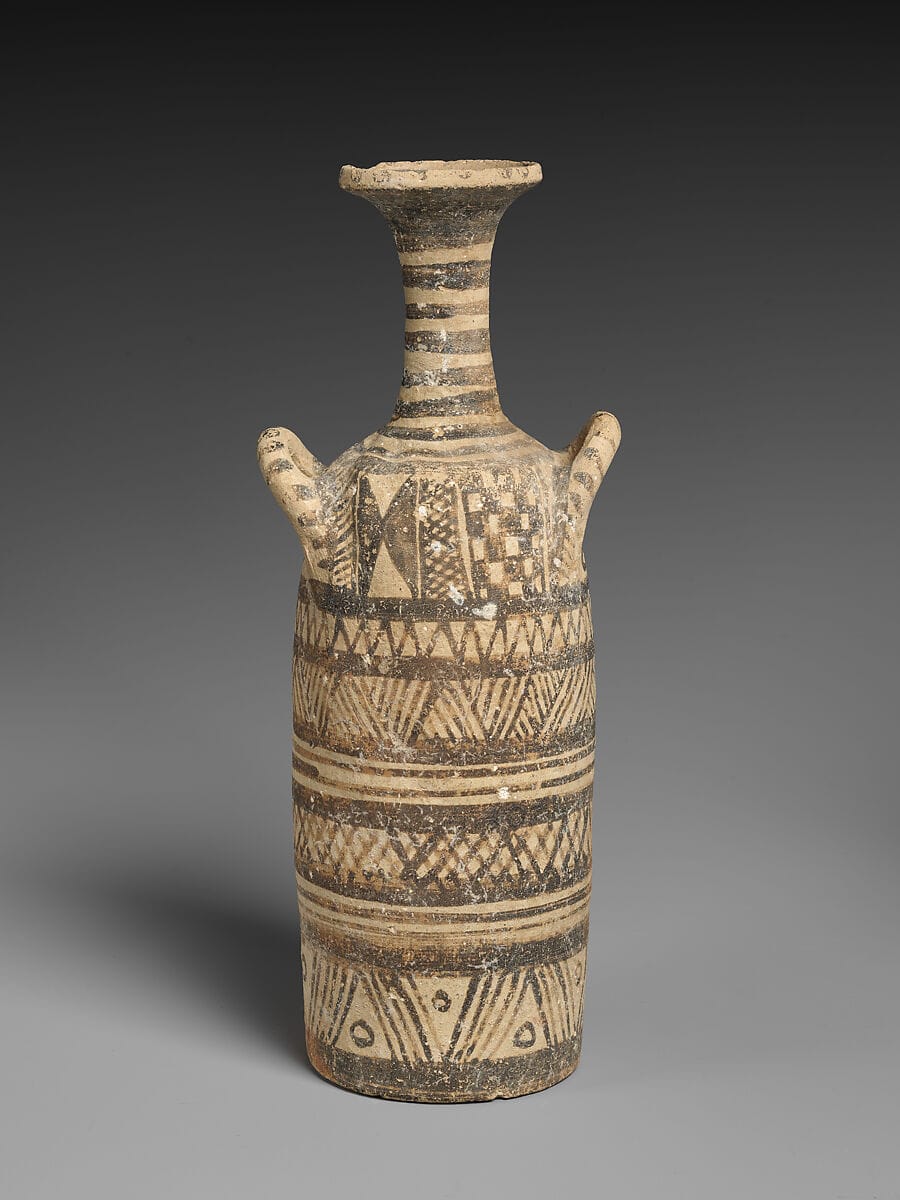
Terracotta bottle
Late Bronze Age III
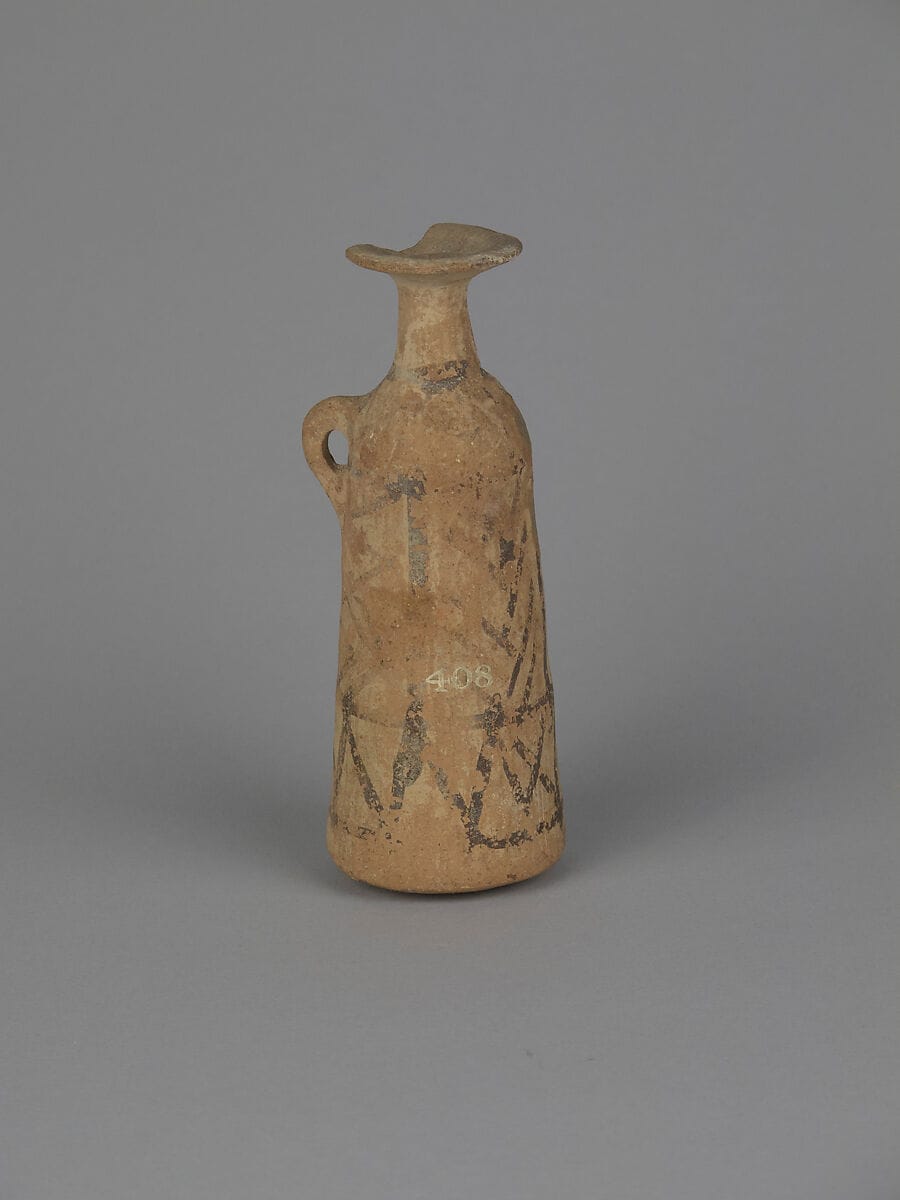
Bottle
Late Bronze Age III
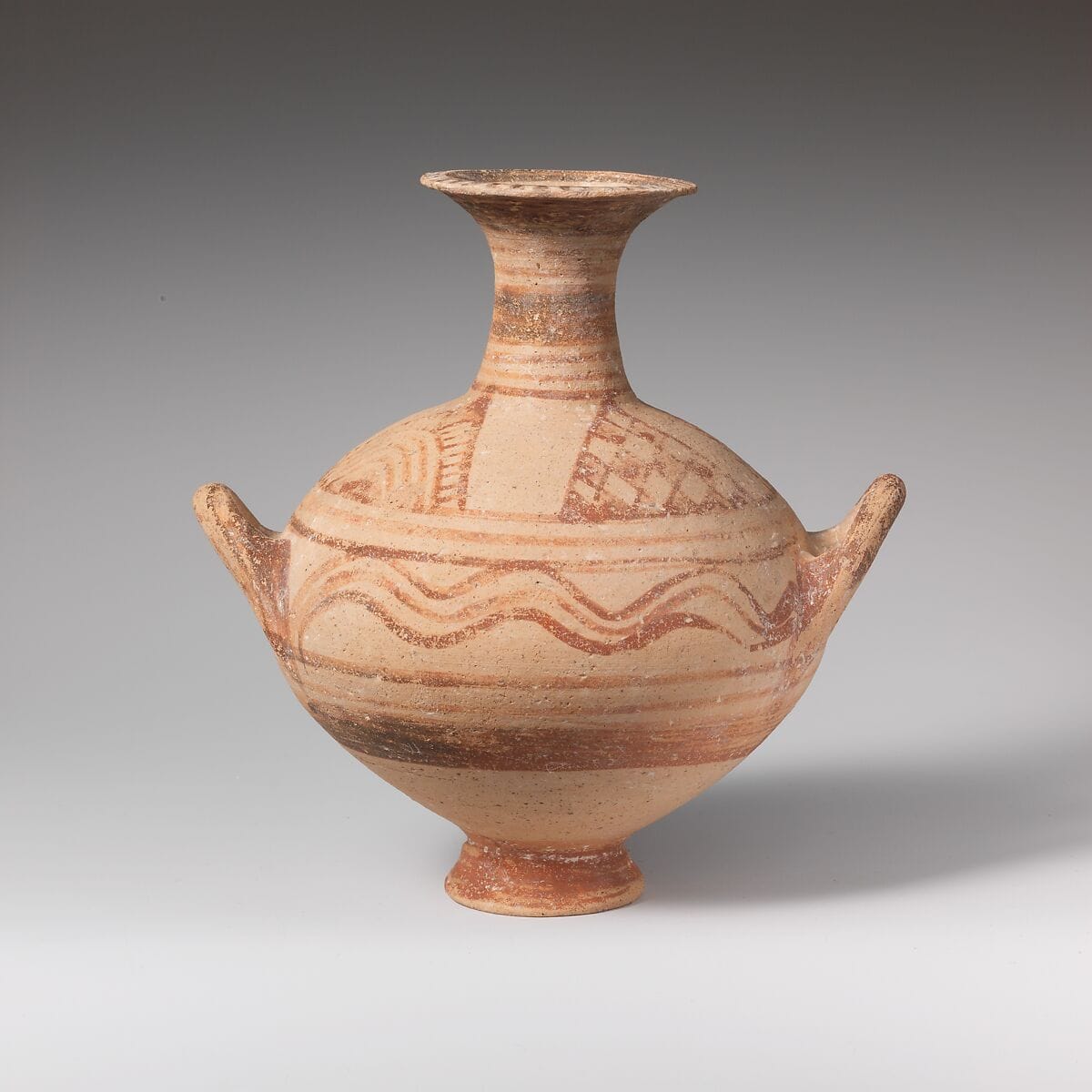
Terracotta globular bottle with two handles
Late Bronze Age III
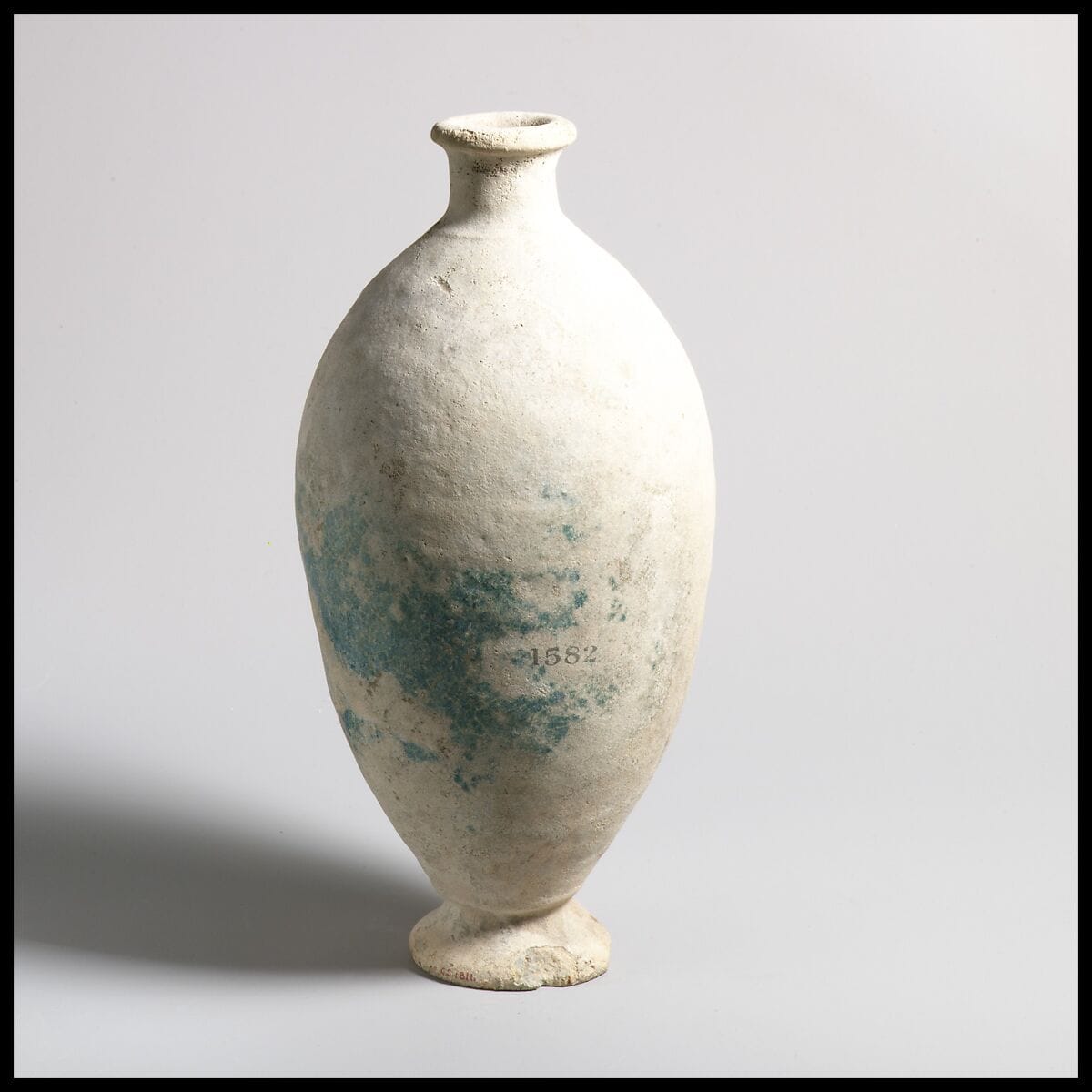
Bottle
Late Bronze Age II
Bottle
Late Bronze Age II
Black Polished Bottle
Early Bronze Age II
Red Polished Bottle
Early Bronze Age II
Black Polished Miniature Bottle
Middle Bronze Age I
Black Polished Miniature Bottle
Middle Bronze Age I
Black Polished Miniature Bottle
Middle Bronze Age I
Red Polished Miniature Bottle
Middle Bronze Age II