
Early Bronze Age II
Red Polished Hemispherical Bowl with Two Rim Lugs
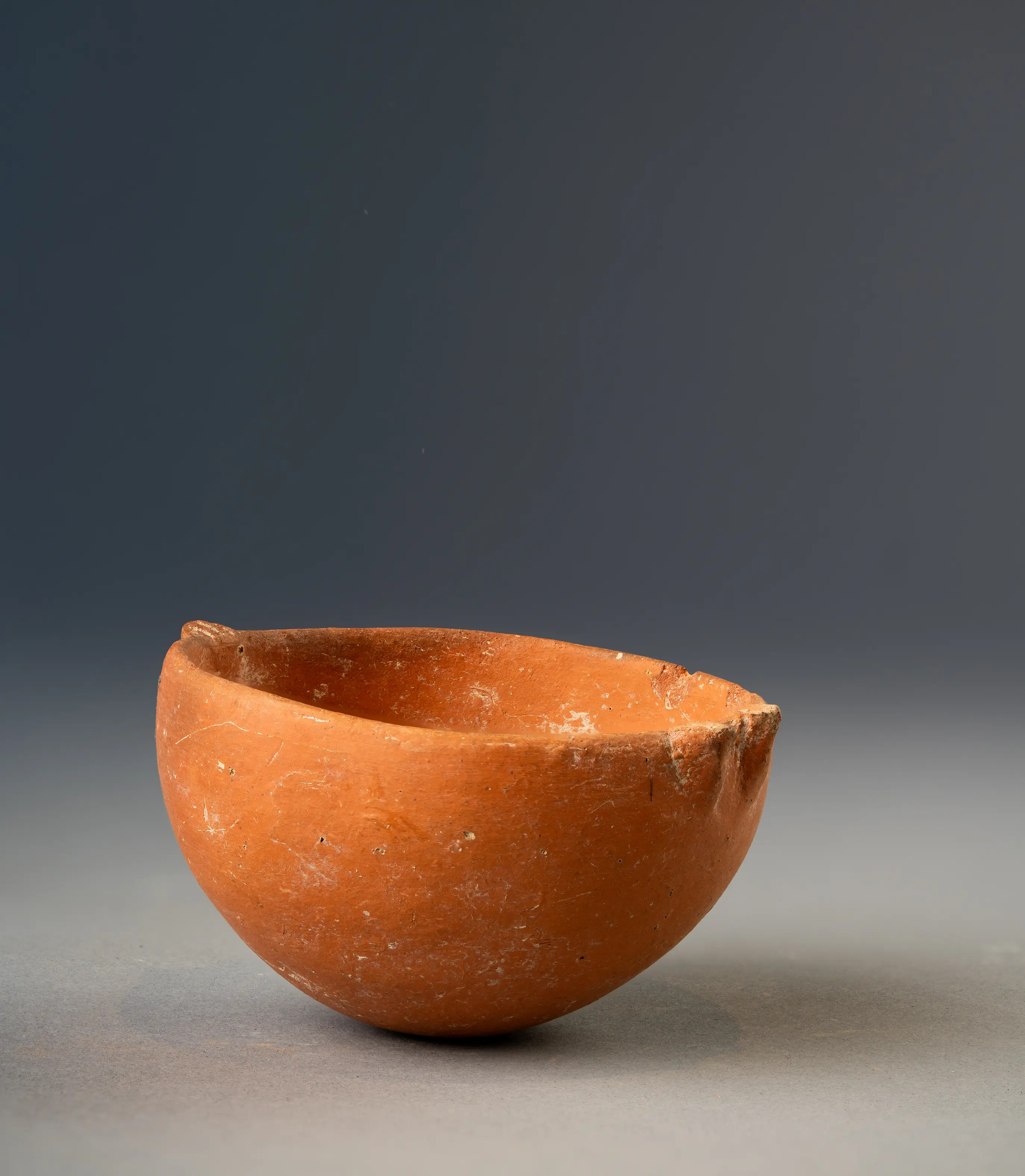
Hand-made Red Polished hemispherical bowl in an even, bright orange-red burnished slip, with two small lugs set roughly opposite on the rim.
Date
2200 - 1900 BC
Accession No.
BWL-BA-007
Collection
Alexis Drakopoulos
Provenance
- By 1965–1969, The Goodman Collection
- 2025–present, Alexis Drakopoulos, London
Early Cypriot II–Middle Cypriot I, c. 2200–1900 BCE · Red Polished ware · Hand-made
A hemispherical bowl with a rounded base and a thin, plain rim, its profile full and even. Two small lugs project from the rim at roughly opposite points. One is a low, rounded nub. The other is a larger tab pinched up from the rim and notched along its top edge, where the clay appears to have broken away; a small chip in the rim sits beside it.
The slip is unusually bright: an even, saturated orange-red over the whole exterior and interior, smoothly burnished, with only light scratches and a scatter of pale lime specks from burial. Faint burnishing strokes are visible inside below the rim.
Commentary
The bowl is a plain Red Polished hemispherical bowl of Stewart's Class XIII F [1]. The usual form has a single knob lug at the rim, often pierced as a string-hole; this example has two, which places it with the two-lug variant that Morris illustrates beside the one-lug bowls [5]. A bowl in Cambridge, undecorated and with two lugs on the rim, is a close structural parallel [3]. Neither lug shows a clear piercing from the side shown here, and the notched top of the larger lug may be the remains of a string-hole that has broken through.
The date follows the long life of the type, c. 2200–1900 BCE. A one-lug bowl of the same shape from Nicosia-Ayia Paraskevi in the British Museum is dated c. 2150–1950 BC [2], and another from Kamarouthkia in Cambridge, with the same slightly inturned rim, is described as possibly of the Red Polished III group [4]. That difference in label illustrates a standing problem: Stewart's sub-wares I to IV mix fabric, date and region, and Merrillees noted that the knob-lug bowl Stewart assigned to Red Polished II is in practice mostly Red Polished III [6]. The bowl is best described simply as Red Polished ware.
What sets this piece apart is its surface. The even orange-red colour shows a firing that stayed oxidising all round the pot, without the black rim of the black-topped bowls or the dark fire-clouds of the mottled ones, and the burnish survives with little wear or deposit. Such bowls probably served for individual portions of drink or food [5]. The find-place is unrecorded.
References
- 1.Stewart, J.R. (1962) The Early Cypriote Bronze Age. The Swedish Cyprus Expedition IV.1A. Lund: Swedish Cyprus Expedition, Index of Types, Class XIII F.
- 2.British Museum, 1888,0927.9. Red Polished I–II (mottled) hemispherical bowl with one pierced lug, Nicosia-Ayia Paraskevi, c. 2150–1950 BC. Collection record.
- 3.Museum of Archaeology and Anthropology, Cambridge, 1951.2000 H. Undecorated Red Polished hemispherical bowl with two pierced lugs on the rim, dated in the record only as Bronze Age or Early Iron Age. Collection record.
- 4.Museum of Archaeology and Anthropology, Cambridge, 1951.1097. Red Polished hemispherical bowl with one horizontally pierced lug, possibly Red Polished III, Kamarouthkia, 89 × 53 mm. Collection record.
- 5.Morris, D. (1985) The Art of Ancient Cyprus. Oxford: Phaidon, pp. 69–72, pls 115–116.
- 6.Merrillees, R.S. (1991) In J.A. Barlow, D.L. Bolger & B. Kling (eds), Cypriot Ceramics: Reading the Prehistoric Record. University Museum Monograph 74. Philadelphia: University Museum, p. 263.
More from the Catalogue
Browse related objects
Bichrome Kylix with Bird Free Field Art
Geometric III
Milk bowl
Bronze Age
Bowl
Geometric III
Krater
Archaic I
Handle of a bowl
Bronze Age
Bowl
Geometric I
Bowl
Bronze Age
Terracotta bowl
Chalcolithic
Silver bowl
Archaic I
Alabaster bowl
Classical
Bronze phiale (libation bowl)
Archaic II
Bowl fragment, inscribed
Archaic II
Bowl
Bronze Age
Bowl
Archaic I
Bowl
Late Bronze Age II
Bowl
Geometric III
Terracotta footed bowl
Archaic I
Marble bowl fragment with Phoenician inscription
Classical