
What Is My Cypriot Antiquity Worth? Real Auction Prices
A Cypriot pot can sell for 70 pounds and a limestone head for 150,000 dollars. Real auction lots show how ware, condition and provenance set the price.

Alexis Drakopoulos
October 3, 2026·Guides · Collecting · Ceramics·16 min read


Share


Alexis Drakopoulos is a Greek Cypriot Machine Learning Engineer working in Financial Crimes. He is passionate about Archeology and making it accessible to everyone. About Me.
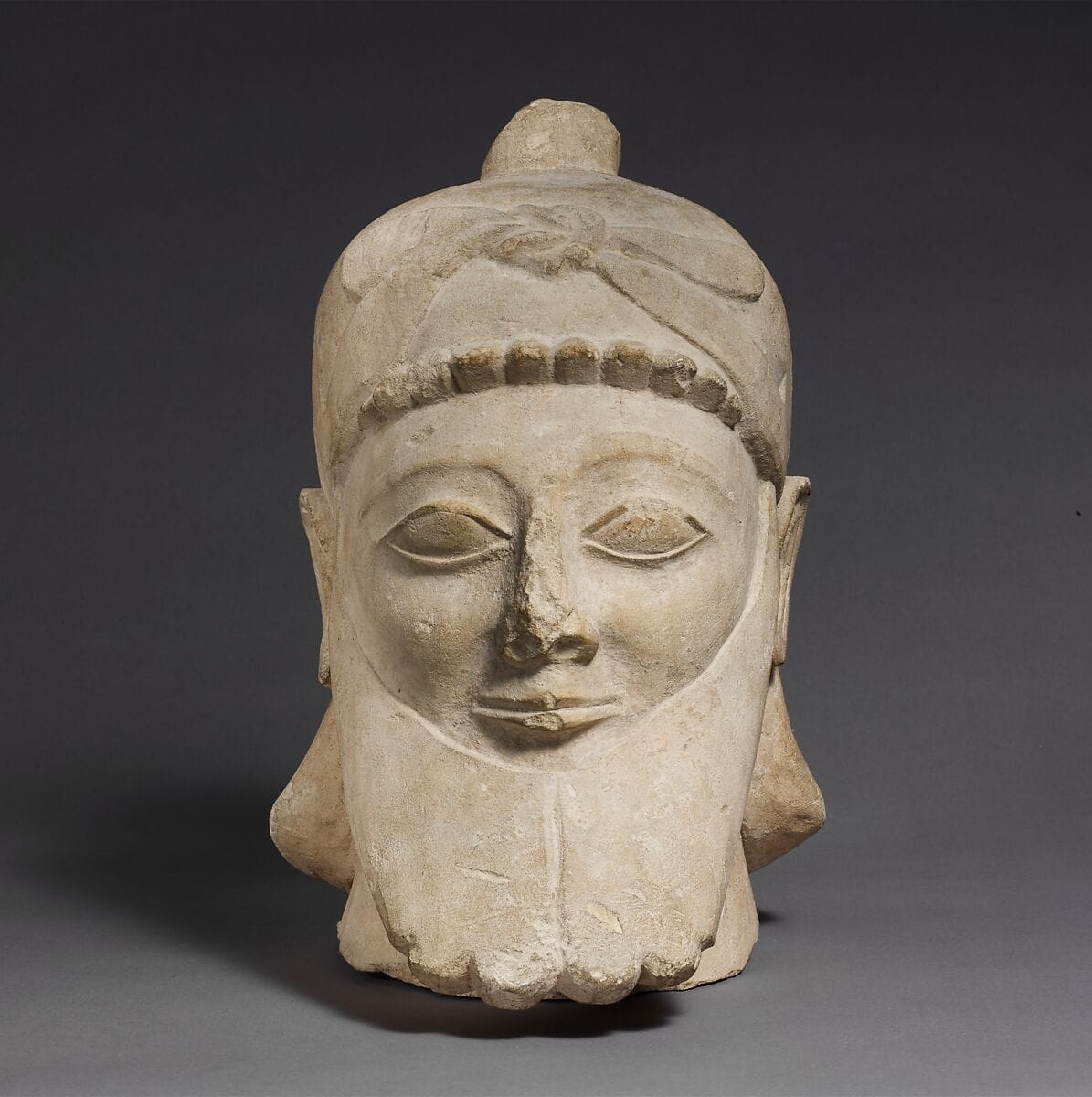
In 1870 Luigi Palma di Cesnola's workmen dug a bearded limestone head in a pointed helmet out of the sanctuary of Apollo at Golgoi. The Metropolitan Museum sold it in 1928, it passed through private hands and the art market in Maryland, and in April 2017 Christie's New York offered it as lot 232, 42.5 cm high, with an estimate of 25,000 to 35,000 dollars [2]. It sold for 150,000 dollars and went to the Harvard Art Museums [1]. Seven years later TimeLine Auctions sold an Iron Age painted dish whose base carries a red ink number suggesting it too had once belonged to the Metropolitan Museum. It made 70 pounds.
Both objects are ancient and Cypriot, and both apparently passed through the same museum. This guide explains what opened the gap between them: the kind of object, its condition, its documented history and where it is sold. It gives real public auction results for each common class, with house, sale, lot and price, and explains how formal valuations work. We do not issue valuations ourselves; we identify pieces free of charge and point owners to qualified appraisers.
What makes a Cypriot antiquity valuable?
Age alone adds very little: most Cypriot antiquities on the market are between 2,000 and 4,500 years old, and 3,000-year-old Base Ring juglets sell for about 100 dollars. Price is set first by the class of object (figures and figural vessels sell for far more than plain pots; our visual key to Cypriot pottery helps you name yours), then by the rarity and quality of the shape, its size, its condition, its documented history and the saleroom.
Class matters most. A plain Red Polished bowl with a wishbone handle sold for 180 dollars at Ancient Resource Auctions in September 2016 (lot 153). A Red Polished jug of the same ware and period, with two necks, cut-out beaks and two modelled birds, sold for 8,000 euros at Nagel in Stuttgart on 11 March 2026 (lot 5), despite being partially restored. Painted scenes act the same way on Iron Age pots: a Bichrome trefoil jug with a figure reaching to a sacred tree made 24,000 pounds at Lyon & Turnbull in 2019 [6], where a Bichrome jug of similar date decorated only with bands and circles usually makes a few hundred to a couple of thousand (Millon in Paris sold one for 700 euros on 27 October 2022, lot 187).
Within a class, the uncommon shape wins. Mass-produced types such as the Base Ring "bilbil" juglet and the White Slip hemispherical bowl, both exported from Cyprus by the thousand in the Late Bronze Age, remain cheap. A Middle Bronze Age White Painted jug with six pierced lugs, four nodules and a twisted double handle sold at Bonhams in 2018 for 6,250 pounds on an estimate of 1,000 to 1,500 [7]; a White Painted jug of the same period with a plain tubular neck sold at TimeLine Auctions in June 2024 (lot 578) for 150.
Size helps, though less than people expect: Bichrome amphorae of 65 cm and 34 cm sold for 5,760 pounds (Bonhams, July 2024) [9] and 1,000 dollars (Freeman's, May 2026).
How much is a Cypriot pot worth?
Most Cypriot pots sell for a few hundred pounds or dollars. A good piece at a major London or New York sale makes one to a few thousand, and painted scenes or modelled figures can take a vessel past 10,000. The table gives single public results in order of price. Estimates are hammer figures; prices are as the house published them, which at Christie's, Sotheby's and Bonhams includes the buyer's premium.
| Object | Sale | Estimate | Sold |
|---|---|---|---|
| Base Ring juglet ('bilbil'), Late Bronze Age | Ancient Resource Auctions, 8 September 2018, lot 182 | $120 to 150 | $100 |
| Red Polished bowl with wishbone handle, Early Bronze Age | Ancient Resource Auctions, 25 September 2016, lot 153 | $300 to 400 | $180 |
| White Painted juglet, Cypro-Geometric III, 10.6 cm | Roseberys, 25 October 2024, lot 94 | £300 to 500 | £300 |
| White Slip II 'milk bowl', Late Bronze Age | Artemis Fine Arts, 21 February 2025, lot 32 | $700 to 1,050 | $350 |
| Red Polished jug with cut-out spout, 48 cm | Chiswick Auctions, 14 September 2016, lot 164 | £700 to 900 | £780 |
| White Slip jug with trumpet mouth, Late Cypriot II | TimeLine Auctions, 4 June 2024, lot 70 | £200 to 300 | £1,700 |
| Bichrome barrel flask with two lead export seals, 23 cm | Bonhams London, 23 July 2020, lot 3 | £1,200 to 1,800 | £2,800 |
| Bichrome amphora, 65 cm | Bonhams London, 4 July 2024, lot 137 | £3,000 to 4,000 | £5,760 |
| White Painted jug with pierced lugs and nodules, 34 cm | Bonhams London, 28 November 2018, lot 120 | £1,000 to 1,500 | £6,250 |
| Red Polished double-necked jug with modelled birds | Nagel, Stuttgart, 11 March 2026, lot 5 | €3,000 to 5,000 | €8,000 |
| Bichrome jar, Cypro-Archaic I | Sotheby's London, 7 December 2022, lot 104 | £4,000 to 6,000 | £12,600 |
| Bichrome trefoil jug with a figure at a tree | Lyon & Turnbull, 15 October 2019, lot 4 | £4,000 to 6,000 | £24,000 |
Red Polished, the hand-made, burnished red ware of the Early and Middle Bronze Age, has a wide spread: Quinn's Auction Galleries sold a plain jug for 170 dollars on 18 September 2021 (lot 107), while a pair with white-filled incision made 2,400 pounds at Bertolami Fine Art in London in July 2019 (lot 11).
White Slip "milk bowls" are the commonest Late Bronze Age export pot, and they sell for hundreds. Base Ring juglets sit lower still: TimeLine sold one in March 2024 (lot 626) for 220 pounds. Black-on-Red juglets and jugs of the Iron Age sell for a few hundred; TimeLine sold a whole collection of Black-on-Red vases, flasks and juglets as one lot for 1,000 pounds in March 2024 (lot 50).
Bichrome is where Iron Age pottery reaches four and five figures, and the price follows the painting, the shape and the saleroom. Concentric circles and lozenges on a small barrel jug made 550 pounds at Apollo Art Auctions in January 2023 (lot 124); a two-handled Cypro-Archaic I jar, also painted with circles, made 12,600 at Sotheby's [10]; a scene with a figure made 24,000 [6]. The historical side of these numbers, from the 16 shillings Pitt-Rivers paid for a jug at the 1883 Cesnola sale onward, is told in how much antiquities cost.
How much are Cypriot figurines and limestone sculptures worth?
Figures sell for more than vessels, and the range is wider. Small Iron Age terracottas can make a couple of hundred dollars; the best Bronze Age figures and Archaic limestone heads with old histories make tens or hundreds of thousands.
Terracotta horse-and-rider figurines show the spread inside one type. A 12.8 cm Cypro-Archaic rider with surface deposits sold for 200 dollars at Ancient Resource Auctions in August 2017 (lot 131A). A 19 cm rider in a crested helmet, with its red, black and blue-green paint, made 7,500 pounds at Bonhams in November 2017 (lot 57). Hand-made snowman figurines seldom appear alone at auction; one went through Sworders on 19 March 2024 (lot 104) in a group of eight small Cypriot antiquities that sold together for 1,300 pounds. Late Bronze Age female figures of the bird-faced, so-called Astarte type are scarcer and dearer: Bonhams sold one for 27,500 pounds in November 2017 on an estimate of 5,000 to 7,000 [8]. Base Ring bulls and bull-shaped vessels usually sell for hundreds to the low thousands; Bonhams sold a bull figure in the same sale for 1,000 pounds (lot 60).
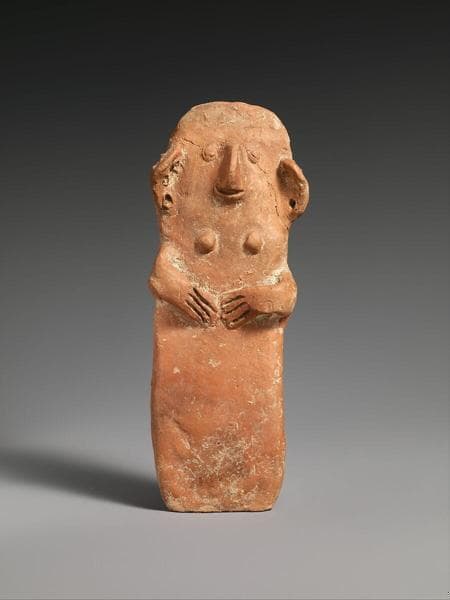
Plank figures, the flat Red Polished figures of the Early to Middle Bronze Age transition, are the top of the clay market. At Bonhams on 30 November 2016 two of them, 29 cm and 18.3 cm, sold for 6,000 and 6,250 pounds (lots 4 and 10). At Bertolami Fine Art on 15 September 2017 a 15.5 cm figure with an Italian export licence and a 2009 sale history made 26,000 pounds (lot 3). At Bonhams on 6 July 2023 a 23 cm figure estimated at 5,000 to 7,000 pounds sold for 53,740 with premium [3]; the reason is in the section on provenance below.
Archaic limestone heads are the most expensive class sold regularly. At Christie's in New York on 25 April 2017 the same sale that produced the 150,000-dollar Golgoi head also sold a 9.5 cm head, small enough to hold in one hand, for 30,000 dollars (lot 234). Dreweatts, a regional English house, sold a fourth-century BC standing figure, 73 cm with its base, of the temple boy type, holding a bird, for 12,000 pounds on 29 October 2024 (lot 22).
What are the most expensive Cypriot antiquities ever sold?
The highest price we know of for a Cypriot antiquity is 448,250 euros, paid at Christie's in Paris in 2003 for a Chalcolithic picrolite cruciform figure estimated at 100,000 to 150,000 [5]. A Late Bronze Age copper oxhide ingot weighing 27.4 kg made 208,250 dollars at Classical Numismatic Group on 28 May 2024, although its recorded history began only in 1986 (the ingot sale). Christie's London sold an early sixth-century limestone head in a conical helmet for 158,500 pounds on 1 October 2015; it had belonged to Louis de Clercq, the first photographer of Cyprus, and passed through the Paris dealer Nicolas Koutoulakis in the 1960s [4]. Add the Golgoi head [2] and the list of recent high points is complete. Every one is a figure, a piece of sculpture or an unusual object. None is an ordinary pot.
Does damage or restoration lower the value?
Yes, but an honest repair costs a rare object less than owners fear, and costs a common object nearly everything. Two Red Polished plank figures reassembled from about six and about eight fragments sold at Arte Primitivo in New York in 2014 for 12,000 and 16,000 dollars (30 September, lot 352, and 25 February, lot 264). The Nagel double-necked jug was catalogued as partially restored and still made 8,000 euros. At the other end, a plank figure "broken in two and glued" made 1,600 euros at Venduehuis der Notarissen in The Hague in 2022 (lot 4009).
Repainting is worse than a break, because a buyer cannot tell which lines are ancient. Overpainted Bichrome and White Painted pots are common in old collections, and some sculpture sold in Cesnola's time had heads joined to bodies that never belonged together or missing parts made up in plaster. Ultraviolet light shows most modern paint and fills; the guide to Cypriot replicas, restorations and fakes explains what to look for.
Do not clean, glue or touch up a piece before a specialist has seen it. Amateur cleaning removes old ink numbers, paper labels and burial deposits, and those are part of the evidence for its history and therefore part of its price.
Why does provenance change the price so much?
A documented history, or provenance, makes a piece saleable at the houses where the highest prices are paid, and it gives buyers and museums confidence that the object left Cyprus legally. In a 2017 paper on investigating the illicit trade, E. Alphas described a deaccessioned Cesnola limestone votary head that opened at a US online auction at nearly 30,000 dollars, "well above comparable lots, probably due to its 'safe' acquisition history" [11].
Such histories are rarer than owners assume. When Fehlmann's students counted the antiquities sold at Christie's and Sotheby's from 1988 to 2008, 1,842 lots were identifiably Cypriot, and only 377 of those had a history reaching back before 1970 [12]. No two antiquities are identical, so treat the pairs below as illustrations.
The plank figures at Bonhams are the clearest. The 2016 figures and the 2023 figure are of similar size and were sold by the same house in the same kind of sale. The 2023 figure came with a pedigree: a Paris collection, a sale at the Hôtel Drouot on 2 June 1967 (lot 99), the Martinet collection and descent in one family [3]. It was knocked down at 42,000 pounds, six times its high estimate, and its 53,740 with premium is more than eight times what each of the 2016 figures made.
Paperwork on the object itself counts too. The Bichrome barrel flask that sold for 2,800 pounds at Bonhams in 2020 had two lead export seals still attached to its handle, the small stamped tags the Department of Antiquities wired to pieces it licensed for export. A Cypro-Geometric Bichrome barrel jug with the same circles and lozenges, and no seals in its catalogue entry, made 550 pounds at Apollo Art Auctions in 2023; part of that gap is the difference between a London saleroom and an online one. The guide to export licences, lead seals and labels explains how to read these marks.
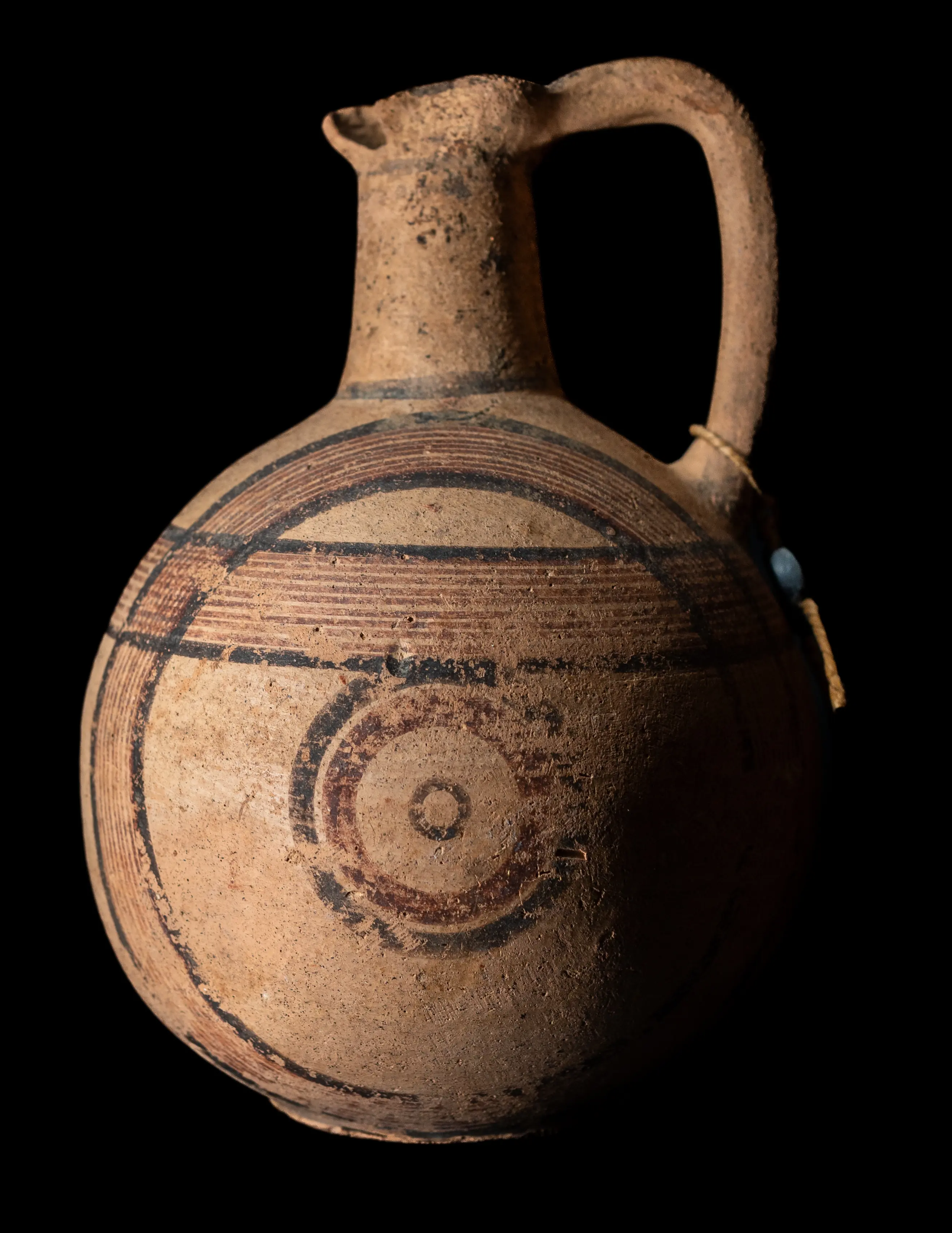
Provenance does much less for an ordinary object. The dish with the Metropolitan Museum-style number made 70 pounds, and two small Bichrome amphorae that left the Met in 1928 and later belonged to the Cyprus Museum in Jacksonville, North Carolina sold at Lyon & Turnbull on 31 July 2024 (lots 34 and 35) for 2,268 pounds each. Good papers make a piece saleable and portable. The large multiples appear when good papers meet a rare or figural object, as they did for the Golgoi head.
Papers also decide where a piece can legally travel: the United States has restricted imports of Cypriot archaeological material since 2002, so a piece documented well enough to reach American buyers is worth more. The guides to selling in the UK and selling in the US set out the rules as of 2026.
Why do auction estimates and results differ so much?
An auction estimate is a range set by the house to attract bidders, with a confidential reserve, normally at or below the low estimate, behind it. It is a forecast of the hammer price, the figure at which the auctioneer's hammer falls. The buyer then pays the hammer price plus a buyer's premium, at the large houses roughly a quarter to a third on top. The seller receives the hammer price less the seller's commission and costs. When the house publishes "sold for", it usually means the buyer's total, which is more than the seller receives.
Results miss estimates in both directions. The Bonhams plank figure hammered at six times its high estimate, while an Early Hellenistic limestone head, published and ex-Metropolitan Museum, sold online at Artemis Gallery on 28 June 2017 (lot 27D) for 10,000 dollars against an estimate of 18,000 to 25,000.
Lots that fail to reach their reserve are "bought in" and go back to the owner. The 65 cm Bichrome amphora was bought in at Bonhams in December 2023 on an estimate of 6,000 to 8,000 pounds and sold seven months later at 5,760 on a lower estimate [9]. What appears to be the same lead-sealed barrel flask that sold in 2020 was offered again at Bonhams on 1 July 2026, estimated at 2,000 to 3,000 pounds, and did not sell.
Asking prices on gallery websites and online estimates are the least reliable guide: Artemis Gallery offered tall Cypro-Archaic oinochoai at 3,000 to 6,000 dollars three times in spring 2024, and none sold. The same kind of object sells for several times more at a major sale with a printed catalogue than at a small online one: the White Painted jug that made 6,250 pounds at Bonhams [7] has a cousin of the same period that made 150 pounds at TimeLine in 2024.
Can I sell my Cypriot antiquity at all?
Usually, if it has a credible history of leaving Cyprus legally; the compendium entry on collecting Cypriot antiquities today sets out the current law and market. The major houses generally ask for evidence that a piece was outside Cyprus before 1970 or left under licence, and they decline pieces that might have come from the occupied north after 1974. A piece without papers can still be genuine and lawfully owned, but its market is smaller and its price lower, which a valuer has to take into account. This page is general information, not legal advice.
Step-by-step selling is covered in selling an inherited Cypriot collection. Most Cypriot material abroad left the island legally, much of it under numbered export licences issued between 1935 and 1996, as Licence No. 7070 explains; if your family brought pieces home, brought home from Cyprus helps date when and how.
How do I get a Cypriot antiquity formally valued?
Ask an independent, accredited appraiser who knows antiquities, and decide first which of three kinds of value you need.
- An auction estimate is free and usually given from photographs, but it comes from a house that wants the consignment, and it predicts a hammer price.
- An insurance or replacement value is what it would cost to buy a comparable piece from a dealer. It is normally the highest of the three, and a high insurance figure does not raise what the piece will fetch at auction.
- Fair market value is used for probate, tax, division of an estate and donations. In US tax law it is "the price at which the property would change hands between a willing buyer and a willing seller, neither being under any compulsion to buy or to sell and both having reasonable knowledge of relevant facts" [13]. In UK inheritance tax it is "the price which the property might reasonably be expected to fetch if sold in the open market at that time" [14].
In the United States, a charitable donation of property claimed at more than 5,000 dollars needs a qualified appraisal by a qualified appraiser, and the donee, the seller and related parties cannot act as that appraiser [15]. If a return is examined, the IRS refers any single work of art with a claimed value of 50,000 dollars or more to its Art Appraisal Services unit [16]. Executors should read antiquities in an estate, and donors returning or donating Cypriot antiquities.
Choose an appraiser who charges a flat or hourly fee, never a percentage of the value, and who does not also offer to buy the piece: in the US, a member of the American Society of Appraisers, the Appraisers Association of America or the International Society of Appraisers with antiquities experience; in the UK, a RICS-registered chattels valuer or an auction house valuation department. For Cypriot material the valuer's first question is whether the piece can be sold openly at all, because a piece without documented history may have a fair market value well below documented comparables. That reflects the legal market and says nothing about authenticity.
A valuer, and we, will ask for the same things:
- Photographs of every side, the base and the inside of the rim, with a ruler in shot.
- Height and maximum diameter in centimetres.
- Every label, painted number and seal, photographed close up.
- Every document: export licence, Cyprus Museum or dealer receipt, letters, old auction catalogues, insurance schedules, family photographs showing the piece.
- When and where the family acquired it, and when it left Cyprus.
- Condition notes: breaks, glue, fills and any repainting.
We do not give prices or formal valuations. We can tell you what the piece is, what period it comes from, what its marks mean and what comparable lots have made in public, and we can point you to an appraiser. Send us photos and whatever papers you have.
References
- 1.Harvard Art Museums, Head of a Male Votary, accession 2017.167 (Arthur M. Sackler Museum, Marian H. Phinney Fund), object record and provenance. https://harvardartmuseums.org/collections/object/358261
- 2.Christie's New York, Antiquities, sale 14355, 25 April 2017, lot 232: A Cypriot limestone head of a male votary, 42.5 cm. Estimate $25,000 to 35,000; sold $150,000 (with buyer's premium). https://www.christies.com/en/lot/lot-6067601
- 3.Bonhams London, Antiquities, 6 July 2023, lot 47: A Cypriot terracotta plank figure, 23 cm. Estimate £5,000 to 7,000; hammer £42,000, sold £53,740 with buyer's premium. https://www.bonhams.com/auction/28251/lot/47/
- 4.Christie's London, Antiquities, sale 10373, 1 October 2015, lot 65: A Cypriot limestone male head, 26.7 cm. Estimate £120,000 to 180,000; sold £158,500. https://www.christies.com/en/lot/lot-5926257
- 5.Christie's Paris, 2003: Chalcolithic picrolite cruciform figure. Estimate €100,000 to 150,000; sold €448,250. https://www.christies.com/en/lot/lot-4186202
- 6.Lyon & Turnbull, Edinburgh, 15 October 2019, lot 4: Cypro-Archaic I Bichrome trefoil jug with a figure at a sacred tree. Estimate £4,000 to 6,000; sold £24,000. https://www.invaluable.com/auction-lot/A964B928E5?objectID=142303610
- 7.Bonhams London, Antiquities, 28 November 2018, lot 120: A Cypriot White Painted jug, 34 cm. Estimate £1,000 to 1,500; sold £6,250. https://www.bonhams.com/auction/24685/lot/120
- 8.Bonhams London, Antiquities, 28 November 2017, lot 53: A Cypriot terracotta female figure, Late Bronze Age. Estimate £5,000 to 7,000; sold £27,500. https://www.bonhams.com/auction/24251/lot/53
- 9.Bonhams London, Antiquities, 4 July 2024, lot 137: A large Cypriot Bichrome amphora, 65 cm. Estimate £3,000 to 4,000; sold £5,760 (previously offered 7 December 2023, lot 48, estimate £6,000 to 8,000, unsold). https://www.bonhams.com/auction/29082/lot/137
- 10.Sotheby's London, Ancient Sculpture and Works of Art Part II, 7 December 2022, lot 104: A Cypriot Bichrome jar, Cypro-Archaic I. Estimate £4,000 to 6,000; sold £12,600. https://www.sothebys.com/en/buy/auction/2022/ancient-sculpture-and-works-of-art-part-ii/a-cypriot-bichrome-jar-cypro-archaic-i-circa-750
- 11.Alphas, E. (2017). From a Bronze Age tomb in Cyprus to the estate of a gentleman in Sussex: Measures taken and problems faced in the investigations on the illicit trade of antiquities. In D. Pilides & M. Mina (Eds.), Four Decades of Hiatus in Archaeological Research in Cyprus: Towards Restoring the Balance (pp. 30-43). Holzhausen.
- 12.Fehlmann, M. Looting and losing the archaeological heritage of Cyprus (Chapter 8). In Proceedings of the MedWorlds II Conference, Istanbul. Bloomsbury Academic, p. 161. https://doi.org/10.5040/9780755608331
- 13.US Treasury Regulations, 26 CFR §20.2031-1(b) (definition of fair market value for estate tax); IRS Publication 561, Determining the Value of Donated Property. https://www.irs.gov/publications/p561
- 14.Inheritance Tax Act 1984, section 160 (market value). https://www.legislation.gov.uk/ukpga/1984/51/section/160
- 15.US Treasury Regulations, 26 CFR §1.170A-17 (qualified appraisal and qualified appraiser); IRS Form 8283, Noncash Charitable Contributions, Section B and instructions.
- 16.Internal Revenue Manual 4.48.2, Valuation Assistance for Cases Involving Works of Art, section 4.48.2.3 (referral to Art Appraisal Services of a single work with a claimed value of $50,000 or more). https://www.irs.gov/irm/part4/irm_04-048-002