
Contents
A terracotta figurine is a small figure of a person or an animal made of fired clay. Cypriots made them for about three thousand years, from the birthing women of the Chalcolithic villages to the riders, musicians and veiled women left by the thousand in the sanctuaries of the Iron Age kingdoms. This page is the overview: what the class includes, how the figures were made, and what changes from one period to the next. The individual types have their own pages, linked in each section, and the systems scholars use to number them are explained in How Cypriot Figurines Are Classified.
What counts as a terracotta figurine
Three things define the class: the material (clay, fired), the scale (small enough to hold), and the fact that the object is a figure in its own right. Karageorghis opens his survey of the Cesnola terracottas with a single line for the whole prehistoric series: "Throughout the Bronze Age, Cypriots produced handmade terracottas that translated their ideas about fertility and regeneration into clay" [1]. He notes that the Early and Middle Cypriot potters modelled scenes from religious and secular life both as decoration on vases and as free-standing pieces [1].
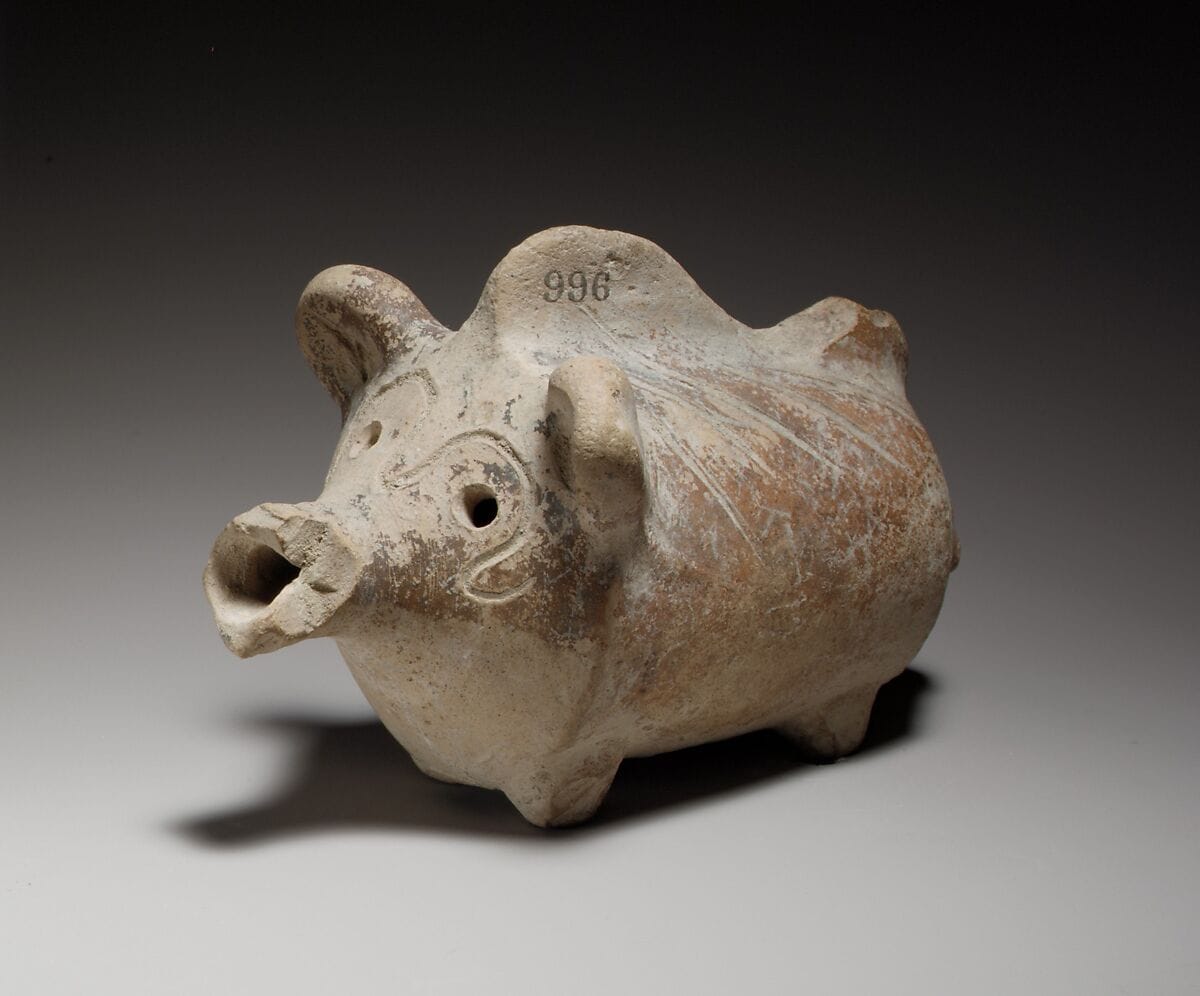
Two neighbouring classes sit just outside the line. The first is the clay vessel in the shape of an animal or a person, the askos and the anthropomorphic jug, treated on Red Polished Zoomorphic Vessels. The boundary can be thin. The Met has a Middle Cypriot I Red Polished piece (74.51.1336), boat-shaped with a horned animal head at each end, 5.1 cm high. Karageorghis explains that askoi "were commonly made in this shape" but that, because of its small size, "the sculptor produced a solid terracotta figurine"; had it been a working askos, the two heads would have been spouts [1, cat. 4]. The second neighbour is the terracotta statue. At the rural sanctuary of Athienou-Malloura the excavators separate the "small-scale handmade terracotta figurines" from fragments of terracotta statues and statuettes, including two slightly under-life-size Cypro-Archaic heads [2, p. 135]. Karageorghis's own corpus does the same, with large and medium sculpture in one volume and the small figurines in others (see the classification page).
See all terracotta figurines in the catalogue.
How the figures were made
Cypriot coroplasts (makers of clay figures) used three techniques, often on the same piece. The Malloura dedications include "handmade, wheel-made, and mold-made figures and figurines" [2, p. 135].
| Technique | How it was done | When | Typical products |
|---|---|---|---|
| Handmade | Solid clay modelled in the hand, details added as pellets and strips, then painted or incised | Chalcolithic onward; the only method in the Bronze Age | Birthing figures, plank figures, Iron Age horse riders and votaries |
| Wheel-made | Body thrown as a hollow cylinder or cone, arms and face added by hand | Cypro-Archaic | Standing men, women carrying jars, musicians |
| Mould-made | Clay pressed into a mould for the front, back left flat or closed by hand | From the 7th century BCE | Nude and draped women, faces set on handmade bodies |
For the Bronze Age the rule is simple: plank figures "are all handmade; molds were used much later, in the seventh century B.C." [1]. In the Cypro-Archaic period the methods were combined. A female musician in the Met from Idalion has a wheel-made, hollow body and a mould-made, hollow head with a vent at the back [1]. Karageorghis counts "more than fifteen known female figurines that have wheel-made bodies and heads, facial characteristics and arms added by hand, and a jar carried on the head" [1]. A mould-pressed figure tends to have a detailed front and a plain, flat back: at Malloura such women were "pressed into a mold, resulting in a flat back with detailed front" [2, p. 140].
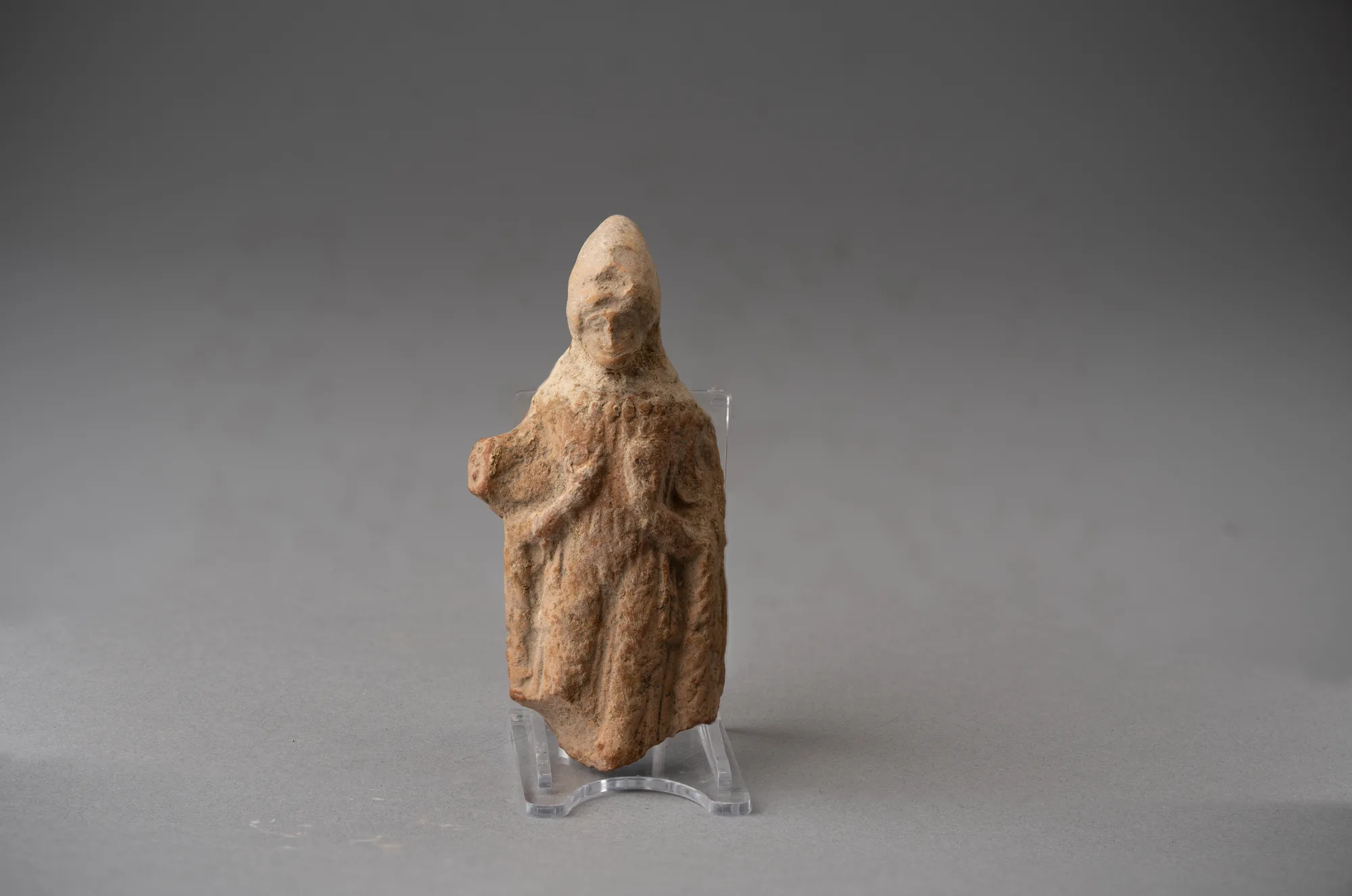
The Drakopoulos collection shows the range. The figure with upraised arms and a tall cylindrical headdress is solid and handmade, its face a pinched nose with pellet ears. The veiled woman holding a flower was pressed from a single mould, and the bearded horseman of the Kourion type has a handmade body carrying a moulded face.
Chalcolithic: the birthing figures
The first large group of clay figures in Cyprus belongs to the Chalcolithic. Winkelmann counts 218 pottery figurines and possible fragments, "the largest repertoire of anthropomorphic representations of the Chalcolithic period" [3]. Most survive only as fragments, and they are more widely spread across the island than the stone figures, perhaps because they were easier to make [3]. They come mainly from settlements; the cemetery at Souskiou-Vathyrkakas has produced a single fragment [3]. Many are painted in the same way as Red-on-White pottery, though no figurine group is confined to one ware, and whether figurines were made by specialists or by the potters who made the vessels cannot be told from the evidence [3].
Most of these figures show women in pregnancy, birth and nursing: squatting, sometimes seated on birthing stools, some pressing milk from their breasts [4]. Birth figures appear in the Early Chalcolithic, are commonest in the later Middle Chalcolithic and decline in the Late Chalcolithic [3]. The best-known group comes from a pit at Kissonerga-Mosphilia, excavated by Edgar Peltenburg. A Red-on-White building model was found packed with about fifty objects, including ten stone and eight pottery figurines, anthropomorphic vessels, a model stool and a triton shell. One clay figure shows a baby's head and arms, in red paint, emerging between the mother's legs, and she wears a cruciform pendant [4]. The types and wear patterns suggest that the stone ones were held in the hand and the free-standing clay ones "may have been used as teaching aids in puberty rituals concerned with pregnancy and birthing"; the deliberate breakage of the model and figures and the burial of the whole group point to a closing ceremony [4]. The stone side of this world is covered on Cruciform Figurines and Neolithic and Picrolite Figurines.
Anthropomorphic figures are absent from Late Chalcolithic contexts. Figurative art came back at the end of the third millennium BCE after a gap of about five centuries, in different forms and tied to different ideas [4].
Early and Middle Bronze Age: plank figures and clay scenes
The new figures were the flat Red Polished plank figures of the Early and Middle Bronze Age, made in the same fabric as Red Polished pottery. Karageorghis treats them as female throughout: even without breasts, "their diadems, necklaces, earrings, and other ornaments" mark them as women [1]. The early ones are "stiff and strictly stylized"; by the Middle Cypriot period they have arms and even short legs, and details in relief. Some hold an infant, and some have two necks on one body, which he reads as perhaps "a male and a female figure together" [1]. They are commonest in Early Cypriot III to Middle Cypriot I. He did not think they represent divinities but saw them as symbols of "regeneration and fertility", and suggested that the flat shape may copy wooden cult statues (xoana) [1].
Not everyone accepts the sex or the meaning. An exhibition entry calls them "the most enigmatic group of images in Cypriot prehistory", notes that some lack any sexual characteristics, and lists the readings proposed for the two-headed type: a sacred marriage, a double-faced goddess, magical monsters, or sympathetic magic for twins [4]. They come mainly from tombs in the north of the island, buried with metal, gold, silver and faience [4]; Karageorghis adds that small numbers now come from settlements, while no sanctuary of the period has yet been found [1]. The full story is on Plank Figures, with the stone versions on Stone Plank Figures.
The Met's plank figure 74.51.1534, 28.4 cm high and said to be from Alambra, is an early example of the stiff, armless type [1, cat. 2]. The Drakopoulos Red Polished two-necked plank figure belongs to the two-necked variety discussed above. A pyxis in the Cyprus Museum (inv. 7837, H. 20 cm) carries plank figures facing each other on its rim, one with a baby, and shows how the same figures could be attached to a vessel.
Free-standing animals are rare in this period. Animal figures usually sit on the rims of large cult bowls or on vase shoulders [1]; see Tulip Bowls and Cult Vessels and the cemetery at Bellapais-Vounous. For the Late Bronze Age, when Base Ring figures and bulls take over, see Base Ring Ware Bulls and Astarte Figures.
The Iron Age: votives for the sanctuaries
Terracotta figurines reach their greatest numbers in the Cypro-Geometric and above all the Cypro-Archaic period, when they became one of the commonest gifts to the gods. At Malloura more than 600 figurines and fragments were excavated [2, p. 134], and figurines "were a distinct part of the Malloura cult only in the Cypro-Archaic period, a pattern typical of Cypriot cults" [2, p. 143].
The subject depended on the deity. Male gods received figures of "male worshippers, priests, warriors, and horsemen", goddesses received "elaborately garbed women, nude females, and pregnant and kourotrophic figures" [2, p. 135]. Malloura, a sanctuary of a male god, has male votives, while the goddess sanctuaries nearby at Akhna, Arsos and Idalion have female ones [2, p. 135].
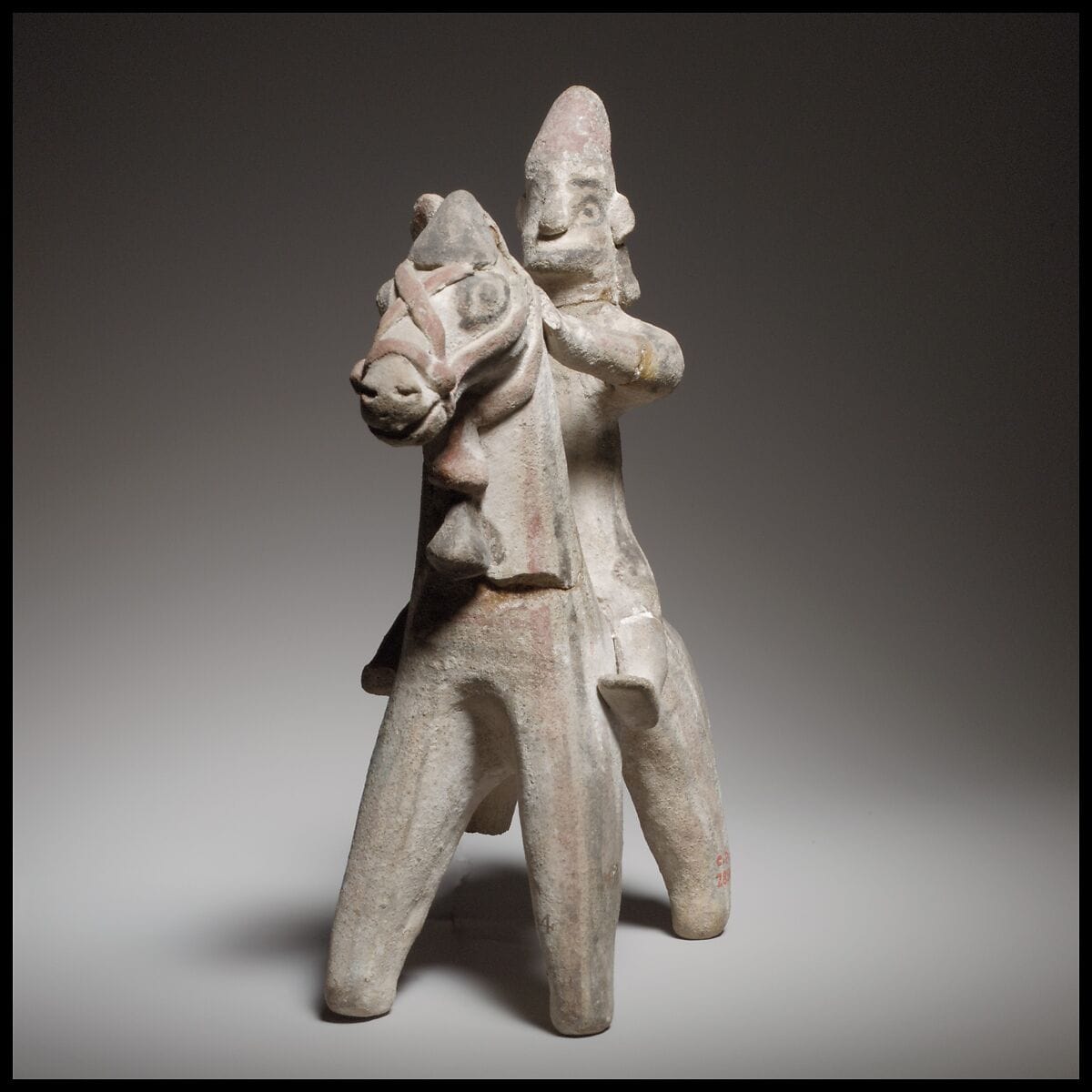
Horse and rider. Riders are common in Cypro-Archaic I and II, a few as early as Cypro-Geometric III; horses with high arched necks usually belong to Cypro-Archaic I [1]. The Met's horse and rider 74.51.1771, 23.5 cm high, is a Cypro-Archaic I example. The Malloura riders are "simple and seemingly unarmed" [2, p. 140], and the excavator reads the popularity of horse imagery there as stressing "elite military status over agricultural concerns" [2, p. 143]. Chariot groups begin in the Cypro-Archaic period and run on into the Hellenistic, most of them of the 7th and 6th centuries BCE, with finds at Marion, Ayia Irini, Kourion, Meniko and Tamassos [2, p. 136]. The Drakopoulos horse and rider with a painted star on the neck, shown at the top of this page, is a handmade example with red and black paint. The type has its own page, Horse and Rider Figurines.
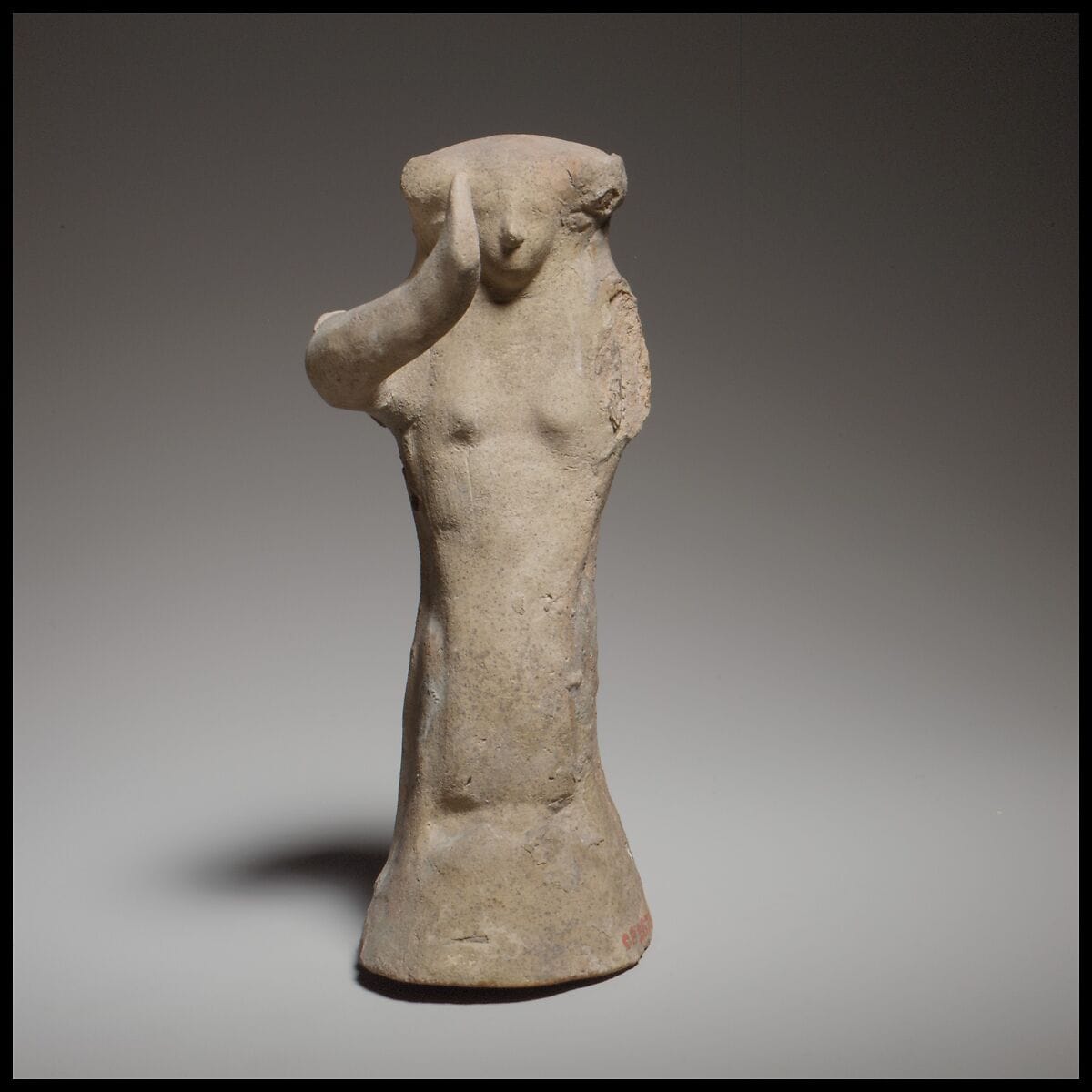
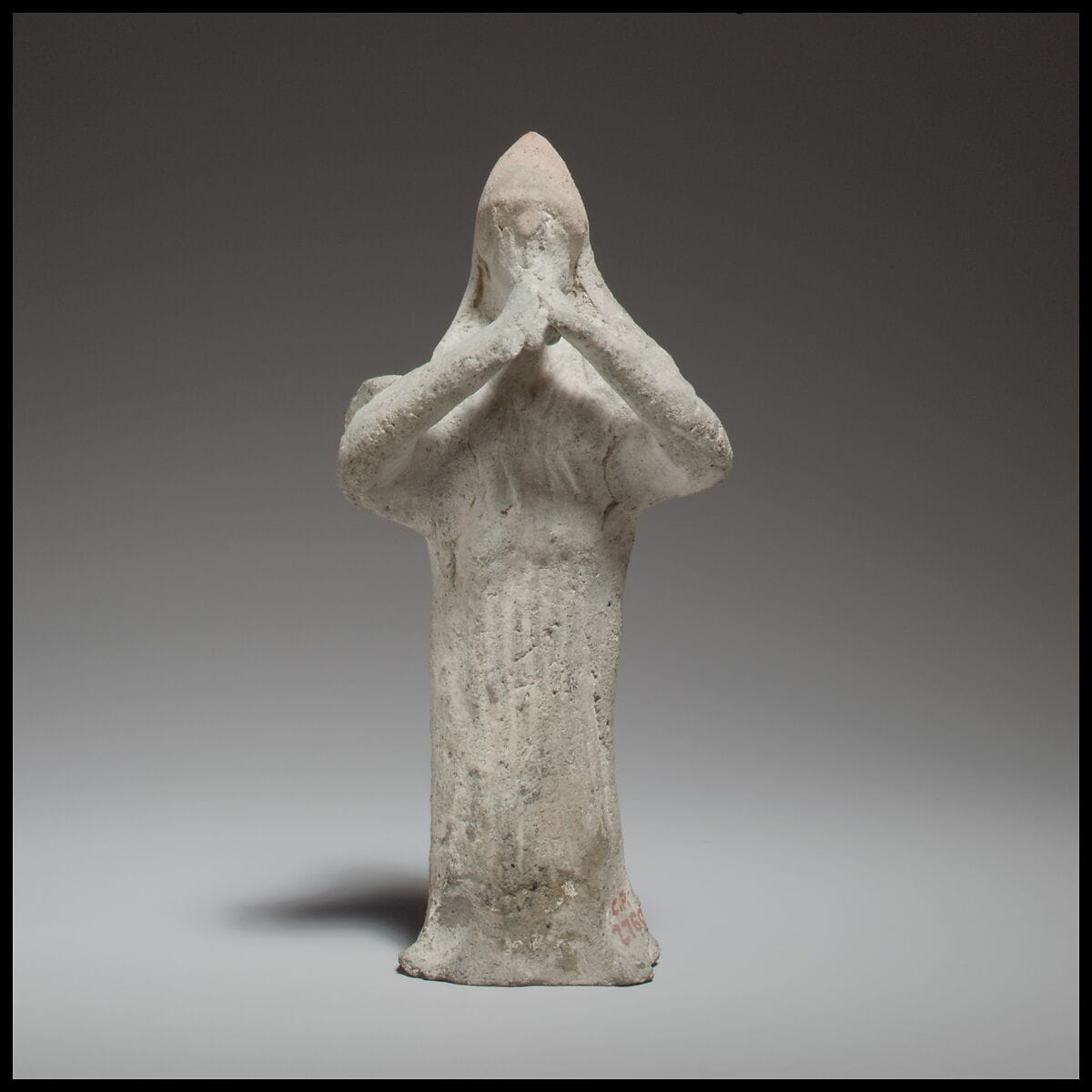
Handmade women with raised arms. The Met's figure with uplifted arms 74.51.1615, 18.4 cm high and said to come from a tomb at Ormidhia, is handmade and dated Cypro-Archaic II [1, cat. 213]. Karageorghis calls the type a goddess, though whether such figures show a goddess or a worshipper is not settled. The Drakopoulos figures with upraised arms and a flaring headdress and the female figure with outstretched arms are of this solid, columnar, handmade kind. The solid "snowman" technique has its own page, Snowman Figurines.
Mould-made women. From the 7th century the mould brought in a new female type, nude or in a fine garment, either with arms at the sides or with hands supporting the breasts. Karageorghis notes that the hands-to-breasts type "was particularly favored at Amathus" and that these figures are frequent in tombs, mainly of the early 6th century BCE; he regarded their iconography as influenced by the East [1]. At Malloura they are reported as common at Kition, Idalion, Tamassos, Arsos, Akhna and Lapithos and "most numerous at Amathous", and "likely inspired by Near Eastern examples" [2, p. 140]. The Drakopoulos hollow votary of the Achna type holds her hands to her breasts in this way. Whether such a figure is the goddess or her priestess is left open even in the museum literature, which describes one Met piece as "probably" a priestess [1].
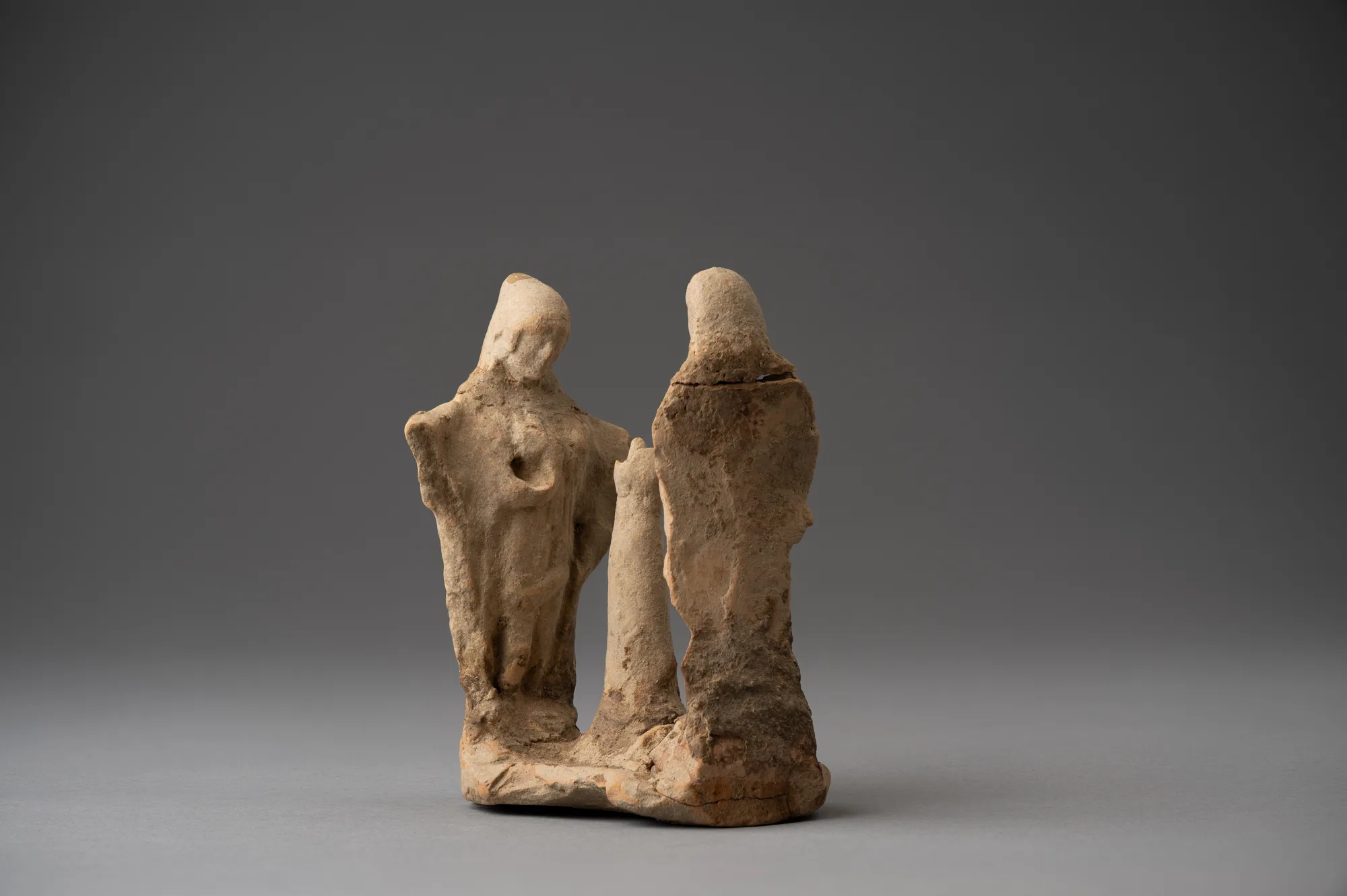
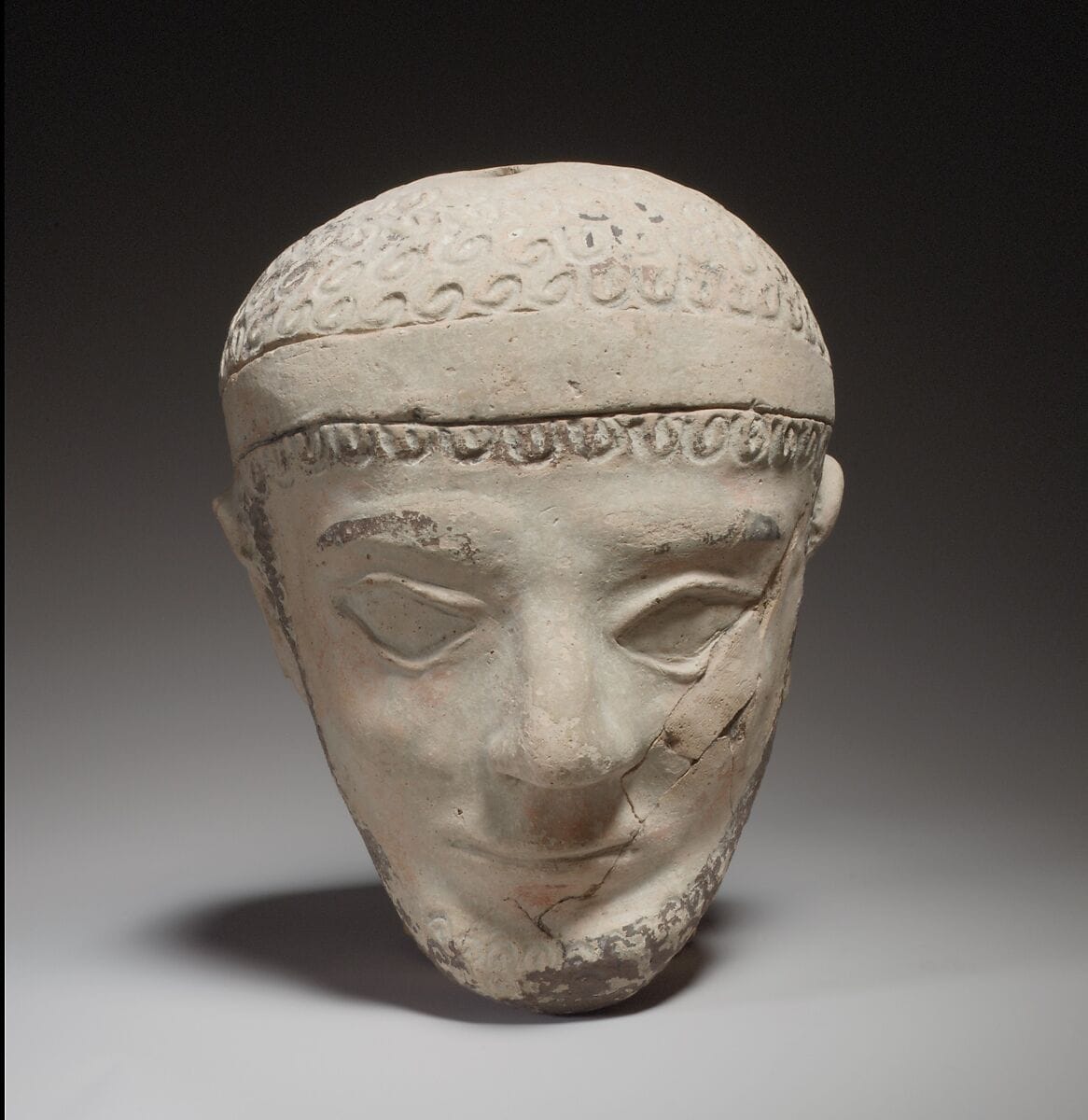
Groups, musicians and masks. Coroplasts also made dancers in a ring, musicians, shrine models and masks. Clay masks were dedicated, not worn [1], and Malloura produced a figure of a man wearing a bull mask [2, p. 141]. The Drakopoulos two veiled figures from a ring-dance group keep the stump of the central tree; see Ring-Dance Groups and the article Two Figures and a Tree.
Workshops and kingdoms. Sabine Fourrier's 2007 study of Archaic figurine production identified nine coroplastic workshops whose distribution, she argues, marks the boundaries of the kingdoms; the style of Idalion dominates the centre of the island, including the Malloura valley [2, p. 135]. Averett accepts the model but presents Malloura's place in the territory of Idalion only as "possible" [2, p. 135].
After the Archaic period
The flood of dedications did not last. The dedication of terracotta figurines "is drastically reduced at Malloura and other cults in the Cypro-Classical and Hellenistic periods", while limestone dedications continued [2, p. 143]. Karageorghis ended his corpus with the Cypro-Archaic period because later work was shaped mainly by Greek art (see the classification page). Production did not stop. The bearded horseman of the Kourion type is dated to the Cypro-Classical to early Hellenistic period, and the Met holds a Hellenistic seated goddess of the 3rd century BCE (74.51.1588).
Dating, contexts and open questions
Most Iron Age figurines are dated by style, because so few come from sealed deposits. At Malloura the figurines were found mostly in secondary deposits, buried as fill when the sanctuary was reorganised in the late 4th century BCE, so their dates rest "broadly" on style [2, p. 134]. Museum pieces from 19th-century collections are worse off: many, like the Met's Ormidhia and Alambra figures, carry only a "said to be from" findspot [1].
Several questions remain open. For the Chalcolithic, it is not known whether figurines were made by specialists [3]. For the Bronze Age, the sex, identity and use of the plank figures are still argued [4]. For the Iron Age, scholars disagree over whether the mould-made women are goddesses, priestesses or worshippers, and over how far Fourrier's workshops map political borders [1; 2, p. 135]. A figure from a tomb and a figure from a sanctuary may share a type and still have been used in different ways.
In the catalogue
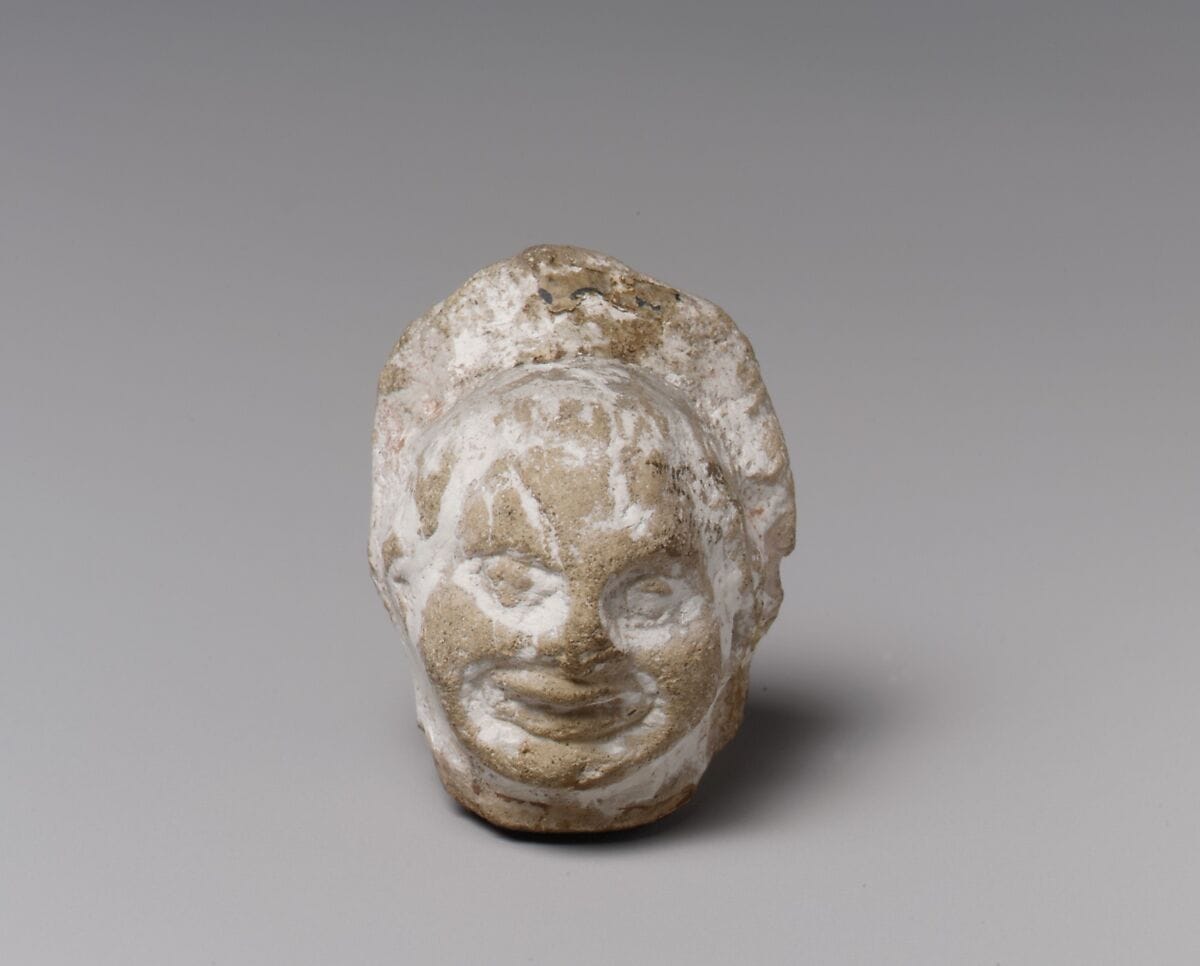
The site's catalogue holds several hundred terracotta figurines from museum collections and the Drakopoulos collection. See all terracotta figurines in the catalogue, or start with the Drakopoulos horse and rider, the handmade figure with upraised arms and the mould-made veiled woman.
Objects on this page
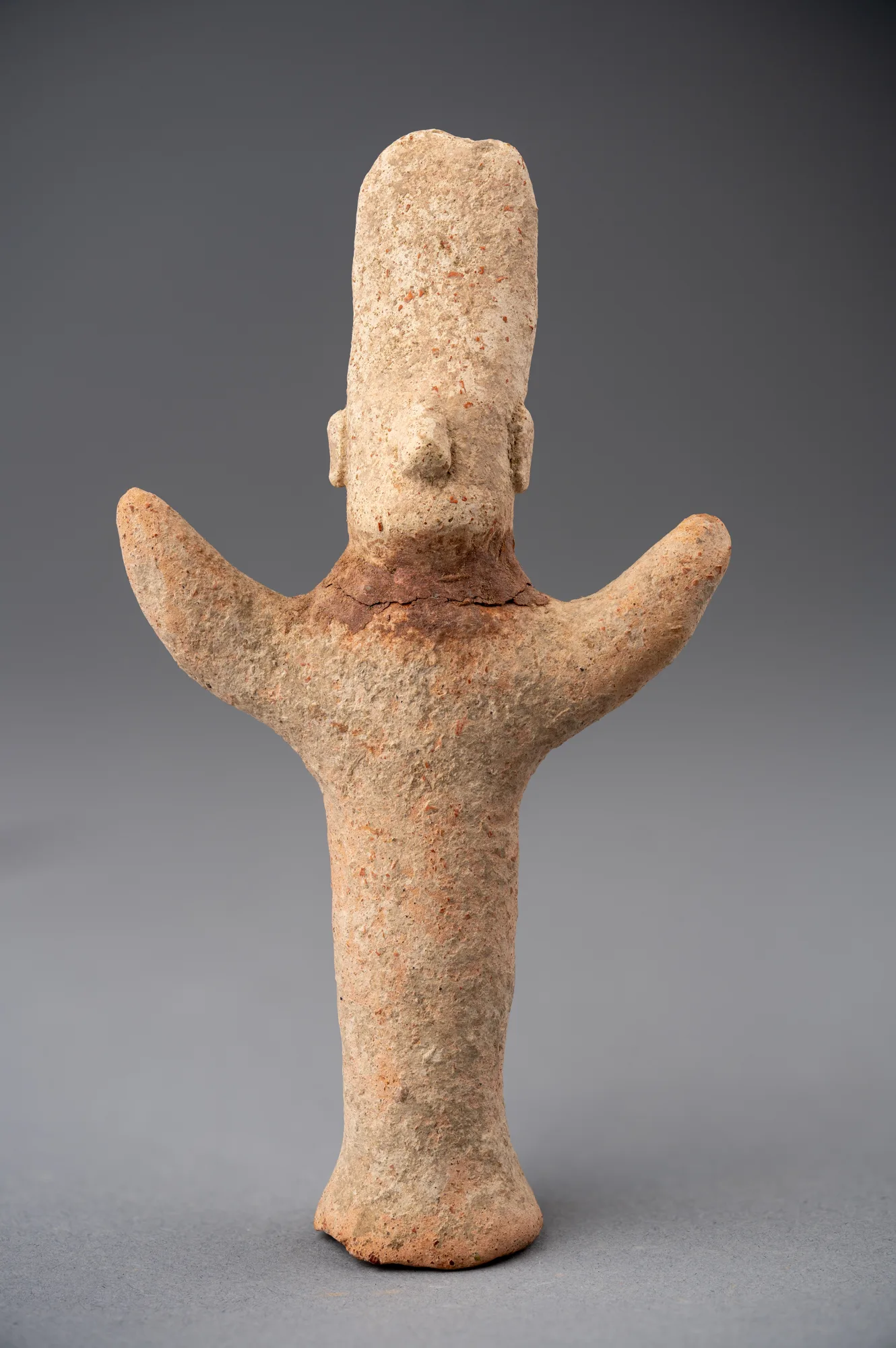 Terracotta Figure with Upraised Arms and Tall Cylindrical HeaddressArchaic · 750–480 BC
- Mould-Made Figure of a Veiled Woman Holding a FlowerArchaic II · 550–450 BC
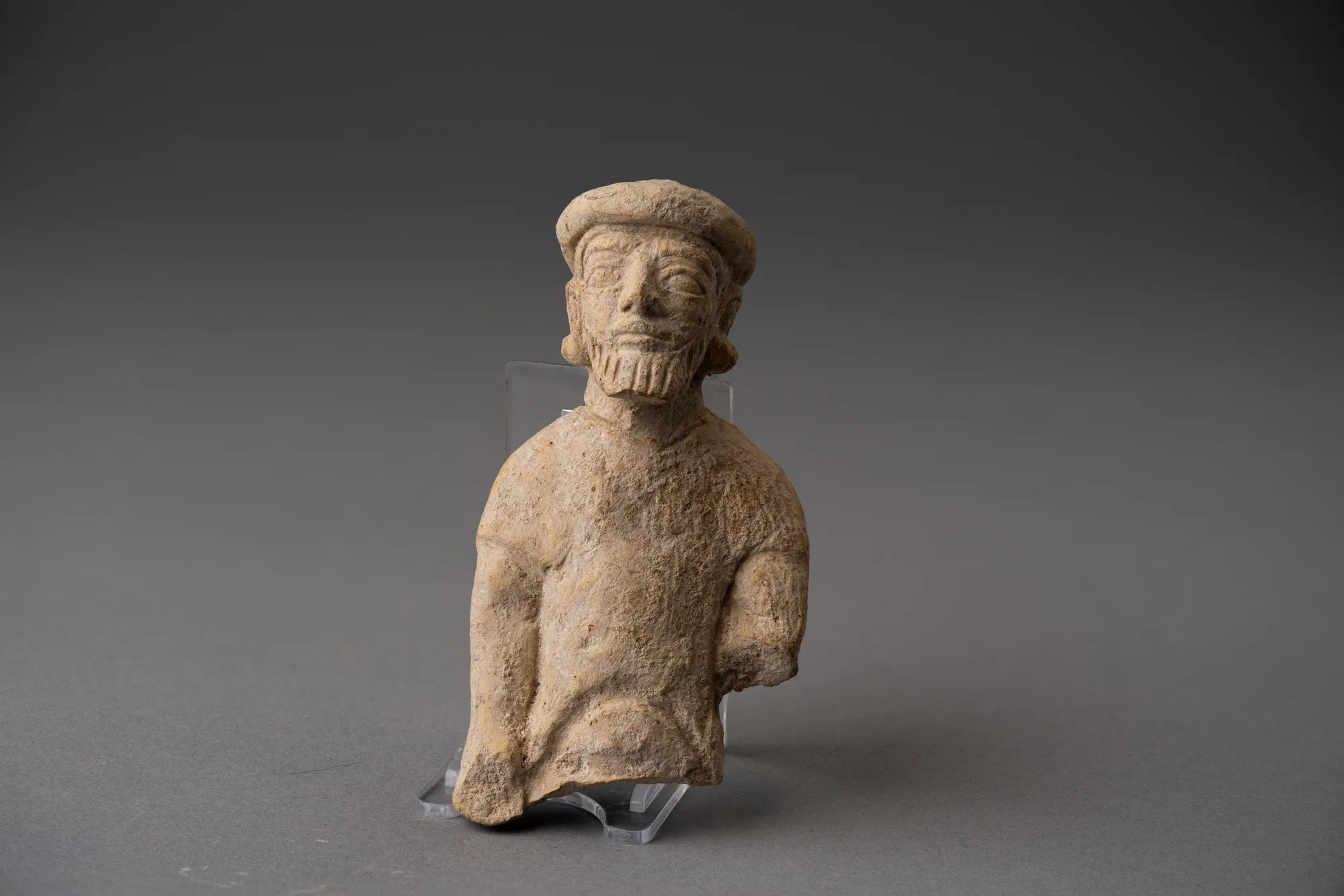 Upper Body of a Bearded Horseman with a Mould-Made Face, Kourion TypeHellenistic · 400–200 BC
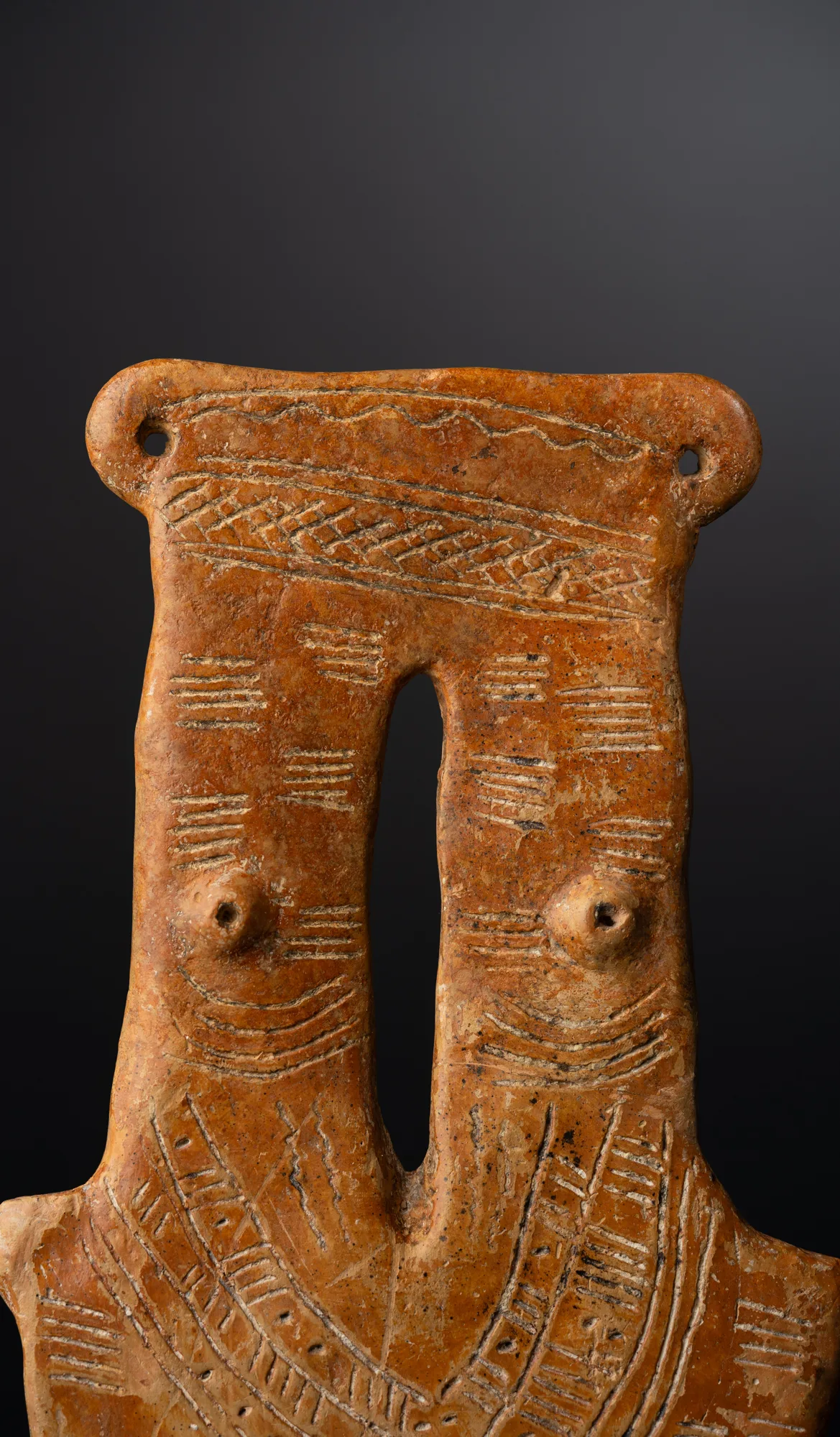 Red Polished Two-Necked Plank FigureMiddle Bronze Age I · 2000–1850 BC
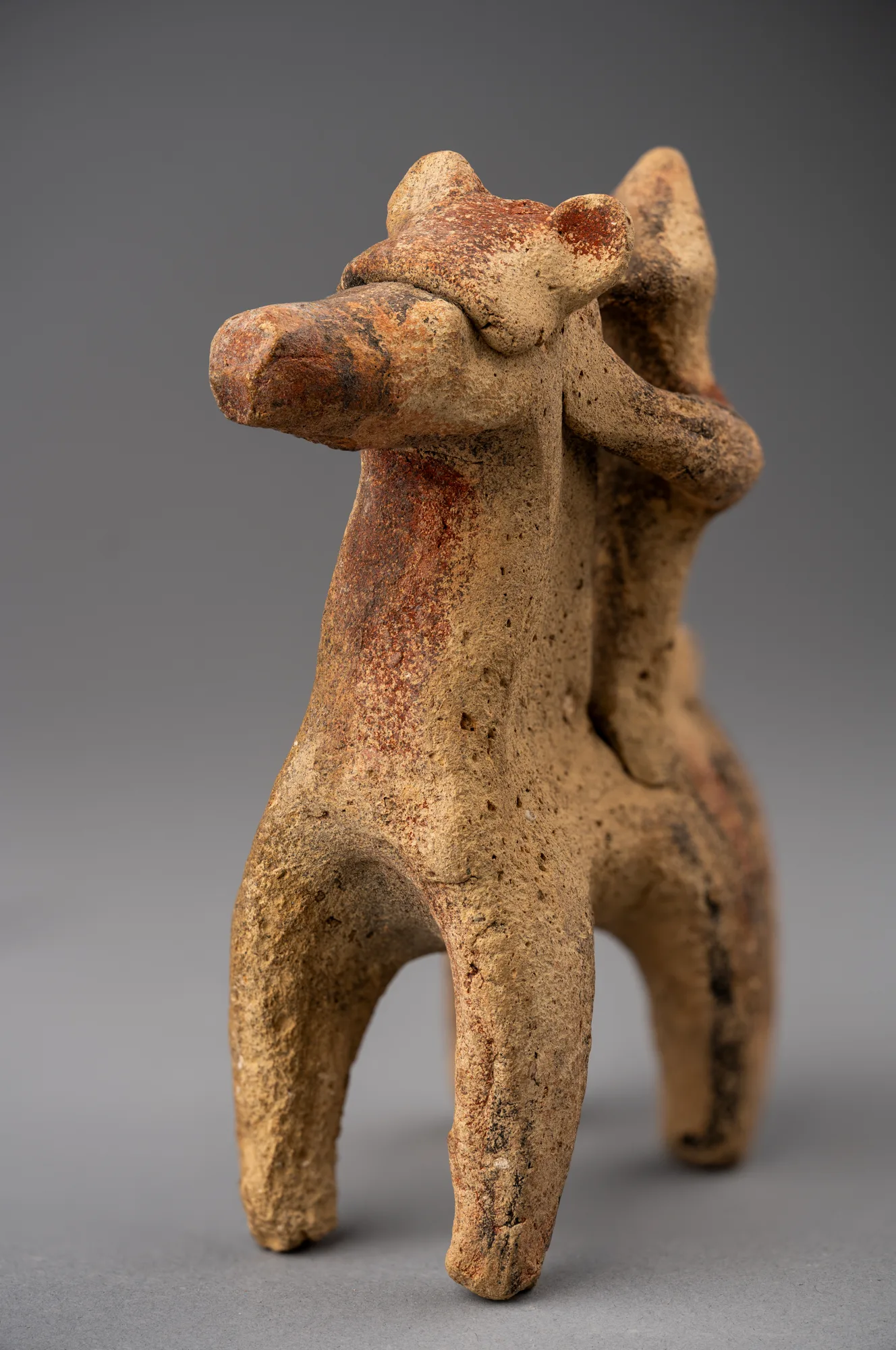 Horse and Rider Figurine with a Painted Star on the NeckArchaic II · 600–480 BC
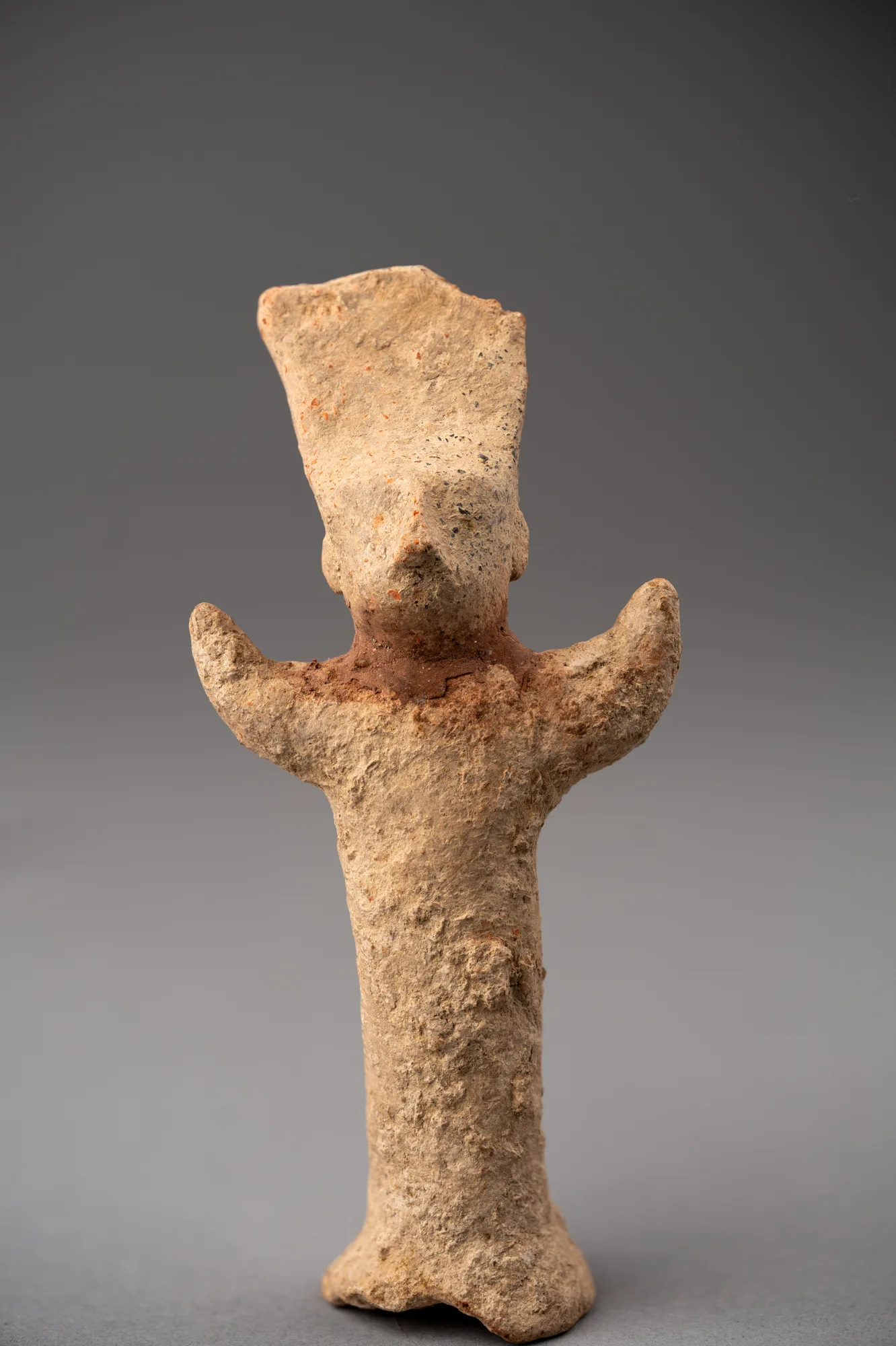 Terracotta Figure with Upraised Arms and Flaring HeaddressArchaic · 750–480 BC
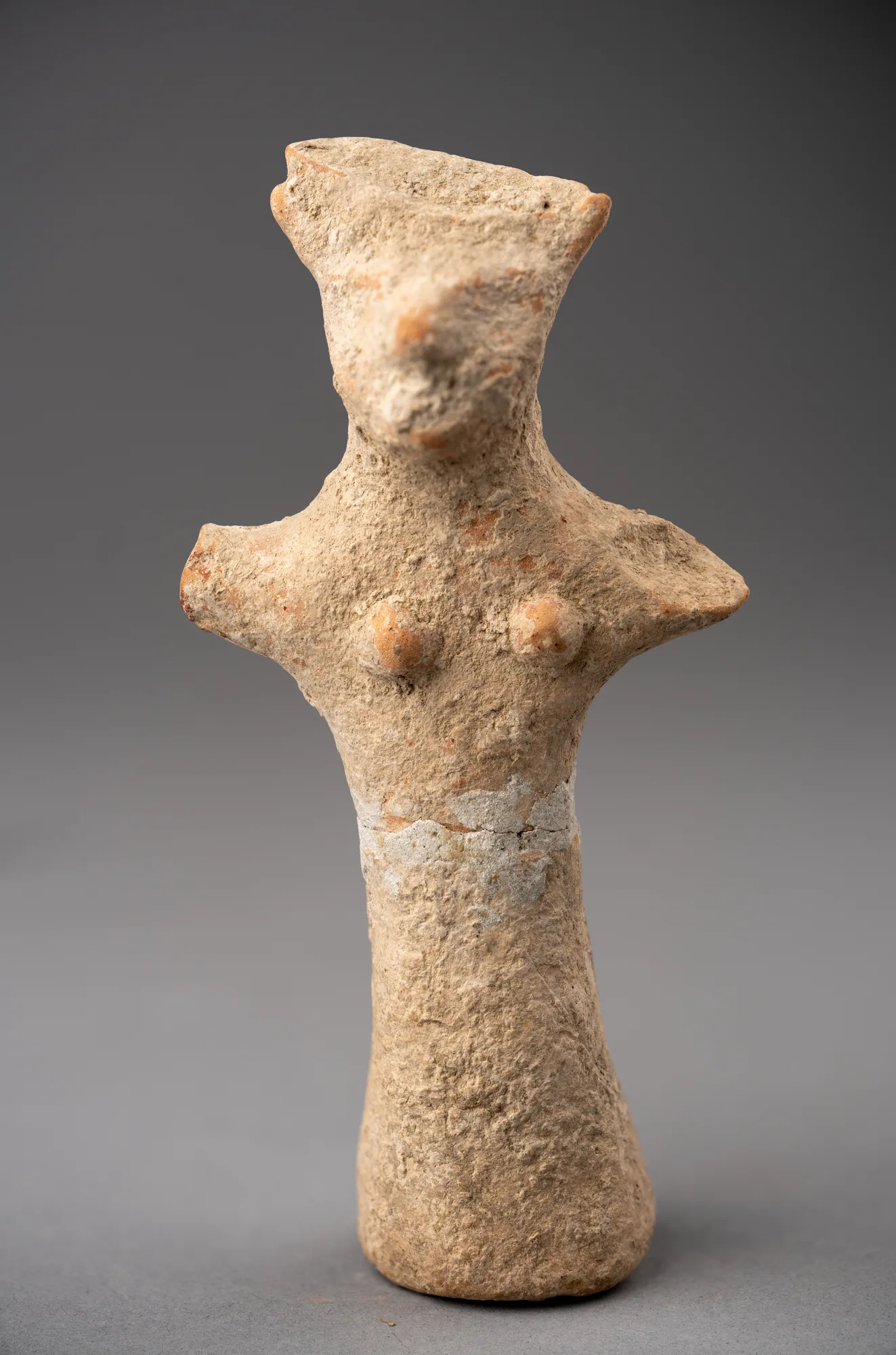 Terracotta Female Figure with Outstretched ArmsArchaic · 750–480 BC
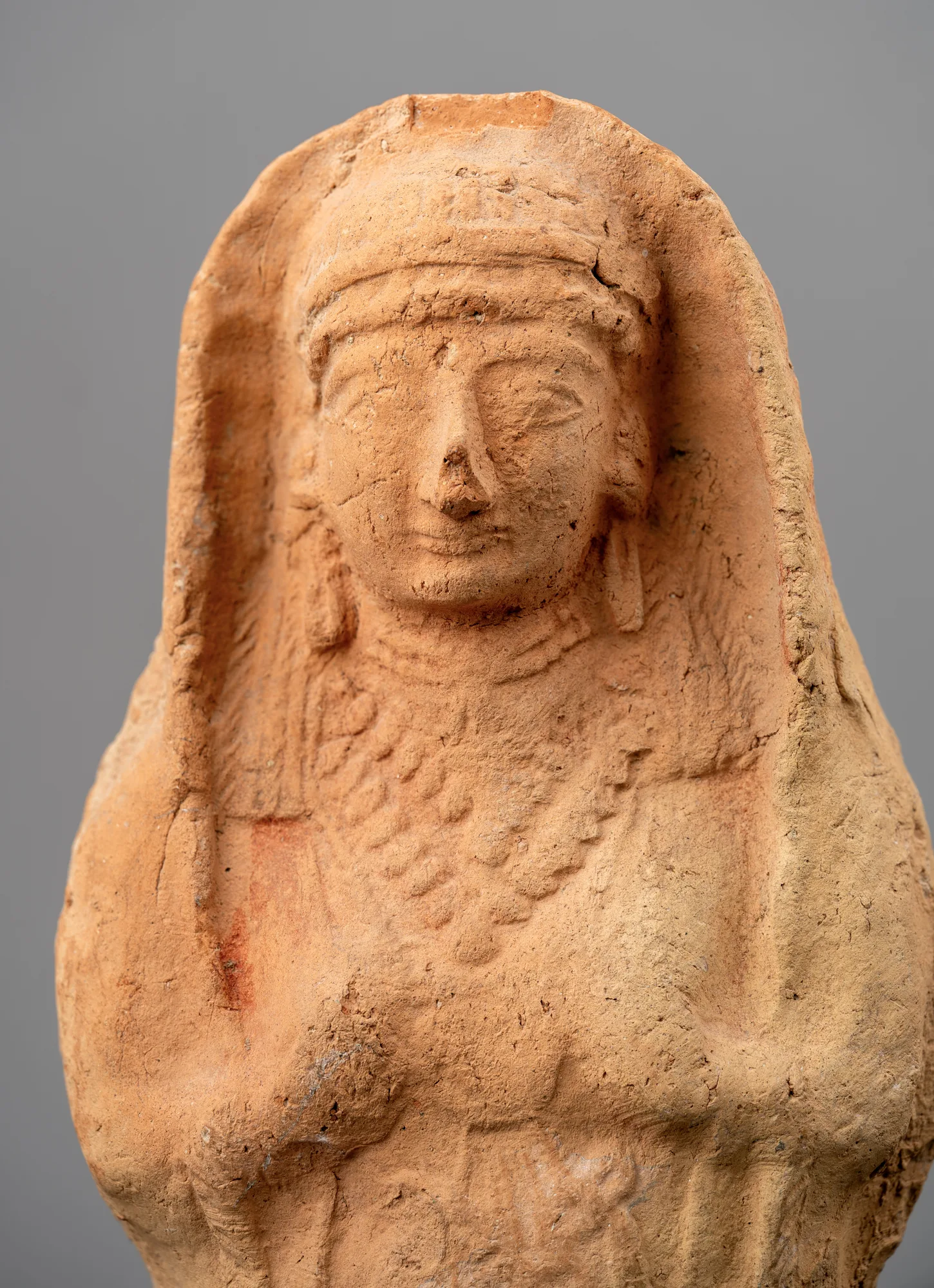 Hollow Mould-Made Female Votary of the Achna Type, Hands to the BreastsArchaic II · 600–480 BC
- Two Veiled Figures from a Terracotta Ring-Dance Group, with the Stump of the Central TreeArchaic · 750–480 BC
In the catalogue
References
- 1.Karageorghis, V. (2000). Ancient art from Cyprus: The Cesnola Collection in the Metropolitan Museum of Art. The Metropolitan Museum of Art.
- 2.Averett, E. W. (2011). The ritual context of the Malloura terracotta figurines. In M. K. Toumazou, P. N. Kardulias, & D. B. Counts (Eds.), Crossroads and boundaries: The archaeology of past and present in the Malloura Valley, Cyprus (AASOR 65, pp. 133–148). American Schools of Oriental Research.
- 3.Winkelmann, C. (2020). The Neolithic and Chalcolithic figurines of Cyprus. Zaphon.
- 4.Idols: The power of images (exhibition catalogue, n.d.).