
Two Figures and a Tree
A hand-sized clay group from Iron Age Cyprus shows two figures turned to face each other across a broken stub. They are the survivors of a ring of dancers, modelled by hand and set turning around a sacred tree, and the one part nobody can name is the thing they were dancing for.

Alexis Drakopoulos
June 10, 2026·Archeology · Artifact · Collection·15 min read


Share


Alexis Drakopoulos is a Greek Cypriot Machine Learning Engineer working in Financial Crimes. He is passionate about Archeology and making it accessible to everyone. About Me.
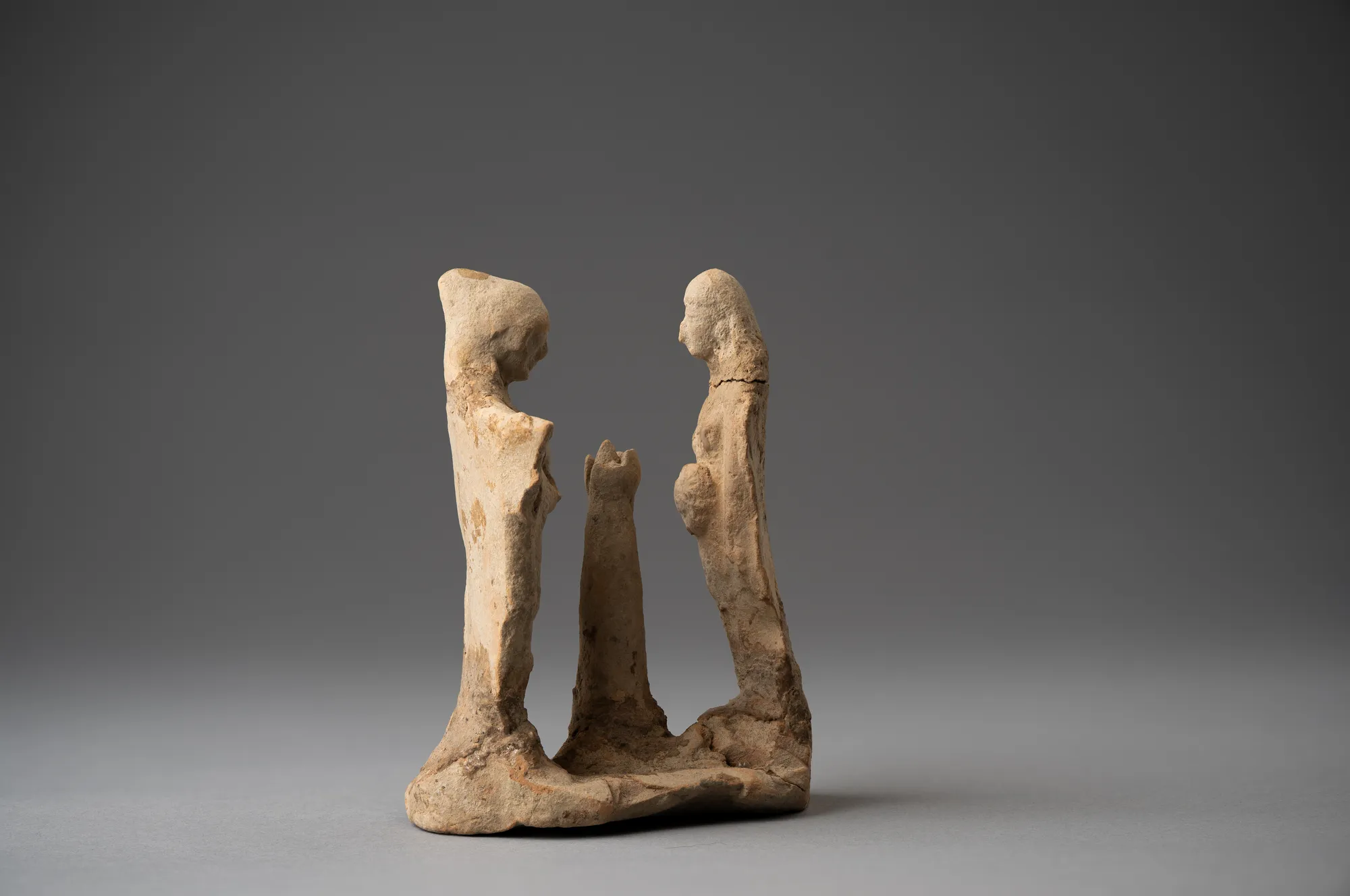
Two pale clay figures stand on a base the shape of a flattened boat, turned to face each other across a stub that breaks off a few centimetres up. They are robed and hooded, a veil or cap drawn over the head and falling to the shoulders, the body widening into a long gown that anchors each figure to the base. The faces are modelled, given a real profile of brow and nose and chin rather than the pinched beak of the cruder figures of the class, and the fronts are finished with enough care that they may have been pressed in part from a mould. One carries a small breast in low relief. The hands are gone, broken away at the wrists, but on one figure a clean socket survives where a hand, or an object passed between the dancers, was once fixed. Nothing else joins the two except the base they share and the broken thing between them.
Put it down on a table and the eye does what eyes do with two figures set face to face: it reads a meeting. A couple, a greeting, a quarrel across a threshold. The reading is almost certainly wrong, and the manner of its wrongness is the better part of the object. These two are survivors. They once stood in a closed ring of dancers turning around the central stub, arms linked into a circle, and the rest of the company has broken away. What presents itself as an intimate pair is the remnant of a crowd.
The piece belongs to the Cypriot Iron Age, most safely to the Cypro-Archaic period, somewhere in the band 750 to 480 BC, though the class as a whole runs from the eleventh century down to the fourth [3][7]. It is a votive, an object made to be given to a god. It came to the Drakopoulos collection from the Goodman collection, a damaged member of a well-published type, and the making of it explains almost everything: how it looks, and why so little of it is left.
Rolled between the palms
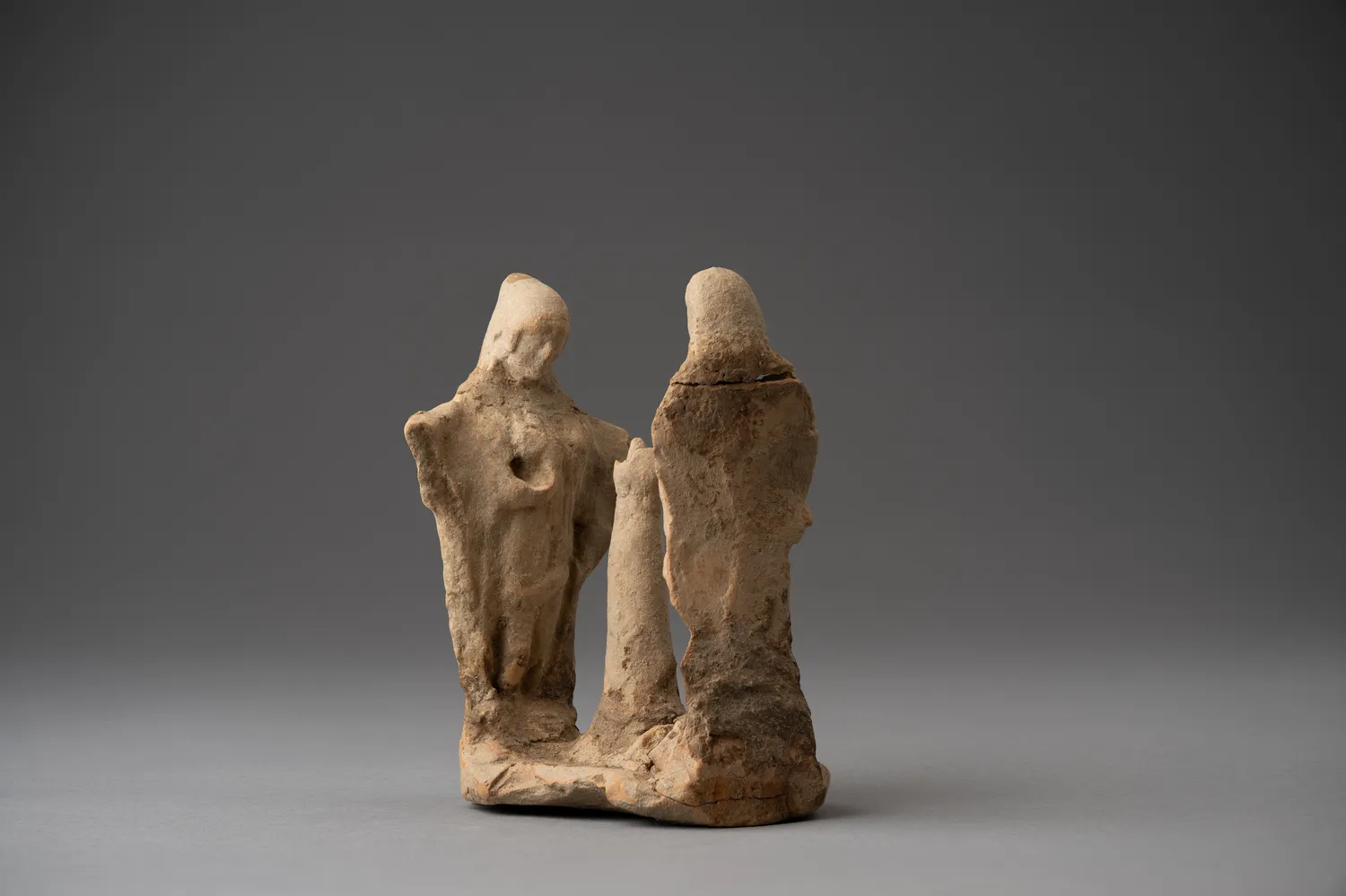
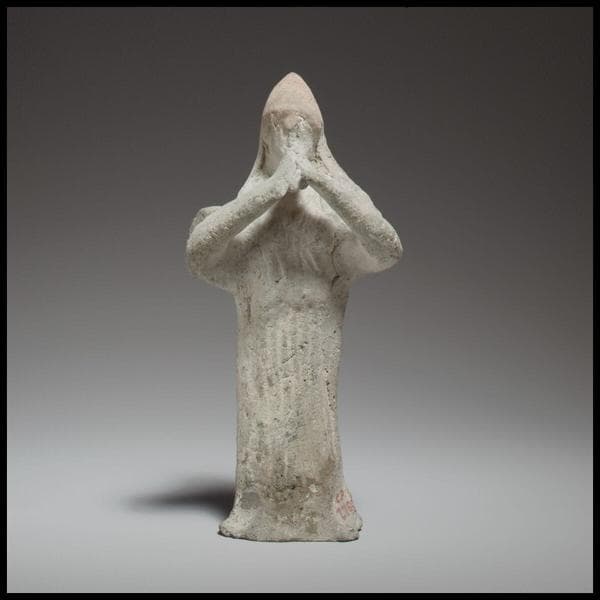
The standard description of how these were made comes from John and Suzanne Young, who catalogued thousands of the figures from the University of Pennsylvania's excavations at Kourion: the body and head were shaped by rolling a piece of clay between the palms, this was then set on end, the base slightly spread to make it stand more securely, and the head modelled, after which arms were added and pellets formed the ears, nose, and often the mouth [4]. Desmond Morris, the painter and zoologist who assembled and catalogued his own collection of Cypriot figures, gives the same body from the outside: a cylinder with a flared base, breasts shown in relief where the figure is female, the head tilted back as if gazing upward [5]. The group in the collection is a more careful piece of work than that account suggests, its faces and robed fronts modelled rather than merely pinched, but the underlying recipe is the same: a body built up by hand, with the parts that matter added on.
English-speaking archaeologists call this the snowman technique, and the name is exact. The figure is built up by hand from rolled and pinched clay, the way a child builds a snowman, and not turned on the wheel that produced the painted pottery of the same island in the same centuries. The Museum of Fine Arts in Boston puts the point flatly: the snowman technique was not associated with the potters' trade [6]. Most of these figures pursue an aesthetic of subtraction, a body reduced to a column, a face to a nose and a cap, a dancer to a vertical mark with the suggestion of a person folded into it; Morris, whose own painting leaned to the surreal, admired the reduction where earlier collectors had filed it under crude. This group takes more trouble than that. The faces are given profiles, the robes a real fall from shoulder to base, and the result sits at the careful end of a class better known for its shorthand.
Seen whole, a ring-dance group is a piece of visual rhythm. A line of near-identical figures, each with a tilted head, bent into a circle so the repetition closes on itself, and the eye is meant to travel round the ring and back to the hub. The same logic runs through the music these sanctuaries kept. The largest single class of Cypriot terracotta musicians is the tambourine-players, a hundred and fifteen of them, all women, well ahead of the eighty-nine lyre-players and the mere twenty-three pipers; the tambourine was the instrument of rhythm, and of the goddess's cult [7]. Drum and ring run on the same engine, the pulse that lets a crowd move as one.
It also follows that the things barely survive. These are low-fired earthenwares, and some of the smallest votives were not fired at all but dried in the sun [3]. A figure rolled from a single piece of clay holds together; the parts added afterward do not. The thin arms that linked dancer to dancer snap at the join, and the central element, built up separately as a slender shaft, snaps at its base. The British Museum keeps detached clay trees broken from groups like this one, conical shafts with rows of applied leaf-pellets and no dancers left around them [1]. The object in the collection is the same accident running the other way: it kept two of its dancers and the foot of its centre, and lost the circle that held them together.
Rebuilding the circle
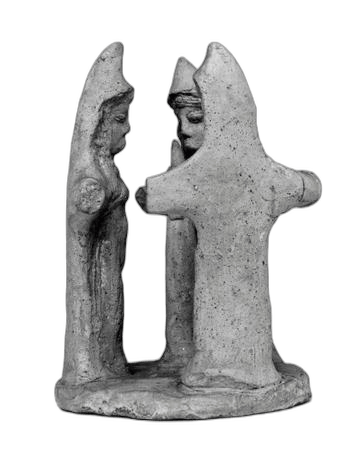
The class was defined a century ago from the Cesnola collection in New York. Groups of ring dancers, the Metropolitan's catalogue records, became popular in Cyprus from the end of the Cypro-Geometric down to the end of the Classical period, and consist of four or more male or female figures, fixed to a round plaque and encircling a central flutist; in some cases the musician is replaced by a sacred tree [2]. That is the whole grammar of the type in three clauses: a closed ring of dancers on a disc, with either a piper or a tree at the hub. Vassos Karageorghis, whose 1995 corpus is the classification everyone still cites, files them under his type III and notes how regularly a surviving group has lost figures and arm-links, so that a circle now reads as a fragment [3].
The textbook example sits in the British Museum: three women dancing round a stylised tree on a round base, fourteen centimetres high, the base ten across [1]. Thomas Kiely, cataloguing it for a recent exhibition, describes the figures with outstretched arms forming a circle around the tree, their lower arms now broken, but they may originally have met to complete the ring [1]. The same incompleteness is everywhere in the type. At Kourion the Youngs found that a base preserving one or two dancers had carried eight, and reconstructed the missing six from the spacing of the feet [4]. Against that pattern, two figures and a broken stub are exactly what a large fragment of a vanished ring looks like.
A genuinely symmetrical pair cannot be ruled out without the rest of the base, and the idea has respectable company. Two figures flanking a central tree or pillar is one of the oldest images in the Near Eastern repertory, the heraldic tree of life between attendants, and it turns up on Cypriot stamp-seals as two standing figures, one on either side of a stylised palmette, each with an arm raised [9]. A minority strand in the scholarship would read a male and female pair at a sacred tree as a marriage scene, the consort myth of the Cypriot goddess made small. Neither reading is the safe one. The heraldic scheme is documented for animals and attendants on seals and metalwork, not as a named human terracotta type; the marriage reading wants one man and one woman with nuptial cues, where the object gives two like-robed figures attending a centre, which is the dance. One thing the piece is not is funerary. The ring-dance groups come from sanctuaries and from the pits sanctuaries were cleared into, almost never from tombs [7].
Whether the two are women, as the British Museum's three are, the object will not quite say. The convention that sorts these figures by headgear, a conical cap for a man and a tiara for a woman, is Karageorghis's, and the literature flags it as a convention rather than a fact; the Cypro-Geometric and Cypro-Archaic dancers carry no clear marks of sex at all [7]. What this pair shows are the long gowns and drawn-up veils of the female type, the same dress the British Museum's three women wear, and the breast modelled on one of them points the same way, but a hooded robe is not proof. Only the latest dancers, the veiled limestone rings carved in the fourth century BC, are plainly women [7].
What stood at the centre
That leaves the broken stub, which is the part we most want and least can name. In the catalogues the centre, when it is not a piper, is read as a stylised tree, a clay shaft hung with leaf-pellets, taken as an allusion to the sacred groves planted in the courtyards of open-air sanctuaries [7]. Kiely is willing to go a step further on the British Museum piece: the tree, he suggests, represents a deity in whose honour the individuals are dancing [1]. The difficulty is that a bare conical shaft does not have to be a tree. Arthur Evans, writing on Mediterranean tree-and-pillar cult in 1901, observed that the sacred tree in such scenes is generally more or less conventionalised in form and often shades off into the foliated pillar [8].
Cyprus, for its part, had a long taste for the aniconic. At Paphos the cult image of Aphrodite was a cone of green-grey stone a little over a metre high, which Tacitus, who had clearly asked, reports had no human form but was a circular block, larger at the bottom and growing smaller to the top, like a cone [10]. Worshippers dedicated miniature stone cones to her, models of the god-stone itself [10]. So the snapped centre of the object could be a tree, or a pillar, or a small image of the goddess as a standing stone, and the same shaft would serve for all three. The centre carried weight, and specialists have read it more than one way even when it survives. A celebrated group in the Louvre sets four dancers and a lyre-player around a perforated tower topped with three birds; the tower has been read as a dovecote and the birds as pigeons, which ties the scene to Aphrodite [7]. A model that goes to such lengths over its hub is not dressing a maypole.
The headdress is also, to a trained eye, regional. Sabine Fourrier, who in 2007 mapped Cypriot figurine styles onto the island's city-kingdoms, places the hand-modelled dance groups with the workshops of Salamis in the east, where the headdress, the nose, the eyes pinched into the clay, and the rough broad-stroke painting are the local signature [20]. The attribution is a matter of style, not of findspot, and this object has none. But the head it lifts is an eastern Cypriot head.
A photograph in clay
The most useful account of what these were for treats them as records. Anastasia Leriou, surveying Cypro-Archaic ritual terracottas, calls groups like this one reminders of fleeting ceremonies, kept most probably in a similar way to photographs, of dances and sacrifices that left nothing else behind [7]. A worshipper who could not stay in the sanctuary forever left a clay stand-in that could, an offering Leriou likens to the Greek tamata still hung in churches today, a prayer made visible and set down to go on praying after the petitioner has gone home [7]. Hundreds of near-identical figures in a single sanctuary are hundreds of such prayers, the same gesture repeated until it filled the courtyard.
That a real dance lies behind the type is not a guess. At the Sanctuary of Apollo Hylates at Kourion, excavators found a paved circular floor with planting-pits at its centre, the physical counterpart of the clay model: a dancing-ring with a living tree, or several, at the hub [11]. The monument itself is one of the livelier disagreements in Cypriot archaeology. Diana Buitron and David Soren, who dug it, dated it to the first century AD and gave it to Apollo [12]. Joan Connelly calls it the best, and only, candidate for a dance floor on the island, and reads the surviving remains as Roman, duplicating a Hellenistic predecessor [13]. Serena Ensoli, most recently, dates the circle to the sixth century BC and gives it to Aphrodite [14]. A single paved ring has been assigned to two gods and dated across seven hundred years, and the dance group in the collection sits somewhere upstream of all of it.
The older frame is the goddess. The earliest ring-dances are Cypro-Geometric, several of the securely provenanced ones come from her sanctuaries, and the dance, music, and fertility that gather around them belong to the Cypriot Great Goddess long before any of them belong to a Greek Apollo [7]. Jacqueline Karageorghis pointed out that an inscription from the temple of Astarte at Kition lists musicians among the sanctuary's permanent officiants [19]. Apollo Hylates, by contrast, is not attested on Cyprus until the first century BC; he is the late inheritor of a much older circle [11].
Their end was uniform. Sanctuaries filled with offerings and were periodically cleared, the broken pieces buried inside the sacred precinct as the gods' inalienable property, in a pit dug for the purpose (a favissa) or an old pit reused for it (a bothros) [7]. Now and then the clearance never came. At Ayia Irini the Swedish Cyprus Expedition found about two thousand terracottas still standing where they had been set, ranged in semicircles around the altar and sealed under a layer of sand, the votive crowd of the sixth century caught in place [15]. The object in the collection went the commoner way. It was swept up, broken, and buried, or else turned up in a dig that no one recorded, which is why, like most of its kind, it carries no findspot at all.
The homebody and the dispersal
It is also a homebody. In the late seventh and sixth centuries BC Cypriot terracottas travelled in bulk to the great Greek sanctuaries: close to a thousand of the three thousand figurine fragments from the Samos Heraion are Cypriot imports, with several hundred more at Lindos on Rhodes [18], and Kiely's count for Naukratis in Egypt runs past two hundred and sixty [17]. The exported types are single worshippers, riders, musicians, animals. No ring-dance group is reported among them. On the evidence surveyed so far the dance-round-a-tree group stayed on the island, a sanctuary type that did not cross the water even as its cousins flooded the markets of the eastern Aegean [17].
The museum examples reached Europe and America by a later road, the nineteenth-century dispersal of Cyprus. Luigi Palma di Cesnola, the United States consul whose collection seeded the Metropolitan, sold ring-dance groups in New York. Robert Hamilton Lang, the Scottish banker and consul at Larnaca who dug at Idalion, sent the dancing-tree group to the British Museum, where it was registered in 1903. And Max Ohnefalsch-Richter, who excavated the very Idalion sanctuary to which Lang's group is attributed, collected or purchased antiquities as a sideline, which he then sold again [16]. The piece in the collection has a quieter modern history. At Goodman it was listed as a heavily damaged Cypriot group of 750 to 480 BC, priced as the broken, inexpensive thing it is, a small fraction of what an intact ring would fetch, if an intact one ever surfaced.
There is a temptation here worth naming. Stripped to two figures and a broken shaft, the object looks modern: spare, frontal, a little forlorn, nearer to a twentieth-century bronze of two people in a bare room than to the busy painted pottery beside which it was made. That spareness is a gift of damage, not a decision by the modeller, who wanted a full and populous ring. The pleasure a present-day eye takes in the fragment is real, and it is also a small anachronism, the same one that makes a roofless temple look graver than it did with its roof on. The honest way to look is to hold both pictures at once: the lean duet the centuries have left, and the crowded circle the maker rolled out, figure by figure, around a tree.
The two still stand on their boat-shaped base, turned in toward each other across the stub of the thing they were dancing for. The British Museum's drawers hold the opposite wreck, the broken-off trees with no dancers around them. Between the two kinds of fragment the whole object can be reassembled in the mind: a ring of pale figures, hands linked, turning around a clay tree, or a pillar, or a cone of stone standing in for the goddess. The base survived. Two of the dancers survived. The one part that would tell us what they were turning toward broke off at the root, and it keeps its own counsel.
References
- 1.Kiely, T. Catalogue entry no. 077, in Cyprus: Crossroads of Civilizations (exhibition catalogue, Musei Reali, Turin), p. 279. With the related detached 'tree' elements broken from such models held in the British Museum (Robert Hamilton Lang material, reg. 1903,1215.6 and associated records).
- 2.The Cesnola Collection of Cypriot Art: Terracottas. New York: The Metropolitan Museum of Art, p. 72 (Cat. 118, ring dancers) and p. 127 (Cat. 217).
- 3.Karageorghis, V. (1995). The Coroplastic Art of Ancient Cyprus IV: The Cypro-Archaic Period, Small Male Figurines. Nicosia: A.G. Leventis Foundation. Type III, pp. 132-141, pls. LXXVII-LXXXVIII.
- 4.Young, J. H., & Young, S. H. (1955). Terracotta Figurines from Kourion in Cyprus. Philadelphia: University Museum, University of Pennsylvania, pp. 42, 53-55.
- 5.Morris, D. (1985). The Art of Ancient Cyprus. Oxford: Phaidon, p. 173.
- 6.Museum of Fine Arts, Boston, Art of Ancient Cyprus (collection publication), p. 44.
- 7.Leriou, A. 'The musician, the dancer and the priest: readdressing Cypro-Archaic ritual,' in V. Vlachou & A. Gadolou (eds.), TERPSIS: Studies in Mediterranean Archaeology in Honour of Nota Kourou (Etudes d'archeologie 10). Brussels: CReA-Patrimoine, 2017, pp. 26-30.
- 8.Evans, A. J. (1901). The Mycenaean Tree and Pillar Cult and Its Mediterranean Relations. London: Macmillan, section 20.
- 9.Reyes, A. T. (2001). The Stamp-Seals of Ancient Cyprus. Oxford: Oxford University School of Archaeology, pp. 140, 144.
- 10.Tacitus, Histories 2.3 (the cone-shaped cult image of Aphrodite at Paphos); with discussion in 'Before Kypris was Aphrodite,' p. 25, and S. O'Bryhim on the miniature stone cone-baetyls dedicated at the Paphian sanctuary.
- 11.Vernet, Y. (2011). 'L'Apollon chypriote, de la nature et des animaux,' Cahiers du Centre d'Etudes Chypriotes 41, p. 256.
- 12.Buitron, D., & Soren, D. Preliminary report on excavations at the Sanctuary of Apollo Hylates, Kourion (the circular monument and its planting-pits), p. 8.
- 13.Connelly, J. B. Excavations on Geronisos Island, Third Report, p. 9.
- 14.Ensoli, S. (2023). On the circular monument at Kourion, in S. Ensoli (ed.), Cipro, Egitto, Palestina: per servire alla conoscenza del Mediterraneo Orientale, p. 40 (dating the ring to the sixth century BC and assigning it to Aphrodite).
- 15.The Cyprus Museum, Nicosia (museum catalogue), p. 76 (the Ayia Irini votive deposit).
- 16.Tatton-Brown, V. (ed.) (2001). Cyprus in the Nineteenth Century AD: Fact, Fancy and Fiction. Oxford: Oxbow, pp. 206, 220.
- 17.Kiely, T. (2015). Cypriot Figures in Terracotta, in Naukratis: Greeks in Egypt (British Museum online research catalogue).
- 18.Papasavvas, G. (2013). 'Intimate prayers: concealed inscriptions in diptychs offered in Cypriot and Aegean sanctuaries,' in D. Michaelides (ed.), Epigraphy, Numismatics, Prosopography and History of Ancient Cyprus (In Honour of Ino Nikolaou) (Studies in Mediterranean Archaeology and Literature PB 179). Uppsala, pp. 171-202 (Cypriot terracotta imports at the Samos Heraion, with the Lindos figures on Rhodes).
- 19.Karageorghis, J. (1977). La Grande Deesse de Chypre et son culte. Lyon: Maison de l'Orient; with the musicians of the temple of Astarte at Kition reported in Cahiers du Centre d'Etudes Chypriotes 28 (1998), p. 21.
- 20.Fourrier, S. (2007). La coroplastie chypriote archaique: identites culturelles et politiques a l'epoque des royaumes (Travaux de la Maison de l'Orient 46). Lyon, p. 29.