
A provenance case
The Paper Trail
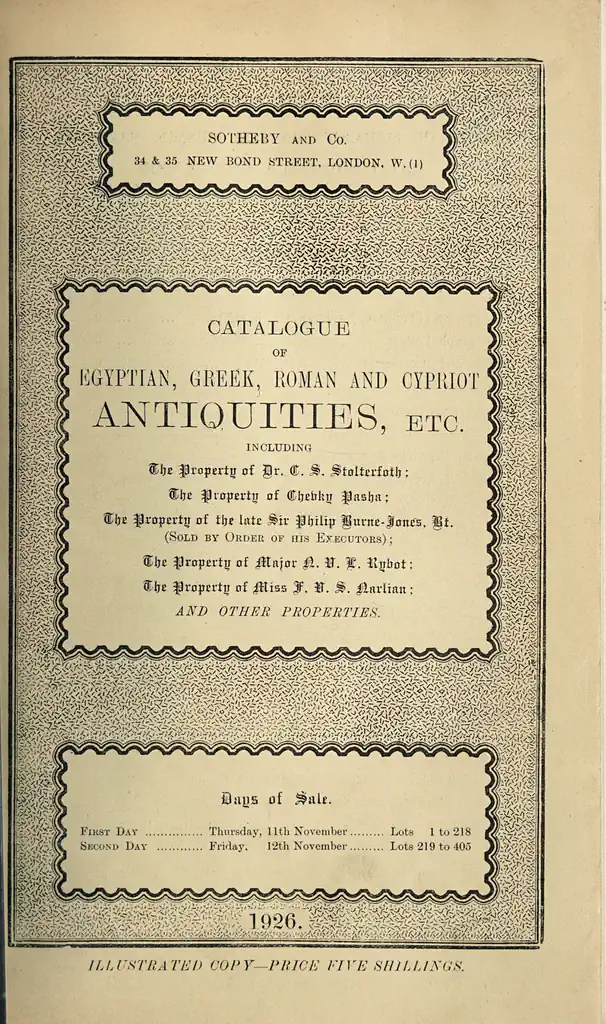
When this amphora came into the Drakopoulos Collection, its recorded history went back only to a collector who died in 1974. A 1926 sale catalogue on the library shelf goes further.
3 to 5 minutes. Sound optional.
Case notes
Research docket
- Object
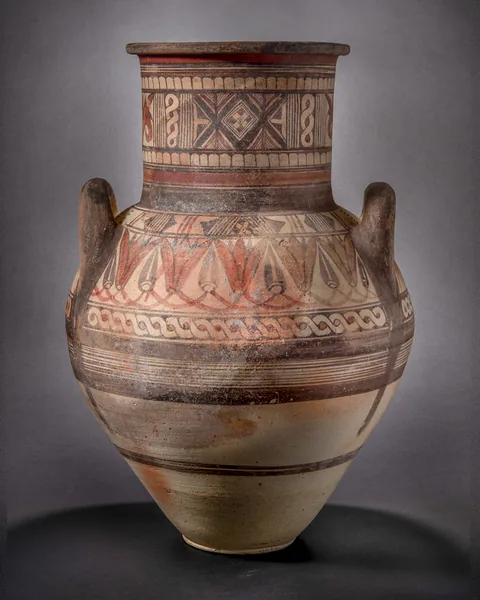
- Amphora. Bichrome IV ware, Cypro-Archaic I, c. 750–600 BC. Two handles on the shoulder; a frieze of lotus flowers and buds.
- Collection
- Drakopoulos Collection, JAR-AR-002
- Height (2024 sale)
- 65 cm
- Earlier history (at intake)
- Bonhams, London, 4 July 2024, lot 139, from the collection of Edward Varley Kayley (d. 1974), then by descent. Nothing recorded before him.
Find this amphora in print. Record the sale, the date, the lot and the plate, then file the card.
The catalogue
Catalogue of Egyptian, Greek, Roman and Cypriot Antiquities, sold by Sotheby & Co. “at their large galleries, 34 & 35, New Bond Street”, London, on Thursday 11 November 1926 and the following day, “at one o’clock precisely”. The Cypriot pottery comes first, on the first day. The catalogue does not name the owner of the Cypriot collection. Twelve plates are bound in after the lot descriptions, one to a leaf, with the backs left blank.
How a sale reference is checked
- Plate and lot. The plate caption gives the lot number, and the lot entry names its plate, so picture and words lock together. Two pots on the same plate can share a shape and a height; only the decoration and the description separate them.
- The height. A height is the one measurable thing in a 1926 entry. Convert it (inches × 2.54) and compare it with the object.
- Words of 1926. The catalogue sold every lot “with all faults, imperfections and errors of description” (Condition V). Its “guilloche” is the cable band of the modern record, and “Kition fabric” is its attribution of the ware to Kition; the amphora is now classed as Bichrome IV ware.
- The buyer. Purchasers had “to give in their names and places of abode” (Condition IV). This copy has the printed list of buyers’ names bound in at the back.
The answer (it gives the case away)
Lot 23, printed page 5:
A Diota, tapering oviform with broad shoulders, two handles on the body, decorated in red and black, on the body horizontal lines, on the shoulders a broad band of lotus flowers above a narrow band of guilloche, and beneath, line and diced ornament, on the neck winged diced lozenges front and back, and lotus flowers above the handles at the sides, 27 in. high; Kition fabric; c. 8th Cent. B.C. [Pl. III]
Provenance
Sotheby & Co., London, Catalogue of Egyptian, Greek, Roman and Cypriot Antiquities, 11–12 November 1926, lot 23, pl. III, as “Kition fabric; c. 8th Cent. B.C.”, H. 27 in. (68.6 cm); bought by Zachariades.
Lot 23 is the amphora. On Thursday 11 November 1926, in Sotheby’s rooms in New Bond Street, it was offered as “A Diota ... Kition fabric” and went to a buyer the list records as Zachariades. The catalogue gives its height as 27 inches (68.6 cm), where the 2024 sale gave 65 cm: a difference still to be checked against the pot.
The catalogue does not name the owner of the Cypriot collection, and Zachariades bought all four of the large diotas in the sale.
Zachariades is a name on a list and nothing more. By 1974 the amphora belonged to Edward Varley Kayley (1900–1974); his family kept it until Bonhams sold it in London on 4 July 2024. It passed through the London gallery ArtAncient and joined the Drakopoulos Collection in January 2025. Only the years between Zachariades and Kayley are still blank.