
Archaic I
Bichrome IV Trefoil Jug with Intersecting Circles and Cyprus Museum Lead Seal
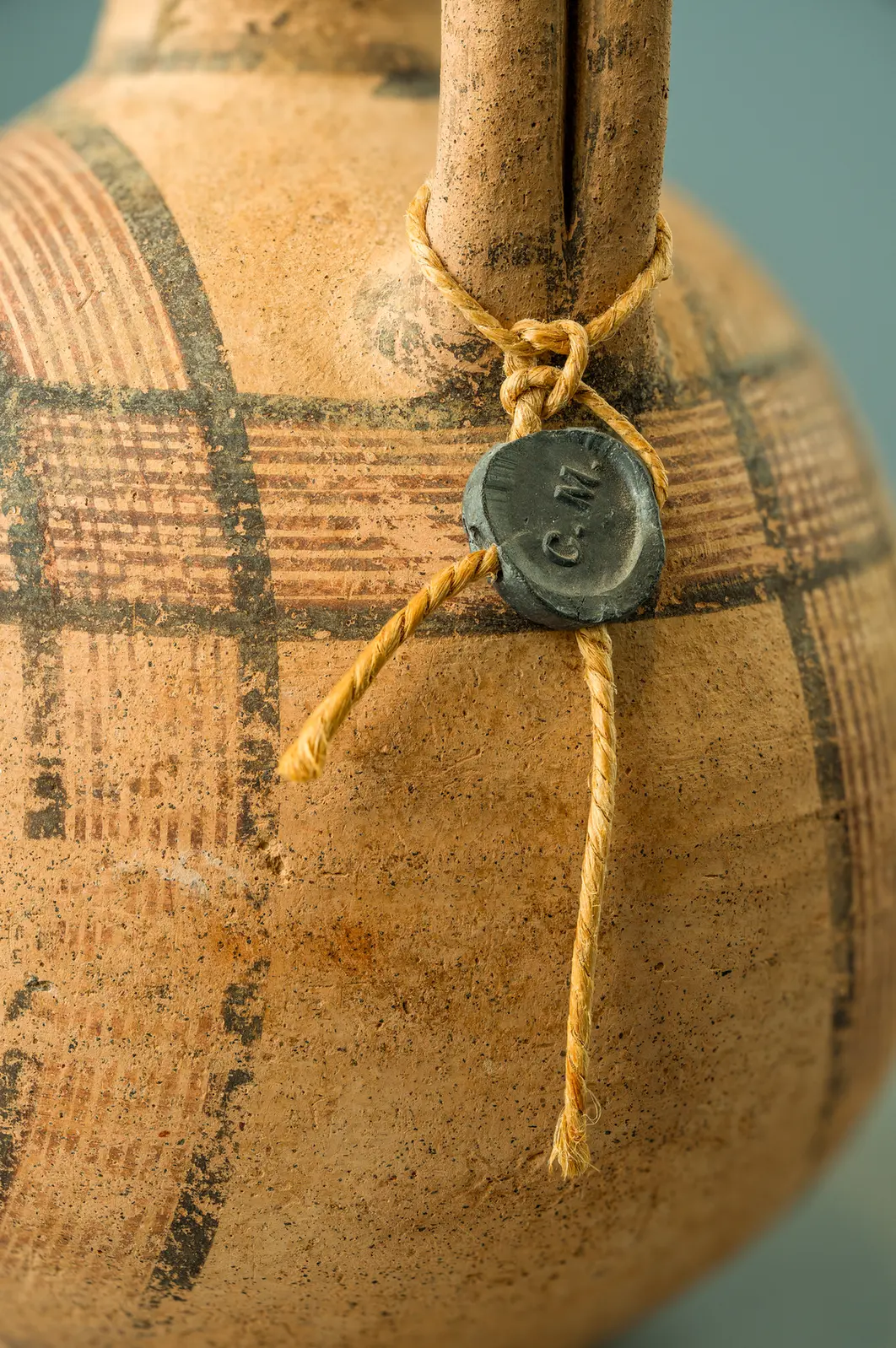
Bichrome IV globular trefoil jug with large side circles crossed by a shoulder band of fine red lines; a lead seal stamped C.M. hangs from the handle.
Date
750 - 600 BC
Accession No.
JUG-GE-007
Collection
Alexis Drakopoulos
Provenance
- Before 2025, private collection, Canada
- 2025–present, Alexis Drakopoulos, London
Cypro-Archaic I, c. 750–600 BCE · Bichrome IV ware · Wheel-made
A globular jug on a low ring base, with a narrow cylindrical neck, a small pinched trefoil mouth and a strap handle from the rim to the shoulder, its outer face split by a deep vertical groove. The pale orange-buff body is painted in black and red. On each side a broad black ring encloses a zone of fine red lines, and inside it sits a target of red and black rings round a small ringed dot. Across the shoulder runs a horizontal belt of the same fine red lines between black bands, cutting through the upper part of both side circles so that the two systems cross like the hoops of a basket. A black band marks the base of the neck. A lead seal stamped with the letters C.M. hangs from the handle on a length of twine.
Commentary
The jug is Bichrome IV, the black-and-red painted ware of Cypro-Archaic I, and its decoration belongs to what Gjerstad called the Western or circle style, which he associated with the western and northern parts of the island. Among its standard ornaments he lists "encircling intersecting lines", and this jug shows that scheme in a clear form, with large vertical circles crossed at the shoulder by a horizontal zone of lines [1, p. 52]. The globular body with trefoil mouth is his Type IV jug with pinched mouth [1, p. 51]. The painter filled the bands with closely spaced red lines instead of solid colour, which gives the ornament a hatched, textile-like look.
The same layout occurs on a White Painted oinochoe from Amathus in the British Museum (1894,1101.286), described as having large vertical concentric circles on the sides intersected at the shoulder by a horizontal band [2], and in simpler form on a Bichrome oinochoe from Kourion (1896,0201.369) [3]. The scheme also travelled. At Tarsus in Cilicia a globular Bichrome IV jug decorated with "large vertical circles of multiple lines crossed near top by zone of multiple horizontal lines", with a red disc at the centre of each side, was judged by its excavator to be a local imitation of the Cypriot class [4]. On these grounds the jug can be dated to Cypro-Archaic I, c. 750–600 BCE.
The initials C.M. stand for the Cyprus Museum. Under the Antiquities Law of 1935, antiquities could leave Cyprus lawfully only under an export licence, and the Department of Antiquities licensed a small number of dealers whose stock it inspected and approved for sale and export [5]. Objects exported this way survive with the Department's lead tag still attached, and the Department has matched such tags and licences against its own archive [6]. The seal on this jug therefore points to a lawful export from Cyprus. It does not give a date, and no permit is known to accompany the jug, so when the export took place is an open question. Examination of the reverse of the seal for a number or second stamp may narrow it.
References
- 1.Gjerstad, E. (1948) The Swedish Cyprus Expedition IV.2: The Cypro-Geometric, Cypro-Archaic and Cypro-Classical Periods. Stockholm: Swedish Cyprus Expedition, pp. 51–52.
- 2.British Museum, London, 1894,1101.286. White Painted oinochoe from Amathus, Cypro-Archaic II. Collection online record.
- 3.British Museum, London, 1896,0201.369. Bichrome oinochoe from Kourion, Cypro-Archaic I. Collection online record.
- 4.Goldman, H. (1963) Excavations at Gözlü Kule, Tarsus III: The Iron Age. Princeton: Princeton University Press, p. 245, no. 1042.
- 5.Powell, J. (2013) Love's Obsession: The Lives and Archaeology of Jim and Eve Stewart. Adelaide: Wakefield Press, pp. 46–47.
- 6.Alphas, E. (2017) From a Bronze Age tomb in Cyprus to the estate of a gentleman in Sussex: measures taken and problems faced in the investigations on the illicit trade of antiquities. In D. Pilides & M. Mina (eds), Four Decades of Hiatus in Archaeological Research in Cyprus: Towards Restoring the Balance. Vienna: Holzhausen, pp. 30–43.
More from the Catalogue
Browse related objects
Bichrome Oinochoe
Archaic I
Free-field bichrome jug with image of an Ibis bird and reeds
Archaic
Squat bichrome jug in free-field style with image of bird picking a lotus flower
Archaic
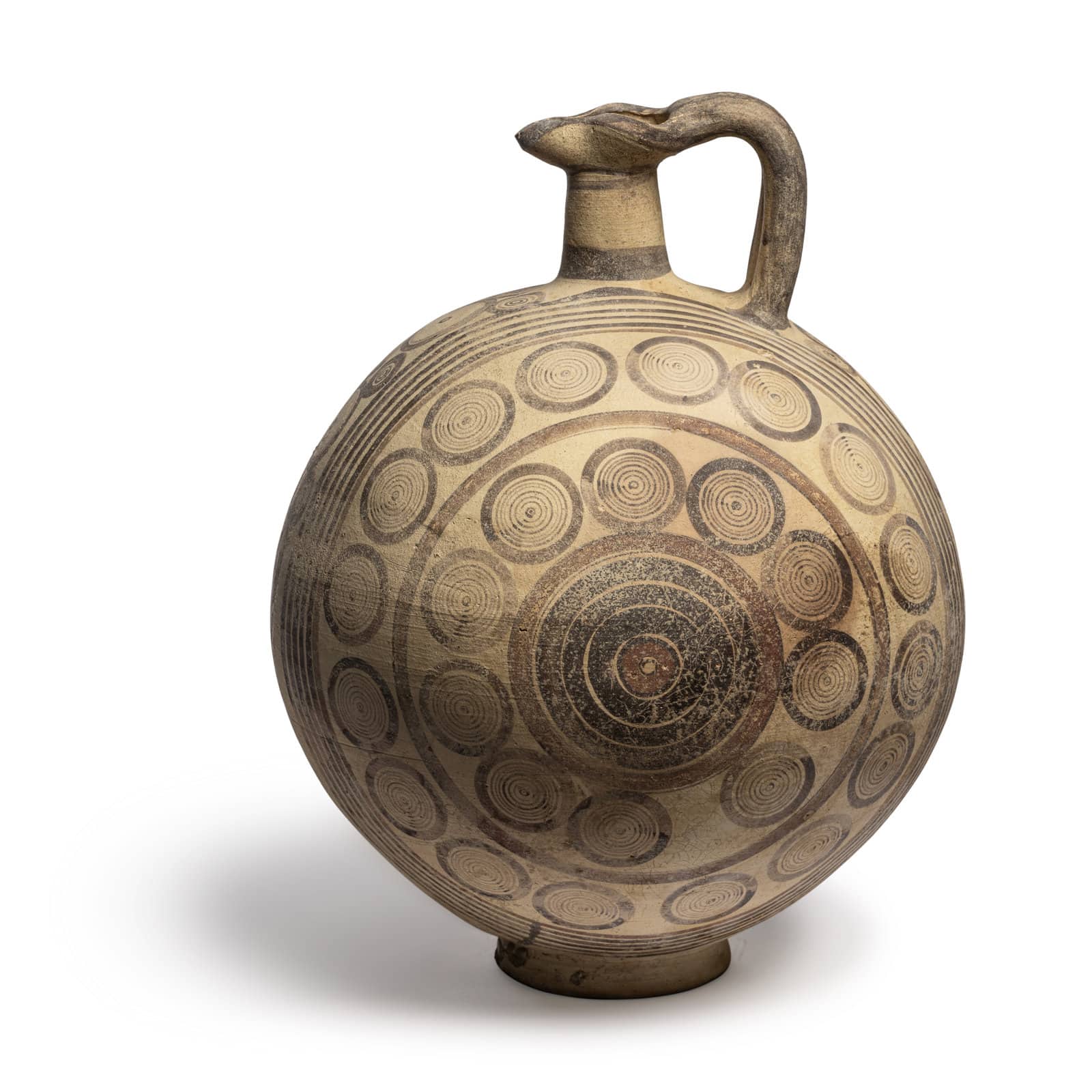
A Cypriot Bichrome-Ware Oinochoe Jug
Archaic I
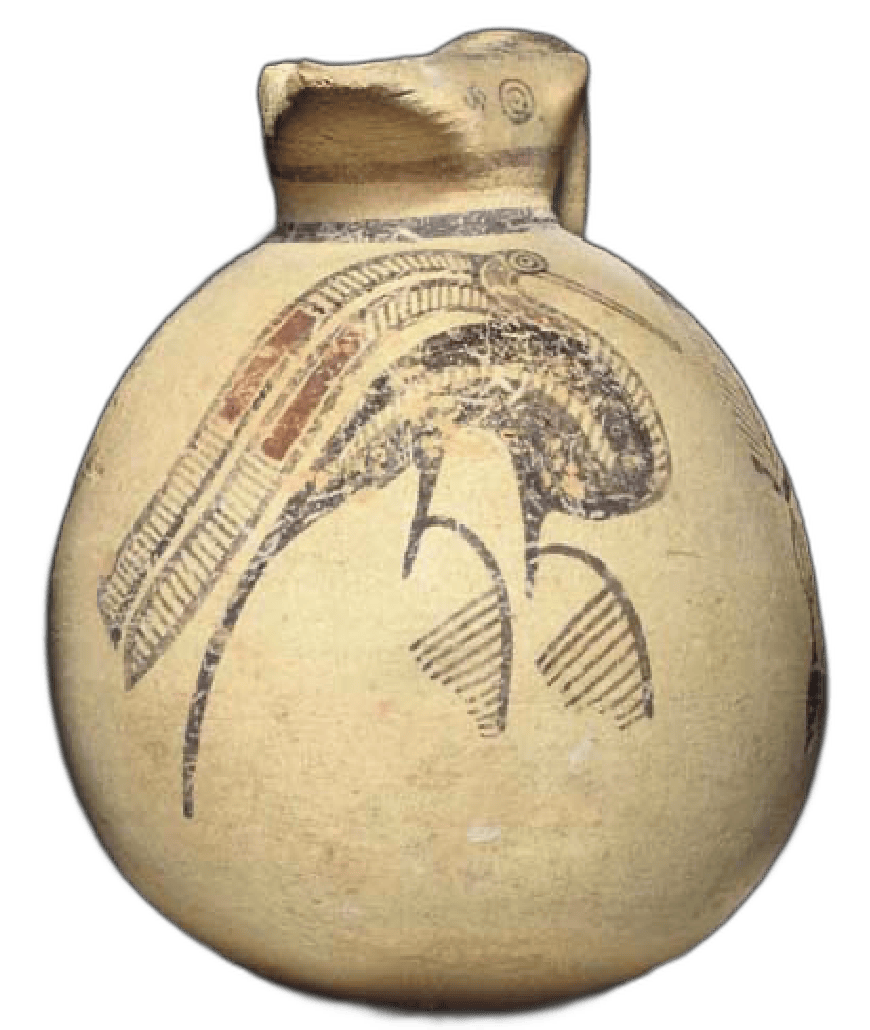
Oinochoe with Free Field Bird
Archaic I
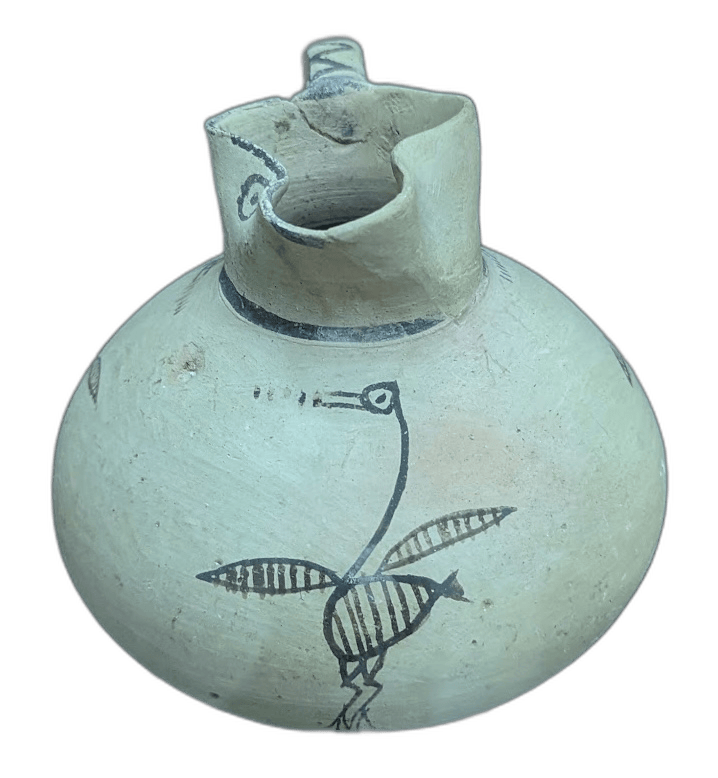
Small Oinochoe with Free Field Bird
Archaic I
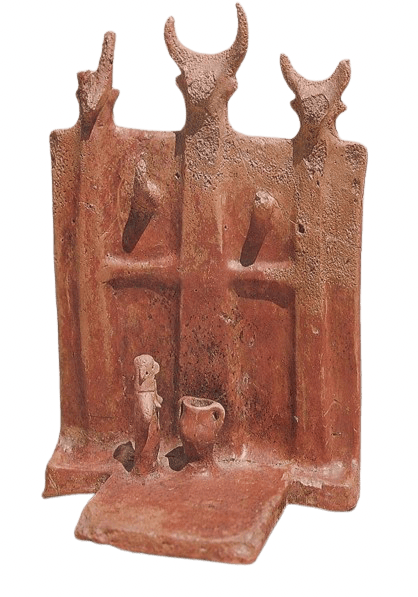
Red Polished Shrine
Middle Bronze Age I
Black-On-Red Geometric Jug Sherd
Geometric II
Bichrome Jug
Geometric
Bichrome Juglet
Geometric
Bichrome Oinochoe
Geometric
Juglet
Archaic II
Oinochoe
Geometric III
Jug
Archaic I
Juglet
Archaic I
Jug
Geometric I
Terracotta jug
Early Bronze Age I
Juglet
Geometric I