
Cyprus Export Licences, Lead Seals and Labels: Reading the Marks
How to read a Cyprus export licence, a lead seal stamped C.M., a Cyprus Museum S.R. number or a dealer's stock number, and where each one can still be checked.

Alexis Drakopoulos
October 3, 2026·Guides · Collecting·16 min read


Share


Alexis Drakopoulos is a Greek Cypriot Machine Learning Engineer working in Financial Crimes. He is passionate about Archeology and making it accessible to everyone. About Me.
On 2 November 1953 Petros Kolokasides, "Antiques Dealer & Persian Carpets" of Nicosia, wrote out a receipt to Walter G. Beasley for Bronze Age and Iron Age jugs, bowls, plates and a kylix, ten oil lamps, a small head and "small broken pieces": twenty-three pounds in all. Beside most lines he wrote a number from his own stock. Four days later the Department of Antiquities issued export licence No. 2655 for the consignment, and the same numbers turn up again on the licence: "one red polished jug with spout, C.C. 2418", "one Iron Age geometric kylix 2390". The receipt was later stamped by customs in Victoria, Australia [1].
Two pieces of paper and one set of numbers follow those pots from a shop in Nicosia to the customs in Victoria. Most families have less: a lead disc on a string, a number painted under the foot, a sticker, a photocopy. This guide takes each mark and paper in turn: what it records, roughly when it dates from, and where it can still be checked. The law itself is set out in the legal export of Cypriot antiquities, and your wider options in inherited Cypriot antiquities.
What does a Cyprus export licence look like?
A long, narrow printed form, about 34 by 18 cm, headed "Government of Cyprus, Department of Antiquities" and "Licence to Export Antiquities", with a serial number printed at top left and the objects written in by hand. The form is marked "Form Antiq. 1" in the top corner, and its printed text barely changed between 1953 and 1966 [1][2][3]:
Permission is hereby given by the Director of Antiquities to the person undersigned to export … being an antiquity / antiquities bearing the above number, examined and passed for export by me and sealed in my presence this … day of … 19… This licence is valid for a period of two years from the date of issue.
Below come the Director's signature, the exporter's signature and a permanent address. "Bearing the above number" means the objects themselves were meant to carry the licence number, which is why export numbers are still found on pots: in the Leipzig study of the Malios collection, seven pieces from one group "still carry export numbers" [5]. "Sealed in my presence" refers to the lead seal described below: licence and seal are two halves of one inspection.
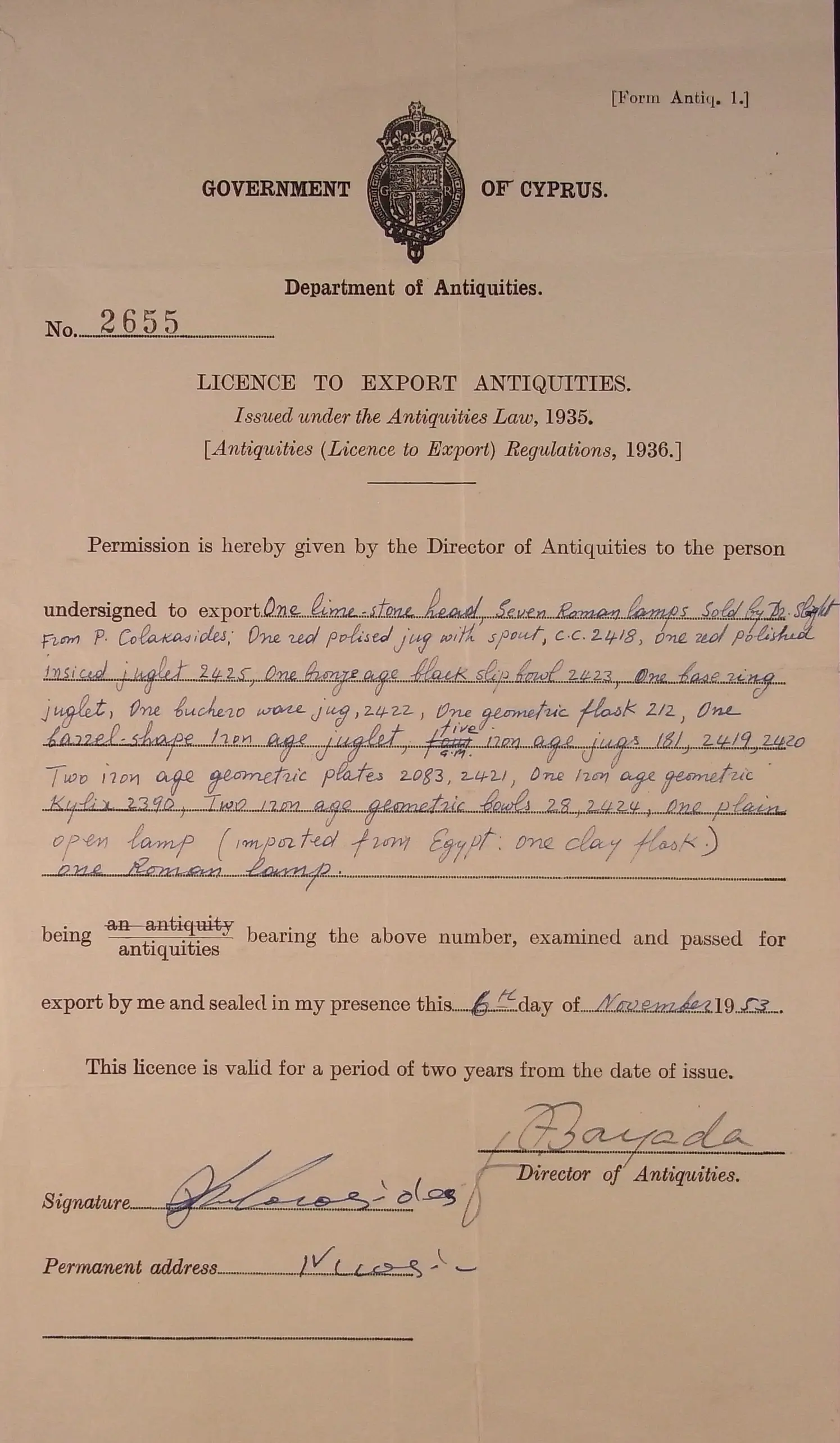
The legal line under the title moved with the statute book. Licence No. 2655 of 1953 cites "the Antiquities Law, 1935" and "Antiquities (Licence to Export) Regulations, 1936" [1]. By 1960 the same line read "Issued under the Antiquities Law, Cap. 43", and it still did in November 1966, under the old royal arms and the words "Government of Cyprus", six years after independence [2][3]. Colonial stationery used up by the Republic is normal, and no reason for suspicion.
An officer could sign for the Director: licence No. 5367 of 1966 is signed "A. Pierides" above the printed title [3]. Before the Department existed the Cyprus Museum's curator signed: the oldest permit in the Malios collection, for a Roman oil lamp in 1935, carries the signature of Porphyrios Dikaios under the 1905 law [5].
Descriptions are brief. The 1960 licence lists numbered boxes of sherds for the French mission at Enkomi, the 1966 one only inventory numbers [2][3], and the 1953 licence includes "one base ring juglet" with no number at all [1]. A licence proves an export happened. Tying it to one particular pot needs something more: a matching number, a seal, a photograph or a receipt.
Licensed export of privately owned antiquities ended with the 1996 amendment of the law [11]. As of 2026, section 27 of the Antiquities Law, Cap. 31, allows an export licence only for temporary exhibition, long-term loan to a museum or university, the study of excavated material, or a gift by the President of the Republic; it forbids any licence for a private collection, and unlicensed export carries up to five years' imprisonment, a fine of up to €45,000, or both [12]. Dealing in antiquities has been prohibited since 1996 as well (section 26), so a licence for a pot bought from a shop is old paper by definition. This page is general information, not legal advice.
Dating a licence by its number
Licences were numbered in a running sequence, so the number gives a rough date. The dated examples we know of [1][2][3][5][14]:
| Licence no. | Date | What it covered |
|---|---|---|
| 550 | 3 March 1935 | One object for a Miss Moodie, now in the Malios collection, Leipzig |
| 2655 | 6 November 1953 | The Kolokasides consignment for Walter G. Beasley |
| 3708 | 15 October 1960 | Boxes of sherds for the French mission at Enkomi |
| 4271 | Between 1960 and 1966, by its place in the sequence | A Bichrome dish later in the Cyprus Museum, Jacksonville, North Carolina |
| 5367 | 11 November 1966 | Objects lent to the French mission at Enkomi |
| 6403 | 5 October 1972 | 42 objects for the American diplomat William Rex Crawford |
| 7070 | 16 January 1978 | 62 objects for A. Strouthos, 32 of them now in Leipzig |
Treat it as a rough guide built from scattered surviving licences. One licence could cover dozens of objects, so seven thousand licences by 1978 means many more than seven thousand pieces. The story of the Leipzig permits is told in Licence No. 7070.
What does a lead seal on a Cypriot pot mean?
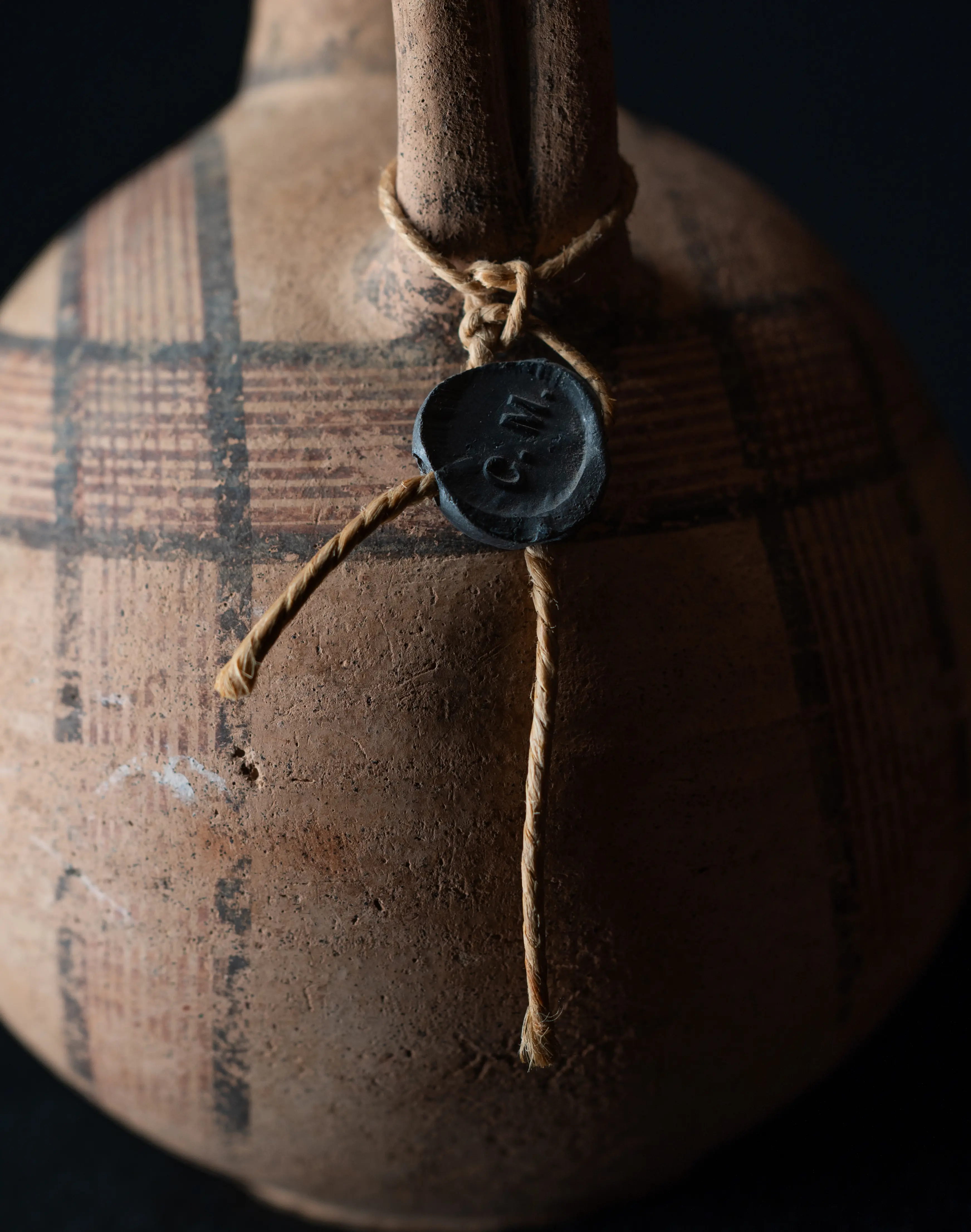
It is the physical trace of an export inspection: a small lead disc pressed onto a cord or wire threaded through the handle or tied round the neck, applied when the consignment was "examined and passed for export … and sealed" [1]. The seals usually read C.M., for Cyprus Museum. The seal on the jug at the top of this page is one; another hangs from the handle of a Bichrome IV trefoil jug in this site's collection.
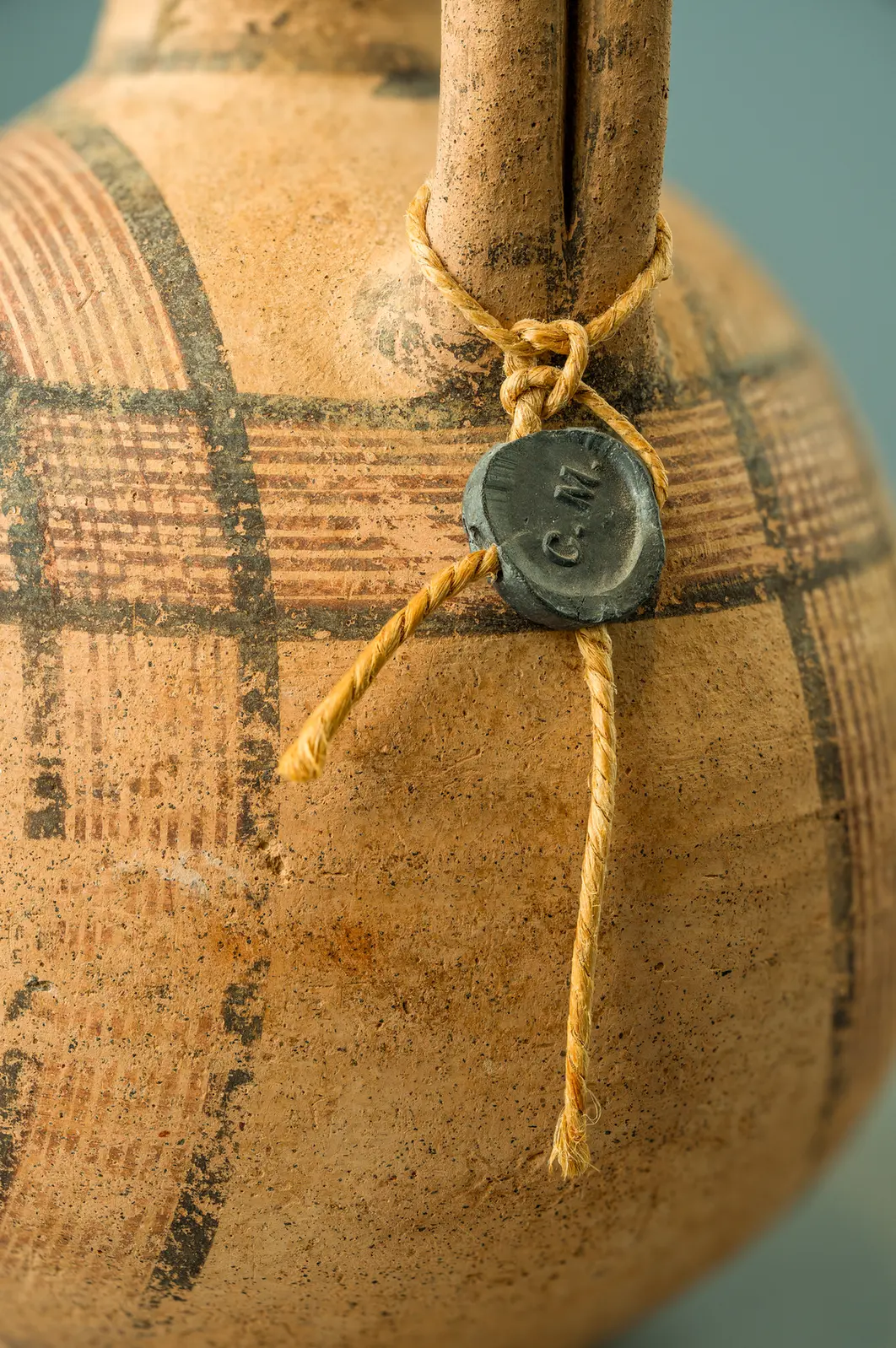
Auction catalogues mention them regularly, nearly always on the everyday pottery and glass that the licensed trade sold in quantity. Bonhams in London sold a Bichrome jug with "a Cypriot lead export bulla attached" on 23 July 2020 (lot 2, £1,785); it had belonged to Alfred de la Penha, who died in 1953, so its seal very probably predates that year. The same sale had a barrel flask with two seals (lot 3, £2,800), and a 31 cm Bichrome oinochoe sold on 28 November 2019 "retains a Cypriot lead export seal attached to the handle" (lot 45, £2,550) [13]. When the Cyprus Museum of Jacksonville, North Carolina was dispersed in 2018, four lots were described as "affixed with C. M. metal tag", and one Bichrome dish still had a handwritten card reading "Export License No 4271" tied to it with the seal [14]. Seal and licence number on one object is the strongest form this evidence takes.
Seals are documented on pieces exported from at least the middle of the twentieth century until licensed export ended. If yours carries a legend other than C.M., or anything on the reverse, photograph both faces and send them to us.
Three cautions. A seal records an export inspection; it is no certificate that the object is genuine or of where it was found. A seal on a cord can be untied and moved, and ancient lead seals (Roman and Byzantine bullae) are sold cheaply, so a loose seal, or one on new string, proves little by itself. And do not cut it off, clean it or re-tie it. The Leipzig researchers found that seals and export numbers were "often removed largely for aesthetic reasons" [5], which is how much of this evidence was lost. A worn groove or a stain on a handle where a cord once ran is worth photographing too.
What is an S.R. number or a Cyprus Museum ticket?
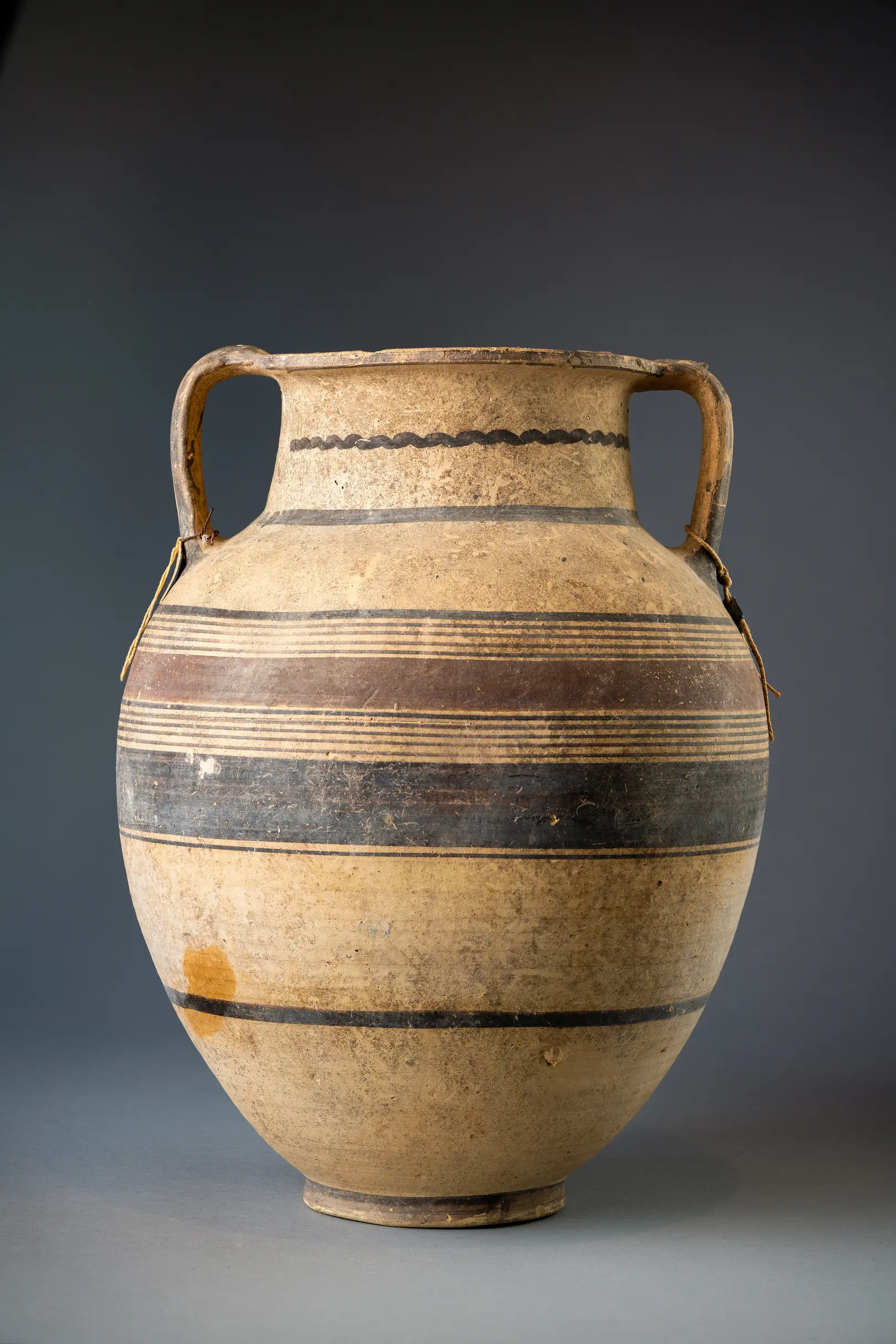
An S.R. number is an entry in the Sales Register of the Department of Antiquities, which means the Cyprus Museum itself sold the object. From the 1920s until 1991 the Museum sold "duplicate" antiquities to visitors, first from a saleroom in its courtyard; later the Department kept a Sales Register of items offered at nominal prices, preferably to universities and museums [6][7]. The number takes the form register number and year: a 42 cm Bichrome amphora in this site's collection carries S.R. 3477/65, was sold through the Register in about 1965 and left Cyprus under licence in 1969.
Earlier saleroom stock had tickets. Rupert Gunnis, in charge of the sales from the late 1920s, found the duplicates unlabelled and had writers of Greek, English and Turkish letter dated labels on Government House invitation cards [6]. We know of no published surviving ticket or saleroom receipt, so a small handwritten card in those languages deserves careful photographs. The history of the saleroom is in how the Cyprus Museum sold antiquities.
One gap matters for owners. Gunnis approved export permits himself and did not keep carbon copies, and some of the "duplicates" of 1926 to 1932 came from an official excavation at Marion [6]. For those years the absence of an official record proves nothing either way.
What paperwork did licensed dealers give?
Receipts, typed stock lists and stock numbers, and sometimes the export licence itself. Under the 1935 law A. H. S. Megaw, Director of Antiquities from 1936 to 1960, licensed only three dealers. He checked their stock, approved what could be sold and exported, and put notices in hotels urging visitors to buy only from dealers who displayed a Department licence [8].
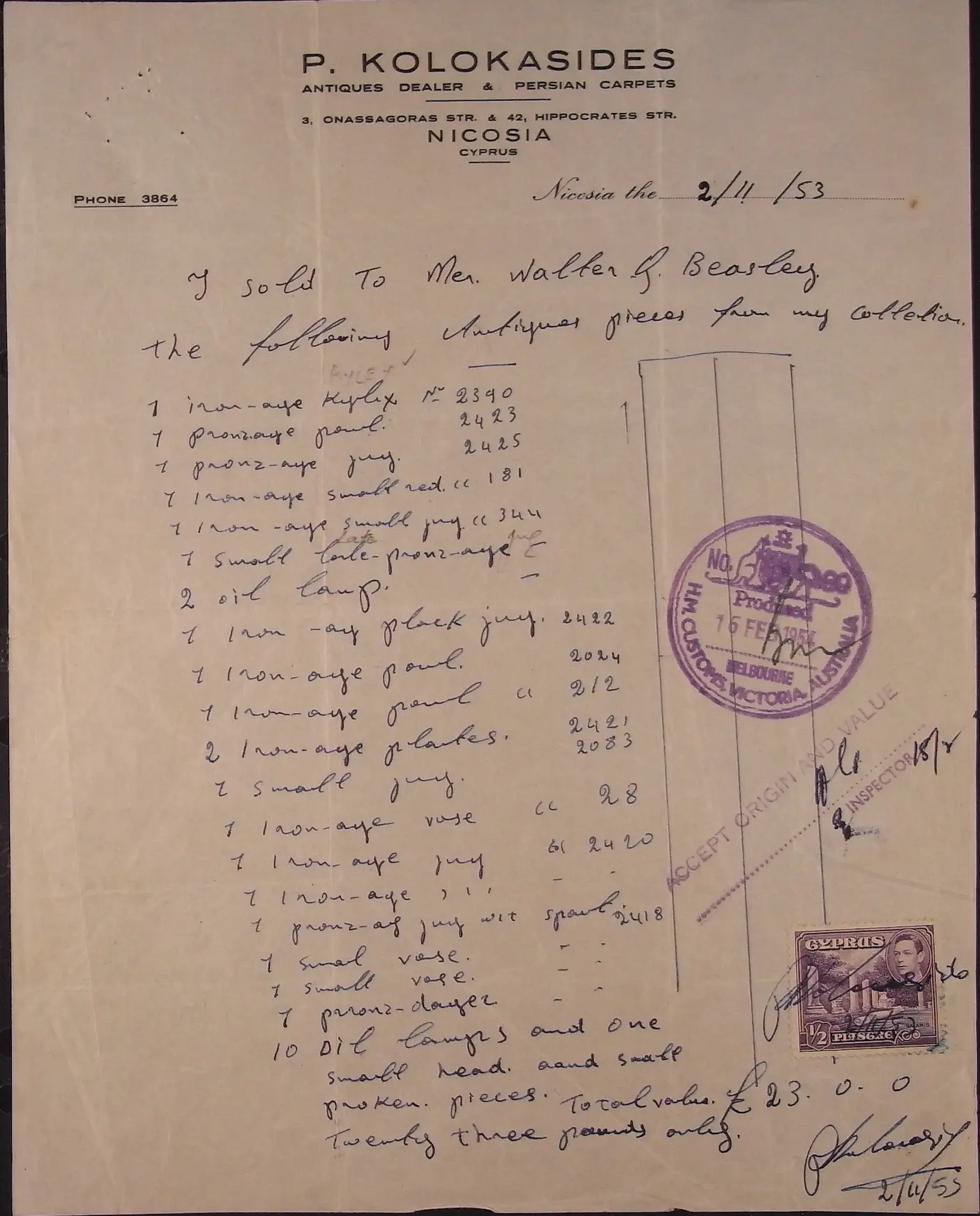
Petros Kolokasides of Nicosia was one of the three, "a licenced dealer in Antiquities in Nicosia, and at the same time a collector" in Vassos Karageorghis's words [10][8]. His letterhead read "P. Kolokasides, Antiques Dealer & Persian Carpets, 3 Onassagoras Str. & 42 Hippocrates Str., Nicosia" [1]. Search every spelling: Kolokasides, Kolokassides, Colocassides, Colakasides. A typed card with a photograph, recording where a bowl was bought from him in the 1950s or 1960s, travelled with that bowl to a gallery sale in 2016, and the Department confirmed its export [4].
The Beasley licence shows the snag. It is signed by Kolokasides as exporter, with his own Nicosia address, and the buyer's name appears nowhere on it [1]. He sometimes did this for clients, so a family searching the Department's files under their grandfather's name may find nothing; search under the dealer's name as well.
George Basil Palma, a chemist whose pharmacy in Varosha doubled as an antiquities shop, was a licensed dealer by the late 1930s. His file in the State Archives in Nicosia (No. 24/37) holds his monthly returns of what he bought and sold, and his correspondence with Megaw [9]. We know of no published Palma label or receipt.
What does a number painted on an ancient pot mean?
Usually an inventory number added by a museum, a collector or a dealer. It becomes provenance only when it is matched to a register, a catalogue or a photograph.
The Metropolitan Museum bought Luigi Palma di Cesnola's collection in 1874 to 1876 and gave it accession numbers in the 74.51 series. It later sold thousands of "duplicates", most visibly at the Anderson Galleries in New York in Sale No. 2253 (30 to 31 March 1928) and Sale No. 2260 (21 to 22 April 1928). Both catalogues are online, and many lots cite plates in Cesnola's Atlas [15]. Some passed through two museums: a painted tankard went from the Met to the Toledo Museum of Art in 1916 (1916.120) and sold at Christie's in 2016 for $8,750 [16]. In the Leipzig study, former Met pieces were recognised by black lacquered bases with gold-ochre numbers [5].
The British Museum's excavations of the 1890s at Amathus, Kourion and Enkomi ended with "duplicates" handed out to schools and museums across Britain, and when some of those institutions later deaccessioned, the objects left with museum numbers on them [18]. A British Museum registration number begins with the year of acquisition and can be searched in the museum's online collection. Finds from the Swedish excavations of 1927 to 1931, the largest lawful export of the century, carry site and tomb numbers that match the expedition's published volumes and the records of the Medelhavsmuseet in Stockholm [18].
Private collectors numbered their pieces too. The de la Penha jug at Bonhams has his inventory number, 203, on the underside [13]. The Severis collection and others formed in Cyprus are published, and a published catalogue is itself provenance.
A number can cut both ways. The Famagusta collector Chr. Hadjiprodromou registered his collection with the Department in 1973. It was looted after 1974, and pieces were recognised at Christie's in London in 1976 because they carried their registration numbers; a picrolite figurine, Hadjiprodromou no. 889, is now back in the Cyprus Museum [19]. A cataloguer's reading of a mark still has to be checked: TimeLine Auctions sold a Cypriot dish in 2024 with "a red inked inscription on the base suggesting prior association with The Metropolitan Museum of Art", for £70 [17]. Until the number is found in the Met's register, "suggesting" is all it does.
How do I trace an old auction sticker or catalogue number?
Find the printed catalogue for that sale and look up the lot. Major houses' catalogues are held in art libraries and increasingly online, and nineteenth-century London sales of Cesnola material survive in copies annotated with buyers' names [18]. That is how the British Museum traced a Cypriot potter figure bought in 2009 back through an 1888 sale of Alessandro Palma di Cesnola and Edwin Lawrence's collection, lot 777, as told in Licence No. 7070.
An old sale proves only that the object was on the market at that date. A kernos, a vessel of joined cups, looted from the Hadjiprodromou collection after 1974, was sold at Sotheby's in July 1982 and again at Sotheby's in 2014 before the Department identified it in 2016; it went back to Cyprus that November [4]. If a sticker from the 1980s is your earliest evidence, it is where research starts.
How can I check whether a licence or seal is genuine?
Ask the Department of Antiquities. It keeps copies of the old export licences and can check a number or a well-photographed seal against them: "each time an object appears accompanied by an export license from Cyprus, this can be confirmed" [4]. It did exactly that for a Red Polished jug sold at Bonhams on 2 October 2014 (lot 2), bought by an American on 28 September 1964 from an authorised dealer for £8 and accompanied by a copy of its licence of 20 October 1964 [4][13]. The Department is part of the Deputy Ministry of Culture in Nicosia, and its published email address is antiquitiesdept@da.culture.gov.cy [20]. Send the licence number and date, a scan, and photographs of the object and seal.
Other places that can confirm a link:
- the State Archives in Nicosia, for dealers' files and returns [9];
- museum online collections (the Met, the British Museum, the Medelhavsmuseet) for a painted number;
- printed auction catalogues for a lot number;
- the Art Loss Register and INTERPOL's stolen works of art database, for whether an object has been reported stolen.
Forged papers exist in the trade, though we know of no published Cypriot case. A well-known Egyptian one: the gilded coffin of Nedjemankh, bought by the Metropolitan Museum in 2017, came with a forged 1971 Egyptian export licence and was returned to Egypt in 2019 [21]. The Department's copies are the protection.
What if the paperwork is missing or doesn't match?
Missing paper is normal. The Leipzig researchers found that permits "were often lost" in private hands over the decades [5]. Most Cypriot antiquities abroad left the island legally, and many have simply shed their papers; looting is real, and belongs mostly to the years after 1974. A licence that fits only loosely usually reflects a brief description; look for a number, a seal or a dealer's list that tightens it. A photocopy or later typed copy is weaker than an original, so check that number, date and signatory fit the table above.
Some things deserve more care: church icons and fittings of any date, and anything whose type or story points to the occupied north after 1974. The guide to antiquities brought home from Cyprus tests a family story against the dates, and the compendium covers looting in occupied northern Cyprus. A stamped or printed mark on the base can belong to a modern museum-shop replica (replicas and fakes). For value, selling and giving back, see what a Cypriot antiquity is worth, selling in the UK or in the US, and returning or donating Cypriot antiquities.
What should I photograph and keep?
Everything on the object or with it, recorded before anyone tidies it.
- The whole object from four sides, top and base, in even light, with a ruler.
- Every mark close up: numbers on the base, inside the foot or on the handle; labels front and back; stickers; both faces of any seal, with its cord and where it passes through.
- Raking light, low and from one side, across the base and handle to pick up faded numbers, glue shadows of lost labels and cord marks.
- Every paper, both sides: licences, receipts, stock lists, letters, photographs, even the box. Keep originals in an envelope with the object, never taped or stapled to it.
- A key saying which paper belongs to which object, since licences describe objects so briefly.
- The family story in writing: who bought it, where, when, and when they lived in or visited Cyprus.
If you are an executor, the guide for executors explains how to inventory a collection without splitting it. When you have the photographs, send them to us and we will help you work out what the marks record and where to check them.
The best-kept evidence we know of belonged to Ethel M. Inman, who bought four small pieces in Cyprus in 1937 and 1939. She had the export permits framed and chained the antiquities to the frames. Permits and objects are still together, now in Leipzig [5].
References
- 1.P. Kolokasides, Antiques Dealer and Persian Carpets, Nicosia: receipt to Walter G. Beasley, 2 November 1953; and Government of Cyprus, Department of Antiquities, Licence to Export Antiquities No. 2655, 6 November 1953 (Form Antiq. 1). Private archive; reproduced in this site's article on Petros Kolokasides.
- 2.Government of Cyprus, Department of Antiquities, Licence to Export Antiquities No. 3708, 15 October 1960. Collège de France, fonds Claude Schaeffer, 34 CDF art. 176; digitised by Université PSL. https://bibnum.explore.psl.eu/s/psl/ark:/18469/2688r/223960
- 3.Government of Cyprus, Department of Antiquities, Licence to Export Antiquities No. 5367, 11 November 1966. Collège de France, fonds Claude Schaeffer, 34 CDF art. 176; digitised by Université PSL. https://bibnum.explore.psl.eu/s/psl/ark:/18469/268d4/223972
- 4.Alphas, E. (2017). From a Bronze Age tomb in Cyprus to the estate of a gentleman in Sussex: Measures taken and problems faced in the investigations on the illicit trade of antiquities. In D. Pilides & M. Mina (Eds.), Four Decades of Hiatus in Archaeological Research in Cyprus: Towards Restoring the Balance (pp. 30-43, esp. pp. 12, 18-19 of the paper). Holzhausen.
- 5.Gatzsche, A. (2023). From Cyprus to Leipzig: Provenance research. In E. Poyiadji-Richter (Ed.), Alexander Malios Collection, Vol. 1: Cypriot Antiquities (pp. 6-11). Alexander Malios Research Institute for Cypriot Heritage and Archaeology.
- 6.Stanley-Price, N. (2025). Illicit excavation and the sale of 'duplicate' antiquities: Rupert Gunnis and the Cyprus Museum, 1926-1932. Cahiers du Centre d'Études Chypriotes, 55, 269-301. https://journals.openedition.org/cchyp/2109
- 7.Interview with Dr. Vassos Karageorghis, Director of the Department of Antiquities of Cyprus. (1983). In E. Herscher, The antiquities market. Journal of Field Archaeology, 10(3), p. 17.
- 8.Powell, J. (2013). Love's Obsession: The Lives and Archaeology of Jim and Eve Stewart (pp. 46-47). Wakefield Press.
- 9.Merrillees, R. S. (2014). George Basil Palma, chemist and collector of Cypriote antiquities in Famagusta, Cyprus, in the 20th century A.D. Cahiers du Centre d'Études Chypriotes, 44, 14-17.
- 10.Karageorghis, V. (1965). Corpus Vasorum Antiquorum, Cyprus 2: Private Collections I. Preface, p. 8.
- 11.Fehlmann, M. Looting and losing the archaeological heritage of Cyprus (Chapter 8, pp. 156-158). Bloomsbury Academic. https://doi.org/10.5040/9780755608331
- 12.Republic of Cyprus, Ο περί Αρχαιοτήτων Νόμος (The Antiquities Law), Cap. 31, as amended to 2024, sections 26 and 27. Consolidated text, CyLaw (Cyprus Bar Association). https://www.cylaw.org/nomoi/enop/non-ind/0_31/full.html
- 13.Bonhams, London: Antiquities, 2 October 2014, lot 2; 28 November 2019, lot 45; 23 July 2020, lots 2 and 3; 1 July 2026, lot 1. Online catalogue entries, bonhams.com.
- 14.Auction of the collection of the Cyprus Museum, Jacksonville, North Carolina (collection of Dr Takey Crist), 2018: lot descriptions of a Cypro-Geometric two-handled dish ($3,800), a Cypro-Geometric Bichrome dish with 'Export License No 4271' card ($900), a pair of White Slip bowls ($260) and a Roman glass bottle ($450).
- 15.Anderson Galleries, New York. (1928). Cypriote & Classical Antiquities: Duplicates of the Cesnola & Other Collections, Sold by Order of the Trustees of the Metropolitan Museum of Art. Sale No. 2253 (30-31 March 1928) and Sale No. 2260 (21-22 April 1928). Internet Archive: cyprioteclassica00ande and cyprioteclassica00ande_0.
- 16.Christie's, Online sale 14572 (2016), lot 24: Cypriot painted tankard, ex Cesnola collection, Metropolitan Museum of Art, and Toledo Museum of Art (1916.120). https://www.christies.com/en/lot/lot-6024232
- 17.TimeLine Auctions, Antiquities, 5 June 2024, lot 574: Cypriot dish with collection numbers and a red inked inscription.
- 18.Pilides, D., & Papadimitriou, N. (Eds.). (2012). Ancient Cyprus: Cultures in Dialogue (pp. 23, 43-44). Department of Antiquities, Cyprus.
- 19.Karageorghis, V. (1990). The A. G. Leventis Foundation and the Cultural Heritage of Cyprus (pp. 54, 58). A. G. Leventis Foundation.
- 20.Republic of Cyprus, Deputy Ministry of Culture, Department of Antiquities: Contact Us (accessed 3 October 2026). https://www.culture.gov.cy/dmculture/da/da.nsf/DMLcontactus_en/DMLcontactus_en?OpenDocument
- 21.Stolen coffin returns to Egypt after Manhattan DA investigation. NBC New York, 25 September 2019. https://www.nbcnewyork.com/news/local/stolen-coffee-returns-to-egypt-after/1706884/