
Contents
Cattle stand on the rims of Early Bronze Age Red Polished cult vessels, form whole vessels in Late Bronze Age Base Ring ware, hang as gold pendants, and fill the votive deposits of Iron Age sanctuaries as terracotta figurines. The bull is a motif in the strict sense: it belongs to no single ware or period, and the same animal is shaped in clay, carved in limestone, cast in bronze and worked in gold over two thousand years. This page follows it phase by phase, sets out what the main scholars have made of it, and flags the recurrent problem of telling a bull from a ram, a goat or a stag. To see every object tagged with the motif, see all bulls and cattle in the catalogue.
What counts as a bull motif
Five kinds of object carry the image. The first is the protome, a modelled head (sometimes with forequarters) set on the rim or shoulder of a vessel. The second is the whole-vessel bull, where the pot itself takes the shape of the animal, as in the Base Ring rhyta. The third is the free-standing figurine. The fourth is the bucranium, a bull's skull or head used as a sign on its own: on poles in the Early Bronze Age clay models, and as real ox skulls in Late Bronze Age sanctuaries. The fifth is the scene, in which cattle appear alongside people: penned in an enclosure, led to sacrifice, attacked by a lion, or feeding a calf.
Cattle also have a closely related cousin on the same pots: the model ox-horn. These life-size clay horns, found in Early Bronze Age tombs, are classed with the "object models" and their shape was "clearly intended to imitate bull horns" [1].
| Phase | Main forms | Examples on this site |
|---|---|---|
| Early Cypriot I–II (c. 2250–2100 BC) | Protomes on Red Polished cult vessels, bulls in relief, clay horn models, enclosure models | Vounous Tomb 36 bowl; Vounous Bowl |
| Early Cypriot III–Middle Cypriot | Bull-headed askoi, modelled bulls on jugs, small figurines | Drakopoulos two-headed askos; Lapithos hollow bull |
| Late Cypriot II (c. 1450–1200 BC) | Base Ring bull rhyta and askoi, gold bull's-head pendants, ox skulls as masks | Met 74.51.825; Met 74.51.3117 |
| Cypro-Archaic (c. 750–480 BC) | Handmade terracotta bulls, bull's-head jugs, limestone votives, bull-masked figures | Drakopoulos bull head; Met 74.51.556 |
| Cypro-Classical (c. 480–310 BC) | Limestone votaries holding bull masks | Golgoi statue, Met 74.51.2463 |
Early Bronze Age: protomes, horns and the Vounous enclosure
The bull motif begins in earnest with the Red Polished cult vessels of the north-coast cemetery at Bellapais-Vounous. Almost all provenanced figurative objects of Early Cypriot I–II (c. 2250–2100 BC) come from Vounous, most of them from James Stewart's excavations of 1937–1938, and among the animals represented there "the vast majority ... are quadrupeds, with horned cattle in the majority" [1]. The south coast chose differently: on its decorated multi-necked jugs 14 of 20 animals are birds [1]. For that other half of the bestiary see Birds.
Porphyrios Dikaios, who excavated at Vounous in 1931–1932, found the clearest link between image and practice. The floor of Tomb 36 was "strewn with a large part of an animal's skeleton (ox) on which small bowls were placed", and in the same chamber lay "a large bowl with bull's heads and snakes pendent from their throats", which itself contained ox bones and a ring vase [2, p. 100]. The tomb also held votive models of bulls' horns [2, p. 122]. Dikaios concluded that the bull "played a considerable part as a sacrificial animal ... offered in tombs" and that it is "often represented on vases in conjunction with the snake" [2, p. 122].
The rim protomes are catalogued in the first volume of Vassos Karageorghis's corpus of Cypriot coroplastic art [3]. From Vounous A Tomb 117 come two protomes broken from a single cult vessel: a bull with incurving horns, 8.3 cm high, and a ram, 6.1 cm high, both now in Birmingham Museum and Art Gallery [3]. Tomb 153 produced a cult chalice with two tulip bowls and "two protomes, one of a bull and the other of a ram, turned outwards" [3]. A cult vessel from Tomb 155, now in the National Gallery of Victoria, Melbourne, carries a pair of bull protomes and a pair of other animals [3]. Cattle protomes thus usually share the rim with sheep or goats. For the vessel types themselves see Tulip Bowls and Cult Vessels and Red Polished ware.
The best-known bull scene is the clay model from Vounous known as the Vounous Bowl: a circular enclosure with figures, cattle in pens and poles topped by bulls' heads. Desmond Morris groups it with a second model from the Kotchati area, a plaque with three bucranial poles joined by two cross-bars above a large jar and a small female figure, which reached the Cyprus Museum after looters found it in the late 1960s [4, pp. 282–283]. Priscilla Keswani describes the Vounous example as a "sacred enclosure" with "cattle penned in stalls along the inner periphery" and "bulls' heads mounted atop the walls", "reminiscent of the shrine models from Kotchati" [5]. How to read these models is the main debate on the motif, taken up below.
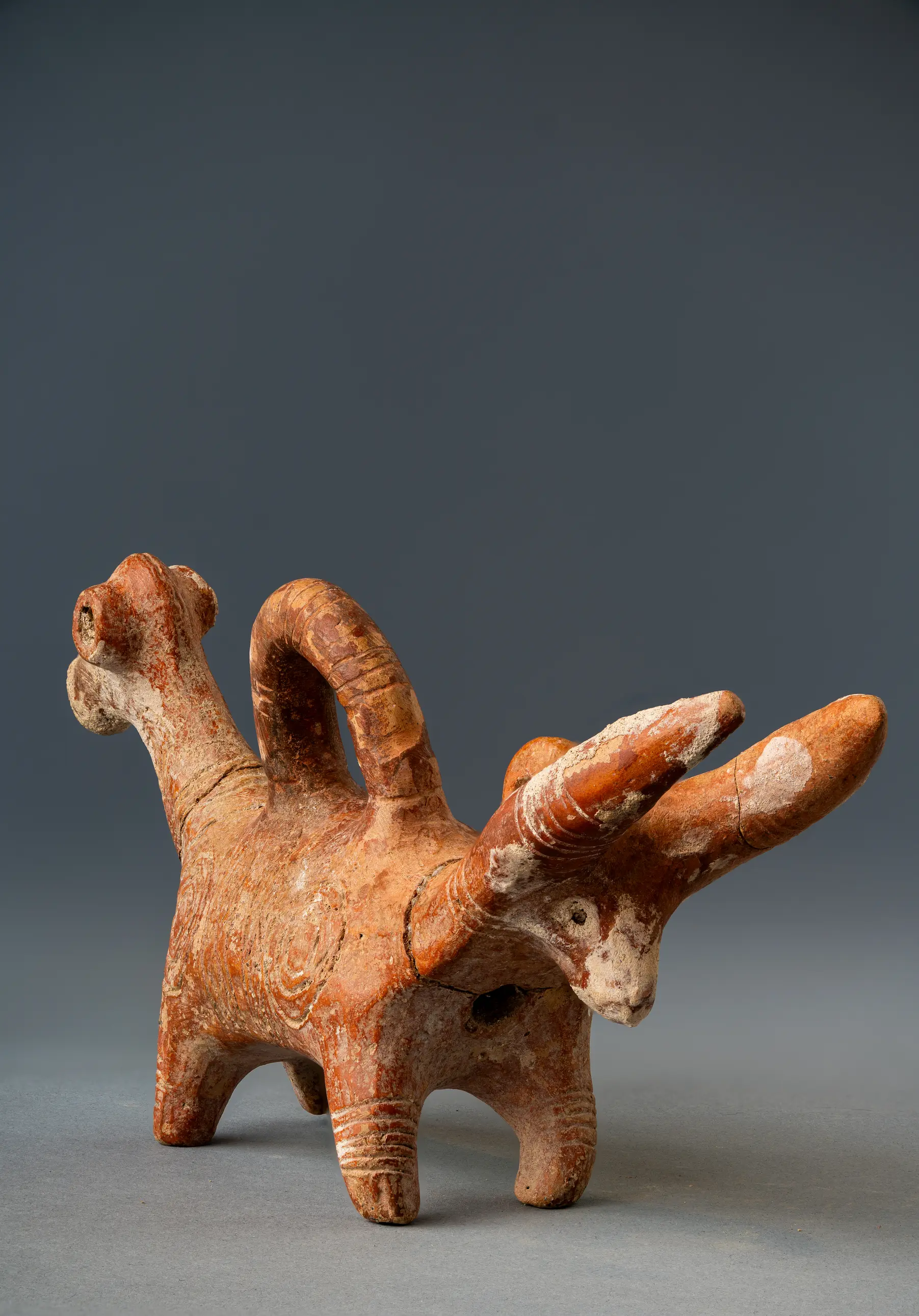
Above: Red Polished two-headed zoomorphic askos with a bull and a long-eared head, Early Cypriot III–Middle Cypriot I, c. 2100–1850 BC. Drakopoulos collection.
Middle Bronze Age continuations
Horn models and decorated jugs outlived the Vounous floruit. Through Early Cypriot III and into Middle Cypriot II they continue at Vounous and spread to the Dhali area and Nicosia Ayia Paraskevi, while jugs with modelled animals appear around Marki and Kotsiatis [1]. A pair of protomes from Nicosia Ayia Paraskevi, a bull and a stag, are in the University of Pennsylvania Museum (MS.69 and MS.70) [1]. Morris illustrates a Red Polished jug from the Margi or Kotchati area with a small modelled bull standing on top of its main handle, 24 cm high [4, p. 107].
At Lapithos, where the University of Pennsylvania opened tombs running from Early Cypriot II to the end of Middle Cypriot III, Ellen Herscher published a late Red Polished bull: "He is hollow, with a hole at his rear, and is designed to stand on his face in order to be filled" [6, p. 59]. The same tombs produced a jug combining a man, a bird and a bull, whose bull is close to those of the Vounous model [6, p. 59]. A hollow, fillable bull is already a vessel, and points forward to the Base Ring rhyta.
The Drakopoulos collection's two-headed askos belongs to this stage. A barrel-shaped Red Polished body on four stub legs carries a bull at one end, with a white-washed muzzle, drilled eyes and two long horns thrust forward, and at the other a narrower head with round pierced ear-lugs. The bull is the easy half to name; the long-eared head is not. The piece is discussed in Red Polished Zoomorphic Vessels and in the article The Two-Headed Cypriot Askos.
Late Bronze Age: rhyta, pendants and skull masks
In the Late Bronze Age the bull becomes a vessel in its own right. The hand-made Base Ring II bull rhyton, with tubular muzzle, pellet eyes, basket handle from neck to back and white painted bands, belongs to Late Cypriot II, c. 1450–1200 BC, and bull figures of this kind appear "quite often in tombs" [7]. Its manufacture, contents and contexts are covered on the dedicated page Base Ring Ware Bulls and under Base Ring ware. A typical example is the Metropolitan Museum's terracotta vase in the form of a bull, Late Cypriot II, 12.7 cm high (Met 74.51.825).
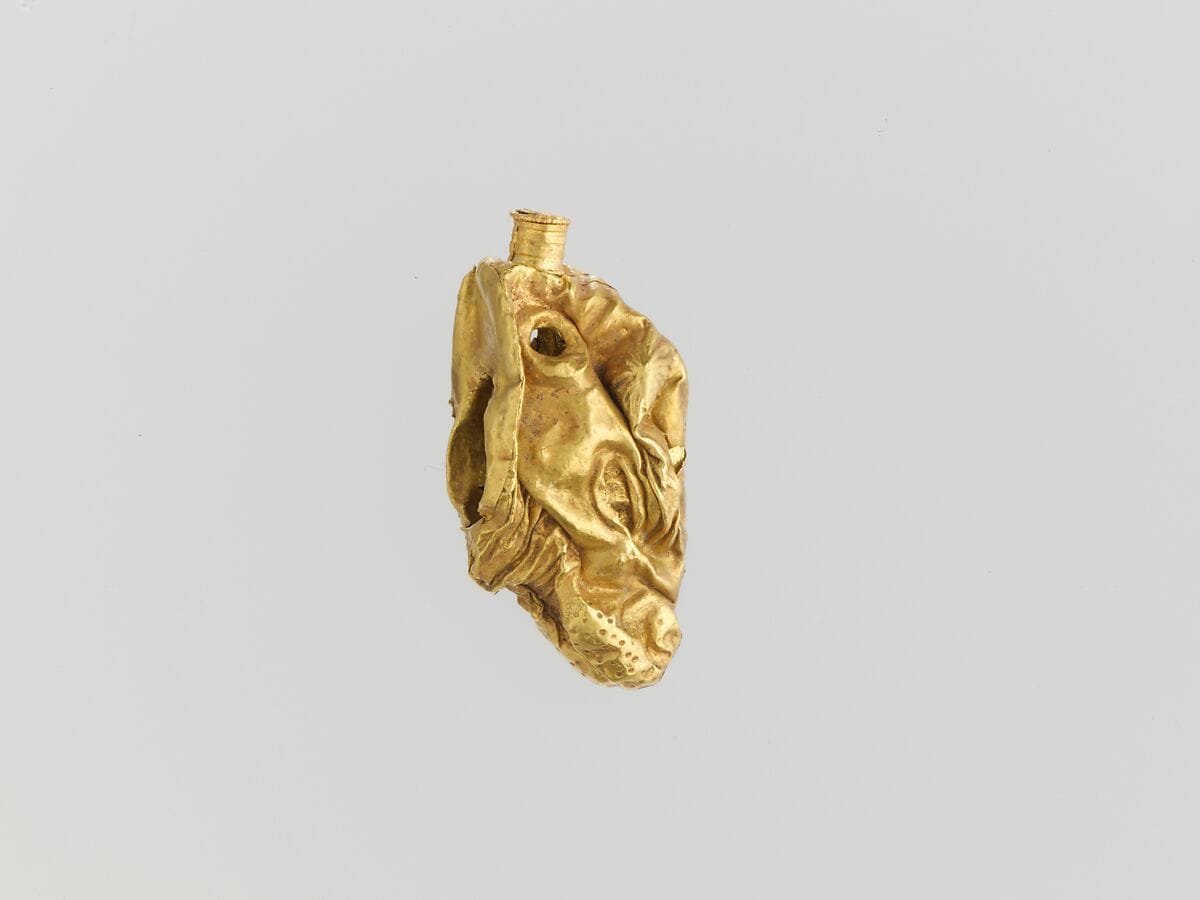
Karageorghis notes that such bull figures, "either in the form of a rhyton or in terracotta", turn up in sanctuaries as well, at Enkomi, Idalion and Ayia Irini, and that terracotta and bronze bulls are sometimes accompanied by human figures leading the animal to sacrifice [7]. The motif also moves into metal. Small gold pendants in the form of a bull's head are among the Late Bronze Age jewellery of the Cesnola collection, such as Met 74.51.3117, 1.8 cm high (Met record).
The most direct evidence for cattle in cult comes from real skulls. In the temple of the "Horned God" at Enkomi, "numerous skulls of oxen were found with their back parts cleaned in order to be worn as masks" [8]. Karageorghis reports bucrania from sanctuaries at Enkomi and Kition and suggests they "may have been worn as masks", and he reads the horned bronze figures of Enkomi in the same light [7]. The mask interpretation is his inference from the trimmed skulls, and his naming of the Enkomi god is his own hypothesis [7].
Iron Age: figurines, protomes and masks
Karageorghis traces the mask custom into the Cypro-Archaic period, when terracotta figurines show people putting on bull masks [7]. Archaic terracottas from the precinct of Apollo Hylates at Kourion and from Ayia Irini "represent priests wearing bull's masks", with the dewlap shown on the mask [8]. The Golgoi sanctuary of Ayios Photios produced a Cypro-Classical limestone statue of a man holding a mask in the form of a bull's head, c. 350–300 BC (Met 74.51.2463), which the Metropolitan Museum reads as probably a priest holding such a mask.
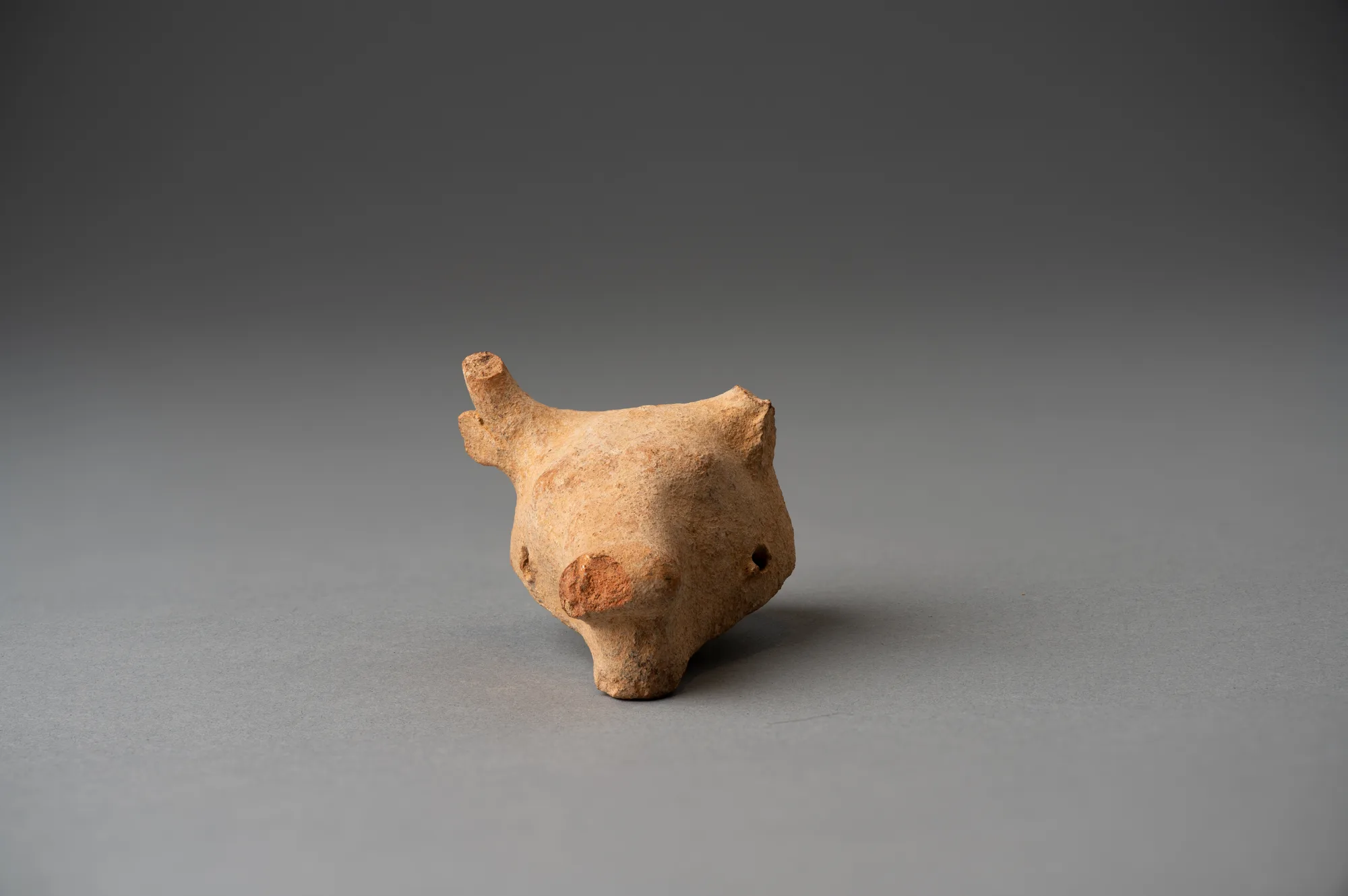
Above: Head of a terracotta bull figurine, Cypro-Archaic, probably c. 750–480 BC. Drakopoulos collection.
The most familiar Iron Age bull is the small handmade terracotta figurine left in sanctuaries. The Drakopoulos bull head is a fragment of one: pale buff clay, a compact rounded skull, one horn rising steeply with a pinched lobe at its root for the ear, and a hole pushed into each side of the head for the eyes. The neck and muzzle are broken away, the usual fate of a solid figurine with a thin neck. For the companion class of mounted figures from the same deposits see Horse-and-Rider Figurines.
On pottery the protome survives as a small head on the shoulder of a jug. The Met's Cypro-Archaic II jug with a bull's head on the front of the shoulder, 13.2 cm high (Met 74.51.556), is a plain example, and its near twin 74.51.557 carries the same feature. For the painted repertory of Iron Age pots see Free-Field Art.
Archaic limestone carvers put cattle into scenes. The Met's limestone votive statuette of a cow and calf, 6th to 4th century BC (Met 74.51.2663), shows the animal as a nursing mother, and a limestone votive relief with a lion killing a bull and two human figures, second half of the 6th century BC (Met 74.51.2878), uses it as prey. A cow and calf also appear among the shepherd scenes in the innermost frieze of an Archaic silver bowl in the Cesnola collection (Met 74.51.4555), next to a central Isis suckling Horus. See also Archaic Limestone Sculpture.
Reading the bull: sacrifice, cult or farmyard
The Vounous evidence has produced three readings. Dikaios, writing in 1940, took the horns on the relief figures of the enclosure wall to be bulls' horns, and set the bull and snake together as cult attributes, citing the Minoan Minotaur and the bull-bodied "Minotaurs" of the Ayia Irini temenos as the nearest parallels [2, pp. 122–123]. On this view the cattle in the Vounous Bowl await sacrifice in a sacred precinct, a reading supported by the ox skeleton and bull-headed bowl of Tomb 36.
Morris, in 1985, rejected what he called the romantic readings. He saw "no sign of any sacrifice taking place"; the two pairs of oxen "have probably been penned up for the night after a hard day in the fields, yoked to the plough", and the bucranial poles are "probably protective signs placed on the outside of a building, based on a simple superstition" [4, p. 282]. For Morris the model shows ordinary village life.
Keswani, in 2004, shifted the question from meaning to distribution. Horn models and cult vessels occur in nearly half the Vounous A tombs and are not confined to the richest burials, so she treats them as a "widely shared complex of ceremonial or sacred regalia" [5]. On that reading the bull signals membership of a funerary community before it signals any particular god.
For the Late Bronze Age and later, the debate turns on the masks. The trimmed ox skulls of Enkomi and the Archaic figurines of masked men are physical evidence; the link between them, and the identity of the deity, rest on Karageorghis's interpretation [7, 8].
Bull, ram or goat?
Identification is a standing caution. Karageorghis's own catalogue entries hedge: a Tomb 153 tulip bowl has "two horned animals' heads (bulls?)" on its rim, a Tomb 81B cult vessel has "two horned animals' heads (bulls? goats?)", and the Melbourne vessel pairs its bulls with an animal he queries as "a goat?" or "a sheep?" [3]. Horned heads on Red Polished vessels are small and schematic, so catalogue labels of "bull" should be read with that uncertainty in mind. Size, the curve and spread of the horns, a dewlap and the shape of the muzzle are the usual guides.
The motif in sum
Cattle run through Cypriot art from the Early Bronze Age to the Cypro-Classical period. In the Red Polished world they belong to tombs and to a shared funerary regalia; in Late Cypriot II they become pouring vessels and the skulls of real oxen enter the sanctuaries; in the Archaic period they are a common votive animal in clay and appear in carved scenes of nursing and predation. The Early Bronze Age, Late Bronze Age and Cypro-Archaic period pages give the wider setting. The site's own collection holds two pieces, and further Cesnola examples are in the Metropolitan Museum collection.
Objects on this page
- Red Polished Two-Headed Zoomorphic Askos with a Bull and a Long-Eared HeadEarly Bronze Age III · 2100–1850 BC
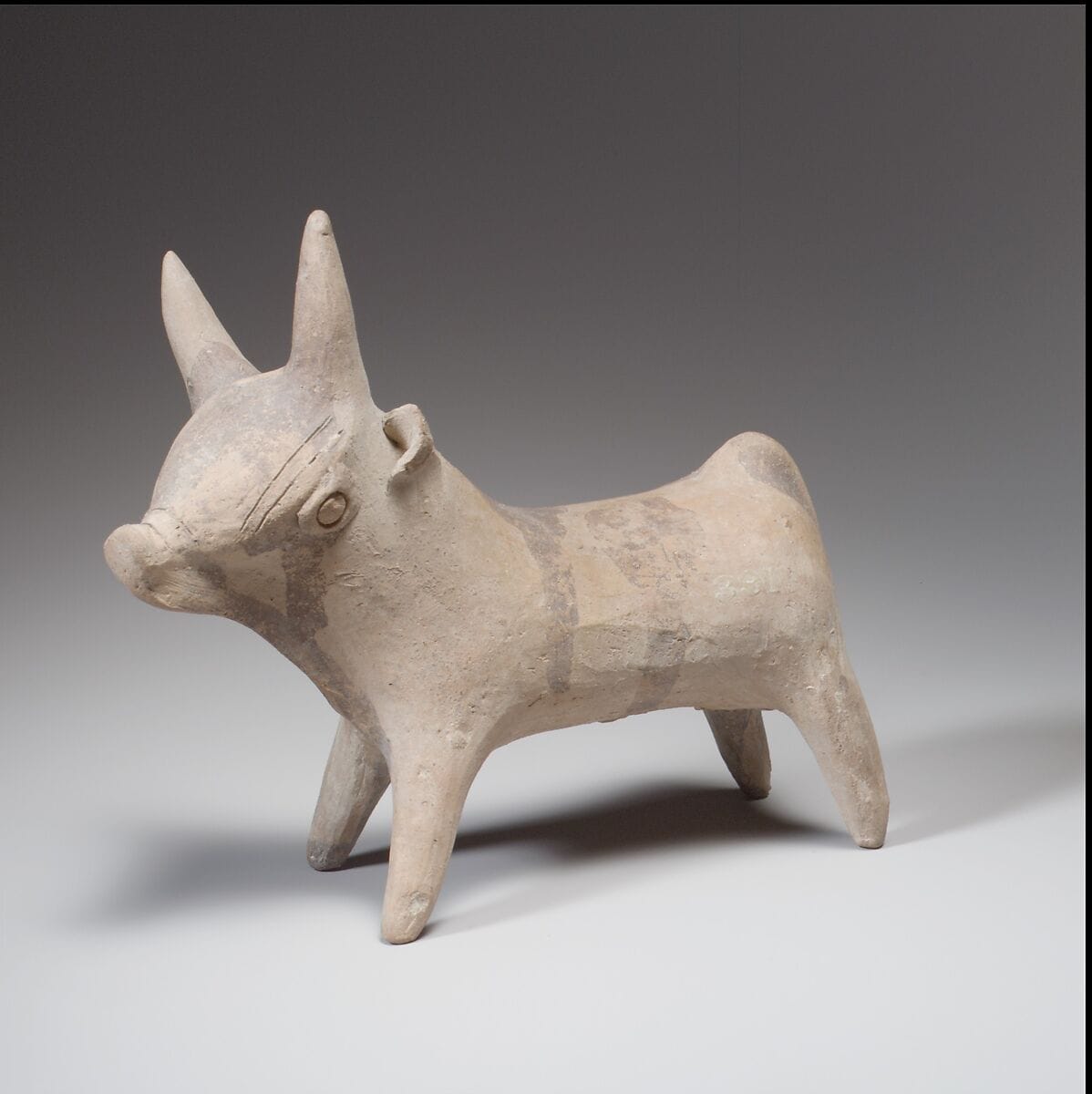 Terracotta vase in the form of a bullLate Bronze Age II · 1450–1200 BC
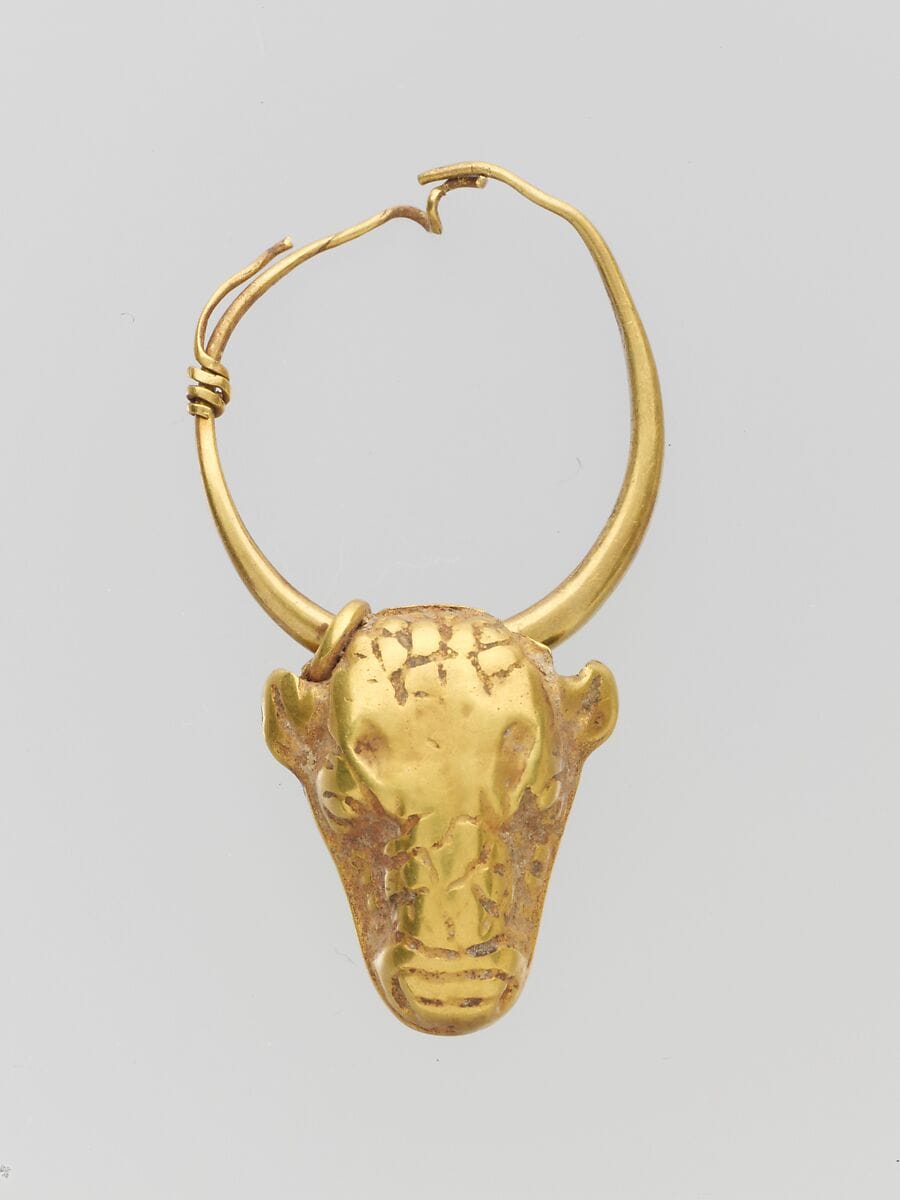 Gold pendant in the form of a bull's headLate Bronze Age II · 1600–1050 BC
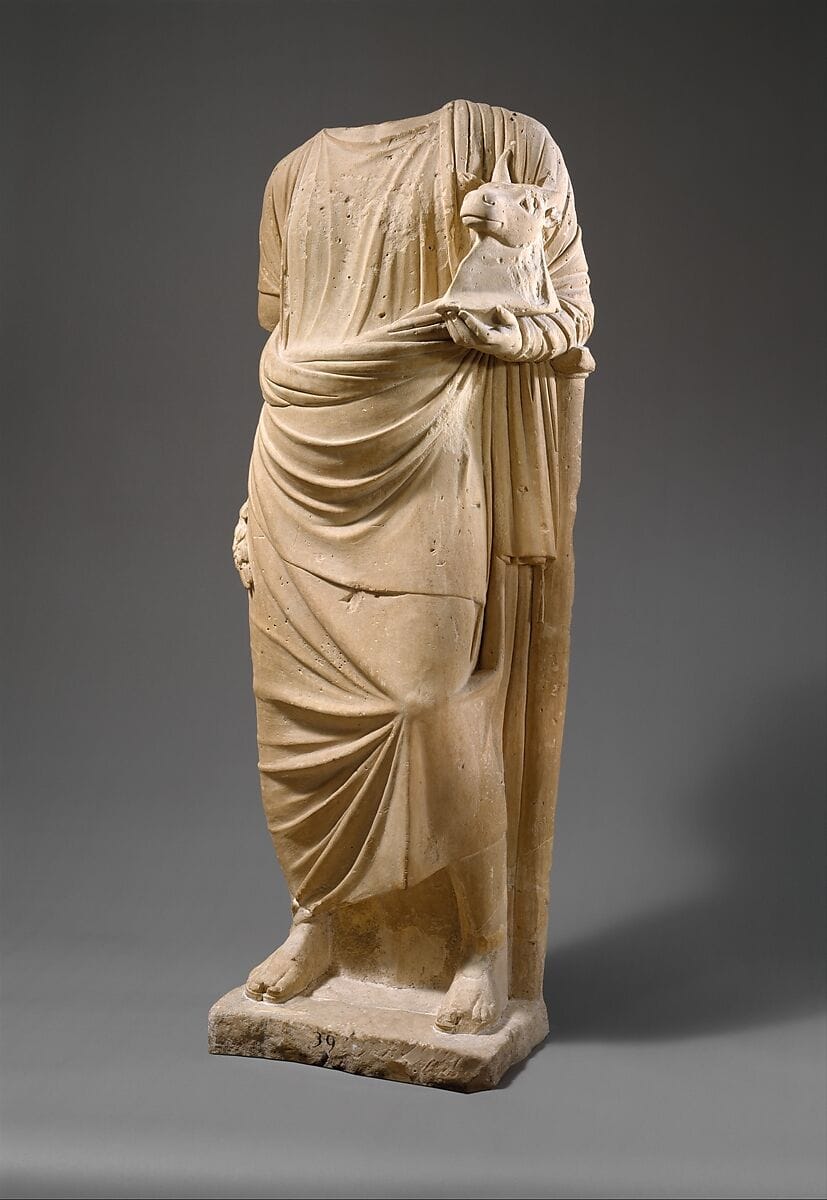 Limestone statue of a man holding a mask in the form of a bull's headClassical · 350–300 BC
- Head of a Terracotta Bull FigurineArchaic · 750–480 BC
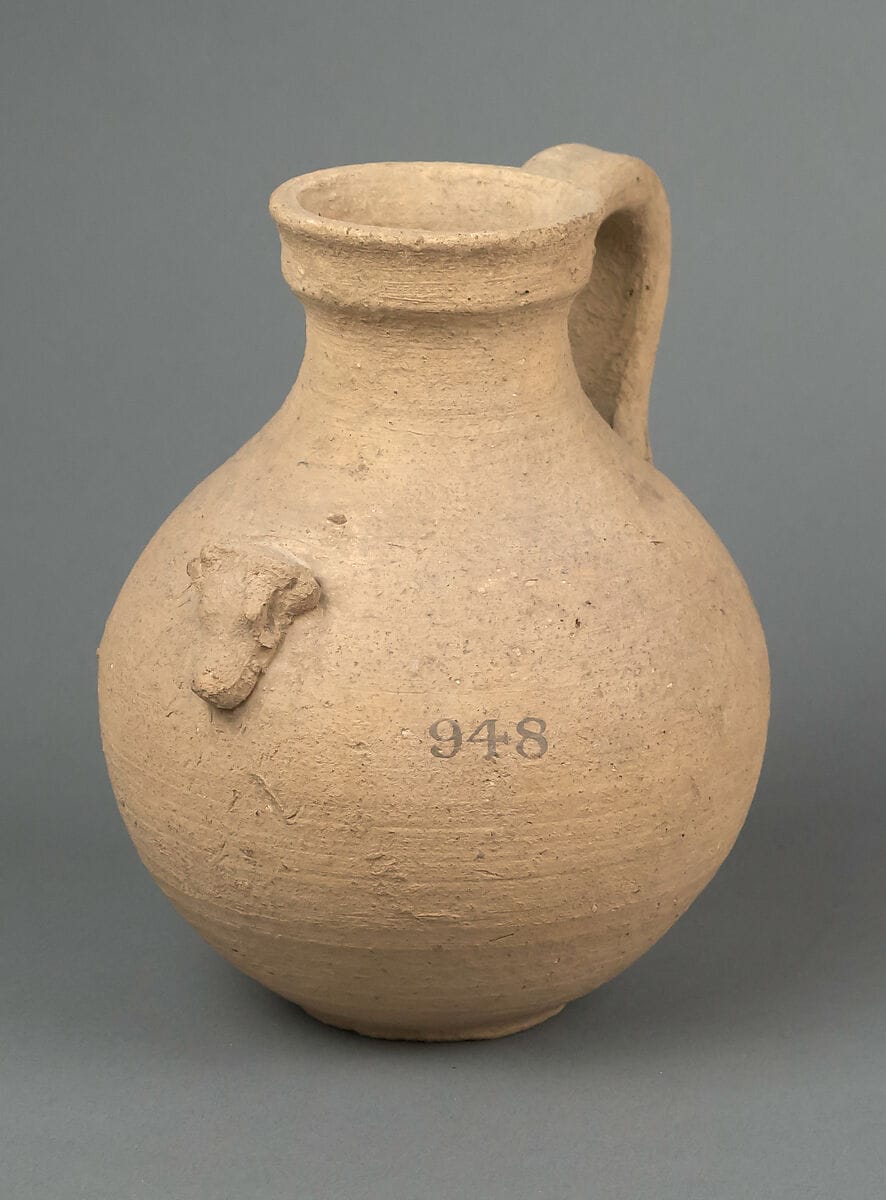 JugArchaic II · 600–480 BC
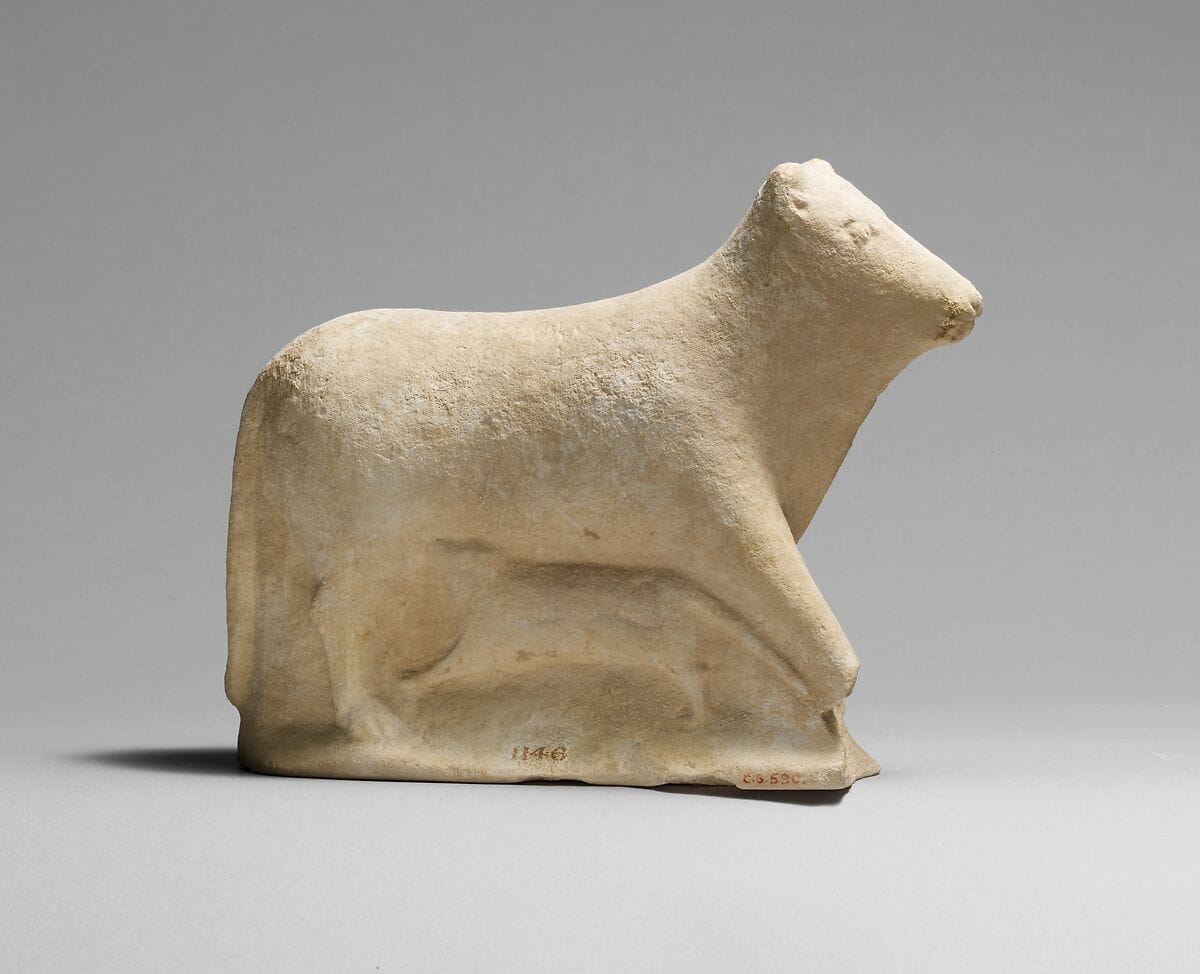 Limestone votive statuette of a cow and calfClassical · 599–323 BC
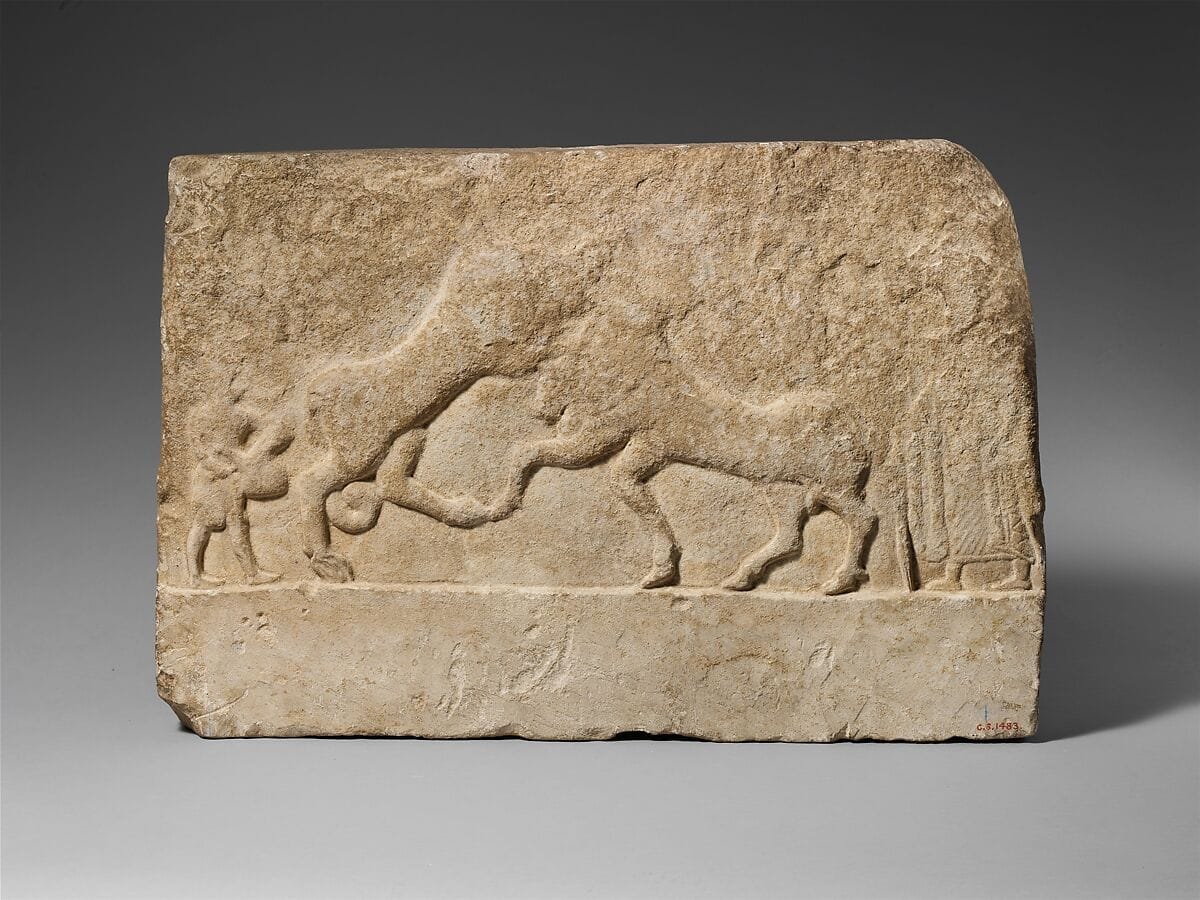 Limestone votive relief with a lion killing a bull and two human figuresArchaic II · 550–501 BC
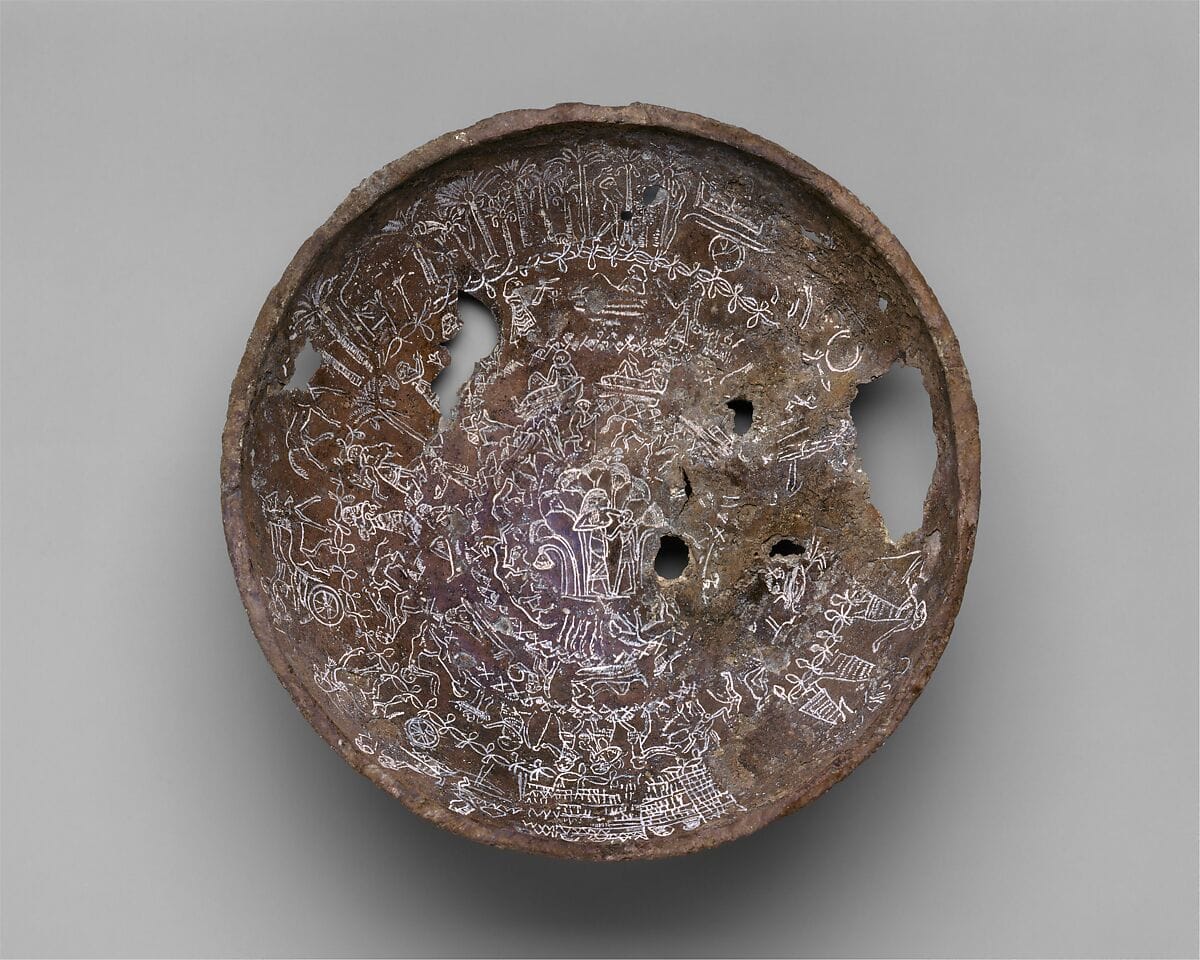 Silver bowlArchaic I · 675–625 BC
In the catalogue
References
- 1.Knox, D. (n.d.). Figurines and figurative vessels at Early Cypriot Bellapais Vounous. In a volume of studies in honour of James R. Stewart.
- 2.Dikaios, P. (1940). The excavations at Vounous-Bellapais in Cyprus, 1931-2. Archaeologia, 88.
- 3.Karageorghis, V. (1991). *The Coroplastic Art of Ancient Cyprus I: Chalcolithic–Late Cypriote I*. Nicosia: A.G. Leventis Foundation.
- 4.Morris, D. (1985). The Art of Ancient Cyprus. Oxford: Phaidon.
- 5.Keswani, P. (2004). Mortuary Ritual and Society in Bronze Age Cyprus. London: Equinox.
- 6.Herscher, E. New light from Lapithos. In The Archaeology of Cyprus: Recent Developments (papers from the First International Colloquium on Ancient Cyprus). Park Ridge, NJ: Noyes Press.
- 7.Karageorghis, V. (1982). Cyprus from the Stone Age to the Romans. London: Thames and Hudson.
- 8.Karageorghis, V. (1976). Kition: Mycenaean and Phoenician Discoveries in Cyprus. London: Thames and Hudson.