
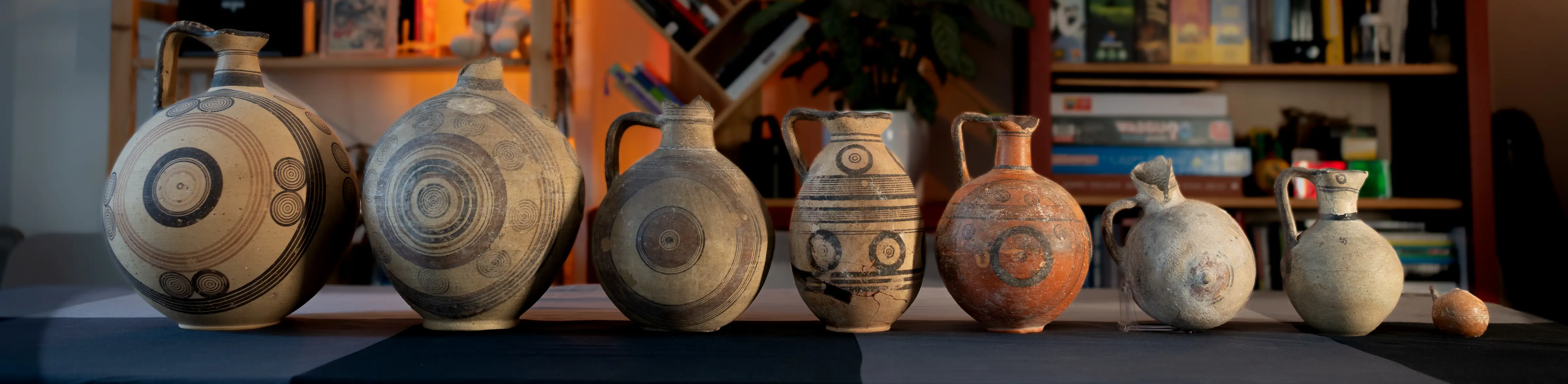
Combed ware is the decorated pottery by which the Cypriot Ceramic Neolithic is recognised. It belongs to the Sotira culture of the later fifth millennium BCE, the first phase in which the islanders made pottery in quantity after two millennia of aceramic farming villages that used stone bowls instead. The technique is a reserve one: the whole vessel was slipped red, and while the slip was still wet a comb-like tool was dragged across it, scraping away lines of slip to expose the lighter clay beneath in alternating red and pale bands. Porphyrios Dikaios defined the ware twice, at Khirokitia in 1953 and at Sotira in 1961, and his descriptions remain the standard ones [1; 2]. Edgar Peltenburg's work at Ayios Epiktitos-Vrysi on the north coast then showed that combing was a southern preference within a single island-wide culture whose northern villages painted their pots instead, the "north-painted, south-combed" divide that still frames the period [3]. This entry covers the combed ware itself, the monochrome and coarse wares that make up most of every Neolithic assemblage, the regional divide, and the chronology that separates Neolithic combing from the Chalcolithic painting that replaced it.
Definition: a reserve technique, not incision
Dikaios's Sotira definition is worth quoting because the ware is so often misdescribed. Its chief characteristic "is its decoration which consists of bands produced by a comblike instrument (a shell, bone, or reed) the notches of which exposed the underlying surface while the slip was still wet and thus produced alternating red and light colored bands"; in some cases the combing exposed "a thin layer of whitish paint underlying the red paint", and "after combing, the surface was polished, usually with oblique or irregular strokes" [1, p. 188]. At Khirokitia he was explicit about the tools: an actual bone comb (find 885β) was recovered, and the number of teeth on the combs used ranges from one to fifteen or more, with teeth 0.5 to 2 mm thick, in one case "as thin as a modern metal pin" [2, p. 296]. Single broad bands 1 to 1.5 cm wide were scraped with a flat piece of wood or reed rather than a comb, and where a section of reed was used its veined inner face left hairline red striations inside an otherwise plain reserved band [2, p. 296; 1, p. 189].
The decoration is therefore negative: the light bands are channels where slip has been removed, and they sit slightly below the surviving red. Dikaios contrasted this with the incised, denticulated-spatula decoration of Byblos, where the tool engraves an unslipped surface [2, p. 369]. A combed Cypriot sherd shows shallow, soft-edged reserve furrows exposing a paler body, not sharp grooves. The same fabric had earlier been called "reserved slip ware" at Erimi; Dikaios renamed it combed ware at Khirokitia "which describes it more accurately", and the older name survives in some literature [2, p. 295].
The fabric is reddish clay with "much limestone grit or fine straw", variably fired. Bowls show a grey-black core between two reddish layers, jugs an outer red layer over an inner grey one; bowl walls average 10 to 14 mm and were sometimes built up of three or four layers that tend to detach. The thick red slip "is polished and hard but in most cases it can be scratched with the finger nail" [1, p. 188]. Petrography has since shown why. The painted and combed wares were made from calcareous marls that fire pale, chosen precisely so that the reserved bands would read against the red, while the coarse and monochrome burnished wares used non-calcareous Troodos clays; no Neolithic pot on Cyprus was fired above about 750 °C, and the grey sandwich core is the ordinary result of a short open firing that never oxidised the wall through [4].
The rest of the assemblage: monochrome, coarse and hybrid wares
Combed ware is the memorable pottery of the period, not the common one. Dikaios listed nine wares at Sotira: "Combed, red-on-white and combed, red-on-white, red lustrous, red-on-red, red slip, black combed, plain white, coarse", with a grey lustrous variant he suspected was a firing accident [1, p. 188]. Later workers have collapsed most of these. Stanley Price's re-tabulation of Dikaios's counts gives, across all phases at Sotira, roughly 48 per cent Red Lustrous, 36 per cent combed, 1.4 per cent painted-and-combed and under 3 per cent Red-on-White [5; 6, p. 18]. More than 80 per cent of the site's pottery is thus red monochrome, with or without combing, and painted decoration is marginal.
Red Lustrous ware is the same paste as the combed ware, simply slipped red "of varying tones", smoothed and burnished with oblique strokes, with no decoration; the slip often flakes to expose a pale undercoat [1, p. 200]. Its shapes are broader than the decorated wares': holemouth jars, large holemouth and hemispherical bowls, small bowls and platters with tubular or bridge spouts, and jugs. It runs at 35 to 55 per cent in every Sotira phase and probably continued into the Early Chalcolithic [1, p. 202; 11, p. 21]. Dikaios's Red Slip ware "may actually be a variety of the red lustrous ware but with less thick red slip", his Grey Lustrous a reduced firing of the same, and his Red-on-Red a faint red pattern on a red ground represented by four sherds [1, p. 202]. Stanley Price folded Red Slip back into Red Lustrous, and the modern shorthand is Red Monochrome Painted (RMP) for the lot [5; 8]. Black Combed ware rests on two sherds, one of them a red lustrous pot painted over with a black wash that was then scraped [1, p. 203]. Plain White consists of a few buff-slipped sherds absent at Khirokitia; Peltenburg argued that such pieces are usually the unpainted parts of Red-on-White vessels [6, p. 18].
Coarse ware is the utilitarian fabric beneath all of this: dark red or brown clay with much grit and chopped straw, hard-fired, smoothed but unslipped, used for holemouth bowls and wide flanged-base trays whose undersides carry impressions of the mats or straw on which they were built and dried [1, pp. 203–204]. It rises from a few per cent in Sotira Phase I to over 13 per cent in Phase III. Boness, Clarke and Goren caution that "coarse" is misleading: the flanged trays average about 50 cm across with bases under 1 cm thick and a U-shaped opening in the wall, and firing failures are not attested, which implies real skill [4]. In the north the earliest pottery of all is a dark, highly burnished Monochrome Burnished ware, originally named Dark Faced Burnished after its Levantine counterpart, which underlies the painted wares at Philia-Drakos A and Dhali-Agridhi [8].
Between combed and painted sits the hybrid that Dikaios called Red-on-White-and-Combed (now Painted-and-Combed). Instead of slipping the whole pot and scraping bands out of it, the potter left the surface pale, painted broad red bands, combed over those bands, and added free-painted rings, chains of rings and lattice in the panels between [1, pp. 195–197; 2, pp. 297–299]. It is rare, 1 to 3 per cent in Phase I at Sotira and up to 11 to 13 per cent in a few Phase III houses, and Dikaios read it as the technical bridge by which "the potter who decorated the combed vases", who had been "entirely the slave of his comb", learned to paint freely [2, pp. 297–298].
Shapes and the combed repertoire
Only two shapes carry combing: the bowl and the jug. The bowls are hemispherical or somewhat open, often with a small flat or concave base and a tubular spout at or just below the rim; Sotira 96a is the best-preserved example, with multiple wavy bands pendent from the rim inside and out. The jugs are handleless: a globular type with walls up to 2 to 3 cm thick, an ovoid type with tapering lower body and cylindrical neck, and a broader ovoid type that Dikaios thought copied a fruit or skin container [1, pp. 188–192]. Two complete combed bowls were reconstructed at Khirokitia, one 32.5 cm across with an open spout rising obliquely above the rim [2, p. 296]. Bowls were routinely combed differently inside and out, a simple exterior with an elaborate interior or the reverse, so that a sherd with two different schemes on its faces is almost certainly a Neolithic bowl [1, p. 189].
The motif vocabulary is entirely made of bands. Dikaios catalogued single broad straight bands, sometimes outlined in red to correct faulty scraping; single narrow straight bands, occasionally meeting at right angles to form a net; double and multiple straight bands in parallel groups; single broad and single narrow wavy bands; twin and triple wavy bands; multiple wavy bands, "the culmination technically of the combed pattern", combed with up to eighteen lines at once; alternating straight and multiple wavy bands that frame panels; and chevrons, zigzags and, at Khirokitia, rare rows of discs bisected by combed lines [1, pp. 190–192; 2, p. 297]. The potter "could move his hand at will, thus changing the direction of the bands or turning from straight to wavy bands", which is why the same vessel commonly carries different schemes on different parts [1, p. 189].
Through the four Sotira phases the frequency of combed ware fluctuates without a strong trend (commonly 35 to 45 per cent in Phases II and III, 20 to 25 per cent in Phase IV), but the quality changes. Phases I and II favour single broad bands and coarse multiple bands made with wide-notched tools; "in Phase III the combed style reached its greatest brilliance and development", with instruments "with much thinner and closer notches which produce bands of great beauty and subtlety" [1, pp. 194–195]. Stanley Price found so little change between phases that he argued for a short occupation [6, p. 17].
The north-painted, south-combed divide
Dikaios already saw combing as a southern habit. At Khirokitia he called it "more characteristic of Khirokitia and other sites of the southern group, especially Kalavassos, Mari, Sotira, and also in the deepest levels of Erimi", against the north-coast site of Klepini-Troulli where the technique "is virtually absent" [2, p. 346]. He explained the contrast chronologically: the boldly painted pottery of Troulli was earlier (his Neolithic Ib), the combed pottery of Sotira later (Neolithic II).
Peltenburg's excavation of Ayios Epiktitos-Vrysi in 1969 to 1973 overturned that reading. Vrysi is deeply stratified, with fifteen consistent radiocarbon dates, and its pottery is overwhelmingly painted: "almost all the pottery belongs to" Red-on-White, while combed sherds stay "well below 5%"; at Sotira, by contrast, "up to 45% is combed and up to 6% has painted designs" [3, p. 66]. Since the two villages share the same house types, hearths, benches, stone tools and even rare picrolite pendants, and their radiocarbon dates overlap, Peltenburg concluded that painted and combed pottery "hitherto regarded as signposts of different chronological periods, should ... preferably be appreciated as coexistent styles" [3, p. 66]. Combing first appears at Vrysi in the Middle phase, at the same moment as "rippling", a positive multiple-brush patterning that "produces in positive a similar effect as combing does in negative"; both mark the first use of composite tools in Cypriot pottery, and rippling "did not penetrate the south of the island" [3, p. 66; 9, pp. 101–103]. The model that resulted has a northern zone (Vrysi, Troulli, Orga, Philia-Drakos A) dominated by Red-on-White and a southern-central zone (Sotira, Khirokitia, the Vasilikos valley, the Pissouri survey sites) in which combing and red monochrome prevail, the Troodos massif acting as a stiffer barrier than the Kyrenia range [3].
The model has been refined rather than replaced. Joanne Clarke, the leading modern student of this pottery, accepts the regional pattern but complicates it in three ways [10; 8]. Style covaries with settlement type: Red-on-White villages sit on coastal promontories, combed-ware villages on high inland spurs in the Troodos foothills. The chronology rests almost entirely on Vrysi, so southern sites cannot be seriated with the same confidence, and Clarke suspects the coastal painted sites were settled a little earlier than the inland combed ones, making the divide partly a gradient of pottery adoption spreading from north to south [8, pp. 32–33, 140]. And sherd-count comparisons are corrupted by the redeposition of earlier material in later contexts, so some apparent inter-site differences may be noise [8, pp. 32–33]. Her study of four northern sites found stylistic similarity tracking geography at village scale (Troulli and Vrysi, 4 km apart, most alike; Philia, across the Kyrenia range, most divergent), which she read as decorative style used to negotiate social and economic space between groups [10]. The Vasilikos figures are a further corrective to the slogan: at Kalavasos-Tenta, Ayious and Kokkinoyia, monochrome ware makes up 62, 55 and 78 per cent of the pottery, and the combed-plus-painted diagnostic group is a minority of 17, 5 and 4 per cent [5]. What marks the south is red monochrome with a meaningful combed component, against a painted north.
Chronology and dating
Dikaios originally supposed that the Sotira culture followed directly on the aceramic Khirokitia culture, and he dated the pottery at Khirokitia accordingly. The first radiocarbon determinations, around 1960, pushed the aceramic village back to about 5675 ± 100 bc (uncalibrated) while Sotira's combed ware dated to about 3500 to 3190 bc, a gap he acknowledged as "about two thousand years". He reversed himself in print: the Sotira culture with its combed ware "was introduced to Khirokitia evidently by squatters who established themselves among the ruins of the settlement" [1, p. 230]. Every later synthesis agrees that the combed, painted-and-combed and Red-on-White sherds illustrated on Khirokitia plates LXXI to LXXX belong to a Ceramic Neolithic reoccupation separated from the famous pre-pottery village by a hiatus of a thousand years or more [11, p. 15; 12].
Older dates are a trap. Dikaios's "3500 to 3200 BC" for Sotira and Peltenburg's "3600 to 3230 bc" for Vrysi are uncalibrated laboratory figures; calibrated, the Ceramic Neolithic falls in the later fifth millennium, roughly 4500/4700 to 3900 BCE, with the excavated cluster of Sotira, Vrysi and Philia occupying "probably for a shorter period than that range" [6, p. 47; 8]. The latest sites, such as Kalavasos-Kokkinoyia with its subterranean features and monochrome-dominated pottery, run to about 4000 BCE and grade into the Early Chalcolithic [13, p. 60; 8, p. 33].
| Horizon | Approximate dates (cal BCE) | Combed ware | Key contexts |
|---|---|---|---|
| Aceramic Neolithic (Khirokitia culture) | c. 7000 to 5500/5200 | None; stone vessels; one abortive grey ware at Khirokitia | Khirokitia, Kalavasos-Tenta, Cape Andreas-Kastros |
| Hiatus | c. 5500 to 4700/4500 | No pottery known | Contested: abandonment or low visibility |
| Sotira culture, early | c. 4700/4500 | Single broad and coarse multiple bands (Sotira I and II); absent at Vrysi Early phase | Sotira I and II, Vrysi Early, Philia-Drakos A 1 (Monochrome Burnished) |
| Sotira culture, mature | c. 4400 to 4000 | Fine multiple wavy bands, up to eighteen lines (Sotira III); first combing and rippling at Vrysi Middle | Sotira III, Vrysi Middle and Late, Khirokitia reoccupation, Kantou-Kouphovounos |
| Late Ceramic Neolithic | c. 4400 to 3900 | Combing persists beside Red Monochrome Painted and Glossy Burnished wares | Kalavasos-Kokkinoyia, Vrysi Area V E |
| Early Chalcolithic (Erimi culture) | from c. 3900 | Vestigial sherds in the deepest Erimi and Kalavasos-Pamboules levels; then abandoned | Erimi basal levels, Kalavasos-Ayious |
The end of combing is the single most useful chronological fact about the ware. In the deepest levels at Erimi Dikaios found a tiny quantity of combed sherds, and a few more at Kalavasos site B, and used them to argue continuity between Sotira and Erimi [1, p. 226]. Catling stated the principle from the other side: "Combed-Ware had been the hallmark of Neolithic II. Apart from vestigial amounts in the earliest levels at Erimi and Kalavassos site B it played no part in Chalcolithic I" [11, p. 21]. Watkins put numbers to it: combing on 33 to 37 per cent of Sotira pottery against about 4 per cent painted, whereas at Erimi "the amount of combed ware at Erimi was too small to register" and painted pottery was already common at the base [6, pp. 17–19]. Peltenburg used the same logic as a dating criterion at Kissonerga, treating combing as "an esoteric decorative technique that is diagnostic of the Sotira Culture, but one that also recurs sporadically in the early levels of Erimi" [14]. A combed sherd therefore signals a Neolithic date; a purely painted Close Line sherd signals the Chalcolithic.
Where combed ware is found
The southern combed tradition is anchored by Sotira-Teppes, a hilltop village at about 330 m above the Kouris valley with some forty sub-angular houses, dug by Dikaios for the University Museum of Pennsylvania in 1947 to 1952 [1]. Around it cluster the other southern sites: Khirokitia's reoccupation; Kalavasos-Kokkinoyia, Dikaios's "Kalavasos A", an atypical late site of pits and subterranean features between the Maroni and Vasilikos rivers; the handful of sherds from the Late Neolithic component at Kalavasos-Tenta; Mari-Paliambela; and Kantou-Kouphovounos, a large hilltop village 3 km from Sotira excavated by Eleni Mantzourani in 1992 to 1999, with thirty-nine single-room structures and "usual Late Neolithic types" of pottery [13, pp. 56–60; 8]. Dikaios also reported the technique from central sites such as Eliophotes and Philia, and Philia-Drakos A shows "a slightly greater variety of combed patterns than at Vrysi", though combing is never numerically important there [3, p. 68]. On the north coast it is a minority technique from the Middle phase at Vrysi onward. Paralimni-Nissia in the far east, excavated by Pavlos Flourentzos in 1995 to 2001, is a walled coastal village of the same culture with some forty houses [13, p. 58]. The Karpas and the Mesaoria remain largely blank, and the west has only recently produced Ceramic Neolithic occupation, at Kouklia-Liskovouno [3; 8].
Settlement pattern says something about who made these pots. The Sotira-culture villages are small, 0.5 to 1.5 ha, often defensible and sometimes walled, with no central places, no sanctuaries, no evidence of rank or craft specialisation, and a subsistence of cereals, sheep, goat and pig with heavy hunting of fallow deer [3, pp. 68–69; 13, p. 55]. Pottery was hand-built and open-fired in a household setting, and the striking island-wide uniformity of shapes and fabrics has itself become an interpretive problem, read by Clarke as the expression of an insular group identity [4; 8].
Classification and interpretation
Two disputes deserve a plain statement. The first concerns Dikaios's ware system. Peltenburg, reviewing it in 1991, found "a lack of clear breaks between wares (especially monochromes) and an inconsistent application of his own criteria", with Red Lustrous becoming "Red Black Lustrous" merely when blackened by firing, and concluded that the "ware" as a fixed package of fabric, finish and shape does not hold for handmade household pottery [7, pp. 35–37]. Combed ware survives this critique because combing is unmistakable, but it introduces a counting trap: the uncombed stretches of a combed pot are plain red surface, indistinguishable on a small sherd from Red Monochrome Painted, so sherds from the red parts of combed vessels are routinely miscounted as monochrome and the monochrome percentages are inflated by an unknown amount [8, p. 120]. Only a sherd that preserves scraped furrows can be securely called combed.
The second concerns what the technique's disappearance means. Watkins argued for "a fairly sharp cultural discontinuity" between Sotira and Erimi, seeing Late Neolithic sites simply cease with no successor and preferring that reading to Stanley Price's model of population failure followed by recolonisation [6, pp. 16–20]. Peltenburg reframed the break as "settlement discontinuity": sites move, populations and traditions need not fail [14]. Clarke's excavations at Kokkinoyia, where combed ware occurs together with large quantities of the highly burnished Red Monochrome Painted and Glossy Burnished wares characteristic of the Early Chalcolithic, now support a continuous transition in which new ways of making and decorating pottery "for a time existed side-by-side with traditional technologies" [8, p. 44]. The one thing all parties agree on is that Dikaios's original chain, from comb to painted-and-combed to painted, is a description of technique rather than a sequence of periods: combing and early Red-on-White were broadly contemporary, and the comb did not so much give birth to the brush as yield to it [15, p. 84].
Conclusion
Combed ware is a technique before it is a ware: a red slip, a toothed tool, and a pale body chosen to show through. It was made on only two shapes, in villages without specialists or kilns, during a few centuries of the later fifth millennium BCE, and it never travelled beyond the island. Its value to archaeology lies in three facts established by Dikaios, Peltenburg and Clarke between 1953 and 2007: that it is the type-fossil of the Sotira culture and so dates any deposit that contains it; that its concentration in the south and near-absence in the north records a real, if softened, regional division within an otherwise uniform Neolithic society; and that its abandonment in favour of painted Red-on-White is the ceramic signature of the Chalcolithic threshold around 3900 BCE. The open questions are the length and nature of the gap that precedes it, and whether the north-south pattern is regional preference, time-transgressive adoption, or partly an artefact of how sherds have been counted.
References
- 1.Dikaios, P. (1961). *Sotira: A Neolithic settlement in Cyprus*. University Museum, University of Pennsylvania.
- 2.Dikaios, P. (1953). *Khirokitia: Final report on the excavation of a Neolithic settlement in Cyprus on behalf of the Department of Antiquities, 1936–1946*. Oxford University Press.
- 3.Peltenburg, E. J. (1978). The Sotira culture: Regional diversity and cultural unity in Late Neolithic Cyprus. *Levant*, *10*(1), 55–74.
- 4.Boness, D., Clarke, J., & Goren, Y. (2015). Ceramic Neolithic pottery in Cyprus: Origin, technology and possible implications for social structure and identity. *Levant*, *47*(3), 233–254.
- 5.Stanley Price, N. P. (1979). *Early prehistoric settlement in Cyprus: A review and gazetteer of sites, c. 6500–3000 B.C.* (BAR International Series 65). British Archaeological Reports.
- 6.Reade, J. (Ed.). (1981). *Chalcolithic Cyprus and western Asia* (British Museum Occasional Paper 26). British Museum.
- 7.Barlow, J. A., Bolger, D. L., & Kling, B. (Eds.). (1991). *Cypriot ceramics: Reading the prehistoric record* (University Museum Monograph 74). University Museum, University of Pennsylvania.
- 8.Clarke, J., McCartney, C., & Wasse, A. (2007). *On the margins of Southwest Asia: Cyprus during the 6th to 4th millennia BC*. Oxbow Books.
- 9.Peltenburg, E. J. (1982). *Vrysi: A subterranean settlement in Cyprus. Excavations at prehistoric Ayios Epiktitos Vrysi 1969–73*. Aris & Phillips.
- 10.Clarke, J. T. (2001). Style and society in Ceramic Neolithic Cyprus. *Levant*, *33*(1), 65–80.
- 11.Catling, H. W. (1966). *Cyprus in the Neolithic and Bronze Age periods* (Cambridge Ancient History, rev. ed., fasc. 43). Cambridge University Press.
- 12.Steel, L. (2004). *Cyprus before history: From the earliest settlers to the end of the Bronze Age*. Duckworth.
- 13.Winkelmann, C. (2020). *The Neolithic and Chalcolithic figurines of Cyprus* (Marru 7). Zaphon.
- 14.Peltenburg, E. (1993). Settlement discontinuity and resistance to complexity in Cyprus, ca. 4500–2500 B.C.E. *Bulletin of the American Schools of Oriental Research*, *292*, 9–23.
- 15.Bolger, D. L. (1991). The evolution of the Chalcolithic painted style. *Bulletin of the American Schools of Oriental Research*, *282/283*, 81–93.