
Contents
Cyprus gave its craftsmen most of the stone they needed: chert for tools, heavy igneous rocks for bowls and mortars, the soft green picrolite of the Troodos for ornaments, and an easily carved limestone for statues. What the island lacks is marble, and for most of antiquity its sculptors managed without it [5, p. 36]. The story of stone in Cyprus is therefore mostly a story of local materials, with a smaller set of imported luxuries (Egyptian alabaster, Aegean and later Roman marble, carnelian and other gemstones) arriving through exchange. This page surveys each group in turn, roughly in the order Cypriots began to use them. You can see all stone objects in the catalogue.
| Stone | Main uses | Main periods | Local or imported |
|---|---|---|---|
| Chert and flint | Chipped tools | Neolithic, Chalcolithic | Local |
| Andesite and diabase | Bowls, mortars, mace heads | Neolithic onwards | Local |
| Picrolite | Pendants, cruciform figurines | c. 11,000 BCE; Chalcolithic peak | Local |
| Steatite and chlorite | Small vessels, whorls, pendants | Late Bronze Age and later | Mostly local |
| Calcite (alabaster) | Perfume and drop jars | Late Bronze Age onwards | Imported |
| Limestone | Statues and votive heads | From the 7th century BCE | Local |
| Marble | Sculpture, inscriptions | Rare before the Hellenistic period; mostly Roman | Imported |
| Semi-precious stones | Beads, pendants, scaraboids | Late Bronze Age onwards | Mostly imported |
Chert and flint
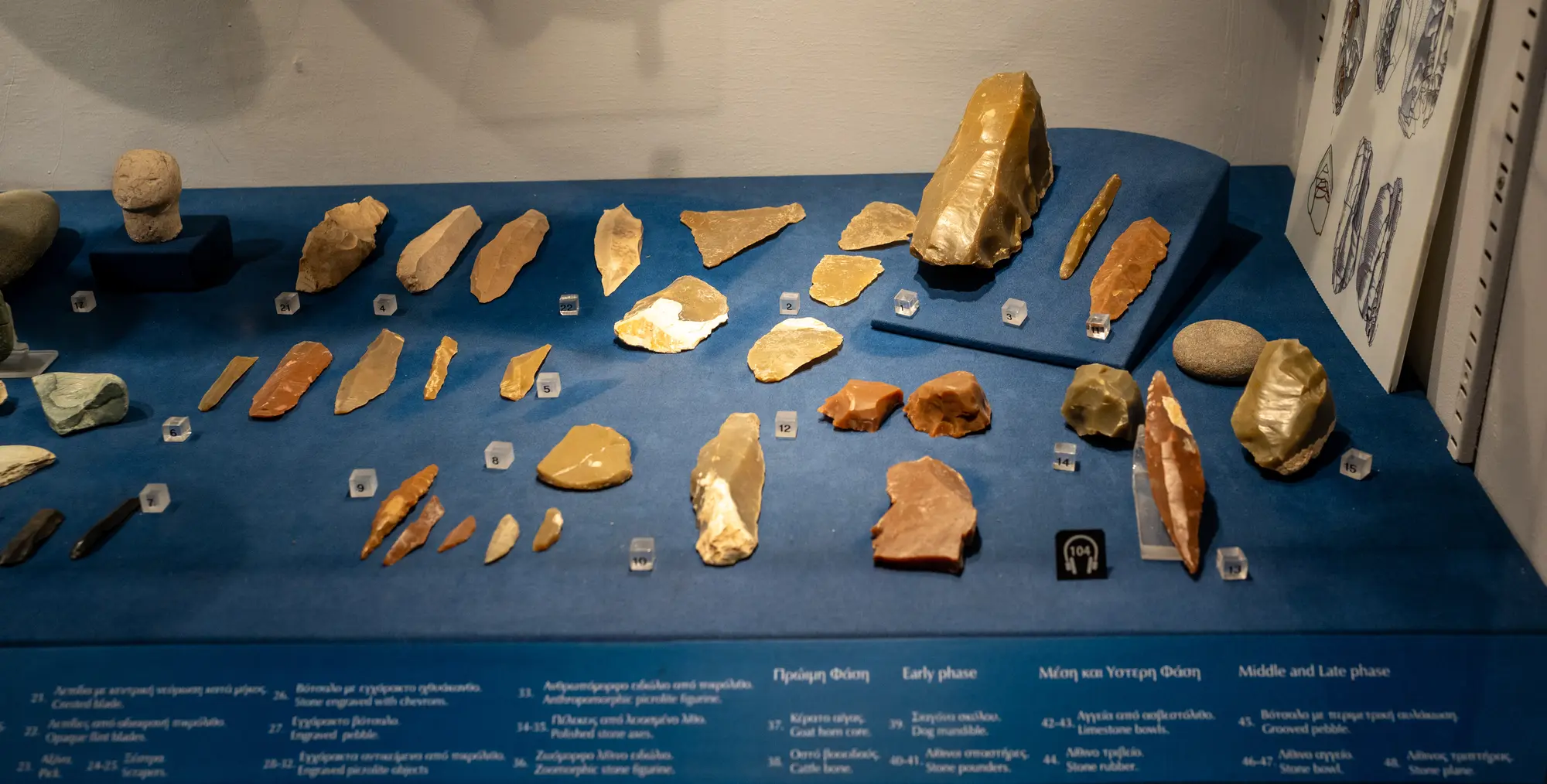
Chipped stone was the everyday cutting tool of the Neolithic and Chalcolithic. Cypriot "flint" is properly chert, and a survey of assemblages from 14 Aceramic Neolithic, 10 Ceramic Neolithic and 14 Chalcolithic sites found that each region (Pafos, Limassol, Larnaca, Nicosia) has its own raw-material profile [8, p. 321]. Prehistorians name the types after their sources and appearance: "Lefkara-translucent" and "Lefkara-basal" cherts, a black "Moni" chert typical of the west, and a poorer group of jaspers, chalcedony and silicified umber lumped together as "JCU" [8, p. 321]. The Pafos district has the greatest variety [8, p. 321].
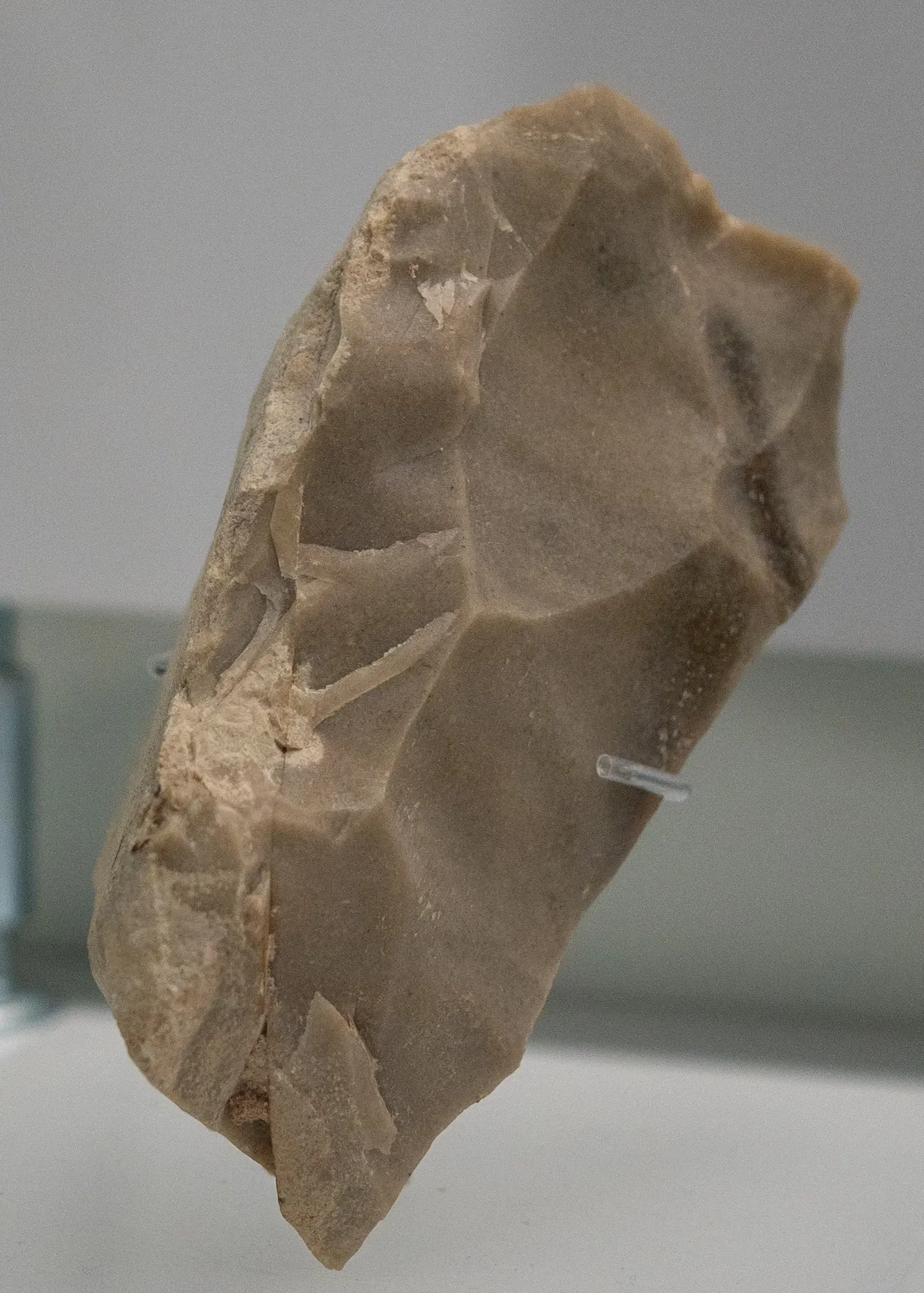
Choices changed over time. At Kalavasos-Tenta knappers relied on the local Lefkara-translucent and Lefkara-basal cherts and shifted towards poorer material in the Middle and Late Aceramic; at Parekklisha-Shillourokambos the Middle Aceramic industry moved to Lefkara-basal chert; and at Kissonerga-Mylouthkia, period 1B, the black Moni chert and the two Lefkara types dominate [8, p. 327]. The catalogue's flint comes from museum displays rather than single tools: an assortment of Neolithic flint in the Cyprus Museum and Neolithic flint in the Larnaca Museum. See all chert and flint in the catalogue.
Andesite and diabase
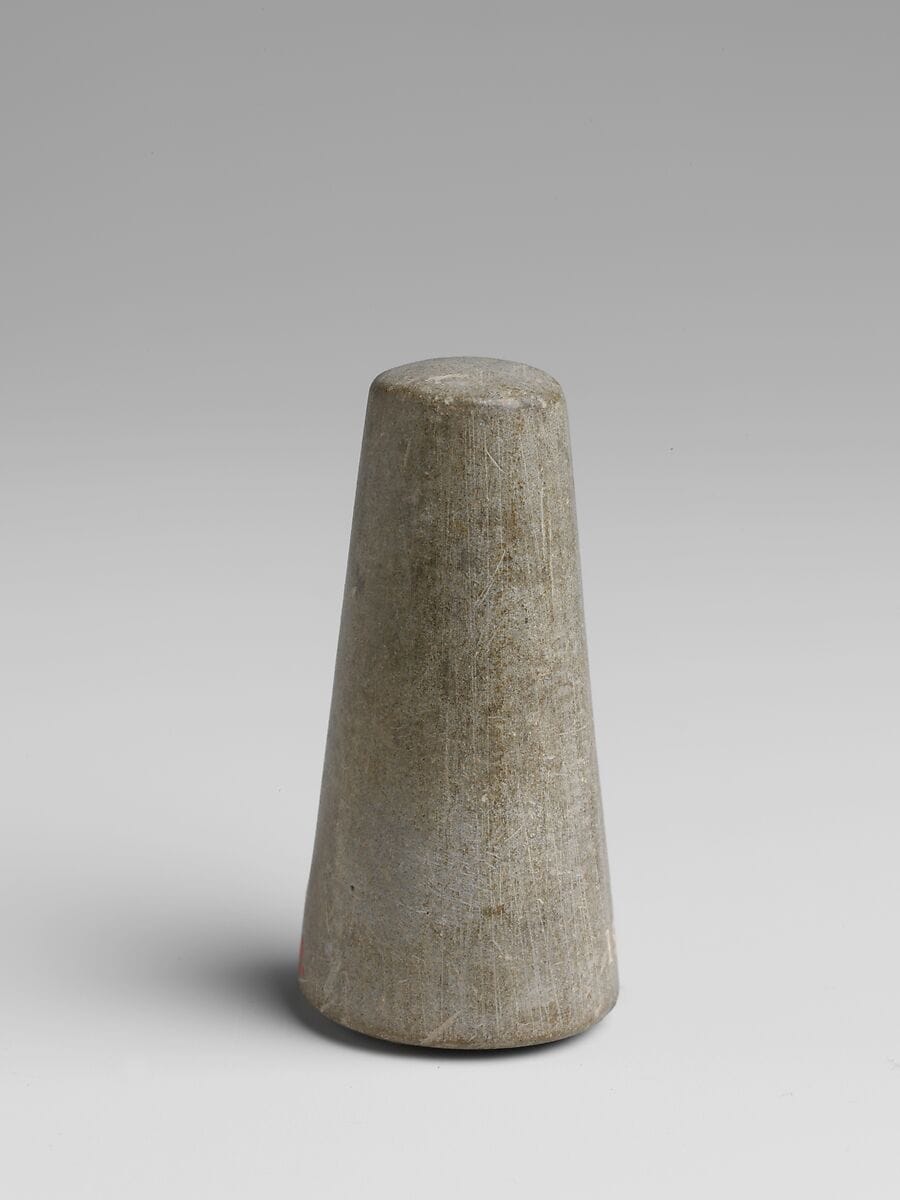
Dark, heavy igneous rocks were the material for vessels and pounding tools from the Aceramic Neolithic onwards. Buchholz and Karageorghis describe the andesite bowls of the 6th millennium as of high technical and aesthetic quality [4, p. 163]. Their examples come from Khirokitia, excavated by Porphyrios Dikaios: a flat bowl of dark grey andesite from Tholos XVII, 30.5 cm long; a round flat bowl of grey andesite from Tholos XVIII, 27 cm across; a rectangular bowl with a spout; and two smaller diabase bowls, one incised, one spouted [4, p. 163]. Small conical stones of andesite with incised decoration come from the same site; their purpose is unknown, and the handbook suggests a religious one [4, p. 163].
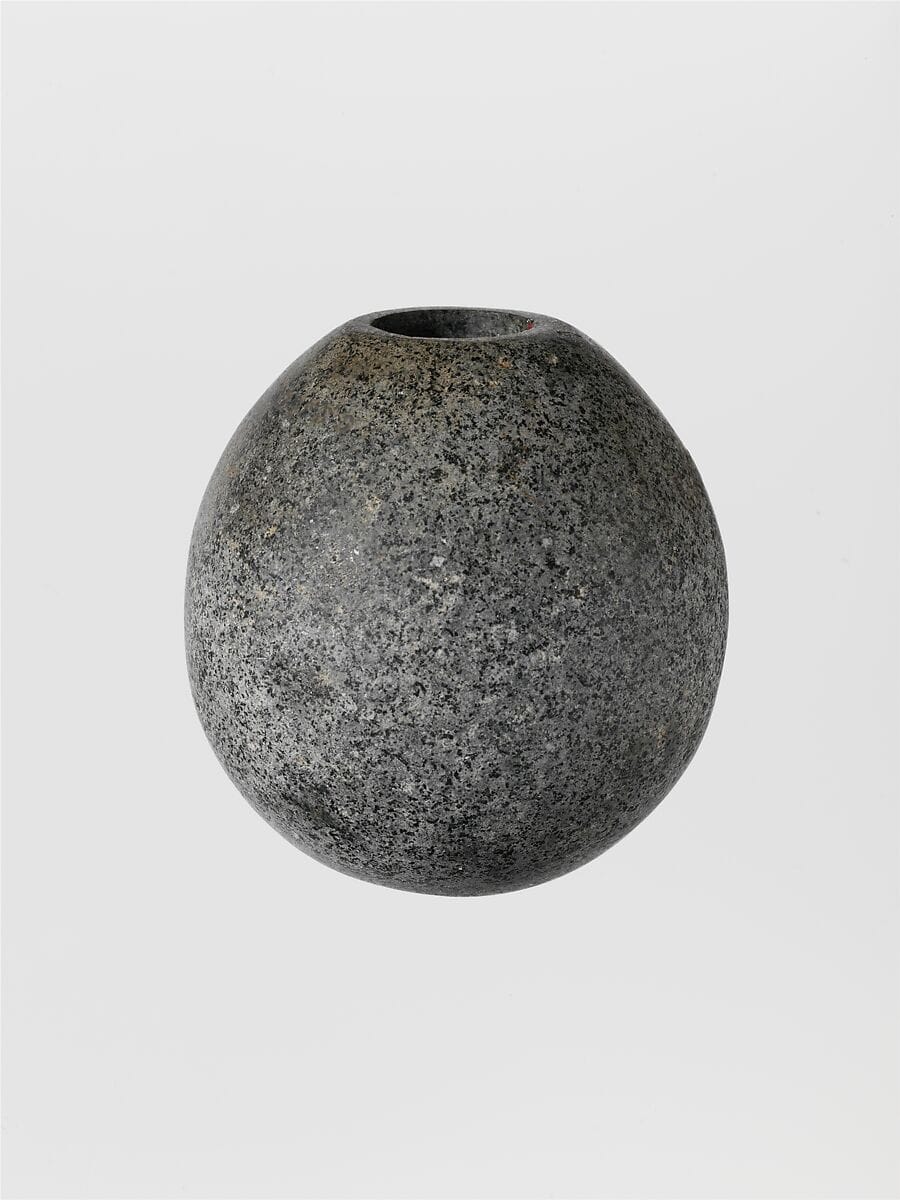
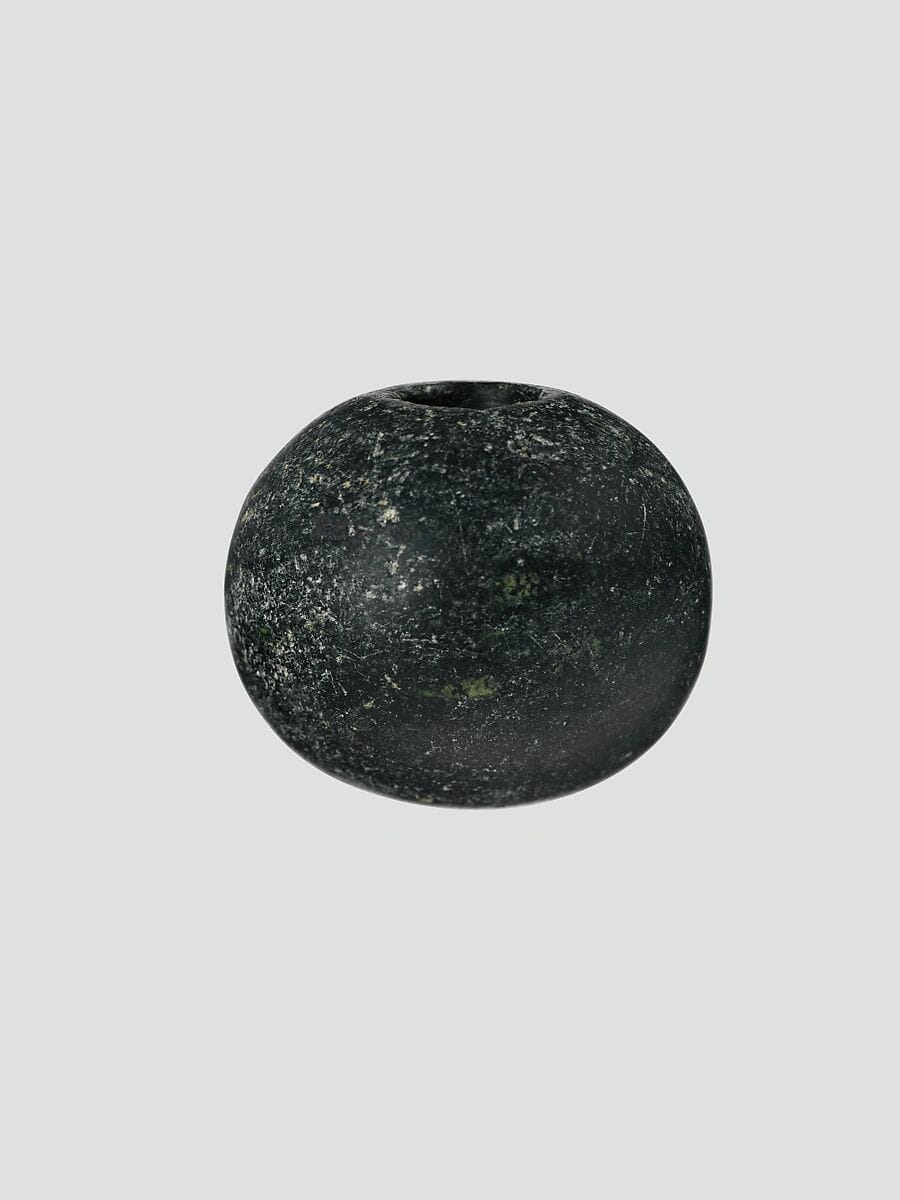
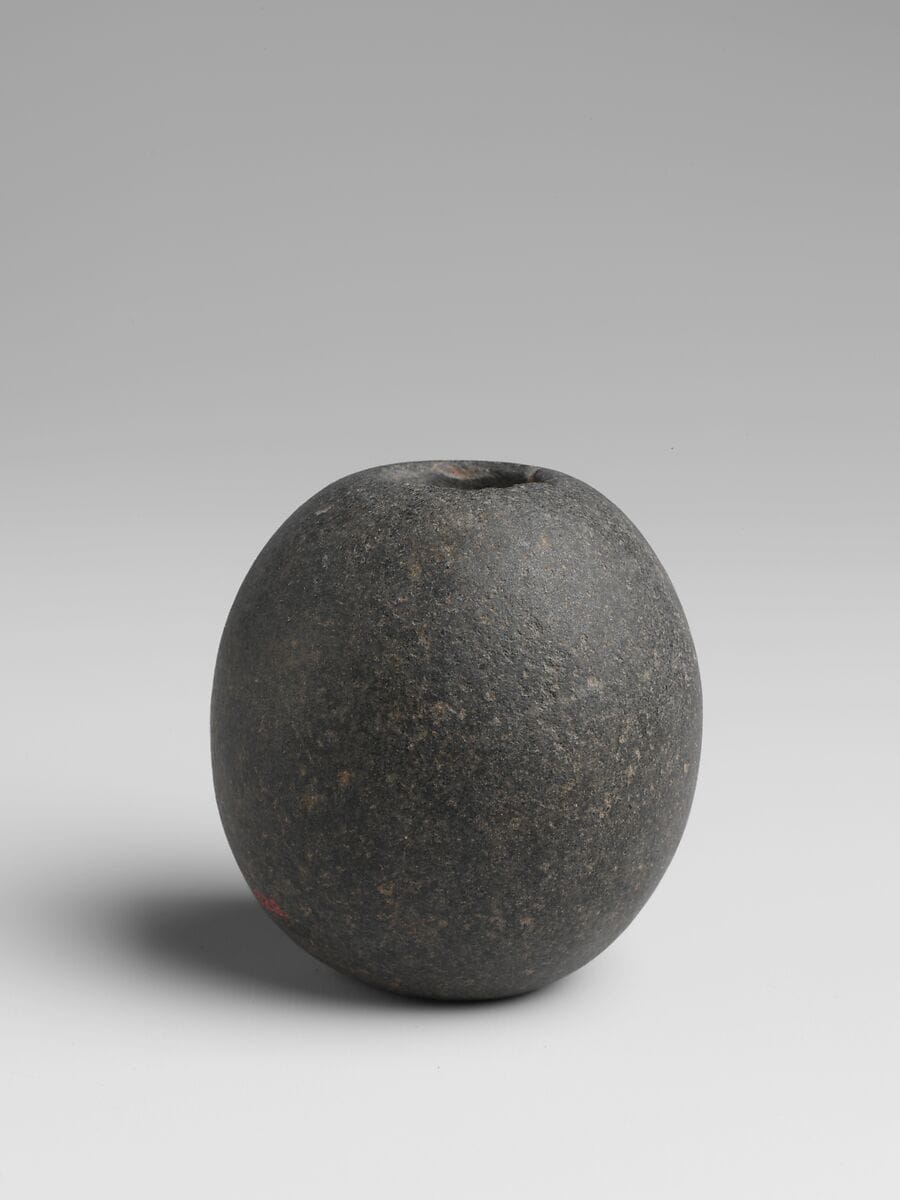
Ground stone stayed in use long after metal arrived. At the Early Bronze Age village of Sotira-Kaminoudhia, excavated by Stuart Swiny, the assemblage divides into carefully made "curated" tools (axes, adzes, mace heads, querns, rubbers, some pestles, dishes and mortars) and "expedient" ones such as hammerstones, pounders and rubbing stones [9, p. 255]. The Metropolitan Museum's Cesnola material includes several such pieces, among them gabbro mace heads, an andesite pestle and a vesicular basalt bowl. Museum labels mix the rock names freely (basalt, andesite, diabase, gabbro), so the catalogue groups them under one heading. See all andesite and diabase in the catalogue.
Picrolite
Picrolite is a soft green to blue stone native to the Troodos ophiolite, and it is the oldest worked stone on the island [2, p. 75]. At Akrotiri-Aetokremnos, in levels dated to about 11,000 cal BC, excavators found six picrolite objects: a bead, three pendants and two small pebbles that were probably pendant blanks [1, p. 664]. Recent analysis shows that picrolite occurs only at discrete spots and in two distinct source regions on the Troodos massif, which challenges the older assumption that people simply picked up nodules from river gravels [1, p. 664].
Its use rose sharply in the Chalcolithic, when picrolite became the main material for cruciform figurines, the hallmark of the 4th millennium BC [1, p. 664; 2, p. 75]. More than a hundred are known, mostly picrolite but also limestone and clay, from sites in the south-west such as Erimi-Pamboula, Lemba-Lakkous, Souskiou-Laona and Kissonerga-Mosphilia [3, p. 55]. At Souskiou-Laona tools, sample figurines, wasters and cores show where they were made [2, p. 75]. One proposal links the search for picrolite with early metallurgy, since copper ores and picrolite sources lie close together [2, p. 75]. The earlier figures are treated under Neolithic and picrolite figurines.
Steatite and chlorite
Soapstone (steatite) is soft enough to cut with simple tools, and in the 2nd millennium BC it became the favoured stone for small Cypriot vessels [4, p. 163]. Buchholz and Karageorghis note that some steatite vessels copy metal models, with imitation handle ends and rivet heads, that a soapstone cup with a spiral rim reflects Aegean influence, and that steatite vessels found on Rhodes and in Athens came from 12th-century Cypriot workshops [4, p. 163].
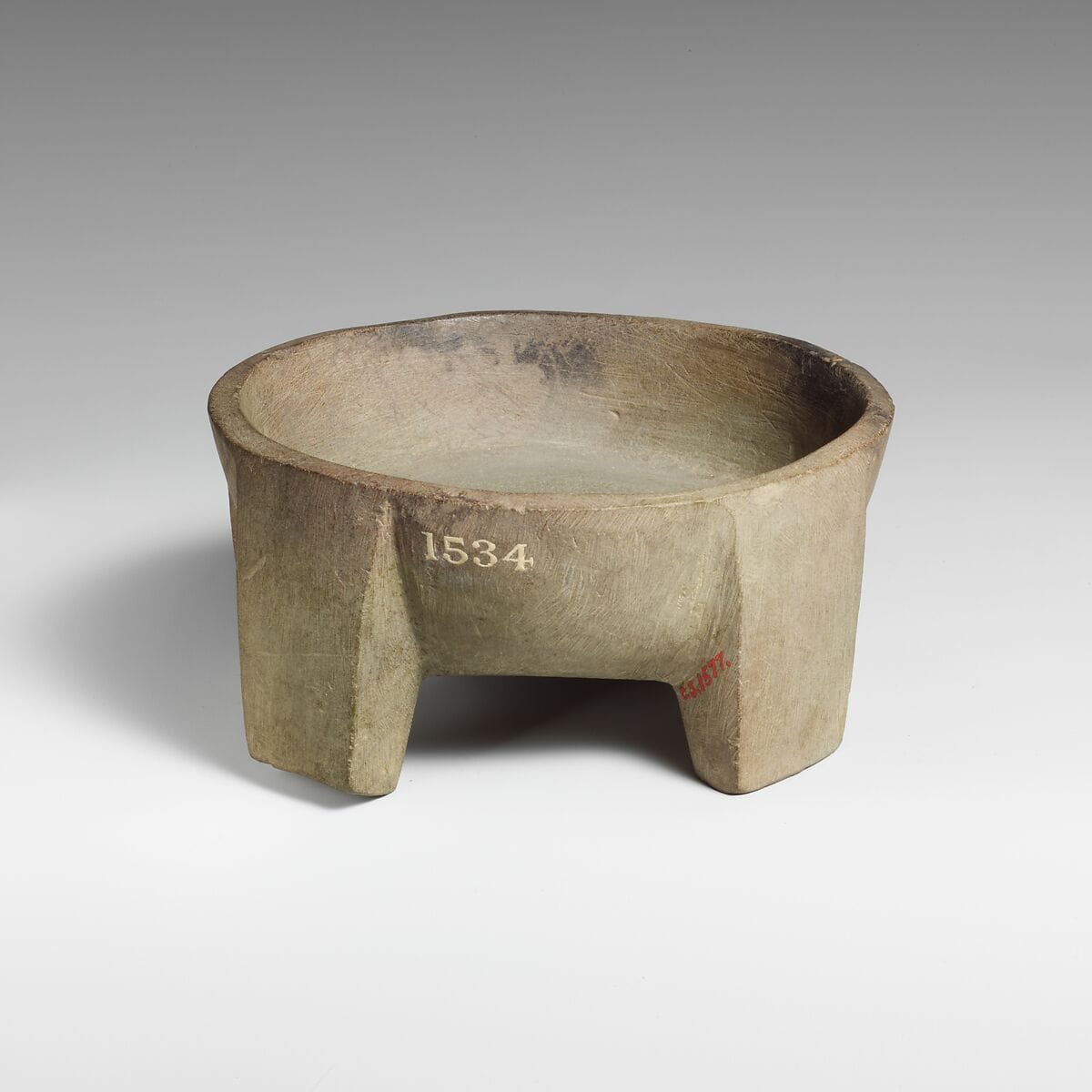
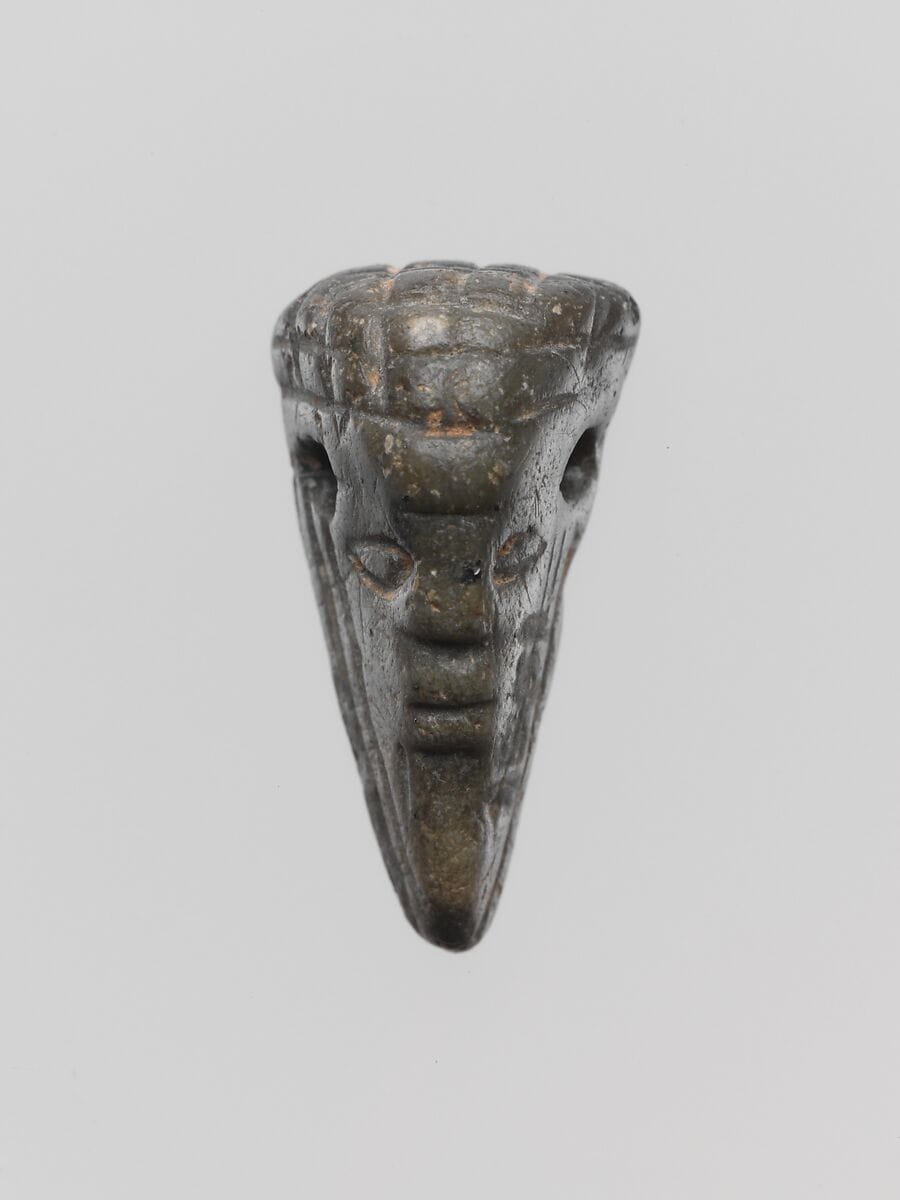
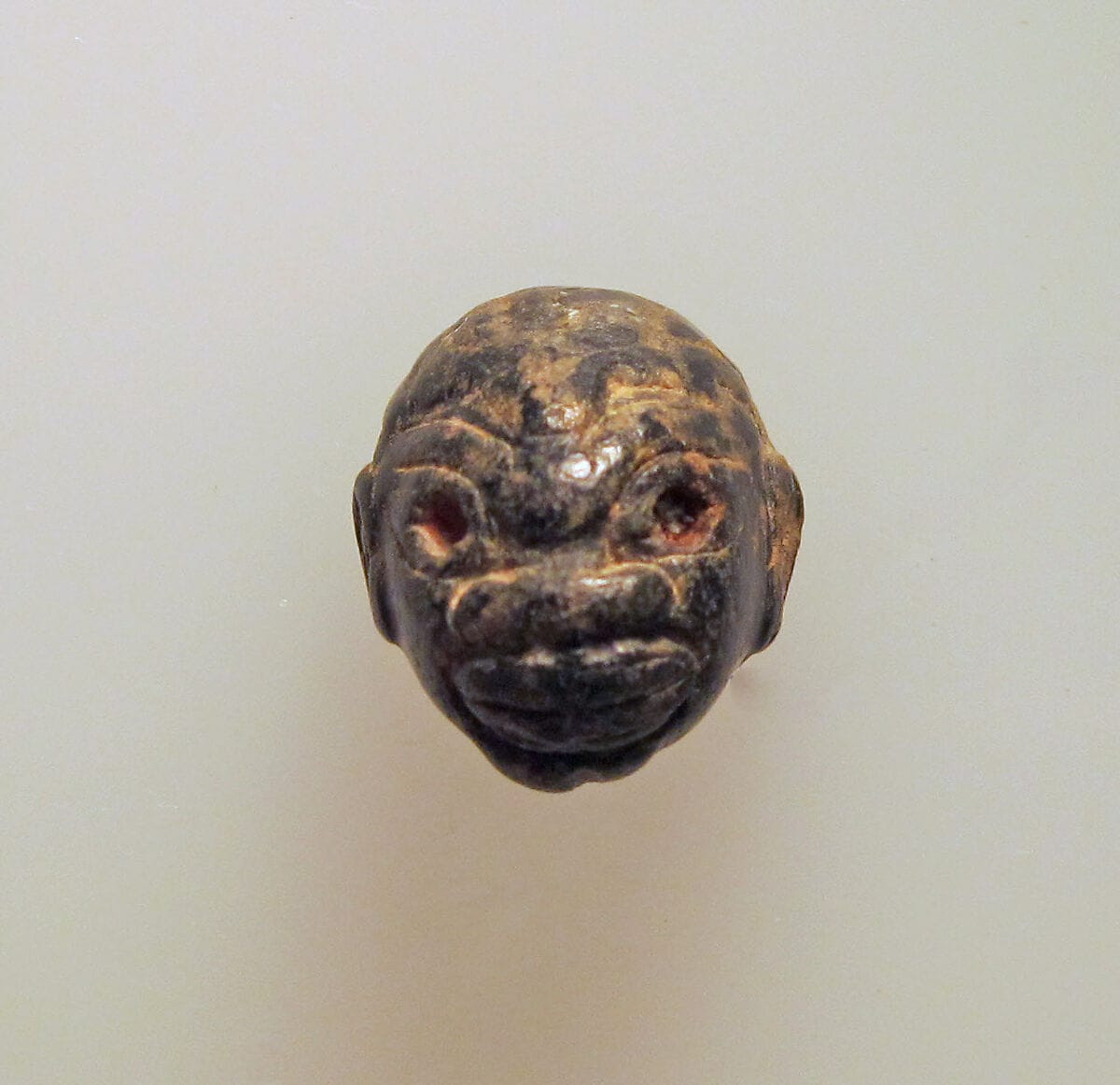
Museum labels use steatite, chlorite, serpentine and soapstone loosely for soft green and grey stones, and picrolite (above) belongs to the same family of Troodos materials. The catalogue therefore groups them together. The Metropolitan Museum's examples are mostly small objects: chlorite spindle whorls (see spindle whorls and textile tools), a miniature chlorite bowl, a chlorite mortar, and pendants carved as heads, such as the pendant in the form of the head of an Assyrian. See all steatite and chlorite in the catalogue.
Calcite (alabaster)
Calcite-alabaster is a white to yellowish, translucent, soft stone, and it was the commonest material for the luxury stone vessels traded across the Late Bronze Age eastern Mediterranean [7, p. 75]. Its main quarries lie in the Eastern Desert of Upper Egypt, between Minya and Assiut, though other formations exist from Crete and Turkey to Iran [7, p. 75]. Buchholz and Karageorghis place the first Egyptian-type alabaster vessels in Cyprus in the 2nd millennium BC, when imported pieces encouraged an Egyptian style in local stonework [4, p. 163].
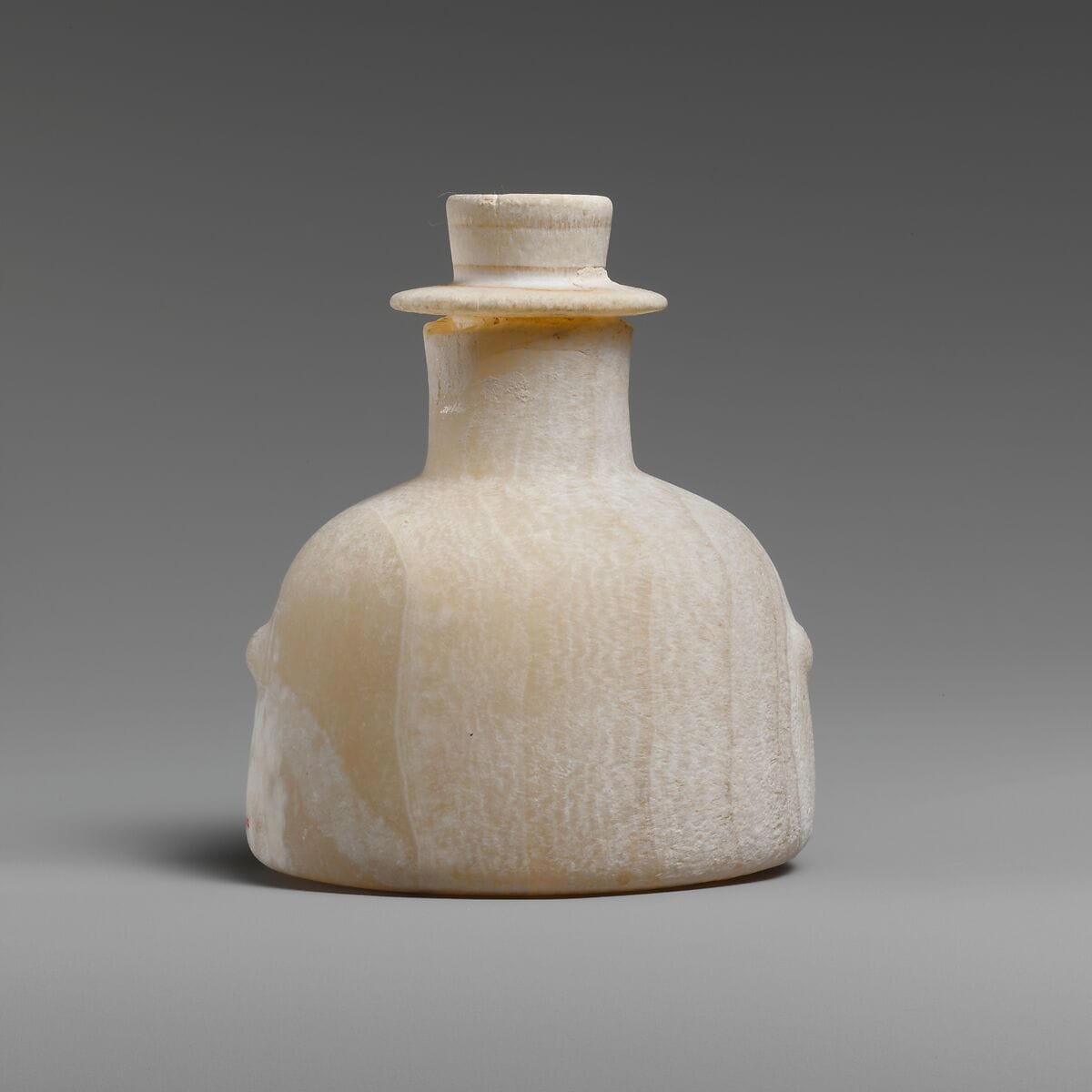
In 2019 the Ghent excavations at Pyla-Kokkinokremos found, in a residential complex in Sector 5, the first intact decorated Egyptian calcite-alabaster drop jar from Cyprus, incised with geometric and floral patterns [7, p. 75]. Only 16 complete decorated drop jars are known from Egypt, the Levant and Assyria, and Crabbé and Bretschneider read the Pyla jar as part of the gift exchange between rulers and elites [7, p. 75]. The catalogue's alabaster is dominated by the Cesnola alabastra in New York, such as this alabaster alabastron and a flask with its stopper. See all calcite and alabaster in the catalogue.
Gypsum
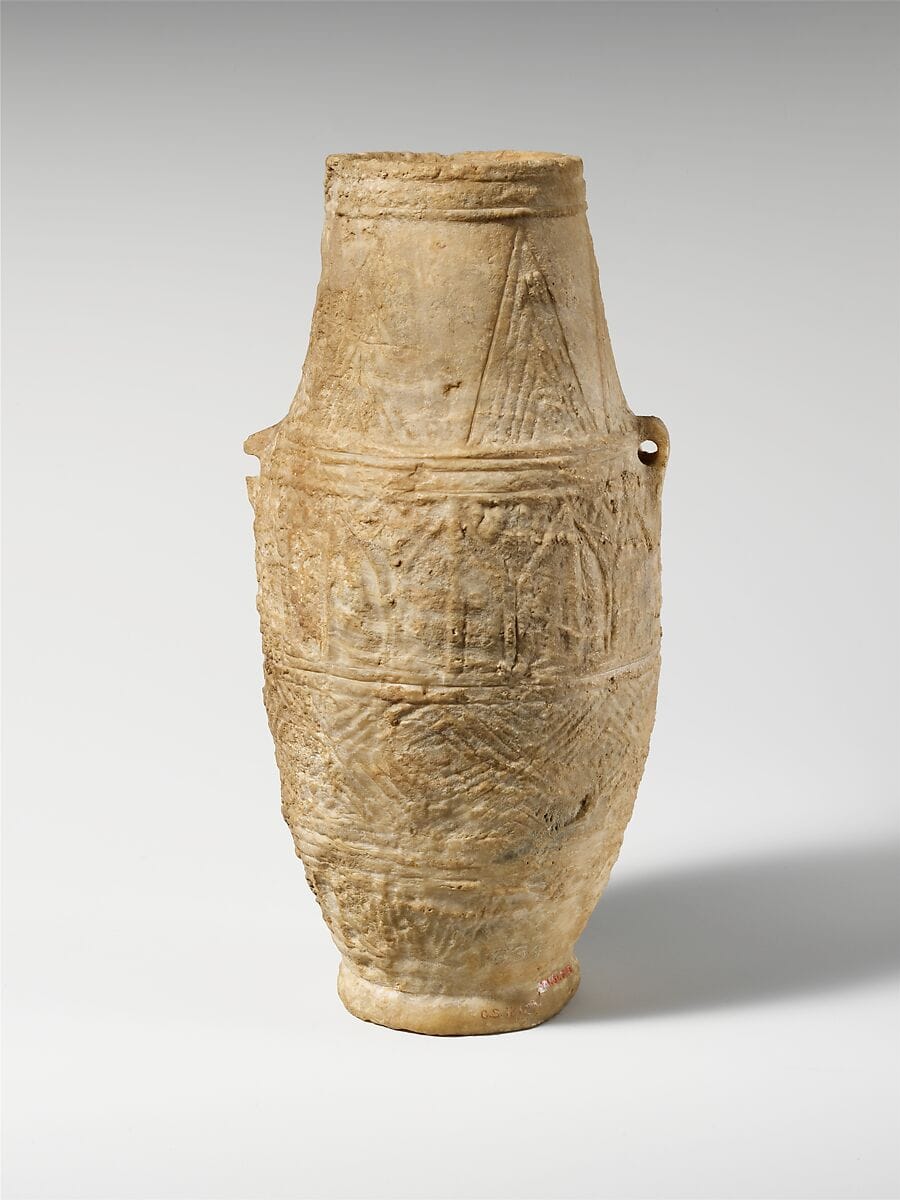
Gypsum is rare in the catalogue, with two objects. The Metropolitan Museum's gypsum jar, 24.1 cm high and dated to the Late Bronze Age (c. 1600–1050 BCE), has the material line "Gypsum (alabaster)" in its museum record: the word alabaster is applied to more than one mineral, and older records do not always say which. The other is a Phoenician gypsum plaque in the British Museum. Neither object has been analysed to show whether the stone is Cypriot or imported. See all gypsum in the catalogue.
Limestone
Limestone is the stone of Cypriot sculpture. Large-scale figures in stone appear from the middle of the 7th century BC, and by the end of that century local limestone was in wide use because the island has no local marble; the limits of the stone helped shape the distinct Cypriot style and its types [5, p. 36]. The main quarries lay in eastern Cyprus, in the Athienou formation, yet monumental limestone statues reached as far west as Kourion and Palaepaphos, and terracotta statues continued to be made alongside them [5, p. 36].
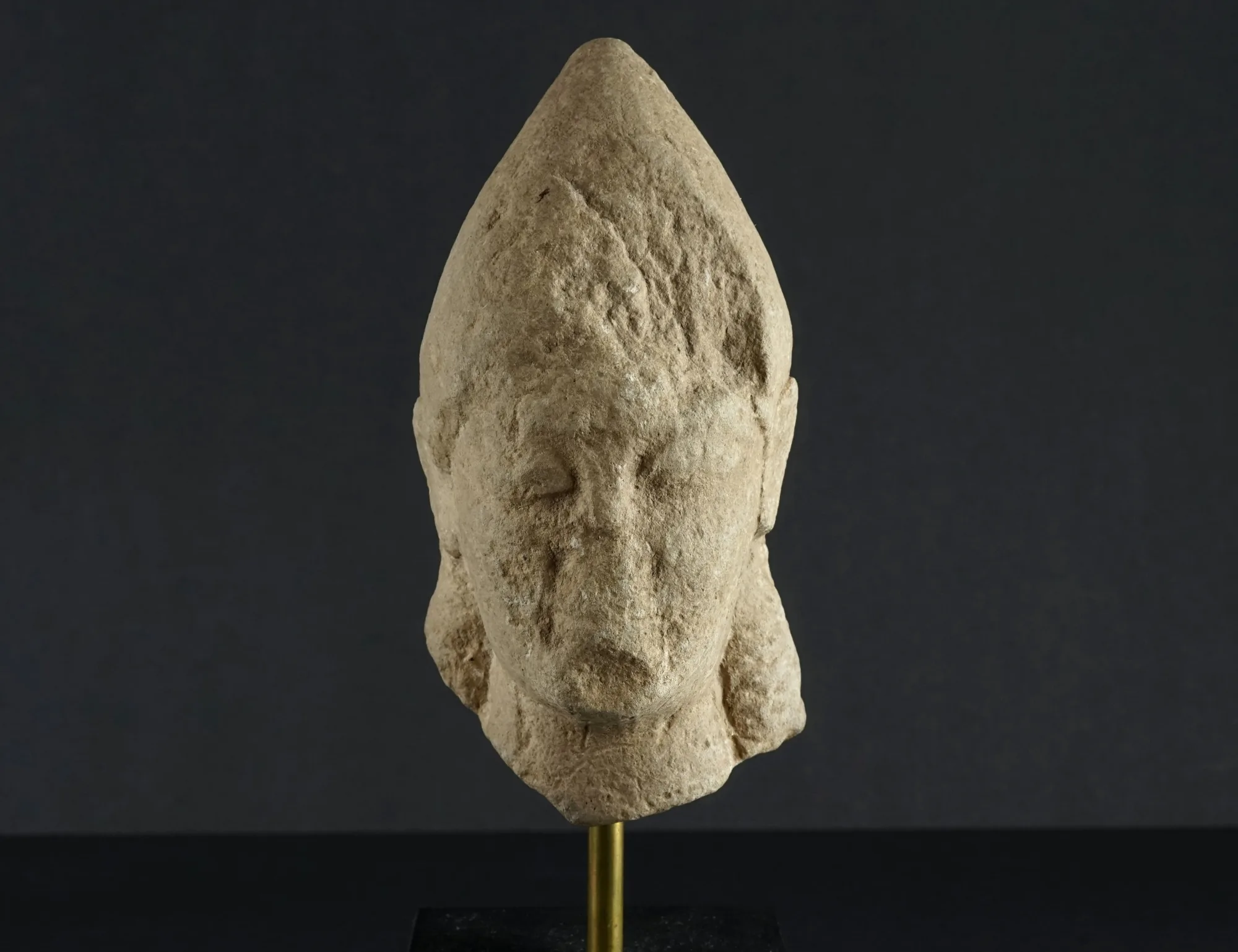
Limestone remained the material of sanctuary dedications into the Roman period, and some types, such as standing draped votaries and seated naked "temple boys", exist only in limestone [6]. Four heads in the Drakopoulos collection show the range: a beardless votary in a conical helmet and a heavily weathered votary in a tall pointed cap (shown here), both Cypro-Archaic II, a votary with a wreath of the 5th century BC, and a boy's head probably from a temple boy statuette. The sanctuaries of Golgoi and Idalion produced hundreds of such pieces [6]. For the sculpture itself see Archaic limestone sculpture, temple boys and limestone polychromy.
Hellenistic and Roman sculptors took their limestone from quarries in the Mesaoria and on the south coast, especially Xylophagou west of Larnaca, where prefabricated sculptures and heaps of chips have been found; unlike the Archaic and Classical statues, the later limestone sculpture has not yet been studied petrographically [6].
Chalk
Chalk is the softest of the white stones and appears in the catalogue only twice, both in the Cesnola Collection in New York. The Metropolitan Museum's chalk jug, 14.3 cm high, is dated with a query to the 5th or 4th century BCE (museum record); a small chalk amphora, 13.7 cm high, is placed even more broadly in the 6th to 3rd century BCE. The line between chalk and soft limestone is hard to draw by eye, and neither vessel has a recorded findspot or analysis. See all chalk in the catalogue.
Marble
White marble, and any coloured marble, had to be imported to Cyprus [6]. White marble sculpture is very rare in the Archaic and Classical periods, and only a number of Hellenistic pieces are known; of 165 marble sculptures recorded for the island, the vast majority are Roman, and their use is read as part of Roman identity [6]. They cluster in the port cities (Salamis, Nea Paphos, Soli, Kourion, Amathus), while the inland sanctuaries of Arsos, Golgoi, Idalion, Phasoula and Voni have yielded hundreds of limestone pieces and no marble at all [6].
Against that background the catalogue's marble is unusual. Most of it is a group of white marble bowl fragments with Phoenician inscriptions in the Cesnola Collection, which the Metropolitan Museum dates to about 389 BCE (museum record); the group also includes a cippus with a Phoenician inscription and the forepart of a sandalled foot. See all marble in the catalogue.
Semi-precious stones
Coloured stones reached Cyprus mostly as finished beads, pendants and seal stones. A necklace from Tomb 9 at Kition, of about 1300–1225 BC and now in the Cyprus Museum, combines 197 glass beads and three of faience or paste with two bottle-shaped carnelian pendants [10, p. 59]. That mix of stone, glass and faience is typical of Late Bronze Age jewellery.
Most of the catalogue's examples are later gold jewellery from the Cesnola Collection in which a stone is set: a gold ring with a green jasper scaraboid, a gold ring with an agate scarab, a necklace of gold and carnelian beads and a gold earring with beryl and garnet. For the settings and forms see jewellery. See all semi-precious stones in the catalogue.
Reading the material labels
Stone names in museum records come from many hands over more than a century, and few rest on analysis. Alabaster can mean calcite or gypsum, basalt and andesite are used for the same dark rocks, and steatite, chlorite and serpentine overlap. The catalogue keeps each museum's own word on the object page but groups near-synonyms under the headings used here, so that a search for one finds the others. Where a source has tested the stone, as with the picrolite sources of the Troodos [1, p. 664] or the Egyptian origin of the Pyla drop jar [7, p. 75], the identification is secure; elsewhere the label is a description of colour and hardness as much as a mineral name.
Objects on this page
 Assorted Neolithic FlintNeolithic · 12000–5500 BC
 Neolithic FlintNeolithic · 7500–5500 BC
 Gabbro mace headEarly Bronze Age I · 2500–1900 BC
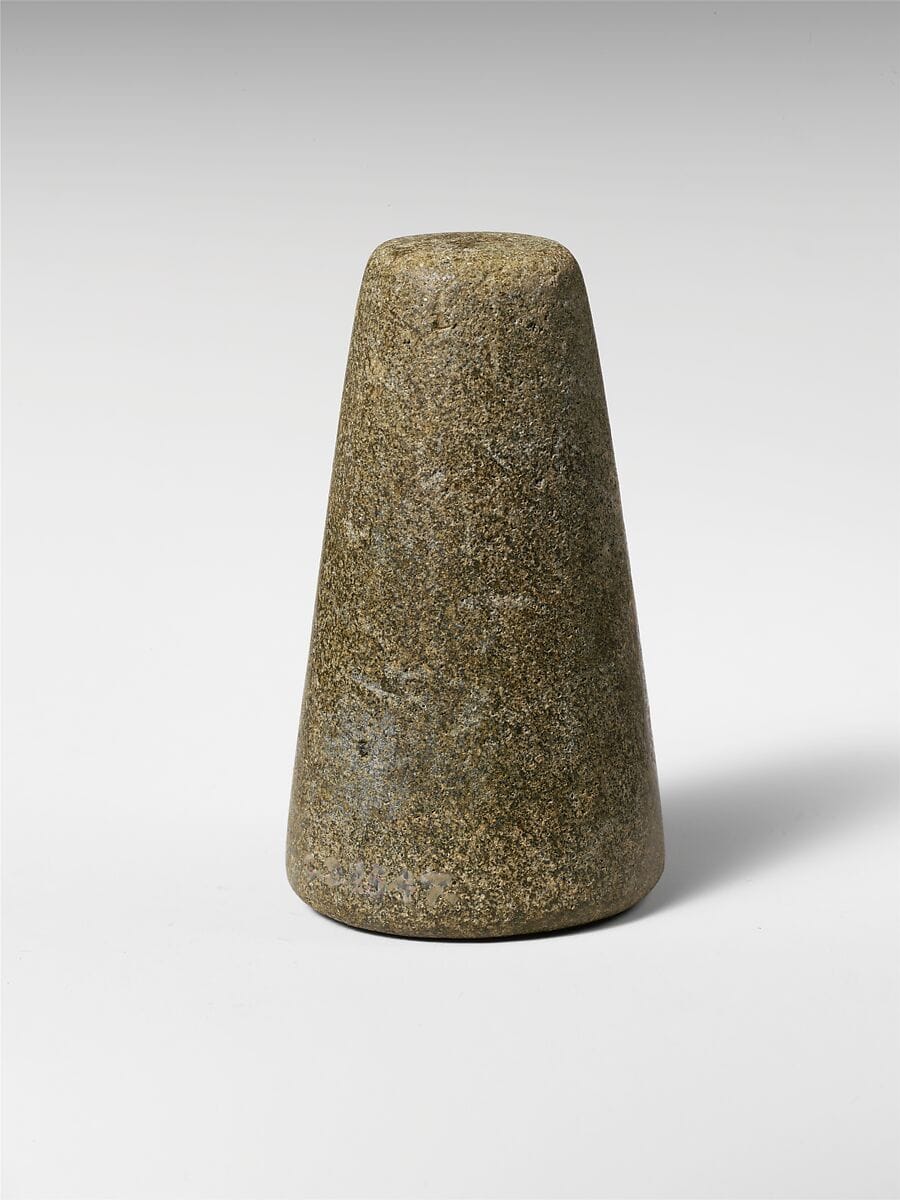 Andesite pestleLate Bronze Age II · 1600–1100 BC
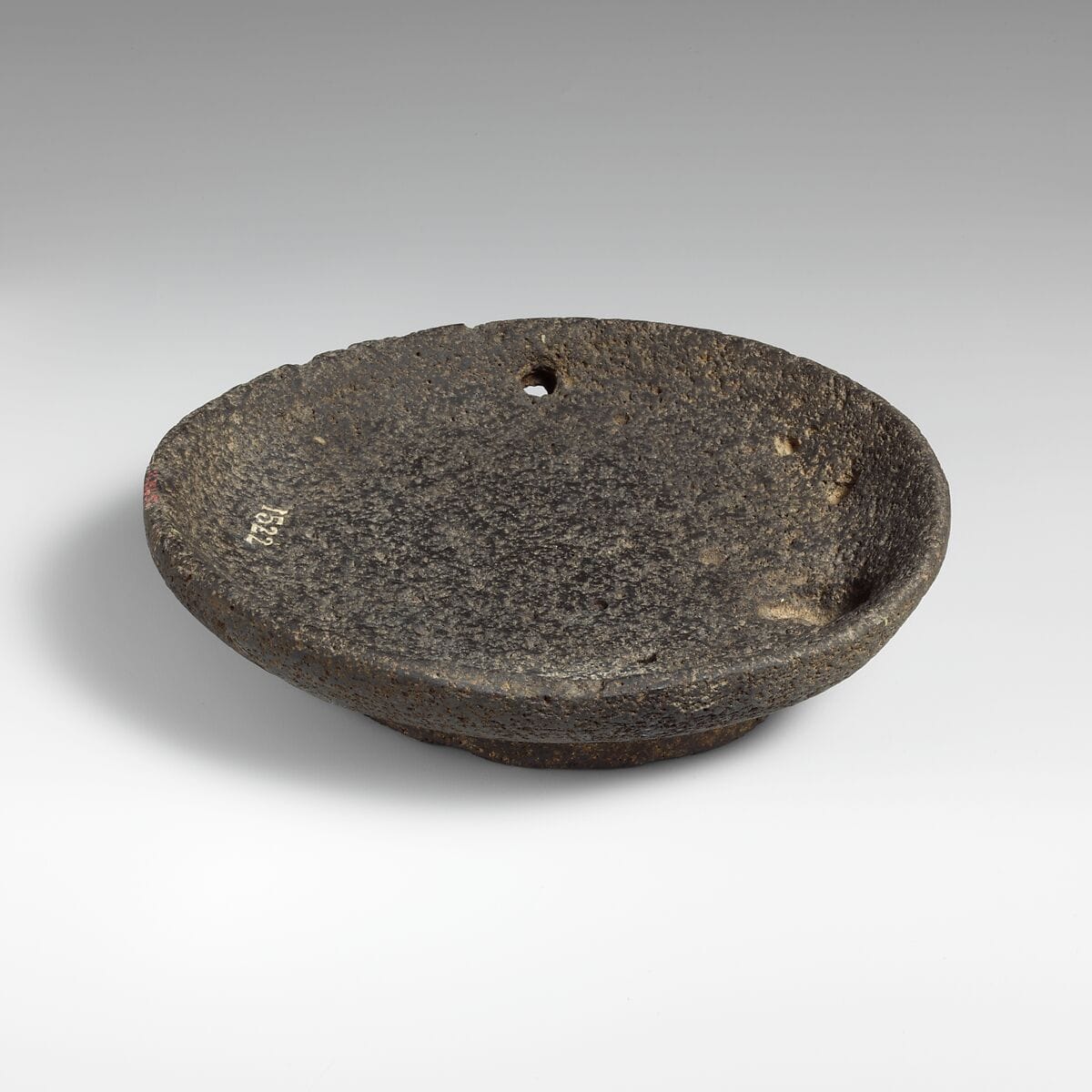 Vesicular basalt bowlLate Bronze Age II · 1600–1200 BC
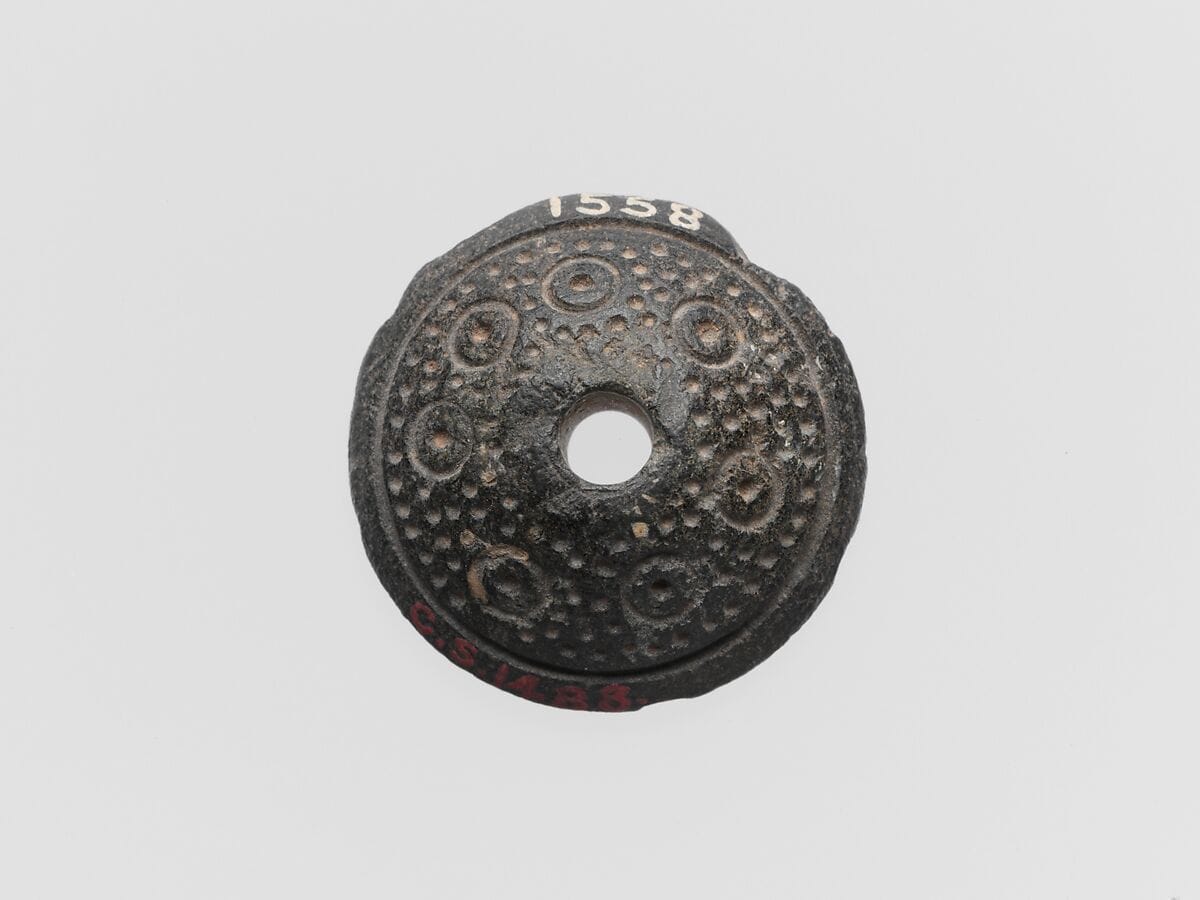 Chlorite spindle whorlLate Bronze Age III · 1200–1050 BC
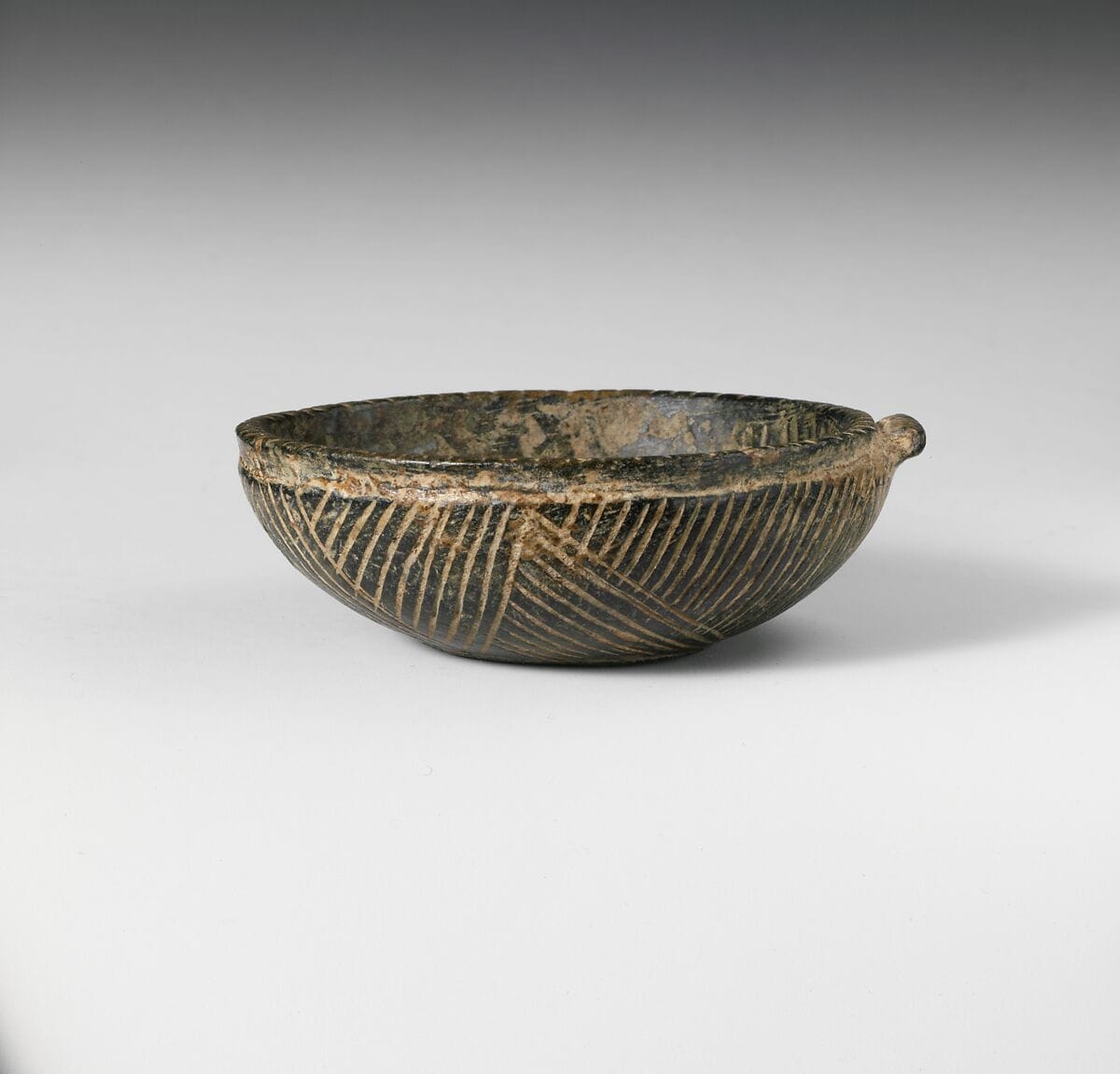 Miniature chlorite bowlLate Bronze Age II · 1600–1050 BC
 Chlorite mortarLate Bronze Age II · 1600–700 BC
 Chlorite pendant in the form of the head of an AssyrianArchaic II · 599–500 BC
 Alabaster flask with stopperHellenistic · 199–50 BC
 Gypsum jarLate Bronze Age II · 1600–1050 BC
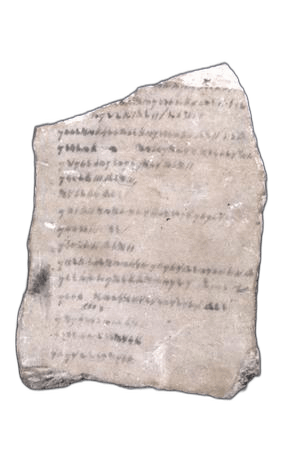 Phoenician Gypsum PlaqueClassical · 400–375 BC
and 12 more objects mentioned on this page
In the catalogue
References
- 1.Moutsiou, T., Ioannides, D., Charalambous, A., Schoeder, S., Webb, S. M., Thoury, M., Kassianidou, V., Zomeni, Z., & Reepmeyer, C. (2022). X-ray fluorescence spectroscopy of picrolite raw material on Cyprus. Heritage, 5, 664–676. https://doi.org/10.3390/heritage5020037
- 2.Cyprus: A dynamic island (n.d.). Exhibition catalogue, entry "Woman in labour" (Cyprus Museum W292).
- 3.Idols: The power of images (n.d.). Exhibition catalogue.
- 4.Buchholz, H.-G., & Karageorghis, V. (1973). Prehistoric Greece and Cyprus: An archaeological handbook. Phaidon.
- 5.Satraki, A. (2005). Manifestations of royalty in Cypriot sculpture. In Postgraduate Cypriot Archaeology 2005 (POCA) proceedings.
- 6.Wriedt Sørensen, L., & Winther Jacobsen, K. (Eds.). (n.d.). Panayia Ematousa II: Political, cultural, ethnic and social relations in Cyprus. Approaches to regional studies (Monographs of the Danish Institute at Athens 6.2). Aarhus University Press.
- 7.Crabbé, A., & Bretschneider, J. (2021). An Egyptian calcite-alabaster drop jar at the Cypriot site of Pyla-Kokkinokremos. Egypt and the Levant, 31, 75–95.
- 8.Chert availability and prehistoric exploitation in the Near East (n.d.). BAR International Series.
- 9.Swiny, S., Rapp, G., & Herscher, E. (Eds.). (2003). Sotira Kaminoudhia: An Early Bronze Age site in Cyprus (CAARI Monograph Series 4). American Schools of Oriental Research.
- 10.Cyprus BC: 7000 years of history (n.d.). Exhibition catalogue.