
Contents
Black Polished (BP) is the dark sister of Red Polished ware. It is handmade, has a fine grey body under a slip that was burnished and fired black, and was used almost entirely for small vessels: bottles, flasks, juglets, little bowls and a few models, nearly all decorated with incised patterns packed with white. It was made on the north coast and in the Mesaoria during the Early Bronze Age and the first half of the Middle Bronze Age, roughly 2300 to 1800 BCE, and most surviving pieces come from tombs. The catalogue holds 31 examples; you can see all Black Polished ware in the catalogue. This page also covers two smaller polished fabrics that sit beside it in the classification: Red-and-Black Polished and Brown Polished.
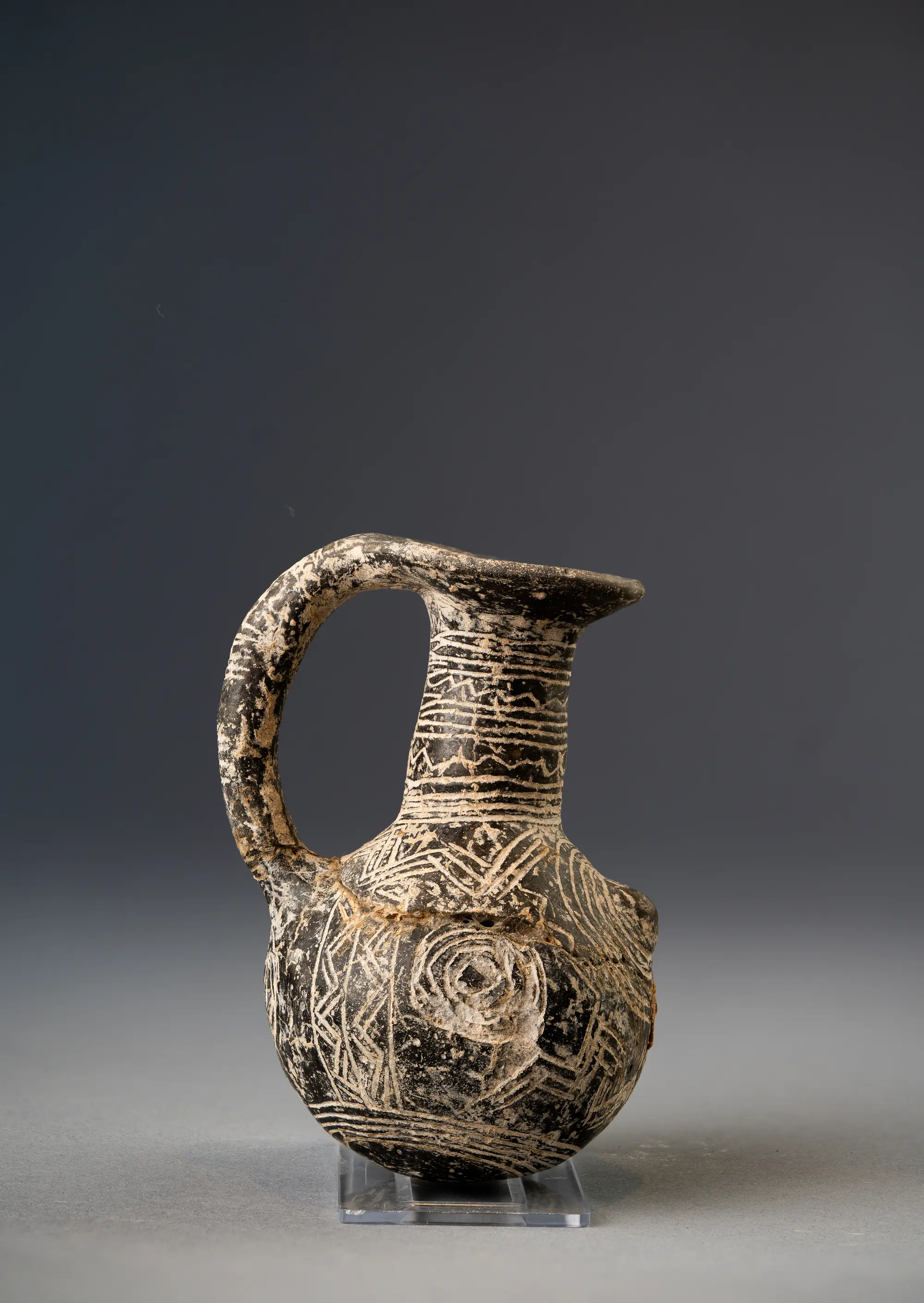
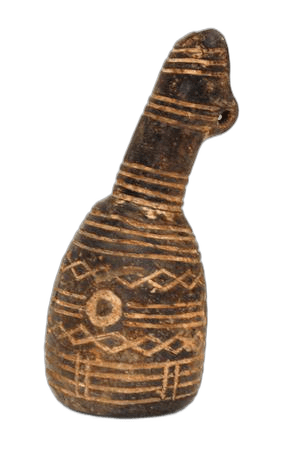
A Black Polished juglet in the Drakopoulos collection, Early Cypriot III to Middle Cypriot I. See the object page.
Definition and identification
The ware was already named in the early twentieth-century literature, by John Myres in his Handbook and by Einar Gjerstad in his Studies on Prehistoric Cyprus and the first volume of the Swedish Cyprus Expedition reports, which Porphyrios Dikaios cited when he set out the standard description in his report on the cemetery at Bellapais-Vounous [1]. His definition is short: "The clay is fine, well silted, grey in colour, and is covered with a black polished slip. The decoration is incised, plain, or filled with white chalk" [1].
In practice the ware is recognised by four things together. The surface is black or very dark grey and burnished to a sheen. The body, seen at a chip or break, is grey rather than red. The vessels are small. And almost all of them carry incised geometric decoration: hatched bands, zigzags, chains of lozenges, concentric circles and small impressed rings, the same vocabulary used on incised Red Polished. British Museum records describe pieces with buff clay "fired black throughout", which shows that the colour comes from firing the whole vessel in a smoky, reducing atmosphere [3]. Some of those records also number the ware in parallel with Red Polished, so that a Vounous bottle is called "Black Polished I (corresponding to Red Polished I)" and a later bowl "Black Polished III" [3]. These are phase labels borrowed from the Red Polished scheme, and they carry the same uncertainties.
Jennifer Webb and David Frankel point out that Black Polished vessels from Early and Middle Cypriot contexts are made in a finer fabric than the few dark Philia sherds sometimes compared with them [4]. Fineness, a grey core and full black firing separate true Black Polished from Red Polished pots that simply went dark in the fire.
Shapes and decoration
Dikaios distinguished six shapes among the Black Polished from Vounous, and his list still covers most of what turns up in collections [1].
| Dikaios type | Shape | Typical decoration |
|---|---|---|
| I | Deep bowl with convex sides and three projections low on the body | Incised |
| II | Small hemispherical bowl with a string-hole projection at the rim | Hatched bands crossing on the base to make four panels, filled with concentric circles |
| III | Small bowl on a cylindrical foot with spreading base | Intersecting zigzag bands |
| IV | Amphoriskos with globular body and wide cylindrical neck | Zigzags round the body |
| V | Globular juglet, tapering neck, funnel rim, handle from rim to shoulder | Incised geometric patterns |
| VI a–c | Bottles: globular with string-hole projection; globular with short cutaway neck; conical or cylindrical with cutaway neck | Hatched bands, vertical zigzags with circles between, chains of lozenges |
Dikaios also recorded a stag's head from a lost zoomorphic vessel [1], and the Vounous tombs produced a Black Polished bowl on a low foot, a model dagger and sheath, and an incised spindle whorl [1]. A conical spindle whorl from Vounous Tomb 92, now in the Ashmolean Museum (AN1940.167), is incised with three groups of four concentric semicircles and dated Early Cypriot I–II [8]. Whorls in the ware are discussed further under spindle whorls and textile tools.
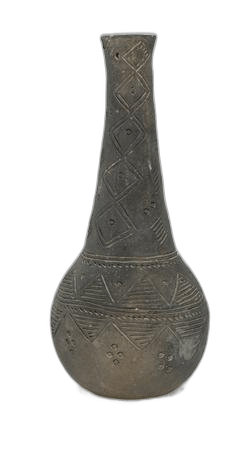
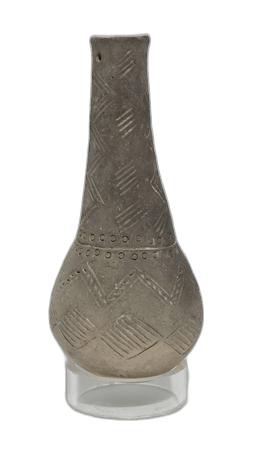
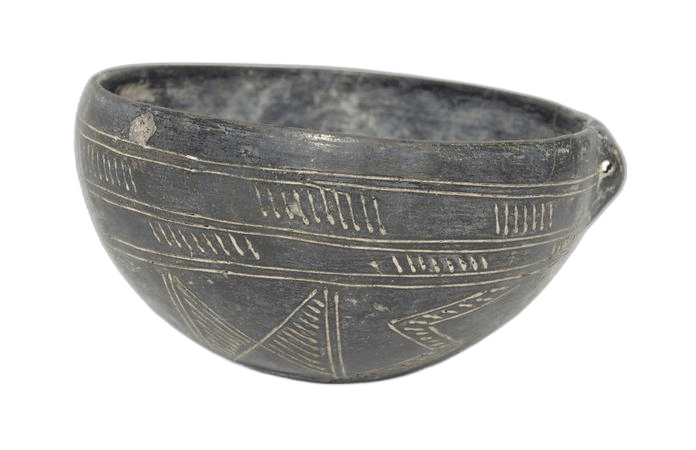
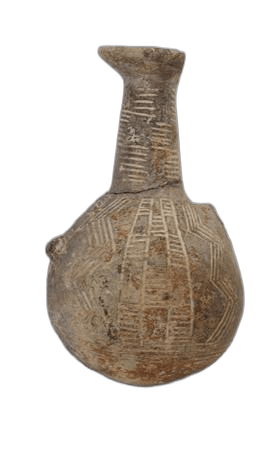
The British Museum pieces in the catalogue show the range. A Black Polished flask from Vounous, 15 cm high, has an ovoid body, a tall tapering neck pierced with a pair of string holes below the rim, and strings of lozenges down the neck [3]. Its companion, a Black Polished bottle of 12.5 cm, is classed as Stewart's Type V A c1 [3]. A hemispherical bowl from Ayia Paraskevi, 10.6 cm across, has a pierced lug below the rim and concentric circles on the base, Dikaios's type II scheme exactly [3]. A three-footed incised bowl from Vounous has three lugs on the rim and a pointed boss in the centre of the interior [3]. Miniature bottles with cutaway spouts, such as one only about 8 cm high with "highly lustrous burnished black slip" [3], belong to a group that Ellen Herscher found best represented at Deneia, with related examples from Lapithos [7].
Zoomorphic vessels were also made. The Metropolitan Museum holds a small askos in the shape of a quadruped, a bull or a ram 9.5 cm long, catalogued as Black Polished [10]. Cadogan, writing in Cypriot Ceramics: Reading the Prehistoric Record, lists duck-shaped vases in Red Polished and Black Polished from Lapithos-Vrysi tou Barba and Nicosia-Ayia Paraskevi, a shape linked with the Early Bronze III Aegean [9]. Herscher dated a Red Polished III duck askos from Lapithos to Early Cypriot IIIA and described the shape as "believed to be ultimately of Aegean origin" [7].
The Drakopoulos juglet at the top of this page is a type V juglet in Dikaios's terms: a squat globular body, tall flaring neck, and a handle from rim to shoulder. Its neck is banded with horizontal lines and zigzags, the shoulder carries hatched chevrons, and small bosses at the widest point are each ringed by incised circles. Bosses ringed in this way are less common than the plain incised schemes.
Chronology
Black Polished begins after the Philia phase. Some scholars once recognised a "Black Polished (Philia)" class, but Webb and Frankel showed that its few members (an incised flask from Nicosia-Ayia Paraskevi Tomb 4, a spindle whorl from Dhenia-Kafkalla Tomb 166 and four flask sherds from Marki-Alonia) are better treated as differentially fired Red Polished Philia. In their words, "the small number of items involved makes it difficult to maintain the existence of Black Polished (Philia) as an intentionally distinct ceramic category" [4].
The earliest production of the ware proper was probably at Vounous or Lapithos, where Black Polished ear-lug pots and flasks were placed "with some frequency in EC I–II tombs" [2]. At Vounous, Dikaios saw "the marked increase of Black Polished ware" as a mark of the last Early Cypriot phase (his period III b, Early Cypriot III), in line with Gjerstad's stratigraphy [1]. By Middle Cypriot I, high percentages of Black Polished distinguish the assemblage at Deneia, which Webb describes as "undoubtedly now a major production centre" [2]. A British Museum bowl classed as Black Polished III is dated Middle Cypriot I–II [3]. From Middle Cypriot I the north also produced Black Slip, a separate ware with light, hard-fired clay, which outlived Black Polished [1, 2].
Distribution and production
Black Polished is one of the clearest regional wares of prehistoric Bronze Age Cyprus. Webb, drawing on David Brewster's 2007 study of the Deneia fabrics, states that it "was almost exclusively in use in the Mesaoria and on the north coast" and that less than 2.5% of provenanced Black Polished was found elsewhere [2]. It is relatively rare at Ayia Paraskevi, Katydhata, Linou and Ambelikou, and only a very minor part of the pottery at Marki and Alambra. In the south and west there is almost nothing, apart from an occasional import such as one piece from Kalavasos [2].
Webb argues that the quality of the Deneia vessels points to experienced potters, probably the same workshops that made incised black-topped Red Polished bowls [2]. That link matters for identification: a black-topped Red Polished bowl has a red, oxidised lower body and a black rim zone, while Black Polished is black all over. Firing methods for both are discussed under pottery kilns and firing.
Almost all complete Black Polished vessels come from chamber tombs at Bellapais-Vounous, Lapithos and Deneia. Webb groups the small decorated flasks and bottles of Red Polished, White Painted and Black Polished as containers "often found in tombs and likely to have contained substances used in small quantities in mortuary ritual", possibly unguents or medicinal preparations [2]. For the shapes themselves see bottles, flasks and jugs.
Names that cause confusion
Several unrelated classes share the words "black" and "polished", and catalogue labels mix them up.
Dikaios also used "Black Polished" for a Chalcolithic class. Edgar Peltenburg observed that its "only distinguishing feature is a gray surface", which "may be due to firing conditions or even use/post-depositional agencies" [5]. It has nothing to do with the Bronze Age ware.
Gjerstad's "Grey and Black Polished" ware of the Iron Age is wheel-made, with grey clay and a grey or black polished slip, and was used for bowls, jugs and amphorae [6]. Iron Age jugs labelled "Black Polished" in museum records belong here, not with the handmade Bronze Age pots.
Black-topped Red Polished, as noted above, is a Red Polished vessel with a deliberately reduced rim zone. Black Slip ware of the Middle Bronze Age has light-coloured, very hard-fired clay under a thin dark wash that flakes [1]. Black Polished has a soft grey body and a burnished slip.
Red-and-Black Polished ware
"Red-and-Black Polished" has been used for two different things. Dikaios and Gjerstad gave the name to Philia-phase vessels fired red with black upper parts; James Stewart merged these into his Red Polished I (Philia), and later work has dropped the term for that phase [4]. Peltenburg rejected Gjerstad's identification of Red-and-Black Polished (Philia) at Ambelikou-Ayios Georghios [5], and Diane Bolger dropped the term from the Kissonerga-Mosphilia classification, equating it with differentially fired Red Polished Philia [9].
The second use, which the catalogue follows, is Ellen Herscher's. In a 1973 paper she isolated a Red-and-Black Polished ware from the western Karpas peninsula, a class well represented in Desmond Morris's private collection [9]. Webb describes it as a fabric "used only for the production of flasks", with over 150 examples known, "rarely found beyond the Karpas" [2]. The catalogue dates the class to about 2300 to 2000 BCE. It should not be confused with Red-on-Black ware, a later painted ware of the same eastern region [2]; see Red-on-Black ware.
The single catalogue object, a Red-and-Black Polished amphora in the Cyprus Museum, Jacksonville, is 11 inches tall, with twin vertical handles, a flat base and white-filled incision on the neck, shoulder and upper body. It was reconstructed from fragments long ago. Since Herscher's Karpas ware is a flask fabric, an amphora with a flat base may belong instead to the older, differentially fired Philia sense of the term, and its label should be read with that in mind. You can see all Red-and-Black Polished ware in the catalogue.
Brown Polished ware
Brown Polished is the southern counterpart. Herscher described "a group of small Brown Polished vessels" from the south and south-east coast, mostly bottles with some juglets, spindle whorls and a few bowls, in a "very fine soft light gray-brown fabric with a thin lustrous dark brown or gray-brown slip", which suggested to her Red Polished not fired in a fully oxidising atmosphere [11]. The incision is fine and linear, with bands filled with lines, dots or short strokes; several pieces often occur in one tomb, and they survive mostly in fragments [11].
The greatest number come from Kalavasos-Panayia Church, with others from Episkopi-Phaneromeni and from Tombs 4, 8 and 12 at Sotira-Kaminoudhia [11]. At Sotira a Brown Polished bottle of Type A has a piriform body, flaring rim and fine incision with white filling and lozenges filled with punctures, preserved to 13.3 cm [12]. Kalavasos-Panayia Church Tomb 46 held Brown Polished vessels together with black-topped Red Polished III bottles and juglets from the north coast, which suggests an Early Cypriot III to Middle Cypriot I date for that group [11]. Webb adds that 42 Brown Polished flasks from Psematismenos-Trelloukkas confirm production from Early Cypriot I, and that their chemistry differs from the local Red Polished, so they were brought in [2]. Like Red-and-Black Polished, it was "used almost entirely for the production of flasks" and is a regional fabric of the south coast [2]. The ware runs from about 2400 to 1900 BCE. The catalogue holds no Brown Polished pieces yet; see the catalogue term page.
Studying Black Polished today
Black Polished is a small ware and the scholarship on it is scattered. Stewart's Early Cypriot typology in the Swedish Cyprus Expedition was built mainly on Red Polished, and museum records still apply his type numbers to Black Polished pieces [3]. Herscher's work on regional wares [11] and the Frankel and Webb excavations at Marki and Deneia put the emphasis on fabric and region, and Brewster's fabric study of the Deneia material is the basis for the distribution figures above [2]. For neighbouring wares see Drab Polished in the west and White Painted in the north, and for the wider setting Middle Bronze Age village life and the pottery types index. The Drakopoulos collection juglet shown above is one of the 31 Black Polished pieces in the catalogue.
Objects on this page
- Black Polished Juglet with Incised Decoration and Circled BossesEarly Bronze Age III · 2100–1850 BC
 Black Polished FlaskEarly Bronze Age II · 2300–2100 BC
 Black Polished BottleEarly Bronze Age II · 2300–2100 BC
 Black Polished BowlEarly Bronze Age III · 2100–1850 BC
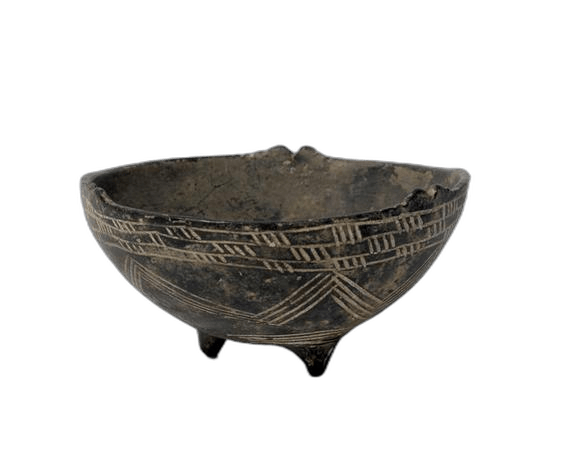 Black Polished Incised BowlMiddle Bronze Age I · 1950–1750 BC
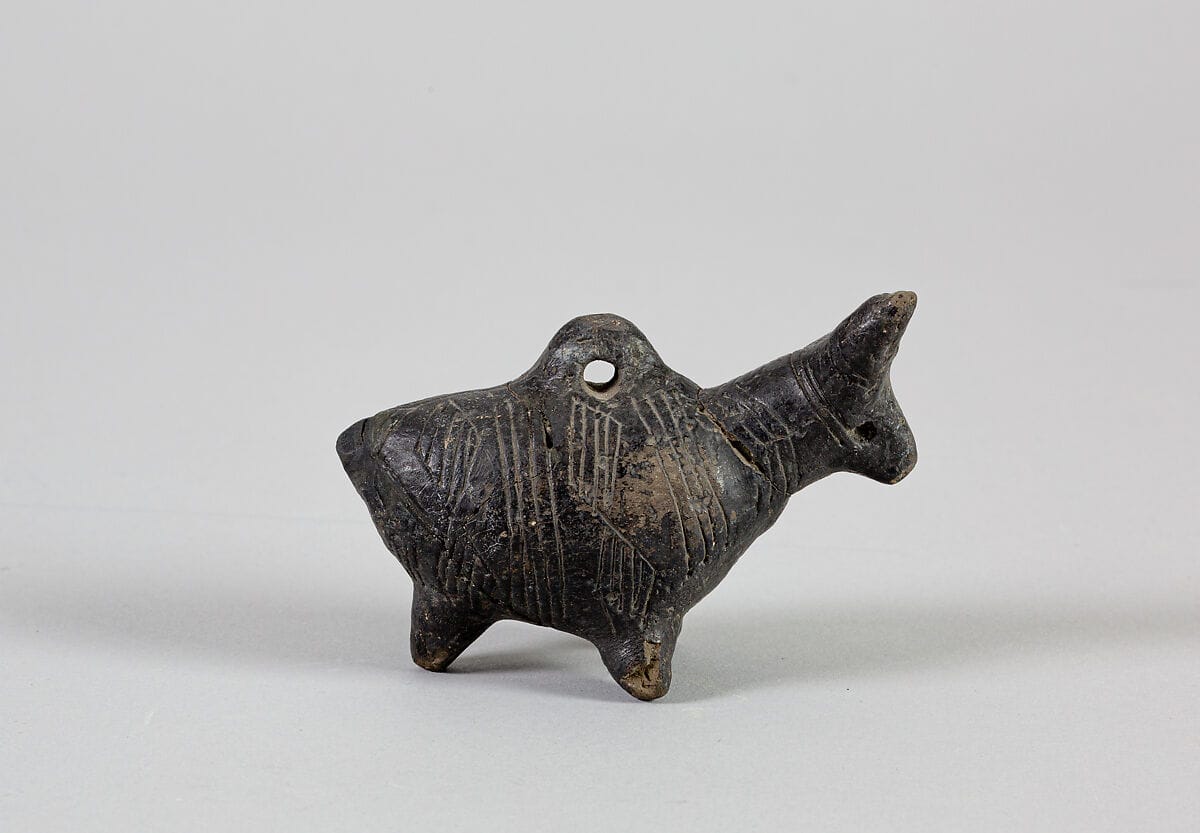 Terracotta askos in the shape of a quadrupedMiddle Bronze Age I · 2000–1725 BC
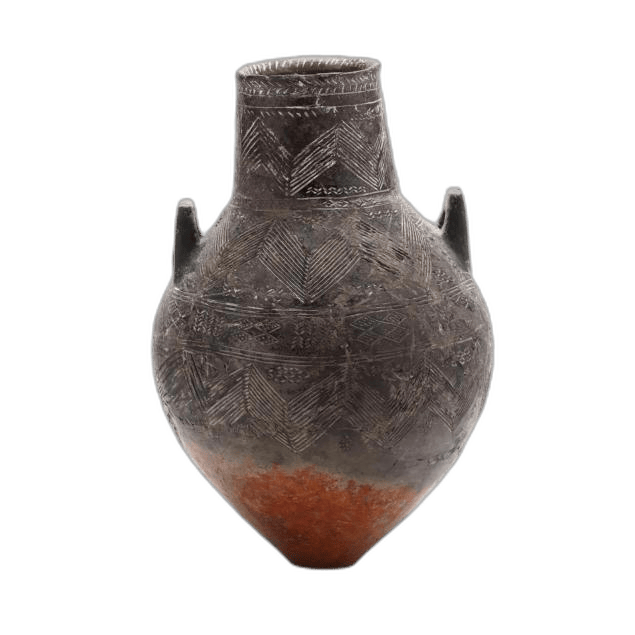 Cypriot Bronze Age Polished Red and Black Ware AmphoraEarly Bronze Age I · 2500–2000 BC
In the catalogue
References
- 1.Dikaios, P. (1940). The excavations at Vounous-Bellapais in Cyprus, 1931–2. Archaeologia, 88, 1–174.
- 2.Webb, J. M. (n.d.). Pottery production and distribution in prehistoric Bronze Age Cyprus: The long road from measurement to meaning. In a volume of studies in honour of David Frankel.
- 3.British Museum, London. Collection records 1939,0217.43; 1939,0217.27; 1888,0927.18; 2001,0423.2; 1980,1126.7; 1884,1210.17.
- 4.Webb, J. M., & Frankel, D. (1999). Characterizing the Philia facies: Material culture, chronology, and the origin of the Bronze Age in Cyprus. American Journal of Archaeology, 103(1), 3–43.
- 5.Peltenburg, E. (1991). Toward a definition of the Late Chalcolithic in Cyprus: The Monochrome pottery debate. In J. A. Barlow, D. L. Bolger, & B. Kling (Eds.), Cypriot ceramics: Reading the prehistoric record (University Museum Monograph 74). University of Pennsylvania Museum.
- 6.Gjerstad, E. (1948). The Swedish Cyprus Expedition, Vol. IV, Part 2: The Cypro-Geometric, Cypro-Archaic and Cypro-Classical periods. Swedish Cyprus Expedition.
- 7.Herscher, E. (1975). New light from Lapithos. In N. Robertson (Ed.), The archaeology of Cyprus: Recent developments (pp. 39–60). Noyes Press.
- 8.Pilides, D., & Papadimitriou, N. (Eds.). (2012). Ancient Cyprus: Cultures in dialogue. Department of Antiquities, Cyprus.
- 9.Barlow, J. A., Bolger, D. L., & Kling, B. (Eds.). (1991). Cypriot ceramics: Reading the prehistoric record (University Museum Monograph 74). University of Pennsylvania Museum.
- 10.Metropolitan Museum of Art, New York. Terracotta askos in the shape of a quadruped, accession 74.51.6718 (Cesnola Collection).
- 11.Herscher, E. (1991). Beyond regionalism: Toward an islandwide Early and Middle Cypriot sequence. In J. A. Barlow, D. L. Bolger, & B. Kling (Eds.), Cypriot ceramics: Reading the prehistoric record (University Museum Monograph 74). University of Pennsylvania Museum.
- 12.Swiny, S., Rapp, G. R., & Herscher, E. (Eds.). (2003). Sotira Kaminoudhia: An Early Bronze Age site in Cyprus (CAARI Monograph 4). American Schools of Oriental Research.