
Contents
Pottery reached Cyprus late. Potters in the northern Levant were making vessels by about 6800 to 6500 cal BC, yet Cyprus went on without pottery for more than a millennium after its Aceramic Neolithic villages, and the first Cypriot pots appear only after a gap in the radiocarbon record of roughly a thousand years [1]. This page gathers the wares of the four thousand years or so between those first pots and the arrival of Red Polished (Philia) ware at the start of the Bronze Age: the island's Ceramic Neolithic and Chalcolithic, c. 5200 to 2400 BCE in the catalogue's scheme. Two of the main families, Combed ware and Red-on-White ware, have their own pages. The four sections below cover the monochrome classes that bracket them: the burnished wares at the very beginning of Cypriot pottery and the red and black wares at the end of the Chalcolithic. You can see all Neolithic and Chalcolithic wares in the catalogue.
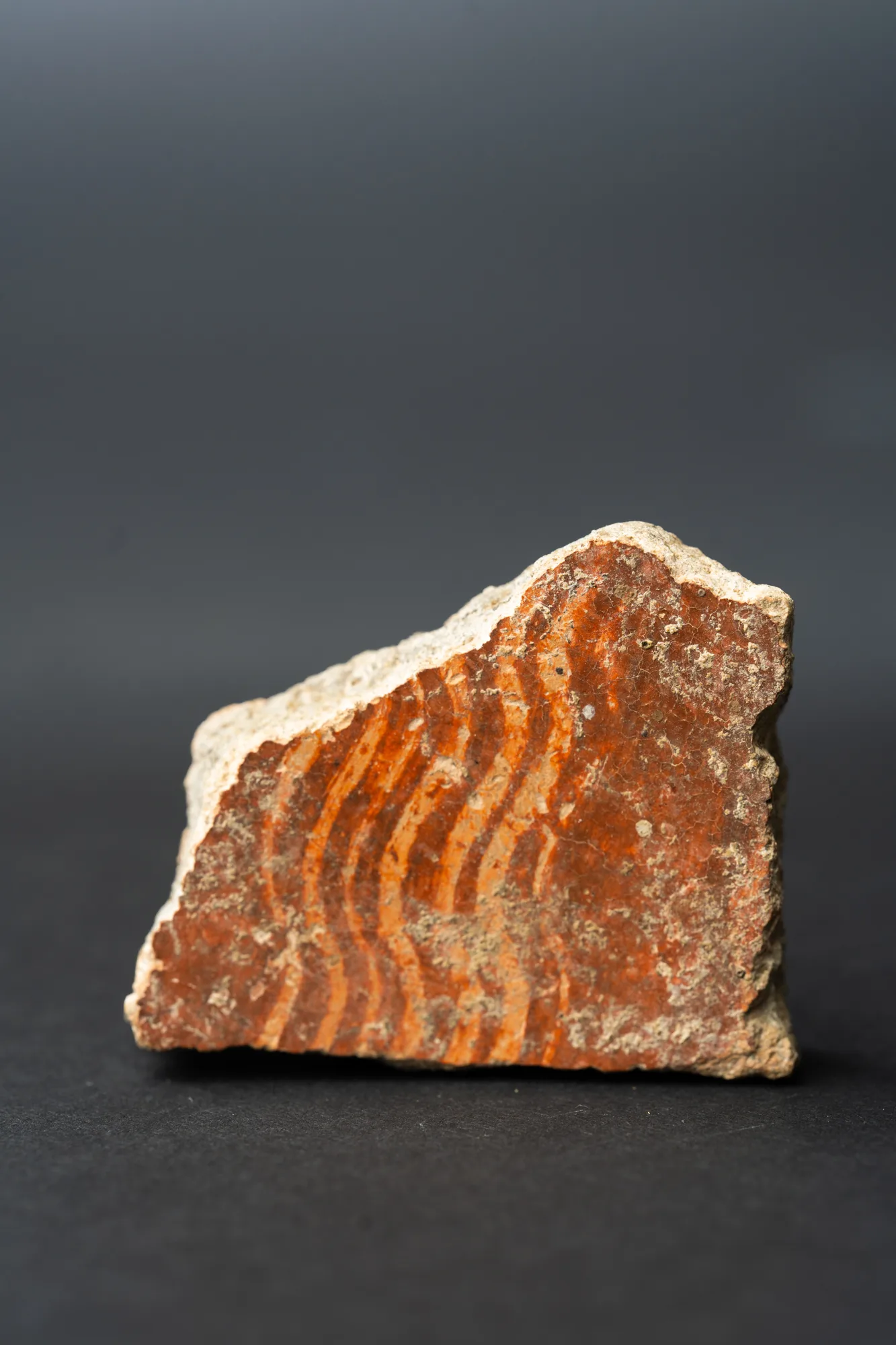
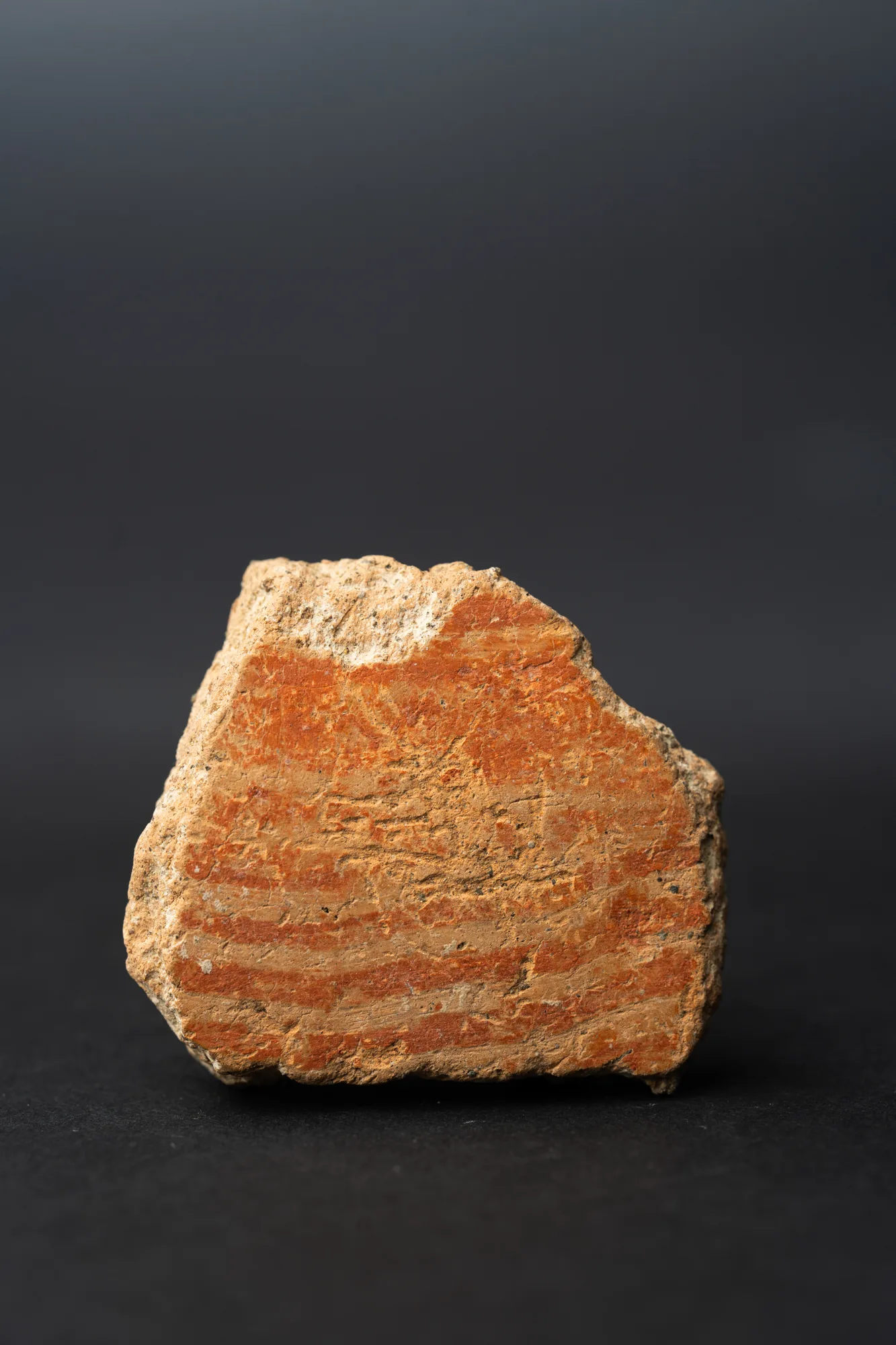
The catalogue's examples of this group all belong to the painted and combed traditions in between. Three bowl fragments in our own collection, a Combed ware fragment with parallel bands (shown at the head of this page), one with multiple wavy bands and one with oblique bands, show the red slip scraped back to a pale ground that marks the southern-central tradition of the Late Ceramic Neolithic [1]. The Hunterian Museum's group of nine fragments from Ayios Epiktitos-Vrysi, including a spout, painted with wavy lines and broad red bands on a cream ground, represents the northern painted tradition of the same period. The Cyprus Museum's Red-on-White building model from Kissonerga-Mosphilia is a Chalcolithic painted piece. None of the four wares described below is yet represented by a catalogued object.
Overview
| Ware | Period | Approximate date | Key sites |
|---|---|---|---|
| Dark-Faced Burnished ware | Early Ceramic Neolithic | c. 5200–4500 BCE | Dhali-Agridhi, Philia-Drakos A |
| Neolithic Monochrome ware | Ceramic Neolithic | c. 4800–4000 BCE | Philia-Drakos A, Kouklia-Vathyrkakas |
| Red Monochrome Painted ware | Middle Chalcolithic, continuing later | c. 3600–2500 BCE | Kissonerga-Mosphilia, Lemba-Lakkous, Erimi-Pamboula, Sotira-Kaminoudhia |
| Red-and-Black Stroke-Burnished ware | Late Chalcolithic | c. 2900–2400 BCE | Lemba-Lakkous, Kissonerga-Mosphilia, Chlorakas-Palloures |
All the dates in this table are approximate, and two of them are disputed. The start of the Ceramic Neolithic depends on how a handful of radiocarbon determinations are read: Boness, Clarke and Goren date the whole Ceramic Neolithic to 4400 to 3900/3700 cal BC [1], while John Coleman placed the hiatus between the Aceramic and the earliest Ceramic Neolithic at about 5600 to 4800 BC and the first pottery after it [2]. The end of the Chalcolithic is also set differently. Vassos Karageorghis put the end of Chalcolithic I at Erimi-Pamboula at about 2500 BC on Porphyrios Dikaios's radiocarbon dates [3], and the site's chronology page uses 2500 BCE; more recent work gives the Late Chalcolithic as c. 2900/2700 to 2400 BC [4]. The catalogue follows the later figure.
The naming is a problem in its own right. A discussion summary in the 1991 volume Cypriot Ceramics complained of a "breeding nomenclature for Chalcolithic monochromes (Red Slip, Red Lustrous, Red Monochrome, Red Monochrome Painted, Red Polished, etc.) which is no less than dizzying", and argued that "taxonomic splitting has served to underscore the divisions between wares while at the same time masking the palpable similarities between them". The proposed remedy was closer attention to vessel shape [5]. The names below are the ones in current use, with their older equivalents.
Dark-Faced Burnished ware
Dark-Faced Burnished ware (DFBW) is the earliest pottery so far known in Cyprus. It is a plain monochrome ware with a dark, burnished surface, and it has been recognised at only a few sites, chiefly Dhali-Agridhi in the Yialias valley and Philia-Drakos A, where it lay stratigraphically below pottery with painted patterns [2]. Lindy Steel describes it as an "ephemeral phase", identified by Watkins at Philia-Drakos and also at Dhali-Agridhi, that came before the main Ceramic Neolithic [6]. Coleman, following Watkins, thought the phase was "probably fairly short" [2].
The name was borrowed from the mainland. Lehavy, publishing the Dhali-Agridhi pottery for the American Expedition to Idalion, called it Dark-Faced Burnished Ware "by analogy to the ware found in Syro-Cilicia" [7]. That analogy is about appearance. The Anatolian and Syrian dark-faced burnished wares are an older and separate tradition, and Coleman saw no need to derive the Cypriot pottery from Anatolia or from the Beersheba culture [2]. The Cypriot ware should be kept distinct from its namesake.
Dating rests on very few samples. Two radiocarbon determinations from Dhali-Agridhi gave 5810 to 4765 BC (GX-2847A) and 4885 to 4405 BC (P-2769); Coleman thought the earlier one should carry little weight. At Philia-Drakos A the ware was followed almost at once by Late Neolithic painted wares that "probably do not date before ca. 4450 B.C." [2]. Karageorghis cited a Dhali-Agridhi date of 4465 ± 310 (c. 5310 BC) for pottery comparable to the earliest at Philia-Drakos A, and treated it with the caution "if the date is correct" [3]. The Idalion excavators recorded a real disagreement over what the site meant. Stanley Price, from the continuous development from monochrome to painted pottery at Philia, concluded that "the monochrome ware at Philia is no earlier than the early fourth millennium"; Lehavy read the Dhali-Agridhi dates as showing two different occupations separated by at least a millennium [7]. A deposit at Kalavasos-Tenta was first reported with Dark-Faced Burnished sherds, but it is water-laid, and Coleman judged its radiocarbon date (P-2780, 4975 to 4550 BC) unreliable and the pottery probably late in the Ceramic Neolithic [2].
Coleman reported the view of Watkins and Edgar Peltenburg that the decorated pottery of the Ceramic Neolithic was a development of Dark-Faced Burnished ware [2]. The ware is therefore the starting point for both the painted Red-on-White of the north and the Combed ware of the south. You can see all Dark-Faced Burnished ware in the catalogue.
Neolithic Monochrome ware
Later studies describe the first Cypriot pottery in different terms. Boness, Clarke and Goren call the earliest assemblage "Coarse Ware" and "Monochrome Burnished Ware" (MBW), following Joanne Clarke, Peltenburg and Watkins. In their account the initial phase lasted about two hundred years and showed no regional variation; afterwards Monochrome Burnished Ware gradually declined and painted wares replaced it, while Coarse Ware continued throughout the Ceramic Neolithic [1]. Their petrographic study of 88 vessels from seven sites found every one locally made, with "a clear distinction between the production technologies of coarse ware and painted ware" [1].
How far Monochrome Burnished Ware and Dark-Faced Burnished ware are the same thing is not settled in print. Both names describe the earliest burnished, one-colour pottery at Philia-Drakos A, and a contributor to the 1991 Cypriot Ceramics volume noted that the earliest Philia phase "has similar monochrome burnished pottery" to Dhali-Agridhi [5]. The difference between the terms is one of emphasis: one stresses the dark surface, the other the burnishing and the single colour. The catalogue keeps them as two entries because both names occur in museum records, and Neolithic Monochrome ware is the later and broader of the two. Watkins also recorded red painted decoration on monochrome burnished pottery early in the Philia sequence [1], so the boundary between monochrome and painted pottery was never sharp.
Monochrome red survived in the south after the burnished phase. In the southern-central region most painted pottery of the Late Ceramic Neolithic was "decorated in monochrome red, or in monochrome red which was then combed" [1], which is the Combed ware represented by the fragments in our own collection. The north, west and east painted mostly in Red-on-White [1]. Steel follows the view that these were regional differences within one period, and that Sotira-Teppes in the south and Vrysi in the north were contemporary [6].
The Ashmolean Museum holds sherds of this early material: a fragment of Monochrome Burnished ware from Kouklia-Vathyrkakas (AN1953.1245.e), presented by H. W. Catling in 1953, and a body fragment of a dark burnished vessel from Ayios Epiktitos-Vrysi (AN1974.214), presented by Peltenburg in 1974. You can see all Neolithic Monochrome ware in the catalogue.
Red Monochrome Painted ware
Red Monochrome Painted ware (RMP) belongs to the painted Chalcolithic, alongside Red-on-White. At Sotira-Kaminoudhia its fabric, dark red to red (2.5YR 3/6 to 6/8), is identical to the fabric used for Red-on-White. The surface carries a thin, lustrous reddish slip, often with brush or cloth marks visible, laid over an orange or cream underslip that is thinner than the slip of Red-on-White [5]. It was made in the same range of shapes as Red-on-White [5]. At Lemba-Lakkous the ware differs: it lacks the buff slip, and the paint was applied directly to the wet, smoothed, burnished or self-slipped surface [5].
The name is a relabelling. Sherds from Erimi-Pamboula that Dikaios (1936) and later Heywood and colleagues (1981) called "Red Slip" are identical in fabric and surface treatment to the Red Monochrome Painted ware of Sotira-Kaminoudhia [5]. In the west the class was defined in the 1980s, when Peltenburg, Bolger and their colleagues listed it among a range of Chalcolithic monochromes: Glossy Burnished, Red Monochrome Painted, Black Topped, Coarse Painted Monochrome, Spalled, Red Lustrous, and Red and Black Stroke Burnished [8].
Its date is earlier than the catalogue's present range of c. 3000 to 2500 BCE suggests. Karageorghis described Red Monochrome Painted and Red-on-White pottery at Kissonerga-Mosphilia with bold patterns such as multiple festoons on hemispherical bowls [3], material of the Middle Chalcolithic, which Hadjigavriel dates c. 3600/3400 to 2900/2700 BC [4]. Peltenburg stated that of the western monochromes "only RB/B is exclusive to the LChal", which leaves Red Monochrome Painted as a ware that began before the Late Chalcolithic and continued into it [8]. A working range of c. 3600 to 2500 BCE fits these statements better than the catalogue's figures.
No museum record yet identifies a published object as Red Monochrome Painted. The Ashmolean has red burnished Chalcolithic sherds from Erimi (AN1935.705.l) and Kissonerga-Mylouthkia (AN1978.41.c), but their labels do not name the ware. You can see all Red Monochrome Painted ware in the catalogue.
Red-and-Black Stroke-Burnished ware
Red-and-Black Stroke-Burnished ware (RB/B, also called Red and Black Stroke Burnished or, in Dikaios's older terms, Red and Black Lustrous) is the signature ware of the Late Chalcolithic. At Sotira-Kaminoudhia it has "a distinctive brick-red fabric (10R 5/8) with blue/gray (limestone) grit temper", immediately distinguishable from every other fabric on the site. The mottled brick-red surface (2.5YR 5/8 to 6/8) is wet-smoothed or, more rarely, self-slipped, and burnish marks are sometimes visible; both bowls and closed shapes occur [5].
Peltenburg described a shared Late Chalcolithic repertoire behind the ware names. Potters in east and west made the same shapes and showed "identical preferences for low relief modeling", a "deliberate interplay of red and black surface treatments and increasingly thin walls". Fine small bowls with slightly everted rims and convex or broad flat bases are common, pithoi appear in the same family, and relief decoration becomes more popular: pairs of vertical bars below bowl rims at Lemba and Kalavasos, and circular bosses in the west and at Ambelikou and Kalavasos-Pamboules [8]. He placed the ware at the centre of that family: RB/B "is exclusive to the LChal" and is the only western monochrome with "a broad spectrum of forms in common with eastern sites" [8].
The fabric points to the Paphos District. Preliminary thin-section work suggested that RB/B was likely made from Mavrokolymbos or Marathounda resources, and its rarity outside the district, at Sotira-Kaminoudhia, perhaps Erimi-Pamboula, and Kalavasos-Archangelos and -Pamboules, suggested to Peltenburg "copies or regional exports" [8]. The mid-third-millennium date of the family "is fixed only in the west" [8]. Maria Hadjigavriel has since compared the RB/B of three neighbouring sites in the Ktima lowlands, Lemba-Lakkous, Kissonerga-Mosphilia and Chlorakas-Palloures, to trace how potting knowledge passed between them [4]. A follow-up study with Maria Dikomitou Eliadou applied petrography and handheld X-ray fluorescence to Red and Black Stroke-Burnished, Red Monochrome, Spalled, Red (and Black) Lustrous and coarse wares from Chlorakas-Palloures, Kissonerga-Mosphilia, Ambelikou-Agios Georghios and Politiko-Kokkinorotsos [9]. They describe the Late Chalcolithic as "a shift towards the production of monochrome wares", locally produced across the island, with "red-slipped and burnished surfaces and/or blackened surfaces, occasionally featuring relief decoration", and note that wares from different sites correlate "primarily in terms of surface treatment and general shape repertoire" [9].
The ware sits at the boundary with the Bronze Age, which is why its classification has mattered. Dikaios named the monochrome pottery of Ambelikou "Red Lustrous" and "Red-and-Black Lustrous" and assigned it to a later Chalcolithic phase around 2500 BC [3]. Stanley Price grouped Red Lustrous with Red Polished; Peltenburg rejected this, arguing that "clearly discordant morphologies" should not be lumped together. His re-examination of the Ambelikou pottery in the Cyprus Museum found no sherd identified as Red Polished (Philia) that "withstands close scrutiny", and he concluded that Ambelikou-Ayios Georghios belongs "exclusively to the Late Erimi cultural tradition" [8]. The question of where the Chalcolithic monochromes end and Red Polished begins is still argued over.
The Ashmolean holds a red burnished sherd from Kissonerga-Mylouthkia (AN1978.41.b), labelled Late Chalcolithic and presented by Peltenburg in 1978; the label does not name it as RB/B. You can see all Red-and-Black Stroke-Burnished ware in the catalogue.
After the Chalcolithic
The four wares on this page mark the two ends of Cypriot pottery before the Bronze Age: a short-lived dark burnished ware at the beginning, and a regional family of red and black burnished wares at the end, with the painted Red-on-White and Combed traditions in between. Much of the classification still rests on a few stratified sites in the Paphos District and on small, often unpublished sherd groups elsewhere, and the names reflect that. For the techniques behind these pots, see The Making of Ancient Cypriot Pottery; for the burials in which some of them were placed, see Neolithic and Chalcolithic burial. The work of Diane Bolger and Jennifer Webb on Chalcolithic terminology, cited by all the recent studies above [9], and the Philia-phase pages on Red Polished (Philia) ware continue the story into the Early Bronze Age.
Objects on this page
 Combed Ware Bowl Fragment with Parallel BandsNeolithic · 4500–3900 BC
- Combed Ware Bowl Fragment with Multiple Wavy BandsNeolithic · 4500–3900 BC
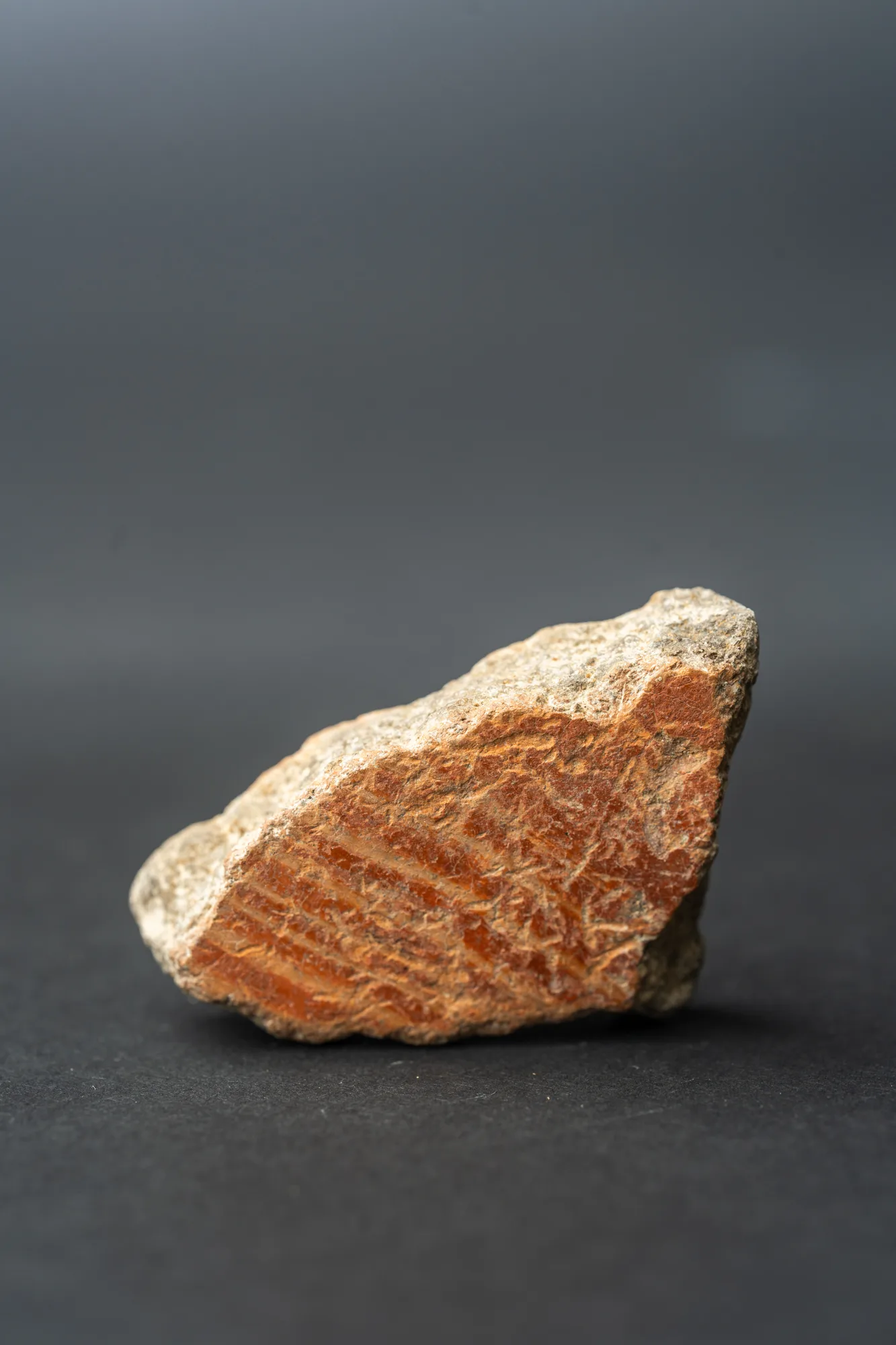 Combed Ware Bowl Fragment with Oblique BandsNeolithic · 4500–3900 BC
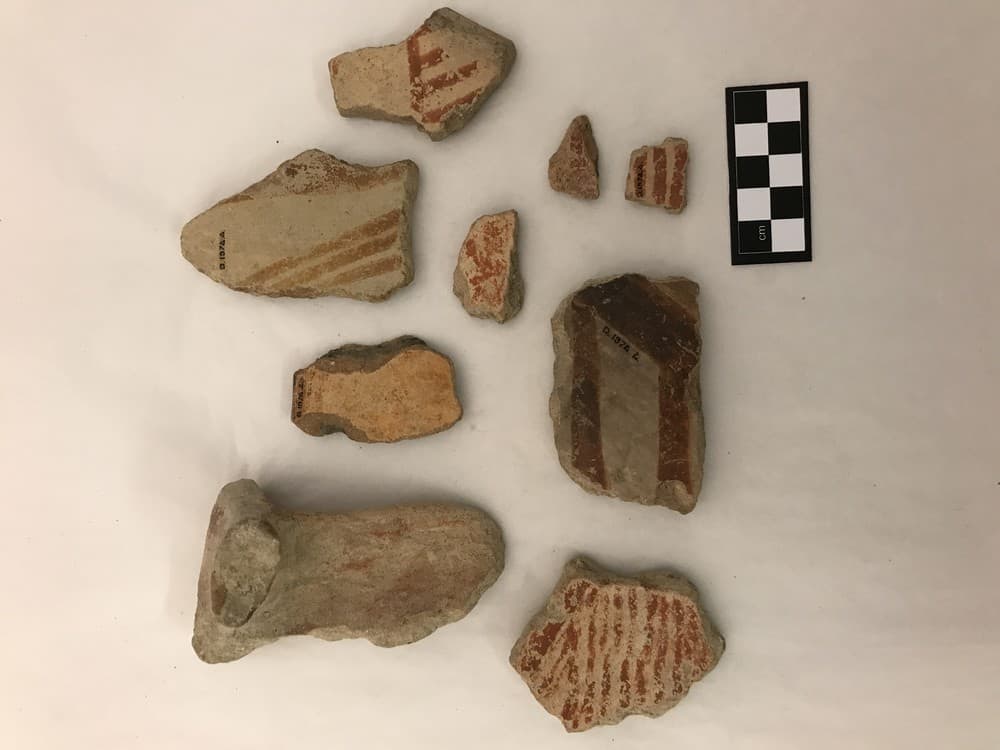 vesselNeolithic · 5500–4000 BC
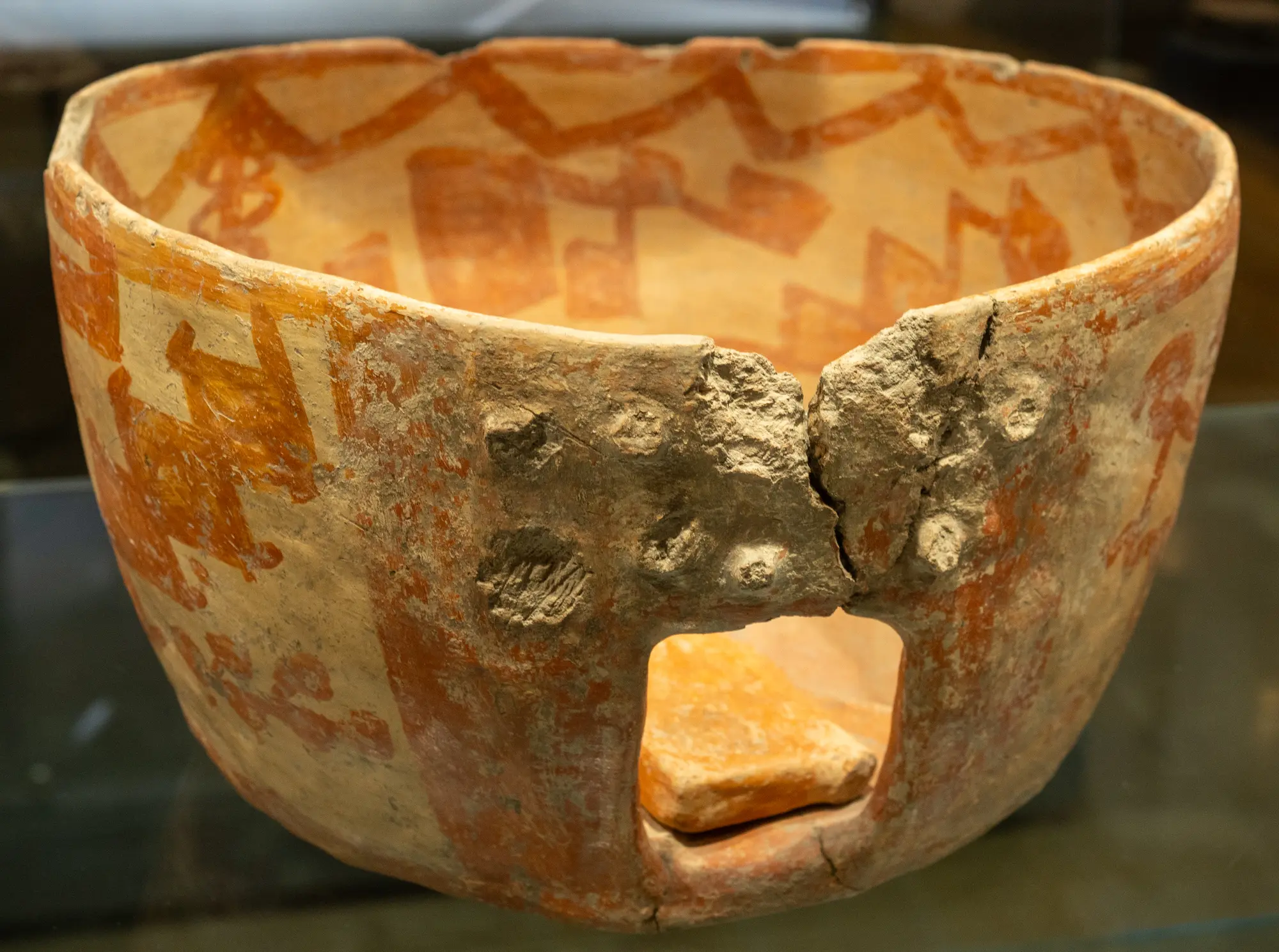 Chalcolithic Red-on-White Building ModelChalcolithic · 4000–2400 BC
In the catalogue
References
- 1.Boness, D., Clarke, J., & Goren, Y. (2015). Ceramic Neolithic pottery in Cyprus: Origin, technology and possible implications for social structure and identity. Levant, 47(3), 233–254.
- 2.Coleman, J. E. (1992). Greece, the Aegean, and Cyprus. In R. W. Ehrich (Ed.), Chronologies in Old World archaeology (3rd ed.). University of Chicago Press.
- 3.Karageorghis, V. (1982). Cyprus from the Stone Age to the Romans (Ancient Peoples and Places 101). Thames and Hudson.
- 4.Hadjigavriel, M. (2020). A tale of red and black: Reconstructing transfer of knowledge in Late Chalcolithic Cyprus. Archaeological Review from Cambridge, 35(2), 81–86.
- 5.Barlow, J. A., Bolger, D. L., & Kling, B. (Eds.). (1991). Cypriot ceramics: Reading the prehistoric record (University Museum Monograph 74). University Museum, University of Pennsylvania.
- 6.Steel, L. (2004). Cyprus before history: From the earliest settlers to the end of the Bronze Age. Duckworth.
- 7.Stager, L. E., & Walker, A. (Eds.). (1989). American expedition to Idalion, Cyprus 1973–1980 (Oriental Institute Communications 24). Oriental Institute of the University of Chicago.
- 8.Peltenburg, E. (1991). Toward a definition of the Late Chalcolithic in Cyprus: The monochrome pottery debate. In J. A. Barlow, D. L. Bolger, & B. Kling (Eds.), Cypriot ceramics: Reading the prehistoric record (University Museum Monograph 74). University Museum, University of Pennsylvania.
- 9.Hadjigavriel, M., & Dikomitou Eliadou, M. (2025). Tracing traditions: An analytical study of Late Chalcolithic ceramics from Cyprus. Journal of Archaeological Science: Reports.