
Contents
Sgraffito is the name for pottery decorated by scratching a design through a pale slip so that the darker clay beneath shows through, then sealing the surface under a glaze. In medieval Cyprus it became the everyday fine tableware: small bowls and footed cups made in workshops at Paphos, Enkomi, Lapithos and Nicosia from the early 13th century until the 16th, under Frankish (Lusignan) and then Venetian rule. On this site the ware is the main medieval entry among the pottery types, and you can see all medieval glazed sgraffito in the catalogue. The catalogue term spans 1100 to 1600 so that it can hold earlier imported pieces and loosely dated museum objects; the Cypriot workshops themselves start in the 13th century.
Identification and technique
The recipe is simple to describe. A red-firing clay vessel is coated with white slip; the decorator scratches the design through the slip with a sharp point; a light glaze goes over the whole. After firing, the glaze lying in the incised lines reads dark, while over the slip it stays pale [1]. The name comes from the Italian verb sgraffiare, to scratch or engrave [3, p. 7].
Cypriot potters added colour. After a first firing, copper oxide and iron oxide were splashed in turn over the engraved surface and the pot was fired a second time. Copper gives green, iron a warm brownish yellow, and the finished glaze is shiny, transparent and impermeable [2, p. 42]. The vessels were wheel-made and stacked in the kiln on three-legged clay stilts, which left three small scars in the floor of each bowl. Those stilt marks, together with kiln wasters, are the proof used to locate the workshops [2, pp. 41–42].
In excavated assemblages the Cypriot product is recognised by its shapes as much as by its decoration. By the 13th century small sgraffito bowls with relatively high ring feet and carinated sides had become the dominant fine ware on the island, and the incised designs were often picked out with a darker glaze [1]. A study of the glazed pottery from Polis Chrysochous calls sgraffito the most common type of medieval glazed ware found on Cyprus [3, p. 7].
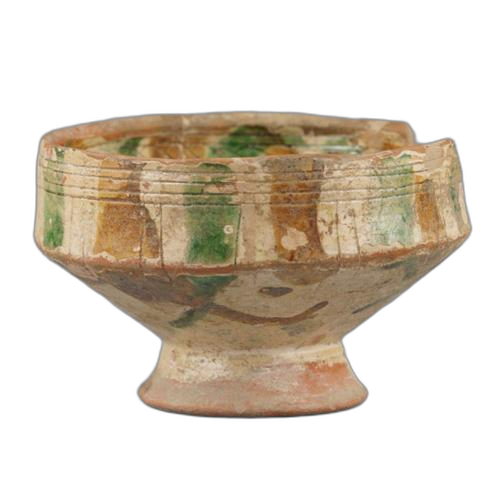
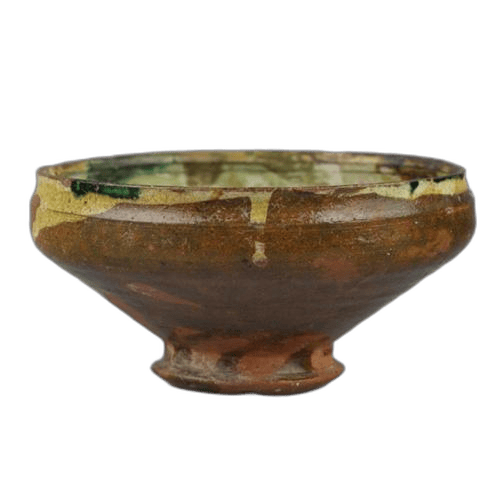
The bowl above, in the Royal Ontario Museum, shows the standard make-up: wheel-thrown earthenware, incised after slipping and lead-glazed, 14.8 cm across, with a male figure on the interior. The museum attributes it to Cyprus and dates it to 1375–1400 (Sgraffito bowl with figure of a man).
Origins and the 13th-century start
Sgraffito did not begin in Cyprus. The technique seems to have originated in the Near East, became one of the major types of Byzantine pottery in the Aegean, and was imitated in the Levant and in Italy [1]. Imported sgraffito reached the island first. Zeuxippos Ware, a hard, shiny, usually yellow-glazed sgraffito on bright reddish-orange clay, is dated mainly to the early 13th century, with manufacture continuing until nearly 1300 [1]. A broadly incised class, Incised-Sgraffito Ware, was first identified by A. H. S. Megaw in 1975 in the finds from Saranda Kolones, the castle at Paphos, and dated to the 13th century [3, p. 7].
Local glazed production followed. The archaeological evidence places its start in the early to middle 13th century [3, p. 7]. Demetra Papanikola-Bakirtzi links the appearance of island workshops to the period after the Frankish conquest of 1204 in the Aegean, when centrifugal forces pulled the Byzantine world apart; Cyprus itself had been outside the Byzantine empire since 1191 [2, p. 44].
Subgroups and chronology
Papanikola-Bakirtzi classifies Cypriot sgraffito by the width of the incised line and by the use of colour [2, p. 42]. Her scheme, set out fully in her 1996 study of the Paphos and Lapithos workshops, is the framework most specialists still use [4, p. 93].
| Group | Incision | Colour | Date (AD) |
|---|---|---|---|
| Plain Incised-sgraffito | Broad | Monochrome glaze | Early 13th century |
| One-colour Incised-sgraffito | Broad | One colour | First half 13th century |
| Brown and Green Incised-sgraffito | Medium | Green and brown brushstrokes | Late 13th to early 14th century |
| Brown and Green Sgraffito | Fine | Green and brown | Late 13th to 16th century |
| Green-painted Sgraffito | Fine | Green strokes tracing the main lines | Late 15th to early 16th century |
The early Plain Incised group carries human, animal, bird, plant and geometric motifs [2, p. 42]. Brown and Green Sgraffito, finer in line and mostly geometric or vegetal with fewer figures, is the largest group of Cypriot medieval pottery [2, p. 43]. It is also the most widely distributed Cypriot glazed ware inside and outside the island; it was made until the 14th century at Paphos and Enkomi and until the 16th at Lapithos [3, p. 7]. Green-painted Sgraffito belongs to the Venetian period, and its commonest motif is a curved-sided lozenge enclosing a medallion [2, p. 43]. Two sister groups use no incision at all: Slip-painted ware [2, p. 43] and the 16th-century Green-painted ware associated with Lapithos [3, p. 7].
An older scheme survives in excavation reports. Joan du Plat Taylor and Megaw published twelve groups in the late 1930s, running from Plain Sgraffito (Group I) to Imported Wares (Group XII), and survey teams still print concordances between the two systems [4, p. 93].
Workshops
Four production centres are attested by wasters, stilts and unfinished pots.
In the Paphos district, workshops at Kato Paphos, at Lemba and probably at Kouklia used a hard, coarse, greyish or blackened clay and gave their bowls a low, splayed, often upturned ring foot. They made Slip-painted ware and all the early incised groups as well as Brown and Green Sgraffito. Thirteenth-century shapes are deep carinated bowls and deep dishes with a horizontal rim; in the 14th century an angular bowl with flaring walls and an upright rim appears. The potters also threw lamps. The workshops ran through the 13th and 14th centuries [2, pp. 44–45].
Near Famagusta, the Enkomi workshop used a pale whitish-pink sandy clay, favoured human figures, and was active in the 14th century [2, p. 45]. The Prastio-Agios Savvas excavators allowed a later date, possibly the 15th and 16th centuries, for what they called Enkomi ware [1]; the dating of this centre is not settled.
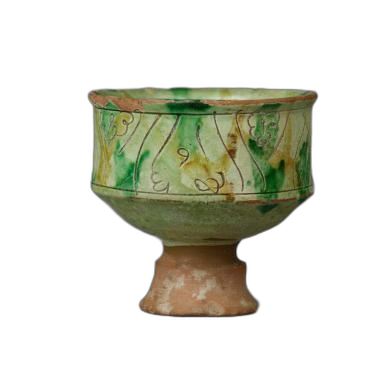
On the north coast near Kyrenia, the potters of Lapithos used a fine, pale reddish fabric for slender shapes: bowls on high feet with tall upright rims, goblets on high stepped feet, and fewer dishes. Most of its output is Brown and Green Sgraffito, decorated over the whole surface inside and out with vegetal and geometric designs, stylised human figures and birds. Wasters, many tripod stilts and vessels fused together in the kiln have come from rescue excavation and survey there. Hemispherical bowls in Green-painted Sgraffito and Green-painted ware, with simplified motifs, close the sequence [2, pp. 45–46]. The goblet with a tall hollow stem is a characteristic 15th- or 16th-century shape [5, p. 342].
In Nicosia, tripod stilts and wasters show that sgraffito was also made in the capital. The products resemble Lapithos Brown and Green Sgraffito so closely that Papanikola-Bakirtzi asks whether Lapithos potters settled in Nicosia [2, p. 46].
Motifs and use
The figured pieces are the best known. Painters drew dancers and musicians, among them a pair of women dancing face to face, scenes of feasting, armoured knights with shields and spears who reflect the Frankish ruling class, and a falconer that matches travellers' accounts of elite hunting on the island. Birds, plants and geometric designs make up the rest of the repertoire [2, p. 46]. The Leventis Municipal Museum arranges its collection by motif: people, coats of arms, birds and fish, plants and flowers, geometric, and plain [4, p. 93]. For the plant designs see also plant motifs.
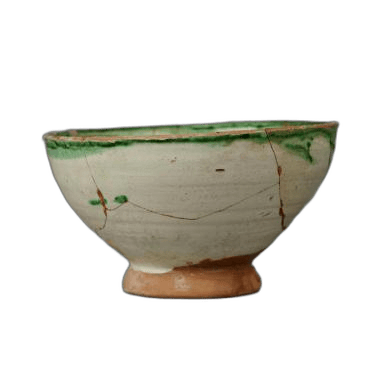
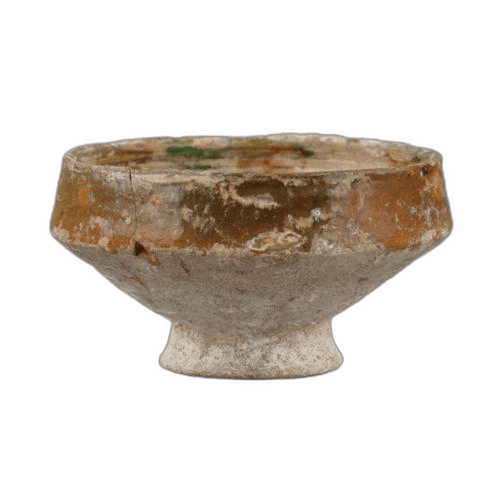
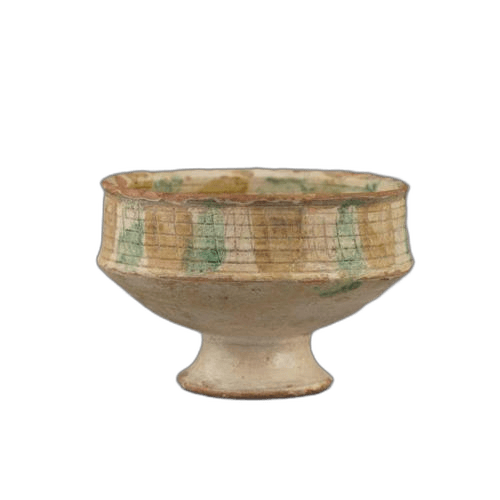
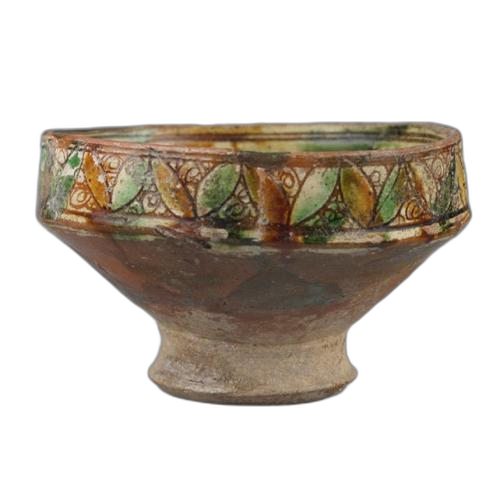
Three more Royal Ontario Museum pieces in the Ontario collection show the range. A footed cup with a human head in profile, 14.3 cm across and dated by the museum to 1475–1525, is attributed only to "Mediterranean, probably Cyprus". A bowl with a multi-petalled rosette, a gift of the Dowager Lady Loch, is dated to the 13th century. A pedestal cup with leaves and wavy lines is labelled "Lapithos workshop" but dated 1200–1300, earlier than the published Lapithos sequence; either the attribution or the date needs revisiting. Workshop attributions on old museum pieces like these rarely rest on a recorded findspot.
These were domestic tablewares, mostly bowls and cups, yet many survive whole because they were buried. There was a custom of setting a glazed bowl beside the dead, and graves around the churches of Katholiki and Ayios Nikolaos at Kouklia yielded near-complete glazed vessels [5, p. 342].
Dating problems
The chronology rests on a weak base. Much of the classic material consists of museum and private-collection pots from robbed tombs with no context, which the Troodos survey team calls "a rather slim base for absolute chronology", and dates have often been tied anecdotally to political events [4, p. 93]. Marie-Louise von Wartburg warned in 2007 that separating Paphos ware and Lapithos ware chronologically on style alone is "an operation full of pitfalls", and urged testing the standard sequence (Paphos first in the 13th century, Lapithos from before the end of the 14th) against stratified excavation [4, p. 93]. The Polis study is one answer: it began from a domestic building with context and characterised its bodies, slips and glazes scientifically, finding Paphos and Lapithos tableware side by side with imports [3].
The same weakness affects collecting. Pots without a findspot cannot help with dating, and the trade in such material raises the issues discussed under collecting Cypriot antiquities today.
Where to see it
The Leventis Municipal Museum in Nicosia holds one of the strongest collections of Cypriot sgraffito, published as Colours of Medieval Cyprus [2]. The Ashmolean Museum in Oxford has several complete Lusignan-period bowls, among them a sgraffito bowl purchased in 1965 (AN1965.735, 14.2 cm across), a bowl given by Gerald Reitlinger in 1978 (AN1978.738), and a group of sherds purchased in 1970 (AN1970.967). The Royal Ontario Museum pieces are listed above. For the ware's place in the long history of Cypriot pottery, the Roman period entry is the latest chronology page on the site.
Objects on this page
In the catalogue
References
- 1.Rupp, D. W., Fox, S. C., Herscher, E., McClellan, M. C., Clarke, J. T., D'Annibale, C., Gregory, T. E., & Critchley, J. (1999). Prastio: Agios Savvas tis Karonis Monastery (Pafos District, Cyprus): 1994–1995 field season and 1992–1995 artifact analyses. Bulletin of the American Schools of Oriental Research, 316, 23–88. https://doi.org/10.2307/1357500
- 2.Papanikola-Bakirtzi, D., et al. (2004). Colours of medieval Cyprus: Through the medieval ceramic collection of the Leventis Municipal Museum of Nicosia. Nicosia: Leventis Municipal Museum.
- 3.Kelepeshi, C., & Živković, J. (2023). Reassembling the pieces, reassessing the picture: An analytical study of medieval pottery (mid. twelfth–sixteenth c.) from Polis Chrysochous, Cyprus. Archaeological and Anthropological Sciences. https://doi.org/10.1007/s12520-023-01909-y
- 4.Given, M., Knapp, A. B., et al. (2013). Landscape and interaction: The Troodos Archaeological and Environmental Survey Project, Cyprus. Volume 1: Methodology, analysis and interpretation.
- 5.Maier, F. G., & Karageorghis, V. (1984). Paphos: History and archaeology. Nicosia: A. G. Leventis Foundation.