
Research·News
Famagusta's Lusignan walls have lost far more stone to sea salt than its Venetian walls, study finds
A French team finds the same limestone in both phases of Famagusta's walls and credits the Venetians' thicker, earth-backed walls and broad mortar joints for their slower decay.



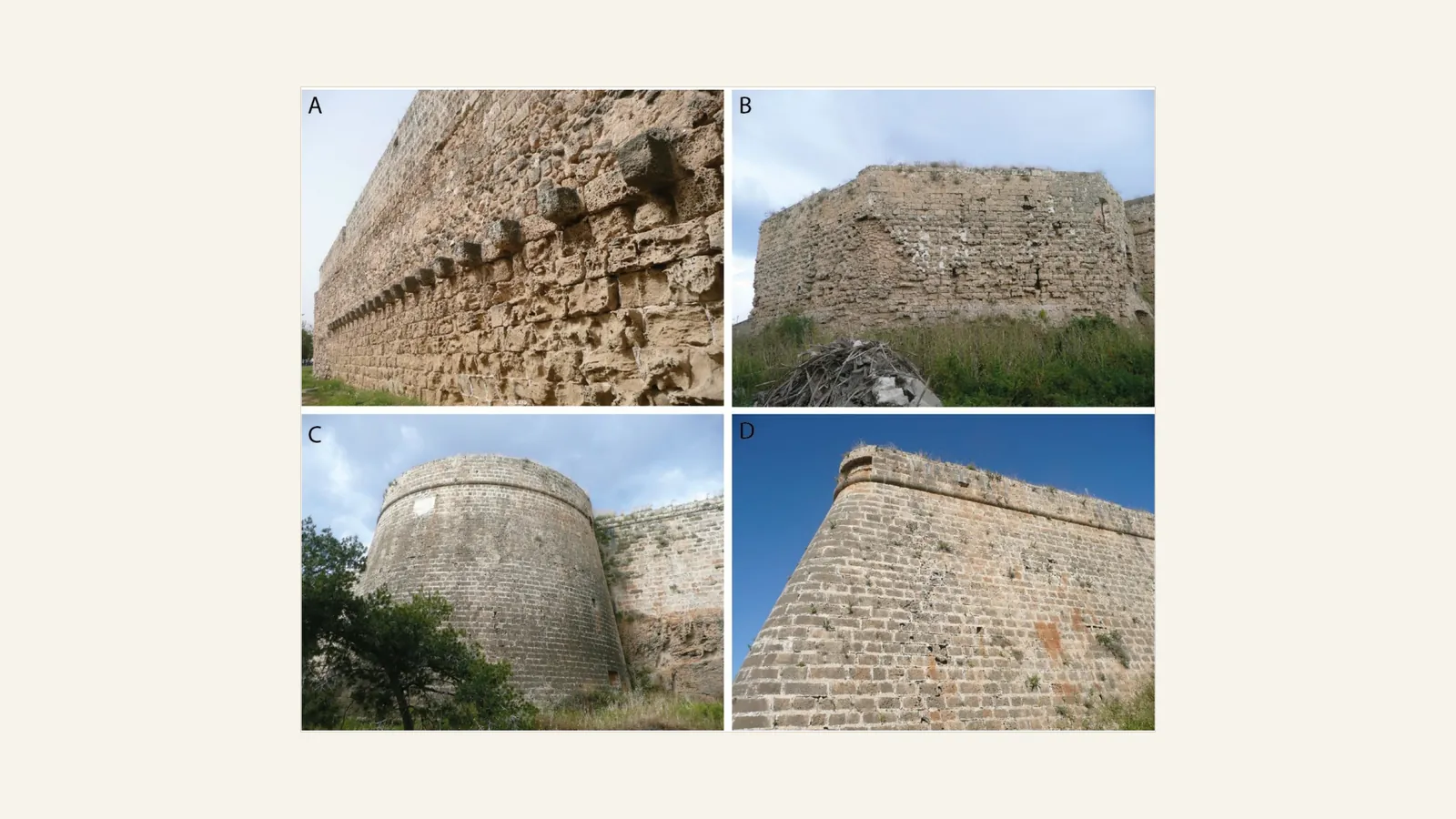
The limestone walls that the Lusignan kings built round Famagusta (Ammochostos in Greek; Gazimağusa in Turkish) around 1300 have weathered far more deeply than the Venetian masonry added two centuries later, although both were cut from the same rock and stand in the same salty sea air. That is the finding of a French team from the Université Clermont Auvergne and the Université de Reims Champagne-Ardenne, with Franck Vautier as first author, in a paper in Geomorphology (volume 512, 2026), which is open access.
Famagusta has been in the part of Cyprus illegally occupied by Turkey since the 1974 invasion.
The authors attribute the slower decay of the Venetian work to the way the Venetians rebuilt the defences: thicker walls backed with earth, wide mortar joints and a broader ditch, which changed how moisture and salt move through the masonry.
Two building campaigns, one circuit
The walls run for about 3 km round the old city, with fourteen towers and bastions and the citadel known as Othello's Castle. They stand up to 14 m high and up to 7 m thick, and most of the stone was quarried from the ditch that surrounds them. Drawing on Nicolas Faucherre's 2006 map of the medieval and Venetian masonry, the paper dates the first large campaign to 1291–1310, under Henri II and Amaury de Lusignan: curtain walls topped with crenellations and carried walkways on corbels, broken at intervals by octagonal towers.
Venice took over Cyprus in 1489 and refurbished the defences in two main episodes, the paper says. In the 1490s and 1500s the curtain walls were raised and round towers built or reshaped; in the 1540s to 1560s the ditch was widened on its outer side and raised artillery platforms were added, together with the arrowhead-shaped Martinengo Bastion, which the paper dates to 1562. Travellers who came in the sixteenth century, among them Jacques Le Saige in 1518 and the Englishman John Locke in 1553, remarked on how thick the walls had become; the authors connect this with the earth ramparts, or terrepleins, heaped up behind the Venetian masonry.
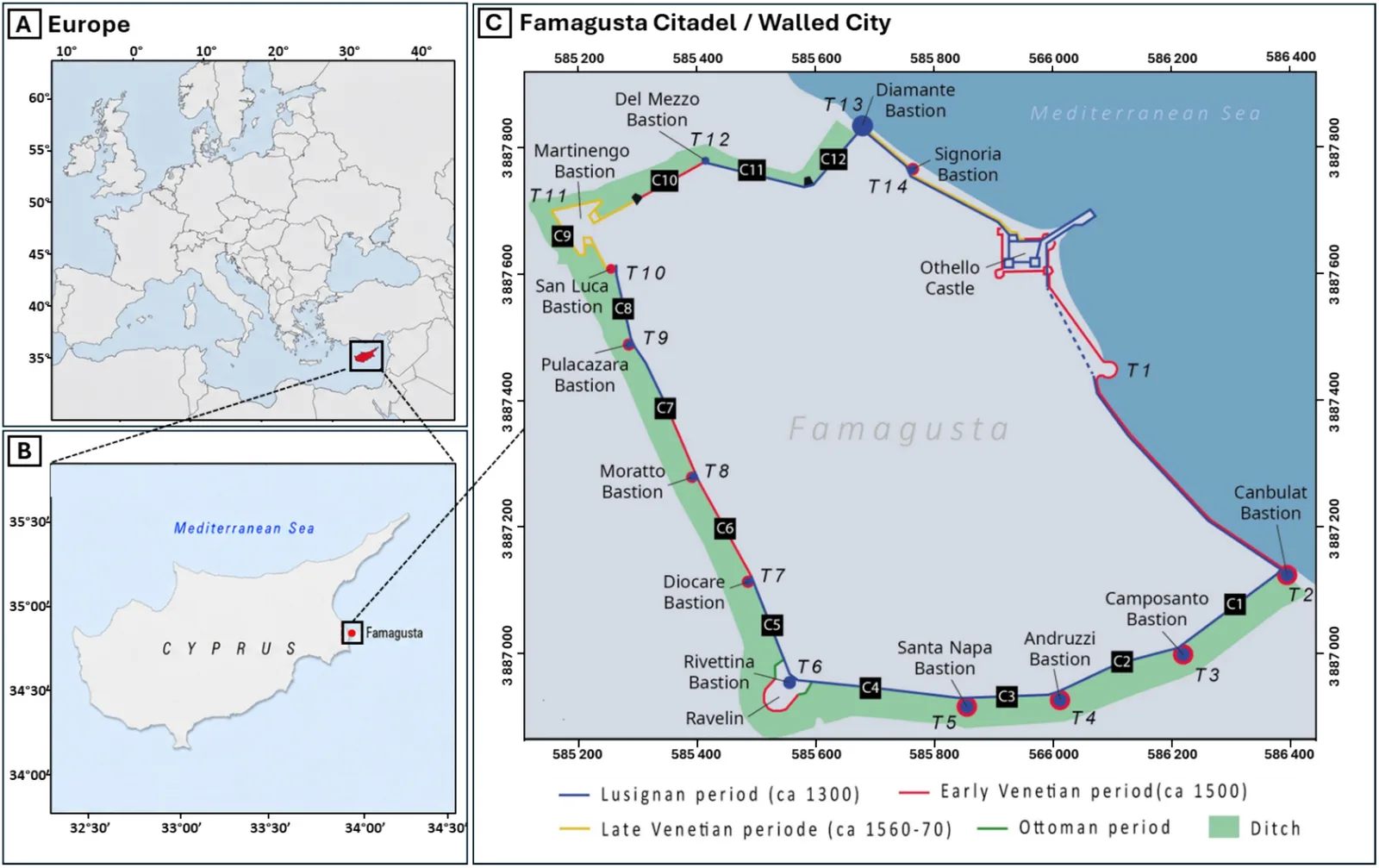
The walls then faced the Ottoman siege of 1570–1571. Written accounts collected by the team suggest the fortifications came through it largely intact: the churches inside the walls were badly damaged, but the Venetian surrender is put down mainly to a lack of food and ammunition, and Ottoman work on the walls seems to have been limited to filling cracks and mending parapets. Under British rule, between 1950 and 1955, Theophilus Mogabgab cleared the Ravelin's underground gallery and the rock-cut ditch at the Land Gate for the Department of Antiquities.
Measuring seven centuries of decay
The team surveyed the walls in 2015. It built 3D models of the curtain walls and towers by Structure-from-Motion photogrammetry, which reconstructs surfaces from overlapping photographs, and compared each wall face with a reference surface interpolated from the parts of it that are still intact. The gap between the two gives the depth of stone lost. They also mapped every 0.5 by 0.5 m square of the curtain walls by building phase and condition, tested surface hardness and water absorption on the walls themselves, and analysed five fallen blocks in the laboratory for chemistry, texture and pore structure.
The lost depth varies strongly round the circuit. Sections nearest the sea and walls facing south are the most worn, with mean losses of up to about 60 mm in the worst 10 m stretches, while some landward walls show almost none. The salt comes from spray carried on the wind. Accounts written between 1573 and 1683 describe the main ditch as dry or holding fresh water; only the stretch beside the citadel was open to the sea, as writers of 1394 and 1573 record.
Phase by phase, the contrast holds almost everywhere. On the seaward curtain wall C1, 62.18% of the Lusignan surface is weathered against 12.26% of the Venetian; on most landward walls no weathered Venetian surface was found at all. Among the Venetian towers, T2, 35 m from the shore, has 25.37% of its stones weathered, and several towers more than about 370 m inland have none. At similar distances from the sea, the authors put the reduction from Lusignan to Venetian at roughly 5 to 37 times for the share of weathered surface and 3 to 8 times for the depth lost, figures they call indicative.
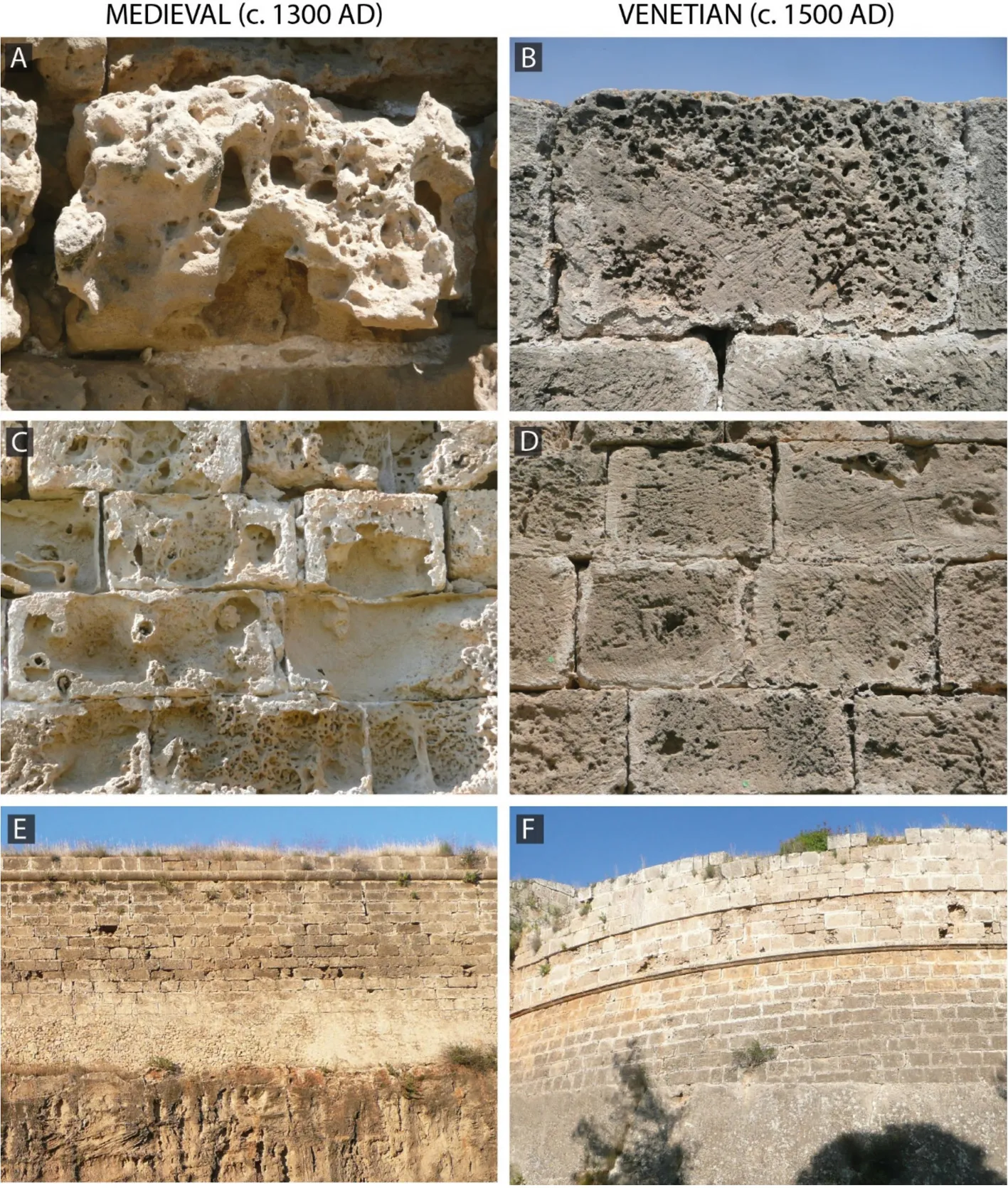
The Lusignan stone is pocked by alveolar weathering, the honeycomb of cavities that salt crystals carve in porous limestone, some of them tens of centimetres across. The worst damage lies under the corbelled walkways and staircases and just above the sloping base of several walls. The Venetian blocks are greyed by a film of microorganisms such as cyanobacteria, their cavities, where there are any, measured in millimetres or a centimetre or so, and many still carry mason's marks and the grooves of the toothed chisel.
The same stone, built differently
The authors set out to test the common assumption that a difference in decay between building phases means a difference in stone. The laboratory samples from both phases belong to the same limestone, with a grain of about 300 micrometres, and the field tests found sound Lusignan and sound Venetian stone as hard and as absorbent as the sound bedrock they were cut from. The same held for weathered stone of either date against weathered bedrock. On that evidence the team rules out the rock as the main cause.
They look instead at how the walls were built. The Lusignan ramparts average about 2 m thick, of small blocks set in mortar joints about 1 cm wide; the Venetian ones average about 6 m, of larger blocks in thick, smoothed joints about 10 cm wide, with earth ramparts behind them and a ditch 30–40 m wide in place of one of 15–20 m. In the authors' reading, the broad joints take up salt in place of the stone and close off the block edges, while the thicker, earth-backed walls change how water is stored inside the masonry and how it dries out. They describe this as a change in how the wall system responds to the same weather and spray.
The team adds its own caveats. Much Lusignan stone had already decayed by 1489: repairs with small stones, lime mortar and limewash are common at the foot of the medieval walls, and some cavities measured today were filled by the Venetians and have reopened since, so the Lusignan rates are apparent values. A wetter climate in Cyprus from about 1520, suggested by preliminary cave-deposit records, would not explain the better state of the Venetian stone, and the authors treat climate as at most a secondary factor.
Original sources
On ancientcyprus.com
- Excavations
- Famagusta: clearing the Ravelin and citadel
- Institutions
- Department of Antiquities of Cyprus
More in Research
- Network study of 299,171 km of Roman roads puts Byzantium and Antioch ahead of Rome
- University of Cyprus to lead €4.3m EU pottery network that will recruit 15 PhD researchers
- Pyla-Koutsopetria survey volume is a free download, hyperlinked to the finds data behind it
- Silver bowl from Amathus may carry the earliest known picture of a hoplite phalanx
- Athens' 200 triremes were built partly with timber from Cyprus, study says