
Events·Event
Nicosia conference on 6–7 November hears new work on Erimi, Ayia Irini and the "Achaeans"
The sixth "Ancient Cypriot Literature through the Centuries" conference meets at the Archbishop Makarios III Foundation, with papers from Chalcolithic Erimi to Byzantine Cyprus.


Conference
- When
- 6–7 November 2026 Tomorrow
- Where
- Ceremony Hall, Archbishop Makarios III Foundation, Nicosia
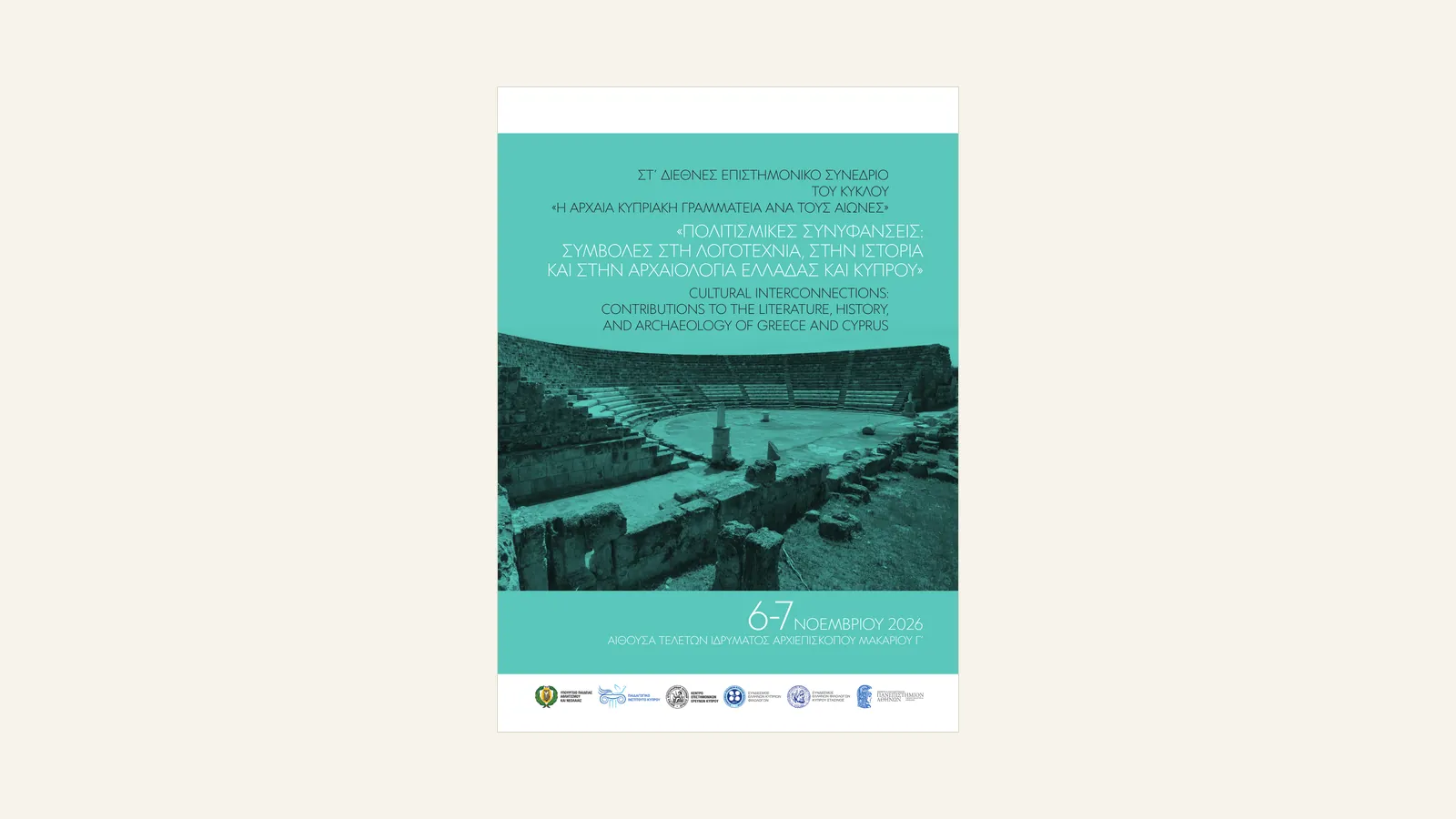
A two-day conference in Nicosia on Friday and Saturday, 6 and 7 November, sets new work on Chalcolithic Erimi, the sanctuary of Ayia Irini and the "Achaeans" of Cypriot tradition beside papers on Stoic philosophy and Byzantine letters. It is the sixth international meeting in the cycle "Ancient Cypriot Literature through the Centuries" (Η Αρχαία Κυπριακή Γραμματεία ανά τους αιώνες), and this year's theme is cultural interconnections between Greece and Cyprus in literature, history and archaeology. The Ministry of Education, Sport and Youth announced it on 4 November.
The sessions take place in the Ceremony Hall of the Archbishop Makarios III Foundation. On the ministry's side the organisers are its Directorate of Secondary General Education, the Cyprus Research Centre and the Cyprus Pedagogical Institute; they work with the Department of Philology of the National and Kapodistrian University of Athens and its Laboratory of Cypriot Studies, with the "Stasinos" association of Greek philologists of Cyprus, and with the Association of Greek Cypriot Philologists of the secondary teachers' union OELMEK. The ministry names secondary-school philology teachers, the island's universities, writers and researchers as the audience, and says the conference is also open to the general public.
Friday: from Erimi to Ayia Irini
Registration opens at 16:30. Dr Eirini Paraskeva-Rodosthenous, deputy director of the Cyprus Research Centre, welcomes the audience, and greetings follow from Archbishop Georgios of Cyprus, from the head of the Athens philology department, Theodora Antonopoulou, from Grammatiki Karla, who directs the Laboratory of Cypriot Studies, and from the Minister of Education, Dr Athena Michaelidou. Pupils of the Gymnasium Dianellou and Theodotou then perform a short play, "The bridal shoe".
The first session opens with a survey by Andreas I. Voskos, emeritus professor of ancient Greek philology at Athens, of the parallel histories of Greece and Cyprus through the centuries. The archaeology follows. Giorgos Vavouranakis, professor of Aegean prehistory, and Ioannis Voskos present a pendant from Erimi-Pamboula, which they set in the island's contacts with the Aegean early in the 3rd millennium BCE. Vavouranakis directs, with Voskos, the University of Athens excavation that reopened the Chalcolithic village at Erimi in July 2025. Its first season found parts of two buildings and picrolite ornaments, and the Department of Antiquities dates the settlement to c. 3500–2900 BCE; a second season followed in 2026.
The same pair, in reverse order, then take "'Achaeans' in Cyprus: myth and reality". Voskos has written on Aegean newcomers to the island before: with A. Bernard Knapp he published a paper in the American Journal of Archaeology in 2008 that read the material culture of 12th- and 11th-century BCE Cyprus as a mixing of Cypriot, Aegean and Levantine traditions, and rejected the idea of a Mycenaean colonisation.
The last paper of the evening, by the archaeologist Giorgos Bourogiannis, treats Cypriot sanctuaries of the 1st millennium BCE through the case of Ayia Irini. The area has been illegally occupied by Turkey since the 1974 invasion, and the sanctuary now lies in a military zone closed to fieldwork. The Swedish Cyprus Expedition dug it in the winter of 1929–30 and found almost 2,000 terracotta votives standing in a semicircle round a limestone altar. Since 2011 Bourogiannis has led a project at the Medelhavsmuseet in Stockholm on the sanctuary's unpublished pottery, more than 100,000 sherds. A discussion and a concert by the four-part mixed choir of the Athens Department of Music Studies, conducted by Nikos Maliaras, close the day.
Saturday: kings, philosophers and Byzantium
Beatrice Pestarino, a Leverhulme Early Career Fellow at the University of Liverpool, opens Saturday with a paper tracing Cyprus's part in the making of Hellenistic kingship, from qa-si-re-u to basileus. Athina Bazou, associate professor of ancient Greek philology at Athens, follows with Persaeus of Citium, the Stoic from Kition, in the new edition of the fragments of the early Stoics, and Aikaterini-Nina Karvouni, assistant professor in the same field, speaks on Antinoos and Cyprus. Michael Grünbart of the University of Münster presents a project on the history and culture of Byzantine Cyprus from 300 to 1200 CE.
After the break, Konstantinos Th. Raptis, assistant professor of Byzantine archaeology at Athens, and Dr Stella D. Vasileiadou of the Ephorate of Antiquities of Thessaloniki discuss the type, origin and distribution of the carved decoration and marble church furnishings of the Early Byzantine basilicas at Cape Drepanon. Three literary papers end the programme: Marina Loukaki on Nikolaos Mouzalon, a Constantinopolitan scholar who taught in the metropolis of Cyprus early in the 12th century; Charis Messis on Cyprus and its society in Byzantine literature of the 12th to 14th centuries; and Michalis Kalavros on the Mesolonghi of Petros Stylianou. Conclusions are set for 14:00, with the close at 14:15.
Original sources
On ancientcyprus.com
- Sites
- Erimi-Pamboula, Kition
- People
- Grammatiki Karla, Giorgos Vavouranakis, Ioannis Voskos, A. Bernard Knapp, Giorgos Bourogiannis, Beatrice Pestarino, Michael Grünbart
- Institutions
- National and Kapodistrian University of Athens, Cyprus Research Centre, University of Liverpool, Westfälische Wilhelms-Universität Münster
- Periods
- Chalcolithic, Late Bronze Age, Cypro-Archaic, Hellenistic
More in Events
- Lapithos symposium on 7 November follows the occupied town from antiquity to displacement
- Kassianidou, Reeve and Ulbrich to discuss Cypriot antiquities in UK museums in London on 7 December
- Three coin curators trace money from Asia Minor to Byzantium in a Nicosia lecture on 9 November
- Engraver Panayiotis Andreou leads two free coin-engraving workshops at Nicosia's Leventis Museum
- Leventis Foundation screens Papapetrou's films; he recalls Karageorghis's return to Salamis