
Events·Event
Three coin curators trace money from Asia Minor to Byzantium in a Nicosia lecture on 9 November
A free Greek-language talk at the Leventis Municipal Museum, part of the Messages on Metal exhibition, follows coinage from its 7th-century BCE invention onward. Booking is required.


Lecture
- When
- 9 November 2026 In 6 days
- Where
- Leventis Municipal Museum of Nicosia, Nicosia
- Admission
- Free
Three numismatic curators will give a public lecture on the history of coinage at the Leventis Municipal Museum of Nicosia on Monday 9 November 2026, from 19:30 to 20:30. The talk, "From Hand to Hand: The Story of an Invention that Changed the World", is part of the programme around Messages on Metal, the exhibition of coins from Alpha Bank's collection that the museum is showing until 10 January 2027.
Speakers and subject
Dr Dimitra I. Tsangari heads Alpha Bank's cultural collections and archives, curates its numismatic collection and curated the exhibition. With her are Eleni Zapiti and Lefki Michaelidou, who curate the A. G. Leventis Gallery's Gold Collection and are the authors of Coins of Cyprus from the Collection of the Bank of Cyprus Cultural Foundation (2008).
Their range runs from the earliest issues of Asia Minor in the 7th century BCE to the Byzantine Empire, according to the museum's announcement. Well-known coins from each period will illustrate the major changes in minting and the dominant currencies of the ancient world. The speakers also take up the origins: why coins were first made, and who first used them. Money appears in the talk as an instrument of trade and of political power, and the coin as a surface on which rulers and cities placed their chosen images and messages.
Admission is free and the talk is in Greek. Places must be reserved by telephone on +357 22661475 or by email at education@leventismuseum.org.cy. The lecture begins at the advertised time, and the museum asks the audience to come ten minutes early.
Where coinage began
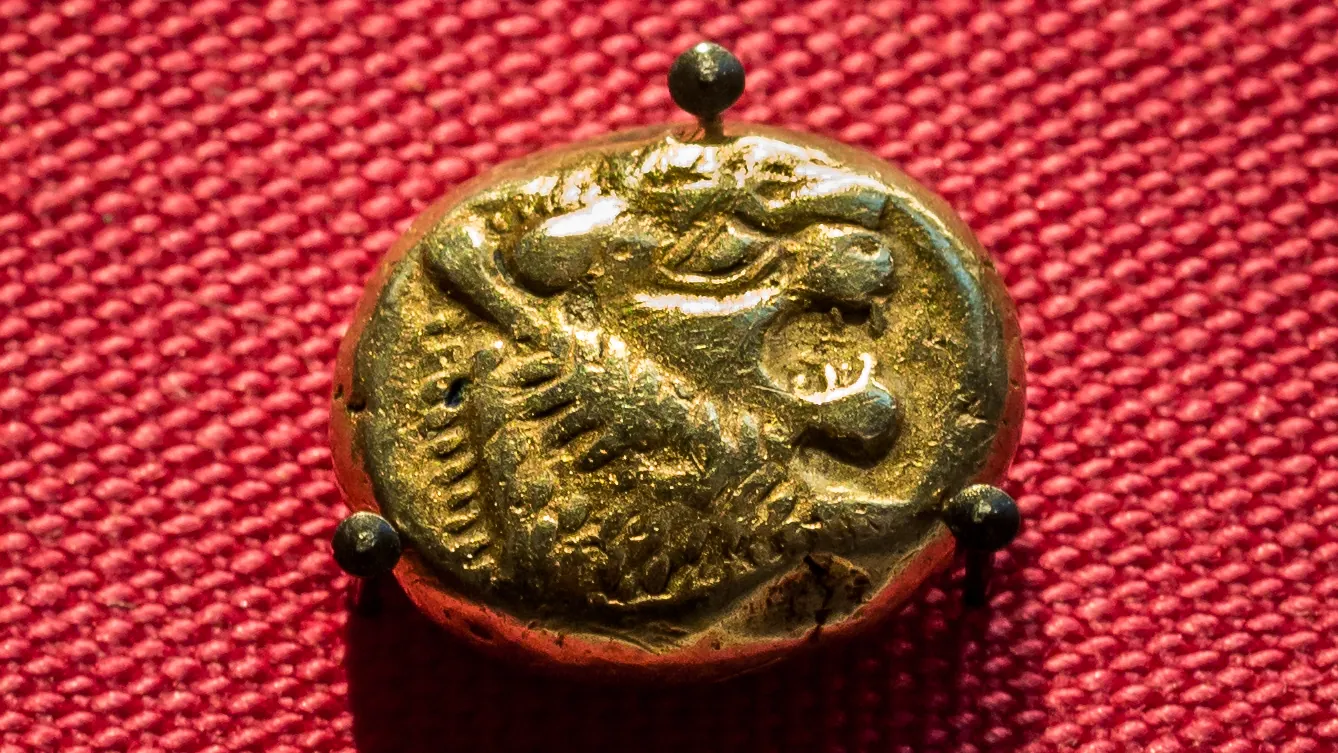
The world's first coins were made of electrum, a pale natural alloy of gold and silver found in the Pactolus and Hermos rivers of Lydia, in western Asia Minor. They were struck in the later 7th century BCE, possibly by Lydia first and soon afterwards by many east Greek cities; the Lydian mint came to issue coins stamped with a lion's head, like the one pictured above [1]. A common explanation is that coins of exact weight spared the issuer from weighing out bullion for many identical payments, such as wages for mercenaries. Robert Wallace argues for another: the gold in western Anatolian electrum varied from about 74 to 86 percent and was hard to test, so a stamped piece of fixed weight gave each coin of an issuer the same value [1].
The first coins of Cyprus
Minting on the island began in the 6th century BCE, in silver and on a local Cypriot weight standard whose heaviest coin, the siglos, weighed about 11 g [2, p. 163]. Among the first issues are the sigloi of the kingdom of Salamis, struck by King Evelthon or his successors around 530/20–500 BCE, with a ram lying on the obverse, the name Evelthon in the Cypriot syllabic script, and a blank reverse. The example in the Bank of Cyprus Cultural Foundation (inv. no. 1999-09-01) weighs 11.28 g. A siglos of Evelthon's successors, dated about 480 BCE, keeps the ram and the legend "of Evelthon" and adds an Egyptian ankh on the reverse, with the syllabic sign ba, for "king", inside its loop [2, p. 163]. Salamis lies in the north of the island, illegally occupied by Turkey since the 1974 invasion.
Original sources
On ancientcyprus.com
- Sites
- Salamis
- People
- Eleni Zapiti, Lefki Michaelidou
- Periods
- Cypro-Archaic, Cypro-Classical, Hellenistic, Roman
References
- 1.Wallace, R. W. (2012). Electrum, electrum coinage. In R. S. Bagnall, K. Brodersen, C. B. Champion, A. Erskine and S. R. Huebner (Eds.), The Encyclopedia of Ancient History. Wiley-Blackwell. https://doi.org/10.1002/9781444338386.wbeah06118
- 2.Hadjisavvas, S. (Ed.). (2010). Cyprus: Crossroads of Civilizations. Nicosia: Government of the Republic of Cyprus.
More in Events
- Engraver Panayiotis Andreou leads two free coin-engraving workshops at Nicosia's Leventis Museum
- Leventis Foundation screens Papapetrou's films; he recalls Karageorghis's return to Salamis
- Nicosia symposium traces despotism from classical Athens to Montesquieu and Hume on 4 November
- Kalavasos remembers Ian Todd on 7 November with talks and villagers' photographs of the digs
- Five potters run a free clay workshop at Nicosia's Giabra Pierides museum on 15 November