
Fieldwork·Brief
Hollows cut into a Bronze Age threshold at Erimi match a senet game board
The University of Siena's 2026 season at Erimi-Laonin tou Porakou exposed the full plan of a 250 m² courtyard building and dug three late Middle Bronze Age chamber tombs.



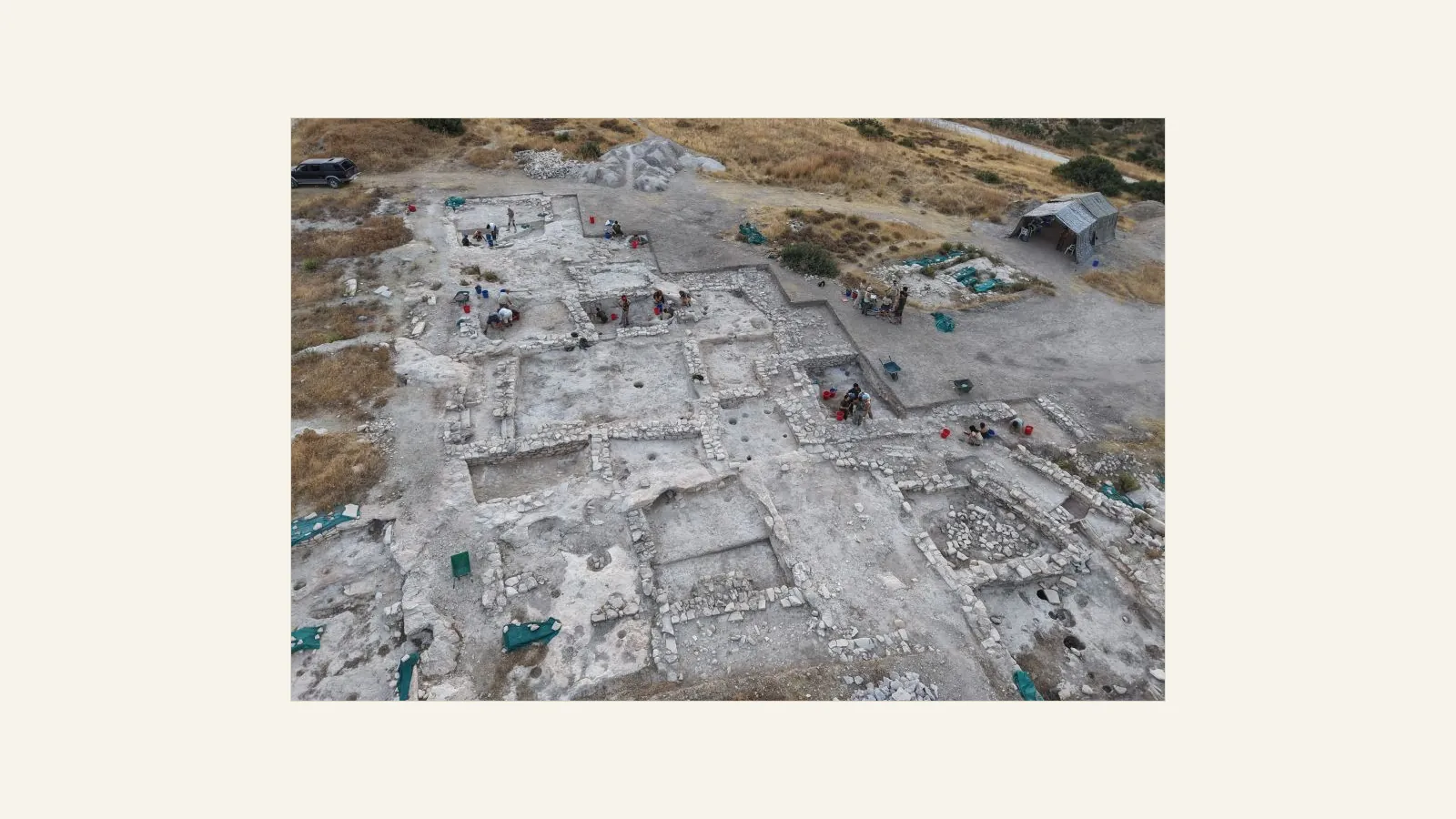
Small hollows carved into a stone threshold in a large Middle Bronze Age building at Erimi-Laonin tou Porakou, in the Kouris valley of Limassol District, form a pattern that the Department of Antiquities finds consistent with a senet-type game board. The Department announced the season's results on 1 September 2026; the team, archaeologists, specialists and students from Italy and Cyprus, dug from 27 July to 21 August. The Erimi Italian mission is a University of Siena project under the scientific direction of Professor Luca Bombardieri, run with Italy's Ministry of Foreign Affairs and International Cooperation and the Department. This year it exposed the whole plan of the building and excavated three chamber tombs.
The Central Building room by room
The Central Building stands on the hilltop, south of the textile workshop complex dug in earlier seasons. Massive outer walls enclose about 250 m², entered from an alley running east to west. A narrow vestibule, Unit 1, has two doorways with single-stone thresholds, which the Department takes as a dog-leg route into a large central courtyard.
Six rooms flank the courtyard symmetrically, Units 2, 3 and 7 on the west and Units 5, 6 and 8 on the east, and all are now fully excavated. Of the eastern rooms only Unit 6 opens straight off the courtyard, over a large threshold of dressed stone; the game pattern is cut into that sill. At the south end of the same room is a deep underground deposit with an estimated capacity of about 2.80 m³.
Beneath the south wing lay an older building on a different alignment, long and rectangular, with massive load-bearing walls. The later builders partly reused it for a staircase, presumably leading to a possible upper floor, and for the row of three rooms in the west wing. On the east the Central Building stood free, facing an open area with installations and lines of postholes, probably from light or temporary timber structures. Roofed spaces lie further east, among them at least one rectangular unit that was probably domestic (Unit SA VII).
Three tombs in Area E
In the southern cemetery, outside the settlement, the team fully excavated three chamber tombs, T2656 to T2658, each entered through a vertical dromos, the shaft-like entrance passage. T2656 is a large single chamber with a wide dromos and a bench along the back wall, opposite the entrance; an inner passage leads from it to a second chamber on the west. Together the tombs held multiple burials and their funerary deposits, which the Department assigns to the community's later phase, at the end of the Middle Bronze Age.
A workshop village above the Kouris
Radiocarbon dates put the founding of the settlement at about 1960 BCE and its abandonment before about 1650 BCE [2, p. 62]. Its best-known feature is the hilltop workshop, whose basins and channels the excavators connect with processing and dyeing textiles [1]. Marialucia Amadio, studying its buildings, judged that their stone thresholds were possibly added in the site's later phase [2, p. 178].
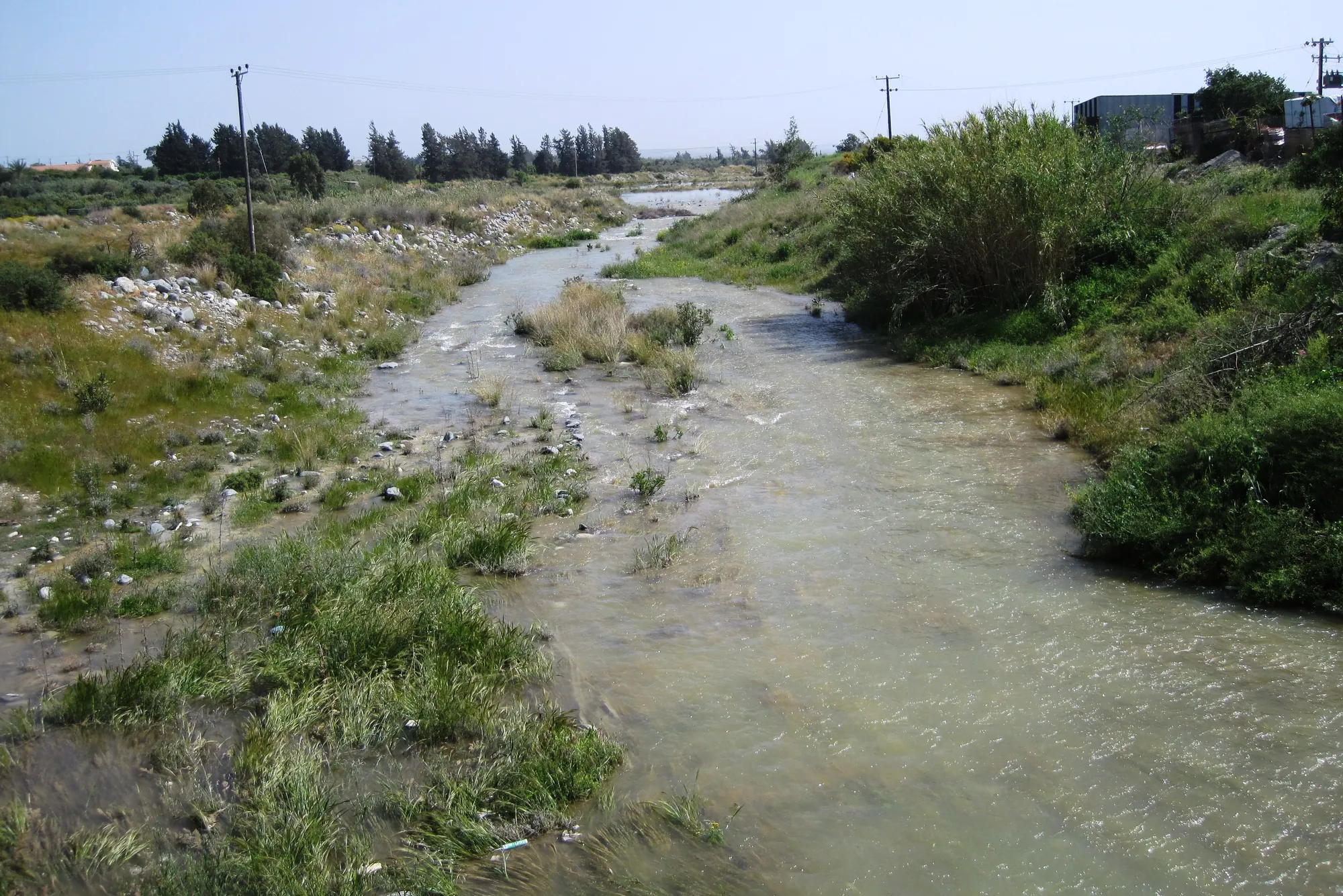
How far the community stood above its neighbours has been argued. In 2013, when only a single structure beyond the workshop had been uncovered, Bernard Knapp accepted that the workshop signalled specialised production but saw no sign that the site was anything other than a typical rural village of its period [3, p. 23]. The courtyard building and the older building beneath it were exposed after he wrote.
Original sources
On ancientcyprus.com
- Institutions
- University of Siena, Department of Antiquities of Cyprus
- Periods
- Middle Bronze Age
References
- 1.Bombardieri, L., & Monaco, M. (2019). Going over the common thread with a fine-tooth comb, Actors and interaction in a Middle Bronze Age textile start-up. Cahiers du Centre d'Études Chypriotes, 49, 81-102. https://doi.org/10.4000/cchyp.459
- 2.Amadio, M. (2017). Architecture and Urbanisation in Bronze Age Cyprus: local and regional innovations in materials, technology and social representation. Doctoral dissertation, University of Reading.
- 3.Knapp, A. B. (2013). Revolution within evolution: the emergence of a 'secondary state' on protohistoric Bronze Age Cyprus. Levant, 45(1), 19-44. https://doi.org/10.1179/0075891413Z.00000000015
- 4.Crist, W., de Voogt, A., & Dunn-Vaturi, A.-E. (2016). Facilitating interaction: board games as social lubricants in the ancient Near East. Oxford Journal of Archaeology, 35(2), 179-196. https://doi.org/10.1111/ojoa.12084
- 5.Swiny, S., Rapp, G., & Herscher, E. (Eds.). (2003). Sotira Kaminoudhia: An Early Bronze Age Site in Cyprus (CAARI Monograph Series 4). American Schools of Oriental Research.
More in Fieldwork
- Hellenistic quarry under Paphos's Fabrika hill became an unused tomb, then a church
- This Week in Cypriot Archaeology: 31 August–6 September 2026
- This Week in Cypriot Archaeology: 27 July–2 August 2026
- Grape seeds and unfired loom weights found in Bronze Age work complex at Erimi-Pitharka
- 2026 dig at Kissonerga-Skalia adds to the case for Bronze Age beer, Akamas municipality says