
Events·Feature
Leiden hosts PoCA 2026, the 23rd Postgraduate Cypriot Archaeology Meeting, on 11–13 November
Thirty-four researchers from 21 institutions give 32 papers and posters; entry is free, in person or on Zoom, and Artemis Georgiou of the University of Cyprus gives the keynote.


Conference
- When
- 11–13 November 2026 In 22 days
- Where
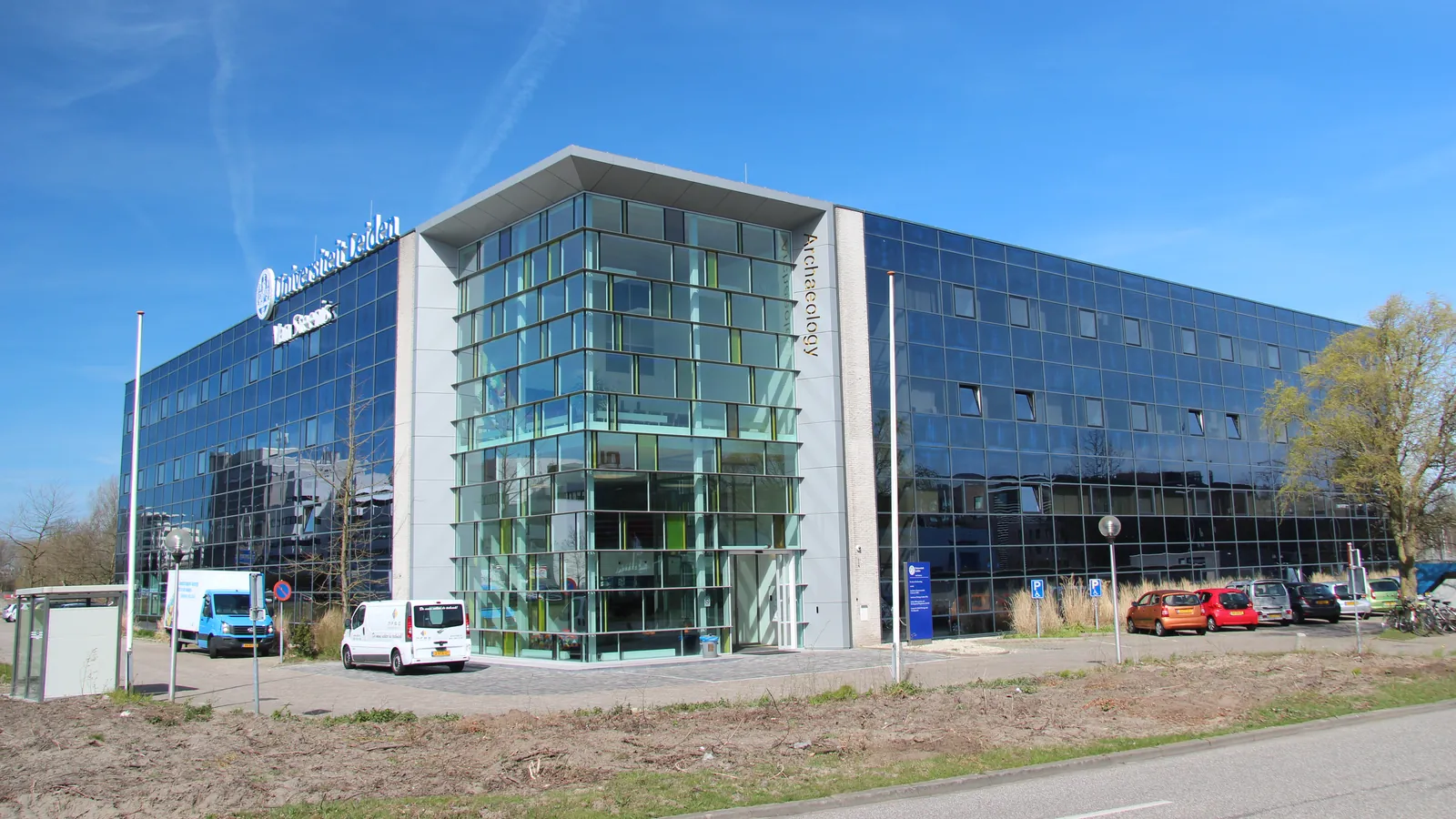
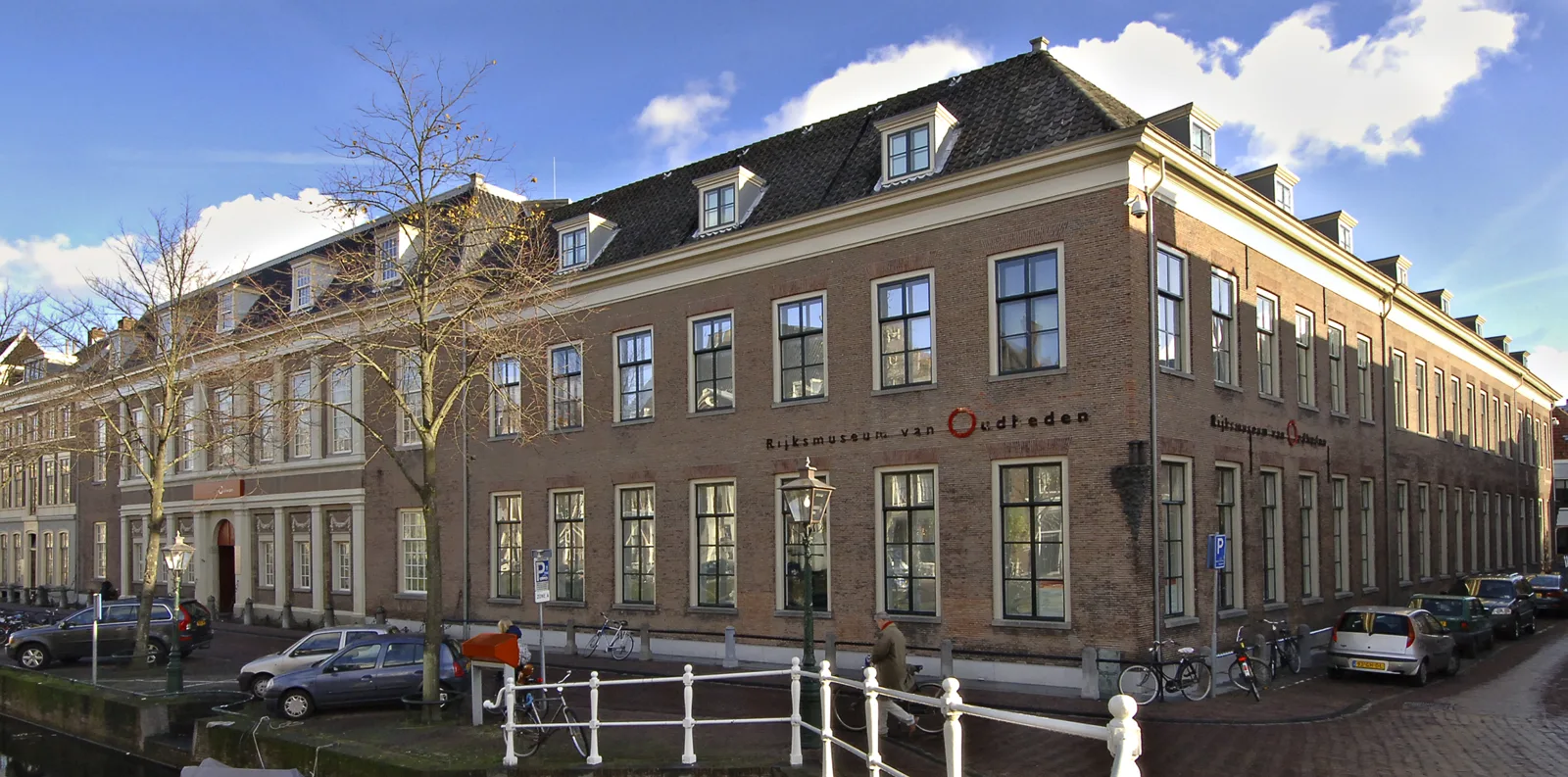
- Rijksmuseum van Oudheden (11 November) and Faculty of Archaeology, Van Steenis Building (12–13 November), Leiden
- Online
- Also online
- Admission
- Free
The 23rd Postgraduate Cypriot Archaeology Meeting, PoCA 2026, takes place in Leiden, the Netherlands, from Wednesday 11 to Friday 13 November 2026, hosted by the Department of World Archaeology of Leiden University's Faculty of Archaeology. Over three days, 34 researchers, from 21 universities, institutes and programmes and one working independently, present 26 papers and 6 posters on the archaeology of Cyprus, and Artemis Georgiou of the University of Cyprus gives the keynote lecture. It is the first time the meeting has been organised at Leiden.
Attendance is free, in person or online by Zoom. The organisers ask everyone who comes, whether to listen, present, chair or help, to register by 1 November; a separate Zoom registration is linked from the conference website. The opening afternoon and keynote, on 11 November, are at the Rijksmuseum van Oudheden; the sessions on 12 and 13 November are at the Faculty of Archaeology on Einsteinweg.
PoCA is a yearly meeting for people at the start of a research career: master's graduates, doctoral candidates and postdoctoral researchers no more than six years past the PhD who work on Cypriot archaeology. It gives them a place to present and publish their work, and to meet senior colleagues. The organisers are marking 25 years of the series this year, and they intend to publish the Leiden papers in an edited volume.
Who organises it
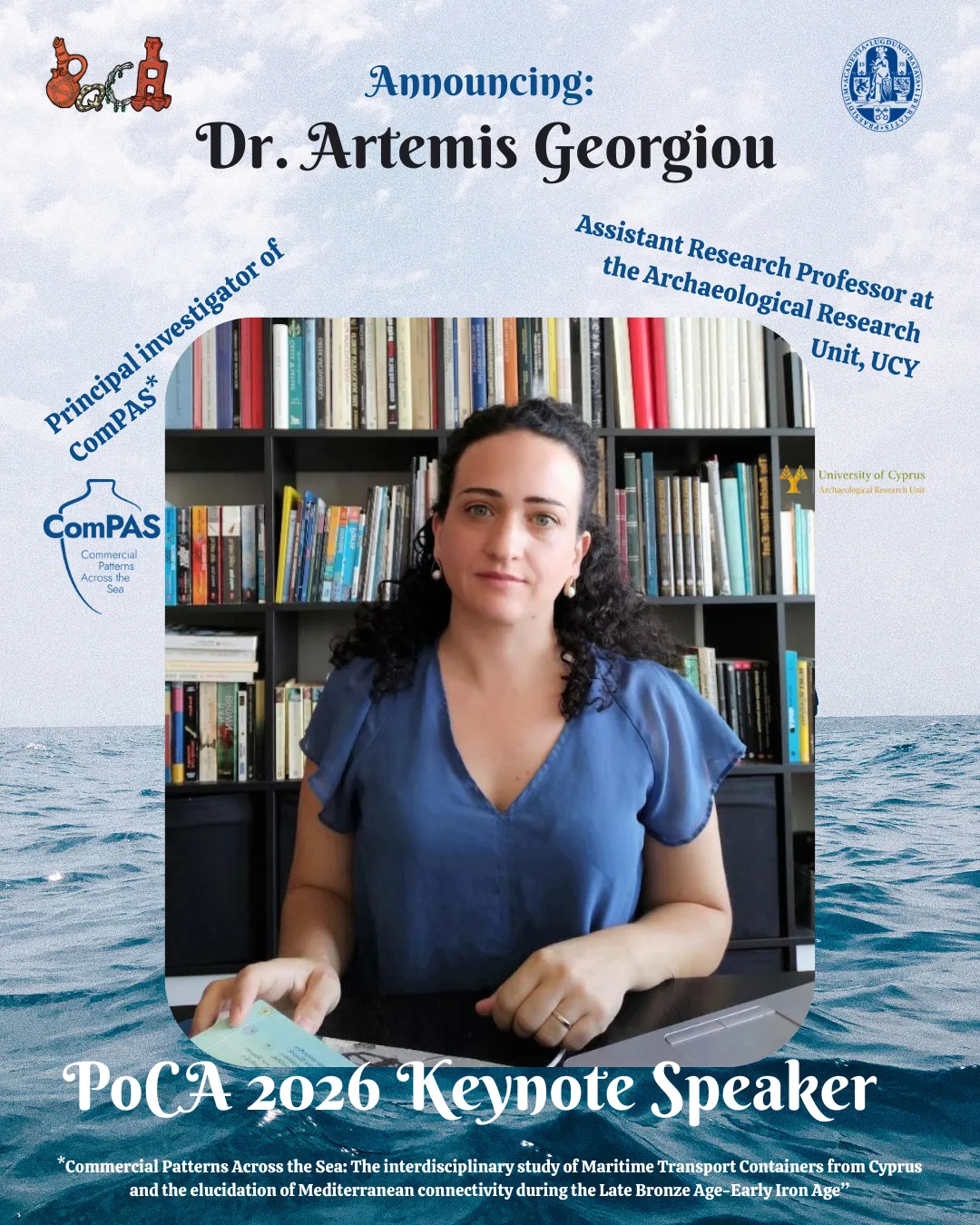
All six members of the organising committee belong to the Inequal Cyprus Project: the postdoctoral researchers Maria Hadjigavriel and Donna de Groene, and the PhD candidates Jaris Darwin, Azra Say-Ötün, Jack Tillman and Max Lenssen.
The Inequal Cyprus Project runs from 2025 to 2030 on an Advanced Grant from the European Research Council, led from Leiden by Bleda Düring, Professor of Archaeology of West Asia. It asks how social inequalities first became persistent in late prehistoric Cyprus, that is, how wealth and standing came to pass from one generation to the next. The team studies houses, burials, figurative objects, crafts and exchange, with isotope analysis for diet and mobility, portable X-ray fluorescence (XRF) to trace where materials came from, and petrography, the study of rock and clay under the microscope, for how things were made. Its partners are the Department of Antiquities, Cyprus, the STARC research centre of The Cyprus Institute and the Cyprus American Archaeological Research Institute (CAARI).
Eight of the 32 presentations come from Leiden researchers. One poster, Vasiliki Savvidou's, deals with the burials at Chlorakas-Palloures, a Middle and Late Chalcolithic village north of Paphos damaged by farming and building work. The Cypriot authorities asked Düring in 2013 to take up rescue excavations there, and Leiden's campaign at the site ran from 2015. The site's wheat traces were in the news this year.
PoCA's steering committee is coordinated by Giorgos Papantoniou of Trinity College Dublin. Its other members are Lindy Crewe, director of CAARI; Charalambos Paraskeva of the Department of Antiquities; George Papasavvas and Athanasios K. Vionis of the University of Cyprus; Jennifer M. Webb of La Trobe University and the University of Cyprus; and Jaris Darwin for Leiden. The programme credits institutional support to NINO, the Netherlands Institute for the Near East, and to Düring and the Inequal Cyprus Project.
The keynote: Late Bronze Age Cyprus
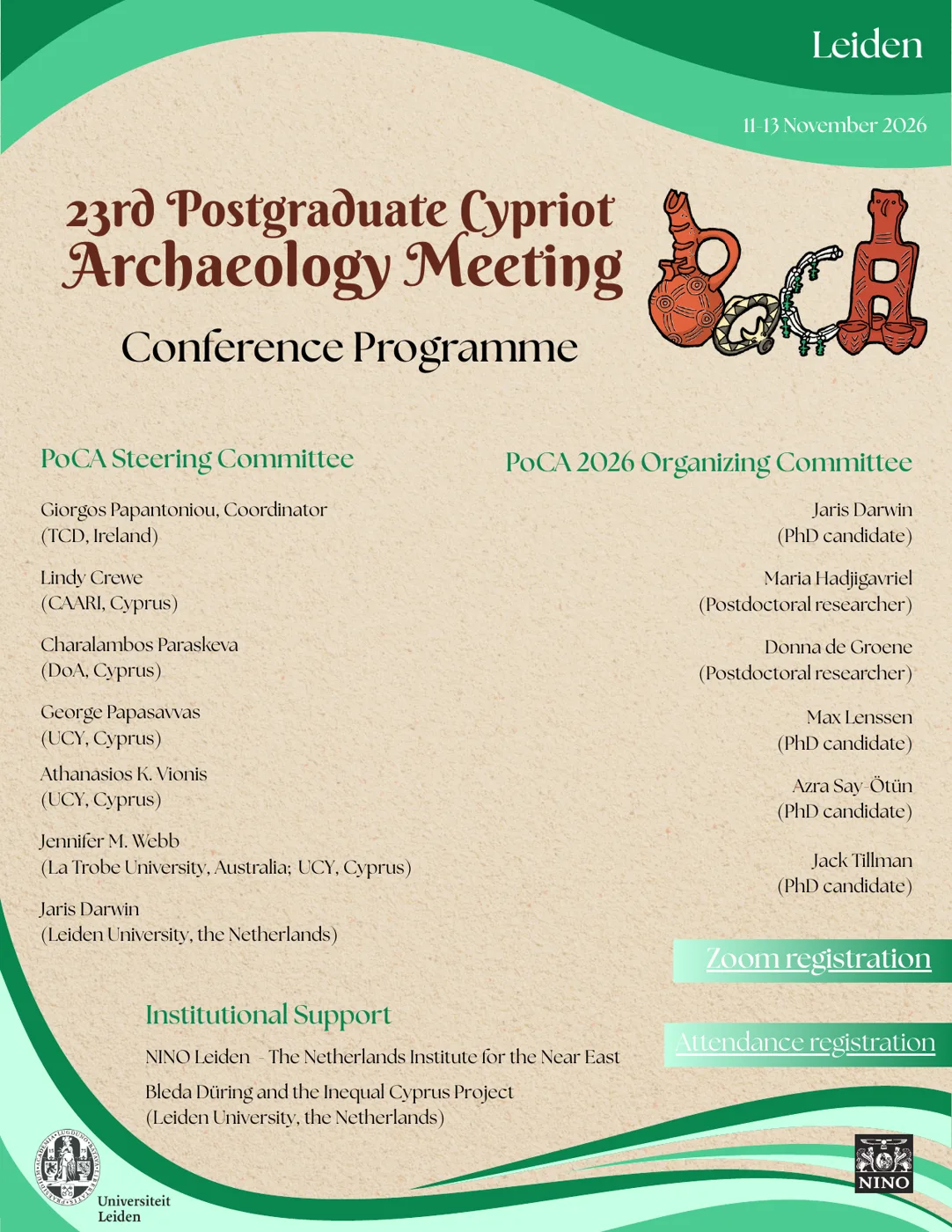
Artemis Georgiou, Assistant Research Professor at the Archaeological Research Unit of the University of Cyprus, opens the meeting with the keynote lecture on Wednesday 11 November at 15:00 CET. It takes place in the Leemanszaal of the Rijksmuseum van Oudheden, the Dutch National Museum of Antiquities, and can also be followed online. Her title is “Insights and new directions in the archaeology of Late Bronze Age Cyprus: Internal dynamics and interregional connectivity”.
The programme says the talk is aimed at students and young researchers and has two halves. The first is practical: how to approach the island's archaeology and the problems of method and interpretation its material poses in every period. The second offers a fresh account of Cypriot communities between about 1650 and 1100 BCE, built on recent projects: regional differences in pottery and the technical choices of potters as signs of social and political order, the part images played in making and negotiating relationships, and what long-distance exchange reveals about the island's course. Georgiou leads ComPAS (Commercial Patterns Across the Sea), a project on the transport jars that carried goods around the Mediterranean in the Late Bronze and Early Iron Ages. Her Oxford doctoral thesis dealt with Pyla-Kokkinokremos, Maa-Palaeokastro and the history of Cypriot settlements in the 12th century BCE.
How to attend
Wednesday 11 November is held at the museum on Rapenburg: registration from 12:00, the welcome at 14:00, then half an hour of bids from groups hoping to host PoCA in 2027, and the keynote at 15:00, followed by drinks at Café de Keyzer. The sessions on Thursday 12 and Friday 13 November run in the Faculty of Archaeology's Van Steenis Building on Einsteinweg, in room F1.04 on Thursday and E0.04 on Friday, from 9:00 CET. Each paper has a 20-minute slot, with discussion at the end of each session; posters are presented in person in five minutes. The language of the meeting is English.
Full details are on the conference website. Travel and accommodation are up to each participant; the organisers point to cheaper rooms in The Hague, a short train ride away. Leiden University's own event listing runs to Saturday 14 November because of an optional day in Amsterdam, at participants' own cost: a city walk and a visit to the Allard Pierson museum.
What the programme covers
The 32 presentations run from the Epipalaeolithic to the politics of heritage today. A poster on inland survey covers the earliest period; most papers deal with the Chalcolithic and the Bronze Age, from houses and tombs to water management, cylinder seals, timber and animals; later periods enter with Hellenistic coins found by French teams at Kition, stone vessels from the agora of Nea Paphos and a coin of a king of Lapethos. The last session turns to the present: the political division of the island and its effect on archaeology, the travels of a funerary stele from Golgoi to Valhalla, New York, contemporary art, and archaeology's part in building peace. The call for papers excluded work using data from excavations carried out since 1974 in the area occupied by Turkey, while allowing observational study there undertaken with the knowledge of the Department of Antiquities.
Who is speaking
The sessions, chairs, speakers, affiliations and paper titles as the programme gives them. Times are CET; (P) marks a poster. Titles appear as the programme prints them.
Session 1, Thursday 12 November, 9:00. Settlement strategies: Building and maintaining communities and networks. Chairs: Victor Klinkenberg and Bleda Düring.
| Speaker | Affiliation | Title |
|---|---|---|
| Aiyana Plasman | Leiden University | “Unpacking the practice of caching in Chalcolithic Cyprus” |
| Azra Say-Ötün | Leiden University | “Do we yet know the answer to the question: Who is moving in prehistoric Cyprus?” |
| Hannah Stengler | Uppsala University | “Hiding in the blue: Water management strategies on Late Bronze Age Cyprus” |
| Antria Lavithi (P) | Trinity College Dublin | “Children and religion in ancient Cyprus: Decoding the presence of children in Cypriot sanctuaries from the Cypro-Geometric to the Roman Period” |
Session 2, Thursday 12 November, 11:00. Entwined environments: Exploring human relationships with the natural and built world. Chairs: Jack Tillman and Jennifer Swerida.
| Speaker | Affiliation | Title |
|---|---|---|
| Jaris Darwin | Leiden University | “Forever and always or frequently forgotten? Aspects of building longevity and discontinuity in Late Cypriot Prehistory” |
| Stratos Mavros | National and Kapodistrian University of Athens | “In search of fertile grounds: A GIS spatial analysis of agricultural suitability in Southwest Cyprus” |
| Yasmine Cornelissen | Erasmus Mundus (University of Evora, Aristotle University of Thessaloniki, Sapienza University) | “Digging deeper into mining activity at Stavrovouni Mountain (Southeastern Cyprus): Evidence, chronology, and challenges” |
| Bri Jones (P) | UC Berkeley | “Epipaleolithic trailblazers: Inland survey and landscape learning in Prehistoric Cyprus” |
Session 3, Thursday 12 November, 13:30. Politics and people: Articulating and enforcing identity. Chairs: Donna de Groene and Sarah Schrader.
| Speaker | Affiliation | Title |
|---|---|---|
| Jack Tillman | Leiden University | “Death and difference: Tomb building and burial pathways in third millennium BCE Cyprus” |
| Thomas Humphrey | Independent Researcher | “Iconomachy: Monumentality and the decline of the cylinder seal in Late Bronze Age Cyprus” |
| Momoko Narukawa | Nagoya University | “Rethinking ‘Homeric’ burials: A comparative study of Palaepaphos-Skales and Al-Bass” |
| Sofia Sakaridou | International Hellenic University | “Foundation myths as propagandistic tools: The case of the Teucrids, the royal dynasty of Salamis” |
| Vasiliki Savvidou (P) | Leiden University | “The Palloures burials in context” |
Session 4, Thursday 12 November, 16:00. Style and substance: Analyzing human handiwork. Chairs: Maria Hadjigavriel and Martina Revello Lami.
| Speaker | Affiliation | Title |
|---|---|---|
| Philippe Anduze | Université Lumière Lyon 2 | “The contribution of coins from French excavations to the study of monetary circulation in Kition during the Hellenistic period” |
| Sebastian Bała | Jagiellonian University | “Stone vessels from the Agora of Nea Paphos in the light of Jagiellonian University excavations (Paphos Agora Project)” |
| Paola Pizzo | Czech Academy of Sciences, Brno | “Volcanic ashes in Cypriot mortars: Documenting a new discovery” |
| Suzanne Gilles (P) | Université Lumière Lyon 2 | “The systematic analysis of pot-marks from the north coast of Cyprus during the Early and Middle Bronze Age” |
Session 5, Friday 13 November, 9:00. Maritime worlds: Tracing the role of the sea in ancient lifeways. Chairs: Jaris Darwin and Robin Jonker.
| Speaker | Affiliation | Title |
|---|---|---|
| Morgan Edwards | University of Southampton | “Settlements and the sea: Access and interactions within the maritime cultural landscape of Prehistoric Bronze Age Cyprus – The case of Episkopi Bay” |
| Andreas Ladas | National and Kapodistrian University of Athens | “Beyond Copper: Reassessing Cyprus as a potential source of timber in the Late Bronze Age” |
| Georgios Apeitos | University of Oxford | “Public maritime epigraphy: Cyprus and the Eastern Mediterranean” |
Session 6, Friday 13 November, 11:00. Food or friend: The roles of animals in prehistoric society. Chairs: Azra Say-Ötün and Jason Laffoon.
| Speaker | Affiliation | Title |
|---|---|---|
| Donna de Groene | Leiden University | “A zooarchaeological approach on funerary feasting during the Chalcolithic and Prehistoric Bronze Age Cyprus” |
| Theoni Panagiotopoulou | The Cyprus Institute | “Diet in the Cypriot Middle Bronze Age: Bioarcheological insights from Linou” |
| Samuel Blixt | Lund University | “Quadrupeds and bull heads: A socio-cultural contextualization of the animal figurines from Sinda” |
| India Pruette (P) | University of California, Berkeley | “The herd mentality: A social zooarchaeology of human-caprine relationships in Prehistoric Bronze Age Cyprus” |
Session 7, Friday 13 November, 13:30. Emblems and icons: Approaching imagery in the archaeological record. Chairs: Aris Politopoulos and Maria Hadjigavriel.
| Speaker | Affiliation | Title |
|---|---|---|
| Max Lenssen | Leiden University | “Ideals on display? Scenic compositions and lived realities in Prehistoric Bronze Age Cyprus” |
| Antonis Gennadiou | University of the Aegean | “The inverted crescent and disc in ancient Cypriot context: An original Cypriot motif?” |
| Dorota Zaprzalska | Jagiellonian University | “Beyond the single image: Exploring the complexity of composite icons” |
| Miglena Dimova (P) | Sofia University “St. Kliment Ohridski” | “Athena with bull horns on the coins of ṢDQMLK, king of Lapethos” |
Session 8, Friday 13 November, 15:30. Things that were, are, and may be: Examining the political entanglements of cultural heritage. Chairs: Max Lenssen and Aris Politopoulos.
| Speaker | Affiliation | Title |
|---|---|---|
| Maria Hadjigavriel | Leiden University | “Where do we go from here? Working with and around the Cypriot Dispute in Cypriot Archaeology” |
| Caroline Barnes, Pertev Basri and Eleanor Q. Neil | The University of British Columbia; Durham University; Aarhus University | “From Golgoi to Valhalla (NY) and back again: Tracing the history of a funerary stele through social theories of value” |
| Ari Amaya-Akkermans | Global College for Advanced Studies | “Contemporary art and archaeology: Deep-mapping the multi-temporalities of Cyprus” |
| Antigoni Michael | Trinity College Dublin | “Re-shifting narratives and creating peace: A comparative approach in rethinking the role of archaeology in conflict and post-conflict environments (in Cyprus and beyond)” |
The day ends with a zine-making workshop on Cypriot heritage, Foldable Heritage, led by Maria Hadjigavriel and Eleanor Q. Neil, and at 18:15 with the closing remarks and the announcement of where PoCA meets in 2027.
Original sources
- PoCA 2026: 23rd Postgraduate Cypriot Archaeology Meeting
Event
- PoCA 2026: Conference programme (PDF)
Event
- PoCA 2026: About
Event
- PoCA 2026: Organising and steering committees
Event
- PoCA 2026: Call for papers
Event
- PoCA 2026: Venue and accommodation
Event
- PoCA 2026: Registration
Event
- Leiden University: Postgraduate Cypriot Archaeology Meeting
Official release
- Leiden University: The Inequal Cyprus Project
Official release
- Leiden University: Excavating Chlorakas-Palloures
Official release
- Oxford University Research Archive: Georgiou, Pyla-Kokkinokremos, Maa-Palaeokastro and the settlement histories of Cyprus in the twelfth century BC (DPhil thesis)
Paper
On ancientcyprus.com
- Sites
- Chlorakas-Palloures, Kition, Golgoi
- People
- Artemis Georgiou, Maria Hadjigavriel, Bleda S. Düring, Victor Klinkenberg, Giorgos Papantoniou, Lindy Crewe, George Papasavvas, Athanasios K. Vionis, Jennifer M. Webb
- Institutions
- Leiden University, Rijksmuseum van Oudheden, Allard Pierson, Cyprus American Archaeological Research Institute, University of Cyprus, Archaeological Research Unit, University of Cyprus, Department of Antiquities of Cyprus, The Cyprus Institute, Trinity College Dublin, La Trobe University, Uppsala University, National and Kapodistrian University of Athens, University of California, Berkeley, International Hellenic University, Université Lumière Lyon 2, Jagiellonian University, University of Southampton, University of Oxford, Lund University, University of the Aegean, Durham University, Aarhus University
More in Events
- Today in Cypriot Archaeology: 19 October 2026
- Pylon exhibition in Limassol traces the Episkopi men J. Lawrence Angel measured in 1949
- Oxford's Amy Styring talks on crop isotopes and past farming at the Cyprus Institute on 30 October
- Cesnola's biographer Anna Marangou lectures on him and the Ohnefalsch-Richters on 2 November
- Anna Reeve traces how Cypriot antiquities reached British museums in a CAARI lecture on 5 November