
Contents
Late Antique Cyprus runs from the refoundation of the Roman world around Constantinople in 330 CE to the Arab raids of the 640s and 650s. The catalogue also files this span as Late Roman, Early Christian and Early Byzantine: the names describe the same island seen from the state, the Church and the later empire. In these three centuries the provincial capital moved from Paphos to a rebuilt Salamis renamed Constantia, the island's Church won its independence from Antioch, and the countryside filled with basilicas. Most of the objects the catalogue holds for the period are terracotta oil lamps, and they are a fair sample of what a household or a tomb of the time contained. The earlier story (annexation, the senatorial province, Paul and Barnabas) is on the Roman Cyprus page, which this page picks up from; see all Late Antique and Early Byzantine objects in the catalogue.
Dates and turning points
The opening date is a convention borrowed from imperial history. On the island the break came with earthquakes. Runciman puts two of them in 332 and 342 CE and says they destroyed Paphos, Salamis and most of the large cities; Constantius II (337–361) rebuilt Salamis, which took the name Constantia and was the new capital by the middle of the fourth century [1, p. 146]. Zavagno describes Salamis-Constantia as the political and ecclesiastical capital of Cyprus "from the 360s to the end of Byzantine rule in the late twelfth century" [2, p. 1]. The encyclopaedia entry for Salamis gives the sequence of major quakes as 16/17, 76/77, 342 and 394 CE, and says the temple of Zeus fell in 332 and/or 342 [3, p. 234]. The sources do not agree on every date, and the safest summary is a cluster of destructive shocks in the 330s and 340s.
The closing date is the Arab raids, traditionally dated 649 and 653/4 [2, p. 9]. Neither date marks an abandonment of the island, and the end of the period is the most argued part of it (see the last section).
| Date (CE) | Event |
|---|---|
| 332 and 342 | Earthquakes destroy Salamis, Paphos and other cities [1] |
| by c. 350-360s | Salamis rebuilt as Constantia, the new capital [1] [2] |
| 368-403 | Epiphanios archbishop at Constantia [5] |
| c. 365-380 | Earthquake at Kourion (date debated) [4] |
| 431 | Council of Ephesus confirms the Cypriot Church against Antioch [5] |
| 474-491 | Zeno grants autocephaly after the finding of Barnabas's relics [5] |
| 527-565 | Justinian makes Cyprus a separate province with a salaried governor [5] |
| 628-640 | Archbishops add arches to the restored Constantia aqueduct [7] |
| 649 and 653/4 | Arab raids under Mu'awiya [2] |
The earthquake at Kourion and its date
At Kourion a later, separate earthquake ended the Roman town. Its date is a live disagreement. David Soren first dated the destruction to about 370 CE from the coins at the sanctuary of Apollo, then tied it to the tsunami of 21 July 365 that Ammianus Marcellinus describes; Costello's re-examination of the coinage supports the later date of about 370 [4, p. 12]. The quarrel matters for dating objects: Lightfoot notes fourteen lamps from Kourion said to have been buried by the quake of 21 July 365, a deposit whose precise date depends on which side of the argument is right [8]. The house finds and the human victims are described on the earthquakes page.
The capital and the cities
Constantia was a smaller city than the Salamis it replaced. After the quakes the Gymnasium was left in ruins and the rest of the city rebuilt as a Christian town; the gymnasium was later partly restored as baths, and the theatre stage was crudely rebuilt around 375 to 425 before being abandoned in the sixth century [3, p. 234]. The largest church on the island, the basilica of Ayios Epiphanios, was built between 375 and 400 for the archbishop of that name, and the Campanopetra basilica with its monastery followed around 470 to 500 [3, p. 234].
Building did not stop in the seventh century. After Heraclius ended the Persian war in 630, an aqueduct bringing water from the hills around Kythrea, some 20 km away, was restored and paired with a large cistern, the Vouta, set over the north portico of the agora. Inscriptions on its lost piers named the emperor, and the archbishops Arcadios (628), Plutarchos (635–636) and possibly Sergios (640) paid for further arches [7]. A hoard of sixth- and early seventh-century lead seals in the western atrium of the Campanopetra basilica shows the church administration still at work [2, p. 9].
Paphos, according to Saint Jerome, lay in ruins after the mid-fourth-century earthquake but recovered, with secular and church building on a large scale in the late fourth and early fifth centuries. The so-called House of Theseus, possibly the old governor's residence, stayed in use until the early seventh century, and the Chrysopolitissa basilica, with seven aisles, matched Ayios Epiphanios in size before being remodelled with five naves in the early sixth century [7]. At Amathus the town became poorer but continued, and its fortifications were extended to the sea in the late seventh century [7].
The Church and its independence
The Church of Cyprus became the island's strongest institution in this period. Epiphanios was archbishop from 368 to 403, when Constantia took over from Paphos as the metropolis. In the early fifth century the Patriarch of Antioch tried to bring the Cypriot Church under his authority; the Cypriots won their case at the Council of Ephesus in 431. Under Zeno (474–491) Peter of Antioch reopened the claim. Archbishop Anthemios then found the relics of Saint Barnabas outside Salamis, with a copy of the Gospel of Saint Matthew, and Zeno declared the Church autocephalous, with privileges that included the right to carry an imperial sceptre and to sign in red ink [5, p. 14]. Justinian (527–565) made Cyprus a separate province with a salaried governor, grouped with the Crimea, western Asia Minor and the Aegean islands under the Quaestor of the Danube [5, p. 14].
Basilicas and the countryside
The churches of the fourth to seventh centuries had timber roofs, imported marble fittings and floors of mosaic or opus sectile. They kept local features into the sixth and seventh centuries, though their mosaics show influence from Syria and Palestine [6, p. 13]. The contributors to the 2018 volume edited by Horster, Nicolaou and Rogge read the rural basilicas as a network marking out properties and estates, and see the cult of saints on the island as largely a cult of its own bishops [6, pp. 13–14]. Eleni Procopiou reports there on new church finds at Amathus, Kofinou, Menogeia, Choirokoitia, Dali-Agridia and Akrotiri [6, p. 14].
Christian and Jewish lamps
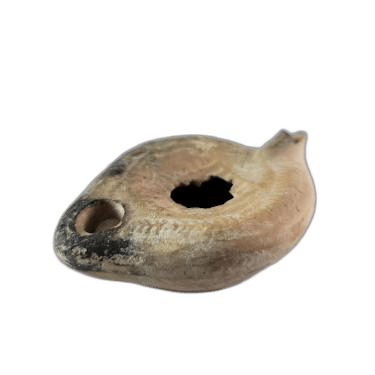
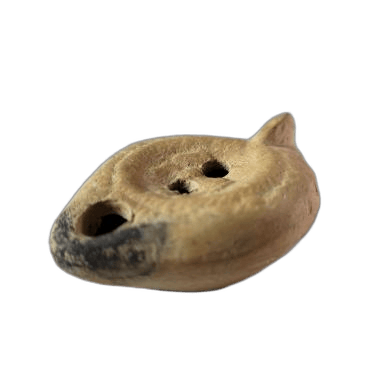
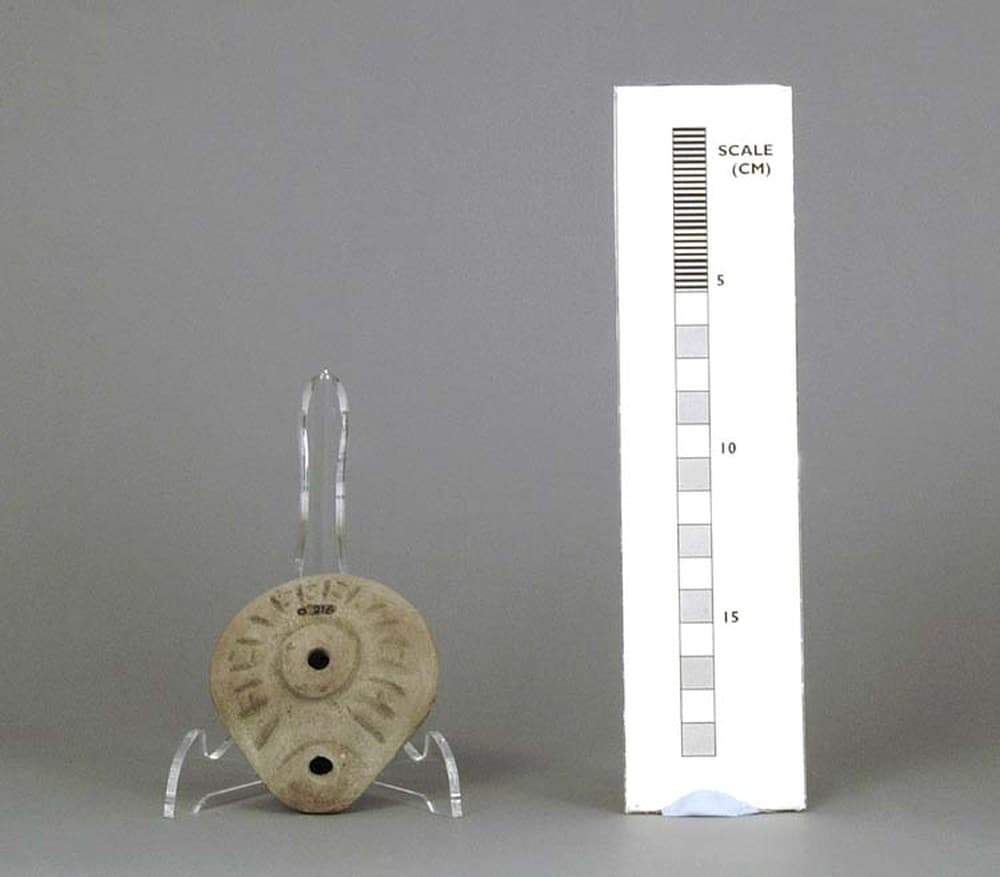
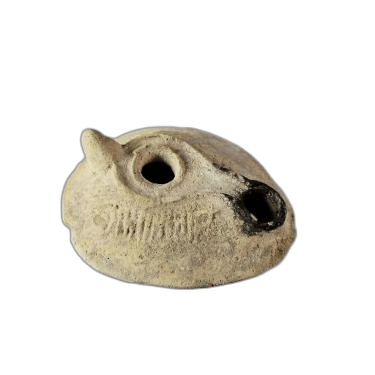
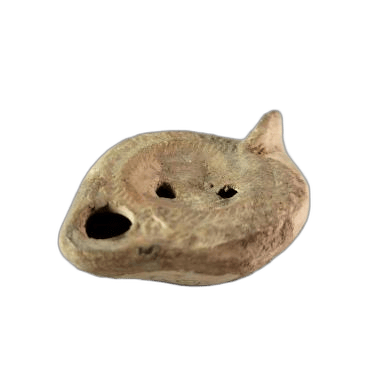
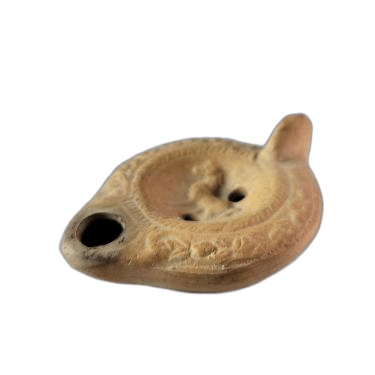
Lamps are the commonest Late Antique object in the catalogue. Most belong to the mould-made family with an unpierced handle that Vessberg classed as Type 18, the standard late Roman lamp in Cyprus and the wider eastern Mediterranean; the seventh century brought the slipper lamp, Vessberg Type 19 [8]. The Royal Ontario Museum's lamp with a wide-armed cross and an inscription and its lamp with a horse, both dated to the fourth century, are typical, and the plainer round lamp in the Hunterian Museum has a flat body and short nozzle with no handle.
Christian lamps in Cyprus come in a small number of types and designs, and some are among the last terracotta lamps used on the island [8]. A slipper lamp with a cross from the Kornos Cave near Lapithos, published by Hector Catling and Dikigoropoulos in 1970, is the only one of its type known from Cyprus and confirms the seventh-century date of Type 19; a slipper lamp with a cross from the Salamis Bench Deposit may date to the end of the seventh century or later [8]. The Ontario Museum's oil lamp dated 550 to 700 belongs to this last phase.
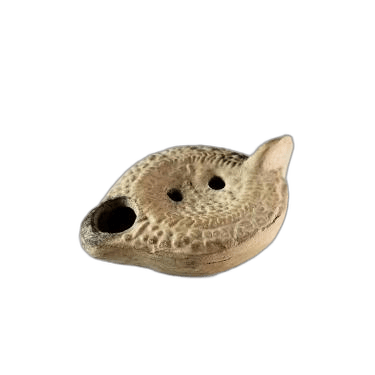
Lamps with a menorah are among the few traces of a Jewish community on the island. The single menorah lamp in the Cesnola collection, Metropolitan Museum 74.51.1867, is a Type 18 lamp of the fourth or fifth century, and Lightfoot groups it with others from Cyprus that all date to the fourth century [8]. The dating is not settled: two similar lamps from a tomb at Paleokastro, now in the museum in Kyrenia Castle, have been dated to the second or third century [8]. The catalogue's lamp with menorah in Toronto is attributed to Cyprus but was collected in the Fayyum in Egypt, so its Cypriot origin is the museum's judgement, not a findspot. A menorah lamp of the fifth or sixth century in the same museum is said to come from Mukhmas in Palestine, and the Yale University Art Gallery's Type 18 lamp 1912.504, from Palestine, shows how far the shape spread.
Another common Type 18 design carries a nude male figure with a jar and an amphora under a vine. It has been read as the miracle at Cana, but Lightfoot doubts a Christian meaning because the figure is naked except for a belt [8]. Many of the Ontario lamps came through the Lady Loch gift, and the museum's Cypriot holdings should be read with that history in mind.
Pottery and trade
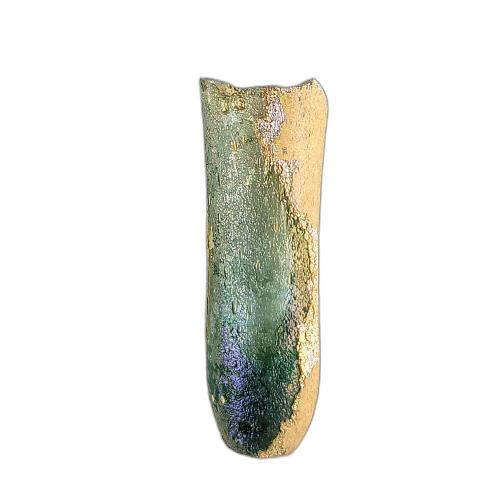
Fine tableware of the period is a red-slipped ware with a long-running name problem. Hayes called it Cypriot Red Slip Ware, dating it from the fourth to the seventh century; Jackson and colleagues published kiln evidence for the same ware (Late Roman D) in southern Asia Minor in 2012, which challenges the Cypriot label [9]. Wine and oil travelled in Late Roman 1 amphorae (see jar). The Troodos survey found that imported red wares dominated until the fourth century and regional Cypriot wares thereafter, and that Cypriot Red Slip and Late Roman 1 amphorae, long thought to end in the mid-seventh century, continued into the eighth century or later [10, p. 83]. Glass of the period is covered on the glass page.
The Arab raids and the continuity debate
Hill, writing in 1940, follows the Arab sources: Mu'awiya sailed from Acre in 647, 648 or 649 (Hill could not choose), took and destroyed a Constantia "full of people", profaned the basilica of Epiphanios and imposed a tribute of 7,200 gold pieces. Umm Haram died on the expedition and was buried at Hala Sultan Tekke [11, p. 309]. A second raid followed in 653/4, and in 688 a treaty between Justinian II and Abd al-Malik neutralised the island [13, p. 217]. The encyclopaedia entry for Salamis records limited reoccupation in the late seventh and early eighth centuries, including a defensive wall around the basilica of Ayios Epiphanios, and a smaller church built about 698 to its south-east that stayed in use until 1344 [3, p. 234].
The older reading of this evidence is catastrophe: the cities sacked, the population fled, the capital moved to Lapithos [2, p. 1]. Luca Zavagno (2014, 2017) argues instead for transition. He points to the seventh-century building at Constantia and the continuing life of Amathus, and quotes Metcalf: coins of Constans II minted after 653, and lead seals of the later seventh and early eighth centuries, are unequivocal evidence of continued occupation [7]. Metcalf also calls the story that refugees from Constantia founded Famagusta a myth without evidence [12, p. 553]. The pottery end-dates moving into the eighth century point the same way [10, p. 83]. The debate is open, but the evidence now favours a poorer island that went on living in its towns over one emptied in a single generation.
Where to see it
The lamps in this entry are in the Royal Ontario Museum, the Hunterian Museum in Glasgow and the Metropolitan Museum of Art. The period continues on the island in the monuments themselves: the basilicas of Salamis-Constantia and Kourion, the Chrysopolitissa at Paphos and the late walls at Amathus. For what came before, see Hellenistic and Roman Cyprus.
Objects on this page
In the catalogue
References
- 1.Runciman, S. (1990). The Byzantine period. In D. Hunt (Ed.), Footprints in Cyprus (pp. 136–174). Trigraph.
- 2.Zavagno, L. (2014). 'A wonderful city of palms and dates': Salamis-Constantia in transition from Late Antiquity to the early Middle Ages (ca. 600–ca. 800 CE). Mediterranean Historical Review. https://doi.org/10.1080/09518967.2014.975566
- 3.Salamis. (n.d.). In The Oxford encyclopedia of archaeology in the Near East (Vol. 4, p. 234). Oxford University Press.
- 4.Davis, T. W. (2010). Earthquakes and the crises of faith: Social transformation in late antique Cyprus. Buried History, 46.
- 5.The painted churches of Cyprus: Treasures of Byzantine art. (n.d.).
- 6.Horster, M., Nicolaou, D., & Rogge, S. (Eds.). (2018). Church building in Cyprus (fourth to seventh centuries): A mirror of intercultural contacts in the Eastern Mediterranean. Waxmann.
- 7.Zavagno, L. (2017). Cyprus between Late Antiquity and the Early Middle Ages (ca. 600–800): An island in transition (Birmingham Byzantine and Ottoman Studies 21). Routledge.
- 8.Lightfoot, C. S. (n.d.). The Cesnola Collection of Cypriot Art: Terracotta oil lamps. The Metropolitan Museum of Art; Yale University Press.
- 9.Jackson, M., Zelle, M., Vandeput, L., & Köse, V. (2012). Primary evidence for Late Roman D Ware production in southern Asia Minor: A challenge to 'Cypriot Red Slip Ware'. Anatolian Studies, 62, 89–114. https://doi.org/10.1017/S0066154612000051
- 10.Landscape and interaction: The Troodos Archaeological and Environmental Survey Project, Cyprus (Vol. 1). (n.d.).
- 11.Hill, G. (1940). A history of Cyprus (Vol. 1). Cambridge University Press.
- 12.Metcalf, D. M. (2009). Byzantine Cyprus, 491–1191. Cyprus Research Centre.
- 13.A traveller's history of Cyprus. (n.d.).