
Contents
From the end of the 4th century BCE to the 7th century CE, the fine tableware used in Cyprus came as a series of slipped wares, each replacing the last. The order, worked out mainly at Nea Paphos, runs from Hellenistic colour-coated ware, which imitated Attic and local black gloss, to the glossy red Eastern Sigillata A imported from the Syro-Cilician coast. Cypriot Sigillata followed from the time of Augustus, and Late Roman D, long called "Cypriot Red Slip Ware", took over from the 4th century CE [1, pp. 166–170; 2]. Two questions keep coming back. Was a ware made on the island at all, and if so, where? And how much of it reached which coast? This page covers the wheel-made fine wares in turn and ends with the plainer kitchen and lamp fabrics, which are much less studied. For the political background see the Hellenistic and Roman period pages. You can see all Hellenistic, Roman and later wares in the catalogue.
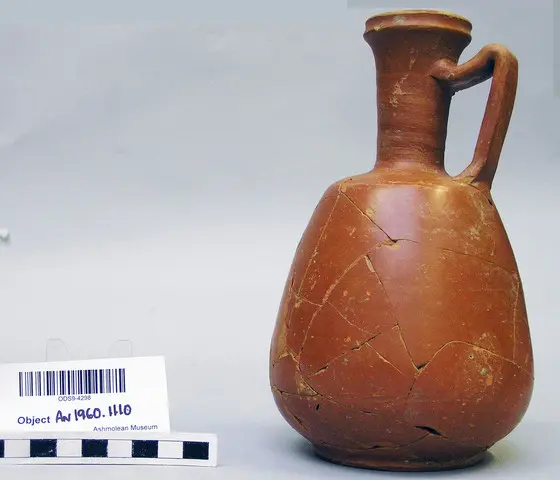
A Cypriot Sigillata jug said to come from Amathous, 18.8 cm high (Ashmolean Museum AN1960.1110, museum record). Its red slip and crisp wheel-made profile are typical of the island's own sigillata of the 1st century CE.
The modern classification is largely the work of John W. Hayes. He identified Cypriot Sigillata in 1967, published the standard typologies of Eastern Sigillata A and Cypriot Sigillata in 1985, defined colour-coated ware from the House of Dionysos at Nea Paphos in 1991, and named "Cypriot Red Slip Ware" in his Late Roman Pottery of 1972 [1, pp. 166, 168; 2; 4, p. 3]. Most of the debates below are arguments with, or refinements of, Hayes's conclusions.
| Ware | Date on Cyprus | Where made | Main finds on Cyprus |
|---|---|---|---|
| Hellenistic colour-coated ware | End of 4th c. BCE to 1st c. CE | Several centres, some on Cyprus; one group from Cyprus or the Levant | Commonest Hellenistic fine ware at Nea Paphos |
| Eastern Sigillata A | From mid-2nd c. BCE; peak late 1st c. BCE; small output to early 3rd c. CE | Probably between Tarsus and Antioch | East and south coasts; Nea Paphos in the late Hellenistic period |
| Cypriot Sigillata (Eastern Sigillata D) | 1st c. BCE to first half of 3rd c. CE; peak c. 50–100 CE | Disputed: Soloi region, Nea Paphos area, or Pamphylia | Commonest in the west |
| Late Roman D (Cypriot Red Slip) | 4th to 7th c. CE, perhaps later | Gebiz in Pamphylia proven; Cypriot workshops not found | The commonest late Roman fine ware on the island |
Hellenistic black-gloss and colour-coated wares
Hellenistic colour-coated ware (CCW) was made in the eastern Mediterranean from the beginning of the Hellenistic period into early Roman times, from the end of the 4th century BCE to the 1st century CE. Its shapes stay close to those of black-gloss pottery. Where black gloss has a shiny, metallic black surface, CCW is covered with a matt or semi-lustrous slip of variable colour. The slip was usually applied by dipping, so the base and the lower part of the outside were left bare. On some earlier pieces the slip was brushed on instead [2]. The catalogue's "Hellenistic Black Slip" is not one of Hayes's ware names; objects labelled this way are best treated as dark-slipped pieces within the colour-coated range.
At Nea Paphos CCW is the commonest class of Hellenistic fine ware. In the early Hellenistic levels it appears alongside black gloss, and in late Hellenistic and early Roman contexts (mid-2nd century BCE to the 1st century CE) alongside Eastern Sigillata [2]. Hayes defined the ware from the House of Dionysos deposits, and its variety reflects several production centres, some on Cyprus and some elsewhere [2]. Hayes also traced the forerunners of Cypriot Sigillata to colour-coated wares of south-western Cyprus [1, p. 168].
Provenance is still being worked out by clay analysis. Marzec, Kiriatzi, Müller and Hein analysed 164 Nea Paphos samples. Two groups of shapes, 35 samples in all, formed a single chemical cluster whose source is unknown; the distribution of these pots points to somewhere on Cyprus or in the Levant [2]. The same team followed this with a combined typological, technological and provenance study of the late Hellenistic CCW from the site [3]. Imports also arrived from Egypt: Egyptian colour-coated bowls and plates turn up at Nea Paphos in contexts of the late 3rd and 2nd centuries BCE [1].
Cypriot potters also copied Attic black gloss directly. A small bowl with an inturned rim in Oxford, 11.3 cm across, is a Cypriot imitation of an Attic black-gloss salt-cellar, covered in a thin black wash instead of true gloss (Ashmolean Museum AN1938.1403, museum record). The Cypriot Hellenistic black-slip jug in Jacksonville and a slip-painted feeding bottle in Toronto belong in the same broad group. For the shapes, see bowl, jug and bottle. See all Hellenistic black-gloss and colour-coated wares in the catalogue.
Fine ware was not the only local Hellenistic product. The small island of Geronisos, off the west coast, has produced "Pink Powdery Ware", a local west Cypriot ware of the late Hellenistic period, together with locally made mould-made lamps that follow Egyptian models closely [1, p. 206].
Eastern Sigillata A
Eastern Sigillata A (ESA) was the first of a family of eastern Mediterranean fine wares with a glossy red-slipped surface. Hayes's 1985 classification has been adopted almost universally. No kilns have been found, but clay analyses have led nearly all scholars to place production somewhere between Tarsus and Antioch. Poblome proposed in 2001 that ESA was the vasa Rhosica mentioned by Cicero in a letter to Atticus written at Laodikeia on 20 February 50 BCE, which would put the workshops at Rhosos (modern Arsuz); the idea has not won general acceptance [1, p. 166].
ESA appears around the middle of the 2nd century BCE. A black-slipped predecessor began in the second quarter of that century, and the red-gloss version followed around 150–130 BCE [1, p. 167]. Exports on a large scale began in the late 2nd century BCE and peaked in the second half of the 1st century BCE, although one recent study places the peak in the early 1st century CE [1, pp. 166–167]. John Lund describes its arrival this way: "Like a tsunami, Eastern Sigillata A rolled over large parts of the Levant, also engulfing the eastern and southern shores of Cyprus" [1, p. 166]. It is the main fine ware at Nea Paphos throughout the late Hellenistic period and becomes more common the further east one goes along the south coast. At Panagia Ematousa near Aradippou it makes up about 72% of the sigillata [1, p. 166].
On Cyprus ESA was eclipsed by Cypriot Sigillata in the Augustan period [1, p. 167]. It declined through the 1st century CE, especially in the west, and through the 2nd. New forms were introduced under the Antonines, and production carried on at a small scale into the first half of the 3rd century CE [1, p. 166].
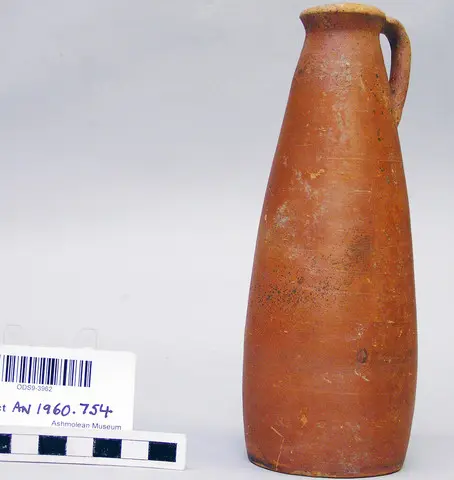
Older literature sometimes calls ESA "Pergamene" ware: Quilici in 1971 refers to "the type known as «Pergamene»", meaning Eastern Sigillata A [1, p. 169]. The label survives in museum titles. The Ashmolean's Cypriot Sigillata bottle (Pergamene ware) combines the old name with the newer identification, which is Cypriot Sigillata (AN1960.754, 17.6 cm high, museum record).
ESA also made mould-made relief vessels. A sherd in the Royal Ontario Museum, 9.6 cm across, comes from an Eastern Sigillata A relief krater. Complete ESA vessels in American collections include a jug of the 1st century BCE to 1st century CE in the Princeton University Art Museum (y310), probably from Cyprus, and two cups in the same museum (y1929-77 and y1940-323). See all Eastern Sigillata A in the catalogue.
Cypriot Sigillata
Cypriot Sigillata is the same ware as Eastern Sigillata D (ESD). Hayes identified it in 1967 and published its typology in 1985; excavators still refer to its forms by his "P" numbers [1, p. 168]. A little was made in the 1st century BCE. Output grew in the 1st century CE and peaked around 50–100 CE, then fell away in the 2nd century and stopped in the first half of the 3rd [1, p. 170]. In the House of Dionysos at Nea Paphos it starts to dominate the fine wares in the Augustan period, and it is commonest in the west of the island. At Panagia Ematousa in the south-east it does not overtake ESA until the 2nd century CE [1, p. 170].
The name takes a side in a debate that is still open. In 1967 Hayes judged it "far more likely to come from the Soloi region", while allowing that "the possibility that it is not from Cyprus at all cannot be altogether ruled out". He restated the Soloi attribution in 1991 [1, pp. 168–169]. Meyza noted in 1995 that there was "no decisive proof ... in the form of workshops found on the island" [1, p. 169]. Field survey in the hinterland of Soloi by the Troodos Archaeological and Environmental Survey Project turned up only a few, late pieces, which does not support a Soloi origin [1, p. 169]. In 1997 Lund argued instead for the area around Nea Paphos. His case is strengthened by the large repertoire of early Cypriot Sigillata forms on Geronisos, many of them rare [1, pp. 169–170]. Hayes in 2003 still held that the ware was made in Cyprus [1, p. 169].
Clay analysis has added a complication. Cypriot Sigillata is chemically similar to Late Roman D, which is now known to have been made at Gebiz in Pamphylia. Lund draws the consequence plainly: this "raises the possibility that some (or all) of the Cypriot Sigillata workshops might also have been located in Pamphylia, but there is at present no evidence" [1, p. 170].
Examples in this catalogue include two vessels in the Ashmolean: the jug from Amathous shown above and the bottle discussed under Eastern Sigillata A. A jug in the Hunterian Museum, Glasgow, is also catalogued here as Cypriot Sigillata. See all Cypriot Sigillata in the catalogue.
Cypriot Red Slip
Late Roman D ware (LRD) was first classified at Antioch by Waagé in 1948. In Late Roman Pottery (1972) Hayes tentatively placed its origin on Cyprus because of where it was found and proposed the name Cypriot Red Slip Ware. The fullest study, Meyza's Nea Paphos V: Cypriot Red Slip Ware (2007), keeps that name [4, p. 3]. The ware was in use from the 4th to the 7th century CE. Armstrong has proposed (2009) that it continued into the 8th or perhaps the early 9th century [4, p. 3]. It is the commonest fine ware on Cyprus in the late Roman period and is found widely around the eastern Mediterranean [4]. On Cyprus it competed with imported red-slipped wares from North Africa (Late Roman A, African Red Slip) and from Phocaea in western Asia Minor (Late Roman C) [4, p. 3]. Until the mid-7th century it predominates among the fine wares of the Episcopal Precinct at Kourion, and it appears with Cypriot Sigillata in the finds from Petrera at Maroni.
The Cypriot name has since been challenged. No production centre has been found on Cyprus. From 2008 the Pisidia Survey Project located seven production centres near Gebiz, 32 km north-east of Antalya, and their output covers the whole standard repertoire of the ware, together with cooking pots and amphorae [4, pp. 2–3]. Jackson and his colleagues concluded in 2012 that "Cypriot Red Slip Ware" is the wrong name for these Anatolian products and revived "Late Roman D". They did not rule out Cypriot workshops as well, since earlier clay analyses by Rautman fit Cypriot geology [4, p. 3]. Lund accepts that LRD, "previously attributed to Cyprus only, … is now known to have been manufactured at Gebiz in the area of ancient Pednelissos in Pamphylia" [1, p. 170].
The catalogue does not yet hold a published example of this ware. See Cypriot Red Slip in the catalogue as examples are added.
Plain wares and lamp fabrics
The everyday pottery of Hellenistic and Roman Cyprus (cooking pots, frying pans, storage jars, unguentaria and lamps) is much less studied than the fine wares, and no agreed classification of Cypriot "Roman plain" fabrics exists yet. The few lamp studies show the same mix of local work and imports seen in the tablewares. Locally made mould-made lamps at Geronisos follow Egyptian prototypes closely, while true Ptolemaic terracotta lamps are rare: fewer than a dozen are known from Cyprus, five of them from the Maloutena quarter of Nea Paphos and two from Salamis [1, p. 206]. African Red Slip imports reach the island from the 2nd and 3rd centuries CE onwards [1, p. 206].
The catalogue has no objects filed under this heading yet. See Roman plain and lamp fabrics in the catalogue.
Using the sequence
Because each ware has a fairly well defined date range, these fine wares are the main tool for dating Hellenistic and Roman deposits on Cyprus. A deposit with colour-coated ware and black gloss but no red sigillata is likely to be earlier than about 150 BCE. Eastern Sigillata A without Cypriot Sigillata points to the late Hellenistic period, and a dominance of Cypriot Sigillata points to the 1st century CE, especially in the west. Late Roman D marks the 4th century CE or later. The proportions also differ by region. ESA is more common in the east and Cypriot Sigillata in the west, so the same date can produce a different mix at Kition and at Nea Paphos [1, pp. 166, 170]. Several other catalogue pieces, such as a pedestal cup with leaves and wavy lines and a footed bowl in Toronto, are catalogued under the general Hellenistic and Roman heading until their ware is identified more closely. For the earlier pottery see the index of Cypriot pottery types.
Objects on this page
- Cypriot Sigillata jugBronze Age · 3900 BC–100 AD
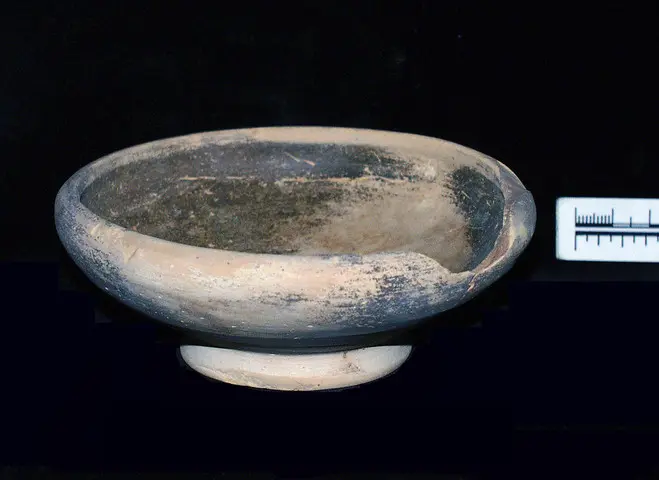 Black wash covered small bowl with inverted rim, Cypriot imitation of an Attic black-gloss salt-cellarHellenistic · 312–58 BC
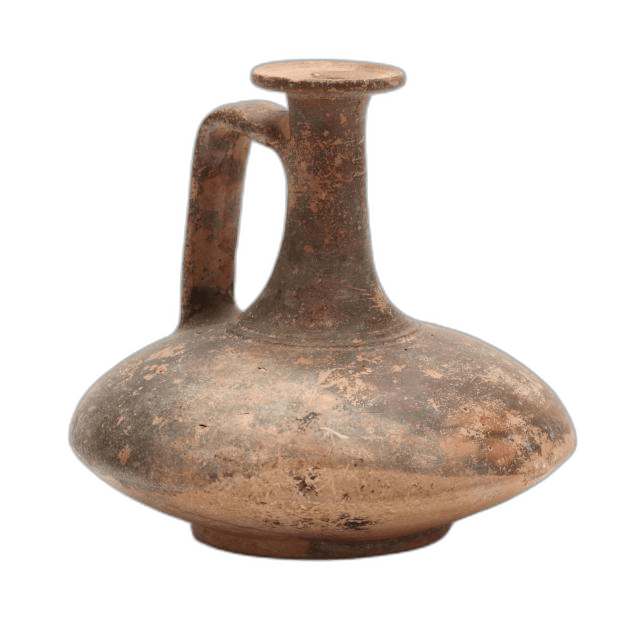 Cypriot Hellenistic Black Slip JugHellenistic · 300–1 BC
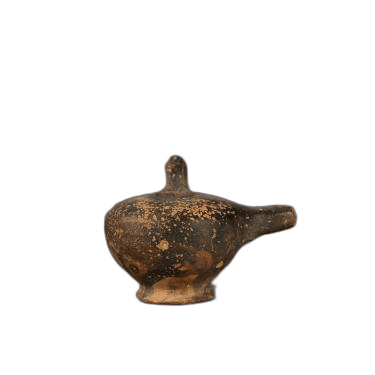 Feeding bottleRoman · 3–2 BC
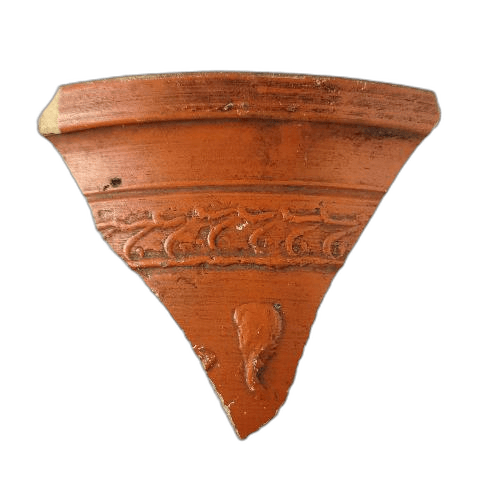 Fragment from an Eastern Sigillata "A" Ware Relief KraterRoman · 20 BC–10 AD
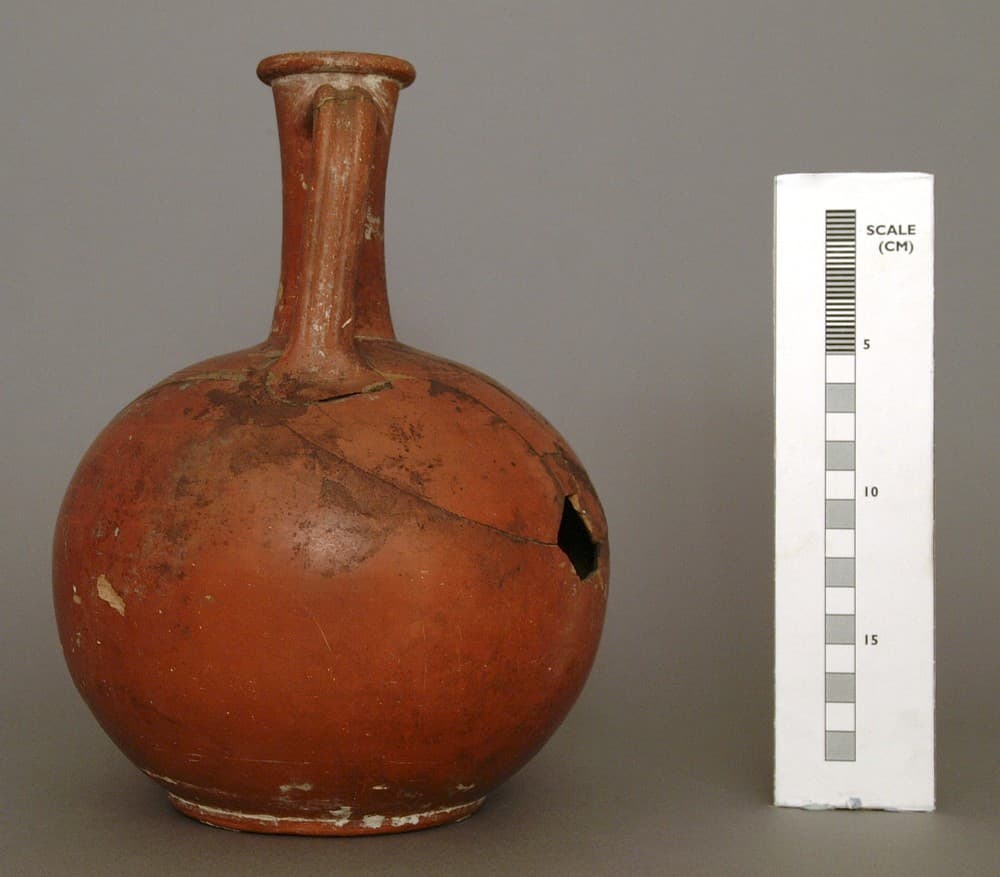 jugRoman · 1–300 AD
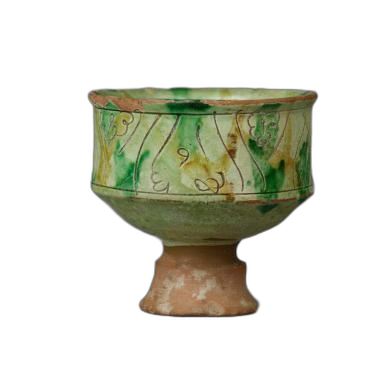 Pedestal cup with decoration of leaves and wavy lines1200–1300 AD
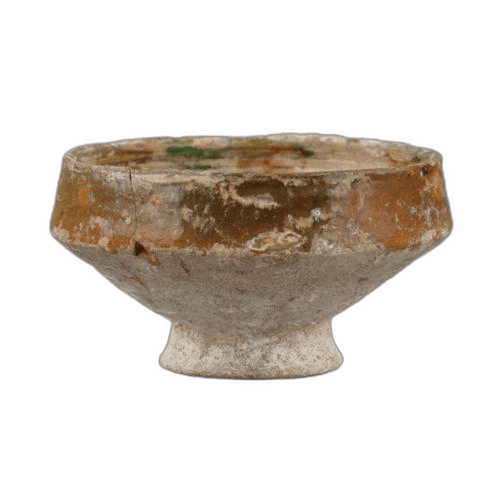 Footed bowlRoman · 13–14 AD
In the catalogue
References
- 1.Lund, J. (2015). A study of the circulation of ceramics in Cyprus from the 3rd century BC to the 3rd century AD (Gösta Enbom Monographs 5). Aarhus University Press.
- 2.Marzec, E., Kiriatzi, E., Müller, N. S., & Hein, A. (2018). The provenance and technology of a group of Hellenistic colour-coated ware pottery from the excavations at Nea Paphos on Cyprus. Journal of Archaeological Science: Reports, 21, 1035–1043. https://doi.org/10.1016/j.jasrep.2017.10.006
- 3.Marzec, E., Kiriatzi, E., Müller, N. S., & Hein, A. (2019). An integrated typological, technological and provenance investigation of Late Hellenistic colour-coated pottery from Nea Paphos, Cyprus. Archaeological and Anthropological Sciences, 11, 4103–4122.
- 4.Jackson, M., Zelle, M., Vandeput, L., & Köse, V. (2012). Primary evidence for Late Roman D Ware production in southern Asia Minor: a challenge to 'Cypriot Red Slip Ware'. Anatolian Studies, 62, 89–114. https://doi.org/10.1017/S0066154612000051