
Contents
The first coins of Cyprus were struck in the late sixth century BCE, when Cyprus was divided into several city-kingdoms that all paid tribute to the Persian Great King [1, p. 59]. From then until the Roman period, coinage is one of the few sources that come straight from the hands of the people who governed the island: each king put his own sign, script and gods on his silver, and the changes in those choices track the politics of the Cypro-Archaic and Cypro-Classical kingdoms more closely than any surviving text. You can see all coins in the catalogue.
Weight, metal and how coins were made
The earliest Cypriot coins were of silver only. They were made by striking: a weighed blank of metal was placed between two dies and hammered. At first only the lower die was engraved, but an engraved upper punch die soon followed, so that both faces carried a design [1, p. 59]. The design identified the issuing authority, usually with an abbreviated inscription.
All the kingdoms adopted the same weight standard, the "Persic", which had originated in western Asia Minor and been taken over by the Persians [1, p. 59]. The main denomination of the Persian period was the double shekel of about 10.8 g [1, p. 59]. Evangeline Markou describes the early silver sigloi of Salamis as following a local standard "based on a heavier unit of ca 11g" [3]. By the late fifth century BCE a wide range of small silver fractions was in use: thirds, sixths, twelfths, twenty-fourths and forty-eighths, the smallest weighing little more than a tenth of a gram. Veronica Tatton-Brown reads these as "the small change of the day, for buying and selling in the market-place"; the British Museum holds a number of them from a hoard found at Idalion in 1869 [1, p. 59].
Because each coin was struck by hand, the hammer blow was rarely centred, and coins of the same type look different from one another depending on the die, the force of the strike and their wear in circulation [3]. Markou points out that this makes each surviving coin a separate piece of evidence, and that counting the dies behind a series allows estimates of how much coin a ruler issued [3].
The mints and their emblems
By the fifth and fourth centuries BCE virtually every major city had a mint: Salamis, Paphos, Kition, Idalion, Amathus, Lapithos and Marion [1, p. 59]. Vassos Karageorghis puts it as the ten kingdoms each issuing their own coinage "on the model of the Greek city-states" [2, p. 177]. Many designs were borrowed from coins elsewhere in the Greek world, and Aegean silver moved east into the Persian Empire; Cypriot coins turn up in hoards found mostly in Egypt and Syria [1, p. 59].
| Kingdom | Typical emblem | Script of the legends |
|---|---|---|
| Salamis | Ram; ankh | Cypriot syllabary, for a time Phoenician, later Greek as well |
| Paphos | Bull; eagle | Cypriot syllabary |
| Idalion | Sphinx; lotus | Cypriot syllabary |
| Kition | Herakles-Melqart | Phoenician |
| Lapithos | Greek subjects in Greek style | Phoenician |
| Marion | Apollo; Europa on the bull | Cypriot syllabary |
Emblems and scripts after Tatton-Brown [1, pp. 59–60] and Karageorghis [2, p. 177].
The choice of script is the most telling detail. Salamis, Paphos, Idalion, Amathus and Marion wrote their kings' names in the Cypriot syllabary, while Kition, the chief Phoenician city, and Lapithos used Phoenician letters; at Lapithos the subjects are Greek and the style Greek, with Phoenician legends [1, pp. 59–60]. The legends of Salamis moved from Cypriot to Phoenician and back to Cypriot with Greek, a sequence Tatton-Brown links to the political upheavals of the kingdom [1, p. 60]. Two silver coins in the Cyprus Museum show the range: one of King Stasandros of Paphos, mid-fifth century BCE, 2 cm across, with a bull on the obverse and a flying eagle on the reverse; and one of King Timocharis of Marion, second half of the fifth century, 2.3 cm, with a wreathed head of Apollo and Europa riding the bull [2, p. 177]. The 2012 exhibition Ancient Cyprus: Cultures in Dialogue assembled royal issues from nearly every kingdom, from Lysandros of Amathus and Sidqmilk of Lapithos to Evnostos of Soloi [4, p. 89].
Salamis and Evelthon: the first royal coins
The earliest coins of the kings of Salamis are silver sigloi with a recumbent ram on the obverse, the name Evelthon in the nominative in syllabic script (e-u-we-le-to-ne), and a smooth reverse [3]. Evelthon was a king of Salamis whom Herodotus places in events at the end of the sixth century BCE [3]. The next series keeps the ram but puts the name in the genitive (e-u-we-le-to-to-se) and adds a reverse design: an Egyptian ankh in an incuse square, with various syllabic signs around or inside its loop. That series is dated by hoards buried after 480 BCE [3]. A siglos of Evelthon's successors (480–450 BCE) in the Ashmolean Museum weighs 11.11 g (Kyprios Character record); a siglos of an unidentified king of the first quarter of the fifth century in Copenhagen weighs 10.60 g (Kyprios Character record) [3].
The date of the very first issue is not fixed. Karageorghis names Evelthon of Salamis, c. 560–525 BCE, as the first king to strike coins [2, p. 177]; Tatton-Brown dates the beginning of Cypriot coinage more generally to the late sixth century [1, p. 59]; Markou ties Evelthon to the end of that century through Herodotus and dates his second series after 480 by hoards [3].
Reading the signs: a debate
The syllabic signs around the Salamis ankh have been read in many ways. Early in the twentieth century they were taken as evidence that Evelthon had conquered the whole island, as initials of later kings, or as an abbreviation of the island's own name, and attempts were made to match them with the successors Herodotus names. Markou, following Picard, concludes that these legends cannot be attached to known names [3]. She treats this as a general warning against fitting coin legends to the names in literary texts [3].
A second case shows the same problem. A series with a lion on the obverse, a bull on the reverse and a single syllabic sign was long attributed to Golgoi (or Soloi), on the reading go. Jonathan Kagan showed in 1999 that the sign is ko, not go, which removes the link to Golgoi; when the same sign was found on gold tenths of Evagoras I, it prompted the suggestion that Evagoras had conquered Golgoi, which Markou rejects. What ko stands for remains unknown [3]. Kagan's own survey opens by noting how much of early Cypriot coinage was still uncertain at the end of the twentieth century, and that G. F. Hill's British Museum catalogue of 1904 was still the best overview [5].
Evagoras I and the first gold
Evagoras I of Salamis (411–373 BCE) promoted Greek culture at his court. His coins are in a fine Greek style, he introduced Greek lettering on coin inscriptions, and he issued the first gold coins struck on the island [1, p. 60]. Karageorghis gives a political reading: gold was the prerogative of the Persian king, so gold in Evagoras's name implied that he considered himself the king's equal [2, p. 177]. The exhibition catalogue gives a more practical one: during the "Cypriot War" of the early fourth century both Evagoras I and Milkyaton, king of Kition, issued gold for the first time in Cyprus to pay their mercenaries [4, p. 89]. Markou uses die counts to compare how much gold each of the two kings struck during that war [3]. Gold was not a regular part of fourth-century coinage, but several kings used it alongside silver [4, p. 89].
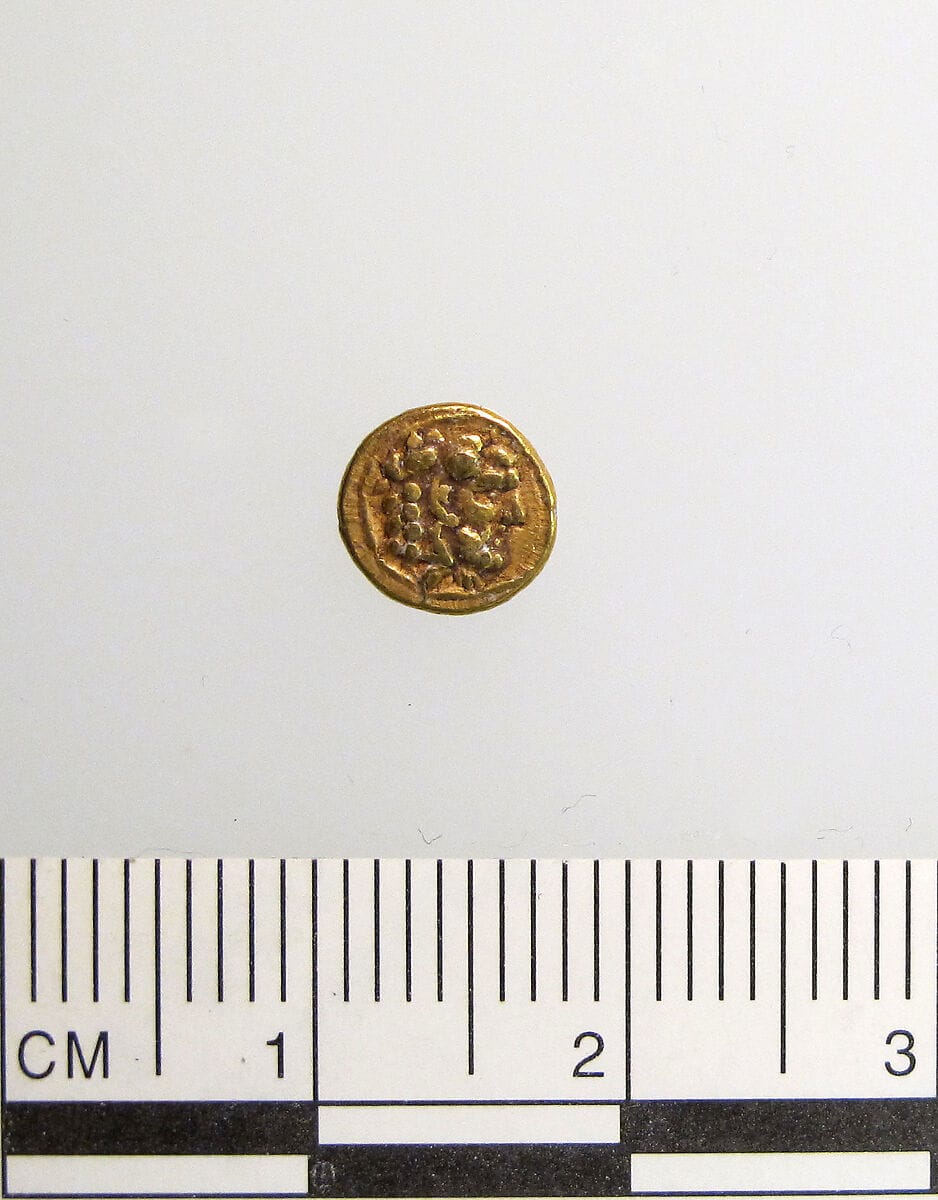
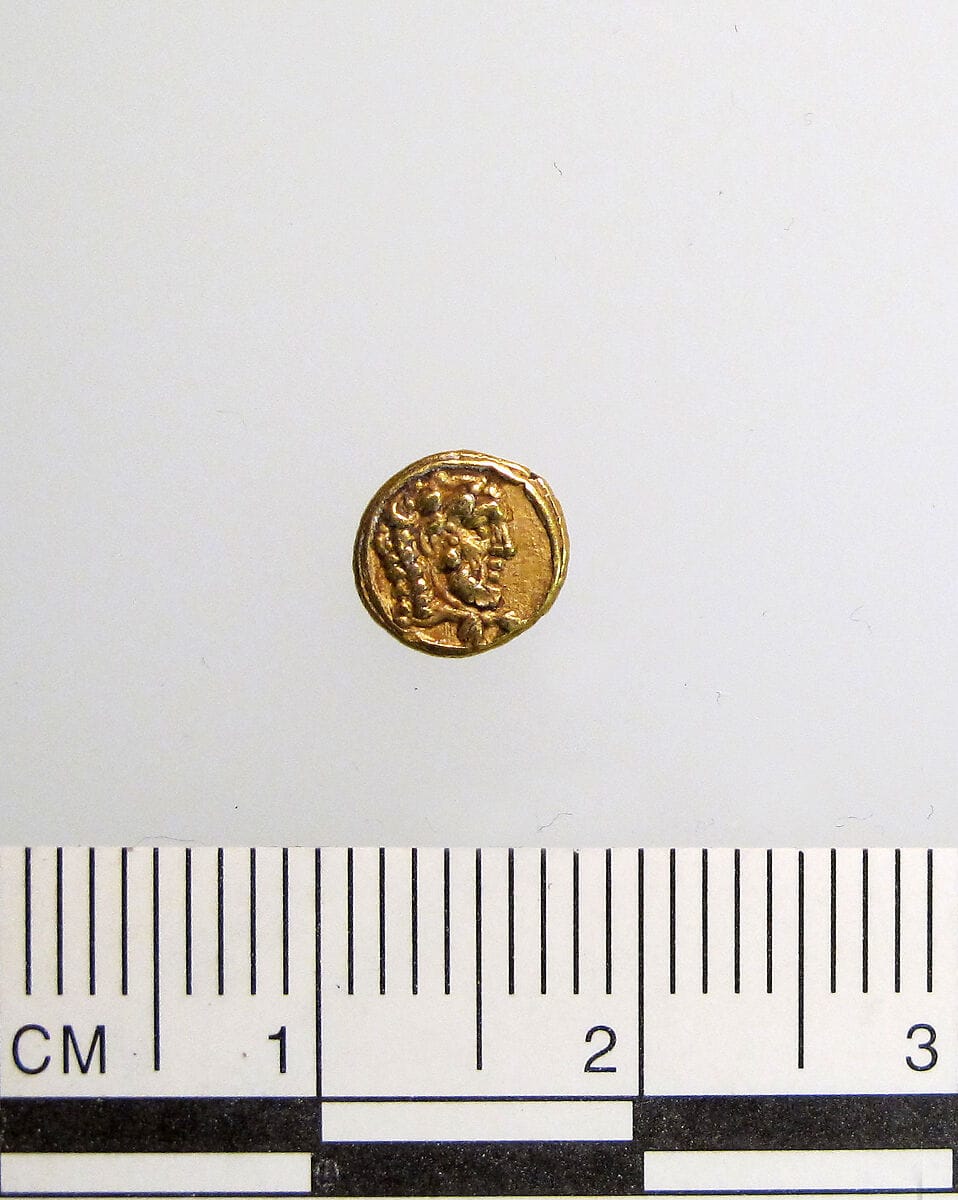
The Metropolitan Museum holds tiny gold pieces of this kind from the Cesnola collection. Two in our catalogue, a gold coin of Salamis and its twin, are recorded as twentieths of a stater of Evagoras I, with the head of Herakles in a lion-skin on the obverse and a goat's head on the reverse. Tatton-Brown illustrates the same pairing on the gold fractions of Evagoras I, which carry the Cypriot sign ba for the royal title basileus [1, p. 60]. A Yale stater of Evagoras I is a silver piece of 9.75 g. A third Met gold piece, a tenth of a stater of Salamis with Aphrodite on one side and Athena in a Corinthian helmet on the other, is attributed in its record to King Nikokles.
Later in the century, Evagoras II (361–351 BCE) struck the first bronze coinage in Cyprus, an alternative to the very small silver fractions, which were impractical to use [1, p. 60]. At Kition, Pumayaton, who reigned for some fifty years from 362/1 to 312 BCE, was the first to put a regnal year on the reverse of his coins. The largest volume of his gold dates to his thirtieth year, 333/2 BCE, when Alexander attacked Tyre; J. P. Six suggested in 1883 that the money was aid for Tyre. Alexander later took Tamassos from Pumayaton and gave it to Pnytagoras of Salamis [4, p. 90].
Alexander and the end of the kingdoms
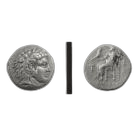
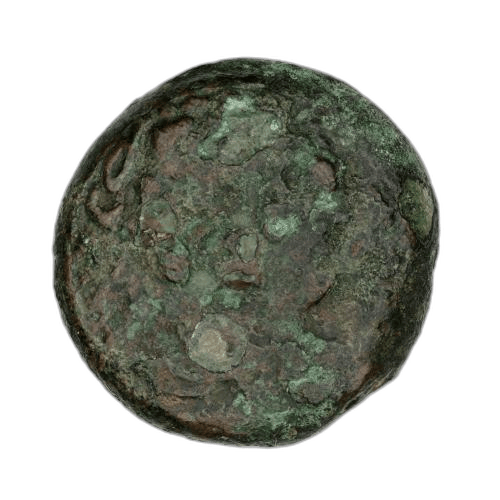
It is unclear whether the Cypriot kings went on issuing their own coins during Alexander's reign (332–323 BCE). What is clear is that several Cypriot mints struck Alexander's common coinage, the issues of each mint distinguished by monograms or symbols on the reverse [4, p. 90]. Silver tetradrachms with the head of Alexander as Herakles were struck at Salamis, Kition and Amathus, and some of them travelled to Egypt: the Royal Ontario Museum holds examples from a hoard found at Damanhur, among them a tetradrachm of the Salamis mint of 17.24 g, one from Kition and one from Amathus. The same museum has a small bronze unit of Alexander from Salamis, 5.28 g. These are now catalogued in the Ontario collection.
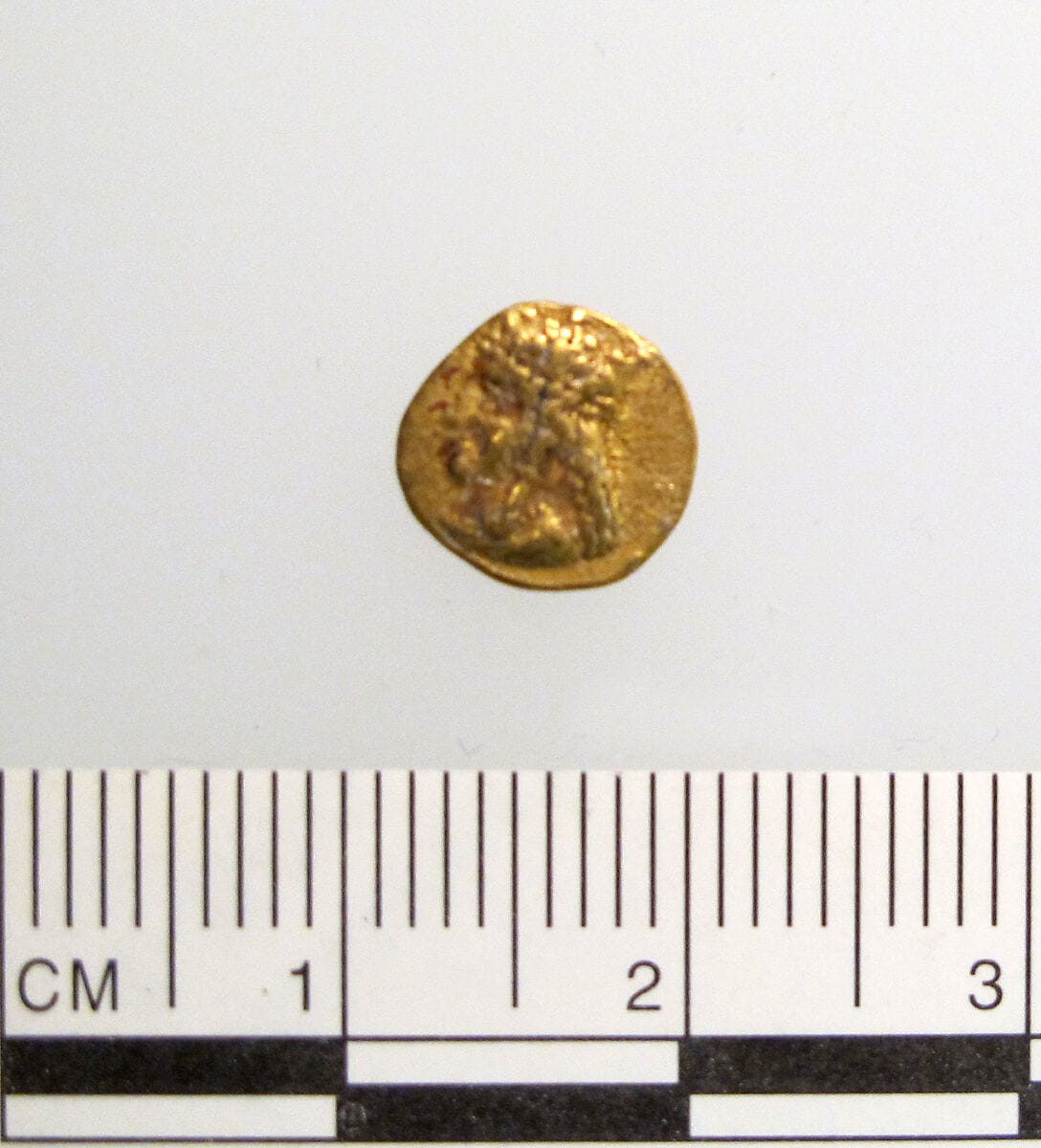
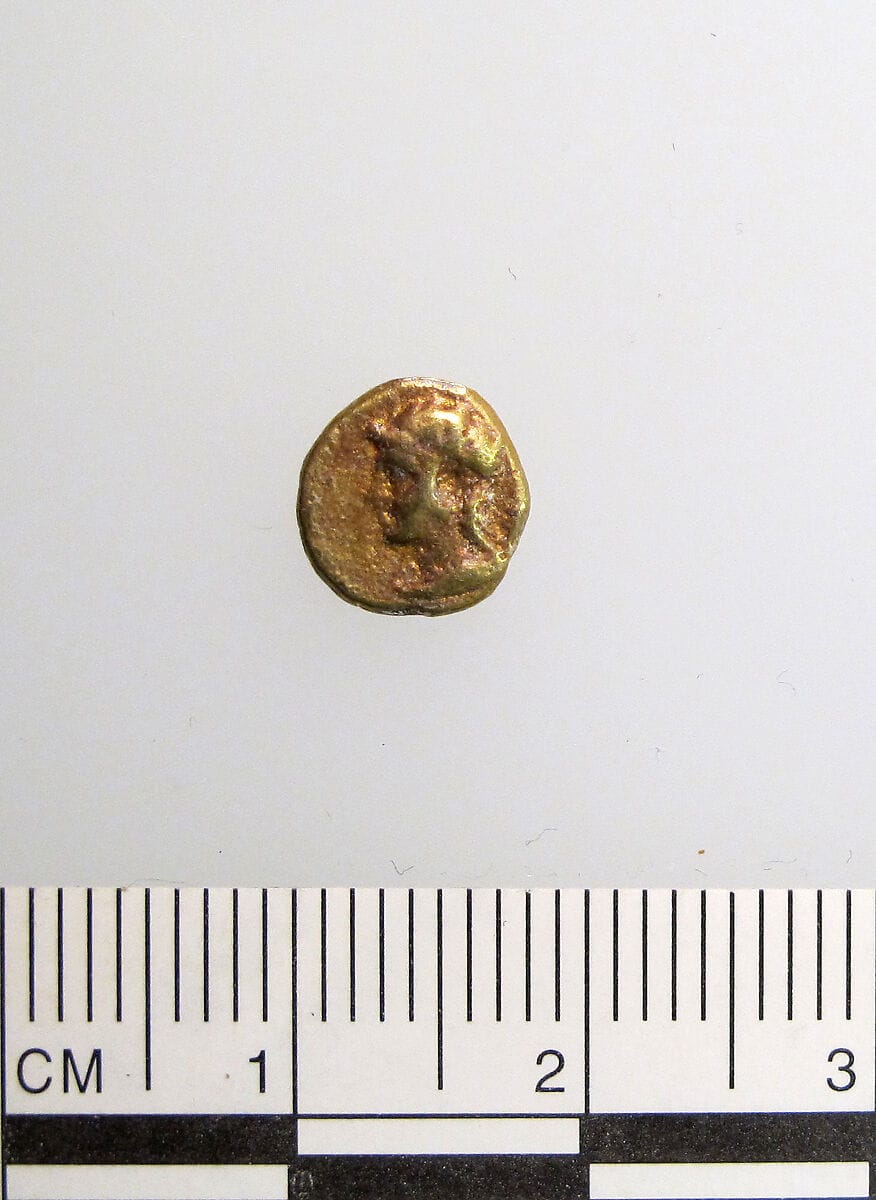
After Alexander's death in 323 BCE the Cypriot kings split between the rival camps of his successors and, until 315, issued mostly gold [4, p. 90]. Between 312 and 310/9 BCE Ptolemy I abolished the kingdoms, and the end of autonomous royal coinage is the clearest evidence for it [4, p. 90]. Ptolemy's brother Menelaos, his general on the island, struck gold in his own name using local iconography after the death of Nikokreon, the last king of Salamis [4, p. 90]. A Met gold tenth of Salamis attributed to Menelaos shows a turreted Aphrodite. Demetrios Poliorketes held Cyprus from 306 to 295/4 BCE [4, p. 90].
Ptolemaic and Roman coinage
From 295 until 31 BCE Cyprus belonged to the Ptolemaic kingdom of Egypt (see Hellenistic Cyprus). A Ptolemaic official was in charge of the royal coinage on the island. Early Ptolemaic coins are hard to attribute to Cyprus because they carry no mint marks, but in the third century there were four mints, at Salamis, Paphos, Kition and probably Amathus, later marked with their initials (PA, SA, KI). Nea Paphos became the capital early in the second century, and the excavation of the House of Dionysos there revealed evidence of minting. The last Ptolemaic coins of Cyprus were struck under Cleopatra VII [4, p. 90]. Markou notes that the discovery of a coin mint at Paphos is still the main reference point for how blanks were made in Hellenistic Cyprus [3].
Under Rome, from 30 BCE, the island had a provincial coinage struck for local needs. It was never abundant, and it circulated alongside many countermarked Roman coins from other eastern mints [4, p. 90]. Under Vespasian, silver tetradrachms of regnal years 7 to 9 are attributed to Cyprus by their iconography and by hoard evidence. A tetradrachm of year 8 (75/76 CE) in the Cyprus Museum, 12.5 g, shows the laureate emperor on the obverse and the temple of Aphrodite at Palaepaphos on the reverse, with its conical cult stone; a bronze of Vespasian and Titus of the same year names the KOINON KYPRION, the union of Cypriot cities responsible for the ruler cult and for the bronze coinage, and shows Zeus of Salamis [4, p. 202]. The two reverse types may point to mints at Nea Paphos and Salamis [4, p. 202]. The Royal Ontario Museum's tetradrachm of Vespasian, 12.15 g and 25.5 mm across, is recorded as struck in Cyprus.
What coins can and cannot tell us
Coins give dates, names of kings, scripts, gods and weights that no other source preserves for many Cypriot kingdoms, and the design changes at Salamis follow its shifting allegiances. Their limits are just as clear. Many early types cannot be tied to a named king, the meaning of single syllabic signs is often unknown, and attempts to match coin legends to names in Herodotus have repeatedly failed [3]. Most finds come from hoards, many of them buried outside Cyprus in Egypt and Syria [1, p. 59], so the coins in museums reflect where silver went as much as where it was used. For the colonial-era collections that brought many of these coins to New York, London and Toronto, see the Cesnola collection and collecting Cypriot antiquities today.
Objects on this page
 Gold coinClassical · 391–380 BC
- Gold coinClassical · 391–380 BC
 Gold coinHellenistic · 320–309 BC
- Tetradrachm of Alexander III as HeraklesHellenistic · 332–323 BC
 Tetradrachm of Alexander III as HeraklesHellenistic · 325–320 BC
 Tetradrachm of Alexander III as HeraklesHellenistic · 323–320 BC
 Unit coin of Alexander the GreatHellenistic · 332–323 BC
 Gold coinHellenistic · 312–306 BC
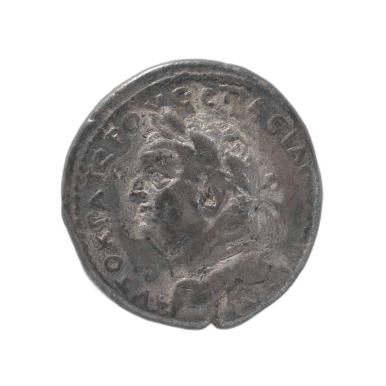 Tetradrachm of VespasianRoman · 76–78 AD
In the catalogue
References
- 1.Tatton-Brown, V. (1997). *Ancient Cyprus* (2nd ed.). British Museum Press.
- 2.Karageorghis, V. Ancient Cyprus: 7000 Years of Art and Archaeology.
- 3.Markou, E. (2016). Incorporating numismatics into historical studies: The case of Cyprus. In G. Bourogiannis & C. Mühlenbock (Eds.), Ancient Cyprus Today: Museum Collections and New Research. Åströms förlag.
- 4.Pilides, D., & Papadimitriou, N. (Eds.). (2012). Ancient Cyprus: Cultures in Dialogue. Nicosia: Department of Antiquities, Cyprus.
- 5.Kagan, J. H. (1999). The Archaic and Early Classical coinage of Kourion. Cahiers du Centre d'Études Chypriotes, 29.