
Contents
The nine centuries between the Arab raids of the seventh century and the Ottoman conquest of 1570-71 are the last chapter of the island's story covered on this site. In that time Cyprus was a Byzantine frontier province, a Crusader kingdom ruled by the French house of Lusignan, a Genoese foothold at Famagusta and finally a Venetian colony. The site's catalogue uses 650 CE as the start of this period, because the Roman page already covers Late Antiquity into the seventh century, and 1571 as its end. Museums divide the same span differently: the Ashmolean Museum labels its Cypriot medieval objects "Byzantine Period (Cyprus) (395 - 1191 CE)" and "Lusignan Dynasty (Cyprus) (1191 - 1489)". The objects that survive from these centuries in our catalogue are almost all glazed table wares, and most of this page is about them. see all Byzantine and medieval objects in the catalogue
Early Byzantine Cyprus and the "Dark Ages"
Historians have long divided early medieval Cyprus into three parts: a Late Antique "golden age" running from the late fourth or early fifth century to the seventh, the "Byzantine Reconquista" after 965, and an in-between period traditionally called the "Cypriot Dark Ages" [1, p. 15]. The key document for that middle stretch is a treaty dated to 686-88 that divided the island's tax revenue between the Umayyad caliphate and Byzantium. Older historians read the result as a "condominium", a buffer zone or no man's land, and assumed that it neutralised social and economic life: repeated destruction, the end of urban life, a retreat inland and a purely rural economy. Zavagno lists Dikigoropoulos, Kyrris, Megaw, Browning, Hadjisavvas, Karageorghis, Rautman and Metcalf among those who held versions of this view, and argues that it leans too heavily on the written sources; his own reading stresses continuity and resilience [1, p. 15].
The archaeology does not settle the matter. Survey at Pyla-Koutsopetria on Larnaca Bay found a "fairly lengthy break" in fine wares from the late seventh or early eighth century to the twelfth [3, p. 121]. Imported fine tablewares of those centuries are known mainly from Paphos: Glazed White Ware I from Constantinople, Plain Glazed Ware, and Plain Glazed Ware in a white fabric, none of which turned up at Koutsopetria [3, p. 121]. A gap in one class of pottery at one coastal site is a gap in the evidence, and it remains open how far it reflects a gap in settlement.
The Middle Byzantine province (965–1191)
Byzantium recovered the island in 965. The chroniclers Skylitzes and Kedrenos record that the patrician and strategos Niketas Chalkoutzes drove out the Arabs under the emperor Nikephoros Phokas, and a kourator of Cyprus became the island's principal official [1, p. 194]. The written record of this recovery amounts, in Zavagno's phrase, to a few "laconic scraps" [1, p. 194]. Byzantine church architecture of this period set the types that went on being built after 1191, and the twelfth-century hermit Saint Neophytos belongs to its last decades [2, pp. 225, 227].
The Lusignan kingdom (1192–1489)
In 1191 the island passed from the usurper Isaakios Komnenos to Richard I, who handed it to the Knights Templar; they gave it back after a Cypriot revolt, and the island was then bought by Guy de Lusignan, who established a Frankish rule "which lasted from 1192 until 1489" [2, p. 225]. The new kingdom imported a Western feudal system, with a Haute Cour, a Basse Cour and the law code of the Assizes (later translated into the Cypriot dialect), and a society divided into dependent paroikoi, perperiarii and free francomati [2, p. 225]. The Latin Church dominated the Orthodox one, and the Orthodox bishoprics were cut from fourteen to four. Famagusta became a busy port exporting salt, sugar, wine, raw cotton and luxury textiles, and after the fall of Acre in 1291 it took in refugees from the mainland. Hadjisavvas's catalogue calls this the "golden age of medieval Cyprus in terms of cultural accomplishment", while noting that it was oppressive for the local population; the chroniclers Leontios Machairas and Georgios Boustronios wrote its history in Greek [2, p. 225].
Most of the medieval buildings a visitor sees today are Lusignan. The earliest surviving are the cathedral of St Sophia in Nicosia and the abbey church at Bellapais (early thirteenth century). After about 1300 the French Rayonnant cathedral of St Nicholas in Famagusta set the style for churches such as St George of the Latins and Saints Peter and Paul in the same city, and St Catherine in Nicosia; the Bellapais cloister, of the fourteenth century, is the latest phase of Gothic on the island [2, pp. 225–227]. Secular buildings include the castles of Kolossi and Saranda Kolones at Paphos, the fortified Royal Manor at Kouklia and the sugar refinery at Kolossi [2, p. 227]. Byzantine church types continued alongside the Gothic ones, at Agios Demetrianos and Agios Georgios at Dali and Agios Iakovos at Trikomo, and a hybrid Franco-Byzantine type joined a Gothic basilica to a Byzantine dome, as at St George of the Greeks in Famagusta and the Panagia Hodegetria (Bedestan) in Nicosia [2, p. 227]. Thirteenth-century wall paintings at Moutoullas, Kalopanagiotis and Sotira mix eastern elements with "crusader painting"; fourteenth-century work at Pelendri and Anogyra shows the Palaeologan style of Constantinople [2, p. 227].
The kingdom's decline began with the Genoese seizure of Famagusta in 1373-74, which the Genoese held until 1464, and the Mamluk invasion of 1426. After the royal army's defeat at Choirokoitia the kingdom became a tributary vassal of Mamluk Egypt [2, pp. 227–228]. Drought, locusts and pirate raids added to the strain. The last king, James II, married the Venetian Caterina Cornaro [2, p. 228].
Venetian rule (1489–1571)
Caterina Cornaro ruled as queen from 1473 until 1489, when Cyprus became part of the Venetian Republic [2, p. 228]. Venice governed through a Lieutenant and two Counsellors in Nicosia and Captains at Famagusta, the Salt Lakes of Larnaca, Paphos and Kyrenia, keeping the twelve old administrative districts. The island's defence relied on stradioti light cavalry and a peasant militia, the cernide. Grain went to Venice, which provoked bread protests and the revolt of James Diassorin [2, p. 228].
The visible Venetian legacy is military. The walls of Nicosia, with eleven heart-shaped bastions to plans by Giulio Savorgnano, were begun in 1567 and barely finished by July 1570; the circuit at Famagusta, attributed in part to Giovanni Girolamo Sanmichele, absorbed Lusignan and Genoese work, and there were further works at Kyrenia, Larnaca and Paphos and watch-towers at Alaminos, Kiti, Pyla and Xylofagou [2, p. 228]. In 1570 the Ottoman commander Lala Mustafa took the whole island except Famagusta, which held out under siege for a year; the Ottomans defeated the Venetians in 1571 and ruled Cyprus until 1878 [4, p. 48]. Venetian rule also changed the island's tableware: imported Italian maiolica "gradually replaced the main part of the local glazed ceramic production" [5, p. 2].
Glazed pottery and sgraffito
](https://cdn.ancientcyprus.com/ontariomuseum/8.png)
Glazed ceramics became a significant class of pottery in Cyprus during the late Byzantine and Frankish centuries, developing mainly between the twelfth and sixteenth centuries in several workshops [5, p. 2]. They were everyday objects: bowls, footed cups and jugs for the table [2, p. 227]. The main technique is sgraffito: the potter coated a red-firing body with white slip, scratched the design through the slip to the darker clay, often added copper green and iron brown, and covered the pot with a lead glaze [5, pp. 1–2]. Slip-painted ware, decorated by painting with slip, is the other main group [2, p. 227]. Decoration runs from geometric and plant motifs to birds, dragons, falconers and human figures, simplified and brightly coloured [2, p. 227].
Laboratory analysis of glazes from Lapithos and Nicosia, dated to the thirteenth to fifteenth centuries, found that all are lead glazes in the Byzantine tradition; some carry a little tin, too little to make them opaque, and copper, iron, cobalt and vanadium supply the colours. They were fired at about 900-950 °C [5, pp. 1–2]. Clay tripod stilts, kiln furniture on which the pots were set for firing, appear from the early thirteenth century and leave marks in the well of a bowl [5, p. 2; 7, pp. 155–156]. The chemistry separates Lapithos from Nicosia products and suggests a workshop in Nicosia, though no kiln has been found there [5, pp. 1–2].
Workshops: Paphos, Lemba, Lapithos and Enkomi
The main production centres were in the south-west, at Lemba and Kato Paphos, and in the north, at Lapithos and elsewhere in the Kyrenia district [5, p. 2]. Paphos ware, mainly of the thirteenth and fourteenth centuries, has a red body (grey or black when over-fired) with white slip usually only on the inside and the upper outside, on an upturned ring base with sharp edges. Lapithos ware, mainly of the fifteenth and sixteenth centuries, has a reddish body slipped inside and over most of the outside, leaving only the foot bare, on tall, elegant feet; most of it is sgraffito in green, yellow-brown or orange. A third workshop near Enkomi, outside Famagusta, is known from unfinished vessels and tripods; its pale whitish-pink sandy clay is glazed only inside and stands on a low ring base [5, p. 2]. (The medieval Lemba kilns are in the modern village near Paphos and have nothing to do with the Chalcolithic settlement at Lemba-Lakkous.)
The Leventis Municipal Museum's catalogue shows how these criteria are used in practice: plain glazed bowls whose fabric and shape "connect the vessel with Paphos Ware" are placed in the thirteenth century, and a chalice whose features connect it with Lapithos ware in the fifteenth [7, pp. 155–156].
How the wares are classified, and the dating problem
The first classification, by du Plat Taylor and Megaw in 1937-39, sorted the pottery into twelve groups by colour and technique, from Plain Sgraffito (I) and Slip-painted (II) through Early Brown and Green Sgraffito (III) to Green-painted wares (VIII-IX) and Imported Wares (XII) [6, p. 93]. Demetra Papanikola-Bakirtzis replaced it in 1996 with a workshop-based system, which most medieval archaeologists still use [6, p. 93]:
| Workshop | Ware | Date |
|---|---|---|
| Paphos | Slip-painted; plain incised; one-colour incised | 13th century |
| Paphos | Brown-and-green sgraffito | 14th century |
| Paphos | Plain glazed | 14th–15th century |
| Lapithos | Brown-and-green sgraffito | late 14th–15th century |
| Lapithos | Green Painted Sgraffito A and B | late 15th–early 16th century |
| Lapithos | Green Painted | 16th century |
The system has a weakness that its users acknowledge. The well-preserved museum vessels on which it rests came largely from clandestine digging, such as robbed tombs, so they give complete shapes without contexts, and the absolute dates are "often based rather on anecdotal correlations with political events than on clear stratigraphy" [6, p. 93]. Marie-Louise von Wartburg, working on excavated material, has called the conversion of style into chronology "an operation full of pitfalls" and questioned the standard sequence of Paphos first (thirteenth century) and Lapithos later, asking for stratigraphic evidence in place of traditional consensus [6, p. 93]. Papanikola-Bakirtzis's 2004 catalogue of the Leventis collection sidesteps the problem by arranging the pots by motif: people, coats of arms, birds and fish, plants and flowers, geometric designs and plain glazed wares [6, p. 93; 7].
Find-spot counts need the same caution. At Pyla-Koutsopetria the Cypriot sgraffito and green-and-brown glazed wares of the thirteenth to fifteenth centuries make up fewer than 0.2% of the fine wares [3, p. 121].
Medieval Cyprus in the catalogue
](https://cdn.ancientcyprus.com/ontariomuseum/61.png)
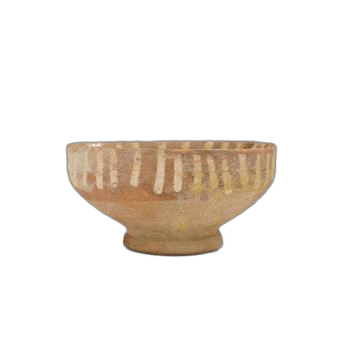
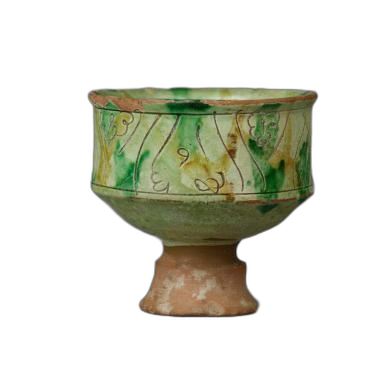
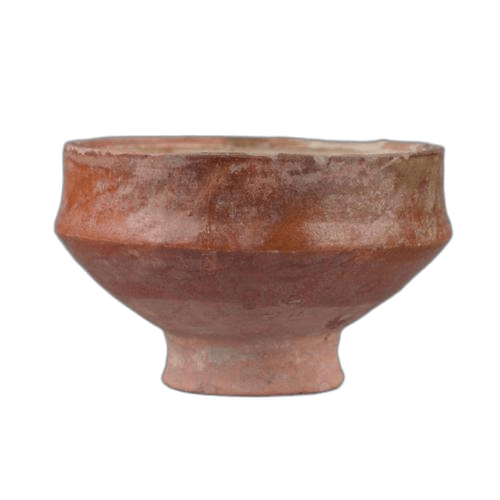
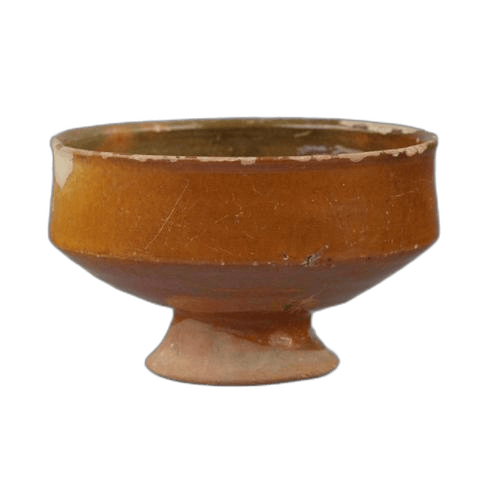
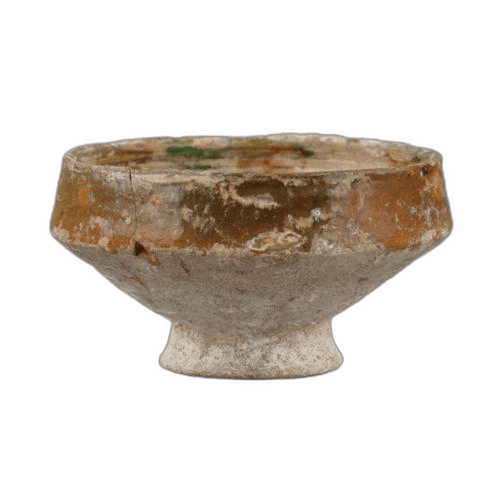
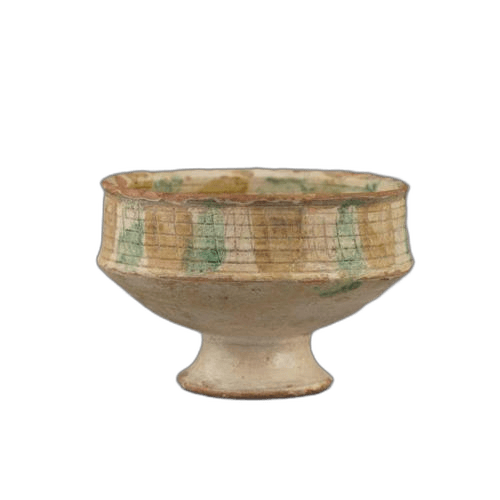
Nearly every medieval object in the catalogue comes from the Royal Ontario Museum's group of Cypriot glazed wares (accession numbers 962.236), which are listed under the Royal Ontario Museum collection. There is no medieval piece in the Drakopoulos collection. The Ontario pieces map neatly onto the classes above:
- A bowl with incised decoration in copper green and iron brown, "possibly Paphos" and dated to the thirteenth or fourteenth century by the museum, is a brown-and-green sgraffito bowl of the Paphos kind.
- A footed bowl with abstract designs, slipped, painted and glazed, belongs to the slip-painted ware.
- A pedestal cup with leaves and wavy lines is attributed by the museum to the Lapithos workshop but dated 1200-1300; that date sits awkwardly with the fifteenth- and sixteenth-century floruit of Lapithos ware in the literature [5, p. 2], and shows how loose the dating of museum pieces without context can be.
- A footed cup with a human head in profile, dated about 1475-1525, carries the figural decoration typical of the late sgraffito.
Comparable pieces in Britain include an Ashmolean sgraffito bowl, AN1965.735, 14.2 cm across and labelled Lusignan, and a green-glazed jug, AN1983.233, labelled Byzantine.
Related pages
For the centuries before, see Roman Cyprus and the chronology overview. For the ancient pottery sequence that the medieval glazed wares follow on from, see the pottery section; for the island's seismic history, see earthquakes. The ancient cities of Salamis, Kition and Kourion have their own site pages.
Objects on this page
In the catalogue
References
- 1.Zavagno, L. (2017). Cyprus between Late Antiquity and the Early Middle Ages (ca. 600–800): An Island in Transition (Birmingham Byzantine and Ottoman Studies 21). Routledge.
- 2.Hadjisavvas, S. (Ed.). (2010). Cyprus: Crossroads of Civilizations [Exhibition catalogue]. National Museum of Natural History, Smithsonian Institution.
- 3.Caraher, W. R., Moore, R. S., & Pettegrew, D. K. (2014). Pyla-Koutsopetria I: Archaeological Survey of an Ancient Coastal Town (ASOR Archaeological Reports 21). American Schools of Oriental Research.
- 4.Mirbagheri, F. (2010). Historical Dictionary of Cyprus (Historical Dictionaries of Europe 69). Scarecrow Press.
- 5.Charalambous, A. C. (2014). Cypriot medieval glazed pottery: A study on provenance and manufacture. In Cypriot Medieval Ceramics (pp. 279–298). Nicosia.
- 6.Given, M., Knapp, A. B., et al. (2013). Landscape and Interaction: The Troodos Archaeological and Environmental Survey Project, Cyprus. Vol. 1: Methodology, Analysis and Interpretation (Levant Supplementary Series 14). Oxbow.
- 7.Papanikola-Bakirtzis, D. (2004). Colours of Medieval Cyprus through the Medieval Ceramic Collection of the Leventis Municipal Museum of Nicosia. Leventis Municipal Museum.