American classicist who dug the bath building and Roman theatre at Kourion for the Penn Museum in 1948-50, but lost the final publication to Richard Stillwell.
Biography
DeCoursey Fales Jr. was the excavator who, between 1948 and 1950, excavated the palace and baths beside the theatre on the Kourion bluff, now called the house of Eustolios, for the University Museum of Pennsylvania5,6. Find a Grave gives his birth in New York on 9 March 1918 and his death in Cambridge, Massachusetts, on 12 April 2000, aged 827. The Penn Museum gives the same years, 1918-20006. His parents were DeCoursey Fales (1888-1966) and Dorothy Mildred Virginia Mitchell Fales, and his brother was Haliburton Fales7. His father collected rare books and manuscripts and gave them to New York University in 19578. Papers on the son, given to that library by his wife Iten Scott Fales, include school reports from Buckley, St. Paul's and Harvard and American School of Classical Studies papers from 1942 to 19548.
Kourion, 1948-1950
An expedition account says that "after the war in 1948" Fales, then "a Harvard student", joined the expedition9. The colonial report for 1948 calls him "a newcomer" who further examined the "Palace" building with mosaic floors on the acropolis of Curium, where a new mosaic was found10. Museum records list his finds near the bottom of "bath I" on 27 October 1948, entered in his first field notebook9. A letter of 1948 reports that he was "gaining momentum" and might have the whole palace cleared to its latest floors before the writer left9.
By 1949 Fales was convinced, a field report says, that the building was a bathing establishment and not a bath and palace9. The chief object of aesthetic significance there, the report adds, was a mosaic medallion of a lady with an inscription he read as "The Founding Spirit" (Ktisis)9,11. The colonial report for 1949 records that he cleared the adjoining Roman theatre, with a vaulted passage round the auditorium and traces of a colonnade12. An expedition report describes it as a solid masonry structure seating "something over 3000", an earlier theatre, possibly of the third century BC, enlarged in the second century AD and used for a while as an arena9. One of his notebook entries is dated 24 October 19499.
In the autumn of 1949 and the spring of 1950, under the general direction of Bert Hodge Hill, Fales cleared the greater part of the theatre and the bathing establishment, which the American Journal of Archaeology thought was probably built not long after AD 40813. A. H. S. Megaw wrote that he "completed his investigations" there, and that new coin finds placed the baths probably in the early fifth century AD1. The sources differ on when the theatre was finally destroyed: Megaw says by earthquake "in the fourteenth century"1, the American Journal of Archaeology "in the fourth century A.D."13. The area is now called the house and baths of Eustolios6. His preliminary report, "Kourion: The Amusement Area", appeared in the University Museum Bulletin 14, no. 4, in June 19509. Its page range is printed as 27-35 in one bibliography9 and as 27-36 in another14.
The lost publication
In 1951 Fales was at Dumbarton Oaks in Washington, where McFadden wrote to him as "Deke"9. That year Eisenhart wanted his paper on the theatre for the Proceedings of the American Philosophical Society, though Fales would have to enlarge it9. In 1952 McFadden wrote that Fales "has been ill for two years" and that it was doubtful whether he could publish the site9.
A note of 1953 judged his latest effort "as hopeless as the preceding ones" and gave the theatre to the Blegens9. Rodney Young was chosen to write telling him to turn in his notes, and a Museum letter says Young "did the firing" after consulting McFadden and Hill9. In April 1953 Fales asked to continue the publication for two more years and offered the Museum $15,000 at once, "to satisfy the Philosophical Society"9. Percy Madeira, a friend of Fales's father, was "embarrassed about the dropping of Fales" and wished to accept9. On 12 January 1954 the Museum assured Richard Stillwell that Fales no longer had any rights to publish the Curium material9. His belongings were shipped from Limassol to Gladstone, New Jersey, in February 19549.
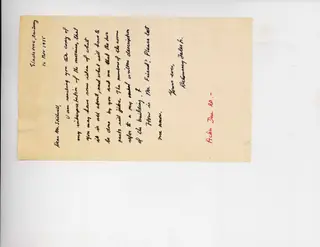
On 12 November 1955 Fales sent Stillwell from Gladstone his interpretation of the mosaics, so that "the two parts will jibe"9. The manuscript divides the floors into four main groups and opens with the inner court, with seven birds, two fishes and three large inscriptions; its notes run past 4009. In 1956 he took a Harvard PhD with a dissertation, The Arena-Bath Area at Curium in Cyprus, which recent work on Kourion still cites5. Stillwell's Kourion: The Theater (1961) judged one suggestion of Fales, "who excavated the theater", "possible but relatively improbable"15.
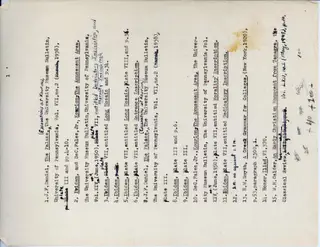
Fales gave papers to the Archaeological Institute of America in 1959, on the New York Band-Cup Painter, and in 1962, on an unpublished fragment from the North Slope of the Acropolis at Athens that he attributed to Kleitias16,17. The Penn Museum says he never completed a final publication of Kourion, and that he was for many years a professor of classics at Emerson College6.
Life and work
1948
Mr. De C. Fales jnr. of the Pennsylvania University Museum Expedition further examined the Palace building at Curium and found a new mosaic. (1948)
In the Kourion expedition papers of 1948: «This would suit Fales perfectly, since the lifting of the floors would give him an opportunity to make soundings under them»
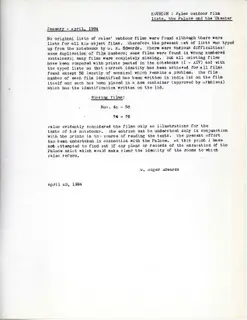
Completed, for the Pennsylvania University Museum Expedition, his investigations of the Kourion theatre and adjoining baths; the theatre was first built in the third century BC, and new coin finds put the baths probably in the early fifth century AD (Megaw's summary).
In the Kourion expedition papers of 1949: «Fales has been digging at "palace" (now proved to be thermae, a Roman baths establishment) since March 2, with about 18 men.»
In the Kourion expedition papers of 1949: «Fales' report and our application for the second $5,000 is going through to the Philosophical Society today.»
In the Kourion expedition papers of 1949: «I am not writing you about Fales' excavations as you have already his own report, and he will be sending you another before very long. I can say, however, that his excavations are beginning to become very impressive. Although there is a good deal more for him to do on the site of the palace, or the "bath" as it is now called, he has already began work on the theater.»
In the Kourion expedition papers of 1949: «Falet' account of the first eight weeks of work on the hill of Curium was sent you in March, and I have been glad to learn from George McF. that you found it sufficient to show that way a good beginning had been made of the Philosophical Society's grant. I now enclose his much briefer and even more informal account of the second eight weeks' work.»
Published 'Kourion: The Amusement Area' in the University Museum Bulletin (UPMB 14.4, pp. 27-35); Megaw cites a preliminary report with plans on both buildings at 'XIV, 4, pp. 27 f.'
In the Kourion expedition papers of 1951: «wouldn't be a good idea to have Fales read his paper on the Theater which is to be published in the Proceedings»
In the Kourion expedition papers of 1953: «Fales puts it this way: first, that he be allowed to continue work on the publication for the bath and the theater during the next two years»
In the Kourion expedition papers of 1953: «we should not accept Fales' money unless there is a fairly good chance that he is capable of doing the work»
In the Kourion expedition papers of 1953: «whether there is a fair prospect that Fales will be able to complete at Curium the Palace and Theater at Curium»
In the Kourion expedition papers of 1953: «Fales has come in here with the very strange proposition that he be allowed two more years to complete the final report on the baths and the theater, and that if we allow him to do that, he will turn in to the Museum $10,000 to refund the Philosophical Society grant and $5,000 to cover the costs of another man»
In the Kourion expedition papers of 1955: «he will carry on Fales' work toward the publication of the palace, theater and Baths on the Bluff of Curium.»
In the Kourion expedition papers of 1955: «the excavation had been done by Decourcey Fales, Jr., and that he had been working on the publication for some time»
In the Kourion expedition papers of 1972: «These coins were found during De Coursey Fales's investigations and I suppose that, other records apart, they are listed in his notebooks.»
5.“[Chapter on Kourion in the seventh century]”. Cyprus in the Long Late Antiquity: History and Archaeology Between the Sixth and the Eighth Centuries.
6.Penn Museum (2015). “Kourion excavation team”. Penn Museum, Kourion website (Wayback snapshot).
7.Find a Grave. DeCoursey Fales Jr. (1918-2000), memorial 145292266. Online
8.Fales Library and Special Collections, New York University. Fales Family Papers (MSS.029): finding aid. Online
9.University of Pennsylvania Museum. “Kourion (Curium) Expedition records”. Penn Museum Archives, PU-Mu 1050. Penn Museum Archives.
10.Colonial Office (1949). Annual Report on Cyprus for the Year 1948. HMSO.
11.Roger S. Bagnall and Thomas Drew-Bear (1973). “Documents from Kourion: A Review Article. Part 2: Individual Inscriptions”. Phoenix 27, 213-244.
12.Colonial Office (1950). Report on Cyprus for the Year 1949. HMSO.
13. (1951). “[Archaeological news: Kourion]”. American Journal of Archaeology 55.
14. (1960). “[Paper on Salamis baths]”. Akten des XI. Internationalen Byzantinistenkongresses, München 1958.
15.R. Stillwell (1961). “Kourion: The Theater”. Proceedings of the American Philosophical Society 105, 37-78.
16. (1960). “Sixty-First General Meeting of the Archaeological Institute of America (1959)”. American Journal of Archaeology 64, 182-189.
17. (1963). “Sixty-Fourth General Meeting of the Archaeological Institute of America (1962)”. American Journal of Archaeology 67, 208-219.