
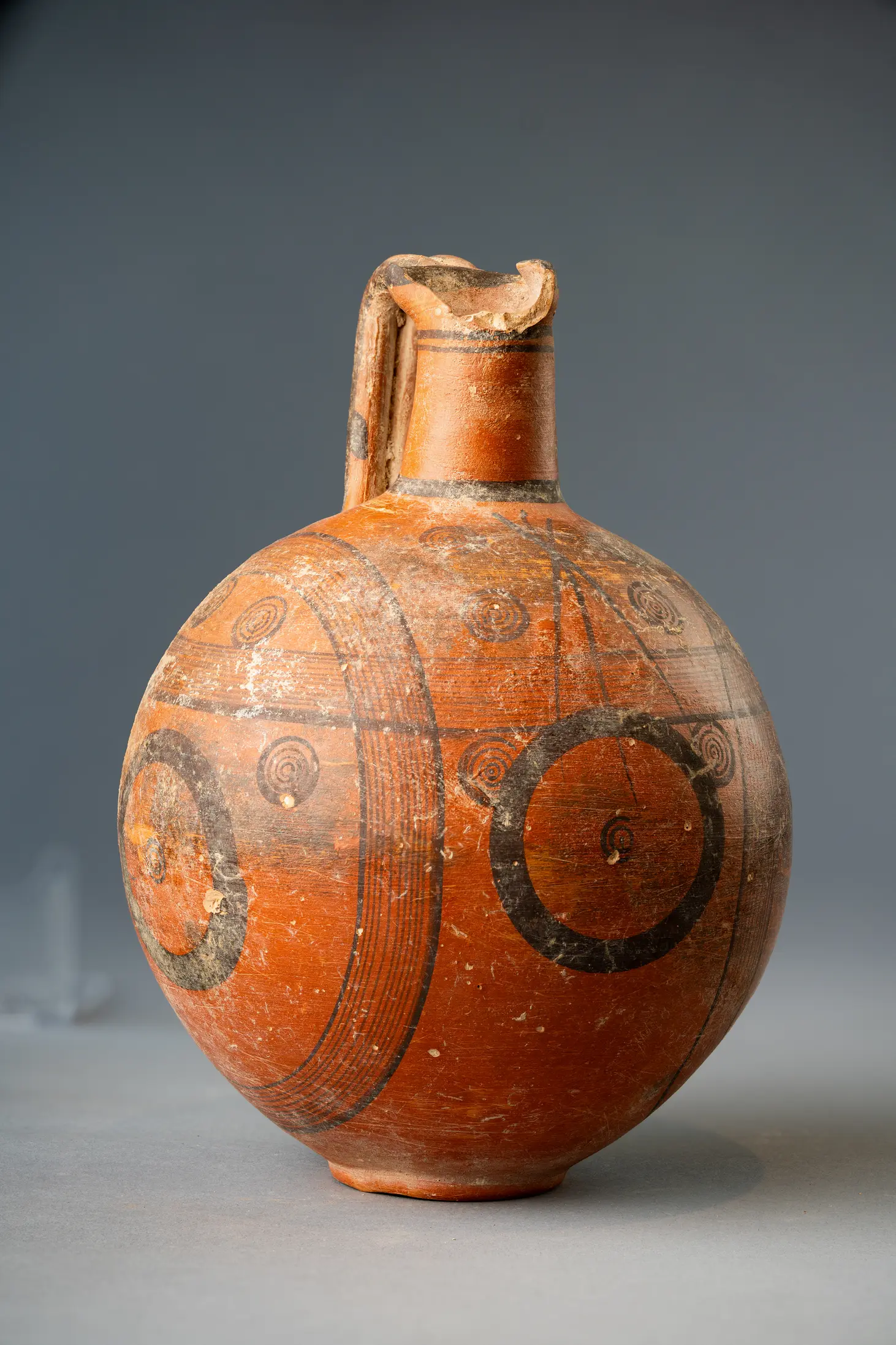
Archaic I
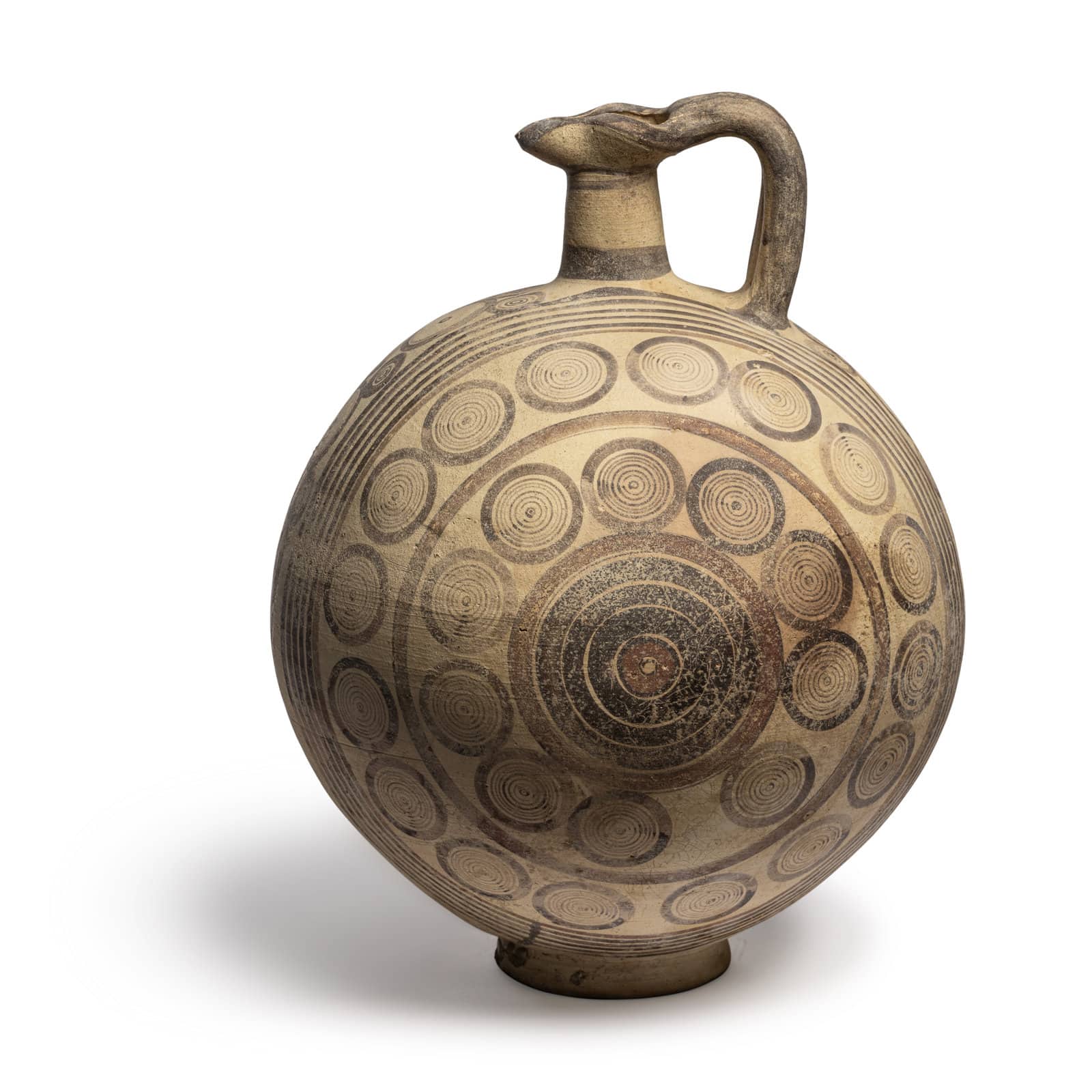
Black-on-Red Globular Jug with Concentric-Circle Decoration
Large Cypriot Black-on-Red globular jug, c. 750–600 BCE, painted with heavy side rings, sweeping arc groups and a shoulder row of small circles; mouth missing.
Date
750 - 600 BC
Accession No.
JUG-GE-016
Collection
Alexis Drakopoulos
3D Model
Cypro-Archaic I, c. 750–600 BCE · Black-on-Red ware · Wheel-made
A large jug with a nearly spherical body on a low ring base and a narrow cylindrical neck. The mouth has broken away; the jagged edge that remains, with the top of the strap handle attached behind it, points to a pinched trefoil mouth like those of its closest parallels. The orange-red slip is painted in matt black. On each side of the body a thick black ring surrounds a reserved field with a small concentric circle at its centre. Between the two sides, tall groups of fine concentric arcs sweep down the body, and small concentric circles are set round the shoulder above and below a pair of encircling lines. Black bands mark the neck. The surface is scuffed, with fine scratches, patches of whitish deposit and small spots of loss.
Commentary
The ware is Black-on-Red, black paint on a red slip. The body shape and the ornament match the globular jugs of Gjerstad's Black-on-Red II (IV), the ware's Cypro-Archaic I stage [1]. Gjerstad described the circle style of that stage as more developed than before: circles grouped or joined into rows, an outer circle-line drawn thicker than the rest, and large intersecting concentric lines on jugs [1]. All three features appear here in the heavy side rings, the small circles grouped on the shoulder and the sweeping arc groups.
Three museum jugs are close in shape, scale and scheme. A Black-on-Red II oinochoe from Aradhippou in the British Museum, 1880,0710.6 (H. 20 cm), has a globular body on a narrow ring base, a narrow neck and trefoil mouth, and large concentric circles enclosing smaller ones on each side [2]. A jug in the Ringling Museum, SN28.574 (H. 21.75 cm), once in the Cesnola Collection, carries a similar arrangement [3], and the Kunsthistorisches Museum in Vienna holds another Black-on-Red II (IV) jug, IV 1530, given in 1879 [4].
The British Museum and Vienna jugs are dated c. 750–600 BCE, and the Ringling example c. 800–650 BCE, so a Cypro-Archaic I date is the most likely. Gjerstad's staging of the ware is typological, and some of his later shapes turn up in the earliest firmly dated Black-on-Red contexts on the Levantine coast [5]. With Cypriot production now placed from c. 900 BCE [6], a date in the 8th century cannot be excluded. The fully developed circle style favours the later part of that range.
A jug of this size is a pouring vessel for wine or water at table. Most whole examples of the shape come from tombs, where jugs were set with bowls for drinking and serving.
Without the mouth the original height cannot be given, and the form of the lip remains an inference from the parallels. The painter's arrangement, with the side rings interrupted by the arc groups, is carefully spaced, though the small shoulder circles are laid out less evenly than the main rings.
References
- 1.Gjerstad, E. (1948) The Swedish Cyprus Expedition IV.2: The Cypro-Geometric, Cypro-Archaic and Cypro-Classical Periods. Stockholm: The Swedish Cyprus Expedition, Black-on-Red II (IV) ware, Figs. XXXVII–XL.
- 2.British Museum, London, 1880,0710.6. Black-on-Red II oinochoe from Aradhippou, Cypro-Archaic I, H. 20 cm.
- 3.The John and Mable Ringling Museum of Art, Sarasota, SN28.574. Black-on-Red jug, c. 800–650 BCE, H. 21.75 cm; ex-Cesnola Collection and Metropolitan Museum of Art, sold Anderson Galleries 1928.
- 4.Kunsthistorisches Museum, Vienna, Antikensammlung IV 1530. Jug of Black-on-Red II (IV) ware, c. 750–600 BCE; gift of 1879.
- 5.Schreiber, N. (2003) The Cypro-Phoenician Pottery of the Iron Age. Leiden and Boston: Brill, pp. 280–284.
- 6.Kleiman, A., Fantalkin, A., Mommsen, H. and Finkelstein, I. (2019) 'The Date and Origin of Black-on-Red Ware: The View from Megiddo', American Journal of Archaeology 123.4, pp. 531–555.
More from the Catalogue
Browse related objects
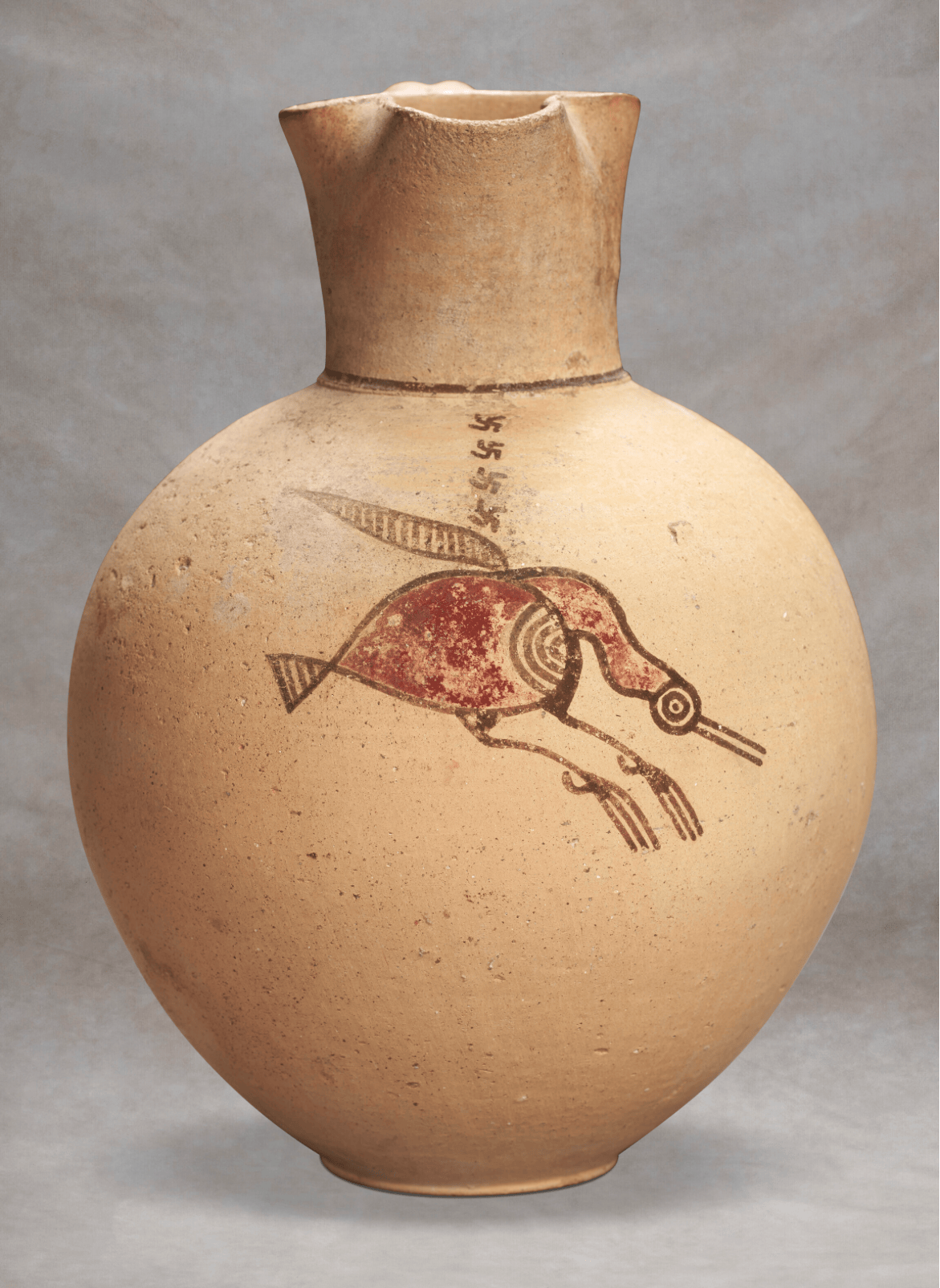
Bichrome Oinochoe
Archaic I
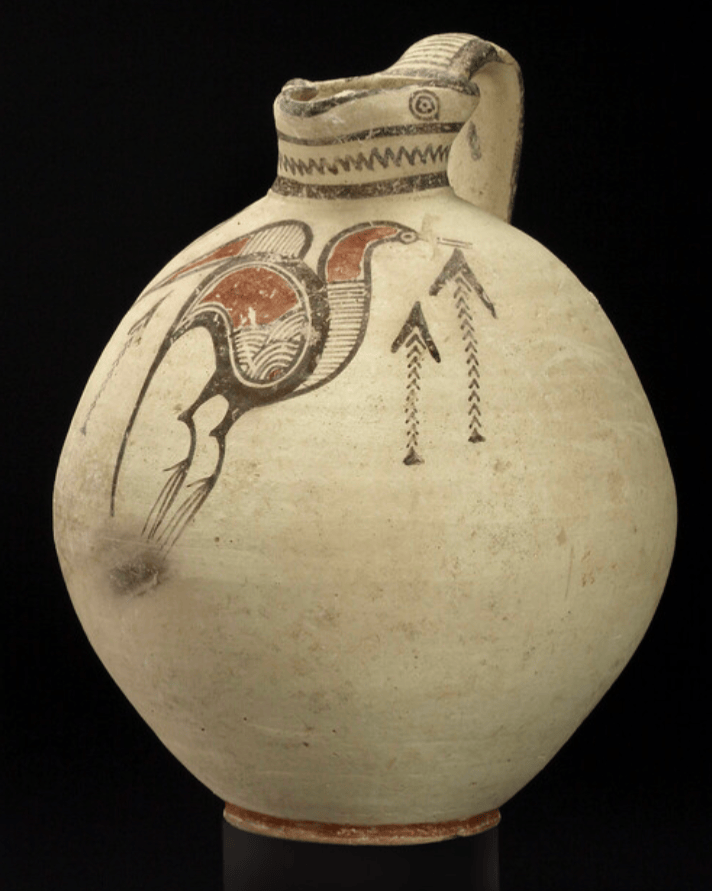
Free-field bichrome jug with image of an Ibis bird and reeds
Archaic
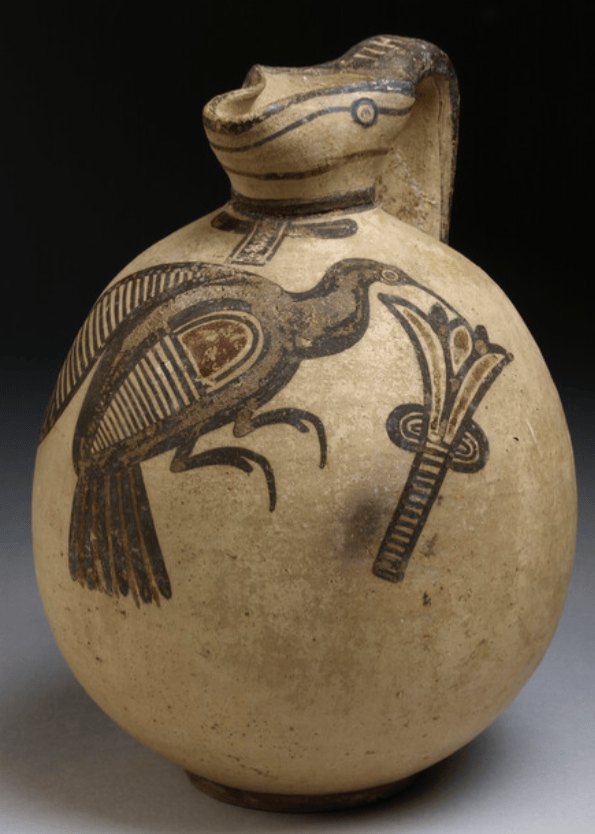
Squat bichrome jug in free-field style with image of bird picking a lotus flower
Archaic
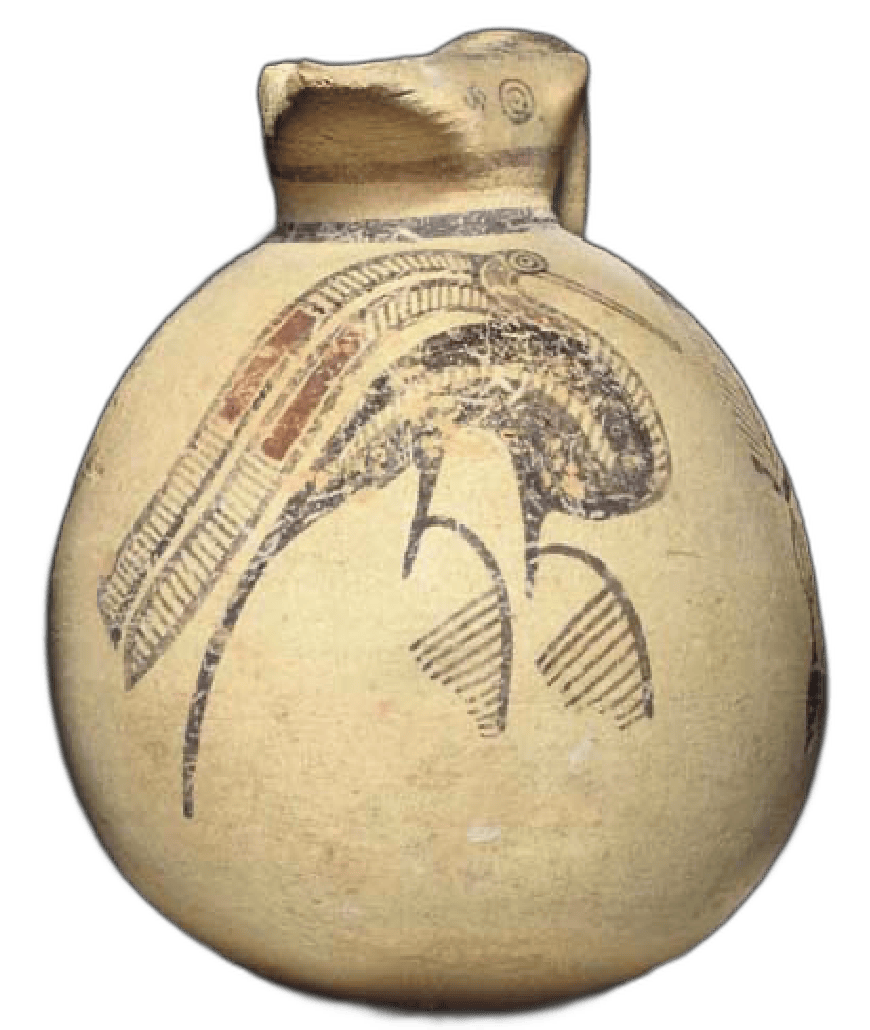
A Cypriot Bichrome-Ware Oinochoe Jug
Archaic I
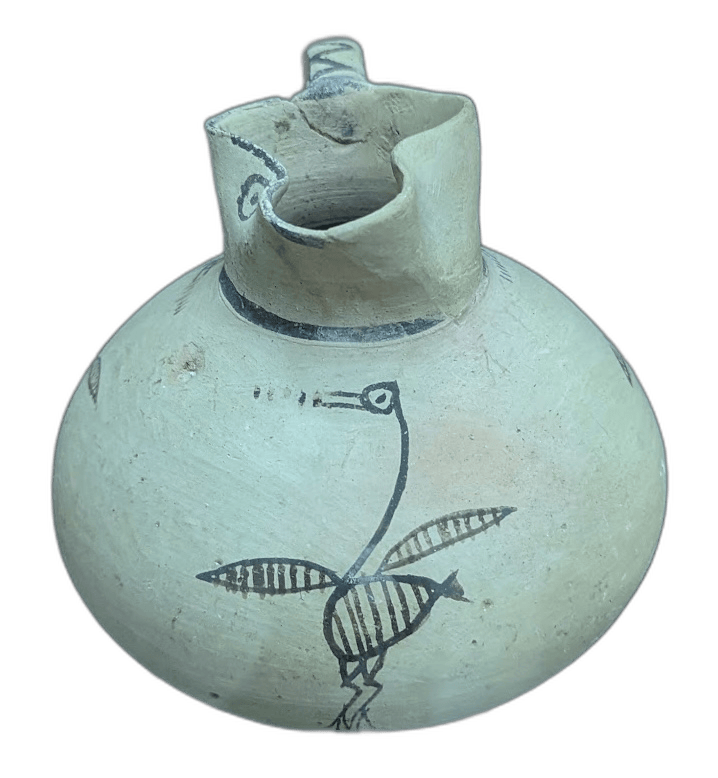
Oinochoe with Free Field Bird
Archaic I
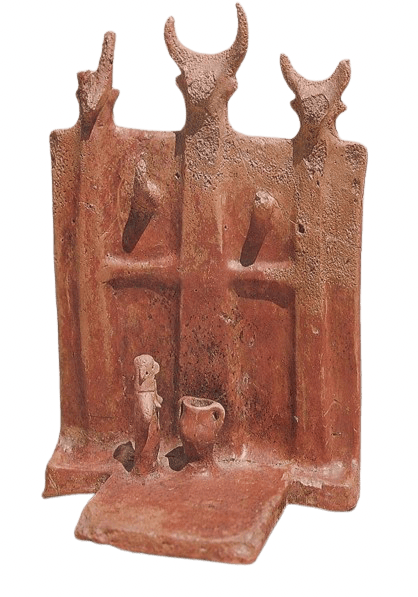
Small Oinochoe with Free Field Bird
Archaic I
Red Polished Shrine
Middle Bronze Age I
Black-On-Red Geometric Jug Sherd
Geometric II
Bichrome Jug
Geometric
Bichrome Juglet
Geometric
Bichrome Oinochoe
Geometric
Juglet
Archaic II
Oinochoe
Geometric III
Jug
Archaic I
Juglet
Archaic I
Jug
Geometric I
Terracotta jug
Early Bronze Age I
Juglet
Geometric I