
Geometric III
Black-on-Red One-Handled Bowl with Wavy-Line Rim
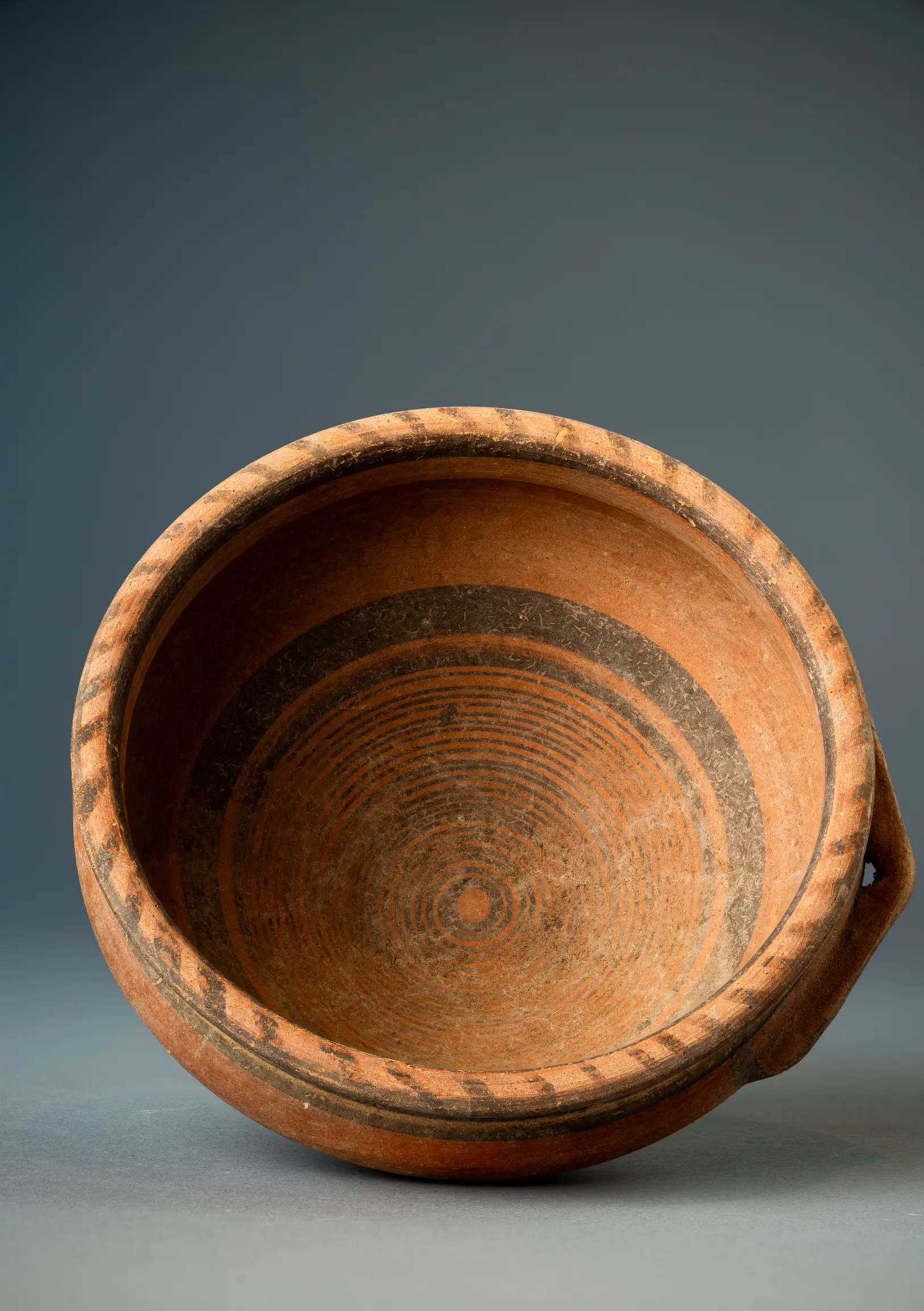
Cypriot Black-on-Red bowl with a raised concave rim, one horizontal handle, a wavy line and barred lip, and hair-fine concentric circles inside, c. 850–600 BCE.
Date
850 - 600 BC
Accession No.
BWL-GE-003
Collection
Alexis Drakopoulos
Provenance
- 1965–1969, The Goodman Collection
- 2025–present, Alexis Drakopoulos, London
Cypro-Geometric III–Cypro-Archaic I, c. 850–600 BCE · Black-on-Red ware · Wheel-made
A bowl on a low ring foot, its conical lower body swelling to a shoulder. Above the shoulder rises a short, slightly concave rim finished with a rolled lip. A single horizontal loop handle sits just below the rim. The lower body carries a plain orange-red slip, with the wheel ridges clearly visible. The rim zone is paler, buff-pink, and holds a black wavy line between framing bands. Black paint coats the handle and runs down onto the body beneath it. Short transverse bars cross the top of the lip all the way round.
Inside, a broad black band circles the mid-wall. Below it the floor is filled with dense, hair-fine concentric circles struck on the wheel, closing on a small reserved dot at the centre.
Commentary
The bowl is Cypriot Black-on-Red ware: wheel-made, red-slipped and painted in matt black [1]. The shape is Gjerstad's Black-on-Red I (III) bowl type 4, which he defined by its raised, concave rim and single horizontal handle below the rim, and which he considered a new shape within the Cypriot repertoire. His type 10 of the following stage, with a "contracted, raised rim", continues it [1]. A Black-on-Red bowl with one horizontal handle in the Ashmolean Museum (AN1953.299; H. 8.2 cm, D. 16.3 cm), dated to the Cypro-Archaic period, has the same basic form. So does Kourion-Kaloriziki K 696, a deep bowl of Cypro-Archaic I date with "one small hor. ribbon handle well below rim" and concentric circles at the centre of the interior [2].
The decoration mixes two habits. The dense interior circles are typical of Black-on-Red open shapes. Kaloriziki K 683 has "a wide zone of hair-fine multiple" concentric circles inside, much like the floor of this bowl [2]. The wavy line on the rim is less usual. Gjerstad noted only "a few instances" of rectilinear ornaments in early Black-on-Red, borrowed from contemporary White Painted and Bichrome pottery [1]. The barred lip has parallels on the rims of the barred Kaloriziki plates K 697 and K 702 [2].
This borrowing points slightly towards the earlier part of the ware's life, but the evidence is thin. Gjerstad's sequence of stages has proved unreliable as a clock, because forms he assigned to the second stage turn up in the first mainland contexts [3]. First Cypriot production is now placed around 900 BCE [4]. A range of c. 850–600 BCE is therefore given here.
The bowl would have served as a drinking or serving bowl. Complete examples of the type are known mostly from tomb groups. The paler rim zone raises a genuine question. It could be a thinner application of slip or simply wear. If added white paint were ever found there, the bowl would move into the Bichrome Red class, but no white is visible. A dark line running down the body from the handle also needs examination in hand, to establish whether it is paint or a mended crack.
References
- 1.Gjerstad, E. (1948) The Swedish Cyprus Expedition IV.2: The Cypro-Geometric, Cypro-Archaic and Cypro-Classical Periods. Stockholm: Swedish Cyprus Expedition, Black-on-Red I (III) ware section, bowls type 4, Figs. XXIV–XXVI; Black-on-Red II (IV) bowls type 10.
- 2.Benson, J.L. (1973) The Necropolis of Kaloriziki (Studies in Mediterranean Archaeology 36). Göteborg: Paul Åströms Förlag, Black-on-Red II bowls and plates, nos. K 683, K 696, K 697, K 702.
- 3.Schreiber, N. (2003) The Cypro-Phoenician Pottery of the Iron Age. Leiden and Boston: Brill, pp. 280–284.
- 4.Kleiman, A., Fantalkin, A., Mommsen, H. and Finkelstein, I. (2019) 'The Date and Origin of Black-on-Red Ware: The View from Megiddo', American Journal of Archaeology 123.4, pp. 531–555.
More from the Catalogue
Browse related objects
Bichrome Kylix with Bird Free Field Art
Geometric III
Milk bowl
Bronze Age
Bowl
Geometric III
Krater
Archaic I
Handle of a bowl
Bronze Age
Bowl
Geometric I
Bowl
Bronze Age
Terracotta bowl
Chalcolithic
Silver bowl
Archaic I
Alabaster bowl
Classical
Bronze phiale (libation bowl)
Archaic II
Bowl fragment, inscribed
Archaic II
Bowl
Bronze Age
Bowl
Archaic I
Bowl
Late Bronze Age II
Bowl
Geometric III
Terracotta footed bowl
Archaic I
Marble bowl fragment with Phoenician inscription
Classical