CNRS historian at HiSoMA, Lyon, who directs the French mission at Amathus, edits the Cahiers du Centre d'Études Chypriotes and writes on the texts of Archaic Cyprus.
Biography
Anna Cannavò is a historian of ancient Cyprus, a chargée de recherche at HiSoMA in Lyon, director of the French archaeological mission at Amathus and editor-in-chief of the Cahiers du Centre d'Études Chypriotes12.
Training and posts
Her laboratory's staff page gives her birth in Italy on 9 November 198212. From 2000 to 2005 she studied classics as a student of the Scuola Normale Superiore at Pisa12. She then wrote a doctoral thesis in ancient history, from 2005 to 2011, in joint supervision between the Scuola Normale and the Université Lumière Lyon 2, funded by the Scuola Normale for its first three years12. The staff page names its supervisors as Decourt and Ampolo and dates the defence to 19 November 201112. Cannavò herself writes that the thesis was defended at Pisa in November 20117.
From 2008 to 2010 she taught Italian as a lectrice at the ENS de Lyon, and from 2010 to 2012 she was a temporary lecturer in Greek history and archaeology at Lyon 212. She won the Fondation des Treilles prize in ancient history in 201012. With Aurélie Carbillet she organised the Postgraduate Cypriot Archaeology conference at Lyon in 2011 and edited its proceedings as volume 41 of the Cahiers12. In 2012–2013 she held a Marie Curie/Gerda Henkel postdoctoral fellowship at the University of Liège, and from 2013 to 2017 she was a scientific member of the École française d'Athènes12.
The texts of Archaic Cyprus
Early articles dealt with Egyptian rule over Cyprus in the sixth century BC, in a volume dated 2003 that appeared in 2008, and with the role of Cyprus in the Neo-Assyrian economic system, read through its textual evidence, in a volume dated 2007 that appeared in 201112. In 2010 she revisited "factoids" about the Cypriot kingdoms "twenty-five years after Maier" in Transeuphratène12. Catherine Kearns writes that Archaic Cyprus lacks a comprehensive volume and that "Cannavò (2011) synthesizes the textual evidence", meaning the thesis13. Kearns also cites her for the textual sources for Amathus, and lists her among scholars who "tentatively posit" that Qarthadasht and Nuria of the Assyrian lists refer to Kition and Amathus13. A chapter in Assyria and the West (2025) points to her 2015 review of the Qart-hadasht–Kition identification; it reports her view that the name change lasted only a century, and objects that the same can be said for other candidates, "above all Amathus"14.
Later work kept to the kingdoms and their neighbours: the Cyprus chapter of A Companion to the Achaemenid Persian Empire (2021), an article on Kition from Phoenician kingdom to Hellenistic city (2022), and a 2024 survey of Phoenician presence in Cyprus outside its main sites12. In a chapter on mercenaries in Beyond Cyprus she notes that "some scholars even deny the existence of Cypriot mercenaries", and shows Cypriots serving as mercenaries in the Near East and Egypt before the end of the fourth century in literary, administrative and epigraphic sources15. She writes there that the Cypriot War, in which Evagoras I opposed the Great King, "seems" to be a turning point15. Her 2016 article in the Cahiers studied contacts between languages and scripts in the Mediterranean islands16.
Writing the history of the discipline
In 2012 she published in the Cahiers part of the first chapter of her thesis, on Cyprus in nineteenth- and twentieth-century historical writing, a history she traces back to the first travellers and collectors of antiquities7. There she calls Einar Gjerstad's synthesis "still an indispensable reference point", and argues that his interpretation of Cypriot kingship imposed itself on all later research, leaving a marked gap in studies of Iron Age political structure for several decades7.
Cannavò has also worked on the papers of the nineteenth-century collections: she wrote on the epigraphic section of the Cesnola photograph album at the Turin Academy of Sciences (2015), and with Luca Bombardieri published a Phoenician inscription from the Cesnola collection in Turin (2016)12. In 2020, with Stephan G. Schmid, she published the fourth part of Paul Schröder's archives, the inscriptions he studied in the Lang and Cesnola collections on trips to Cyprus in 1870 and 1873 and wrote of to Justus Olshausen1. The inscriptions come mostly from Lang's work at Idalion and Drymou, and also from Luigi Palma di Cesnola's at Kition-Batsalos and Golgoi1.
Amathus and Kition
Antoine Hermary writes that the French mission at Amathus enjoyed "a real renewal", marked first by the recruitment in 2013 of Cannavò and Ludovic Thély as scientific members of the EfA17. With Thély she was responsible for an international conference on transitions and ruptures of the Cypriot kingdoms, organised by the EfA, held at the Maison de Chypre in Athens on 20–21 March 201518. The two edited its proceedings, Les royaumes de Chypre à l'épreuve de l'histoire, published by the École française d'Athènes in 201810. David W. Rupp calls it "a timely addition" with new discoveries and re-studied older material, but adds that "the uninitiated will find this volume almost impenetrable"19.
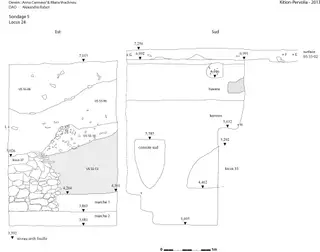
She published on mapping ancient Amathus and, with L. Fadin, on its geographical information system (both 2016)12. Her survey of the Amathus territory received a special jury mention in the 2022 open-science research-data prize12. With Sabine Fourrier and A. Rabot she wrote Kition-Bamboula VII (2018), on excavations in the Kition necropoleis in 2012–201412. In 2020 she was editorial secretary of the Cahiers, and for the 2026 Louvre exhibition catalogue Chypre au Louvre she wrote the chapter on French excavations at Amathus12,20.
Life and work
2011
Doctoral thesis 'Histoire de Chypre a l'epoque archaique: analyse des sources textuelles', Universite Lumiere Lyon-2 (as cited in the reference list of an article on the Sargon stele).
Published 'Chypre dans les etudes historiques des XIXe et XXe siecles. Decouverte de l'antique, construction du passe' on the historiography of Cyprus; cited by Merrillees and by the 2025 'empire and excavation' papers.
Published 'Towards a history of the histories of Cyprus' (PoCA 2010 proceedings, Oxbow) and 'Les Teucrides de Chypre au miroir d'Isocrate'; Salamis conference volume (2019) quotes the latter on the Teucrid kingdom context of Isocrates' praise of Evagoras.
Co-edited with L. Thely 'Les royaumes de Chypre a l'epreuve de l'histoire' (BCH Supplement 60, Athens: Ecole francaise d'Athenes); Fourrier and Iacovou contributed chapters.
With Stephan G. Schmid published 'From Paul Schroder's archives on Cyprus IV. The inscriptions from the Lang and Cesnola collections' (CCEC 50, 157-193), on Phoenician and syllabic inscriptions from Lang's excavations and acquisitions at Idalion and Drymou and Cesnola's at Kition-Batsalos and Golgoi, known from Schroder's 1870 and 1873 correspondence.
Said in the recorded talk «Architectural decoration of the Stoas of the Agora of Amathus» (Archaeological Research Unit - University of Cyprus, 2024-11-19): Director of the French Archaeological Mission in Amathus.
8.A. Cannavò (2015). “Towards a history of the histories of Cyprus”. Cypriot Cultural Details. Proceedings of the 10th Postgraduate Cypriot Archaeology Conference (PoCA 2010), Venice, 161-177. Oxford, Oxbow Books.
14.P. van der Veen and R. Wallenfels (eds) (2025). Assyria and the West: A Fresh Look at the Unshakeable Pillars of Late Bronze and Iron Age Chronology. Archaeopress.
15.Anna Cannavò. “Mercenaries. Cypriots abroad and foreigners in Cyprus before the Hellenistic period”. Beyond Cyprus: Investigating Cypriot Connectivity in the Mediterranean (AURA Supplement 9).
16.Anna Cannavò (2016). “Au fil des écritures. Phénomènes de plurilinguisme et de plurigraphisme dans les îles méditerranéennes”. Cahiers du Centre d'Etudes Chypriotes 46 (Hommage à Antoine Hermary).
17.A. Hermary (2014). “1975-2014 : fouilles françaises d'Amathonte”. Cahiers du Centre d'Études Chypriotes 44.
18.Ludovic Thély (2014). “[News of the French missions in Cyprus]”. Cahiers du Centre d'Études Chypriotes 44.
19.D. W. Rupp. “[Review of A. Cannavò and L. Thély (eds), Les royaumes de Chypre à l'épreuve de l'histoire]”. Gnomon 94 (Heft 8). C.H. Beck.
20.A. Karnava (2020). “Old inscriptions, new readings”. Cahiers du Centre d'Études Chypriotes 50.
22.Pierre Aupert (2016). “Itinéraires croisés”. Cahiers du Centre d'Études Chypriotes 46.
23.Anna Urszula Kordas and Szymon Popławski, «Architectural decoration of the Stoas of the Agora of Amathus», recorded lecture, 62nd Public Lecture Series, Archaeological Research Unit - University of Cyprus, published on YouTube 2024-11-19, at 0:06:02. Online
24.A. Cannavo and S. G. Schmid, 2020, From Paul Schroder's archives on Cyprus, IV. The inscriptions from the Lang and Cesnola collections.
25.M. Given, 2025, Over the landscape, in the landscape? Knowledge and agency in Cypriot archaeology, 1870-1910.
26.<i>Kition-Bamboula VII: Fouilles dans les nécropoles de Kition (2012–2014), Travaux de la maison de l’Orient et de la Méditerranée n° 75</i>, by Anna Cannavò, S (2020).
27.Cannavó and Thély, Les royaumes de Chypre à l'épreuve de l'histoire : Transitions et ruptures de la fin de l'âge du Bronze au début de l'é…, 2018.
28.A. Cannavò, A. Carbillet, 2011, Introduction au POCA 2011.
29.Carbillet and Cannavó, Introduction au POCA 2011, 2011.
30.L. Thély, 2014, La naissance de la mission de l'École française d'Athènes à Amathonte (1969-1975); M. Given, 2025, Over the landscape, in the landscape? Knowledge and agency in Cypriot archaeology, 1870-1910.
31.A. Cannavò, S. Fourrier et al., 2020, Kition-Bamboula VII: Fouilles dans les nécropoles de Kition (2012–2014).
32.Nielsen et al., Ancient Cyprus today: Museum Collections and new Research Approaches to the Archaeology of Cyprus, 2015.
33.M. Given, 2025, Over the landscape, in the landscape? Knowledge and agency in Cypriot archaeology, 1870-1910; S. G. Schmid, 2025, Was there an official German interest in the archaeology of Cyprus between 1878 and 1914?.
Corrections and additions
Did you know this person?
We would like to hear from relatives, colleagues and anyone who knows more about this person's life and work.