
The House of Koutoulakis
Nicolas Koutoulakis never dug in Cyprus, yet his name on a Cypriot limestone head is now a reason for caution. The Cypriot sculpture he handled arrived in one batch: the residue of Louis de Clercq's collection, which the Louvre passed over in 1967 and the house of Koutoulakis sold on.

Alexis Drakopoulos
May 15, 2026·History · Collecting · Archeology·9 min read


Share


Alexis Drakopoulos is a Greek Cypriot Machine Learning Engineer working in Financial Crimes. He is passionate about Archeology and making it accessible to everyone. About Me.
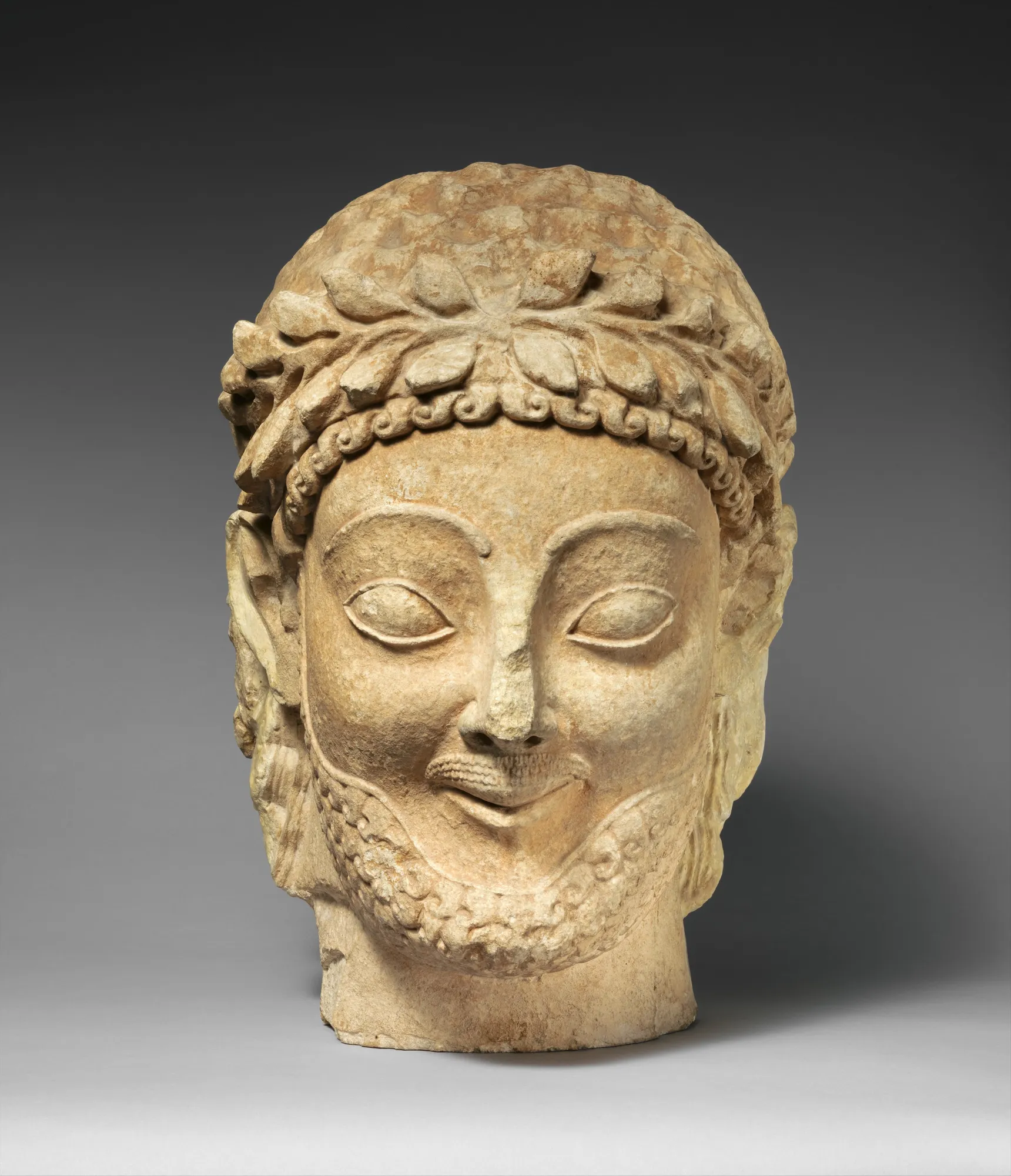
A Cypriot limestone head went under the hammer at Christie's in London on 16 December 2020 with a provenance of exactly two lines. Louis de Clercq (1836–1901), Paris. Nicolas Koutoulakis (1910–1996), Paris and Geneva; thence by descent. Two collectors, two sets of dates, and between them a gap of more than sixty years the catalogue does not account for. The head is Archaic, carved in the soft limestone of a Cypriot sanctuary around 500 BC, the kind of votary that once stood by the hundred in the precincts of Idalion and Golgoi. The first name belongs to a French industrialist who never set foot on a Cypriot dig. The second belongs to the man whose name, in the trade today, a careful cataloguer treats as a reason to look twice. [11]
David Gill, who has tracked the antiquities market for two decades, states the rule without softening it: "association with Koutoulakis should sound an alarm bell." [3] No source, though, ties Nicolas Koutoulakis to the looting of Cyprus. The traffic that followed the Turkish invasion of 1974, the sawn-out mosaics of the Kanakaria church and the stripped chapels of the occupied north, ran through other hands; the man held responsible for most of it, Aydın Dikmen, belonged to a different side of the line. Koutoulakis died in 1996, before most of that casework matured. His Cypriot thread is older and quieter, and it runs back through the gap in that provenance line to the Frenchman who never dug.
A Cretan who inherited the trade
He was a Cretan, born in 1910, dead in Geneva in 1996. [3][5] He inherited his business. His uncle was Manolis Segredakis, the Cretan founder of an antiquities gallery in Paris; when Segredakis died at the end of the 1940s, the nephew took over the gallery and, as the Cycladic scholar Pat Getz-Gentle puts it, "soon became the preeminent purveyor of Cycladic objects." [4] He worked from two addresses, the Paris gallery and a house in Geneva, and dealt across the whole map of the ancient Mediterranean: Greek, Etruscan, Roman, Egyptian, Near Eastern, Minoan. He had no formal schooling and traded, by one account, "in goods worth millions"; the same account calls him "sometimes considered the most successful buyer and seller of antiquities in the modern age." [5]
His Cycladic business is the part that made his name. The pale marble figures of the third-millennium Cyclades had shaped modern taste, admired and imitated by Brancusi, Modigliani and Moore, and Koutoulakis sat at the supply node that fed it. He was "the chief source of material for his fellow antiquities dealers and galleries of modern art" in Europe and the United States, and the collections that passed through his hands read like a roll-call of the postwar market: the de Menils, the Goulandris foundation in Athens, Shelby White and Leon Levy, Michael Steinhardt. [4] He is also the dealer Getz-Gentle named, in 2008, as the man responsible for dispersing the so-called Keros Hoard, the looted scatter of Cycladic fragments she had photographed at his premises by the dozen, an identification others in the field have since contested. [4]
Why the name is an alarm bell
The alarm bell rings for reasons that have nothing to do with Cyprus. A hand-drawn chart of the Italian illicit-antiquities trade, drawn by the dealer Pasquale Camera and seized by the Carabinieri in 1995, the so-called organigram, carries Koutoulakis's name with a line ruled to the dealer Robert Hecht. [3] Gill's study of him, the one piece of scholarship to take him as its single subject, works through a cohort of objects he sold to American and European museums that later proved to come from clandestine digs: a bronze head the Getty bought in 1971 and afterward tied to the looted Roman site of Bubon in Turkey, more than a hundred architectural terracottas he gave the Ashmolean in 1973 that came from a temple at Cisterna di Latina, a "Neolithic Family Group" he sold to White and Levy in 1982 that was seized from the Metropolitan and returned to Greece. [3]
One object in Gill's account folds the story back on its owner. A marble head that had been in Koutoulakis's hands since 1965 turns up in a seized dealer's archive as a set of Polaroids, posted to Gianfranco Becchina on 29 May 1987 by a looter named Costas Gaitanis, of Herakleion, Crete. [3] The Cretan dealer and the Cretan looter, twenty-two years and one island apart, attached to the same head: the photograph is the kind of document that makes Gill's alarm bell more than a figure of speech. The head went back to Athens in 2015. None of it is Cyprus.
The de Clercq dispersal
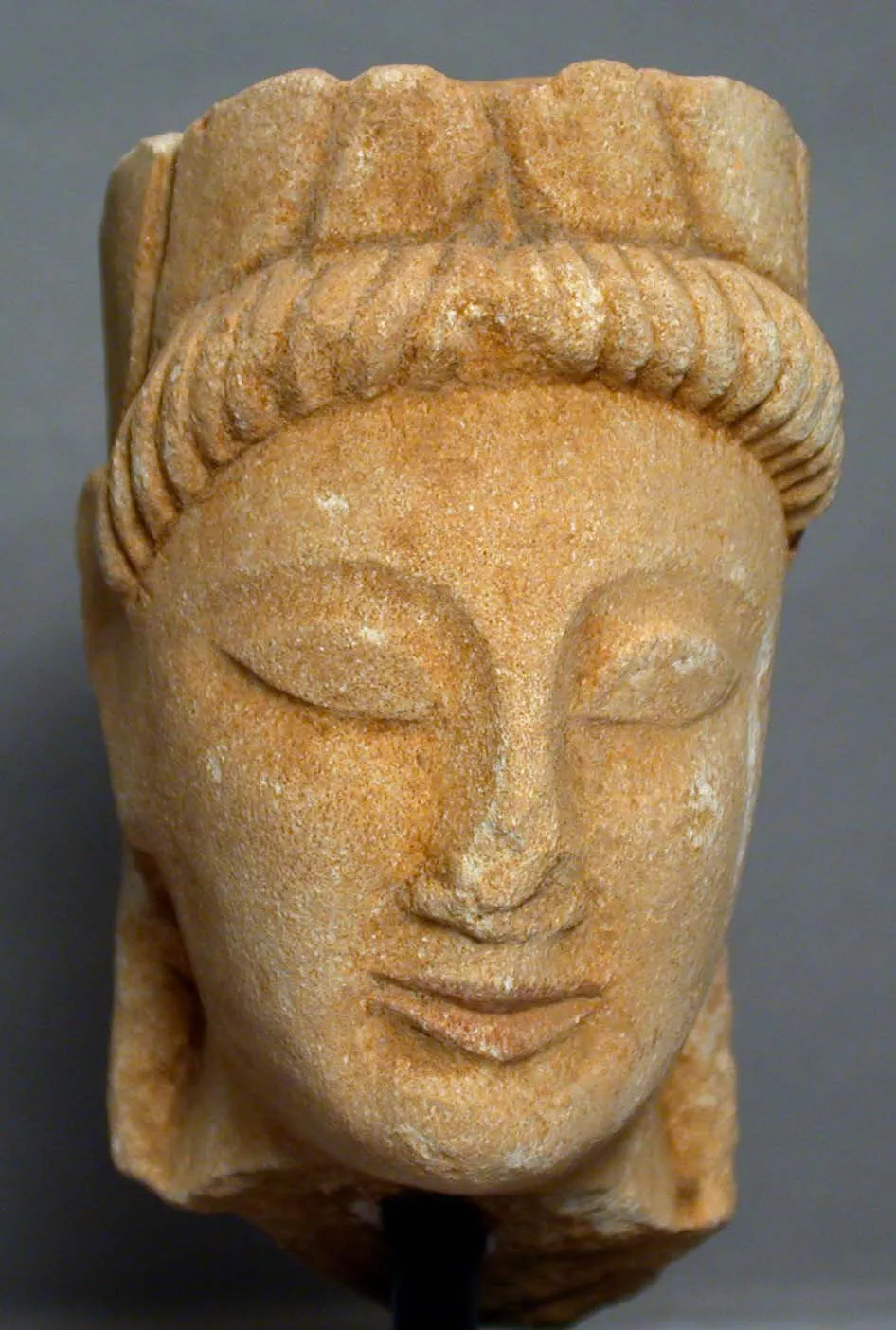
What Cyprus gave Koutoulakis arrived in one consignment, and it was already a century old when he got it. Louis de Clercq, a French industrialist, traveller and early photographer, assembled in the second half of the nineteenth century one of the great private collections of the age, running from Mesopotamian antiquities to Oriental seals. Its Cypriot section he did not dig. He bought it, in bulk, from Antoine Péretié, the chancellor of the French consulate at Beirut, who had spent the previous decades acquiring Cypriot sculpture through the same consular networks that were emptying the island's sanctuaries for the Louvre and the British Museum; Péretié supplied close to two-thirds of de Clercq's collection. [1] After de Clercq died in 1901 the archaeologist André de Ridder catalogued and photographed the Cypriot pieces, which appeared in 1908 as the fifth volume of the Collection De Clercq. [7]
Then the collection sat with the heirs for two generations. In 1967 de Clercq's descendant Henri de Boisgelin gave it to the French state, to the Louvre and the Cabinet des Médailles. The state did not take all of it. Annie Caubet, then a curator in the Louvre's oriental antiquities department, set down what became of the rest in a sentence that is the documented core of Koutoulakis's Cypriot career. The Cypriot ensemble was "of great quality," she wrote, but "only a small part was chosen by the Louvre at the time of the donation by the heirs in 1967; the rest was dispersed through the house of Koutoulakis." [1]
The house of Koutoulakis. That is the mechanism, named and dated. A second curator, writing in the same journal about the Cypriot holdings of the Musée d'Archéologie nationale at Saint-Germain-en-Laye, names him again over a particular limestone statuette of a woman, reputedly from Idalion, published in de Ridder's 1908 catalogue: the piece was passed over in 1967, "which explains how it later turned up on the art market, dispersed with other pieces by Nicolas Koutoulakis." [2] The residue of a dead collector's holdings, photographed and published and entirely legitimate on paper, went back onto the market through a Geneva dealer in the very years when the modern rules of provenance were being written.
Where the pieces went
They scattered the way his stock always scattered. The cleanest case sits in the Metropolitan Museum: an Archaic limestone male head with a wreath, ex–de Clercq, held by Koutoulakis until 1979, then bought by Nanette Kelekian, whom a network study of the trade identifies as his single most frequent buyer, and given to the Met on her death in 2020. [9][10] Others surface at auction with the same two-name pedigree and the telltale coda. The London head of December 2020 carried "Louis de Clercq … Nicolas Koutoulakis … thence by descent"; a female votary head crossed Christie's two years later under the banner "Property from the Estate of Nicolas Koutoulakis." [11]
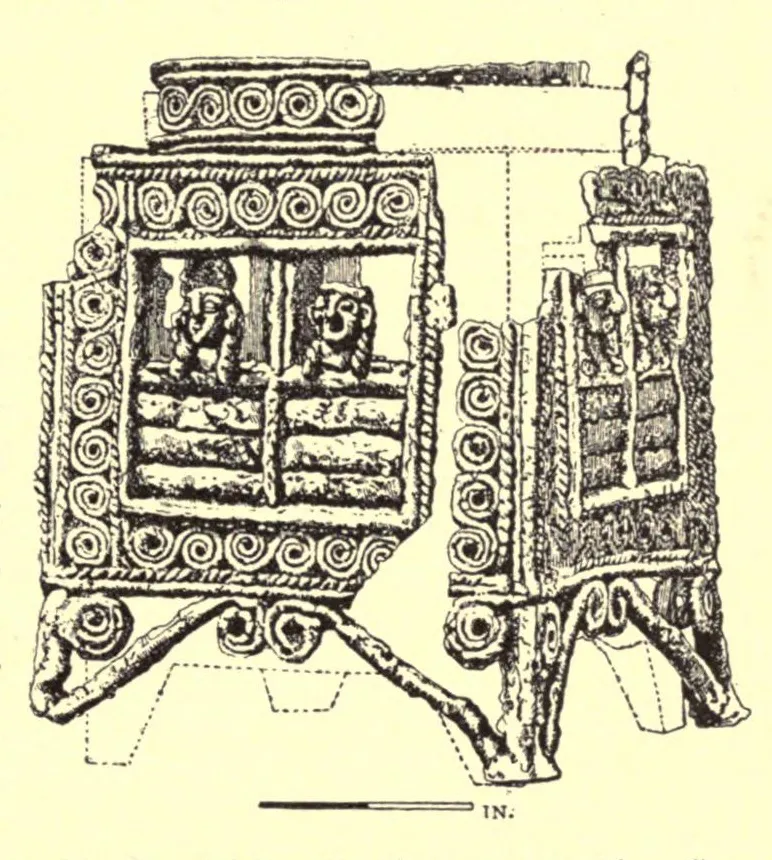
The descent is the point. He died in 1996, and the Cypriot sculpture he had taken in around 1967 was still reaching the market through his heirs in Geneva half a century later. A four-sided bronze stand of the well-known Enkomi type passed from him to his son Emmanuel; a Bronze Age Cypriot vessel came up at TimeLine Auctions in 2024 still tagged to "the collection of Nicolas Koutoulakis, Paris-Geneva, 1967." [8][11]
The stock with no find-spot
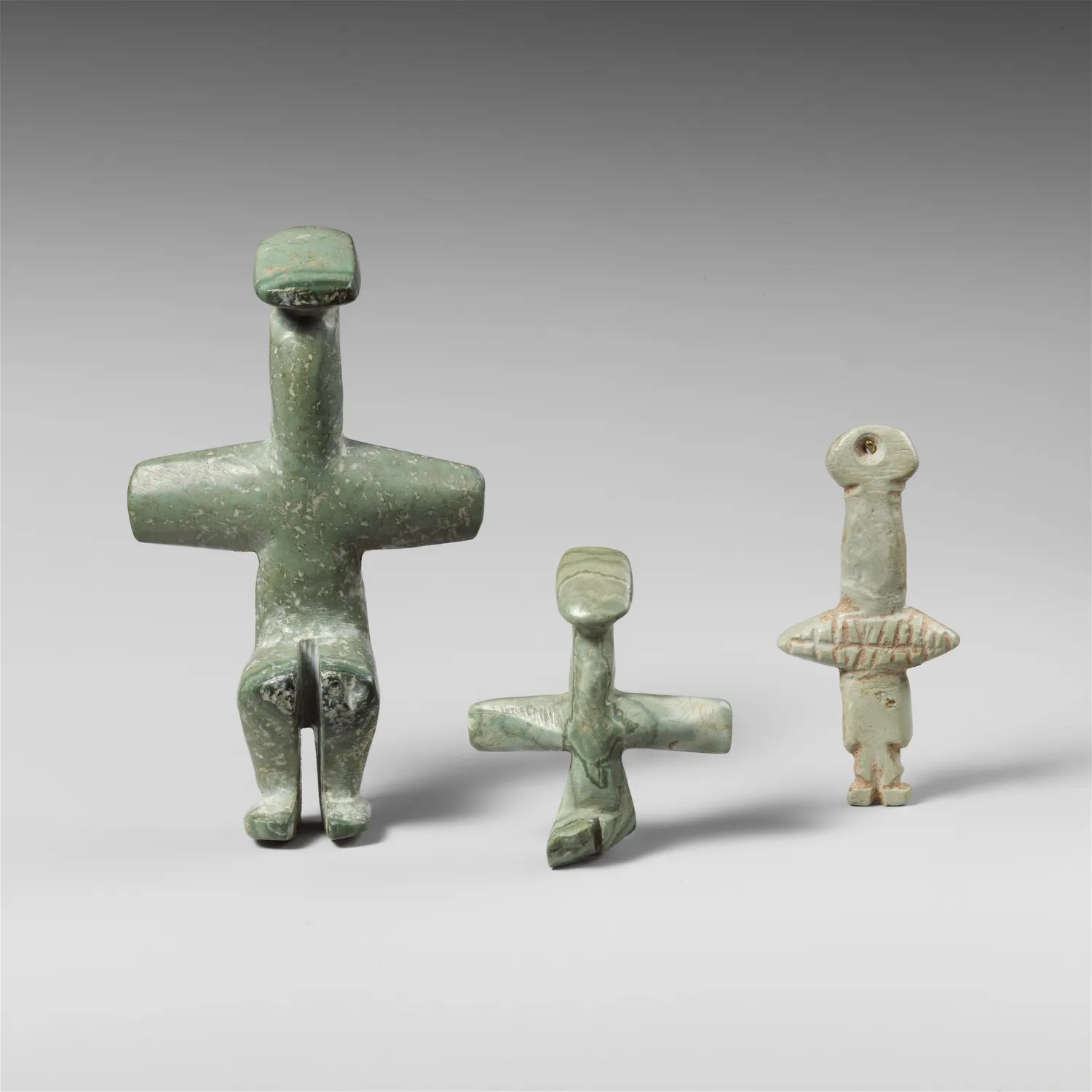
Not all of his Cypriot material came with de Clercq's paperwork. In 1951 the Met bought from him two small figures of Chalcolithic Cyprus, cut from picrolite, the blue-green stone the island's earliest carvers favoured; in 1971 it acquired two miniature terracottas, an eighth-century jug and amphora, again from him. [6][9] Joan Mertens, cataloguing the picrolite figures in 1975, called them "among the very few additions to the Museum's Cypriot collection within the past century," which is to say since Cesnola sold the museum its founding ten thousand. [6] What none of these pieces has is a find-spot, or any history at all before the day Koutoulakis sold them. Their Cypriot origin is read from their type, not from any record of the ground they came out of. That is the ordinary condition of his stock, and the de Clercq head is the exception that proves the rule: only the pieces with a genuine nineteenth-century pedigree can say where, on the island, they began.
And the pedigree is what does the work. A pre-1970 provenance, a named collection, a publication date of 1908: these are the documents that let a Cypriot head sell cleanly today, the things that quiet the alarm bell. Read backward, they are also a record of the first dispersal. De Clercq's Cypriot sculpture reached him through Péretié, and Péretié assembled it in the decades when Cyprus had no antiquities law and consuls dug its sanctuaries at will. The clean provenance and the looted object are the same object, sixty years apart, and Koutoulakis stands at the hinge between them. He did not take these things out of the ground. He put a century-old extraction back into circulation with its papers in order.
The statuette at Saint-Germain-en-Laye is reputed to come from Idalion. As the museum's own historian notes, that claim "rests on no secure evidence." [2] What is certain is the rest of the itinerary: into de Clercq's collection by way of Péretié's Beirut rooms, photographed for de Ridder in 1908, passed over by the Louvre in 1967, and out onto the market through the house of Koutoulakis. The find-spot is a guess. The dispersal is on the record.
References
- 1.Caubet, A. (2012). Les collections d'antiquités chypriotes au musée du Louvre. Cahiers du Centre d'Études Chypriotes, 42, esp. p. 13 ('le reste fut dispersé par les soins de la maison Koutoulakis'); on the de Clercq collection, its origin in the Beirut purchases from Antoine Péretié, and the 1967 Boisgelin donation.
- 2.Cahiers du Centre d'Études Chypriotes, 42 (2012), companion article on the Cypriot collection of the Musée d'Archéologie nationale, Saint-Germain-en-Laye, p. 15 n. 49 (the ex–de Clercq limestone female statuette reputedly from Idalion, passed over in 1967, 'dispersée avec d'autres pièces par Nicolas Koutoulakis').
- 3.Gill, D. W. J. (2019). Context Matters: Nicolas Koutoulakis, the Antiquities Market and Due Diligence. Journal of Art Crime, 22, 71–78.
- 4.Getz-Gentle, P. Personal Styles in Early Cycladic Sculpture (Wisconsin Studies in Classics), pp. 209–213; and 'The Keros Hoard Revisited,' American Journal of Archaeology 112 (2008): 299–305, with the rejoinder by Papamichelakis, G. & Renfrew, C., AJA 114 (2010): 181–185.
- 5.Ehrman, B. D. (2006). The Lost Gospel of Judas Iscariot. Oxford University Press, pp. 83–85.
- 6.Mertens, J. R. (1975). Three Chalcolithic Figures from Cyprus. Metropolitan Museum Journal, 10, 5–8.
- 7.de Ridder, A. (1908). Collection De Clercq, V: Les antiquités chypriotes. Paris.
- 8.The Horse in Ancient Greek Art (2017), p. 170 (a four-sided bronze stand of the Enkomi type, with a Koutoulakis-to-Emmanuel-Koutoulakis provenance).
- 9.Picón, C. A., et al. (2007). Art of the Classical World in the Metropolitan Museum of Art: Greece, Cyprus, Etruria, Rome; with the Metropolitan Museum's published provenance records (limestone male votary head, acc. 2021.40.26; picrolite figures, acc. 51.11.6 and .7; terracotta jug and amphora, acc. 2021.40.64 and .62).
- 10.A social network analysis of the illicit antiquities trade identifying Koutoulakis as a top-ten network node and Nanette B. Kelekian as his most frequent buyer (corpus id 10.1007_978-3-032-02014-7_5, pp. 22–23).
- 11.Auction catalogues: Christie's, London, 16 December 2020 (ex–de Clercq Cypriot heads, 'thence by descent'); Christie's, London, 7 December 2022 ('Property from the Estate of Nicolas Koutoulakis,' Cypriot female votary head); TimeLine Auctions, December 2024 (Early Bronze Age Cypriot vessel, 'collection of Nicolas Koutoulakis, Paris-Geneva, 1967').