
Antiquities in an Estate: A Practical Guide for Executors
How executors should secure, inventory, value and sell or donate antiquities in an estate: UK probate and US appraisal rules, museum routes and Cypriot checks.

Alexis Drakopoulos
October 3, 2026·Guides · Collecting·17 min read


Share


Alexis Drakopoulos is a Greek Cypriot Machine Learning Engineer working in Financial Crimes. He is passionate about Archeology and making it accessible to everyone. About Me.
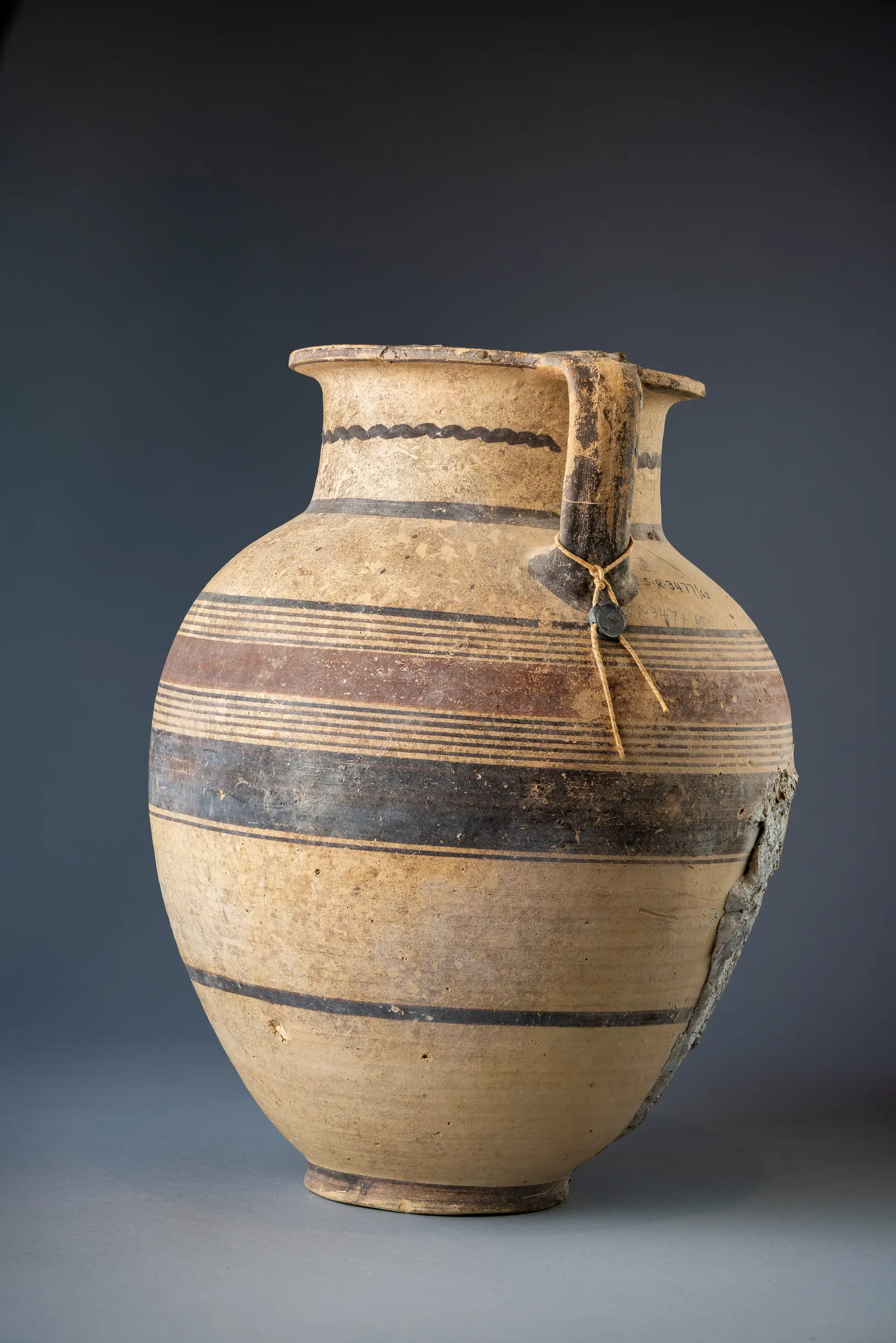
On 2 October 2014 Bonhams in London offered a Red Polished jug from a Midwestern American private collection, lot 2, estimated at £3,000 to £5,000, with a copy of a Cypriot government export licence dated 20 October 1964. The Cyprus Department of Antiquities found the licence in its own register: one Bronze Age jug, bought by an American for eight Cyprus pounds from an authorised dealer on 28 September 1964 [1]. A sheet of paper kept in a drawer for fifty years had made the jug saleable.
The same year Sotheby's sold the collection of the late Stanley J. Seeger, including a Cypro-Geometric kernos, a hollow ring vase, from the registered collection of Christakis Hadjiprodromou in Famagusta. Photographed in Turkey after 1974 on its way west, it had already been sold once at Sotheby's, in 1982. In July 2016 it turned up on a London online gallery, and that November it went back to Cyprus [1]. An estate sale at a major auction house had not settled its history.
This guide is for executors, estate lawyers, probate valuers and clearance firms who find antiquities in an estate, very often Cypriot pottery of the kind the island's licensed trade exported for decades. It covers the order of work, UK probate valuation and US estate appraisal, the routes to a museum, and what to check before anything is sold or divided. It is general information, not legal or tax advice.
What should an executor do first when an estate contains antiquities?
Secure the objects and the papers together, before anyone clears, sorts or divides the house. The basic handling rules (no cleaning, no splitting, photograph everything, keep every paper) are in I inherited antiquities: what to do first. An executor adds a few steps, because the first weeks of an estate are when documentation is most easily lost.
- Secure before you sort. Keep the pieces in the property, or move them as a group to secure storage, before clearance firms, charity collections or relatives go through the rooms.
- Instruct clearance firms in writing to set aside anything that looks ancient, any box of potsherds, and all papers, catalogues and photographs, including old envelopes, tissue-wrapped fragments and sweet tins.
- Make a numbered inventory that ties each object to its photographs, its place in the house and every label or paper found with it. Photograph each shelf as found and record which pieces shared a box: a group is evidence of what was bought together.
- Search for paperwork where you already look for financial papers: bureau drawers, old insurance schedules, the previous owner's will and probate papers, letters home from Cyprus, passports and service records that date a posting on the island, marked auction catalogues, dealer invoices.
- Hold all valuations and sales until the inventory is complete, and keep copies of everything you hand over.
- Tell the beneficiaries early that the pieces may need to stay together until assessed.
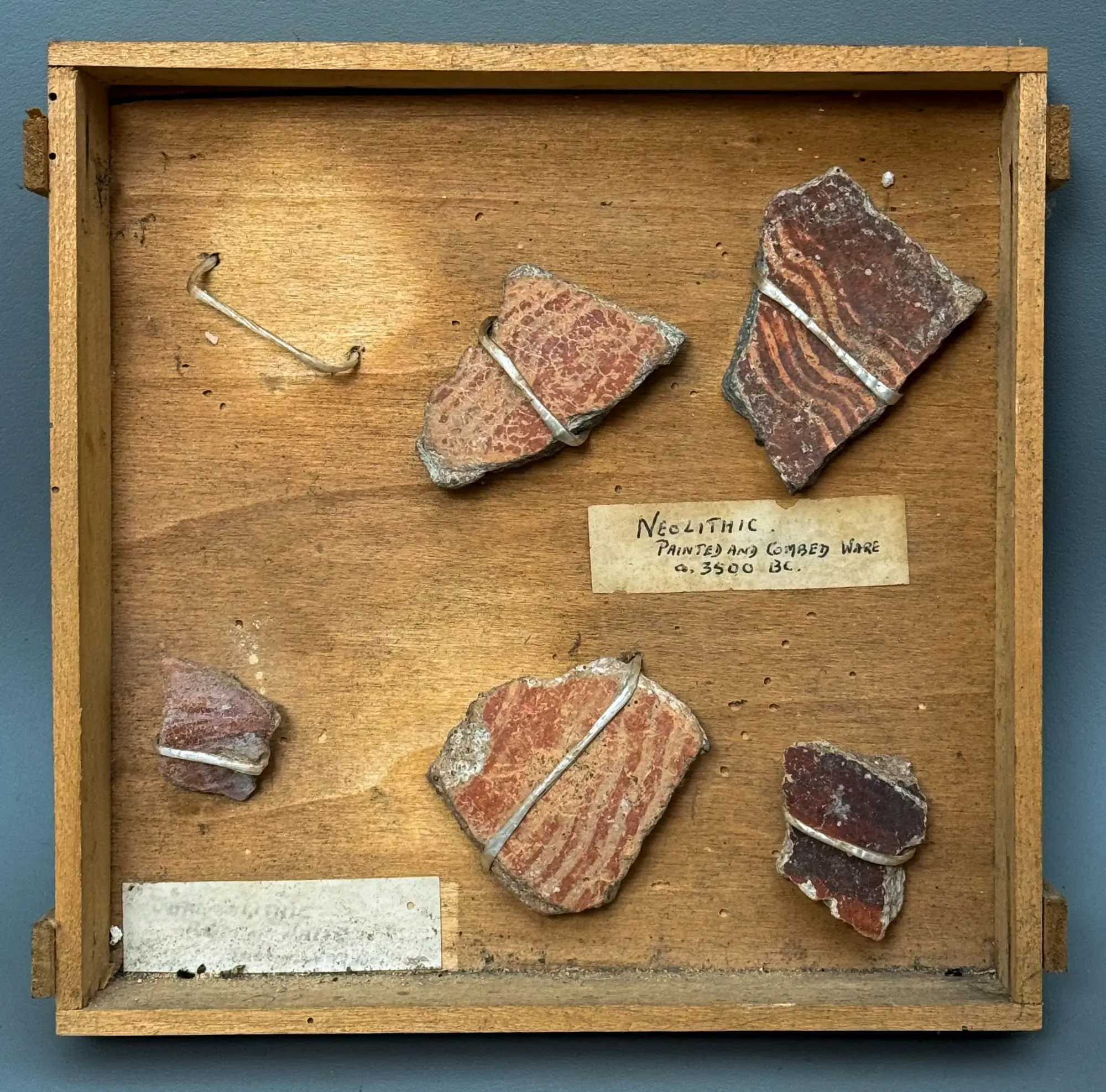
Paperwork hides in odd places: five sherds collected by a colonial judge survived, labelled, in a Dutch chocolate box that helped trace them (The Judge, the Escape, and a Chocolate Box). A bowl that passed through the licensed Nicosia dealer Kolokasides in the 1950s or 1960s travelled with "an old typed card with attached photo stating acquisition details and attribution" and a Cyprus Museum lead export tag, which let the Department of Antiquities verify it against its own archive [1]. Export permits "were often lost" [17], so an earlier probate inventory or an itemised insurance list is worth keeping with the objects. If you cannot tell what the pieces are, try the visual key to Cypriot pottery or send us photos: identification is free, and the answer often decides which of the steps below apply.
Do inherited antiquities have to be declared for probate?
Yes. In the UK they are household and personal goods on the inheritance tax account; in the US they belong in the estate inventory. Owning and inheriting antiquities is lawful in both countries. The UK's Dealing in Cultural Objects (Offences) Act 2003 applies only to objects unlawfully excavated or removed after 30 December 2003, and only to someone who deals in them dishonestly, knowing or believing them tainted [7]. An executor selling family pieces in good faith commits no offence under it. If an executor comes to believe a piece was looted, or receives a credible claim, the position changes: take advice before selling or distributing anything.
How are antiquities valued for probate in the UK?
At open-market value: under section 160 of the Inheritance Tax Act 1984, the price the object "might reasonably be expected to fetch if sold in the open market" at the date of death [2]. HMRC usually accepts a professional valuation that says it was prepared on that basis, and warns that an insurance replacement figure can overstate or understate it. A sale after the death, especially at auction, is the best evidence, at the gross hammer price before commission; valuation and sale costs cannot be deducted. On form IHT407, executors value each item or group, say whether anything has been sold, and attach any professional valuation [3].
For an antiquity, the open market is the market for that object with its actual history. A Bichrome jug with an export licence and an identical jug with no papers are different properties: a responsible auction house may decline the second, and the valuer should reflect that, which is why the provenance file comes first. Most Cypriot pots in family collections fetch hundreds of pounds or a few thousand, though two Early Bronze Age plank figures made £53,740 and £42,000 at Bonhams in 2023 (collecting Cypriot antiquities today). Ranges by class are in what is my Cypriot antiquity worth?.
The probate value becomes each beneficiary's base cost for capital gains tax; gains on a chattel sold for £6,000 or less are exempt, but a set sold to the same person counts as one chattel, so a matched pair or tomb group sold piecemeal to one buyer is treated as one item [15]. With the nil-rate band at £325,000 and frozen as of 2026, a few Cypriot pots rarely decide whether tax is due at all.
How do US estate appraisals for antiquities work?
At fair market value, "the price which a willing buyer would pay to a willing seller, neither being under any compulsion to buy or to sell and both having reasonable knowledge of relevant facts" [9]. If the effects include articles "of marked artistic or intrinsic value of a total value in excess of $3,000" (the regulation's examples include antiques, statuary and vases), an expert appraisal made under oath must be filed with the estate tax return, with the executor's sworn statement on the appraiser's qualifications and independence [9].
The federal basic exclusion amount is $15,000,000 for deaths in 2026, so most estates owe no federal estate tax [11]. The appraisal still matters, because heirs take the date-of-death value as their income-tax basis (Internal Revenue Code §1014) for a later sale. The IRS's Art Advisory Panel generally reviews items valued above $150,000 [10], which few Cypriot pieces approach. Choose an appraiser with demonstrable antiquities experience who works to USPAP, the US appraisal standard.
As of 2026, the two systems compare like this:
| Question | United Kingdom | United States |
|---|---|---|
| Basis of value | Open-market value (Inheritance Tax Act 1984, s. 160) | Fair market value (26 CFR 20.2031-6) |
| Formal valuation | Professional valuation on an open-market basis, attached to form IHT407 | Expert appraisal under oath if artistic items total more than $3,000 |
| Tax threshold | £325,000 nil-rate band, frozen | $15,000,000 basic exclusion for deaths in 2026 |
| When heirs later sell | Probate value is the capital gains base cost | Date-of-death value is the heirs' basis |
| Route to a museum | Conditional exemption, private treaty sale, Acceptance in Lieu; Cultural Gifts Scheme for heirs | Charitable bequest or gift, subject to museums' AAMD 2013 guidelines |
| Crossing a border | Individual export licence for archaeological objects over 100 years old | Restricted Cypriot material needs an export certificate or proof of earlier departure |
| Criminal law to know | Dealing in Cultural Objects (Offences) Act 2003 | National Stolen Property Act |
Can antiquities settle inheritance tax or go to a UK museum?
Only if they are pre-eminent, which very few estates' antiquities will be. Conditional exemption defers inheritance tax on a pre-eminent object or collection, normally claimed within two years of the death, if the new owner undertakes to keep the object in the UK, preserve it and allow public access [2][4]. A private treaty sale to a museum or other body listed in Schedule 3 of the 1984 Act deducts the notional tax from an agreed value and adds back a douceur of 25% of that tax for an object; public auctions are excluded [4]. Acceptance in Lieu settles the tax by transferring pre-eminent objects to the nation, judged by an Arts Council England panel, within an annual cap of £40 million shared with the Cultural Gifts Scheme [5]. Offers require due diligence on title and provenance [4], and an archaeological object with gaps in its history after 1970 would struggle; the realistic Cypriot candidate is a documented 19th-century collection.
The Cultural Gifts Scheme is for living donors, so it applies after the objects pass to the heirs: a UK taxpayer who gives a pre-eminent object to the nation gets a tax reduction of 30% of its value. From 6 April 2027 joint owners, such as siblings who inherit a collection together, will each be able to claim on their share [6].
Can an estate give antiquities to a museum in the US?
Yes, if a museum will take them, which is usually the harder test. Under the Association of Art Museum Directors' guidelines (revised 2013), which cover gifts and bequests, a museum normally should not acquire an object unless research shows it was outside its country of probable modern discovery before 17 November 1970, or legally exported after; donors "and their representatives", executors included, are asked for every document they hold [12]. The 2013 revision added an exception where the donor signed a promise, will or trust document before 2008, and such acquisitions are posted on the AAMD's public Object Registry [12]. A bequest in a will signed before 2008 therefore has a route a later will lacks; ask the museum before relying on it.
A bequest is deducted on the estate tax return. Heirs who give after inheriting use Form 8283, with a qualified appraisal for gifts above $5,000 signed no earlier than 60 days before the gift, and a complete copy attached for art (which includes ceramics and antiques) of $20,000 or more [10]. Gifts and voluntary returns are covered in returning or donating Cypriot antiquities.
Why do Cypriot antiquities need extra care?
Because Cyprus vests its antiquities in the state, suffered looting after 1974, and watches the market. The Antiquities Law of 1935, much amended, now vests all antiquities in the Republic, allows export only for temporary exhibition or study, and forbids dealing on the island; licensed export of private pieces continued until 1996 [1]. Heirs to a collection declared in Cyprus may keep it but cannot sell or export it.
After the Turkish invasion of 1974, cemeteries, sanctuaries and churches in the north were plundered (looting in occupied northern Cyprus), and the Hadjiprodromou collection was scattered. Besides the kernos, a horse-and-rider figurine from it was offered by a London gallery at £2,500 as "Ex German private collection of Mr. H. Wagner, Berlin. Previously on the European market and purchased at auction in the 1970s/1980s"; the gallery handed it to the Metropolitan Police and it went home in July 2016 [1].
Most Cypriot material in British and American homes, though, left the island legally between 1869 and the 1970s, through excavation shares, the Cesnola-era sales, the Cyprus Museum's own saleroom and dealers licensed from 1935, and much of its paperwork has since been lost (Licence No. 7070). That trade sold Iron Age pottery, lamps, glass and small terracottas by the thousand and very little fine sculpture. A box of Bichrome jugs from a 1960s posting is the ordinary case; a plank figure, a large figured Red Polished vessel or a Byzantine icon with no history before 1974 calls for real caution.
Even ordinary pieces can be stopped without papers. In November 2025 the Department found a Bichrome III juglet and jug of the Cypro-Geometric III period (c. 900 to 750 BC) in online sales at Brunk Auctions and Nadeau's Auction Gallery; they were withdrawn after consultation with the houses and returned voluntarily through the Cyprus Embassy in Washington. In February 2026, 18 pieces in an online sale at Sloans & Kenyon, among them Bronze Age vessels and a 4th-century BC limestone head, were withdrawn and handed to the same embassy [14]. Neither announcement says the pieces were looted.
What does good provenance for a Cypriot piece look like?
A numbered document or mark tying the object to a legal sale or export, ideally one the Department can match in its archive. The commonest are a numbered Cyprus export licence (the Department keeps copies [1]), a lead seal stamped C.M. on a handle, a Cyprus Museum Sales Register number, a licensed dealer's receipt, a Metropolitan Museum Cesnola number beginning 74.51, and publication under a named collector. Below those come records that place an object in the family by a given year: one provenance line quoted by Alphas reads, in full, "Listed in a 1995 insurance valuation, no. 28" [1].
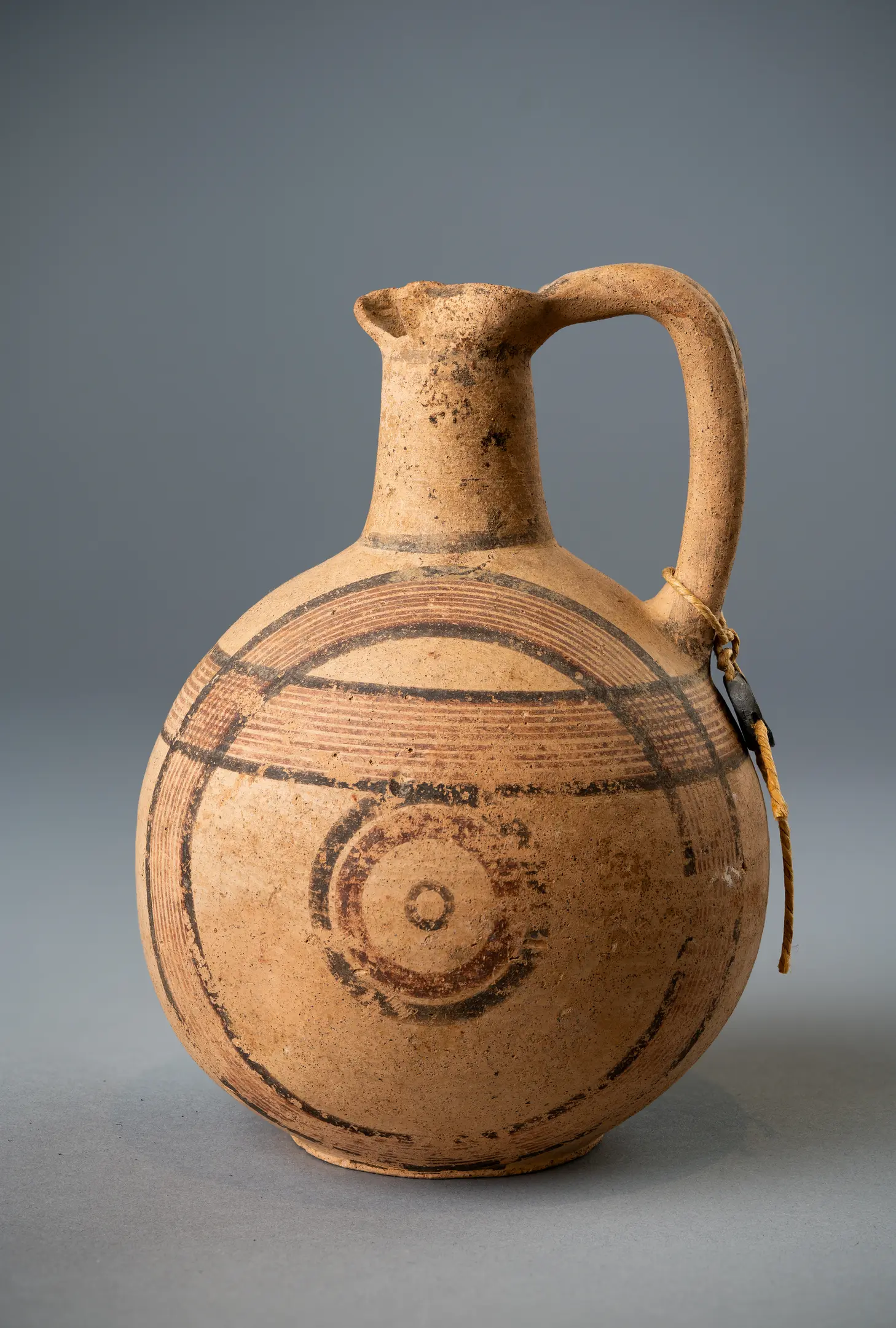
The amphora at the top of this page carries two such marks, the Sales Register number S.R. 3477/65 inked beside a handle and a lead seal on string, and was exported under licence in 1969 (catalogue entry). The jug beside this paragraph still has its C.M. seal. Each kind of mark is explained in Cypriot export licences, lead seals and labels; family stories of postings on the island are the subject of brought home from Cyprus.
Can the collection be split among the heirs?
Yes, once each piece has been identified, documented and valued, and with care for groups. One licence or receipt often covers several objects, and a piece that leaves with one heir can lose the paper that stays with another. Work in order: inventory, identification, provenance, valuation, then division or sale. Copy shared documents for every piece and note who holds each original. In England and Wales, personal representatives can appropriate an asset to a beneficiary's share at an agreed value [16], so a documented group can go to one heir with the others equalised from other assets.
How should antiquities be insured, stored and moved?
Tell the household insurer about the death promptly, since many home policies restrict cover once a property stands empty. Store pieces dry, out of direct sun, on padded shelves, in acid-free tissue rather than newspaper, with labels and lead tags attached. Red Polished and Base Ring wares, and anything with a flaking surface, are fragile. Old plaster fills are common on pots from old collections and no cause for suspicion; leave them. To move them, pack each piece upright in a padded box inside a second box, never lift a pot by its handle, and tie lead seals down.
Borders bring their own rules, as of 2026. An archaeological object more than 100 years old needs an individual export licence from Arts Council England to leave the UK, whatever its value; the auction house or shipper normally applies [8]. The EU has required an import licence for archaeological objects more than 250 years old since 28 June 2025 [18]. Under the US agreement with Cyprus, first signed in 2002 and renewed in 2022 until July 2027, restricted Cypriot archaeological and ecclesiastical material (since 2022 including objects as late as AD 1770) may enter the US only with a Cypriot export certificate or evidence that it left Cyprus before the restrictions; objects already in the US are unaffected [13]. A UK estate with an American beneficiary meets this rule the moment it ships.
What can go wrong when an estate sells antiquities?
Mostly withdrawals and delays. A responsible auction house will ask for every document and the family history (who acquired the pieces, when and where), for the grant of probate and identification for each executor, and may search stolen-art registers such as the Art Loss Register. A clear search shows only that the object is not registered as stolen: objects dug from the ground were never registered, and proving looting is "very difficult and in most cases impossible, unless the objects have been recorded in official archives in the past" [1]. Once a lot is online the Department sees it, and a withdrawn lot can hold up the administration for months.
Claims are rarer and more serious. A thief cannot pass good title: the Church of Cyprus recovered the Kanakaria mosaics through an American court in 1989 from a dealer who had bought them [19]. Do not sell or distribute an object under a live claim. Losing a piece's papers, or selling a documented piece cheaply in a house clearance, can also cost the beneficiaries money. A solicitor or attorney with cultural-property experience can advise on a specific case. Sale law is set out in selling Cypriot antiquities in the UK and in the US, and fakes in Cypriot pottery replicas and fakes.
When should an executor contact the Cyprus Department of Antiquities?
When a licence, seal or saleroom number needs confirming, when a label or family story points to the occupied north after 1974, when the heirs want to return pieces, or when an auction house raises a question. Abroad, go through the Cyprus High Commission in London or the Cyprus Embassy in the country concerned.
Heirs do use it. A German citizen who worked at the German Embassy in Cyprus took 37 antiquities home between 1964 and 1968; after his death in 2023 his heir asked the Cyprus Embassy in Berlin to hand them to the Cypriot authorities, and in July 2024 the pieces, Bronze Age vessels, medieval pottery and clay lamps among them, went back [14]. In December 2024 over a hundred antiquities came home through the High Commission in London, from British police and private individuals [14]. The Department reports a growing number of people who wish to give it their parents' collections [1].
How can AncientCyprus.com help an executor?
We identify Cypriot pieces from photographs free of charge, help assemble the provenance file (reading licences, seals and labels, and checking published collections and old sale records), explain the options, and point you to specialists: probate valuers and appraisers, conservators and cultural-property lawyers. We do not sell or broker antiquities, issue formal valuations or give legal or tax advice. The site is run by the Antiquity Preservation Fund, which works openly with the Cyprus Department of Antiquities (our cultural heritage policy). It helps most before a valuer sees the pieces, and the most useful thing to send is often the least promising: the typed card, the envelope or the insurance list found in the bureau with the pots.
References
- 1.Alphas, E. (2017). From a Bronze Age tomb in Cyprus to the estate of a gentleman in Sussex: Measures taken and problems faced in the investigations on the illicit trade of antiquities. In D. Pilides & M. Mina (Eds.), Four Decades of Hiatus in Archaeological Research in Cyprus: Towards Restoring the Balance (pp. 30-43). Holzhausen. Trade provenance wordings and the Hadjiprodromou figurine, p. 36; the kernos, the 1964 licence and the Department's licence archive, p. 37; the Kolokasides bowl, p. 38; heirs donating collections, p. 39.
- 2.Inheritance Tax Act 1984, ss. 30, 31, 160 and Schedule 3. https://www.legislation.gov.uk/ukpga/1984/51
- 3.HM Revenue & Customs. Inheritance Tax Manual, IHTM21041 (Household goods and personal goods: how we value household goods) and IHTM21011 (Form IHT407), updated 7 April 2026. https://www.gov.uk/hmrc-internal-manuals/inheritance-tax-manual/ihtm21041
- 4.HM Revenue & Customs. Guidance on capital taxation and the national heritage (updated 23 August 2024), chapters 10 and 11. https://www.gov.uk/government/publications/capital-taxation-and-tax-exempt-heritage-assets/guidance-on-capital-taxation-and-the-national-heritage
- 5.Arts Council England. (2025). Cultural Gifts Scheme & Acceptance in Lieu Report 2025.
- 6.HM Treasury and HM Revenue & Customs. (2026). Reforming the Cultural Gift Scheme (13 July 2026). https://www.gov.uk/government/publications/cultural-gift-scheme-reform/reforming-the-cultural-gift-scheme
- 7.Dealing in Cultural Objects (Offences) Act 2003, c. 27. https://www.legislation.gov.uk/ukpga/2003/27
- 8.Export of Objects of Cultural Interest (Control) Order 2003 (SI 2003/2759); Arts Council England, Export Licensing Unit, Open General Export Licence value limits.
- 9.Code of Federal Regulations, 26 CFR § 20.2031-6, Valuation of household and personal effects. https://www.law.cornell.edu/cfr/text/26/20.2031-6
- 10.Internal Revenue Service. Instructions for Form 8283 (Rev. December 2025), https://www.irs.gov/instructions/i8283; Art Appraisal Services (reviewed 28 June 2026), https://www.irs.gov/appeals/art-appraisal-services
- 11.Internal Revenue Service. What's new: Estate and gift tax (basic exclusion amount for 2026). https://www.irs.gov/businesses/small-businesses-self-employed/whats-new-estate-and-gift-tax
- 12.Association of Art Museum Directors. (2013). Guidelines on the Acquisition of Archaeological Material and Ancient Art (revised 2013), sections III.C, III.E, III.F, III.H.
- 13.U.S. Customs and Border Protection. (2022). Extension and Amendment of Import Restrictions on Archaeological and Ethnological Material From Cyprus. Federal Register, 18 July 2022, doc. 2022-15398. https://www.federalregister.gov/documents/2022/07/18/2022-15398
- 14.Department of Antiquities, Cyprus, announcements of repatriations: from Stuttgart, July 2024 (reported by Cyprus Business Now, 5 August 2024, https://www.cbn.com.cy/article/2024/8/5/789636/over-30-cypriot-antiquities-repatriated-from-germany); from the United Kingdom, December 2024 (reported by archaeology.wiki, 10 December 2024); from the United States, November 2025 (archaeology.wiki, 9 December 2025) and February 2026 (reported by FastForward, https://fastforward.com.cy/breakthrough/repatriation-18-cy-antiquities-us-online-auction).
- 15.Taxation of Chargeable Gains Act 1992, ss. 262 and 274. https://www.legislation.gov.uk/ukpga/1992/12/section/262
- 16.Administration of Estates Act 1925, s. 41. https://www.legislation.gov.uk/ukpga/Geo5/15-16/23/section/41
- 17.Gatzsche, A. (2023). From Cyprus to Leipzig: Provenance research. In E. Poyiadji-Richter (Ed.), Alexander Malios Collection, Vol. 1: Cypriot Antiquities (p. 7). AMRICHA.
- 18.Regulation (EU) 2019/880 of the European Parliament and of the Council of 17 April 2019 on the introduction and the import of cultural goods. https://eur-lex.europa.eu/eli/reg/2019/880/oj
- 19.Autocephalous Greek-Orthodox Church of Cyprus v. Goldberg & Feldman Fine Arts, Inc., 717 F. Supp. 1374 (S.D. Ind. 1989), affirmed 917 F.2d 278 (7th Cir. 1990).