
Selling Cypriot Antiquities in the UK: Law, Auctions and Export
Selling a Cypriot antiquity in Britain is legal. What decides a sale: the 2003 Act, auction checks, Cyprus withdrawal requests, and export and EU import rules.

Alexis Drakopoulos
October 3, 2026·Guides · Collecting·16 min read


Share


Alexis Drakopoulos is a Greek Cypriot Machine Learning Engineer working in Financial Crimes. He is passionate about Archeology and making it accessible to everyone. About Me.
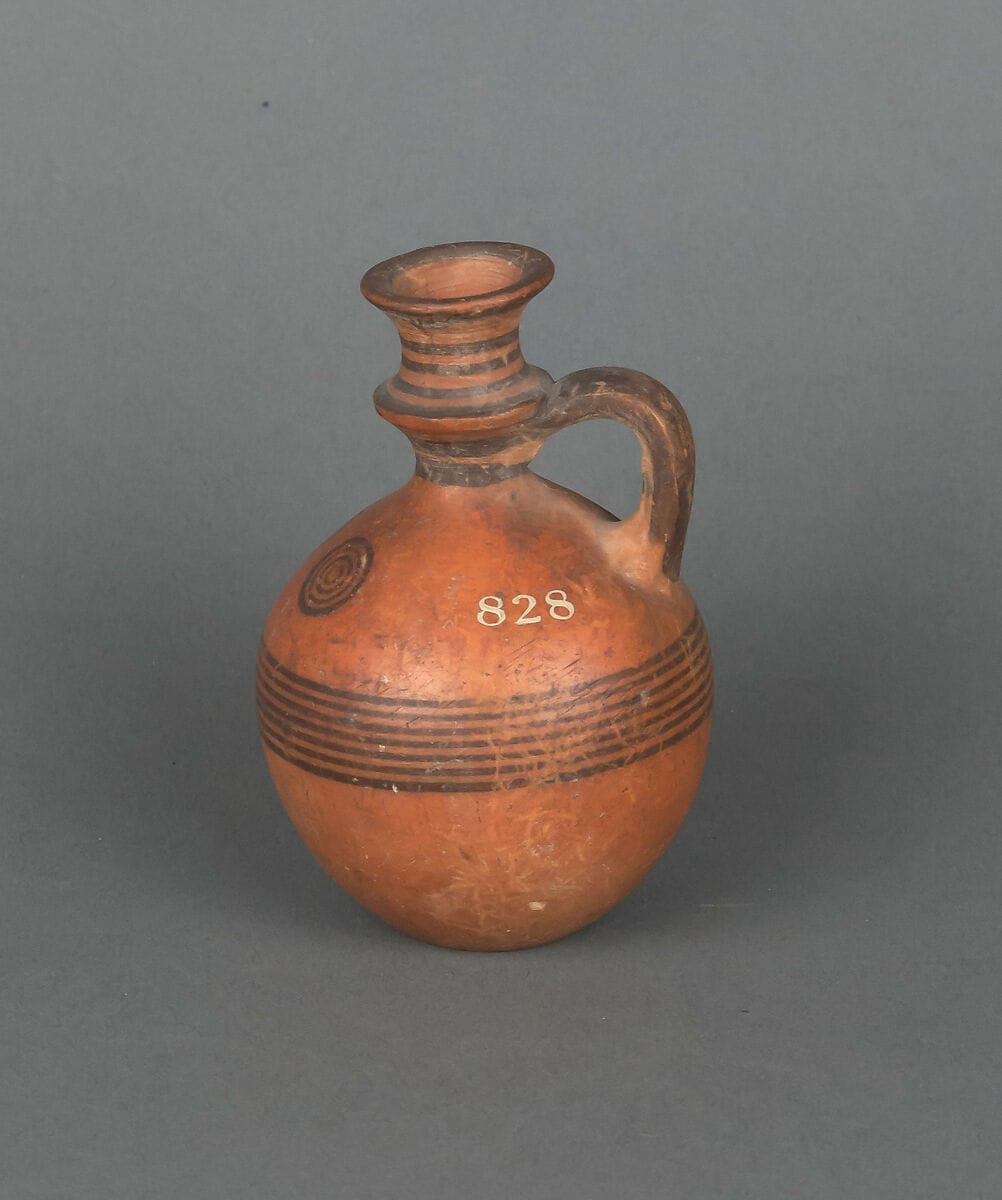
In November 2025 a Black-on-Red juglet about seven centimetres high, a perfume flask of the Cypro-Archaic period (750 to 475 BC), was entered in an online sale at the Cotswold Auction Company in Cirencester. Officers of the Cyprus Department of Antiquities, whose job includes "monitoring the internet for illicit trafficking of Cypriot cultural property", spotted the lot and alerted the auctioneer. The juglet was withdrawn, and the auctioneer handed it to the Cultural Counsellor at the Cyprus High Commission in London [1]. It was the commonest kind of Cypriot pot, the kind a visitor in the 1950s or 1960s could buy legally from a licensed dealer in Nicosia.
Eleven years earlier, on 2 October 2014, Bonhams in London offered a Red Polished jug as lot 2, estimated at £3,000 to £5,000. Its catalogue entry recorded an American collection that acquired it in 1964 and "a copy of the Cypriot Government export license dated 20/10/1964". The Department checked its archive of old licences and confirmed it [2, p. 37]. Both were pots of familiar kinds. One had its paper.
This guide covers the British side of a sale: UK law, how auction houses and the Department of Antiquities act in practice, and the rules when the buyer is abroad. The step-by-step process is in the general guide to selling an inherited Cypriot collection; antiquities from other countries are covered in how to sell antiquities.
Is it legal to sell Cypriot antiquities in the UK?
Yes. As of 2026 no UK law prohibits owning or selling a Cypriot antiquity. The statute aimed at the illicit trade, the Dealing in Cultural Objects (Offences) Act 2003, applies only to objects illegally excavated or removed after it came into force on 30 December 2003, and only to a person who deals in them dishonestly, "knowing or believing" them to be tainted [3][4]. A pot that left Cyprus in 1965, or in 1985, cannot be tainted under the Act.
An object is "tainted" if, after commencement, someone excavates it or removes it from a monument or historic building and that act was an offence, under UK law or "under the law of any other country or territory" [3]. A pot dug illegally in Cyprus in 2010 is therefore tainted in England. To "deal" covers acquiring, disposing of, importing and exporting, and the maximum sentence on indictment is seven years [3]. Ulph and Smith describe the Act's reach in practice as narrow [5]. Unprovenanced objects remain legal under it. Its target is the seller who suspects a problem and sells anyway.
Ordinary criminal law stands behind it. A stolen object stays stolen whatever the date, so a piece taken from a museum or a registered collection, as many were in the north of Cyprus after 1974, falls under the law of theft and handling, and the money-laundering offences of the Proceeds of Crime Act 2002 are one reason an auction house asks where a piece came from.
This page is general information about the law as of 2026, not legal advice. For a valuable piece, or where Cyprus has already been in touch, a cultural-property lawyer is worth consulting.
Why was a Cypriot antiquity withdrawn from a UK auction?
Usually because the Cyprus Department of Antiquities found the lot online and asked the house to withdraw it. The Department's officers watch British sales, small regional and online-only auctions included, and ask for information or for a lot to be withdrawn while they investigate [2, p. 36]. For years a common reply from the trade asked the Department to "transmit time and place of theft" [2, p. 36]. British houses now generally withdraw.
On 6 April 2026 the Department's officers found a Late Cypriot juglet with a ring base, of about 1450 BC, in an online auction. Halls Fine Art Auctioneers facilitated its return, and on 23 June 2026 it reached the High Commission in London, the Department thanking "the holder of the antiquity for voluntarily returning it" [6]. On 3 December 2024 more than 100 Cypriot antiquities, handed to the High Commission "either by the police authorities of the United Kingdom or by private individuals", were repatriated: Neolithic stone tools, pottery from the Early Bronze Age to the medieval period, Roman lamps, coins and icons among them. The Cypriot authorities thanked the Metropolitan Police and North Yorkshire Police [7].
The two sides describe these objects in different terms. Announcing the returns, the Cypriot authorities have said the objects were "illegally removed" from Cyprus in the 1960s and 1970s [1][7]. In those decades, though, export under licence was lawful: the Department issued numbered export licences, the Cyprus Museum sold antiquities over its own counter, and licensed dealers such as Petros Kolokasides sold to visitors. The Department's view rests on what it can verify: without a licence, seal or receipt, nothing shows that a particular export was licensed. Many owners, and this site's history of the trade in Licence No. 7070, hold that much of the Cypriot material in British homes left legally with paper since lost. On the practical difficulty both agree. Proving that "suspicious" antiquities come from looting, theft or illicit export, Alphas wrote in 2017 of the Department's investigations, is "very difficult and in most cases impossible, unless the objects have been recorded in official archives in the past" [2, p. 36].
A withdrawal request, then, usually marks a gap in the file. It does not mean a crime has been proved, or that the owner is accused of one. Its effect is still large: a house will rarely reoffer a queried lot, and an EU buyer cannot obtain an import licence while a claim is pending.
Can Cyprus claim a Cypriot antiquity that is in Britain?
It can ask for it back, and in some circumstances it can go to court, though in practice most cases end with a request. Under Cyprus's Antiquities Law, Cap. 31, all antiquities still undiscovered when the law came into force in 1935 belong to the Government (s. 3). Since 1996 no one may deal in antiquities in Cyprus (s. 26), and export licences are now granted only for exhibitions, loans to museums or universities, study or state gifts, never for a private collection (s. 27) [8]. Lawful private export ended in 1996, and was already rare after 1974; the compendium tells the full story of the legal export of Cypriot antiquities.
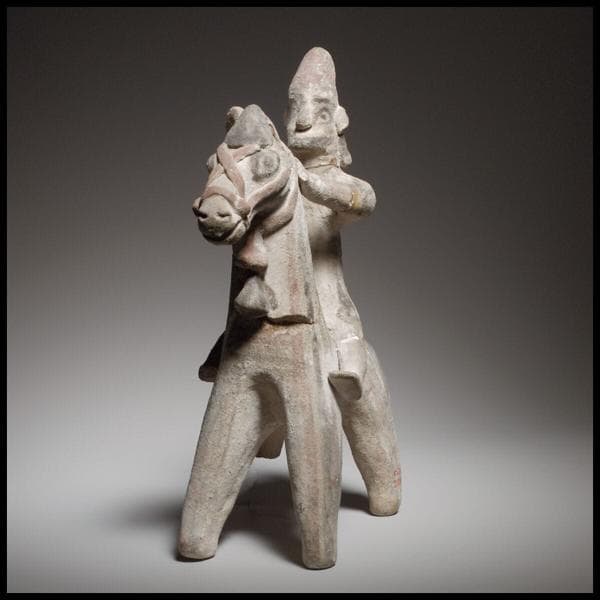
Cyprus uses four routes in Britain. The first two are the withdrawal request and the voluntary handover by the holder to the High Commission, as in the Cotswold and Halls cases. The third is the police, where there is evidence of theft. In 2016 a London gallery offered a Cypro-Archaic terracotta horse-and-rider (a type shown here in a Metropolitan Museum example) at £2,500, with the provenance "Ex German private collection of Mr. H. Wagner, Berlin. Previously on the European market and purchased at auction in the 1970s/1980s". The Department matched it, by photograph and dimensions, to the registered collection of Christakis Hadjiprodromou, kept in his house in Famagusta before 1974. After requests from the Department and the Cyprus Police to the British authorities, the gallery handed it to the Metropolitan Police, who returned it to the Department in July 2016 [2, p. 36]. The theft could be proved because the object had been recorded before it was taken; the compendium entry on looting in occupied northern Cyprus gives the background.
The fourth route is a civil claim. In Iran v Barakat Galleries (2007) the Court of Appeal held that a foreign state can sue in England to recover antiquities it owns under its own laws [10]. We know of no reported case in which Cyprus has used it.
One route closed with Brexit. The Return of Cultural Objects Regulations 1994, which let an EU member state such as Cyprus sue in the UK courts for an object unlawfully removed from its territory, were revoked from 31 December 2020, saving only claims already made [9]. Inside the EU, Directive 2014/60/EU still gives Cyprus that route for objects unlawfully removed on or after 1 January 1993 [11], so it becomes relevant once a piece is sold into an EU country.
What will a UK auction house or dealer ask me for?
A written history of the piece, proof of identity, and your warranty that you own it. Museums and the trade use the 1970 UNESCO Convention as a working date-line for provenance, and for Cypriot material a house will want a documented history from before 1970, ideally from before the invasion of 1974. Alphas found that most provenance lines on Cypriot lots in British online sales, such as "private collection, Wiltshire", do not reach the 1970 threshold [2, p. 36], and "Property of an English Gentleman" now prompts questions [2, p. 35].
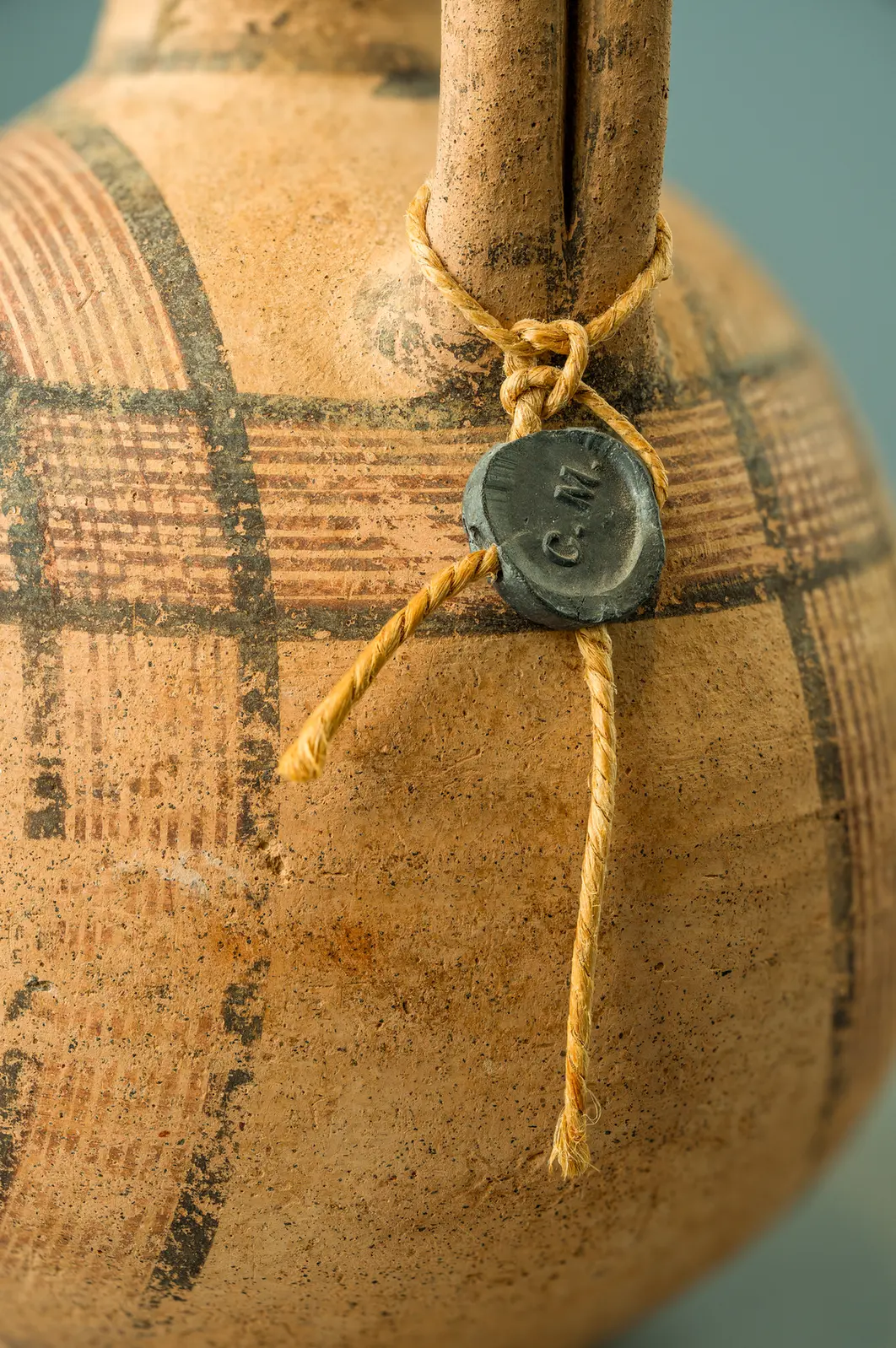
What turns a thin line into a sale is a document the Department can confirm. A Bichrome bowl of the Cypro-Geometric period offered by a gallery in 2016 was described as "ex Collection of Oleg Polunin (1914 to 1985), UK, acquired during the 1950s to 1960s from P. Kolokasides, Cyprus", with a "Cyprus Museum lead export tag attached to the handle", and the Department verified it as it had the 2014 Bonhams jug [2, pp. 37-38]. The Bichrome IV jug shown here has a lead seal stamped C.M. hanging from its handle, the same kind of mark. The guide to Cypriot export licences, seals and labels shows how to read each one.
Houses also search lots against stolen-art databases. The Art Loss Register charges £85 plus VAT for a single search if you commission one yourself, and says that no database of stolen art can be complete [19]. A pot from an unrecorded tomb was never registered anywhere, so a clean certificate says nothing about how the piece left Cyprus.
Expect identity checks too. Since January 2020 auction houses and dealers who trade in works of art above a threshold have been "art market participants" under the Money Laundering Regulations 2017, supervised by HMRC and obliged to check their customers [12][13]. From the end of June 2026 the threshold is £10,000 (10,000 euros before then) [12]. A private owner selling his or her own things is not an art market participant, but the house will usually ask for photo identification, proof of address and sometimes the source of the object. The checks are routine.
Read the consignment agreement before signing. Sellers are commonly asked to warrant good title and lawful export, and the terms say what happens, and who pays, if a claim arrives.
Do I need an export licence to sell to a buyer abroad?
Usually not, from the British side: a Cypriot antiquity worth less than £65,000 can leave Great Britain under the Open General Export Licence, with no application. Objects of cultural interest made more than 50 years before export need a licence, issued by the Export Licensing Unit at Arts Council England [14][15]. Paragraph 1(k) of the open licence covers any such object worth less than £65,000, except listed categories such as finds from UK soil, which a Cypriot antiquity is not; a pair or set is valued together [14].
Almost every Cypriot pot, lamp and figurine falls well under the line. A Red Polished plank figure hammered at £42,000 at Bonhams in 2023 stayed below it; an Archaic limestone male head that made £158,500 at Christie's in 2015 did not (both are in the compendium's guide to collecting today). Above £65,000 an individual licence is needed. For an object in the UK for more than 50 years, an expert adviser may object under the Waverley criteria, and a temporary export bar can give a UK buyer the chance to match the price; for one imported within the last 50 years, the applicant supplies proof of import [15]. Allow several weeks.
Northern Ireland follows EU rules under the Windsor Framework, so direct exports from there to countries outside the EU need an EU export licence [15]. Anywhere in the UK, the export licence concerns British heritage only: it says nothing about whether the piece left Cyprus lawfully, or whether the buyer's country will let it in.
Can I sell a Cypriot antiquity to a buyer in the EU?
Yes, but the buyer needs an EU import licence, and the licence is built from your evidence. Regulation (EU) 2019/880 requires an import licence for "products of archaeological excavations" or "archaeological discoveries" more than 250 years old, whatever their value, which covers every ancient Cypriot object [16]. Since 28 June 2025 applications go through the EU's electronic system for the import of cultural goods (ICG) [17]. The holder of the goods applies in the member state where they first enter, and the authorities decide within 90 days of a complete application [16].
The application needs documents showing that the object left Cyprus, where it was found, in accordance with Cypriot law. One exception matters to British owners. If the object left Cyprus before 24 April 1972, the date the 1970 UNESCO Convention entered into force, the applicant can instead show lawful export from the last country where it stayed for more than five years, here the UK [16]. For a piece in a British family since the 1960s, the file is a lawful UK export plus evidence that it left Cyprus before that date: a 1960s Cyprus licence, a lead seal, dated letters or photographs, a published old collection.
The authorities must refuse a licence where there are reasonable grounds to believe the object left its country of origin illegally, or where that country has a pending claim for its return [16]. A lot the Department of Antiquities has queried cannot enter the EU. Even a granted licence "shall not be construed to be evidence of licit provenance or ownership" [16]. Buyers in the United States face a separate regime, import restrictions on Cypriot archaeological material in force since 2002, explained in the guide to selling Cypriot antiquities in the US.
What does it cost to sell at auction in the UK?
The buyer pays a premium of roughly a quarter to a third on top of the hammer price, and the seller pays commission and fees out of the hammer price. Bonhams, for example, charges buyers 30 per cent on the first £25,000 of the hammer price in UK sales from 1 October 2026, with VAT added to the premium [18]. Bidders allow for the premium, so it lowers the hammer price: the plank figure hammered at £42,000 in 2023 cost its buyer £53,740.
Seller's commission, insurance, photography and lot fees, charges for unsold lots and minimum fees differ from house to house, so ask for the terms in writing before consigning. A documented Iron Age jug sells for a few hundred pounds, and fixed fees can take a large share of a small lot. The guide to what a Cypriot antiquity is worth explains how ware, condition, restoration and provenance set the price, and how much antiquities cost gives the history of the market.
Key dates for a Cypriot antiquity sold in the UK
| Date | What happened | What it means for a UK seller |
|---|---|---|
| 1935 | Cyprus Antiquities Law, Cap. 31 | Undiscovered antiquities belong to the Government; export only under numbered licences |
| 24 April 1972 | 1970 UNESCO Convention enters into force | Pieces that left Cyprus before this date can use the UK export route for an EU import licence |
| July 1974 | Turkish invasion of Cyprus | Looting in the north, including registered collections such as Hadjiprodromou's in Famagusta |
| 1996 | Law 4(I)/1996 amends Cap. 31 | Dealing banned in Cyprus; licensed private export ends |
| 30 December 2003 | Dealing in Cultural Objects (Offences) Act in force | Dishonest dealing in objects illegally dug or removed after this date is a crime in the UK |
| January 2020 | Money Laundering Regulations extended to the art market | Auction houses and dealers check sellers' identity |
| 31 December 2020 | Return of Cultural Objects Regulations 1994 revoked | Cyprus loses its special statutory route to UK courts |
| 28 June 2025 | EU import licences through the ICG system | EU buyers need an import licence for archaeological objects over 250 years old |
| End of June 2026 | Art market threshold set at £10,000 | Art market money-laundering rules apply to sales of £10,000 or more |
What should I do before selling a Cypriot antiquity in the UK?
Build the file first and choose the sale route second.
- Leave the objects as they are: no cleaning, gluing or splitting of groups. Keep every label, tag, lead seal, box and wrapping.
- Photograph each piece from all sides, base and marks included, and gather every paper: licences, receipts, letters, insurance lists, probate inventories, dated family photographs.
- Write down who acquired each piece, where, when and why they were in Cyprus, with the evidence for the dates. The guide for families whose pieces were brought home from Cyprus shows how to test a story against the record.
- Identify what you have, and whether it is ancient at all, with the visual key to Cypriot pottery and the guide to replicas and fakes, or send us photos for a free identification and help with the provenance.
- Check the history against the dates in the table above: 24 April 1972, 1974, 1996.
- Consider asking the Department of Antiquities in Nicosia, or the Cultural Counsellor at the Cyprus High Commission in London, to confirm a licence number or seal; the Department keeps copies of old export licences [2, p. 37].
- Get a value range from more than one source. Formal valuations come from accredited valuers; we do not issue them.
- Disclose everything to the house or dealer, restorations and gaps included, and read the consignment terms.
- If the buyer is abroad, settle the export and import rules before the sale, and send the file with the object.
Executors and solicitors will find the probate side in antiquities in an estate.
What if the Department of Antiquities asks for the piece back?
Pause the sale and send the Department your documents. A request is not a criminal charge. If the papers show a licensed export, a Cyprus Museum sale or a seal the Department can match in its archive, as it matched the licence of the 2014 Bonhams jug, the question may end there. If the file is empty, the realistic options are to withdraw the piece and keep it, to return it voluntarily, as the holders of the Cotswold and Halls juglets did, or to take advice from a cultural-property lawyer. If it matches a stolen object, or you learn it left the north of Cyprus after 1974, do not sell it. The guide to returning or donating Cypriot antiquities explains how a return is arranged and what happens to the person who returns it.
AncientCyprus.com is a free, non-commercial site run by the Antiquity Preservation Fund. We help owners identify Cypriot antiquities, research their provenance and understand the options, and we point to specialists such as conservators, independent valuers and cultural-property lawyers. We do not sell or broker antiquities, issue formal valuations or give legal advice; our own conduct is set out in our cultural heritage policy.
References
- 1.Politis English (25 November 2025). Cyprus repatriates Cypro-Archaic juglet from UK auction. https://www.en.politis.com.cy/culture/970665/cyprus-repatriates-cypro-archaic-juglet-from-uk-auction ; Cyprus Mail (25 November 2025). Cypriot antiquity repatriated from Britain. https://cyprus-mail.com/2025/11/25/cypriot-antiquity-repatriated-from-britain
- 2.Alphas, E. (2017). From a Bronze Age tomb in Cyprus to the estate of a gentleman in Sussex: Measures taken and problems faced in the investigations on the illicit trade of antiquities. In D. Pilides & M. Mina (Eds.), Four Decades of Hiatus in Archaeological Research in Cyprus: Towards Restoring the Balance (pp. 30-43). Holzhausen.
- 3.Dealing in Cultural Objects (Offences) Act 2003 (c. 27), ss. 1-3 and 6. https://www.legislation.gov.uk/ukpga/2003/27
- 4.Gaimster, D. (2004). Measures against the illicit trade in cultural objects: The emerging strategy in Britain. Antiquity, 78(301), 699-707. https://doi.org/10.1017/S0003598X0011333X
- 5.Ulph, J., & Smith, I. (2012). The Illicit Trade in Art and Antiquities: International Recovery and Criminal and Civil Liability. Hart Publishing.
- 6.Politis English (2026). Cypriot antiquity repatriated from the UK after online auction discovery. https://en.politis.com.cy/culture/arts/1016069/cypriot-antiquity-repatriated-from-the-uk-after-online-auction-discovery ; Cyprus Mail (1 July 2026). Ancient Cypriot artefact repatriated from the UK. https://cyprus-mail.com/2026/07/01/ancient-cypriot-artefact-repatriated-from-the-uk
- 7.Cyprus News Agency (3 December 2024). More than 100 Cypriot antiquities were repatriated from the United Kingdom. https://www.cna.org.cy/en/article/7688007/more-than-100-cypriot-antiquities-were-repatriated-from-the-united-kingdom ; Cyprus Mail (9 December 2024). Huge array of ancient artefacts returned to Cyprus from UK.
- 8.Antiquities Law, Cap. 31 (Republic of Cyprus), as amended, including Law 4(I)/1996, ss. 3, 26, 27 and 33. Consolidated text, CyLaw. http://www.cylaw.org/nomoi/enop/non-ind/0_31/full.html
- 9.The Return of Cultural Objects (Revocation) (EU Exit) Regulations 2018 (SI 2018/1086), as amended by SI 2020/975, revoking the Return of Cultural Objects Regulations 1994 (SI 1994/501) from 31 December 2020. https://www.legislation.gov.uk/uksi/2018/1086
- 10.Government of the Islamic Republic of Iran v The Barakat Galleries Ltd [2007] EWCA Civ 1374; [2009] QB 22 (Court of Appeal of England and Wales).
- 11.Directive 2014/60/EU of the European Parliament and of the Council of 15 May 2014 on the return of cultural objects unlawfully removed from the territory of a Member State. Official Journal of the European Union, L 159, 28.5.2014, p. 1.
- 12.The Money Laundering, Terrorist Financing and Transfer of Funds (Information on the Payer) Regulations 2017 (SI 2017/692), reg. 14, as amended with effect from January 2020 to cover art market participants, and by the Money Laundering and Terrorist Financing (Amendment) Regulations 2026 (SI 2026/621), made 9 June 2026. https://www.legislation.gov.uk/uksi/2026/621/made
- 13.HM Revenue & Customs. Money laundering supervision for art market participants (guidance, updated 6 August 2024). https://www.gov.uk/guidance/money-laundering-supervision-for-art-market-participants
- 14.Open General Export Licence (Objects of Cultural Interest), 1 January 2021, granted under article 2 of the Export of Objects of Cultural Interest (Control) Order 2003 (SI 2003/2759), paras 1(k) and 5 and Schedule. Arts Council England, Export Licensing Unit.
- 15.UK Government. Export art, antiques and cultural goods; Exporting or importing objects of cultural interest (guidance updated 28 June 2025). https://www.gov.uk/export-licence-for-cultural-goods ; https://www.gov.uk/guidance/exporting-or-importing-objects-of-cultural-interest
- 16.Regulation (EU) 2019/880 of the European Parliament and of the Council of 17 April 2019 on the introduction and the import of cultural goods. Official Journal of the European Union, L 151, 7.6.2019, pp. 1-14, Articles 3 to 5 and Annex.
- 17.European Commission, Access2Markets (2025). EU introduces new import controls of cultural goods. https://trade.ec.europa.eu/access-to-markets/en/news/eu-introduces-new-import-controls-cultural-goods
- 18.Bonhams. Buyer's premium rates, United Kingdom (rates for sales commencing from 1 October 2026). https://www.bonhams.com/how-to-buy/buyers-premium-united-kingdom/
- 19.Art Loss Register. Frequently asked questions (search fees and certificates). https://www.artloss.com/faqs/