
Events·Event
Ten Cyprus papers at ASOR in Chicago, from Bronze Age deer feasting to claims of Cypriot Neandertals
Two sessions on Friday 20 November at the Hilton Chicago, open to in-person and virtual registrants, bring new work from Makounta, Kissonerga-Skalia, Kalavasos, Maroni and Kourion.


Conference
- When
- 18–21 November 2026 In 29 days
- Where
- Hilton Chicago, 720 South Michigan Avenue, and on Zoom, Chicago
- Online
- Also online
Ten papers on the archaeology of Cyprus will be read on the afternoon of Friday 20 November 2026 at the annual meeting of the American Society of Overseas Research (ASOR), held at the Hilton Chicago from 18 to 21 November. The papers fill the two parts of the society's standing session on the island, chaired by Kevin Fisher of the University of British Columbia and Catherine Kearns of the University of Chicago. They range from the island's first hunter-gatherers to a bronze coin of the 4th century BCE.
The meeting is hybrid: ASOR says more than 100 of its sessions and workshops mix speakers in the room in Chicago with speakers presenting on Zoom. Attendance is by paid registration, made online or with a printed form by mail through ASOR's registration page. The cheaper virtual-only ticket covers every session and workshop, the plenary included, and ASOR members in need can ask for a scholarship of 25%, 50% or the full fee. Chicago is eight hours behind Cyprus in late November, so the first session starts at 10pm Cyprus time and the second at 12:25am on Saturday. The times below are those of the academic programme as updated on 13 October.
Part one: cemeteries, palaces and a script
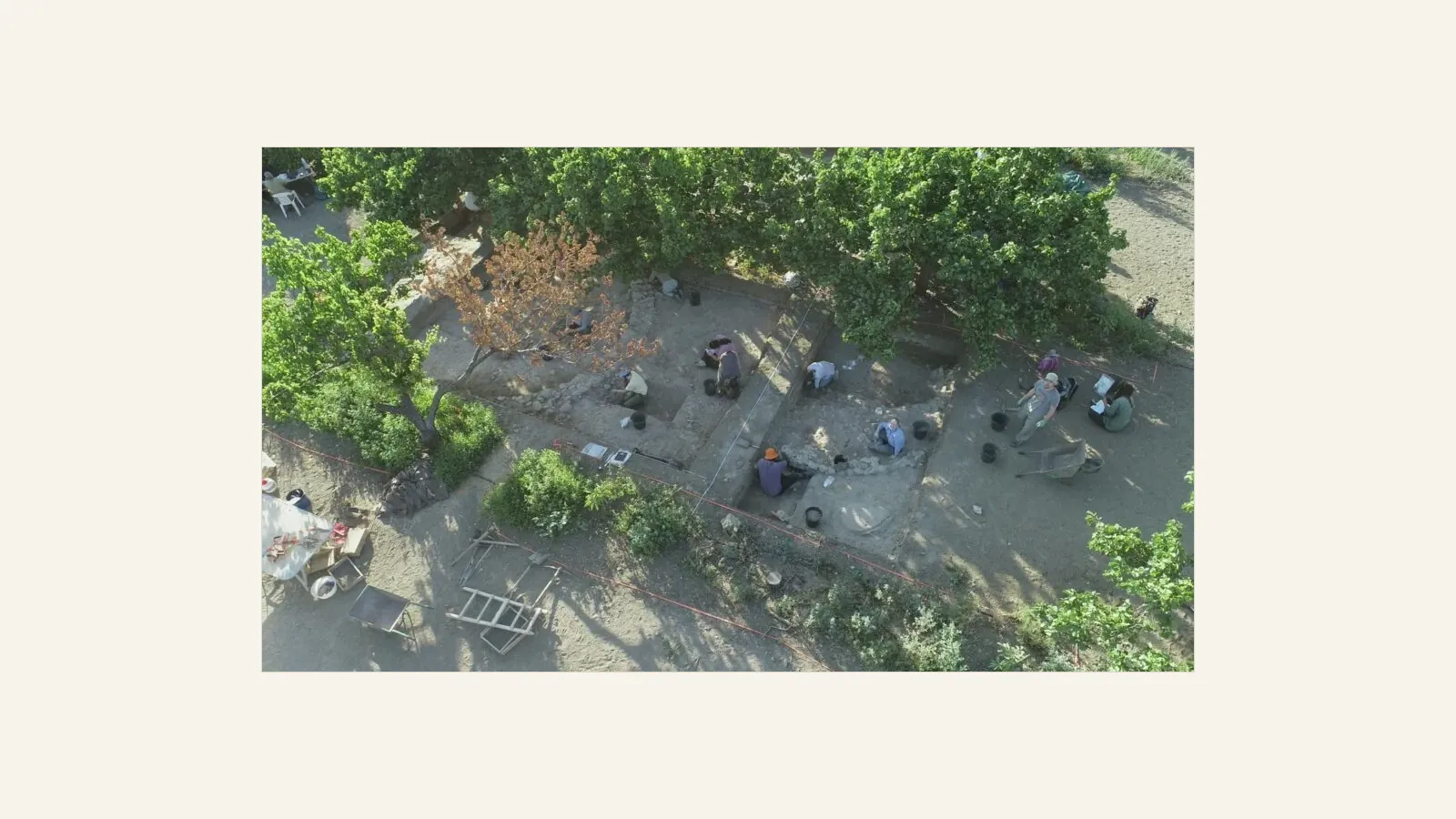
Session 7J opens at 2:00pm with "The Prehistoric Cemetery at Makounta-Voules-Mersinoudia: Excavations in 2025-2026", by Kathryn Grossman and Tate Paulette (North Carolina State University), Lisa Graham (College of Southern Nevada) and Andrew McCarthy (University of Edinburgh). Their project began excavating in 2025 a cemetery of vertical shafts cut into the rock and bell-shaped pits, beside the Chalcolithic and Bronze Age village at Makounta-Voules. Few of the tombs held objects or bones, but the authors write that both the grave goods found and the shapes of most tombs point to the Chalcolithic.
At 2:25 Lindy Crewe of CAARI gives "Recent Work at Bronze Age Kissonerga-Skalia". The coastal settlement in western Cyprus was lived in from the Philia phase, c. 2500 BCE, until c. 1600 BCE. In its last phase a large complex went up over the earlier houses: open spaces enclosed by a monumental wall, with cooking or heating installations on what Crewe calls an industrial scale. The paper reports the 2026 season, in which the team is finishing that last phase and turning to the earlier Bronze Age levels.
At 2:50 Sturt W. Manning (Cornell University) and Kevin Fisher present "Kalavasos and Maroni Built Environments Project: Updates 2026". At Kalavasos-Ayios Dhimitrios the KAMBE project has been digging Building 16, a monumental structure organised around a court, which lies south-west of Building X, excavated earlier by Alison South. Building 16 was first detected by ground-penetrating radar. At its north end the team reports evidence of ritual and ceremonial feasting centred on deer. At Maroni-Vournes the project is tying its own trenches to the excavations directed by Gerald Cadogan, above all the Ashlar Building, and using a large programme of radiocarbon dates to fix when and for how long the area was built up into a monumental centre.
At 3:15 Cassandra Donnelly speaks on "Getting the Cypro-Minoan Corpus Online (GeCCO)". Cypro-Minoan, the script written on Cyprus in the Late Bronze Age, has still not been deciphered. Donnelly's project, held under the Peltenburg Fellowship at CAARI, aims to publish as an open-access online corpus the 3-D models of inscribed Cypro-Minoan objects made by Martina Polig, which have not been published. Donnelly argues that accurate models would help scholars agree on the list of signs and let archaeologists study the inscribed objects closely.
The first part closes at 3:40 with "Landscape Archaeology in the Rural Hinterland of Kourion: A New Project in Progress", by Monika Rekowska and Anna Kordas of the University of Warsaw, Demetrios Michaelides (University of Cyprus; Cyprus Academy of Sciences, Letters and Arts), and the independent researchers Szymon Popławski and Maksym Mackiewicz. Their project, launched in 2024, studies the hills and valleys at Latsithkia, north of the Sanctuary of Apollo Hylates at Kourion, chiefly in the Roman and Late Roman periods; its search for a lost temple gives the project its name.
Part two: the first islanders, water and stone
Session 8J begins at 4:25 with Alan Simmons (University of Nevada, Las Vegas/Desert Research Institute, Reno) and "Still Looking for those Cypriot Neandertals!". Simmons, who excavated Akrotiri-Aetokremnos, argues that recent claims of Lower and Middle Palaeolithic finds on Cyprus rest on weak evidence, and asks for strict Palaeolithic standards before such material is published. Aetokremnos was the first site to take the island's human record back before the Neolithic, yet it belongs to the Epipalaeolithic, around 10,000 BCE, and Simmons notes that even it is still disputed.
At 4:50 Danielle Macdonald (The University of Tulsa), Lisa Maher and Bri Jones (University of California, Berkeley) give "Lithic Landscapes: Coastal and Mountain Occupations in Cyprus' Hunter-Gatherer Past". Their Ancient Seafaring Explorers of Cyprus (ASEC) project found Epipalaeolithic sites in the Tremithos Valley and around Mazotos-Petounta in Larnaca District, with stone tools close to those of Aetokremnos, dated to about 12,000 cal BP. In 2025 the survey moved inland to the Pentaschoinos River Valley and recorded dense scatters of worked stone on river terraces with intact ancient soils.
Madeline Topor (University of British Columbia) follows at 5:15 with "Shaping Power: Water Management and Access in Late Bronze Age Cyprus". From published plans of Kalavasos-Ayios Dhimitrios and Alassa-Paliotaverna, she argues that wells, channels and other water works were often tied to monumental public buildings, where access to water could be tightly controlled.
At 5:40 Anna Kordas presents "Masons' Marks and the Organization of Local Stone Construction in Greco-Roman Cyprus", early results of her doctoral study of largely unpublished marks on building blocks from Nea Paphos, Palaipaphos, Geronissos, Kourion, Latsithkia and Amathus. Marble was not quarried on Cyprus in antiquity, and she notes that the island's public buildings of the first two hundred years of Roman imperial rule used local stone alone.
The day ends at 6:05 with Thomas Landvatter (Reed College) and "Cyprus, Mercenaries, and pre-Hellenistic Egyptian Coinage: Reconsidering a “Kition” Bronze Issue". One face of the coin shows a lion walking left beneath a ram's head; the other, a horse walking left under a star, with a sign of Tanit beside it. It has been assigned to Kition, but underwater excavation at Thonis-Heracleion in Egypt has produced more than 200 of them. Landvatter argues the issue has at least strong Egyptian associations and reflects soldiers and others moving between Egypt and Cyprus in the 4th century BCE. His key evidence is the early Hellenistic fortified site of Pyla-Vigla, where, he says, bronze coins were almost certainly used by mercenaries.
Other Cyprus items at the meeting
Kim Benzel, Curator in Charge at the Metropolitan Museum of Art, opens the meeting on Wednesday 18 November at 7pm with the plenary address "Lapis, Clay, Copper, Water: Presenting Ancient West Asian Art at The Met". On Thursday 19 November at 9:55am Brita Lorentzen (University of Georgia) speaks on "Multi-Scalar Environmental Histories from Dendrochronology of Underwater Heritage in Cyprus and Israel". CAARI holds a reception from 6:30 to 7:30pm on the Friday, straight after the second Cyprus session, on the hotel's second floor. On Saturday at 4:25pm Andrew McCarthy returns with "Now We're Cooking! Neolithic Domestic Cooking vs. Large Scale Feasting in Cyprus", in a session on feasting and foodways.
Original sources
On ancientcyprus.com
- Sites
- Kissonerga, Maroni, Kourion, Kition, Alassa
- Excavations
- Makounta-Voules-Mersinoudia and Stroumpi-Pigi-Agios Andronikos: 2017 survey, Kissonerga-Skalia: the University of Manchester excavations, Kalavasos and Maroni Built Environments Project at Ayios Dhimitrios, Maroni-Vournes: the Cincinnati and British School at Athens excavations (Cadogan), Akrotiri-Aetokremnos: the Simmons excavations
- People
- Kevin D. Fisher, Catherine Kearns, Lindy Crewe, Sturt W. Manning, Cassandra M. Donnelly, Martina Polig, Edgar J. Peltenburg, Andrew McCarthy, Monika Rekowska, Demetrios Michaelides, Alan H. Simmons, Alison K. South, Gerald Cadogan
More in Events
- Leiden hosts PoCA 2026, the 23rd Postgraduate Cypriot Archaeology Meeting, on 11–13 November
- Today in Cypriot Archaeology: 19 October 2026
- Pylon exhibition in Limassol traces the Episkopi men J. Lawrence Angel measured in 1949
- Oxford's Amy Styring talks on crop isotopes and past farming at the Cyprus Institute on 30 October
- Cesnola's biographer Anna Marangou lectures on him and the Ohnefalsch-Richters on 2 November