
Fieldwork·Brief
Ten rock-cut tombs, most of them Chalcolithic, excavated beside a prehistoric village near Polis
Only two of the graves at Makounta-Voules/Mersinoudia still held objects: beads of shell, picrolite, faience and quartz in one, copper spirals and wire in the other.



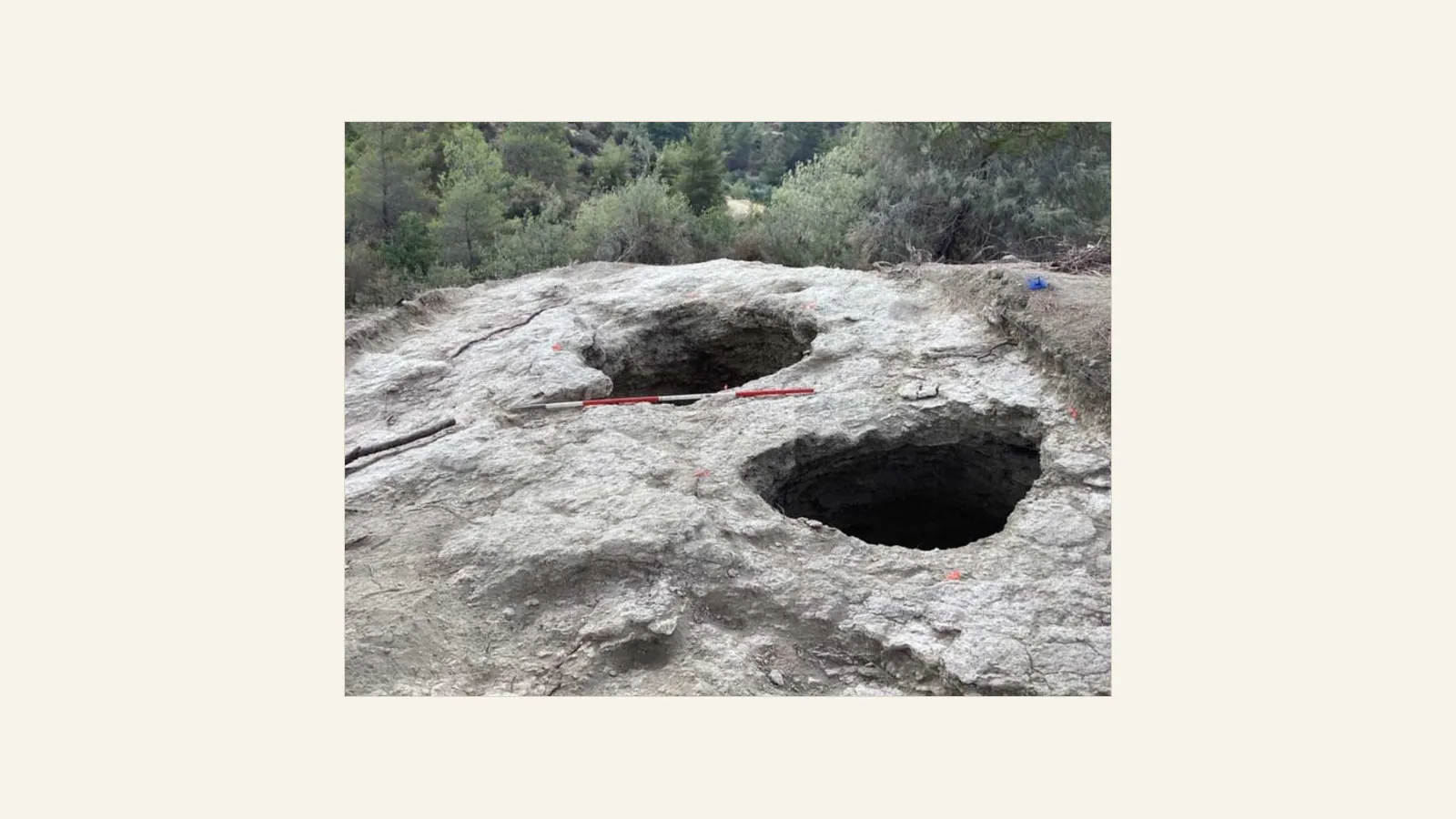
An American team has excavated ten tombs cut into the bedrock of a ridge at Makounta-Voules/Mersinoudia, in the hills north-east of Polis Chrysochous, beside a Chalcolithic village it had partly dug in earlier seasons. The Department of Antiquities announced the results on 11 May 2026. On their shape and the objects in them, it dates most of the graves to the Chalcolithic.
Shafts in the rock
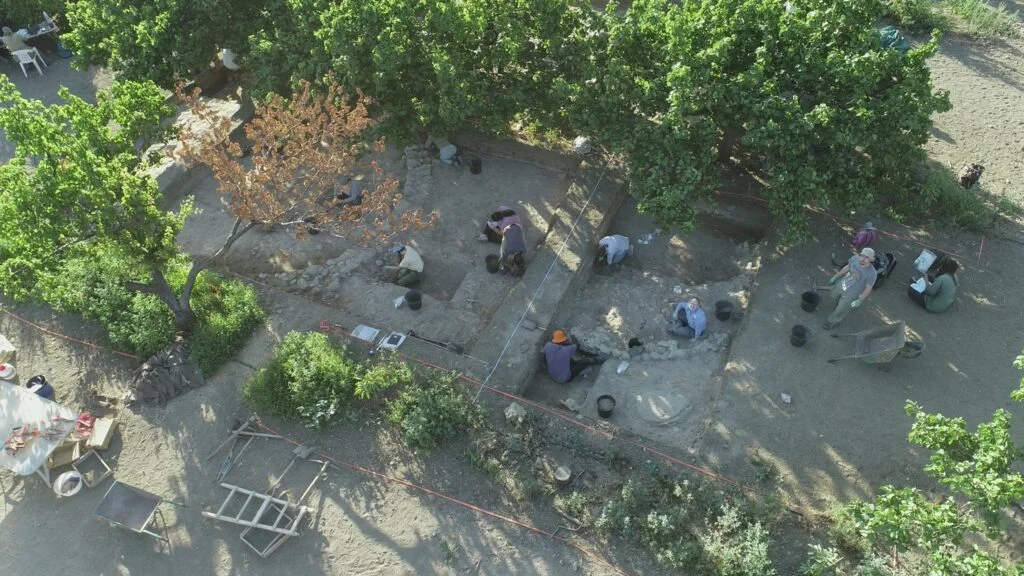
The North Carolina State University team worked on the ridge from 15 June to 17 July 2025 under Dr Kathryn Grossman, with Dr Tate Paulette of the same university and Dr Lisa Graham and Dr Andrew McCarthy of the College of Southern Nevada. The survey of Dr Darius Maliszewski had already located the cemetery, and some cuts showed in the bare rock before digging began. A few tombs had been disturbed in modern times; others had partly slipped down the cliff face.
The Department describes three apparent types. The smallest are round shafts about 1 m across that flare slightly, like a bell, at the bottom. Larger round shafts, about 2 m across, also widen at the base, and a few have a small side chamber, which may have formed through collapse and decay after burial. The third type is a single rectangular pit.
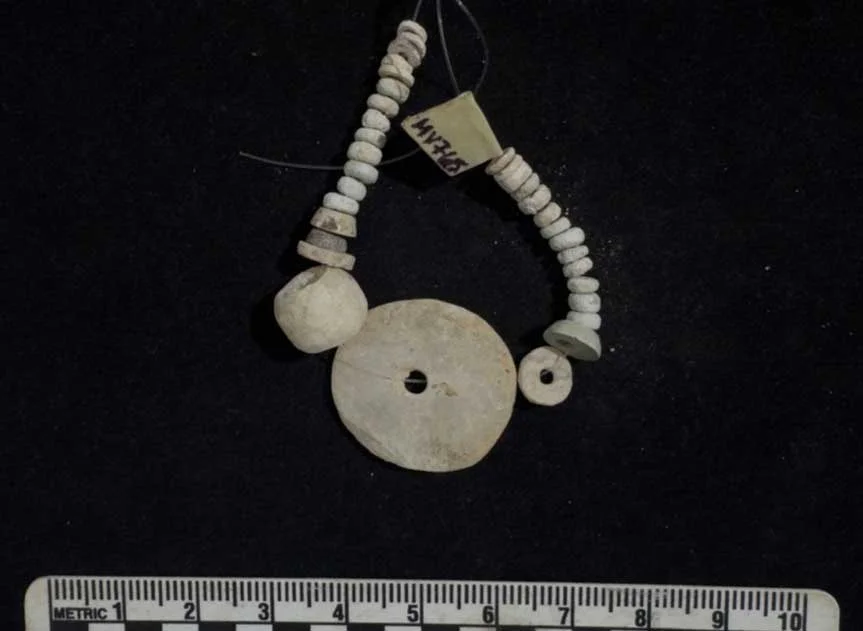
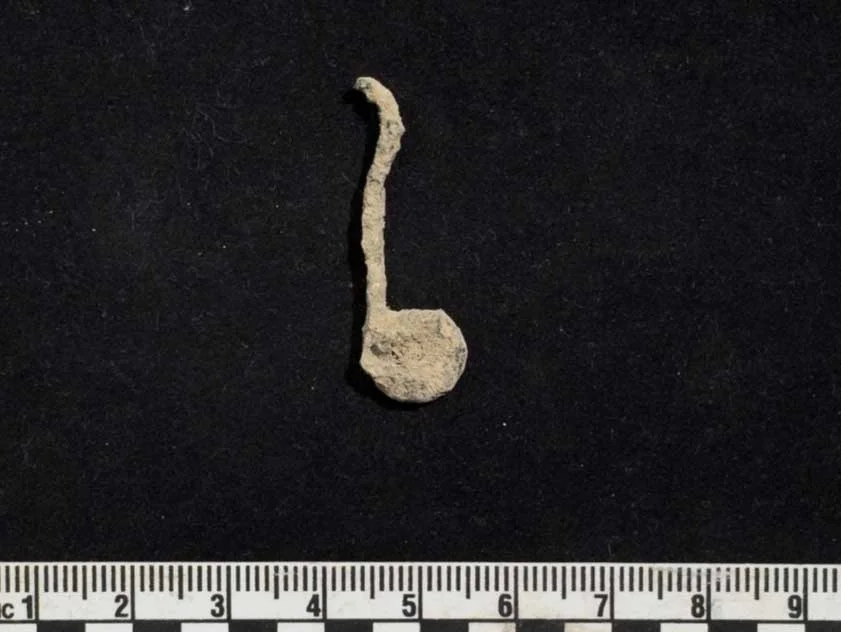
Every grave had been disturbed, and only two still held objects. One gave up dozens of beads of shell, picrolite (a soft green stone), faience and quartz. The other held part of a human skeleton, two copper spirals and broken lengths of copper wire. Unlike the village, whose ground is thick with artefacts, the ridge had almost no surface finds; a large grinding stone and a few sherds lay near one tomb.
The village below the ridge
The site lies in the foothills west of the Argaka Dam, on a north-facing slope above the Makounta river, about 2.5 km from the coast and 1 km from the copper mine at Limni [1, p. 109]. The North Carolina team named it Makounta-Voules-Mersinoudia because the settlement spreads over two neighbouring place names [1, p. 109].
Their 2017 survey collected 31,762 sherds. Most of the diagnostic prehistoric pieces were Chalcolithic, and every Chalcolithic sherd that could be dated more closely was Late Chalcolithic. The team also recorded 91 ground-stone tools and 51 pieces of metal slag, which the authors took as a possible sign of metalworking on the spot [1, pp. 109–110]. Petrographic study has matched the main pottery fabric at Makounta to Late Chalcolithic storage jars at Chlorakas-Palloures, north of Paphos, and a model published in March compared the routes between the two villages by land and by sea.
Beside Souskiou
The Department sets the new cemetery against the Souskiou cemeteries near Palaepaphos, finding both likenesses and differences, and treats it as new evidence for how prehistoric Cypriot communities were organised. Souskiou-Laona and Souskiou-Vathyrkakas, excavated by Edinburgh teams from 1992, are described by their excavators as the only known Chalcolithic cemeteries on Cyprus set apart from a settlement [2, p. 468]. Their tombs were cut into the rock, and some were closed with capstones [2, p. 124].
Laona also yielded about 30 faience beads, dated to the second half of the fourth millennium BCE and the earliest recorded in Cyprus [2, p. 479]. Three of them have tin in their glaze, which the excavators read as a sign that the beads, or the copper scale used to make them, came from abroad [2, p. 479]. One Laona tomb held faience beads together with a copper pendant [2, p. 479].
The American Society for Overseas Research, the US National Science Foundation and the university itself paid for the Makounta season.
Original sources
On ancientcyprus.com
References
- 1.Grossman, K., Paulette, T., Graham, L., & McCarthy, A. (2020). 2017 Survey of Two Prehistoric Sites in Western Cyprus: Stroumpi-Pigi-Agios Andronikos and Makounta-Voules-Mersinoudia. In Proceedings of the 11th International Congress on the Archaeology of the Ancient Near East, Volume 2: Field Reports, 105–110.
- 2.Bolger, D., Crewe, L., & Peltenburg, E. (2019). Ritual, identity and community at Souskiou: Traditions and transformations. In E. Peltenburg, D. Bolger, & L. Crewe (Eds.), Figurine makers of prehistoric Cyprus: Settlement and cemeteries at Souskiou (chap. 21). Oxbow Books.
More in Fieldwork
- Hellenistic quarry under Paphos's Fabrika hill became an unused tomb, then a church
- This Week in Cypriot Archaeology: 31 August–6 September 2026
- Hollows cut into a Bronze Age threshold at Erimi match a senet game board
- This Week in Cypriot Archaeology: 27 July–2 August 2026
- Grape seeds and unfired loom weights found in Bronze Age work complex at Erimi-Pitharka