
Events·Event
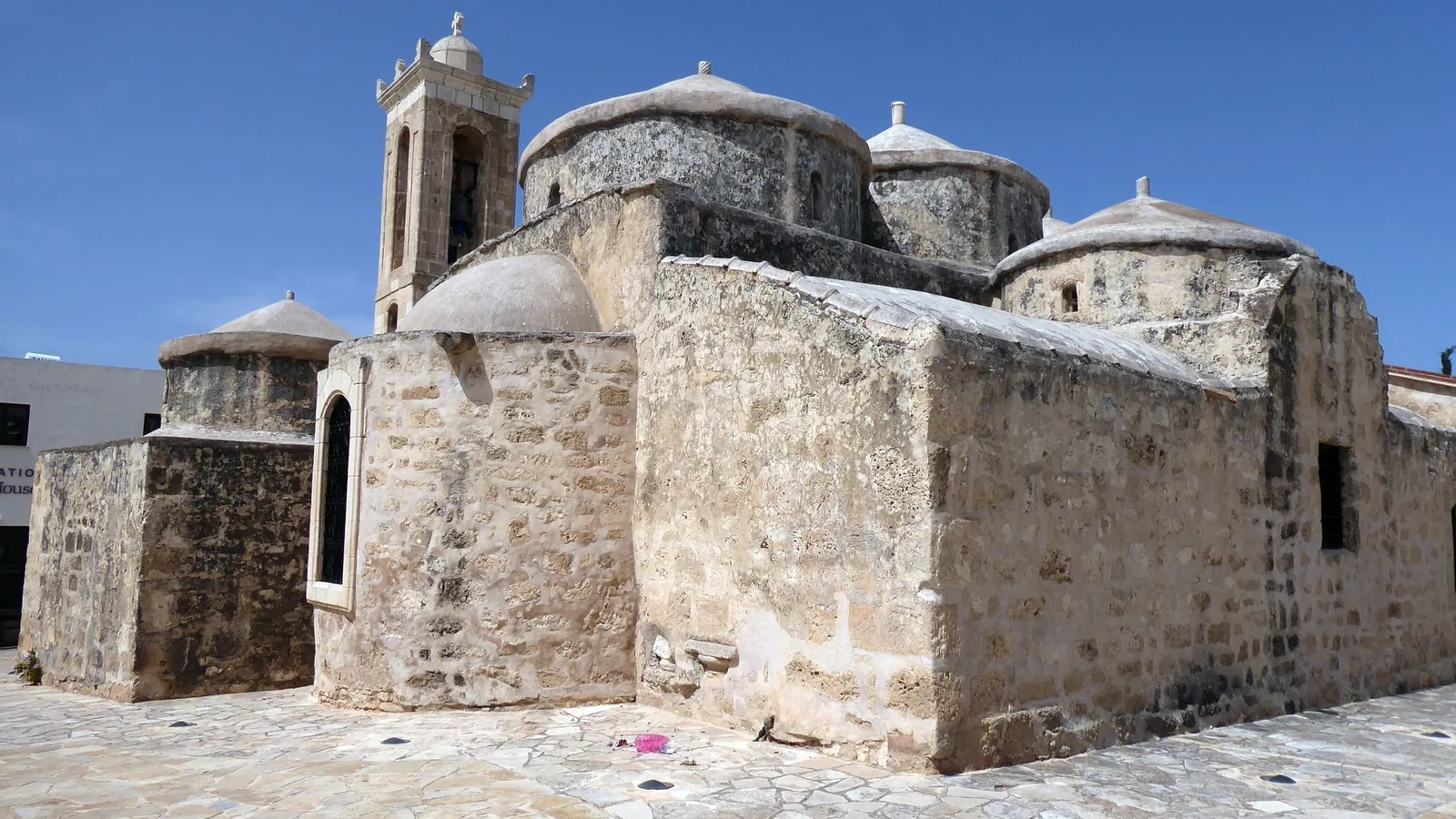
Free guided walk in Yeroskipou on 24 November visits the five-domed church of Agia Paraskevi
The Pafos Regional Board of Tourism's three-hour walk leaves the municipal square at 09:30 and also stops at the Folk Art Museum in the 18th-century House of Hadjismith.



Open day
- When
- 24 November 2026 In 4 days
- Where
- Ierokipia Municipal Square (public bus stop), Yeroskipou
- Admission
- Free
A free guided walk through the centre of Yeroskipou, the town just east of Paphos, sets off at 09:30 on Tuesday 24 November 2026 and ends at 12:30, starting from the municipal square beside the public bus stop. The Pafos Regional Board of Tourism, which spells the town Ierokipia, lists the walk for every Tuesday from 6 October.
The board's listing names four subjects: the church of Agia Paraskevi, the town's link with the cult of Aphrodite, the Folk Art Museum, and the loukoumi sweets ("Geroskipou delights") made in the town. Reservations are taken by telephone and email.
The church of Agia Paraskevi
Demetrios Michaelides, whose University of Cyprus team excavated the Early Christian basilica at Agioi Pente north of the town, calls Agia Paraskevi the most famous monument of Yeroskipou and dates its first building to the eighth or ninth century [1, p. 1]. Marble spolia, pieces reused from an older building, are set into its masonry, but small soundings by the Department of Antiquities found no earlier church beneath it [1, p. 1].
The church is a three-aisled vaulted basilica with five domes laid out as a cross: three over the nave and one over each side aisle. Franz Georg Maier and Vassos Karageorghis, who date it to the 9th century, know only one other church of this form on the island, Saints Hilarion and Barnabas at Peristerona [2, p. 303]. Walls pierced with arches divide its aisles where columns would be usual; they trace the type to the 6th-century basilica of St John at Ephesus, with medieval parallels only in southern Italy and France, and single out its 15th-century frescoes [2, p. 306].
In 2007 landscaping of the square around the church exposed about fifteen medieval burials in rock-cut graves, which the Department excavated under Eustathios Raptou.
The Folk Art Museum
The museum occupies an 18th-century mansion known as the House of Hadjismith, which belonged to the English consular agent Andreas Zimboulakis. A small collection was first shown there in the late 1960s, and the museum opened properly in 1978. It holds 19th- and 20th-century folk art from across Cyprus, much of it from the Paphos district [3, table 3.1].
Hierokepis and the older town
The town's name goes back to Hierokepis, the "sacred garden" of Aphrodite. Strabo places it on the west coast between Palaipaphos and Nea Paphos, and the 5th-century BCE geographer Damastes had used it to mark the south-western end of the island [4, p. 156].
Michaelides puts the archaeological record of the area between the 14th century BCE and the 3rd century CE [1, p. 1]. North of the town lie Late Bronze Age cemeteries; at Asprogia in 1964 Kyriakos Nicolaou excavated three chamber tombs, one with a gold diadem still on the skull. At Agioi Pente, road works in 2002 exposed a Late Antique basilica, excavated by the University of Cyprus from 2003 under Michaelides: mosaic floors laid over burials, and four ossuaries holding nearly 900 coins.
Original source
On ancientcyprus.com
- Excavations
- Yeroskipou-Agioi Pente: University of Cyprus excavation of the Early Christian basilica, Yeroskipou-Asprogia: Department rescue of Late Bronze Age tombs, Geroskipou, Agia Paraskevi square: Department rescue of medieval graves
- Institutions
- Department of Antiquities of Cyprus
- Periods
- Late Bronze Age
References
- 1.Michaelides, D. (2014). The significance of the basilica at Agioi Pente of Yeroskipou. In C. A. Stewart, T. W. Davis and A. Weyl Carr (eds), Cyprus and the Balance of Empires: Art and Archaeology from Justinian I to the Coeur de Lion. Boston: CAARI, 1–16.
- 2.Maier, F. G. and Karageorghis, V. (1984). Paphos: History and Archaeology. Nicosia: A. G. Leventis Foundation.
- 3.Stylianou-Lambert, T. and Bounia, A. (2016). The Political Museum: Power, Conflict, and Identity in Cyprus. Heritage, Tourism and Community 8. Walnut Creek, CA: Left Coast Press.
- 4.Bekker-Nielsen, T. (1999). Strabo and Ptolemy on the geography of western Cyprus. Symbolae Osloenses 74, 151–162.
More in Events
- Children to make pots and work stone at Chalcolithic Lemba as its excavation turns 50
- Ten free events in Nicosia close the Cyprus Insula exhibition, from coins to colonial archaeology
- Evangeline Markou to speak in Athens on the coins of the kings of Kition and Idalion
- Nicosia museum workshop teaches children the peaks and castles of Pentadaktylos
- Nicosia conference on 6–7 November hears new work on Erimi, Ayia Irini and the "Achaeans"