
Lecture·CAARI Cyprus·2024
Clearing the Dust from Legacy Material: Renewed Studies on the Israeli Excavations at Athienou-Bamboulari tis Koukounninas
Chapters
About the lecture
Francesca Meneghetti, the Edgar Peltenburg Fellow at CAARI, presents preliminary findings from her reassessment of the 1971–1972 excavations at Athienou-Bamboulari tis Koukounninas, conducted by an Israeli mission from the Hebrew University of Jerusalem led by Trude Dothan and Amnon Ben-Tor.
Meneghetti begins with the history of investigation around Athienou in the Mesaoria plain, noting survey visits by Catling in the 1950s and rescue trenches by the Department of Antiquities in 1958. She then outlines the four strata identified by the Israeli team, which span from the transition between the Middle Bronze Age and the Late Bronze Age down to the Iron Age. Her research focuses on Stratum III, dated by the excavators from the 16th to the 13th century BC. This phase features a building with a courtyard containing pits and heaps of pottery, metal scraps, copper nodules, and animal bones, yielding an estimated 10,000 vessels.
The core of the lecture addresses the small-sized and miniature vessels stored in the Cyprus Museum. Meneghetti critiques the original publication for omitting Strata IV and I, lacking clear dimensional criteria for miniatures, and treating all small vessels simply as non-functional votives. Having catalogued 780 complete vessels, she finds that 81 percent are closed shapes, predominantly juglets, and that most are made of coarse ware and Plain White Handmade ware, alongside Monochrome, White Shaved ware, and Base Ring. She notes hybrid shapes and vessels made in wares atypical for their form. Drawing on anthropological theory by Jack Davey, she distinguishes between true miniatures (defined in her catalogue as vessels under 7 cm that have larger counterparts but lose certain features) and vessels that are simply small.
In the final section, Meneghetti reconstructs the site's stratigraphy by cross-referencing the published text, plans, sections, and photographs. Focusing on Locus 503 and a funnel-shaped pit in the centre of the courtyard, she demonstrates that Locus 503 was inconsistently assigned across Strata III and II. She proposes dividing it into three distinct sub-loci (503A, 503B, and 503C) and argues that the pit was actually cut during Stratum II rather than Stratum III, which suggests that miniature pottery continued to be used and possibly produced in Stratum II.
From our collection
Pieces in the Drakopoulos collection of the kinds and periods this talk covers: Base Ring ware, Bichrome ware (Iron Age).
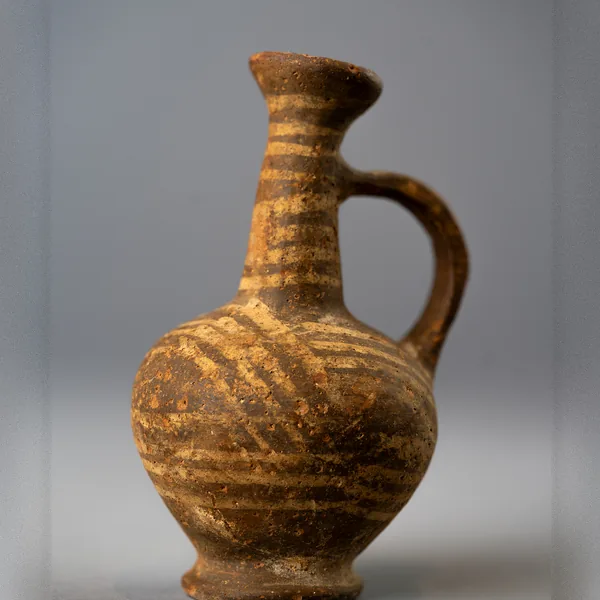
Base Ring II Bilbil Juglet with White-Painted Bands
Base Ring ware
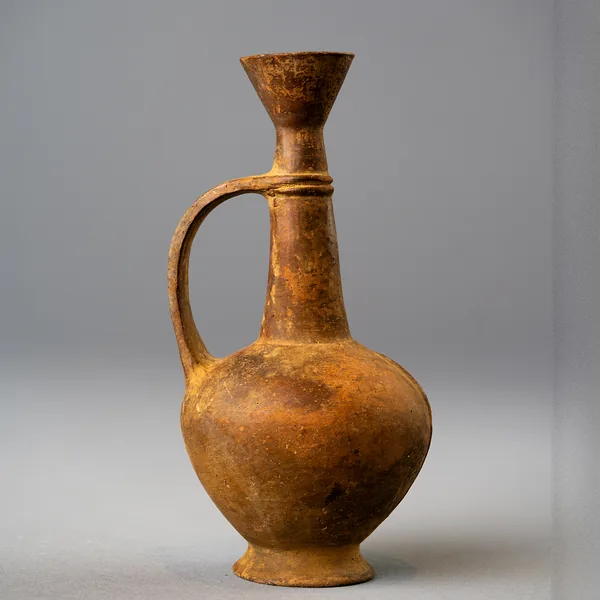
Base Ring Bilbil Juglet with Funnel Mouth and Neck Ridge
Base Ring ware
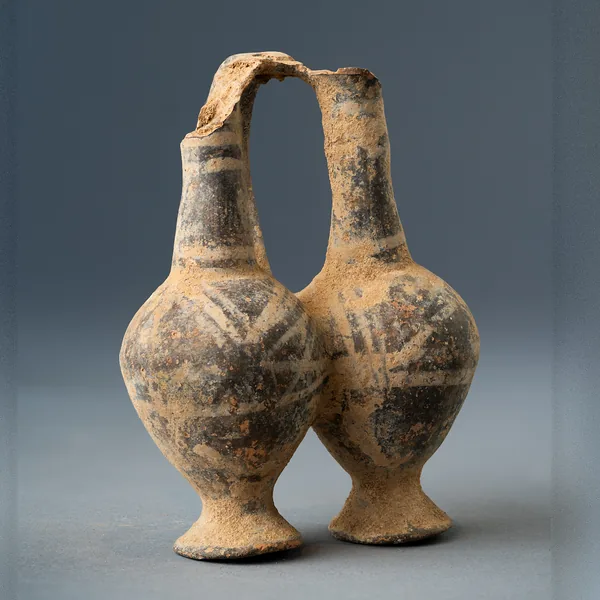
Base Ring II Double Juglet with White-Painted Decoration
Base Ring ware
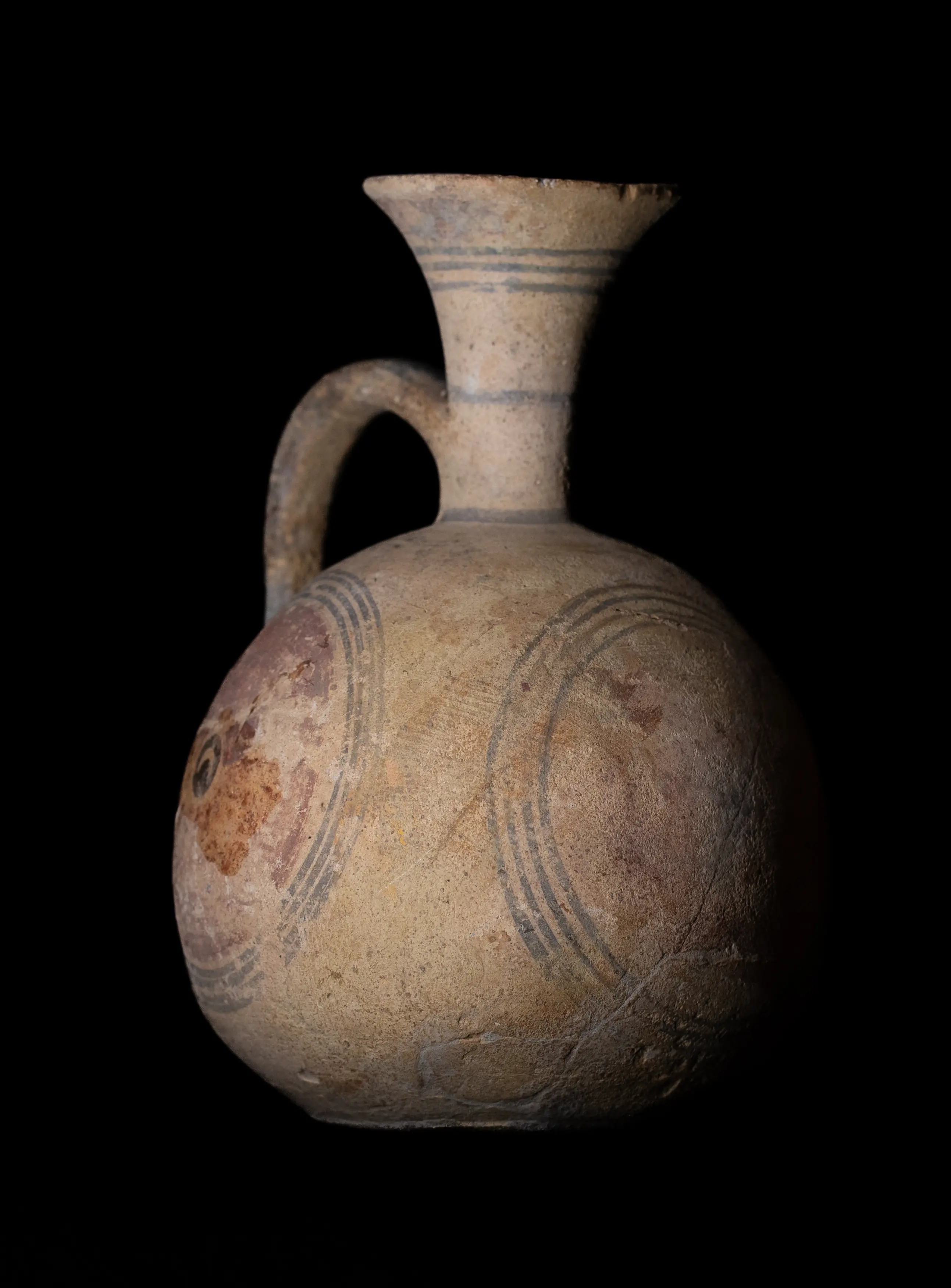
Bichrome Juglet
Bichrome ware (Iron Age)
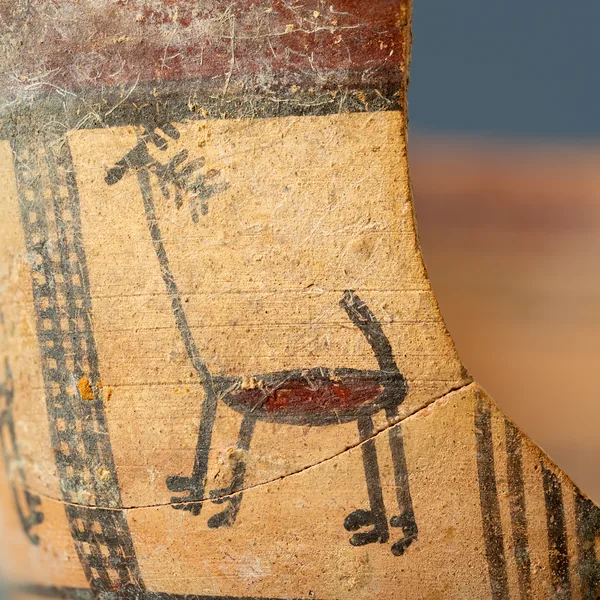
Bichrome Skyphos with Stags in Metopes
Bichrome ware (Iron Age)
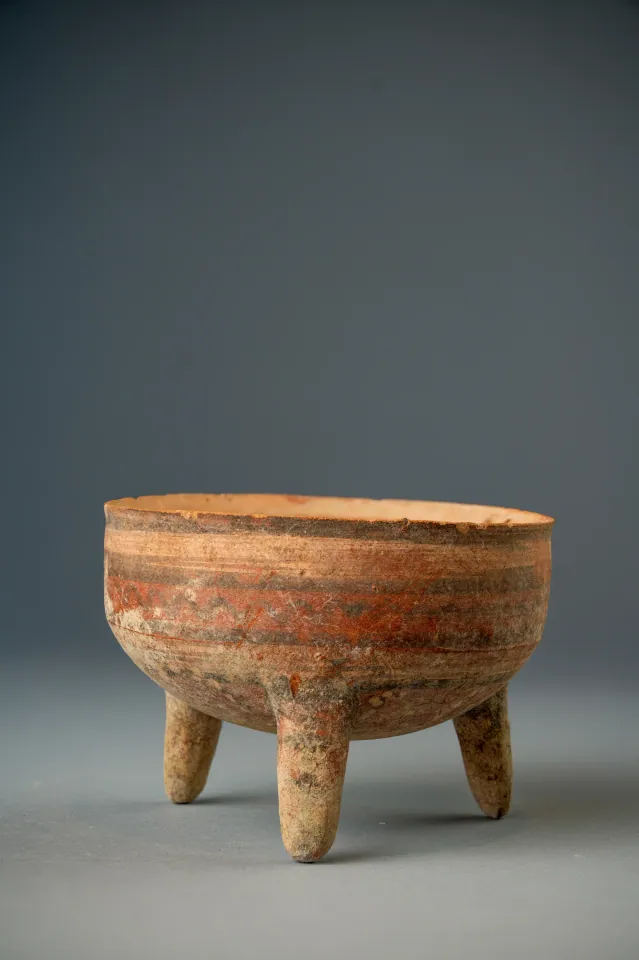
Bichrome Tripod Bowl with Painted Bands
Bichrome ware (Iron Age)
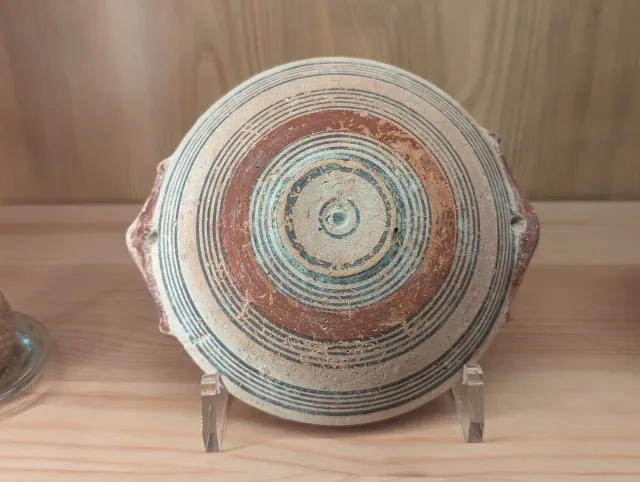
Bichrome IV Bowl with Red-Painted Pierced Lug Handles
Bichrome ware (Iron Age)
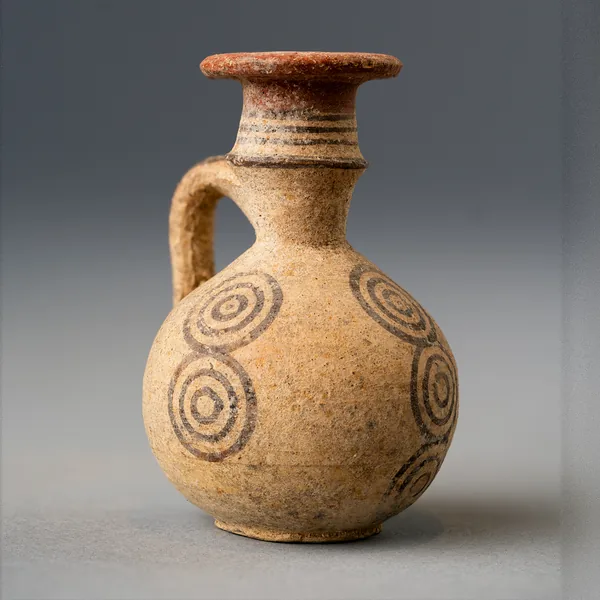
Bichrome IV Handle-Ridge Juglet with Rows of Concentric Circles
Bichrome ware (Iron Age)
Background
Where to read more on this site before or after watching.
The site
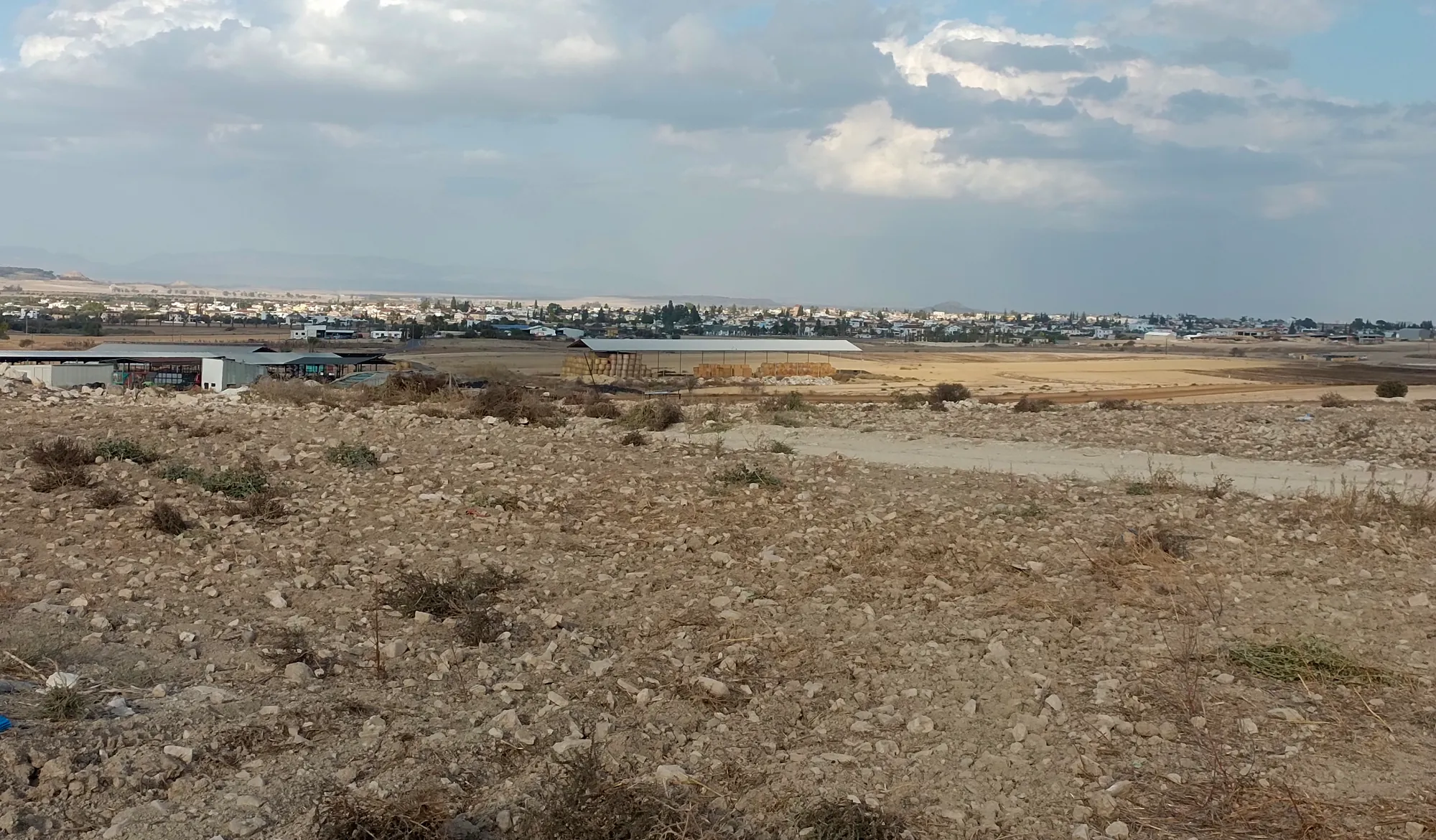
Athienou
The area around Athienou in central Cyprus holds a Late Bronze Age cult place with copper working at Bamboulari tis Koukounninas, used from the 16th to the mid-12th century BC, and the rural sanctuary of Malloura, used from the 8th century BC to the 4th century AD, with its rock-cut tombs on Mağara Tepeşi. The ancient town of Golgoi, just north-east of Athienou, has its own page.
In the compendium
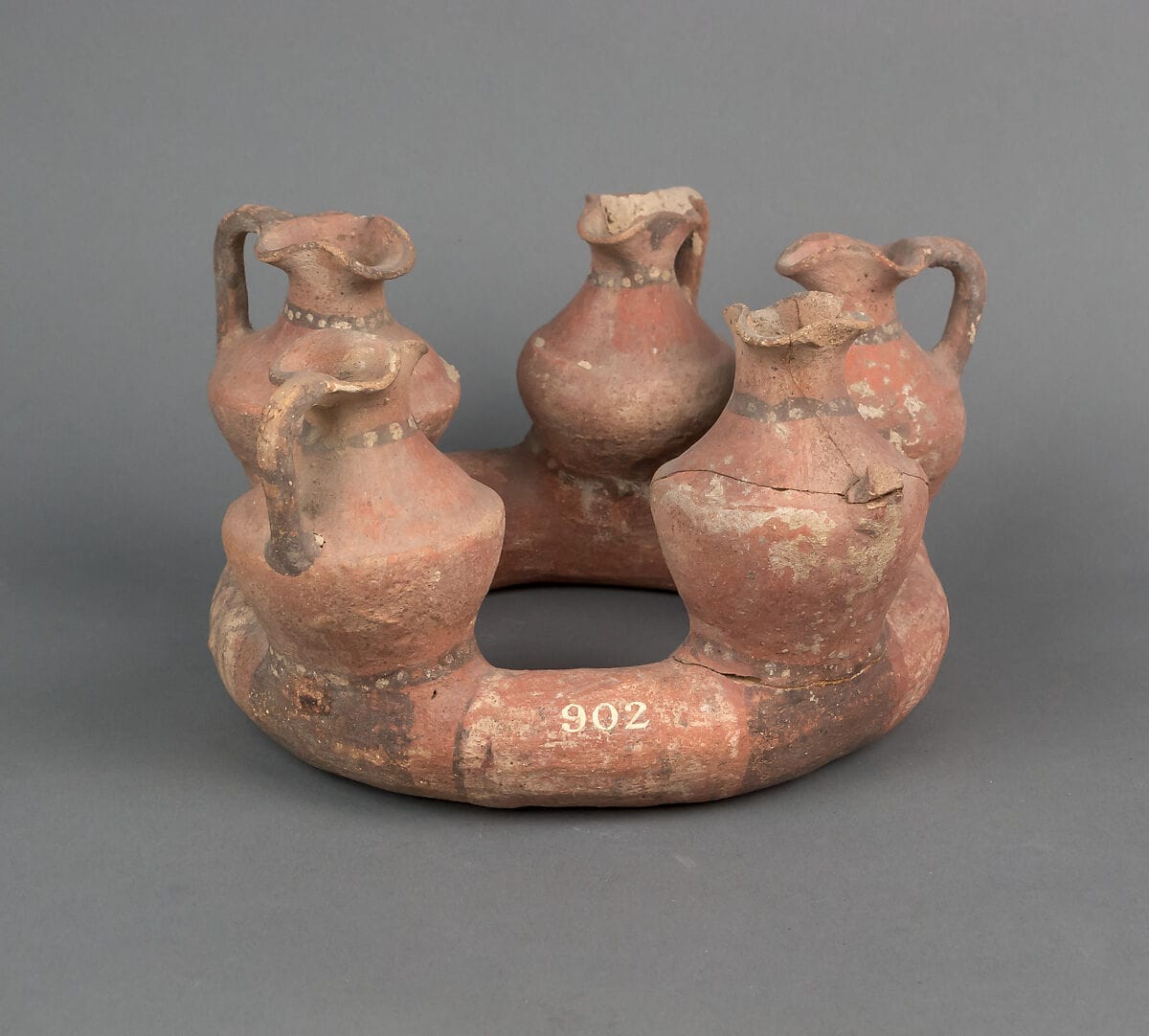
Complex Vessels
Composite, multiple and ring vessels built by multiplying or joining ordinary shapes, mostly Bronze Age tomb pieces, plus figure vases, arm-vessels, incense burners, stands and miniatures.
In the compendium
Juglets
A juglet is a small one-handled jug with a narrow neck, made in Cyprus in most wares and widely exported as a container for perfumed oil.
In the compendium
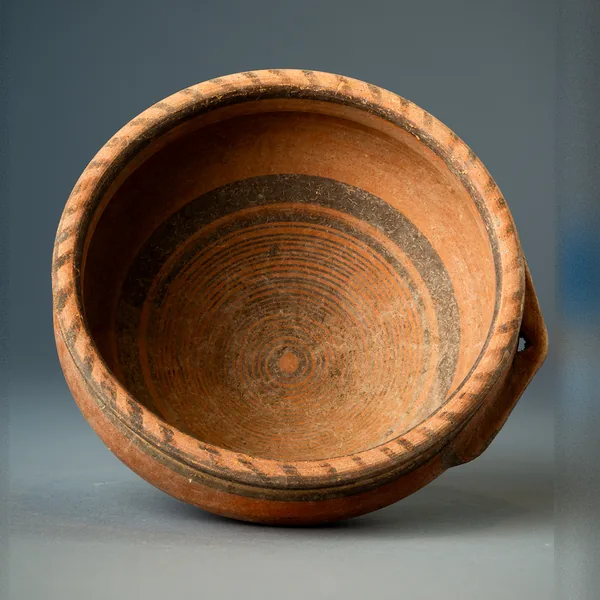
Bowls
The open vessel deeper than a plate and without a pouring neck, the one Cypriot pottery shape made without a break from the Neolithic to the Iron Age.
Map of Cyprus
Places discussed in the talk
- Has a page on this site
- Other places
- Ground above 200, 500, 1,000 m
Places
- 1Athienou
- 2Athienou-Bamboulari tis Koukounninas (approx.)