
Contents
This page is about church art: icons, frescoes, mosaics and liturgical objects, most of them medieval or later. They are not archaeological finds, and their trade was a separate market from the trade in ancient pottery, sculpture and metalwork. See church art and antiquities.
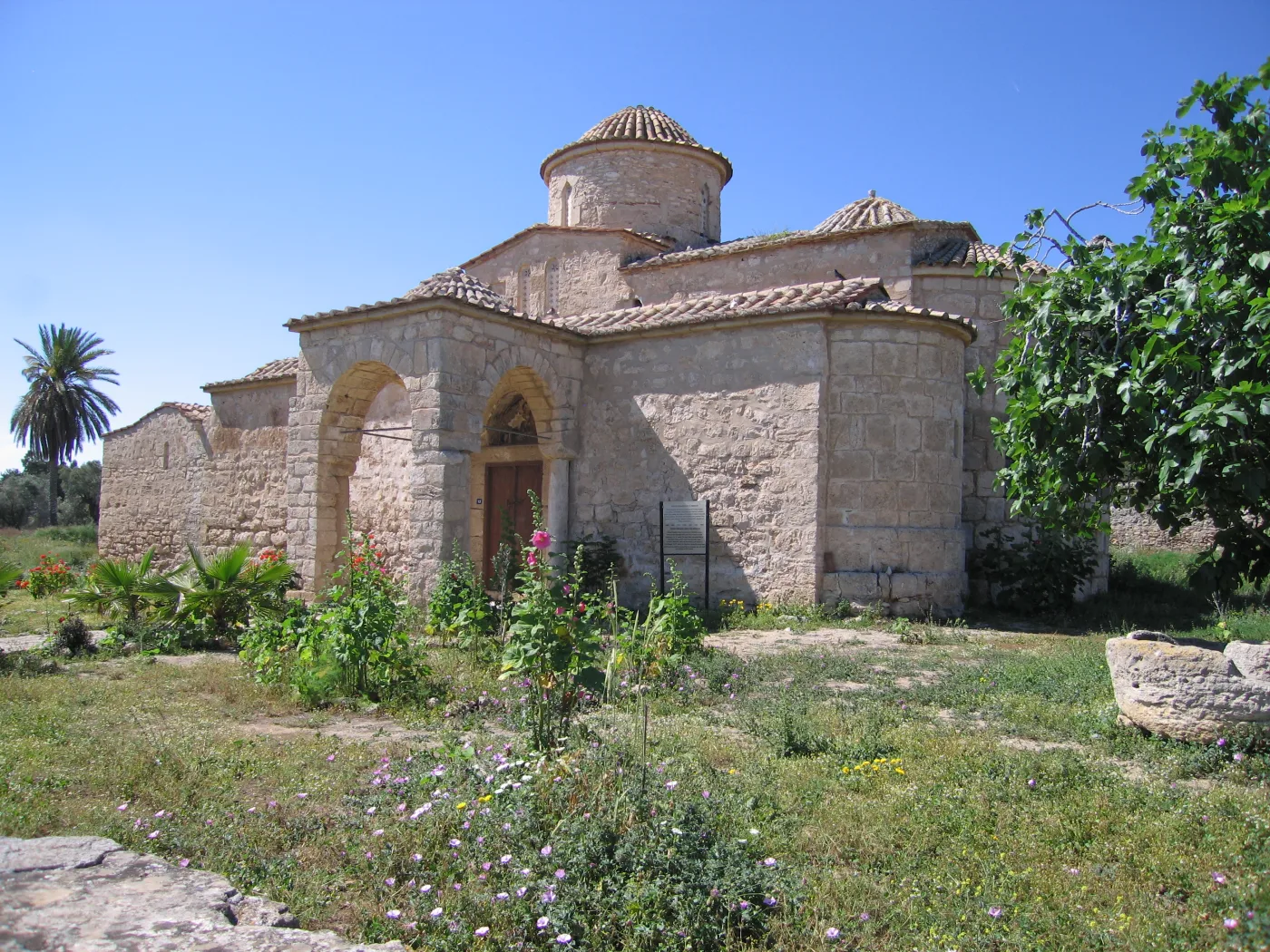
The apse mosaic of the Panagia Kanakaria, a church outside the village of Lythrankomi in the Karpas peninsula, is the best-documented theft of church art from the occupied north of Cyprus. It was set on the apse wall in the early sixth century, restored and photographed in the 1960s, and published in full by Dumbarton Oaks in 1977. Between August 1976 and October 1979, after the village's Greek Cypriot congregation had been forced to leave, it was cut from the wall. Four fragments were sold in the free port of Geneva airport in July 1988 to an Indianapolis art dealer, and an Indiana federal court ordered them returned to the Church of Cyprus in 1989. Other fragments came back through intermediaries in 1983 and 1984, in the Munich operation of 1997 and in two returns of 2018. The trial record shows who handled the mosaic after it left Cyprus and what each was paid. The photograph above, taken in 1973, shows apostle medallions and an archangel in place (photo: Shirazibustan, CC BY-SA 4.0, via Wikimedia Commons).
The church and its mosaic before 1974
The Panagia Kanakaria began as a timber-roofed basilica with three aisles, built about AD 500; the mosaic of the apse was made shortly afterwards [4, p. 233]. The Indiana court dated it to 530 [1]. It showed the Virgin enthroned in a mandorla of light with the Christ as a boy on her lap, archangels on either side, and a frieze of medallions with busts of the twelve apostles [1; 4, p. 234]. Anne Sullivan describes it as the only mosaic of the Theotokos to survive Iconoclasm, which spared it because a treaty of 688 had placed Cyprus beyond effective imperial jurisdiction [4, pp. 233–234]; the court called it "one of only six or seven Byzantine mosaics to survive the ravages of Iconoclasm and the passage of time" [1]. It is Late Antique, one of the few early works among the church art taken from the north.
The mosaic had deteriorated over the centuries. By 1960, the court found, what remained was the figure of Christ, the bust of the north archangel and nine of the twelve apostles [1]. Between 1959 and 1967 it was cleaned and restored under the joint sponsorship of the Department of Antiquities, the Church of Cyprus and Harvard University's Dumbarton Oaks Center for Byzantine Studies, and the knowledge gained in that work went into the monograph by A. H. S. Megaw and E. J. W. Hawkins, The Church of the Panagia Kanakaria at Lythrankomi in Cyprus: Its Mosaics and Frescoes (1977) [1; 3]. The church was a protected monument under the Antiquities Law of 1935; its title stayed with the Church [4, p. 234]. The book's photographs are why the fragments could be identified when they reappeared; Thomas Kline, lead counsel for the Church and the Republic, says it "provided important evidence at trial" [6, pp. 463–464].
Removal between 1976 and 1979
After the Turkish invasion of 1974 the Greek Cypriots of Lythrankomi were enclaved, and services went on in the church until July 1976, when the parish priest fled south; the church was undamaged at that point, and by the end of 1976 every Greek Cypriot in the village had been made to leave [1]. "Sometime between August 1976 and October 1979," the court found, "the interior of the Kanakaria Church was vandalized and the mosaics were forcibly removed from the apse of the church. The mosaics were severely damaged during their removal" [1]. Neither the Republic nor the Church ever authorised their removal or sale [1].
The Department of Antiquities learned of the loss in November 1979 from a visitor to the occupied area [1]. The Republic informed UNESCO, the International Council of Museums, Europa Nostra and the Council of Europe; Constantine Leventis, its ambassador to the United Nations, told the British Museum, the Louvre, Christie's and Sotheby's; Vassos Karageorghis, Director of Antiquities, and Athanasios Papageorghiou, Curator of Ancient Monuments, wrote to colleagues abroad [1]. The court treated this as the diligent search that kept the claim alive [1].
The first return, 1983 to 1984
In 1983 a London dealer brought the Menil Foundation of Houston to a flat in Munich to see frescoes, which the seller said were from Turkey; there they saw a mosaic, which the dealer came to suspect was part of the Kanakaria apse. The frescoes proved to be the Lysi frescoes, and the seller was Aydın Dikmen, a Turkish dealer living in Munich [1; 10, pp. 305–306]. According to depositions summarised by the court, the dealer then persuaded Dikmen to hand over what he had of the mosaic. Ambassador Leventis "secured the recovery of four pieces of mosaic, two of which Cyprus determined were not genuine" [1]. Cypriot officials were told the holder had no more, and were not given his name [1; 4, p. 235].
The sale in Geneva, July 1988
The four fragments at the centre of the lawsuit were the figure of Christ, the bust of the north archangel, and the medallions of St Matthew and St James, each about two feet square [1; 5, p. 358]. Peg Goldberg, an Indianapolis dealer who had dealt "almost exclusively in 19th and 20th century paintings, etchings, and sculptures" since 1981 and did not claim expertise in Byzantine art, had gone to Amsterdam on 30 June 1988 to see a painting for a client [1]. On 1 July an Indianapolis dealer she knew introduced her to the Dutch dealer Michel van Rijn and a California lawyer, who showed her photographs and said the seller wanted $3 million [1]. She was told that the seller had "found" them in the rubble of an "extinct" church in northern Cyprus while working as "an archaeologist from Turkey assigned to northern Cyprus", and that the Turkish Cypriot authorities had let him export them to Germany in the late 1970s [1]. Two days later she learned his name, Aydın Dikmen [1]. Dikmen was never convicted of anything.
On 3 July the buyer and the three intermediaries agreed in Amsterdam to "acquire the mosaics for their purchase price of $1,080,000 (U.S.)", and to divide the profit on any resale: 50 per cent to her company, 22.5 per cent each to the two dealers and 5 per cent to the lawyer [1]. The Seventh Circuit added that the lawyer had already signed a contract, as agent for van Rijn, to buy the mosaics from Dikmen for $350,000, and that she was not told of it [2]. On 5 July the lawyer and Dikmen flew the crates from Munich to Geneva, where they stayed in the free port area of the airport and never passed through Swiss customs; she met Dikmen there once, briefly, and inspected the fragments [1]. An Indianapolis bank lent $1,224,000. The money arrived in Geneva on 7 July in $100 bills; she kept $120,000 and handed over $1,080,000, and Dikmen issued a "General bill of sale" that gave the price as $1.2 million [1]. None of the export papers offered at trial mentioned Dikmen or these mosaics [1]; Sullivan adds that a licence in the name of the Turkish Cypriot administration was among them, and that the administration itself called it a fake [4, p. 235].
By October 1988 a dealer acting for her had approached Marion True of the J. Paul Getty Museum, who said the Getty did not collect Byzantine art and telephoned Karageorghis; the asking price to the Getty was $20 million [1; 4, p. 236]. Cyprus wrote asking for the mosaics back, and sued in March 1989 [1].
Church of Cyprus v. Goldberg, 1989 and 1990
The Church and the Republic sued in replevin in the federal court in Indianapolis; the legal reasoning is set out in Church of Cyprus v. Goldberg. A motion by the Turkish Cypriot administration to intervene was refused [1; 4, p. 234]. The bench trial ran from 30 May to 6 June 1989, and on 3 August 1989 Judge Noland awarded possession to the Church [1].
- Choice of law. Switzerland, where the sale took place, had "an insignificant relationship" to the suit; the buyer, her company, her bank and the mosaics were in Indiana, so Indiana law applied. Under Indiana law "a thief obtains no title", so the buyer never acquired title and her good faith did not matter [1; 4, p. 236].
- Limitation. Indiana's six-year limit ran under the discovery rule from the time the owner knew, or could with diligence have known, who held the mosaics; Cyprus first learned that in late 1988 and sued within months [1; 5, p. 358]. The court rejected the dates the defence proposed: 1979, a Turkish Cypriot newspaper story of 1982 about Dikmen, and the 1983 to 1984 return [1; 4, p. 236].
- Swiss law in the alternative. Even if Swiss law had applied, she would not have been a good-faith purchaser. The court listed the suspicious circumstances: she knew the mosaics came from an area under foreign military occupation; they were unique religious objects that had until recently been part of a building; she paid $1.08 million for pieces that every appraisal in evidence, including the defence expert's, put at between $3 million and $6 million; she knew almost nothing about the seller; she knew one intermediary had a French conviction for forging Chagall signatures; and the deal was done within a week [1; 4, p. 237].
The Seventh Circuit affirmed on 24 October 1990, and rehearing was refused on 21 November [2]. Chief Judge Bauer's opinion closed: "Only the lowest of scoundrels attempt to reap personal gain from this collective loss. Those who plundered the churches and monuments of war-torn Cyprus, hoarded their relics away, and are now smuggling and selling them for large sums, are just such blackguards" [2]. The Supreme Court refused to hear the case in November 1991 [2]. The four fragments had been returned to Cyprus in 1991, after the appeal failed [7]. Patty Gerstenblith notes that the owner bore the whole cost, and that the courts spent much of their attention on whether a Church with no access to its own building had searched hard enough [5, p. 358]. Kline adds a practical consequence: the trial identified the presumed smuggler, which let the Church and the Republic pursue him in Germany [6, p. 464].
Fragments recovered after 1991
Two more medallions came back through the Munich operation of 1997. According to Mark Rose's report in Archaeology, van Rijn, acting as intermediary, delivered the medallion of St Thaddeus to the Cypriot consulate in The Hague on 5 September 1997, and the police found the medallion of St Thomas when they searched a third flat rented by Dikmen under a false name on 26 November 1997 [7]. The money for the buy-backs of that year was raised from the Church of Cyprus; the figures are set out in the state as buyer. The Thaddeus medallion was back in Cyprus on 22 December 1997 [7]. Dikmen was arrested on 10 October 1997 [7]; he was never convicted of anything.
Two further medallions came home in 2018. St Andrew was found in London in 2014, when a dealer asked a colleague to check where it came from; told that it belonged to the Church of Cyprus, he agreed to return it once his expenses were covered, and two Cypriot businessmen paid the cost of its repatriation, reported as $61,200; the return was announced in April 2018 [8]. St Mark was traced to Monaco by a Dutch art investigator and handed to the Cypriot embassy in The Hague in November 2018 by a British family who had bought it "in good faith" more than four decades earlier, for "a small fee to cover restoration and storage costs" [9]. The Cyprus Mail then counted twelve major pieces of the mosaic returned, while "some are still missing"; the April 2018 report said that most of the mosaic had come back "with the exception of one of St. Luke the Evangelist" [8; 9]. The press counts do not square exactly with the nine apostles the court recorded for 1960 [1]. The returned fragments are in the Byzantine Museum of the Archbishop Makarios III Foundation in Nicosia.
Where the money went
The court's figures for the $1,080,000 handed over in Geneva on 7 July 1988 are the fullest record of how the price of an object taken from Cyprus after 1974 was divided [1].
| Recipient (as described in the court record) | Paid in Geneva | Later sums in the record |
|---|---|---|
| Aydın Dikmen, the seller | $350,000 | None recorded |
| Michel van Rijn, intermediary | $282,500 commission | Sold half his 22.5% resale share; amount not stated |
| An Indianapolis dealer, intermediary | $297,500 commission | $375,000 for half his 22.5% resale share |
| A California lawyer | $80,000 fees | 5% of any resale profit |
| A London attorney | $70,000 | None recorded |
| The buyer | Kept $120,000 of the $1.2m loan | Asked the Getty for $20 million |
The two intermediaries each sold half of their resale interest to another Indiana investor, who paid $780,000 for the two halves; the dealer testified that he received $375,000 of it [1]. The court did not say what van Rijn received. If the rest of the $780,000 went to him, his total came to about $687,500; other accounts give about $657,500, which assumes equal halves. Either way, the two intermediaries' commissions in Geneva ($580,000) exceeded the seller's $350,000, and the asking price to the Getty was more than fifty times the seller's share. Whoever cut the mosaic from the wall does not appear in the money record.
The evidence against treating church art as a separate trade
The case is the strongest evidence against two points this section makes: that looting in Cyprus barely paid, and that church art should be kept apart from antiquities. Church art from the north could produce seven-figure sums. Kline calls the seller the presumed smuggler [6, p. 464], and when he was arrested in Munich in 1997 the police found Cypriot frescoes, mosaics, icons and coins in his flat alongside pre-Columbian pottery and stolen paintings [5, p. 370]. Fincham describes, from the accounts of Michael Jansen and van Rijn, an organisation with scouts, men to strip walls and a lookout, and a route through Turkey to flats in Munich [10, p. 305].
It does not show the same for archaeology. The mosaic was a unique, named, photographed part of a building, with one owner and a published image of every figure; that is why it fetched seven figures, and why it could be recovered [1; 3]. A Red Polished bowl from a northern tomb is one of thousands of the same type; in our own unpublished research the median sold Cypriot vessel fetches about $820. The comparison is set out in church art and antiquities and the economics of looting.
What the case means for a buyer today
The Kanakaria judgment remains the reference case for church art from the occupied north. A buyer of a mosaic, fresco fragment or icon from a Cypriot church cannot rely on a free-port sale, a dealer's bill of sale or papers issued in the occupied north: the Seventh Circuit held that decrees of the Turkish administration there did not divest the Church of title, and the suspicious circumstances the district court listed are the ones a court will look for [1; 2]. Where a church was published before 1974, as the Kanakaria was, a fragment can be identified from the photographs, and the Church of Cyprus has gone on recovering such pieces through courts, buy-backs and private returns. The general account of what was taken from the north and what has come back is looting in occupied northern Cyprus.
References
- 1.Autocephalous Greek-Orthodox Church of Cyprus v. Goldberg & Feldman Fine Arts, Inc., 717 F. Supp. 1374 (S.D. Ind. 1989), memorandum of decision and order of 3 August 1989 (Noland J.).
- 2.Autocephalous Greek-Orthodox Church of Cyprus v. Goldberg & Feldman Fine Arts, Inc., 917 F.2d 278 (7th Cir. 1990), decided 24 October 1990 (Bauer C.J.); certiorari denied, 502 U.S. 941 (1991).
- 3.Megaw, A. H. S., & Hawkins, E. J. W. (1977). The Church of the Panagia Kanakaria at Lythrankomi in Cyprus: Its mosaics and frescoes. Dumbarton Oaks.
- 4.Sullivan, A. McC. (1991). Law and diplomacy in cultural property matters. Museum Management and Curatorship, 10(3), 219–243. https://doi.org/10.1080/09647779109515275
- 5.Gerstenblith, P. (2015). For better and for worse: Evolving United States policy on cultural property litigation and restitution. International Journal of Cultural Property, 22(2–3), 357–378. https://doi.org/10.1017/S094073911500017X
- 6.Kline, T. R. (2012). Confronting complexity in the preservation of cultural property: Monuments, art, antiquities, archives, and history. What can Cyprus teach us? Proceedings of the Annual Meeting (American Society of International Law), 106, 462–469. https://www.jstor.org/stable/10.5305/procannmeetasil.106.0462
- 7.Rose, M. (1998). Special report: Church treasures of Cyprus. Archaeology, 51(4). http://archive.archaeology.org/9807/etc/special.html
- 8.OrthoChristian.com. (2018, April 26). 6th-century St. Andrew the First-Called mosaic stolen in 1970s returns to Cyprus. https://orthochristian.com/112548.html
- 9.Cyprus Mail. (2018, November 18). Latest piece from stolen Kanakaria mosaics back in Cyprus. https://archive.cyprus-mail.com/2018/11/18/latest-piece-from-stolen-kanakaria-mosaics-back-in-cyprus/
- 10.Fincham, D. (2015). The rescue, stewardship, and return of the Lysi frescoes by the Menil Foundation. International Journal of Cultural Property, 22(2–3), 301–314. https://doi.org/10.1017/S0940739115000120