
Contents
Some of the best-known kinds of Cypriot pottery take their names from places that have been in the occupied north since the Turkish invasion of 1974. Red Polished vessels with modelled figures are called Vounous or Lapithos types after the Bronze Age cemeteries on the coast below the Kyrenia range; the terracotta votaries of Ayia Irini, the Late Bronze Age gold and Mycenaean kraters of Enkomi, and the tomb furniture of Salamis are all northern. When such an object comes up for sale abroad, its type is sometimes read as a sign of where and when it left Cyprus. The record does not support that reading. Excavators' shares, nineteenth-century digging, the division of 1930 with Sweden, the Cyprus Museum's sales and the licensed market took northern material abroad in large numbers between the 1870s and 1973, and much of it still carries the tomb numbers and registration marks that prove it. A northern type shows where an object was made or buried. Only its documented history shows when, and how, it left the island. The Red Polished tulip bowl from Vounous at the head of this page, now in the Louvre, is an example of that history in a public collection.
What counts as a northern type
The cemeteries of the north coast are the type-sites for much of the Early and Middle Bronze Age. Vounous, near Bellapais, and Lapithos gave their names to regional styles of Red Polished pottery, the modelled scenes and composite vessels that collectors have prized since the 1920s. Karmi, Vasilia and the other cemeteries of the Kyrenia range belong to the same circle. Further west, the sanctuary of Ayia Irini on the coast of Morphou Bay produced about 2,000 terracotta figures of the Cypro-Archaic period. In the east, Enkomi and Salamis supplied Late Bronze Age and Iron Age tomb groups to museums for more than a century. Vouni, Soli, Kythrea, Nitovikla, Ayios Iakovos and the mound of Toumba tou Skourou near Morphou complete a list in which most of the island's best-published excavations before 1974 lie north of the present line.
That concentration is itself part of the explanation. The north coast and the Mesaoria east of Nicosia were among the most intensively dug parts of Cyprus under Ottoman and British rule, by museums, by foreign expeditions and by villagers. A large share of the Bronze Age pottery in the world's museums is northern because the north is where so much of it was excavated and divided. Northern objects therefore reached collections abroad not despite the law of the time but under it, and the record of each channel can be followed site by site.
Salamis and Enkomi in the nineteenth century
The first large northern export came from Salamis and Enkomi. Alessandro Palma di Cesnola began digging at Salamis in 1876 with money from the London collector Edwin Lawrence, and his men were working at Enkomi when the British authorities stopped them on 2 October 1878. He was tried under the Ottoman regulation of 1874, fined four liras, and the antiquities seized at Enkomi and Ormidia were confiscated [3]. The rest of what he had gathered formed the greater part of the Lawrence-Cesnola collection, "more than 14,000 items", which was refused by the British Museum and the South Kensington Museum and sold in four auctions in London between 1883 and 1892 for around £2,500 [4]. The number of pieces from Salamis cannot be separated from the rest [3]. This channel was mixed in its legal standing, and the Salamis account sets out where it crossed the line; but the sales themselves were public auctions in London, and their lots have been circulating for nearly 140 years.
Licensed museum work followed. The South Kensington Museum, now the Victoria and Albert, had about 45 tombs opened at Salamis in 1882, and another 45 at Enkomi the same year. Max Ohnefalsch-Richter dug at Salamis for the British Museum in 1880 and 1882. The Cyprus Exploration Fund's season of 1890 ended with a division of the finds; the Fund's share was presented to the British Museum, among it the marble bull's-head capital, GR 1891,8-6.1, shipped from Famagusta in February 1891 [6]. In 1896 the British Museum, using the Turner Bequest, opened 100 tombs at Enkomi. Lindy Crewe records that the finds from two thirds of the tombs went to London and the rest to the Cyprus Museum [5, p. 27], and the London share was afterwards spread through museums in Britain and abroad as "duplicates" [4]. The Enkomi gold, the ivories and the Mycenaean pictorial kraters in Bloomsbury, and the scattered Enkomi pots in regional museums across Britain, belong to this channel.
The Swedish division of 1930
The largest single lawful export of northern material was the share of the Swedish Cyprus Expedition. Between 1927 and 1931 Einar Gjerstad and his colleagues excavated across the island, but most of their sites lie in what is now the occupied north: Lapithos, Ayia Irini, Enkomi, Vouni, Soli, Kythrea, Nitovikla, Ayios Iakovos, Petra tou Limniti and Mersinaki among them. The division was worked out in the autumn of 1930 by the Director of the Cyprus Museum, the Governor's private secretary and Gjerstad, approved by the Governor, Sir Ronald Storrs, and ratified without change by the Museum Committee on 27 October 1930 [2, p. 410]. Tomb groups and deposits were not to be split, and on those terms "Sweden received about two-thirds of the nearly 18 000 finds", with all the sherd material of scientific value [2, p. 411].
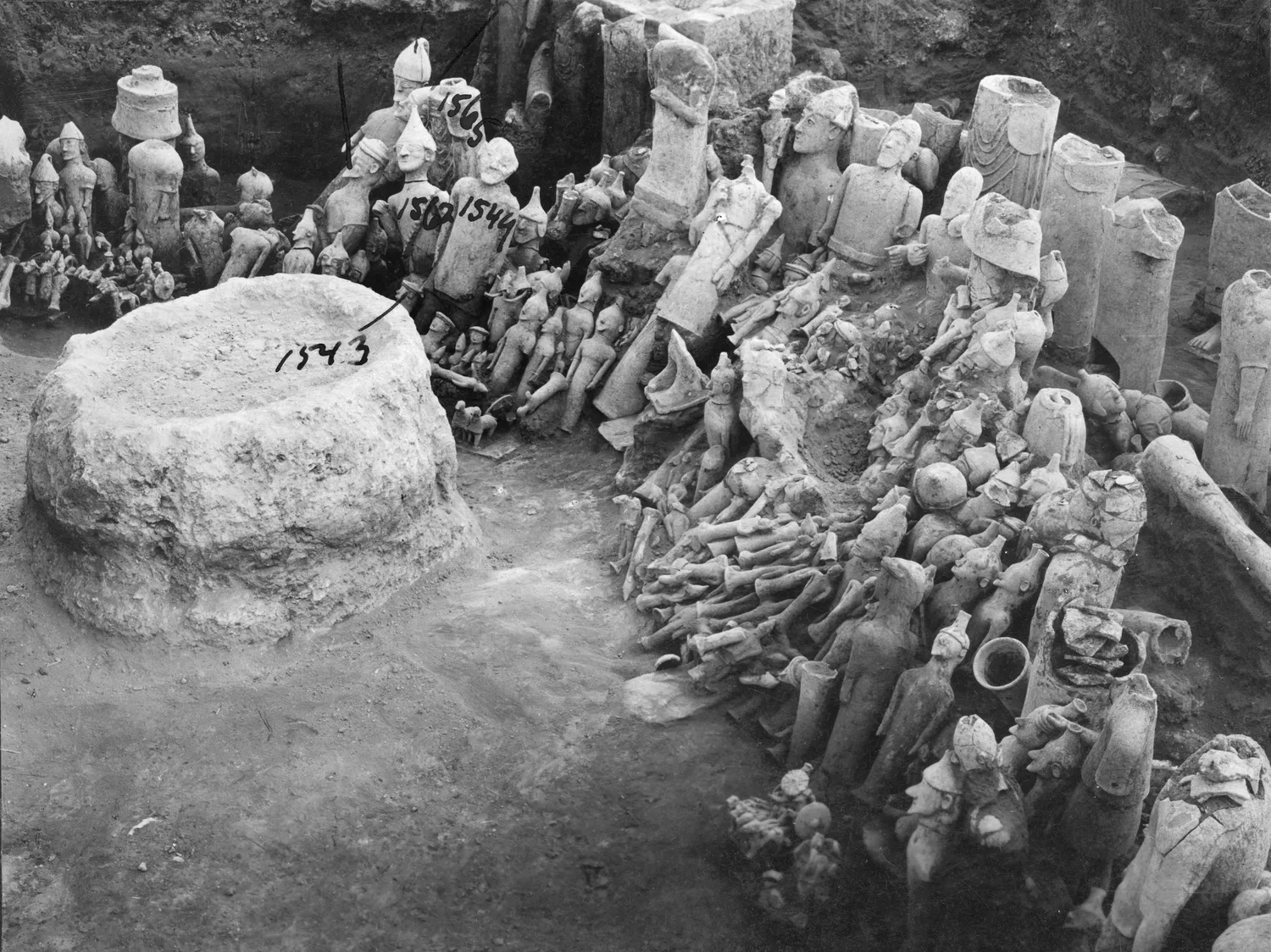
The Ayia Irini terracottas, about 2,000 figures from a single deposit, were the one deliberate exception: they were divided between the two countries [2, p. 411]. In March 1931 the Swedish share went by train from Nicosia to Famagusta in 771 wooden packing cases and sailed for Sweden; about 12,000 objects and 5,000 boxes of sherds reached Stockholm [2, pp. 411–412]. Those objects are the core of the Medelhavsmuseet. A Lapithos tomb group or an Ayia Irini votary in Stockholm is northern by type and find-place, and has been in Sweden since 1931 by an agreement between the colonial government, the Cyprus Museum and the excavators.
Lapithos and Vounous between the wars
American, French, British and Australian excavators took further shares from the north coast under the Antiquities Law of 1905 and its successor of 1935.
At Lapithos the Pennsylvania Cyprus Expedition of 1931 to 1932 dug 38 Bronze Age chamber tombs at Vrysi tou Barba and two Cypro-Geometric cemeteries [7, pp. 39–40]. Under the 1905 law, Stella Diakou writes, Tomb 474 was the only tomb awarded to the Cyprus Museum [8, p. 248]; the rest went to Philadelphia, where Ellen Herscher's survey of 1975 covered 37 tombs held at the Penn Museum [7, p. 56].
At Vounous the record begins with looting. Early in 1931 the Kyrenia police sent the Cyprus Museum "a number of Red Polished vases collected on the site of Vounous", and when Porphyrios Dikaios went out he "saw that extensive looting was being carried out" [1, p. 1]. He cleared 48 tombs for the Museum in 1931 and 1932 while news kept arriving that the villagers had resumed digging [1, p. 1]. Three foreign shares followed. Claude Schaeffer's excavation of 1933 for the Louvre, about thirty tombs, was divided: part went to the Louvre under a decree of 6 December 1934, 174 objects were later sent to Australia, and Schaeffer kept a study collection at his home [9, pp. 21–22]. He gave 43 objects from Vounous to the Musée d'Archéologie nationale at Saint-Germain-en-Laye in 1934 [10, p. 170]. James Stewart and Eleanor Stewart dug for the British School at Athens in 1937 and 1938, and J. L. Myres reported that "part of the excavator's share has come to the Birmingham Museum of Art, the remainder to the Nicholson Museum at Sydney" [11]. The British Museum's Red Polished tulip bowl from Vounous, 1939,0217.3, was bought from Stewart, and Vounous bowls from his tombs are registered at the Manchester Museum.
Division did not end with colonial rule. Stewart dug the cemeteries at Karmi, also in the Kyrenia range, for the University of Melbourne in 1961, under the Republic. The finds of three tombs stayed in the Cyprus Museum and the rest went to Australia, where eleven tomb groups were later passed on to other institutions [12, pp. xxi–xxii].
| Site | Channel | Years | Where the share went | Source |
|---|---|---|---|---|
| Salamis and Enkomi | Alessandro Palma di Cesnola for Edwin Lawrence | 1876-1878 | More than 14,000 items, sold in London 1883-1892 | [3]; [4] |
| Salamis | Cyprus Exploration Fund | 1890 | British Museum, with gifts to other museums | [6] |
| Enkomi | British Museum, Turner Bequest | 1896 | Finds of two thirds of 100 tombs to London | [5, p. 27] |
| Lapithos, Ayia Irini, Enkomi, Vouni, Soli and others | Swedish Cyprus Expedition division | 1927-1931 | About 12,000 objects to Stockholm | [2, pp. 410-412] |
| Lapithos | Pennsylvania Cyprus Expedition | 1931-1932 | All tombs but Tomb 474 to Philadelphia | [8, p. 248] |
| Vounous | Schaeffer for the Louvre | 1933 | Louvre; 43 to Saint-Germain-en-Laye; 174 to Sydney | [9, pp. 21-22]; [10, p. 170] |
| Vounous | Stewart for the British School at Athens | 1937-1938 | Birmingham and the Nicholson Museum, Sydney | [11] |
| Karmi | Stewart for the University of Melbourne | 1961 | All but three tombs to Australia | [12, p. xxi] |
The old market in northern pottery
Beside the excavators' shares ran the market. Vounous was being dug for sale before any archaeologist reached it [1, p. 1], and what the villagers sold in 1930 and 1931 entered collections with no record of its tomb. The Cyprus Museum's own sales of "duplicates", begun in 1926 under Rupert Gunnis and continued until 1991, drew on the Museum's stores, which held the Cypriot share of every northern excavation; how that saleroom worked is told in the article on the Cyprus Museum's sales. After 1935 licensed dealers sold with export permits, and the island's declared private collections, several of them in Famagusta, held northern material lawfully until 1974. Licences and their lead seals are described in the article on export licences and labels.
The London salerooms of the 1960s and early 1970s show how ordinary this material had become abroad. In the autumn of 1967 a London sale offered "more than a hundred" Cypriot antiquities at once [13, p. 6]. Some of the Red Polished pots sold in those years were looted in Cyprus before they reached London; an export licence showed that an object left lawfully, not that it had been lawfully dug, and the legal export entry explains the distinction. But they were on the market before the invasion, and the date of their arrival abroad is the fact a buyer needs to establish.
The Desmond Morris collection
One of the largest private collections of this material formed abroad in those years was Desmond Morris's. In the preface to The Art of Ancient Cyprus (1985), which serves as its catalogue, he writes that he began it after a visit to a London saleroom in the autumn of 1967, and added to it "over the next fifteen years, by visiting the salerooms and art dealers of London, New York, Boston, Amsterdam and Paris"; it then held "over 1,100 items" [13, p. 6]. The book gives purchase details for some objects. Its deer-milking jug, a late Red Polished vessel that Morris thought came from the south-west of the island, "was purchased at a Christie's sale in London on 11 July 1973 (lot 87)" [13, p. 265]. Objects in the collection are numbered in its check-list with the prefix DM.
The collection was sold at Christie's South Kensington on 6 November 2001, in a sale titled "The Art of Ancient Cyprus: The Desmond Morris Collection" [16]. One of the objects in it was a Red Polished model of a grape-treading installation, an elliptical trough on four legs with a sluice, a large standing figure and eight smaller ones around the rim [14]. The A. G. Leventis Foundation bought it and gave it to the Department of Antiquities on 23 January 2002. Vassos Karageorghis, Director of Antiquities from 1963 to 1989, published it in the Department's Report for 2002 under the title "Cypriote Antiquities Repatriated", and presumed that it came from the cemeteries of the Kyrenia mountains [15, p. 67 n. 2]. Sophocles Hadjisavvas and Angelos Chaniotis described it as "a recent acquisition of the Cyprus Museum, from the former Desmond Morris collection" [14]. Purchases of this kind are listed in the register of antiquities bought by the Cyprus Museum and its partners.
The record of the model therefore contains the following facts. It was in a collection formed abroad, chiefly at public sales and from dealers, between 1967 and the early 1980s. The book of 1985 lists twenty prehistoric scenic compositions known to its author, two of them in his own collection, and the grape-treading model is not among them [13, p. 265], so the published record does not show when it entered the collection. It was bought at a public auction in London in 2001 and given to the Republic. The buyer's word for its return was "repatriated", and the reason stated for a northern origin was a presumption from its type. Other lots from the sale have since been sold again with that history written out. Bonhams sold two Plain Red Polished bowls in London on 28 November 2019 with the provenance "Desmond Morris collection, acquired prior to 1985" and the Christie's lot number, 126, and cited their DM numbers in the 1985 book [17].
The evidence against: northern sites looted after 1974
Northern sites were looted after the invasion, and some northern-type objects on the market today are recent. Stuart Swiny wrote in 1997 that "since 1974 this seemingly inexhaustible burial ground", Vounous, "has suffered from repeated bouts of looting" [18]. Hadjisavvas, writing forty years after the invasion, said he had "personally observed recent large-scale looting in the necropolis of Agia Irene in northwest Cyprus" [19, p. 132]. Neither account gives dates, numbers or objects, and no seizure has been published that ties a particular Vounous or Lapithos pot to digging after 1974; but neither statement can be set aside, and the absence of cases may reflect the absence of policing as much as the absence of digging.
Excavated material was also taken from stores. In 1982 the University of Virginia's Bayly Museum accepted 20 Cypriot pots as a gift from the Turkish Cypriot administration of the occupied north, which the report calls a "political entity recognized by no country in the world except Turkey". Most had had earlier numbers erased, but two still carried the numbers of the Harvard and Boston expedition to Toumba tou Skourou, "from whose storerooms 240 objects had been reported missing" [20]. Registered private collections in the north were looted too, among them the Hadjiprodromou collection of Famagusta, whose pieces were recognised at Christie's in 1976 by their registration numbers; that case is told in the article on export licences and labels and in the entry on looting in the occupied north.
The Toumba tou Skourou and Hadjiprodromou cases show the limit of the argument from type, in both directions. The Virginia pots were ordinary types, "with no outstanding specimens among them" [20], and nothing in their shape marked them as stolen; their numbers did. The Hadjiprodromou collection, kept in Famagusta, held objects from southern sites, among them a Red Polished scenic bowl from Margi [13, p. 265]. An object's type tells a buyer neither that it was looted nor that it was not.
What a documented history looks like for a northern-type object
The question for any northern-type object on the market is the same as for any Cypriot antiquity, and the 1974 presumption sets out how it is now applied. For northern material, the record that answers it usually takes one of these forms:
- An excavation number. Tomb and object numbers from Vounous, Lapithos, Enkomi or Ayia Irini, often written in ink on the pot, tie it to a published tomb group and a recorded division. The Toumba tou Skourou pots were identified the same way, as stolen.
- A museum register or deaccession record. British Museum numbers on Enkomi "duplicates", Penn numbers in the UM 32-27 series on Lapithos pottery, and Swedish Cyprus Expedition numbers each fix a date of export.
- A published collection or sale before 1974. A named collection catalogue, or a London, Paris or New York sale catalogue with a lot number, places the object outside Cyprus at a date. Morris's DM numbers do this for the objects in his 1985 check-list.
- Cypriot export documents. A Cyprus Museum sales register number, an export licence or a lead seal shows a lawful export, though not always which object it covered.
An object with one of these is evidence of the lawful history described on this page, whatever its type. An object without any of them is not shown to be looted, but nothing shows that it is not, and that is what the market's presumption turns on. The page on how many Cypriot antiquities left lawfully gives the island-wide figures behind this one, and the entry on collecting Cypriot antiquities today gives the practical steps for a buyer or an owner. Icons, frescoes and other church art from the north are a separate matter, set out in church art and antiquities.
References
- 1.Dikaios, P. (1940). The excavations at Vounous-Bellapais in Cyprus, 1931–2. Archaeologia, 88, 1–174.
- 2.Göransson, K. (2012). The Swedish Cyprus Expedition, the Cyprus collections in Stockholm and the Swedish excavations after the SCE. Cahiers du Centre d'Études Chypriotes, 42, 399–421. https://www.persee.fr/doc/cchyp_0761-8271_2012_num_42_1_1033
- 3.Stanley-Price, N. (2018). Illicit excavation: The trial of Alessandro Palma di Cesnola in Cyprus in 1878. The Antiquaries Journal, 98. https://doi.org/10.1017/S000358151800001X
- 4.Ulbrich, A., & Kiely, T. (2012). Britain and the archaeology of Cyprus. I. The long 19th century. Cahiers du Centre d'Études Chypriotes, 42. https://www.persee.fr/doc/cchyp_0761-8271_2012_num_42_1_1028
- 5.Crewe, L. (2009). Feasting with the dead? Tomb 66 at Enkomi. In T. Kiely (Ed.), Ancient Cyprus in the British Museum: Essays in honour of Veronica Tatton-Brown (British Museum Research Publication 180, pp. 27–48). The British Museum.
- 6.Kiely, T. (2019). From Salamis to Bloomsbury: Transporting the bull's head capital to the British Museum in 1891. In S. Rogge, C. Ioannou & T. Mavrojannis (Eds.), Salamis of Cyprus: History and archaeology from the earliest times to Late Antiquity. Waxmann.
- 7.Herscher, E. (1975). New light from Lapithos. In N. Robertson (Ed.), The archaeology of Cyprus: Recent developments (pp. 39–60). Noyes Press.
- 8.Diakou, S. (2019). The archaeology of the north coast of Cyprus: The evidence from Lapithos. In New directions in Cypriot archaeology. Cornell University Press.
- 9.Dunn-Vaturi, A.-E. (2001). Les fouilles de Claude Schaeffer à Vounous en 1933. Cahiers du Centre d'Études Chypriotes, 31.
- 10.Boucher, A. (2012). La collection chypriote du musée d'Archéologie nationale (MAN) de Saint-Germain-en-Laye. Cahiers du Centre d'Études Chypriotes, 42.
- 11.Myres, J. L. (1951). Review of E. and J. Stewart, Vounous 1937–38 (Lund, 1950). Antiquity, 25(98), 98. https://doi.org/10.1017/S0003598X00020937
- 12.Webb, J. M., Frankel, D., Eriksson, K. O., & Hennessy, J. B. (2009). The Bronze Age cemeteries at Karmi Palealona and Lapatsa in Cyprus: Excavations by J. R. B. Stewart. Studies in Mediterranean Archaeology 136. Paul Åströms Förlag.
- 13.Morris, D. (1985). The art of ancient Cyprus, with a check-list of the author's collection. Phaidon.
- 14.Hadjisavvas, S., & Chaniotis, A. (2012). Wine and olive oil in Crete and Cyprus: Socio-economic aspects. In G. Cadogan, M. Iacovou, K. Kopaka & J. Whitley (Eds.), Parallel lives: Ancient island societies in Crete and Cyprus. British School at Athens Studies 20.
- 15.Karageorghis, V. (2002). Cypriote antiquities repatriated. Report of the Department of Antiquities, Cyprus 2002, 67–82.
- 16.Christie's South Kensington. (2001). The art of ancient Cyprus: The Desmond Morris collection. Sale 9296, London, 6 November 2001.
- 17.Bonhams. (2019). Antiquities. London, New Bond Street, 28 November 2019, lot 35: two large Cypriot Plain Red Polished ware bowls, with saleroom notice on the date of the Christie's sale.
- 18.Swiny, S. (1997). Vounous. In E. M. Meyers (Ed.), The Oxford encyclopedia of archaeology in the Near East (Vol. 5, p. 166). Oxford University Press.
- 19.Hadjisavvas, S. (2015). Perishing heritage: The case of the occupied part of Cyprus. Journal of Eastern Mediterranean Archaeology and Heritage Studies, 3(2), 128–140. https://doi.org/10.5325/jeasmedarcherstu.3.2.0128
- 20.Herscher, E. (1983). The antiquities market: University of Virginia accepts disputed antiquities. Journal of Field Archaeology, 10(3). https://doi.org/10.1179/009346983791504327