
Contents
When the Turkish army occupied the north of Cyprus in 1974, the Department of Antiquities lost a district museum, a museum in Kyrenia, a newly fitted shipwreck gallery, and the stores of excavations at Salamis, Enkomi, Morphou and Phlamoudhi. "All archaeological activity stopped at once", and the archaeological museum of Famagusta, the folk museum of Kyrenia and the shipwreck museum in Kyrenia castle "became inaccessible to the curators of the Department of Antiquities of the Republic of Cyprus" [1, p. 64]. What happened to their contents is known unevenly. One excavation store, at Toumba tou Skourou near Morphou, has a documented loss with a count and two objects traced abroad. The Famagusta museum has a single report, from the Turkish Cypriot press, of objects stolen and offered in London. For the other museums and stores there is no documented loss of archaeological objects at all, and some of their contents are still where they were in 1974 or are on show in museums of the north today. The Kyrenia ship, whose hull heads this page, never left the castle.
What the museums and stores held in 1974
The Famagusta District Museum stood in Varosha, the modern town south of the walled city, which has been fenced off and closed since 1974. It was the regional museum for Salamis and Enkomi. Some of the marble sculpture from the gymnasium and theatre of Salamis was there: a recent catalogue of the Salamis statues still lists a life-size male figure in heroic nudity (inventory Sal.st.16) and another statue excavated in 1968 as "Famagusta, District Museum (1974)", the last place they are known to have been [3, p. 716]. Other statues from the same buildings, the Meleager, the Apollo, the river god, are in the Cyprus Museum in Nicosia [3, p. 716].
Kyrenia had two Department holdings. A district museum in the town took finds from the Department's rescue excavations of the 1960s; the Department's chronicle for 1972 records that it acquired material from several of the emergency-excavated tombs of that year (the Kyrenia rescue excavations) [13]. In the castle, the Department had fitted galleries for the Kyrenia ship, a merchant ship of the late fourth century BC raised in 1968 and 1969, its hull reassembled in one gallery and its cargo of amphorae and millstones in the next. "In autumn 1974 we were planning to inaugurate the shipwreck Museum of Kyrenia when the Turkish Army invaded Cyprus and occupied its northern part, including Kyrenia", Karageorghis wrote [5, p. 72].
The excavation stores were those of projects still in progress. At Salamis the Department had dug the gymnasium, theatre and necropolis since 1952 (Salamis, Department excavations), and the University of Lyon had a mission house and store on the south side of the city (the Lyon mission). At Enkomi the French mission and the Department had excavated the Bronze Age town over several decades. At Morphou the Harvard and Museum of Fine Arts, Boston expedition had excavated the potters' quarter and six tombs at Toumba tou Skourou from 1971 to 1973 (the Harvard-MFA expedition). On the north coast Columbia University had dug at Phlamoudhi from 1970 to 1973 (the Columbia expedition).
What was already safe in Nicosia
A large part of the north's excavated record was not in the north in 1974. Karageorghis brought the whole of the material from the Salamis necropolis, including the royal tombs with their chariots, bronzes and ivories, to Nicosia "for conservation, for study, photography, drawing and publication", except the great bronze cauldron, which was in the laboratory of the Landesmuseum at Mainz. He published it by 1970 and wrote later that if "this material was kept in the Museum of Famagusta ... The Salamis Necropolis would have never been published" [4, pp. 29–31]. The tomb groups from four decades of the Cyprus Survey, the Department's recording of sites across the districts of Famagusta, Kyrenia and Morphou and the Karpas from 1930 to 1974, are in the Cyprus Museum and are now being studied there [12]. The finds that had gone to Stockholm, London and Philadelphia under the old divisions, set out in northern types with lawful histories, were outside Cyprus altogether.
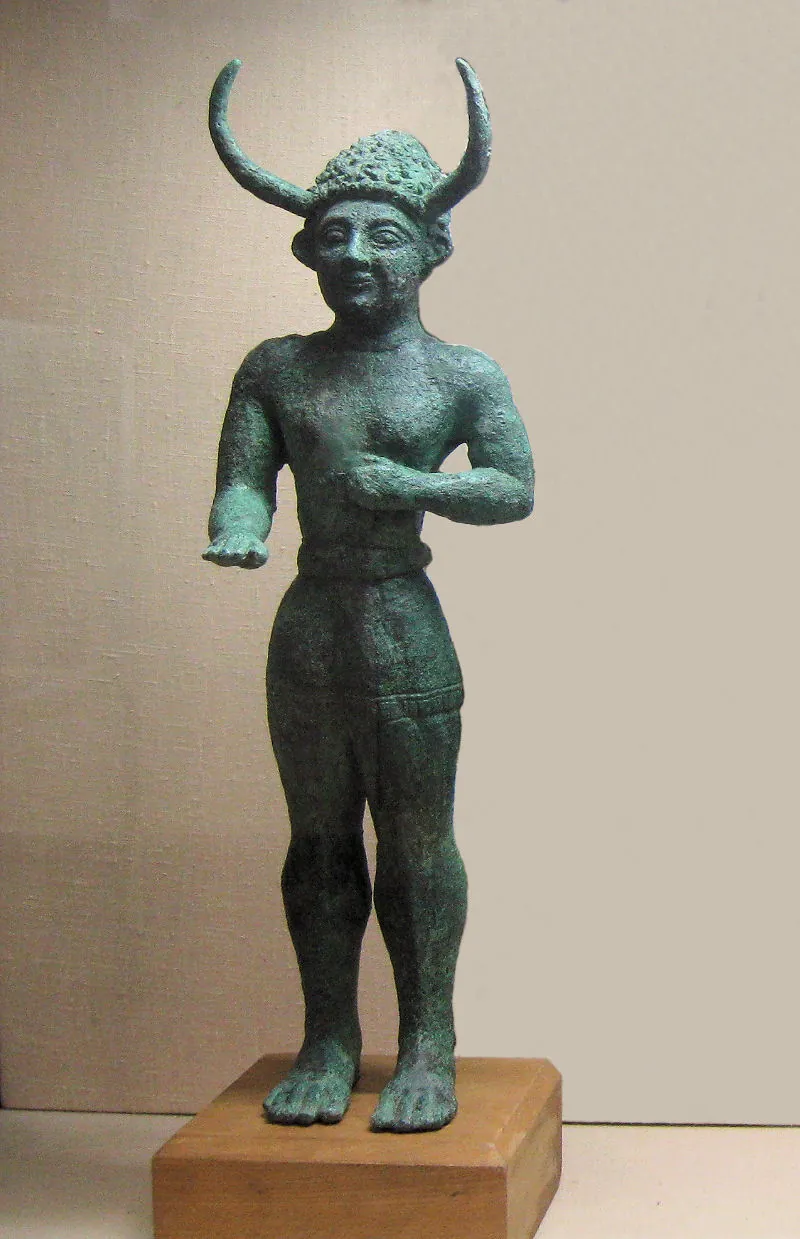
The Cyprus Museum itself, a few hundred metres from the Green Line, was emptied of its most valuable objects in 1974; some went to other parts of the island and some to Athens, where they were shown in special galleries of the National Museum until 1979 [1, p. 64]. The best-known finds from Enkomi, among them the bronze Horned God from the Ashlar Building, were in Nicosia and are there now.
Toumba tou Skourou: the documented loss
The store at Toumba tou Skourou is the one case with numbers. In 1976 Karageorghis wrote that the invasion had made the site inaccessible, that "the vast majority of the intact vases found during the excavations (these include a unique Tell-el-Yehudiyeh jug decorated with birds and floral designs) have disappeared", and that the large storage jars reconstructed on the site had collapsed [5, p. 73]. The excavators' final publication of 1990 records that after the army took Morphou the storeroom was cleared and its contents left outdoors for some time, and that many items were lost; one of the cups later studied from the site was still in the storeroom then, and its present location is uncertain [7, p. 184].
Two of the pots reached the United States. In October 1982 the Bayly Museum of the University of Virginia accepted 20 Cypriot pots as a gift from the Turkish Cypriot administration of the north, which the report calls "a political entity recognized by no country in the world except Turkey", in honour of the dean of its medical school and the director of its psychiatric hospital, in recognition of their services to the Turkish community; the medical school had helped to build a psychiatric hospital in the north. Karageorghis examined them in Charlottesville in January 1983. Most had had earlier catalogue numbers erased and replaced; two still carried the numbers of the Toumba tou Skourou expedition, "from whose storerooms 240 objects had been reported missing" [6, p. 362]. A faculty committee recommended that all 20 go to the Republic of Cyprus. The university's president rejected the recommendation: in March 1983 he sent 18 pieces back to the donors and the two Toumba tou Skourou pots to the Cypriot Embassy in Washington [6, p. 363]. Reviewing the final publication in 1992, Karageorghis wrote that "several complete vases had been stolen from the depot" and that those given to the university, "still bearing the Mission's inventory numbers", were returned to the Department of Antiquities [8].
The figure of 240 is a report of objects missing from the store, not a count of objects exported. Some Toumba tou Skourou material stayed in the north: the museum the Turkish Cypriot authorities opened at Morphou (Güzelyurt) in 1979 [1] devotes two of its rooms to pottery and other finds from the site [11, p. 115]. The 1990 volume itself marks a large number of the inventoried objects as in the Cyprus Museum [8].
The Famagusta museum and other reports
The only specific report of thefts from the Famagusta District Museum comes from the Turkish Cypriot weekly Olay in 1982. Its final instalment said that dealers and their associates were behind "the robberies at the Varosha Museum of Archaeology", and that "a few years ago, when the antiques stolen from the Varosha Museum of Archaeology were on sale in London, the Greek Cypriots intervened and prevented their sale". The Turkish Cypriot antiquities department "has located those antiques which were stolen from the Varosha Museum of Archaeology and whose names were changed. An antique dealer in Morphou was held responsible" [2, pp. 150, 152]. The report gives no date, no count and no description of the objects, and no inventory of losses from the museum has been published. The London sale is not named. The best-documented London sale of objects stolen in Famagusta in those years was the Christie's sale of 27 April 1976, which included pieces from the private Hadjiprodromou collection, not from the museum; whether Olay meant the same sale cannot be established from its text (see the Hadjiprodromou collection). The same series speaks of the robbery of "the coin, stamp, and antique collections from Varosha", which may refer to private collections as much as to the museum [2, p. 143].
For Kyrenia the documented loss is church art. The castle became a depot for icons from northern churches after 1974, and in June 1981 225 of them were found missing; Olay also reported that registers were missing, that forged ones had been made and "that some antiques were replaced by copies" [2, p. 144]. That case is set out in the Kyrenia castle icon depot. No report of archaeological losses from the Kyrenia district museum has been found. At Phlamoudhi, Karageorghis wrote in 1976 that "No report whatsoever has reached us since then about the excavated remains" [5, p. 73]. For the Salamis and Enkomi stores and the Lyon mission house, the published record says that the sites and buildings became inaccessible and that the sites "lie neglected and have been left at the mercy of the elements" [10, p. 130]; it does not record thefts from the stores.
General claims and the evidence against them
The Republic's general statements put museum losses among the losses of the north. In 1983 Karageorghis said that in the occupied area "there has been widespread looting of moveable objects from tombs and collections", and Herscher wrote that churches, "museums, archaeological storerooms, and private collections were affected" [6, pp. 362, 364]. The case for those statements is strong where the evidence is specific: the Toumba tou Skourou store, Olay's Varosha report, and the registered collections. A Turkish Cypriot paper, not a Greek Cypriot one, was the source for the Famagusta museum thefts, and it named its own officials and dealers [2, pp. 150, 152].
The case against reading the general statements as a large loss from museums is also on the record. The Kyrenia ship and its cargo stayed in the castle and survived because the Republic supplied air-conditioning, installed under a UNESCO adviser by United Nations peacekeepers in 1976 [5, pp. 72–73]. By 1994 a guide described the ship as "carefully preserved in the castle, together with a full-size replica and other exhibits" [11, p. 83]; it is there today. The St Barnabas monastery near Salamis, converted by the Turkish Cypriot authorities after restoration began in August 1991, holds an icon museum in the church and an archaeological collection in the monks' cells [1, p. 167], with pottery, statues and Bronze Age weapons [11, p. 76]. Some of the Hadjiprodromou pieces are on display there; of about 2,000 objects, 40 were returned to their owner and the rest are presumed to have been sold abroad [9, p. 78]. Objects that the Republic counts as lost may therefore be in northern museums rather than on the market, and the numbers of objects lost from museums and stores, as distinct from objects whose location is unknown, have not been published. Hadjisavvas's figure of "Some 60,000 ancient and medieval artifacts" exported from the occupied area, which he takes from his own earlier paper, is not broken down by source [10, p. 130]; how much was taken weighs it.
What this means for an object on the market today
A northern museum or excavation store is a documented source for a small number of identifiable objects: those with Toumba tou Skourou inventory numbers, the statues listed in the Famagusta museum in 1974, and whatever carries a Department, Famagusta or Kyrenia museum number of the years before 1974. Such marks are what the University of Virginia pots carried and what the Department looks for; most of the 20 had them erased [6, p. 362]. An object with a mark of this kind and no record of lawful release is a claim the Republic can make. An object without one, of a type found at Salamis, Enkomi or Morphou, is not shown by its type to have come from a northern store; most such pieces abroad left long before 1974 through channels with their own records.
References
- 1.Stylianou-Lambert, T., & Bounia, A. (2016). The political museum: Power, conflict, and identity in Cyprus. Heritage, Tourism and Community 8. Routledge.
- 2.Yaşın, M. (1982). Perishing Cyprus. Olay (Nicosia), four instalments, 26 April to 17 May 1982. Reprinted in translation in Commission on Security and Cooperation in Europe, Implementation of the Helsinki Accords: Human Rights Abuses in Cyprus. Hearing, July 20, 1985 (Washington, DC: US Government Printing Office, 1986), pp. 137–152. https://archive.org/details/micro_IA41152841_0156
- 3.Panayides, P. (2019). Castrating the gods of Salamis: A case study on the sexual mutilation of statuary in Late Antiquity. In S. Rogge, C. Ioannou & T. Mavrojannis (Eds.), Salamis of Cyprus: History and archaeology from the earliest times to Late Antiquity. Waxmann.
- 4.Karageorghis, V. (2019). Excavating at Salamis: 1952–1974. In S. Rogge, C. Ioannou & T. Mavrojannis (Eds.), Salamis of Cyprus: History and archaeology from the earliest times to Late Antiquity (pp. 25–31). Waxmann.
- 5.Karageorghis, V. (1976). Treasures of Cyprus: An exhibition of Cypriot art. Government of Cyprus; circulated by the Smithsonian Institution Traveling Exhibition Service, 1976–1978.
- 6.Herscher, E. (1983). The antiquities market: News and commentary on the illicit traffic in antiquities (University of Virginia accepts disputed antiquities; interview with Vassos Karageorghis). Journal of Field Archaeology, 10(3), 349–369. https://doi.org/10.1179/009346983791504327
- 7.Sørensen, A. H. (2012). Handling handles: Local cups from Toumba tou Skourou, Cyprus, with a Cretan twist. Talanta, 44, 183–205.
- 8.Karageorghis, V. (1992). Review of E. Vermeule and F. Z. Wolsky, Toumba tou Skourou, a Bronze Age potter's quarter on Morphou Bay in Cyprus (Boston, 1990). Journal of Field Archaeology, 19(3).
- 9.Knox, D.-K. (2012). Making sense of figurines in Bronze Age Cyprus: A comprehensive analysis of Cypriot ceramic figurative material from EC I to LC IIIA (c. 2300 BC to c. 1100 BC). PhD thesis, University of Manchester.
- 10.Hadjisavvas, S. (2015). Perishing heritage: The case of the occupied part of Cyprus. Journal of Eastern Mediterranean Archaeology and Heritage Studies, 3(2), 128–140. https://doi.org/10.5325/jeasmedarcherstu.3.2.0128
- 11.Goulding, J., & Goulding, M. (1994). Northern Cyprus (2nd ed., Windrush Island Guides). The Windrush Press.
- 12.Georgiadou, A., Dikomitou-Eliadou, M., Papasavvas, G., Waiman-Barak, P., & Pilides, D. (2020). Bringing life to old museum collections: The interdisciplinary study of pottery from the polities of Salamis, Soloi, Lapithos and Chytroi (MuseCo project). Archaeological Research Unit, University of Cyprus.
- 13.Karageorghis, V. (1973). Chronique des fouilles et découvertes archéologiques à Chypre en 1972. Bulletin de correspondance hellénique, 97.