
Contents
This page is about church art: icons, frescoes, mosaics and liturgical objects, most of them medieval or later. They are not archaeological finds, and their trade was a separate market from the trade in ancient pottery, sculpture and metalwork. See church art and antiquities.
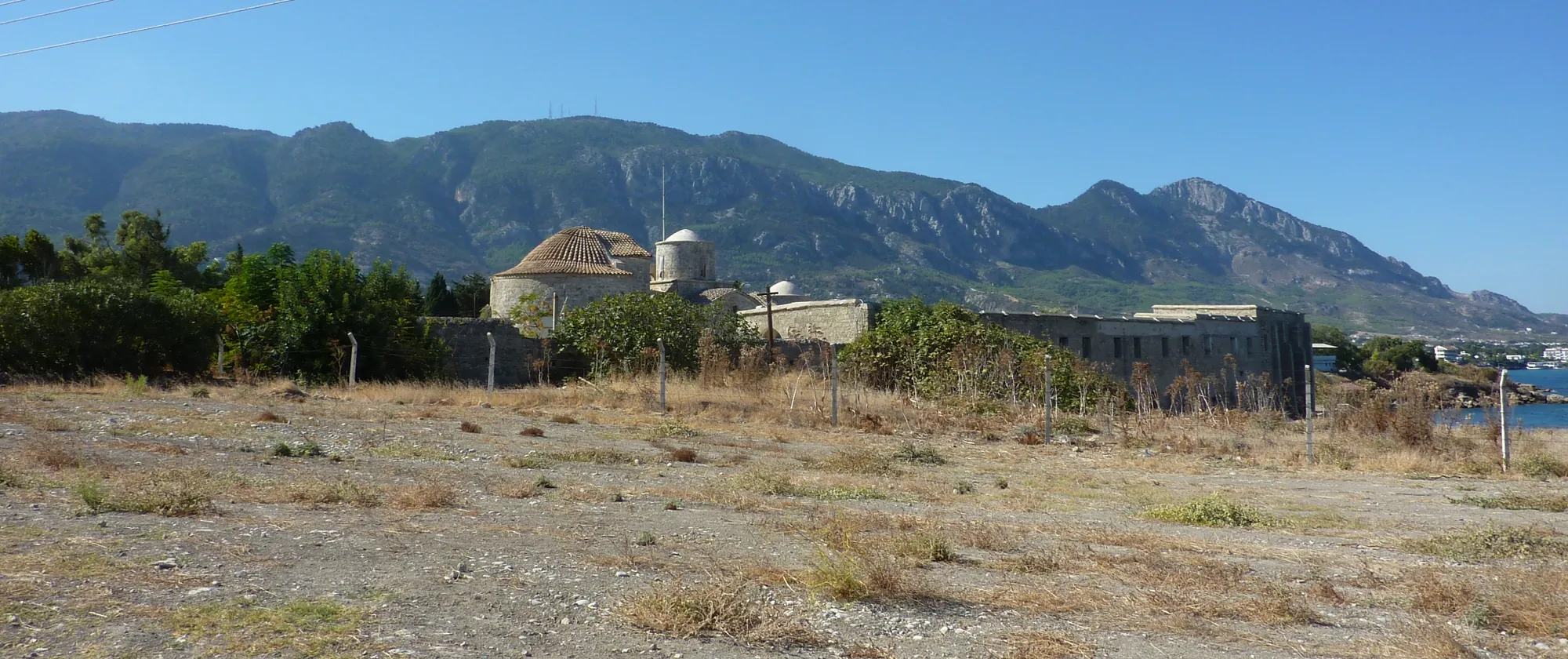
Kyrenia Castle, shown above behind the old harbour with the Kyrenia range beyond (photo: Julian Nyča, CC BY-SA 3.0, via Wikimedia Commons), was one of the places where the icons of the occupied north were gathered after the Turkish invasion of 1974. The churches west of the town had lost their congregations, and the Turkish Cypriot antiquities department brought icons from Lambousa, the Metropolis of Morphou and Larnaka tis Lapithou into the castle for storage. In June 1981, after a smuggled consignment was opened at Ankara airport, an inquiry found that 225 of those icons were missing and that the castle's inventories had been altered. The director of the department's Kyrenia branch was removed and tried in Kyrenia in 1982, and the Turkish Cypriot weekly Olay reported the case in detail while the trial was under way [1, p. 144]. He was not convicted [3, p. 213]. The icons were post-Byzantine and later church paintings, not archaeological objects, and this page deals with them alone. It sets out what the record says about the depot, the inquiry, the trial and its outcome, and what is known of the icons that remain in the north.
Kyrenia Castle after 1974
The castle had been in the care of the Department of Antiquities of the Republic before the invasion, and the Kyrenia ship, the Hellenistic merchant vessel raised in 1969, was about to go on show in a new museum in its galleries when the fighting began in July 1974 [5, p. 63]. After the invasion the castle and its museum passed out of the Republic's reach. The Turkish Cypriot antiquities department, by its own account of events as reported in Olay, decided to use the castle "for a while as a depot for the icons" [1, p. 144].
The icons came from churches in the coastal villages west of Kyrenia and from the see of Morphou. Lambousa, on the shore below Lapithos, had the monastery of the Acheiropoietos and its chapels; Larnaka tis Lapithou lies in the hills of the same district; the Metropolis of Morphou covered the churches of the north-west. Olay names these three as the origins of the icons later found missing [1, p. 144]. The number of icons that entered the depot in all is not stated in any source found, and no inventory of the depot has been published.
How the icons were handed over and recorded
The trial evidence summarised by Olay shows how the depot was run. An official of the department handed a quantity of objects to the director of the Kyrenia branch and entered them in the inventory himself. At the foot of one page he wrote that "the section following this (page) includes the antiques from Morphou"; the next page, which should have listed them, had disappeared [1, p. 144].
The discovery of the loss in June 1981
The loss came to light from outside Kyrenia. On 16 March 1981 three chests labelled "personal property", sent from the occupied north through Tymbou to Germany, were stopped at Ankara airport. They held 158 objects, among them icons sawn into pieces, and when the contents were handed over to the authorities in Cyprus on 29 May 1981, objects on the Kyrenia Castle and St Barnabas inventories were found among them [1, pp. 143–144]. The consignment is the subject of the Ankara airport seizure of 1981.
An inquiry followed in June 1981 by the comptroller general, the security service and the antiquities department. In Olay's words, "despite the robbery of hundreds of icons from the Kyrenia Museum, no incident came to light until the smuggled ring was discovered". The inquiry found that the registered inventories were missing, that some objects sent to the museum had never been registered, and that forged documents had been used; it established that "225 icons, which were brought to Kyrenia Castle from Lambousa, the Metropolis of Morphou, and Larnaca Tis Lapithou, were missing". The antiquities department then set up a commission, which wrote a 40-page report "explaining in detail from where and how the icons and antiques were smuggled" [1, p. 144]. That report has not been published.
The count of 225 is Olay's. At the hearing of the United States Commission on Security and Cooperation in Europe in 1985, a Greek Orthodox priest giving evidence said that officials had stolen "255 icons worth 18,950,626,000 Turkish lira" between September 1974 and 30 May 1981 [2, p. 17]. The dates match Olay's and the number differs by a transposed digit, so the two figures probably describe the same loss; the valuation is the witness's and is given in no other source found.
The trial of the Kyrenia branch director, 1982
The director of the Kyrenia branch, named by Olay as Mehmet Rasıh Savarona, was removed from his post and brought before a criminal court sitting in Kyrenia Castle in the spring of 1982 [1, p. 144]. According to Olay's report of the hearings, the security service's handwriting expert testified that the changes in the inventory were in the director's hand; an employee of the State Printing Office said that the original seals had been replaced; and archaeologists of the department who had examined the inventories said that the numbers on the backs of the icons had been changed, entries blackened out, and that the altered inventories differed from the original lists. One archaeologist told the court that the director had said he would go to Germany by car on someone else's licence, and the public prosecutor told the court that he was "getting ready to flee Cyprus" [1, p. 151].
Those are the prosecution's case as a newspaper reported it during the trial. The outcome is given by Dan Hofstadter, who writes that the official accused of altering the inventory and substituting icons of little value for valuable ones was not convicted [3, p. 213]. No judgment has been published, and no later proceedings over the depot are recorded in the sources found. On the record, then, the director was charged and tried, and not convicted.
What the record does not show
Several things are not known. There is no published list of the 225 icons, so none of them can be matched with an icon recovered later. Olay says that only "a fraction" of the icons stolen in the north had been recovered by 1982 [1, p. 138], but it does not say which of those came from Kyrenia. The Ankara consignment proved that objects from the castle had left it, but its 158 objects cannot be divided between Kyrenia, St Barnabas and other sources from the published accounts [1, pp. 143–144]. Nor does any source say who received the icons that left the castle, beyond the German address on the Ankara chests.
The icons in the north after 1981
Icons gathered from the churches of the north stayed in stores after the robbery. Sophocles Hadjisavvas, a former Director of the Department of Antiquities, wrote in 2015 that "thousands of icons have been taken from churches all over the occupied territory and are now stored in damp and salty environments, such as the medieval galleries of the Kyrenia Museum right on the sea" [4, p. 130]. He does not say how many are at Kyrenia, nor whether any are those listed in the depot inventories of the 1970s.
Some of the icons were put on show. The Turkish Cypriot authorities created five icon museums in Byzantine and post-Byzantine churches [5, p. 65]. In Kyrenia the church of the Archangel Michael, built in 1860 above the harbour, was opened as an icon museum after restoration, in 1990 according to Stylianou-Lambert and Bounia [5, p. 55] and in 1991 according to Mirbagheri [6, p. 141]. Its collection is of icons of the seventeenth to the nineteenth centuries, some belonging to the church itself and others "collected from unspecified churches in the area" [5, p. 55; 6, p. 141]. The monastery of St Barnabas near Salamis became an icon and archaeological museum on the same model (St Barnabas icons). Greek Cypriots and Turkish Cypriots regard these museums in very different ways [5, p. 65],.
The case for the depot as a protective measure
The strongest point against reading the depot only as a source of loss is that it was set up, on the department's own account, to store icons from churches that had been left open [1, p. 144]. The Council of Europe's consultant Robin Cormack wrote in 1989 that "the inexperience, lack of expertise and lack of funds in the north is in part responsible for the losses of material which have occurred since 1974" [4, p. 132]. The theft was also exposed and prosecuted in the north, by Turkish Cypriot officials, and reported in detail by a Turkish Cypriot journalist [1, p. 144]. Against that, the depot was the place from which, on Olay's figures, 225 icons disappeared under the care of the official responsible for it, and the inventories that should have recorded them were destroyed or rewritten [1, pp. 144, 151]. Hadjisavvas's description of the conditions in which icons were still kept in 2015 [4, p. 130] shows that the problem of storage was not solved after the robbery.
What this means for an icon from the region on the market today
A post-Byzantine icon from the churches of Lambousa, Lapithos, Larnaka tis Lapithou or the see of Morphou that has no documented history from before 1974 cannot be cleared of the Kyrenia robbery, because no list of the missing icons has been published. The Church of Cyprus holds its own pre-1974 records and photographs of many northern churches, and it is the body to consult for an icon of this kind. Ancient objects from the same district are a different matter: the tombs of Lapithos and Lambousa were dug for museums and collectors from the nineteenth century onwards, as northern types with lawful histories explains. The wider record of church art from the north is summarised in church art in the occupied north.
References
- 1.Yaşın, M. (1982). Perishing Cyprus. Olay (Nicosia), instalments from 26 April 1982. Translated in Commission on Security and Cooperation in Europe, Human Rights Abuses in Cyprus: Hearing, July 20, 1985 (US Government Printing Office, 1986), Appendix 9. https://archive.org/details/micro_IA41152841_0156
- 2.Commission on Security and Cooperation in Europe. (1986). Implementation of the Helsinki Accords: Human rights abuses in Cyprus. Hearing, July 20, 1985, New York. US Government Printing Office. https://archive.org/details/micro_IA41152841_0156
- 3.Hofstadter, D. (1994). Goldberg's angel: An adventure in the antiquities trade. Farrar, Straus and Giroux.
- 4.Hadjisavvas, S. (2015). Perishing heritage: The case of the occupied part of Cyprus. Journal of Eastern Mediterranean Archaeology and Heritage Studies, 3(2), 128–140. https://doi.org/10.5325/jeasmedarcherstu.3.2.0128
- 5.Stylianou-Lambert, T., & Bounia, A. (2016). The political museum: Power, conflict, and identity in Cyprus (Heritage, Tourism and Community 8). Left Coast Press.
- 6.Mirbagheri, F. (2010). Historical dictionary of Cyprus (Historical Dictionaries of Europe 69). Scarecrow Press.